COLLECTED BY: Eman Awad El-
Sawy
Submitted to: Dr.Mervat El-
Hadedy
What is curriculum development?
• Curriculum development can be defined as
the process of planning, implementing, and
evaluating curriculum that ultimately results
in a curriculum plan.
Ralph Tyler
• Ralph Tyler (1902-1994) published more than 700
articles and sixteen books.
• Best known for The Basic Principles of Curriculum
and Instruction (Ornstein and Hunkins, 1998) which
is based on an eight year study.
• Tyler posits the problem with education is that
educational programs lack unmistakably defined
purposes (“Ralph Tyler’s Little Book, ”n d)
In his book Tyler presented the concept that
curriculum should be:
1. dynamic
2. a program under constant evaluation and
revision.
Curriculum had always been thought of as a
static, set program, and in an era preoccupied
with student testing, he offered the innovative
idea that teachers and administrators should
spend as much time evaluating their plans as
they do assessing their students.
• Since then, Basic Principles of Curriculum and
Instruction has been a standard reference for anyone
working with curriculum development.
• Although not a strict how-to guide, the book shows how
educators can critically approach curriculum planning,
studying progress and retooling when needed.
• Its four sections focus on setting objectives, selecting
learning experiences, organizing instruction, and
evaluating progress.
• Readers will come away with a firm understanding of
how to formulate educational objectives and how to
analyse and adjust their plans so that students meet the
objectives.
• Tyler also explains that curriculum planning is a
continuous, cyclical process, an instrument of education
that needs to be fine-tuned.
• This emphasis on thoughtful evaluation has
kept Basic Principles of Curriculum and
Instruction a relevant, trusted companion for
over sixty years.
• Tyler's straightforward recommendations are
sound and effective tools for educators
working to create a curriculum that integrates
national objectives with their students' needs.
THE TYLER MODEL
• The Tyler Model is:
○ one of the best known models for curriculum
development.
○ known for the special attention it gives to the
planning phases.
○ deductive for it proceeds from the general
(examining the needs of society, for example) to
the specific (specifying instructional objectives).
• Tyler recommends that curriculum planners identify
general objectives by gathering data from three
sources:
1) the learners
2) contemporary life outside the school
3) subject matter.
• After identifying numerous general objectives, the
planners refine them by filtering them through two
screens:
1. the philosophical screen
2. the psychological screen
• In the Tyler Model, the general objectives that
successfully pass through the two screens
become what are now popularly known as
instructional objectives.
• Curriculum objectives indicate both behavior
to be developed and area of content to be
applied.
(Keating, 2006)
Tyler’s Four Fundamental Questions:
1. What educational purposes should the school seek to attain?
2. What educational learning experiences can be provided that
are likely to attain these purposes?
3. How can these educational experiences be effectively
organized?
4. How can we determine whether these purposes are being
attained?
1. What educational purposes should the school seek
to attain?
• Studies of the Learners Themselves as a Source of
Educational Objectives
• Studies of Contemporary Life outside the School
• Suggestions about Objectives from Subject Specialists
• The Use of Philosophy in Selecting Objectives
• The Use of a Psychology of Learning in Selecting
Objectives
• Stating Objectives in a Form to be Helpful in Selecting
Learning Experiences and in Guiding Teaching
2. How can Learning Experiences be selected? Which
are likely to be useful in attaining these objectives?
• Meaning of the Term “Learning Experience”
• General Principles in Selecting Learning
Experiences
• Illustrations of the Characteristics of Learning
Experiences Useful in Attaining Various Types
of Objectives
3. How Can Learning Experiences Be Organized
for Effective Instruction?
• What is meant by “Organization?”
• Criteria for Effective Organization
• Elements to be organized
• Organizing Principles
• The Organizing Structure
• The Process of Planning a Unit of Organization
4. How Can the Effectiveness of Learning
Experiences Be Evaluated?
• The Need for Evaluation
• Basic Notions Regarding Evaluation
• Evaluation Procedures
• Using the Results of Evaluation
• Other Values and Uses of Evaluation Procedures
Strengths of Tyler’s Model
Clearly stated objectives a good place to
begin.
Involves the active participation of the learner
(Prideaux, 2003)
Simple linear approach to development of
behavior al objectives
(Billings & Halstead, 2009)
Criticism of the Tyler Model:
Narrowly interpreted objectives (acceptable
verbs)
Difficult and time consuming construction of
behavioral objectives
Curriculum restricted to a constricted range of
student skills and knowledge
critical thinking, problem solving and value
acquiring processes cannot be plainly declared
in behavioral objectives (Prideaux, 2003)
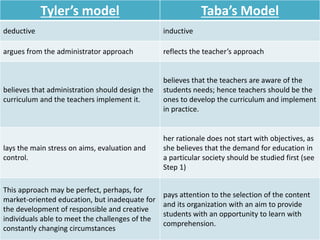
The Taba-Tyler Rationales
• When comparing just the two rationales it is
difficult to ascertain who borrowed from
whom and when, but we have to admit the
basic difference of the two curriculum design
approaches, which has a critical meaning not
only for researchers of modern times, but also
for those developing curricula for current
school praxis.
Tyler’s model Taba’s Model
deductive inductive
argues from the administrator approach reflects the teacher’s approach
believes that administration should design the
curriculum and the teachers implement it.
believes that the teachers are aware of the
students needs; hence teachers should be the
ones to develop the curriculum and implement
in practice.
lays the main stress on aims, evaluation and
control.
her rationale does not start with objectives, as
she believes that the demand for education in
a particular society should be studied first (see
Step 1)
This approach may be perfect, perhaps, for
market-oriented education, but inadequate for
the development of responsible and creative
individuals able to meet the challenges of the
constantly changing circumstances
pays attention to the selection of the content
and its organization with an aim to provide
students with an opportunity to learn with
comprehension.

Tyler model

  • 1.
    COLLECTED BY: EmanAwad El- Sawy Submitted to: Dr.Mervat El- Hadedy
  • 2.
    What is curriculumdevelopment? • Curriculum development can be defined as the process of planning, implementing, and evaluating curriculum that ultimately results in a curriculum plan.
  • 3.
    Ralph Tyler • RalphTyler (1902-1994) published more than 700 articles and sixteen books. • Best known for The Basic Principles of Curriculum and Instruction (Ornstein and Hunkins, 1998) which is based on an eight year study. • Tyler posits the problem with education is that educational programs lack unmistakably defined purposes (“Ralph Tyler’s Little Book, ”n d)
  • 4.
    In his bookTyler presented the concept that curriculum should be: 1. dynamic 2. a program under constant evaluation and revision. Curriculum had always been thought of as a static, set program, and in an era preoccupied with student testing, he offered the innovative idea that teachers and administrators should spend as much time evaluating their plans as they do assessing their students.
  • 5.
    • Since then,Basic Principles of Curriculum and Instruction has been a standard reference for anyone working with curriculum development. • Although not a strict how-to guide, the book shows how educators can critically approach curriculum planning, studying progress and retooling when needed. • Its four sections focus on setting objectives, selecting learning experiences, organizing instruction, and evaluating progress. • Readers will come away with a firm understanding of how to formulate educational objectives and how to analyse and adjust their plans so that students meet the objectives. • Tyler also explains that curriculum planning is a continuous, cyclical process, an instrument of education that needs to be fine-tuned.
  • 6.
    • This emphasison thoughtful evaluation has kept Basic Principles of Curriculum and Instruction a relevant, trusted companion for over sixty years. • Tyler's straightforward recommendations are sound and effective tools for educators working to create a curriculum that integrates national objectives with their students' needs.
  • 7.
    THE TYLER MODEL •The Tyler Model is: ○ one of the best known models for curriculum development. ○ known for the special attention it gives to the planning phases. ○ deductive for it proceeds from the general (examining the needs of society, for example) to the specific (specifying instructional objectives).
  • 8.
    • Tyler recommendsthat curriculum planners identify general objectives by gathering data from three sources: 1) the learners 2) contemporary life outside the school 3) subject matter. • After identifying numerous general objectives, the planners refine them by filtering them through two screens: 1. the philosophical screen 2. the psychological screen
  • 9.
    • In theTyler Model, the general objectives that successfully pass through the two screens become what are now popularly known as instructional objectives. • Curriculum objectives indicate both behavior to be developed and area of content to be applied. (Keating, 2006)
  • 10.
    Tyler’s Four FundamentalQuestions: 1. What educational purposes should the school seek to attain? 2. What educational learning experiences can be provided that are likely to attain these purposes? 3. How can these educational experiences be effectively organized? 4. How can we determine whether these purposes are being attained?
  • 11.
    1. What educationalpurposes should the school seek to attain? • Studies of the Learners Themselves as a Source of Educational Objectives • Studies of Contemporary Life outside the School • Suggestions about Objectives from Subject Specialists • The Use of Philosophy in Selecting Objectives • The Use of a Psychology of Learning in Selecting Objectives • Stating Objectives in a Form to be Helpful in Selecting Learning Experiences and in Guiding Teaching
  • 12.
    2. How canLearning Experiences be selected? Which are likely to be useful in attaining these objectives? • Meaning of the Term “Learning Experience” • General Principles in Selecting Learning Experiences • Illustrations of the Characteristics of Learning Experiences Useful in Attaining Various Types of Objectives
  • 13.
    3. How CanLearning Experiences Be Organized for Effective Instruction? • What is meant by “Organization?” • Criteria for Effective Organization • Elements to be organized • Organizing Principles • The Organizing Structure • The Process of Planning a Unit of Organization
  • 14.
    4. How Canthe Effectiveness of Learning Experiences Be Evaluated? • The Need for Evaluation • Basic Notions Regarding Evaluation • Evaluation Procedures • Using the Results of Evaluation • Other Values and Uses of Evaluation Procedures
  • 15.
    Strengths of Tyler’sModel Clearly stated objectives a good place to begin. Involves the active participation of the learner (Prideaux, 2003) Simple linear approach to development of behavior al objectives (Billings & Halstead, 2009)
  • 16.
    Criticism of theTyler Model: Narrowly interpreted objectives (acceptable verbs) Difficult and time consuming construction of behavioral objectives Curriculum restricted to a constricted range of student skills and knowledge critical thinking, problem solving and value acquiring processes cannot be plainly declared in behavioral objectives (Prideaux, 2003)
  • 17.
    The Taba-Tyler Rationales •When comparing just the two rationales it is difficult to ascertain who borrowed from whom and when, but we have to admit the basic difference of the two curriculum design approaches, which has a critical meaning not only for researchers of modern times, but also for those developing curricula for current school praxis.
  • 18.
    Tyler’s model Taba’sModel deductive inductive argues from the administrator approach reflects the teacher’s approach believes that administration should design the curriculum and the teachers implement it. believes that the teachers are aware of the students needs; hence teachers should be the ones to develop the curriculum and implement in practice. lays the main stress on aims, evaluation and control. her rationale does not start with objectives, as she believes that the demand for education in a particular society should be studied first (see Step 1) This approach may be perfect, perhaps, for market-oriented education, but inadequate for the development of responsible and creative individuals able to meet the challenges of the constantly changing circumstances pays attention to the selection of the content and its organization with an aim to provide students with an opportunity to learn with comprehension.