MULTIPLE
INTELLIGENCE
FOR
TEACHERS
1
Howard Gardner’s
Theory of Multiple
Intelligence
[Frames of Mind-1983]
Najma Kazi
najmakazi@gmail.com
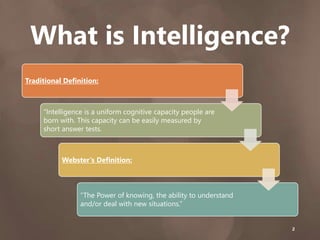
What is Intelligence?
2
Traditional Definition:
“Intelligence is a uniform cognitive capacity people are
born with. This capacity can be easily measured by
short answer tests.
Webster’s Definition:
“The Power of knowing, the ability to understand
and/or deal with new situations.”
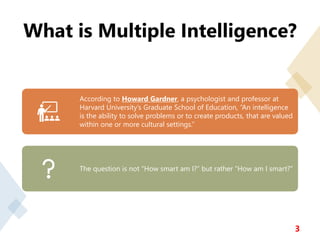
What is Multiple Intelligence?
3
According to Howard Gardner, a psychologist and professor at
Harvard University’s Graduate School of Education, “An intelligence
is the ability to solve problems or to create products, that are valued
within one or more cultural settings.”
The question is not “How smart am I?” but rather “How am I smart?”
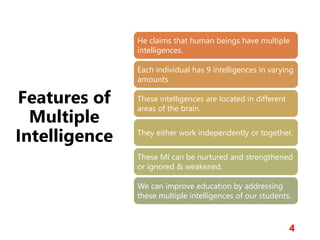
Features of
Multiple
Intelligence
4
He claims that human beings have multiple
intelligences.
Each individual has 9 intelligences in varying
amounts
These intelligences are located in different
areas of the brain.
They either work independently or together.
These MI can be nurtured and strengthened
or ignored & weakened.
We can improve education by addressing
these multiple intelligences of our students.
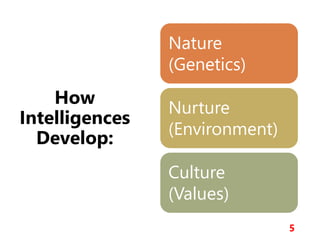
How
Intelligences
Develop:
5
Nature
(Genetics)
Nurture
(Environment)
Culture
(Values)
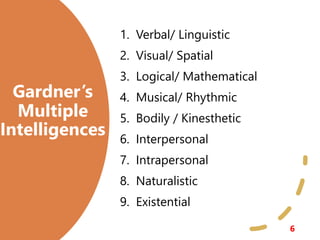
Gardner’s
Multiple
Intelligences
1. Verbal/ Linguistic
2. Visual/ Spatial
3. Logical/ Mathematical
4. Musical/ Rhythmic
5. Bodily / Kinesthetic
6. Interpersonal
7. Intrapersonal
8. Naturalistic
9. Existential
6
1-LINGUISTIC
INTELLIGENCE
7
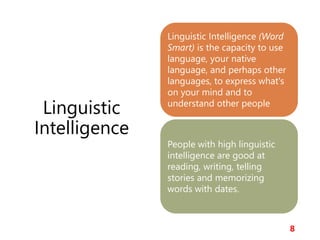
Linguistic
Intelligence
8
Linguistic Intelligence (Word
Smart) is the capacity to use
language, your native
language, and perhaps other
languages, to express what's
on your mind and to
understand other people
People with high linguistic
intelligence are good at
reading, writing, telling
stories and memorizing
words with dates.
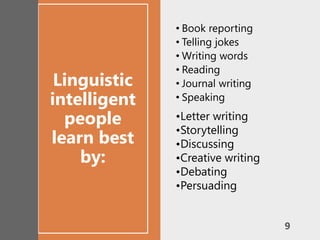
Linguistic
intelligent
people
learn best
by:
• Book reporting
• Telling jokes
• Writing words
• Reading
• Journal writing
• Speaking
•Letter writing
•Storytelling
•Discussing
•Creative writing
•Debating
•Persuading
9
CAREERS •Writer
•Journalist
•Poet
•Teacher
•Radio
Announcer
•Translator
•Lawyer
•Philosopher
•Politician
•Orator
•Actor
•Curator
10
2-Visual -
Spatial
Intelligence
11
What is spatial intelligence?
12
Spatial intelligence (Picture Smart) is the capacity to
think in images and pictures, to visualize accurately
and abstractly.
People with high visual-spatial intelligence have the
ability to visualize with mind’s eye.
They have the potential to recognize and use the
patterns of wide space and more confined area.
Spatial
intelligent
people
learn best
by:
• Brochures
• Collages
• Designs
• Drawings
• Flow Charts
• Mapping
• Molding Clay
• Patterns
• Painting
• Photography
• Posters
• Sculpting
• Visualizing
• Idea Sketching
• Labeling
13
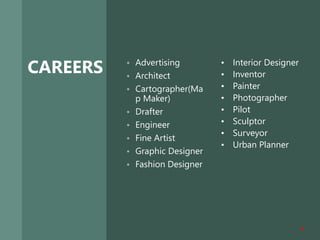
CAREERS • Advertising
• Architect
• Cartographer(Ma
p Maker)
• Drafter
• Engineer
• Fine Artist
• Graphic Designer
• Fashion Designer
• Interior Designer
• Inventor
• Painter
• Photographer
• Pilot
• Sculptor
• Surveyor
• Urban Planner
14
3-Logical-
Mathematical
Intelligence
15
What is Logical-Mathematical
Intelligence?
16
Logical-mathematical intelligence (Logic Smart) is the
capacity to use numbers effectively and reason well.
People with this intelligence think by reasoning, and they
love experimenting, questioning, figuring out logical
puzzles, and calculating.
They are able to identify a problem and solve it right there
on the spot.
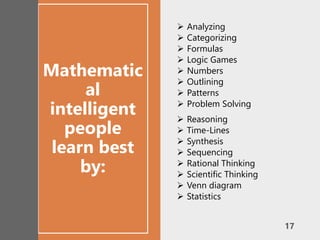
Mathematic
al
intelligent
people
learn best
by:
 Analyzing
 Categorizing
 Formulas
 Logic Games
 Numbers
 Outlining
 Patterns
 Problem Solving
 Reasoning
 Time-Lines
 Synthesis
 Sequencing
 Rational Thinking
 Scientific Thinking
 Venn diagram
 Statistics
17
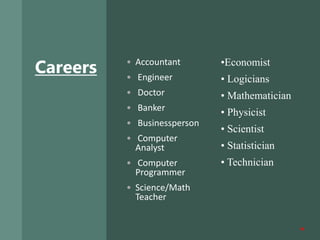
Careers • Accountant
• Engineer
• Doctor
• Banker
• Businessperson
• Computer
Analyst
• Computer
Programmer
• Science/Math
Teacher
•Economist
• Logicians
• Mathematician
• Physicist
• Scientist
• Statistician
• Technician
18
19
Musical
Intelligence
20
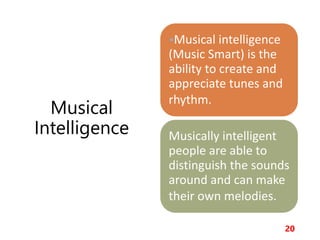
•Musical intelligence
(Music Smart) is the
ability to create and
appreciate tunes and
rhythm.
Musically intelligent
people are able to
distinguish the sounds
around and can make
their own melodies.
Musical
Intelligent
People
learn best
by:
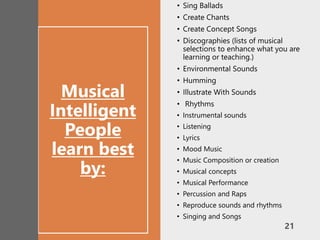
• Sing Ballads
• Create Chants
• Create Concept Songs
• Discographies (lists of musical
selections to enhance what you are
learning or teaching.)
• Environmental Sounds
• Humming
• Illustrate With Sounds
• Rhythms
• Instrumental sounds
• Listening
• Lyrics
• Mood Music
• Music Composition or creation
• Musical concepts
• Musical Performance
• Percussion and Raps
• Reproduce sounds and rhythms
• Singing and Songs
21
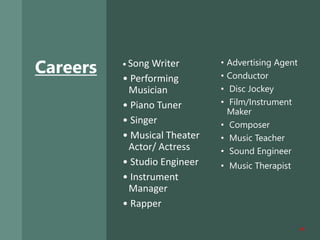
Careers • Song Writer
• Performing
Musician
• Piano Tuner
• Singer
• Musical Theater
Actor/ Actress
• Studio Engineer
• Instrument
Manager
• Rapper
• Advertising Agent
• Conductor
• Disc Jockey
• Film/Instrument
Maker
• Composer
• Music Teacher
• Sound Engineer
• Music Therapist
22
5-Bodily-
Kinesthetic
Intelligence
23
What is
Bodily-
Kinesthetic
Intelligence
?
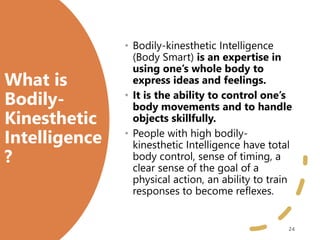
• Bodily-kinesthetic Intelligence
(Body Smart) is an expertise in
using one’s whole body to
express ideas and feelings.
• It is the ability to control one’s
body movements and to handle
objects skillfully.
• People with high bodily-
kinesthetic Intelligence have total
body control, sense of timing, a
clear sense of the goal of a
physical action, an ability to train
responses to become reflexes.
24
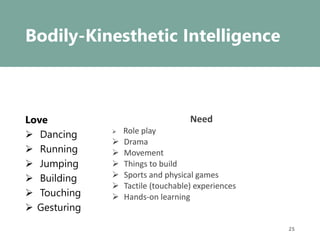
Bodily-Kinesthetic Intelligence
Thinking through physical sensations
Love
 Dancing
 Running
 Jumping
 Building
 Touching
 Gesturing
25
Need
 Role play
 Drama
 Movement
 Things to build
 Sports and physical games
 Tactile (touchable) experiences
 Hands-on learning
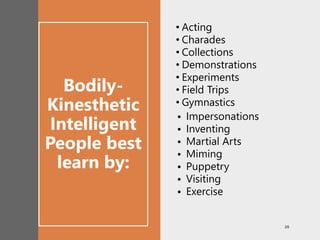
Bodily-
Kinesthetic
Intelligent
People best
learn by:
• Acting
• Charades
• Collections
• Demonstrations
• Experiments
• Field Trips
• Gymnastics
• Impersonations
• Inventing
• Martial Arts
• Miming
• Puppetry
• Visiting
• Exercise
26
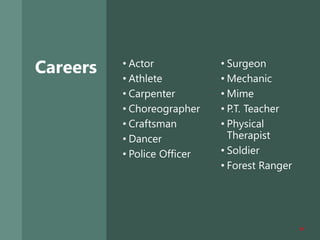
Careers • Actor
• Athlete
• Carpenter
• Choreographer
• Craftsman
• Dancer
• Police Officer
• Surgeon
• Mechanic
• Mime
• P.T. Teacher
• Physical
Therapist
• Soldier
• Forest Ranger
27
6-Interpersonal
Intelligence
28
Interpersonal
Intelligence
29
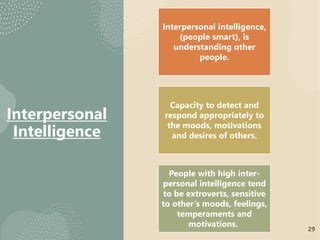
Interpersonal intelligence,
(people smart), is
understanding other
people.
Capacity to detect and
respond appropriately to
the moods, motivations
and desires of others.
People with high inter-
personal intelligence tend
to be extroverts, sensitive
to other’s moods, feelings,
temperaments and
motivations.
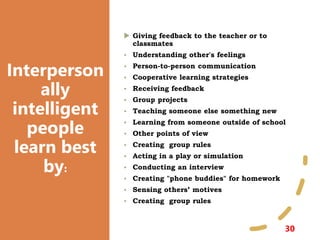
Interperson
ally
intelligent
people
learn best
by:
30
 Giving feedback to the teacher or to
classmates
• Understanding other's feelings
• Person-to-person communication
• Cooperative learning strategies
• Receiving feedback
• Group projects
• Teaching someone else something new
• Learning from someone outside of school
• Other points of view
• Creating group rules
• Acting in a play or simulation
• Conducting an interview
• Creating "phone buddies" for homework
• Sensing others’ motives
• Creating group rules
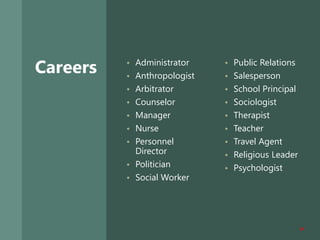
Careers • Administrator
• Anthropologist
• Arbitrator
• Counselor
• Manager
• Nurse
• Personnel
Director
• Politician
• Social Worker
• Public Relations
• Salesperson
• School Principal
• Sociologist
• Therapist
• Teacher
• Travel Agent
• Religious Leader
• Psychologist
31
7-Intrapersonal
Intelligence
32
Intrapersonal Intelligence
3
3
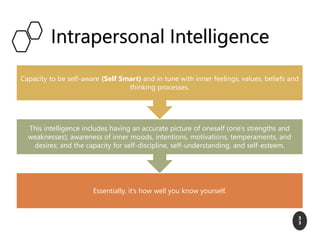
Essentially, it’s how well you know yourself.
This intelligence includes having an accurate picture of oneself (one’s strengths and
weaknesses); awareness of inner moods, intentions, motivations, temperaments, and
desires; and the capacity for self-discipline, self-understanding, and self-esteem.
Capacity to be self-aware (Self Smart) and in tune with inner feelings, values, beliefs and
thinking processes.
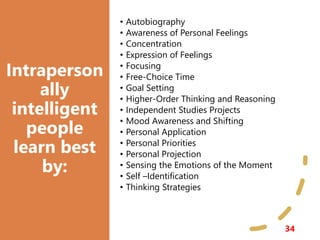
Intraperson
ally
intelligent
people
learn best
by:
34
• Autobiography
• Awareness of Personal Feelings
• Concentration
• Expression of Feelings
• Focusing
• Free-Choice Time
• Goal Setting
• Higher-Order Thinking and Reasoning
• Independent Studies Projects
• Mood Awareness and Shifting
• Personal Application
• Personal Priorities
• Personal Projection
• Sensing the Emotions of the Moment
• Self –Identification
• Thinking Strategies
Careers
• Clergyman
• Entrepreneur
• Program planner
• Psychiatrist
• Psychology
Teacher
• Philosopher
• Theologian
• Researcher
• Spiritual
Counselor
• Psychologist
35
8-Naturalistic
Intelligence
36
Naturalistic Intelligence
3
7
Ability to recognize and categorize plants,
animals and other objects in nature.
People with high naturalistic
intelligence (Nature Smart) are
extremely sensitive to nature,
nurturing and relating information to
one’s natural surrounding.
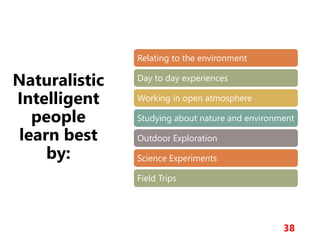
Naturalistic
Intelligent
people
learn best
by:
38
Relating to the environment
Day to day experiences
Working in open atmosphere
Studying about nature and environment
Outdoor Exploration
Science Experiments
Field Trips
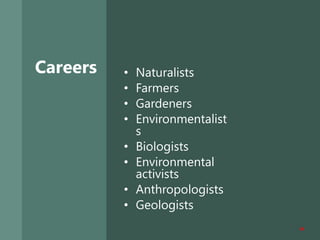
Careers • Naturalists
• Farmers
• Gardeners
• Environmentalist
s
• Biologists
• Environmental
activists
• Anthropologists
• Geologists
39
9-Existential
Intelligence
40
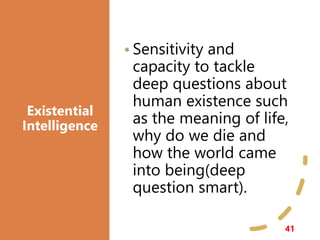
Existential
Intelligence
41
• Sensitivity and
capacity to tackle
deep questions about
human existence such
as the meaning of life,
why do we die and
how the world came
into being(deep
question smart).
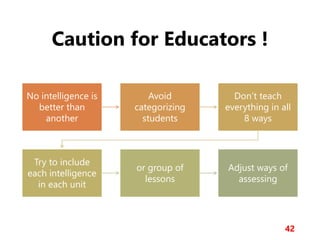
Caution for Educators !
42
No intelligence is
better than
another
Avoid
categorizing
students
Don’t teach
everything in all
8 ways
Try to include
each intelligence
in each unit
or group of
lessons
Adjust ways of
assessing
Questions to Ponder:
43
What does it mean to be a multiple intelligence teacher?
How can I do a better job at teaching to diverse
intelligences?
What are my strongest and weakest intelligences?
What are my goals? Will this benefit my students and
how?
Qualities
of an
Effective
MI
Teacher
• Communicative
• Committed
• Compassionate
• Creative
• Dependable
• Ethical
• Flexible
• Knowledgeable
• Motivational
• Organized
• Positive
• Patient
• Personable
• Perceptive
• Resourceful
• Sense of
Humor
44
THANK YOU
45

Multiple Intelligence for Teachers

  • 1.
    MULTIPLE INTELLIGENCE FOR TEACHERS 1 Howard Gardner’s Theory ofMultiple Intelligence [Frames of Mind-1983] Najma Kazi najmakazi@gmail.com
  • 2.
    What is Intelligence? 2 TraditionalDefinition: “Intelligence is a uniform cognitive capacity people are born with. This capacity can be easily measured by short answer tests. Webster’s Definition: “The Power of knowing, the ability to understand and/or deal with new situations.”
  • 3.
    What is MultipleIntelligence? 3 According to Howard Gardner, a psychologist and professor at Harvard University’s Graduate School of Education, “An intelligence is the ability to solve problems or to create products, that are valued within one or more cultural settings.” The question is not “How smart am I?” but rather “How am I smart?”
  • 4.
    Features of Multiple Intelligence 4 He claimsthat human beings have multiple intelligences. Each individual has 9 intelligences in varying amounts These intelligences are located in different areas of the brain. They either work independently or together. These MI can be nurtured and strengthened or ignored & weakened. We can improve education by addressing these multiple intelligences of our students.
  • 5.
  • 6.
    Gardner’s Multiple Intelligences 1. Verbal/ Linguistic 2.Visual/ Spatial 3. Logical/ Mathematical 4. Musical/ Rhythmic 5. Bodily / Kinesthetic 6. Interpersonal 7. Intrapersonal 8. Naturalistic 9. Existential 6
  • 7.
  • 8.
    Linguistic Intelligence 8 Linguistic Intelligence (Word Smart)is the capacity to use language, your native language, and perhaps other languages, to express what's on your mind and to understand other people People with high linguistic intelligence are good at reading, writing, telling stories and memorizing words with dates.
  • 9.
    Linguistic intelligent people learn best by: • Bookreporting • Telling jokes • Writing words • Reading • Journal writing • Speaking •Letter writing •Storytelling •Discussing •Creative writing •Debating •Persuading 9
  • 10.
  • 11.
  • 12.
    What is spatialintelligence? 12 Spatial intelligence (Picture Smart) is the capacity to think in images and pictures, to visualize accurately and abstractly. People with high visual-spatial intelligence have the ability to visualize with mind’s eye. They have the potential to recognize and use the patterns of wide space and more confined area.
  • 13.
    Spatial intelligent people learn best by: • Brochures •Collages • Designs • Drawings • Flow Charts • Mapping • Molding Clay • Patterns • Painting • Photography • Posters • Sculpting • Visualizing • Idea Sketching • Labeling 13
  • 14.
    CAREERS • Advertising •Architect • Cartographer(Ma p Maker) • Drafter • Engineer • Fine Artist • Graphic Designer • Fashion Designer • Interior Designer • Inventor • Painter • Photographer • Pilot • Sculptor • Surveyor • Urban Planner 14
  • 15.
  • 16.
    What is Logical-Mathematical Intelligence? 16 Logical-mathematicalintelligence (Logic Smart) is the capacity to use numbers effectively and reason well. People with this intelligence think by reasoning, and they love experimenting, questioning, figuring out logical puzzles, and calculating. They are able to identify a problem and solve it right there on the spot.
  • 17.
    Mathematic al intelligent people learn best by:  Analyzing Categorizing  Formulas  Logic Games  Numbers  Outlining  Patterns  Problem Solving  Reasoning  Time-Lines  Synthesis  Sequencing  Rational Thinking  Scientific Thinking  Venn diagram  Statistics 17
  • 18.
    Careers • Accountant •Engineer • Doctor • Banker • Businessperson • Computer Analyst • Computer Programmer • Science/Math Teacher •Economist • Logicians • Mathematician • Physicist • Scientist • Statistician • Technician 18
  • 19.
  • 20.
    Musical Intelligence 20 •Musical intelligence (Music Smart)is the ability to create and appreciate tunes and rhythm. Musically intelligent people are able to distinguish the sounds around and can make their own melodies.
  • 21.
    Musical Intelligent People learn best by: • SingBallads • Create Chants • Create Concept Songs • Discographies (lists of musical selections to enhance what you are learning or teaching.) • Environmental Sounds • Humming • Illustrate With Sounds • Rhythms • Instrumental sounds • Listening • Lyrics • Mood Music • Music Composition or creation • Musical concepts • Musical Performance • Percussion and Raps • Reproduce sounds and rhythms • Singing and Songs 21
  • 22.
    Careers • SongWriter • Performing Musician • Piano Tuner • Singer • Musical Theater Actor/ Actress • Studio Engineer • Instrument Manager • Rapper • Advertising Agent • Conductor • Disc Jockey • Film/Instrument Maker • Composer • Music Teacher • Sound Engineer • Music Therapist 22
  • 23.
  • 24.
    What is Bodily- Kinesthetic Intelligence ? • Bodily-kinestheticIntelligence (Body Smart) is an expertise in using one’s whole body to express ideas and feelings. • It is the ability to control one’s body movements and to handle objects skillfully. • People with high bodily- kinesthetic Intelligence have total body control, sense of timing, a clear sense of the goal of a physical action, an ability to train responses to become reflexes. 24
  • 25.
    Bodily-Kinesthetic Intelligence Thinking throughphysical sensations Love  Dancing  Running  Jumping  Building  Touching  Gesturing 25 Need  Role play  Drama  Movement  Things to build  Sports and physical games  Tactile (touchable) experiences  Hands-on learning
  • 26.
    Bodily- Kinesthetic Intelligent People best learn by: •Acting • Charades • Collections • Demonstrations • Experiments • Field Trips • Gymnastics • Impersonations • Inventing • Martial Arts • Miming • Puppetry • Visiting • Exercise 26
  • 27.
    Careers • Actor •Athlete • Carpenter • Choreographer • Craftsman • Dancer • Police Officer • Surgeon • Mechanic • Mime • P.T. Teacher • Physical Therapist • Soldier • Forest Ranger 27
  • 28.
  • 29.
    Interpersonal Intelligence 29 Interpersonal intelligence, (people smart),is understanding other people. Capacity to detect and respond appropriately to the moods, motivations and desires of others. People with high inter- personal intelligence tend to be extroverts, sensitive to other’s moods, feelings, temperaments and motivations.
  • 30.
    Interperson ally intelligent people learn best by: 30  Givingfeedback to the teacher or to classmates • Understanding other's feelings • Person-to-person communication • Cooperative learning strategies • Receiving feedback • Group projects • Teaching someone else something new • Learning from someone outside of school • Other points of view • Creating group rules • Acting in a play or simulation • Conducting an interview • Creating "phone buddies" for homework • Sensing others’ motives • Creating group rules
  • 31.
    Careers • Administrator •Anthropologist • Arbitrator • Counselor • Manager • Nurse • Personnel Director • Politician • Social Worker • Public Relations • Salesperson • School Principal • Sociologist • Therapist • Teacher • Travel Agent • Religious Leader • Psychologist 31
  • 32.
  • 33.
    Intrapersonal Intelligence 3 3 Essentially, it’show well you know yourself. This intelligence includes having an accurate picture of oneself (one’s strengths and weaknesses); awareness of inner moods, intentions, motivations, temperaments, and desires; and the capacity for self-discipline, self-understanding, and self-esteem. Capacity to be self-aware (Self Smart) and in tune with inner feelings, values, beliefs and thinking processes.
  • 34.
    Intraperson ally intelligent people learn best by: 34 • Autobiography •Awareness of Personal Feelings • Concentration • Expression of Feelings • Focusing • Free-Choice Time • Goal Setting • Higher-Order Thinking and Reasoning • Independent Studies Projects • Mood Awareness and Shifting • Personal Application • Personal Priorities • Personal Projection • Sensing the Emotions of the Moment • Self –Identification • Thinking Strategies
  • 35.
    Careers • Clergyman • Entrepreneur •Program planner • Psychiatrist • Psychology Teacher • Philosopher • Theologian • Researcher • Spiritual Counselor • Psychologist 35
  • 36.
  • 37.
    Naturalistic Intelligence 3 7 Ability torecognize and categorize plants, animals and other objects in nature. People with high naturalistic intelligence (Nature Smart) are extremely sensitive to nature, nurturing and relating information to one’s natural surrounding.
  • 38.
    Naturalistic Intelligent people learn best by: 38 Relating tothe environment Day to day experiences Working in open atmosphere Studying about nature and environment Outdoor Exploration Science Experiments Field Trips
  • 39.
    Careers • Naturalists •Farmers • Gardeners • Environmentalist s • Biologists • Environmental activists • Anthropologists • Geologists 39
  • 40.
  • 41.
    Existential Intelligence 41 • Sensitivity and capacityto tackle deep questions about human existence such as the meaning of life, why do we die and how the world came into being(deep question smart).
  • 42.
    Caution for Educators! 42 No intelligence is better than another Avoid categorizing students Don’t teach everything in all 8 ways Try to include each intelligence in each unit or group of lessons Adjust ways of assessing
  • 43.
    Questions to Ponder: 43 Whatdoes it mean to be a multiple intelligence teacher? How can I do a better job at teaching to diverse intelligences? What are my strongest and weakest intelligences? What are my goals? Will this benefit my students and how?
  • 44.
    Qualities of an Effective MI Teacher • Communicative •Committed • Compassionate • Creative • Dependable • Ethical • Flexible • Knowledgeable • Motivational • Organized • Positive • Patient • Personable • Perceptive • Resourceful • Sense of Humor 44
  • 45.