.
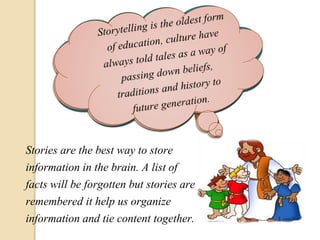
Stories are the best way to store
information in the brain. A list of
facts will be forgotten but stories are
remembered it help us organize
information and tie content together.
Improves listening skills.
Raises the enthusiasm for reading texts to find stories.
Initiates writing because children will quickly want to write
stories and tell them.
Encourage use of imagination and creativity
Really attract the boys who love the acting.
Gives a motivating reason for children to speak English.
Encourage cooperation between students
Encourage active participation
(Martin,2004) stated that teachers should choose a story
 Which attract the children within the first few lines.
Which children will understand well enough to enjoy it.
Which offers the children a rich experience of language .
Which doesn’t have long descriptive passages.
Which is right for the occasion and related to children interests.
Which should have repeated grammatical structures that enables children to
acquire
useful phrases.
Which exercise the imagination.
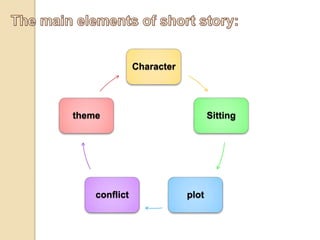
Character
Sitting
plotconflict
theme
Voice Mechanics:
a storyteller Speaks with an appropriate volume for the audience to
hear. Employs clear pronunciation.
Face/Body/Gesture :
A storyteller expressively uses non-verbal communication to clarify
the meaning of the text
Focus :
- Concentration is clear.
- Eye contact with audience is engaging.
 Characterization:
If dialogue is employed, characters are believable to listener.
Storyteller's natural voice is differentiated from character voices.
 Use of space:
Storyteller seems comfortable, relaxed and confident in front of
listeners.
 Pacing:
The story is presented efficiently and keeps listeners' interest
throughout.
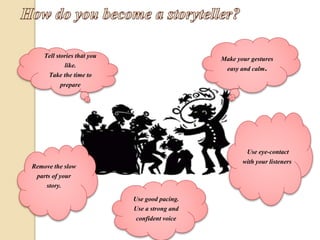
Make your gestures
easy and calm.
Tell stories that you
like.
Take the time to
prepare
Use eye-contact
with your listeners
Use good pacing.
Use a strong and
confident voice
Remove the slow
parts of your
story.
 Read as many different world folktales, fables and legends as you can.
 Watch professional storytellers and take notes about how they do it
every storyteller is different, and you can learn something from them all.
 Pick stories with small numbers of characters and repeating events, as
these are easiest to remember. Having said that, pick any story you like --
no, that you love! If it captivates you, it will captivate the younger ones,
too.
 Write the stories down in a notebook. Writing helps you remember a
story, and it models the same to the children.
 When you start "telling" your story, it's OK to have the book nearby
and to take a look at it if you forget a part. Don't be too hard on yourself.
You are a student again.

Storytelling

  • 2.
  • 3.
    Stories are thebest way to store information in the brain. A list of facts will be forgotten but stories are remembered it help us organize information and tie content together.
  • 4.
    Improves listening skills. Raisesthe enthusiasm for reading texts to find stories. Initiates writing because children will quickly want to write stories and tell them. Encourage use of imagination and creativity Really attract the boys who love the acting. Gives a motivating reason for children to speak English. Encourage cooperation between students Encourage active participation
  • 5.
    (Martin,2004) stated thatteachers should choose a story  Which attract the children within the first few lines. Which children will understand well enough to enjoy it. Which offers the children a rich experience of language . Which doesn’t have long descriptive passages. Which is right for the occasion and related to children interests. Which should have repeated grammatical structures that enables children to acquire useful phrases. Which exercise the imagination.
  • 7.
  • 8.
    Voice Mechanics: a storytellerSpeaks with an appropriate volume for the audience to hear. Employs clear pronunciation. Face/Body/Gesture : A storyteller expressively uses non-verbal communication to clarify the meaning of the text Focus : - Concentration is clear. - Eye contact with audience is engaging.
  • 9.
     Characterization: If dialogueis employed, characters are believable to listener. Storyteller's natural voice is differentiated from character voices.  Use of space: Storyteller seems comfortable, relaxed and confident in front of listeners.  Pacing: The story is presented efficiently and keeps listeners' interest throughout.
  • 10.
    Make your gestures easyand calm. Tell stories that you like. Take the time to prepare Use eye-contact with your listeners Use good pacing. Use a strong and confident voice Remove the slow parts of your story.
  • 11.
     Read asmany different world folktales, fables and legends as you can.  Watch professional storytellers and take notes about how they do it every storyteller is different, and you can learn something from them all.  Pick stories with small numbers of characters and repeating events, as these are easiest to remember. Having said that, pick any story you like -- no, that you love! If it captivates you, it will captivate the younger ones, too.  Write the stories down in a notebook. Writing helps you remember a story, and it models the same to the children.  When you start "telling" your story, it's OK to have the book nearby and to take a look at it if you forget a part. Don't be too hard on yourself. You are a student again.