Friday, May 27, 20161
1. Definition Of Learning Difficulties.
2. Types Of Learning Disabilities.
3. The Relationship Between Academic Learning Disabilities &
Non-academic(developmental).
4. The Difference Between Learning Disabilities, Slow Learning
And Under-achievement.
5. How To Recognize Learning Disabilities(Criteria).
6. Language learning disabilities.
7. Causing Factors For Language Learning Disabilities.
8. Some Remedial Methods For Language Learning Disabilities.
9. The Treatment Of Academic Reading Disabilities.
10. Remedial Teaching Strategies.
Friday, May 27, 20162
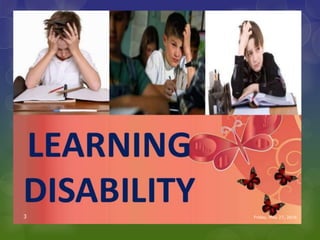
Friday, May 27, 20163
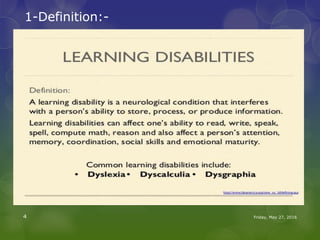
1-Definition:-
Friday, May 27, 20164
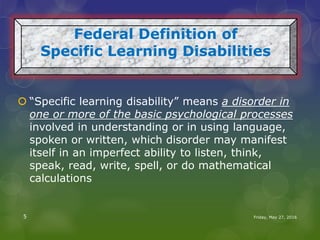
 “Specific learning disability” means a disorder in
one or more of the basic psychological processes
involved in understanding or in using language,
spoken or written, which disorder may manifest
itself in an imperfect ability to listen, think,
speak, read, write, spell, or do mathematical
calculations
Federal Definition of
Specific Learning Disabilities
Friday, May 27, 20165
 In Federal law, under the Individuals with Disabilities
Education Act (IDEA), the term is “specific learning
disability,” one of 13 categories of disability under that
law.
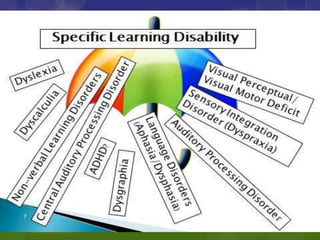
 “Learning Disabilities” is an “umbrella” term describing a
number of other, more specific learning disabilities, such
as dyslexia and dysgraphia.
Friday, May 27, 20166
Friday, May 27, 20167
Friday, May 27, 20168
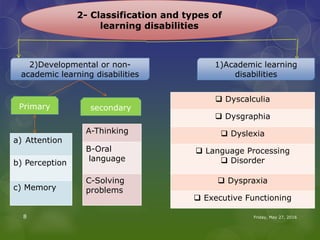
2- Classification and types of
learning disabilities
2)Developmental or non-
academic learning disabilities
1)Academic learning
disabilities
Primary secondary
a) Attention
b) Perception
c) Memory
A-Thinking
B-Oral
language
C-Solving
problems
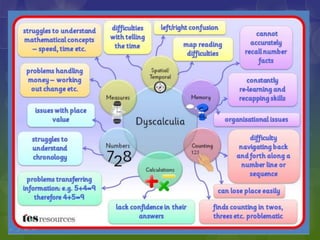
 Dyscalculia
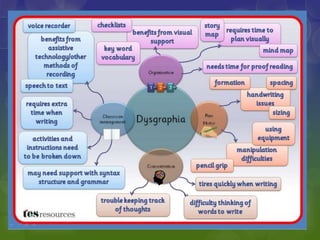
 Dysgraphia
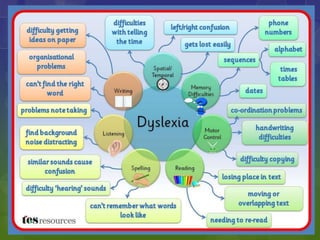
 Dyslexia
 Language Processing
 Disorder
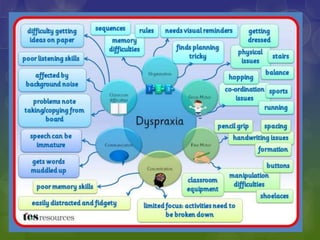
 Dyspraxia
 Executive Functioning
Friday, May 27, 20169
Friday, May 27, 201610
Friday, May 27, 201611
Friday, May 27, 201612
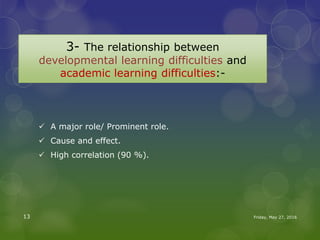
3- The relationship between
developmental learning difficulties and
academic learning difficulties:-
 A major role/ Prominent role.
 Cause and effect.
 High correlation (90 %).
Friday, May 27, 201613
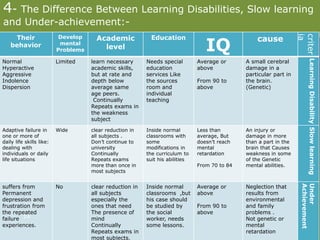
4- The Difference Between Learning Disabilities, Slow learning
and Under-achievement:-
Their
behavior
Develop
mental
Problems
Academic
level
Education
IQ
cause
criter
ia
Normal
Hyperactive
Aggressive
Indolence
Dispersion
Limited learn necessary
academic skills,
but at rate and
depth below
average same
age peers.
Continually
Repeats exams in
the weakness
subject
Needs special
education
services Like
the sources
room and
individual
teaching
Average or
above
From 90 to
above
A small cerebral
damage in a
particular part in
the brain.
(Genetic)
LearningDisability
Adaptive failure in
one or more of
daily life skills like:
dealing with
individuals or daily
life situations
Wide clear reduction in
all subjects .
Don’t continue to
university
Continually
Repeats exams
more than once in
most subjects
Inside normal
classrooms with
some
modifications in
the curriculum to
suit his abilities
Less than
average, But
doesn’t reach
mental
retardation
From 70 to 84
An injury or
damage in more
than a part in the
brain that Causes
weakness in some
of the Genetic
mental abilities.
Slowlearning
suffers from
Permanent
depression and
frustration from
the repeated
failure
experiences.
No clear reduction in
all subjects
especially the
ones that need
The presence of
mind
Continually
Repeats exams in
most subjects.
Inside normal
classrooms ,but
his case should
be studied by
the social
worker, needs
some lessons.
Average or
above
From 90 to
above
Neglection that
results from
environmental
and family
problems .
Not genetic or
mental
retardation
Under
Achievement
14
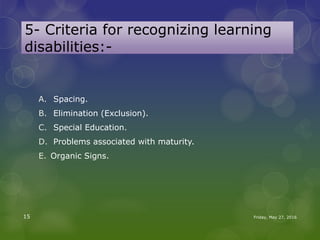
5- Criteria for recognizing learning
disabilities:-
A. Spacing.
B. Elimination (Exclusion).
C. Special Education.
D. Problems associated with maturity.
E. Organic Signs.
Friday, May 27, 201615
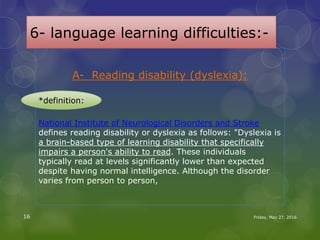
6- language learning difficulties:-
A- Reading disability (dyslexia):
National Institute of Neurological Disorders and Stroke
defines reading disability or dyslexia as follows: "Dyslexia is
a brain-based type of learning disability that specifically
impairs a person's ability to read. These individuals
typically read at levels significantly lower than expected
despite having normal intelligence. Although the disorder
varies from person to person,
Friday, May 27, 201616
*definition:
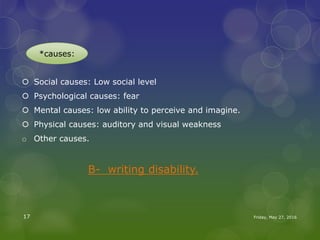
 Social causes: Low social level
 Psychological causes: fear
 Mental causes: low ability to perceive and imagine.
 Physical causes: auditory and visual weakness
o Other causes.
B- writing disability.
Friday, May 27, 201617
*causes:
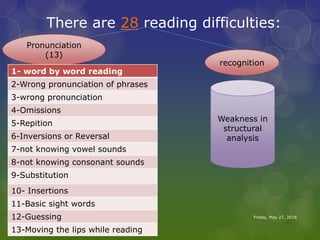
There are 28 reading difficulties:

Friday, May 27, 201618
Pronunciation
(13)
1- word by word reading
2-Wrong pronunciation of phrases
3-wrong pronunciation
4-Omissions
5-Repition
6-Inversions or Reversal
7-not knowing vowel sounds
8-not knowing consonant sounds
9-Substitution
10- Insertions
11-Basic sight words
12-Guessing
13-Moving the lips while reading
recognition
Weakness in
structural
analysis
 Inability to
Friday, May 27, 201619
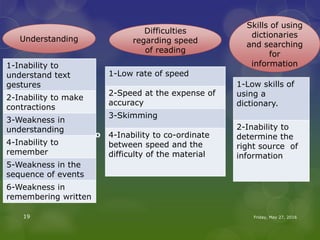
Understanding
1-Inability to
understand text
gestures
2-Inability to make
contractions
3-Weakness in
understanding
4-Inability to
remember
5-Weakness in the
sequence of events
6-Weakness in
remembering written
Difficulties
regarding speed
of reading
1-Low rate of speed
2-Speed at the expense of
accuracy
3-Skimming
4-Inability to co-ordinate
between speed and the
difficulty of the material
Skills of using
dictionaries
and searching
for
information
1-Low skills of
using a
dictionary.
2-Inability to
determine the
right source of
information
7- Causing factors of language learning
disabilities:
1) Organic causes.
2) Environmental causes.
3) Educational causes.
4) Inner psychological reasons.
5) Functional reasons.
Friday, May 27, 201620
8- Some methods of the treatment of
learning disabilities:
1) Dialogue.
2) Doing some experiments
3) Using scientific discoveries
4) The use of models and maquettes
5) Using pictures
6) Using mazes
7) Using stories
8) Treatment based on the use of realism
9) Search / teach tutoring approach
Friday, May 27, 201621
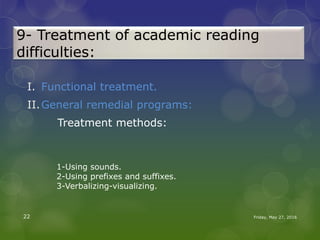
9- Treatment of academic reading
difficulties:
I. Functional treatment.
II.General remedial programs:
Treatment methods:
Friday, May 27, 201622
1-Using sounds.
2-Using prefixes and suffixes.
3-Verbalizing-visualizing.
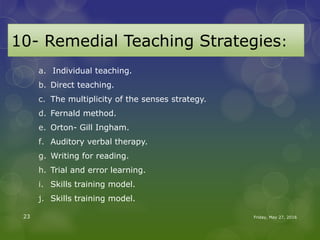
10- Remedial Teaching Strategies:
a. Individual teaching.
b. Direct teaching.
c. The multiplicity of the senses strategy.
d. Fernald method.
e. Orton- Gill Ingham.
f. Auditory verbal therapy.
g. Writing for reading.
h. Trial and error learning.
i. Skills training model.
j. Skills training model.
Friday, May 27, 201623
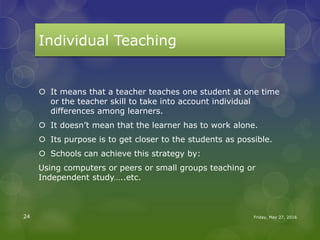
Individual Teaching
 It means that a teacher teaches one student at one time
or the teacher skill to take into account individual
differences among learners.
 It doesn’t mean that the learner has to work alone.
 Its purpose is to get closer to the students as possible.
 Schools can achieve this strategy by:
Using computers or peers or small groups teaching or
Independent study…..etc.
Friday, May 27, 201624
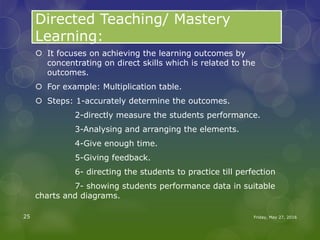
Directed Teaching/ Mastery
Learning:
 It focuses on achieving the learning outcomes by
concentrating on direct skills which is related to the
outcomes.
 For example: Multiplication table.
 Steps: 1-accurately determine the outcomes.
2-directly measure the students performance.
3-Analysing and arranging the elements.
4-Give enough time.
5-Giving feedback.
6- directing the students to practice till perfection
7- showing students performance data in suitable
charts and diagrams.
Friday, May 27, 201625
Writing for reading Strategy
 Modern program.
 Through personal experience.
 Children find it easy to read a word which they gathered
its letters.
 For example: A picture of a train.
 Steps of writing for reading strategy(steps-ten units-
Three words).
Friday, May 27, 201626
Friday, May 27, 201627

Remedial teaching strategies

  • 1.
  • 2.
    1. Definition OfLearning Difficulties. 2. Types Of Learning Disabilities. 3. The Relationship Between Academic Learning Disabilities & Non-academic(developmental). 4. The Difference Between Learning Disabilities, Slow Learning And Under-achievement. 5. How To Recognize Learning Disabilities(Criteria). 6. Language learning disabilities. 7. Causing Factors For Language Learning Disabilities. 8. Some Remedial Methods For Language Learning Disabilities. 9. The Treatment Of Academic Reading Disabilities. 10. Remedial Teaching Strategies. Friday, May 27, 20162
  • 3.
  • 4.
  • 5.
     “Specific learningdisability” means a disorder in one or more of the basic psychological processes involved in understanding or in using language, spoken or written, which disorder may manifest itself in an imperfect ability to listen, think, speak, read, write, spell, or do mathematical calculations Federal Definition of Specific Learning Disabilities Friday, May 27, 20165
  • 6.
     In Federallaw, under the Individuals with Disabilities Education Act (IDEA), the term is “specific learning disability,” one of 13 categories of disability under that law.  “Learning Disabilities” is an “umbrella” term describing a number of other, more specific learning disabilities, such as dyslexia and dysgraphia. Friday, May 27, 20166
  • 7.
  • 8.
    Friday, May 27,20168 2- Classification and types of learning disabilities 2)Developmental or non- academic learning disabilities 1)Academic learning disabilities Primary secondary a) Attention b) Perception c) Memory A-Thinking B-Oral language C-Solving problems  Dyscalculia  Dysgraphia  Dyslexia  Language Processing  Disorder  Dyspraxia  Executive Functioning
  • 9.
  • 10.
  • 11.
  • 12.
  • 13.
    3- The relationshipbetween developmental learning difficulties and academic learning difficulties:-  A major role/ Prominent role.  Cause and effect.  High correlation (90 %). Friday, May 27, 201613
  • 14.
    4- The DifferenceBetween Learning Disabilities, Slow learning and Under-achievement:- Their behavior Develop mental Problems Academic level Education IQ cause criter ia Normal Hyperactive Aggressive Indolence Dispersion Limited learn necessary academic skills, but at rate and depth below average same age peers. Continually Repeats exams in the weakness subject Needs special education services Like the sources room and individual teaching Average or above From 90 to above A small cerebral damage in a particular part in the brain. (Genetic) LearningDisability Adaptive failure in one or more of daily life skills like: dealing with individuals or daily life situations Wide clear reduction in all subjects . Don’t continue to university Continually Repeats exams more than once in most subjects Inside normal classrooms with some modifications in the curriculum to suit his abilities Less than average, But doesn’t reach mental retardation From 70 to 84 An injury or damage in more than a part in the brain that Causes weakness in some of the Genetic mental abilities. Slowlearning suffers from Permanent depression and frustration from the repeated failure experiences. No clear reduction in all subjects especially the ones that need The presence of mind Continually Repeats exams in most subjects. Inside normal classrooms ,but his case should be studied by the social worker, needs some lessons. Average or above From 90 to above Neglection that results from environmental and family problems . Not genetic or mental retardation Under Achievement 14
  • 15.
    5- Criteria forrecognizing learning disabilities:- A. Spacing. B. Elimination (Exclusion). C. Special Education. D. Problems associated with maturity. E. Organic Signs. Friday, May 27, 201615
  • 16.
    6- language learningdifficulties:- A- Reading disability (dyslexia): National Institute of Neurological Disorders and Stroke defines reading disability or dyslexia as follows: "Dyslexia is a brain-based type of learning disability that specifically impairs a person's ability to read. These individuals typically read at levels significantly lower than expected despite having normal intelligence. Although the disorder varies from person to person, Friday, May 27, 201616 *definition:
  • 17.
     Social causes:Low social level  Psychological causes: fear  Mental causes: low ability to perceive and imagine.  Physical causes: auditory and visual weakness o Other causes. B- writing disability. Friday, May 27, 201617 *causes:
  • 18.
    There are 28reading difficulties:  Friday, May 27, 201618 Pronunciation (13) 1- word by word reading 2-Wrong pronunciation of phrases 3-wrong pronunciation 4-Omissions 5-Repition 6-Inversions or Reversal 7-not knowing vowel sounds 8-not knowing consonant sounds 9-Substitution 10- Insertions 11-Basic sight words 12-Guessing 13-Moving the lips while reading recognition Weakness in structural analysis
  • 19.
     Inability to Friday,May 27, 201619 Understanding 1-Inability to understand text gestures 2-Inability to make contractions 3-Weakness in understanding 4-Inability to remember 5-Weakness in the sequence of events 6-Weakness in remembering written Difficulties regarding speed of reading 1-Low rate of speed 2-Speed at the expense of accuracy 3-Skimming 4-Inability to co-ordinate between speed and the difficulty of the material Skills of using dictionaries and searching for information 1-Low skills of using a dictionary. 2-Inability to determine the right source of information
  • 20.
    7- Causing factorsof language learning disabilities: 1) Organic causes. 2) Environmental causes. 3) Educational causes. 4) Inner psychological reasons. 5) Functional reasons. Friday, May 27, 201620
  • 21.
    8- Some methodsof the treatment of learning disabilities: 1) Dialogue. 2) Doing some experiments 3) Using scientific discoveries 4) The use of models and maquettes 5) Using pictures 6) Using mazes 7) Using stories 8) Treatment based on the use of realism 9) Search / teach tutoring approach Friday, May 27, 201621
  • 22.
    9- Treatment ofacademic reading difficulties: I. Functional treatment. II.General remedial programs: Treatment methods: Friday, May 27, 201622 1-Using sounds. 2-Using prefixes and suffixes. 3-Verbalizing-visualizing.
  • 23.
    10- Remedial TeachingStrategies: a. Individual teaching. b. Direct teaching. c. The multiplicity of the senses strategy. d. Fernald method. e. Orton- Gill Ingham. f. Auditory verbal therapy. g. Writing for reading. h. Trial and error learning. i. Skills training model. j. Skills training model. Friday, May 27, 201623
  • 24.
    Individual Teaching  Itmeans that a teacher teaches one student at one time or the teacher skill to take into account individual differences among learners.  It doesn’t mean that the learner has to work alone.  Its purpose is to get closer to the students as possible.  Schools can achieve this strategy by: Using computers or peers or small groups teaching or Independent study…..etc. Friday, May 27, 201624
  • 25.
    Directed Teaching/ Mastery Learning: It focuses on achieving the learning outcomes by concentrating on direct skills which is related to the outcomes.  For example: Multiplication table.  Steps: 1-accurately determine the outcomes. 2-directly measure the students performance. 3-Analysing and arranging the elements. 4-Give enough time. 5-Giving feedback. 6- directing the students to practice till perfection 7- showing students performance data in suitable charts and diagrams. Friday, May 27, 201625
  • 26.
    Writing for readingStrategy  Modern program.  Through personal experience.  Children find it easy to read a word which they gathered its letters.  For example: A picture of a train.  Steps of writing for reading strategy(steps-ten units- Three words). Friday, May 27, 201626
  • 27.