Submitted to:-
Dr. Indira Dhull
Dept.of.Edu
M.D.U(Rohtak)
Submitted By:-
Priyamvada
M.Ed (257)
 Introduction
 Meaning
 Definition
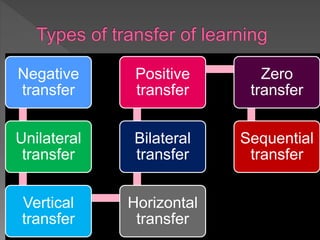
 Type of transfer of
learning
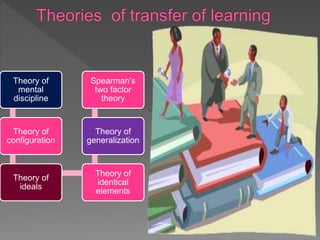
 Theories of transfer
of learning
 Implication of
transfer of learning
 Conclusion
 References
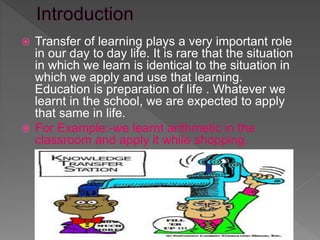
 Transfer of learning plays a very important role
in our day to day life. It is rare that the situation
in which we learn is identical to the situation in
which we apply and use that learning.
Education is preparation of life . Whatever we
learnt in the school, we are expected to apply
that same in life.
 For Example:-we learnt arithmetic in the
classroom and apply it while shopping.
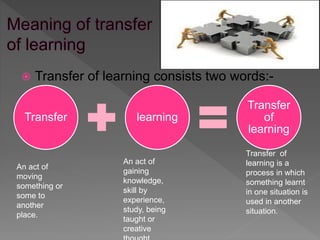
 Transfer of learning consists two words:-
Transfer learning
Transfer
of
learning
An act of
moving
something or
some to
another
place.
An act of
gaining
knowledge,
skill by
experience,
study, being
taught or
creative
Transfer of
learning is a
process in which
something learnt
in one situation is
used in another
situation.
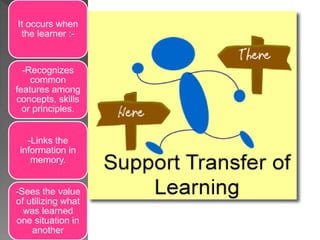
It occurs when
the learner :-
-Recognizes
common
features among
concepts, skills
or principles.
-Links the
information in
memory.
-Sees the value
of utilizing what
was learned
one situation in
another
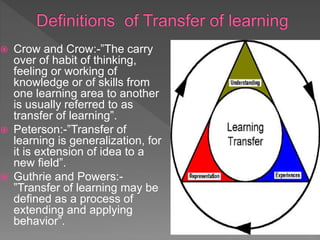
 Crow and Crow:-”The carry
over of habit of thinking,
feeling or working of
knowledge or of skills from
one learning area to another
is usually referred to as
transfer of learning”.
 Peterson:-”Transfer of
learning is generalization, for
it is extension of idea to a
new field”.
 Guthrie and Powers:-
”Transfer of learning may be
defined as a process of
extending and applying
behavior”.
Purposeful
Utilization of
previous
knowledge
Helpful in
adjustment
Utilization of
mental
capacities
Development
of insight
Effect
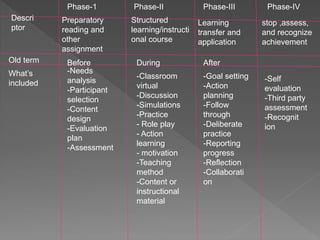
-Needs
analysis
-Participant
selection
-Content
design
-Evaluation
plan
-Assessment
-Classroom
virtual
-Discussion
-Simulations
-Practice
- Role play
- Action
learning
- motivation
-Teaching
method
-Content or
instructional
material
-Goal setting
-Action
planning
-Follow
through
-Deliberate
practice
-Reporting
progress
-Reflection
-Collaborati
on
-Self
evaluation
-Third party
assessment
-Recognit
ion
What’s
included
Old term
Descri
ptor
Before During After
Phase-1 Phase-II Phase-III Phase-IV
Structured
learning/instructi
onal course
Learning
transfer and
application
stop ,assess,
and recognize
achievement
Preparatory
reading and
other
assignment
Negative
transfer
Unilateral
transfer
Vertical
transfer
Horizontal
transfer
Bilateral
transfer
Positive
transfer
Zero
transfer
Sequential
transfer
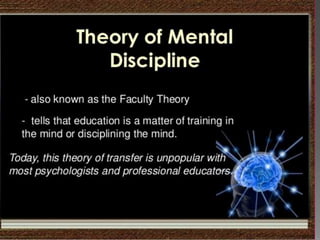
Theory of
mental
discipline
Theory of
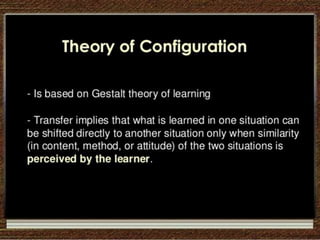
configuration
Theory of
ideals
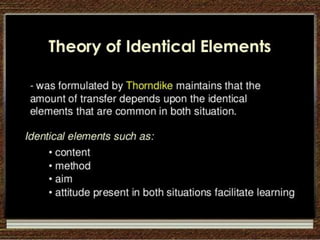
Theory of
identical
elements
Theory of
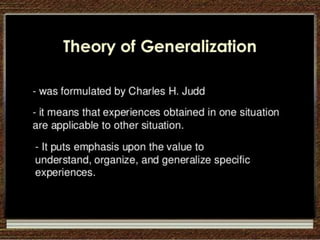
generalization
Spearman’s
two factor
theory
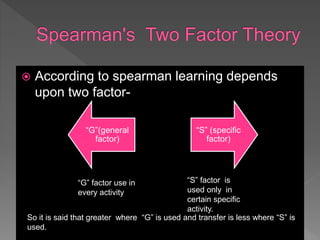
 According to spearman learning depends
upon two factor-
“G”(general
factor)
“S” (specific
factor)
“G” factor use in
every activity
“S” factor is
used only in
certain specific
activity.
So it is said that greater where “G” is used and transfer is less where “S” is
used.
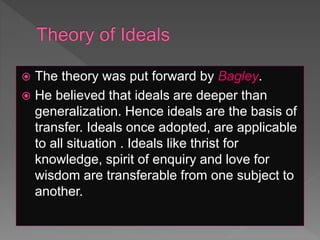
 The theory was put forward by Bagley.
 He believed that ideals are deeper than
generalization. Hence ideals are the basis of
transfer. Ideals once adopted, are applicable
to all situation . Ideals like thrist for
knowledge, spirit of enquiry and love for
wisdom are transferable from one subject to
another.
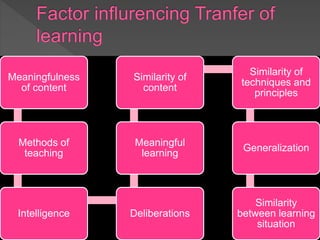
Meaningfulness
of content
Methods of
teaching
Intelligence Deliberations
Meaningful
learning
Similarity of
content
Similarity of
techniques and
principles
Generalization
Similarity
between learning
situation
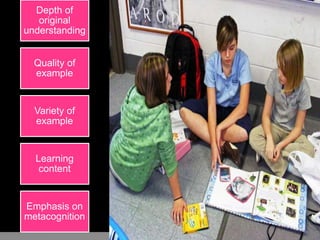
Depth of
original
understanding
Quality of
example
Variety of
example
Learning
content
Emphasis on
metacognition
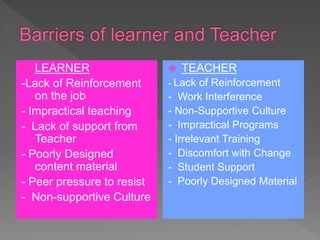
 LEARNER
-Lack of Reinforcement
on the job
- Impractical teaching
- Lack of support from
Teacher
- Poorly Designed
content material
- Peer pressure to resist
- Non-supportive Culture
 TEACHER
- Lack of Reinforcement
- Work Interference
- Non-Supportive Culture
- Impractical Programs
- Irrelevant Training
- Discomfort with Change
- Student Support
- Poorly Designed Material
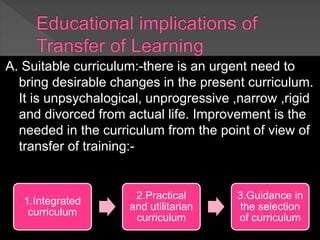
A. Suitable curriculum:-there is an urgent need to
bring desirable changes in the present curriculum.
It is unpsychalogical, unprogressive ,narrow ,rigid
and divorced from actual life. Improvement is the
needed in the curriculum from the point of view of
transfer of training:-
1.Integrated
curriculum
2.Practical
and utilitarian
curriculum
3.Guidance in
the selection
of curriculum
 Effective methods of teaching should be used for
increasing the possibilities of transfer.
Emphasis on
correlation
Co-ordination
between theoretical
knowledge and
practical
Emphasis on
intelligent methods
of learning
Use of practice
Use of life like
methods
Use of illustrations
and audio-visual
aids
Attitude of
transferability
Special attention
towards intelligent
students
Use of
generalization
Knowledge of similarity of content
Clarity of thought
Effective methods of teaching
Use of generalization
Development of thinking
Development of understanding
Application of acquired knowledge
Special attention towards intelligent student
Laws of association
Use of concentration
Deliberate and purposeful efforts
 Transfer of training is effectively and continuing
applying the knowledge, skills, and/or attitudes
that were learned in a learning environment to
the job environment. Closely related to this
concept is Transfer of Learning—the
application of skills, knowledge, and/or attitudes
that were learned in one situation to another
learning situation (Perkins, 1992). This
increases the speed of learning
 Dr. Walia J.S. (2010) Foundations of
Educational Psychology, N.N 11, Gopal
Nagar Jalandhar city Punjab
 Mangal S.K (2007) Educational Psychology,
Prakash Book Depot Ludhiana
 Dr. Pandaya K.P(1983), Advanced
Educational Psychology for Teachers,
Amitash Prakashan Ghaziabad Delhi
Transfer of learning

Transfer of learning

  • 1.
    Submitted to:- Dr. IndiraDhull Dept.of.Edu M.D.U(Rohtak) Submitted By:- Priyamvada M.Ed (257)
  • 2.
     Introduction  Meaning Definition  Type of transfer of learning  Theories of transfer of learning  Implication of transfer of learning  Conclusion  References
  • 3.
     Transfer oflearning plays a very important role in our day to day life. It is rare that the situation in which we learn is identical to the situation in which we apply and use that learning. Education is preparation of life . Whatever we learnt in the school, we are expected to apply that same in life.  For Example:-we learnt arithmetic in the classroom and apply it while shopping.
  • 4.
     Transfer oflearning consists two words:- Transfer learning Transfer of learning An act of moving something or some to another place. An act of gaining knowledge, skill by experience, study, being taught or creative Transfer of learning is a process in which something learnt in one situation is used in another situation.
  • 5.
    It occurs when thelearner :- -Recognizes common features among concepts, skills or principles. -Links the information in memory. -Sees the value of utilizing what was learned one situation in another
  • 6.
     Crow andCrow:-”The carry over of habit of thinking, feeling or working of knowledge or of skills from one learning area to another is usually referred to as transfer of learning”.  Peterson:-”Transfer of learning is generalization, for it is extension of idea to a new field”.  Guthrie and Powers:- ”Transfer of learning may be defined as a process of extending and applying behavior”.
  • 7.
  • 10.
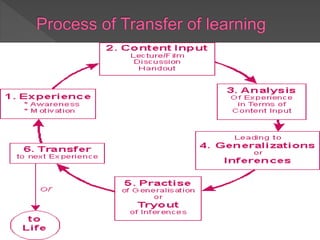
    -Needs analysis -Participant selection -Content design -Evaluation plan -Assessment -Classroom virtual -Discussion -Simulations -Practice - Role play -Action learning - motivation -Teaching method -Content or instructional material -Goal setting -Action planning -Follow through -Deliberate practice -Reporting progress -Reflection -Collaborati on -Self evaluation -Third party assessment -Recognit ion What’s included Old term Descri ptor Before During After Phase-1 Phase-II Phase-III Phase-IV Structured learning/instructi onal course Learning transfer and application stop ,assess, and recognize achievement Preparatory reading and other assignment
  • 13.
  • 14.
    Theory of mental discipline Theory of configuration Theoryof ideals Theory of identical elements Theory of generalization Spearman’s two factor theory
  • 19.
     According tospearman learning depends upon two factor- “G”(general factor) “S” (specific factor) “G” factor use in every activity “S” factor is used only in certain specific activity. So it is said that greater where “G” is used and transfer is less where “S” is used.
  • 20.
     The theorywas put forward by Bagley.  He believed that ideals are deeper than generalization. Hence ideals are the basis of transfer. Ideals once adopted, are applicable to all situation . Ideals like thrist for knowledge, spirit of enquiry and love for wisdom are transferable from one subject to another.
  • 21.
    Meaningfulness of content Methods of teaching IntelligenceDeliberations Meaningful learning Similarity of content Similarity of techniques and principles Generalization Similarity between learning situation
  • 22.
    Depth of original understanding Quality of example Varietyof example Learning content Emphasis on metacognition
  • 23.
     LEARNER -Lack ofReinforcement on the job - Impractical teaching - Lack of support from Teacher - Poorly Designed content material - Peer pressure to resist - Non-supportive Culture  TEACHER - Lack of Reinforcement - Work Interference - Non-Supportive Culture - Impractical Programs - Irrelevant Training - Discomfort with Change - Student Support - Poorly Designed Material
  • 24.
    A. Suitable curriculum:-thereis an urgent need to bring desirable changes in the present curriculum. It is unpsychalogical, unprogressive ,narrow ,rigid and divorced from actual life. Improvement is the needed in the curriculum from the point of view of transfer of training:- 1.Integrated curriculum 2.Practical and utilitarian curriculum 3.Guidance in the selection of curriculum
  • 25.
     Effective methodsof teaching should be used for increasing the possibilities of transfer. Emphasis on correlation Co-ordination between theoretical knowledge and practical Emphasis on intelligent methods of learning Use of practice Use of life like methods Use of illustrations and audio-visual aids Attitude of transferability Special attention towards intelligent students Use of generalization
  • 26.
    Knowledge of similarityof content Clarity of thought Effective methods of teaching Use of generalization Development of thinking Development of understanding Application of acquired knowledge Special attention towards intelligent student Laws of association Use of concentration Deliberate and purposeful efforts
  • 27.
     Transfer oftraining is effectively and continuing applying the knowledge, skills, and/or attitudes that were learned in a learning environment to the job environment. Closely related to this concept is Transfer of Learning—the application of skills, knowledge, and/or attitudes that were learned in one situation to another learning situation (Perkins, 1992). This increases the speed of learning
  • 28.
     Dr. WaliaJ.S. (2010) Foundations of Educational Psychology, N.N 11, Gopal Nagar Jalandhar city Punjab  Mangal S.K (2007) Educational Psychology, Prakash Book Depot Ludhiana  Dr. Pandaya K.P(1983), Advanced Educational Psychology for Teachers, Amitash Prakashan Ghaziabad Delhi