Collected by
Mona El Sayed Abbas
Fatma Mahmoud Eid
 Shared Reading is an interactive reading
experience that occurs when students
join in or share the reading of a big book or
other enlarged text while guided and supported
by a teacher or other experienced reader
 In Shared Reading, students participate in
reading, learn critical concepts of how print
works, get the feel of learning and begin to
perceive
themselves as readers (Fountas & Pinnell,
1996).
 The shared reading approach is appropriate
when the challenges in a text may make it too
difficult for students to read alone. A group
can share the reading of a text that is
relevant to the topics students are studying
but is too difficult for some students to read
independently. All students will then be able
to participate in group learning activities
based on the information in the text.
 Shared reading is a collaborative
learning activity that emulates and
builds from the students experience
with bedtime stories
 With this instructional technique
students have an opportunity to
gradually assume more responsibility
for the reading as their skill level and
confidence increase
 Allows students to enjoy materials that they
may not be able to read on their own.
 • Ensures that all students feel successful by
providing support to the entire group.
 • Students act as though they are reading.
 . Helps in teaching frequently used
vocabulary.
 • Encourages prediction in reading.
 • Helps students develop a sense of story and
increases comprehension
 Shared reading is a link in helping students become
independent readers. It allows the teacher to model
and support students using prediction and
confirming skills. It allows less confident students the
chance to share stories/articles/poetry in a non-
threatening situation. It focuses on the meaning, fun,
enjoyment, characters and sequence of a story and
allows them to relate it back to their own
experiences. It promotes discussion, problem-solving
and critical thinking by students.
 Shared reading can be done with a small group/large
group/whole class and can be an
article/poem/story/etc. It is a technique that can be
used with any level, age, ability, and curriculum area.
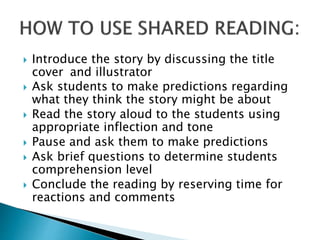
 Introduce the story by discussing the title
cover and illustrator
 Ask students to make predictions regarding
what they think the story might be about
 Read the story aloud to the students using
appropriate inflection and tone
 Pause and ask them to make predictions
 Ask brief questions to determine students
comprehension level
 Conclude the reading by reserving time for
reactions and comments
 Ask questions about the story and relate the
story to the students similar experiences
 Ask the students to retell the story in their
own words
 Re-read the story and allow time for
independent reading
 Conduct follow-up activities such as making
crafts related to the story
 Select a text which has a teaching point that
meets the needs of the students. Ensure that
all students have a copy of the text or are
able to clearly see the text e g overhead
projector transparencies or in an enlarged
book form.
 Discuss with students the topic to find out
prior knowledge.
 State the purpose of the text. Share the
learning intentions and the success criteria
with the students.
 Ask Students to predict the text from the
cover, title, and illustrations.
 Teacher reads the text with as few stops as
possible. Encourage students to participate
where appropriate.
 Encourage students to talk about the text and
the language features of the text. Identify and
discuss with students the conventions of
various text forms, discuss meanings in texts
relating them to their own experiences, model
the use of information skills such as retrieving
information from a text.
 It is a key approach in the acquisition of
language/reading attitudes and processes for
non-English speaking background students.
 http://www.educationworld.com/a_curr/strategy
/strategy008.shtml#sthash.JUu7ExS9.dpuf

 Learn More About Shared Reading
The following Web links also provide valuable
information about the shared-reading strategy.
 Shared Reading: An Effective Instructional Model
A description of shared reading and its benefits.
 Shared Reading
An explanation of the strategy with an emphasis
on using shared reading with young children
Tha
nk
you

Shared reading strategy

  • 1.
    Collected by Mona ElSayed Abbas Fatma Mahmoud Eid
  • 2.
     Shared Readingis an interactive reading experience that occurs when students join in or share the reading of a big book or other enlarged text while guided and supported by a teacher or other experienced reader  In Shared Reading, students participate in reading, learn critical concepts of how print works, get the feel of learning and begin to perceive themselves as readers (Fountas & Pinnell, 1996).
  • 3.
     The sharedreading approach is appropriate when the challenges in a text may make it too difficult for students to read alone. A group can share the reading of a text that is relevant to the topics students are studying but is too difficult for some students to read independently. All students will then be able to participate in group learning activities based on the information in the text.
  • 4.
     Shared readingis a collaborative learning activity that emulates and builds from the students experience with bedtime stories  With this instructional technique students have an opportunity to gradually assume more responsibility for the reading as their skill level and confidence increase
  • 5.
     Allows studentsto enjoy materials that they may not be able to read on their own.  • Ensures that all students feel successful by providing support to the entire group.  • Students act as though they are reading.  . Helps in teaching frequently used vocabulary.  • Encourages prediction in reading.  • Helps students develop a sense of story and increases comprehension
  • 6.
     Shared readingis a link in helping students become independent readers. It allows the teacher to model and support students using prediction and confirming skills. It allows less confident students the chance to share stories/articles/poetry in a non- threatening situation. It focuses on the meaning, fun, enjoyment, characters and sequence of a story and allows them to relate it back to their own experiences. It promotes discussion, problem-solving and critical thinking by students.  Shared reading can be done with a small group/large group/whole class and can be an article/poem/story/etc. It is a technique that can be used with any level, age, ability, and curriculum area.
  • 7.
     Introduce thestory by discussing the title cover and illustrator  Ask students to make predictions regarding what they think the story might be about  Read the story aloud to the students using appropriate inflection and tone  Pause and ask them to make predictions  Ask brief questions to determine students comprehension level  Conclude the reading by reserving time for reactions and comments
  • 8.
     Ask questionsabout the story and relate the story to the students similar experiences  Ask the students to retell the story in their own words  Re-read the story and allow time for independent reading  Conduct follow-up activities such as making crafts related to the story
  • 9.
     Select atext which has a teaching point that meets the needs of the students. Ensure that all students have a copy of the text or are able to clearly see the text e g overhead projector transparencies or in an enlarged book form.  Discuss with students the topic to find out prior knowledge.  State the purpose of the text. Share the learning intentions and the success criteria with the students.  Ask Students to predict the text from the cover, title, and illustrations.
  • 10.
     Teacher readsthe text with as few stops as possible. Encourage students to participate where appropriate.  Encourage students to talk about the text and the language features of the text. Identify and discuss with students the conventions of various text forms, discuss meanings in texts relating them to their own experiences, model the use of information skills such as retrieving information from a text.  It is a key approach in the acquisition of language/reading attitudes and processes for non-English speaking background students.
  • 11.
     http://www.educationworld.com/a_curr/strategy /strategy008.shtml#sthash.JUu7ExS9.dpuf   LearnMore About Shared Reading The following Web links also provide valuable information about the shared-reading strategy.  Shared Reading: An Effective Instructional Model A description of shared reading and its benefits.  Shared Reading An explanation of the strategy with an emphasis on using shared reading with young children
  • 12.