Psychological Foundation of Education;
MULTIPLE INTELLIGENCES
by Howard Gardner and Learning Styles
Clarence Michelle Sordilla
Psychological
Foundation of Education
• presents some of the principles of psychology
that are relevant to learning and teaching.
• It provides the basis for understanding how
the learners learn
• Behavioral Psychology and Cognitive
Development
• Are my students’
smart?
• What's a smart person
like?
• What type of smart
are they?
How smart are you?
• Stanford-Binet
IQ test
• Scholastic
Aptitude Test
• Stanford-Binet
- to gauge intelligence through five factors of cognitive ability.
- fluid reasoning, knowledge, quantitative reasoning, visual-
spatial processing and working memory.
- Both verbal and nonverbal responses are measured.
- Each of the five factors is given a weight and the combined
score is often reduced to a ratio known commonly as the
intelligence quotient, or IQ.
• Scholastic Aptitude test
- An aptitude test is an exam used to determine an
individual's propensity to succeed in a given activity.
- Aptitude tests assume that individuals have inherent
strengths and weaknesses, and have a natural
inclination toward success or failure in specific areas
based on their innate characteristics.
- The SAT is a standardized test widely used for college
admissions in the United States.
MULTIPLE INTELLIGENCE
By Howard Gardner
Howard Gardner
• American cognitive
psychologist
• Harvard Graduate School of
Education
• Professor of Cognition and
Education
• Co-Director of Project Zero
Boston University School of Medicine
• Adjunct Prof. Of Neurology
• Author of 16 books
What is intelligence?
• “The ability to solve problems or to create
products that are valued within one or more
cultural settings.”
Frames of Mind: The Theory of Multiple Intelligences (1983)
• “A biopsychological potential to process
information that can be activated in a cultural
setting to solve problems or create products that
are of value in a culture.”
Intelligence Reframed (1999)
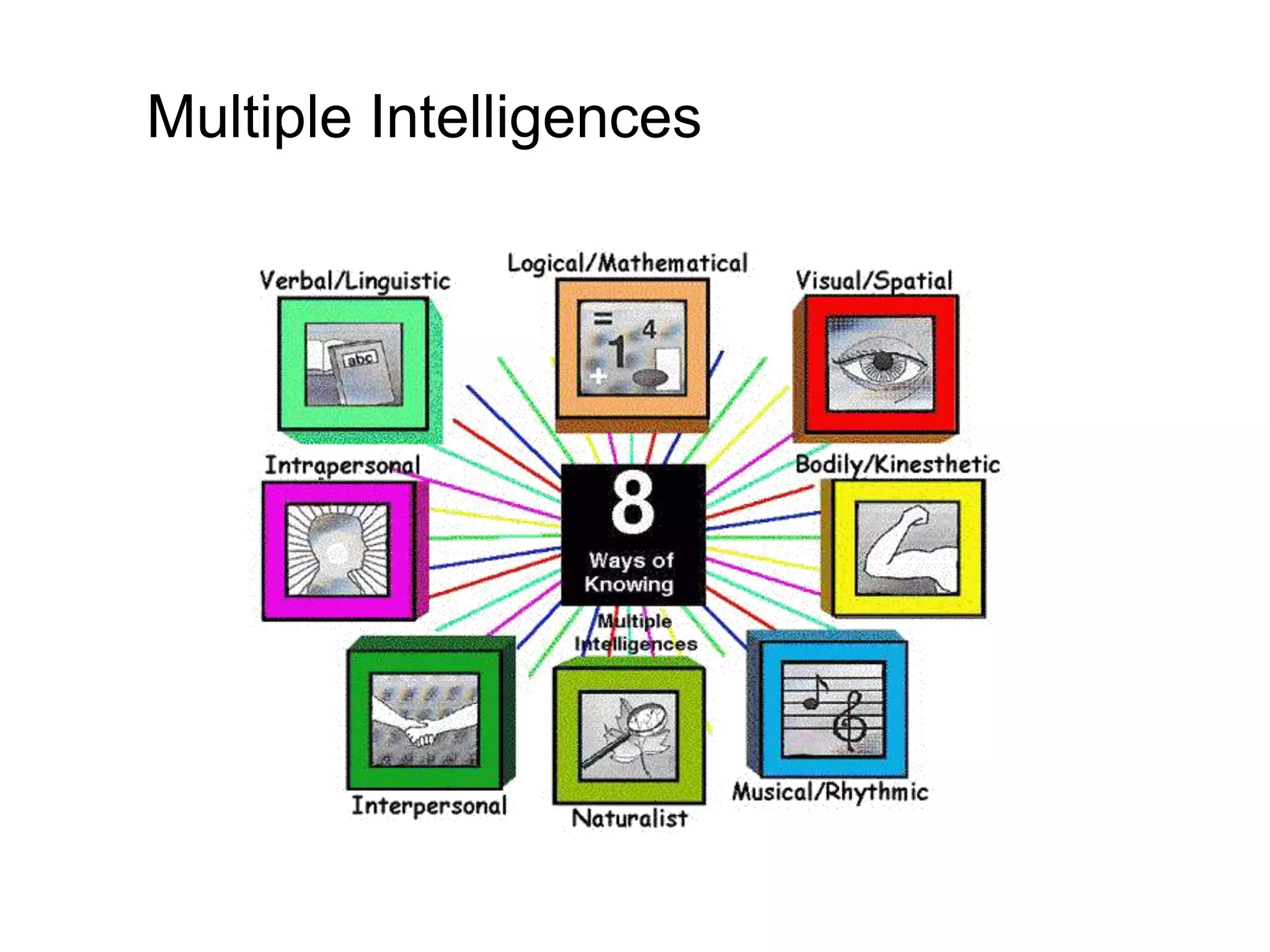
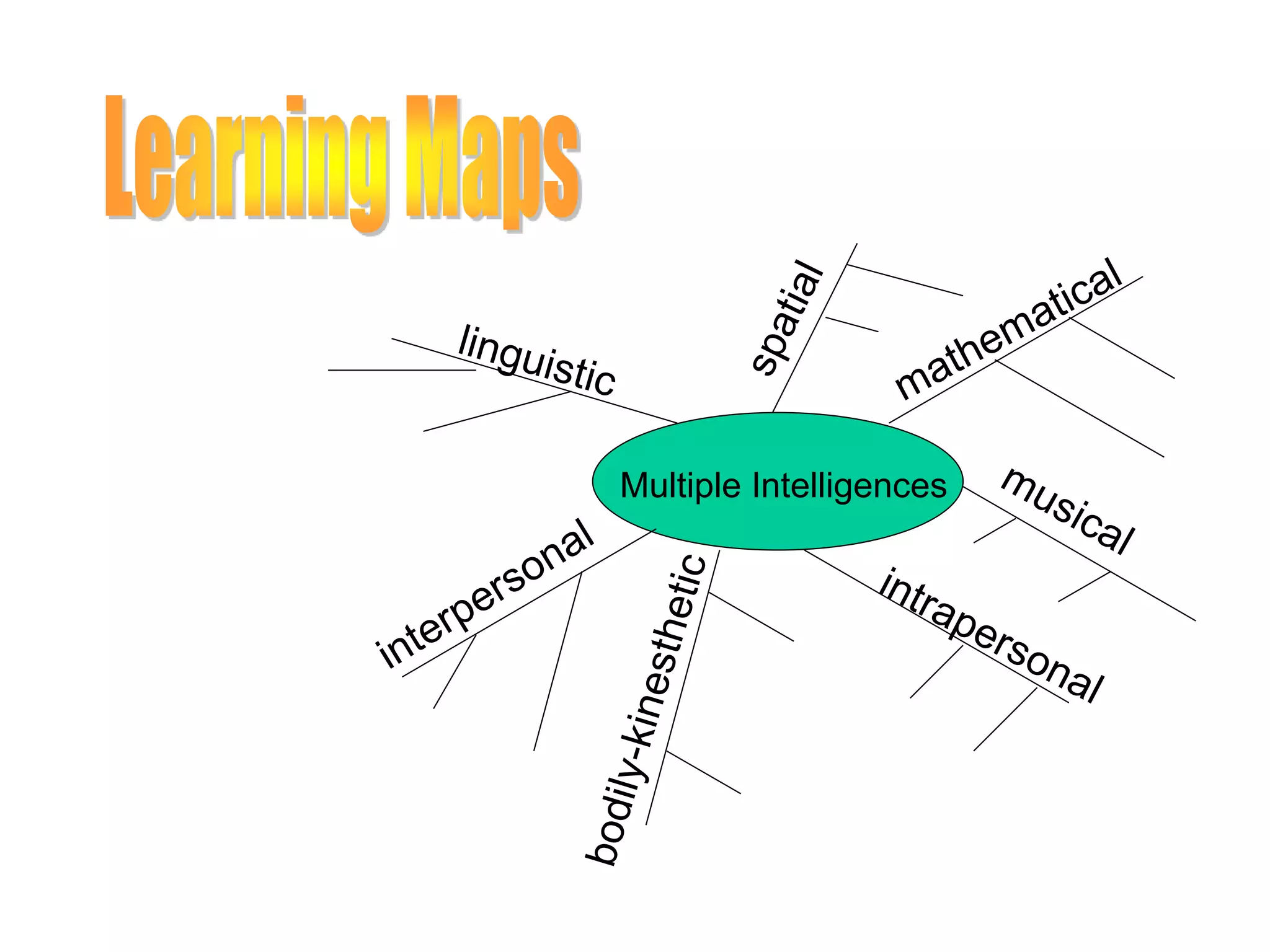
Multiple Intelligences
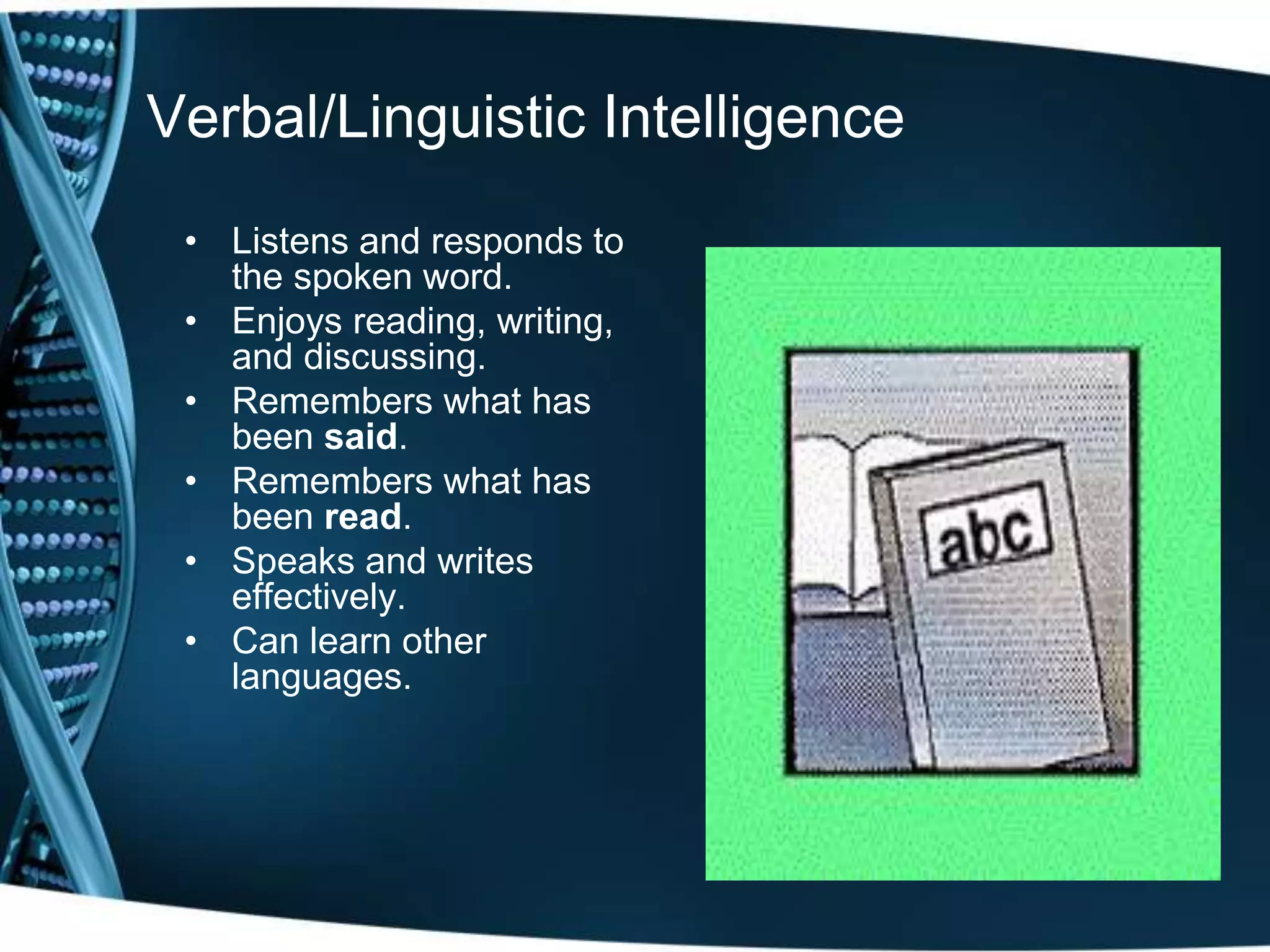
Verbal/Linguistic Intelligence
• Listens and responds to
the spoken word.
• Enjoys reading, writing,
and discussing.
• Remembers what has
been said.
• Remembers what has
been read.
• Speaks and writes
effectively.
• Can learn other
languages.
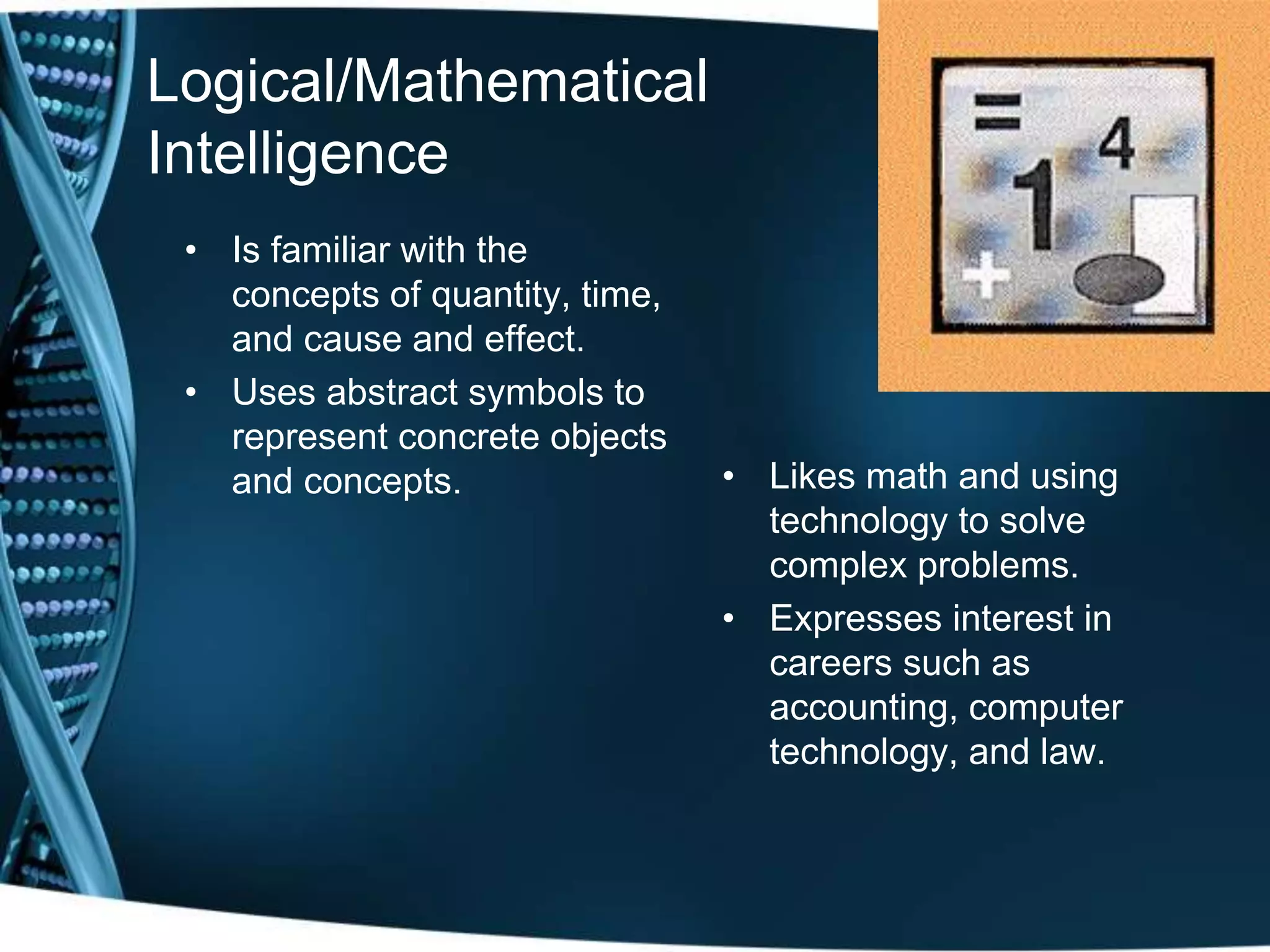
Logical/Mathematical
Intelligence
• Is familiar with the
concepts of quantity, time,
and cause and effect.
• Uses abstract symbols to
represent concrete objects
and concepts. • Likes math and using
technology to solve
complex problems.
• Expresses interest in
careers such as
accounting, computer
technology, and law.
Bodily/Kinesthetic
Intelligence
• Prefers to touch, handle, or
manipulate what is to be learned.
• Develops coordination and a sense of timing.
• Learns best by direct involvement and
participation.
• Remembers most clearly what was done, rather
than what was said or observed.
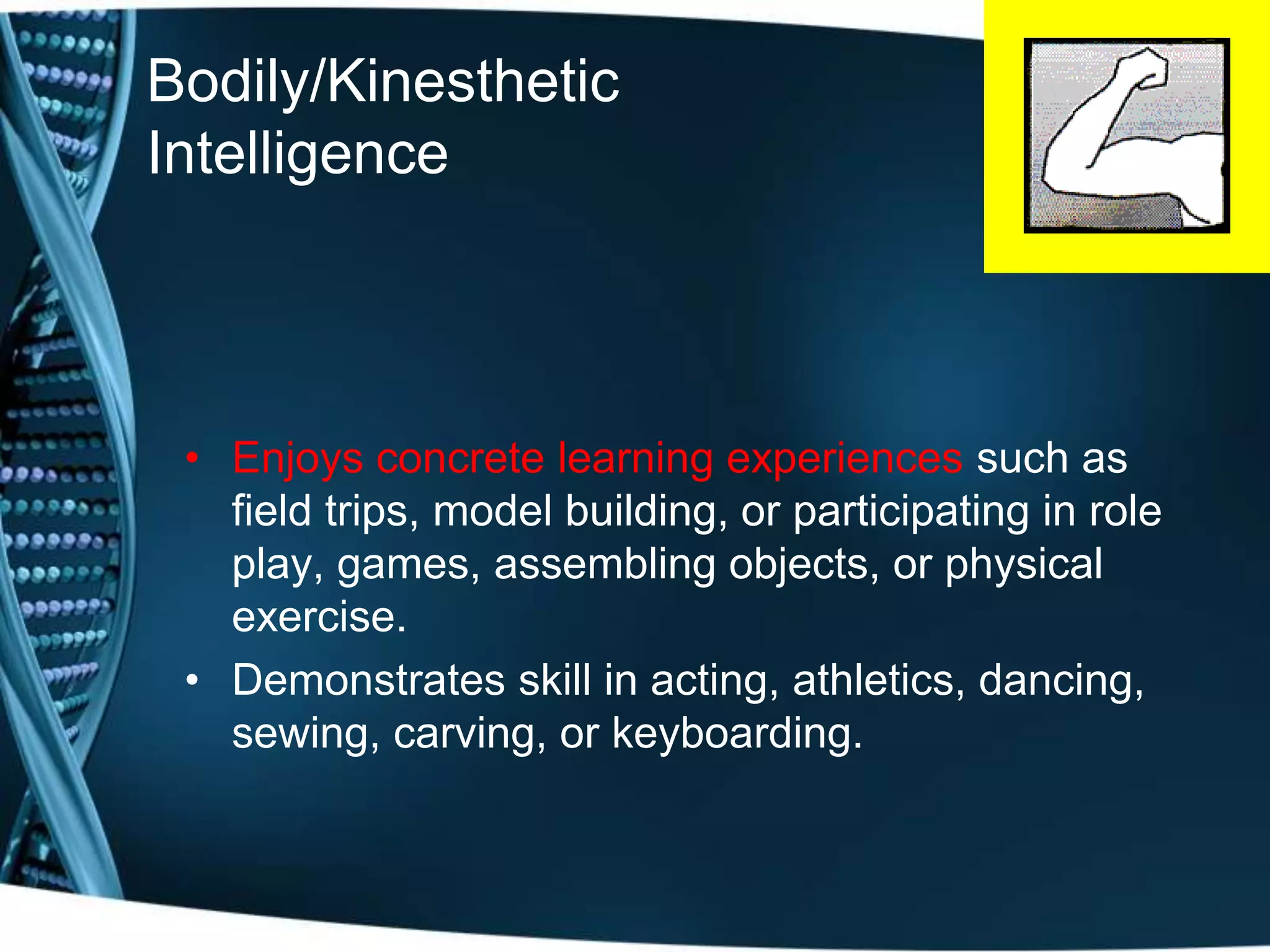
Bodily/Kinesthetic
Intelligence
• Enjoys concrete learning experiences such as
field trips, model building, or participating in role
play, games, assembling objects, or physical
exercise.
• Demonstrates skill in acting, athletics, dancing,
sewing, carving, or keyboarding.
Visual/Spatial
Intelligence
• Learns by seeing and observing. Recognizes
faces, objects, shapes, colors, details, and
scenes.
• Thinks in pictures and visualizes detail.
• Uses visual images as an aid in recalling
information.
• Enjoys doodling, drawing, painting, sculpting, or
otherwise reproducing objects in visible form.
Musical Intelligence
• Listens and responds with interest to a variety of
sounds including the human voice, environmental
sounds, and music, and organizes such sounds
into meaningful patterns.
• Is eager to be around and learn from music and
musicians.
• Develops the ability to sing and/or play an
instrument.
Interpersonal
Intelligence
• Bonds with parents and interacts with others.
• Forms and maintains social relationships.
• Perceives the feelings, thoughts, motivations,
behaviors, and lifestyles of others.
• Expresses an interest in interpersonally-oriented
careers such as teaching, social work,
counseling, management, or politics.
Intrapersonal
Intelligence
• Is aware of his range of emotions.
• Is motivated to identify and pursue goals.
• Works independently.
• Establishes and lives by an ethical value system.
• Strives for self-actualization.
Naturalist Intelligence
• Recognizes and can name many different types
of trees, flowers, and plants.
• Has an interest in and good knowledge of how
the body works and keeps abreast of health
issues.
• Is conscious of tracks, nests, and wildlife on a
walk and can “read” weather signs.
• Has an understanding of, and interest in, the main
global environmental issues.
How you are smart . . .
impacts the way you teach.
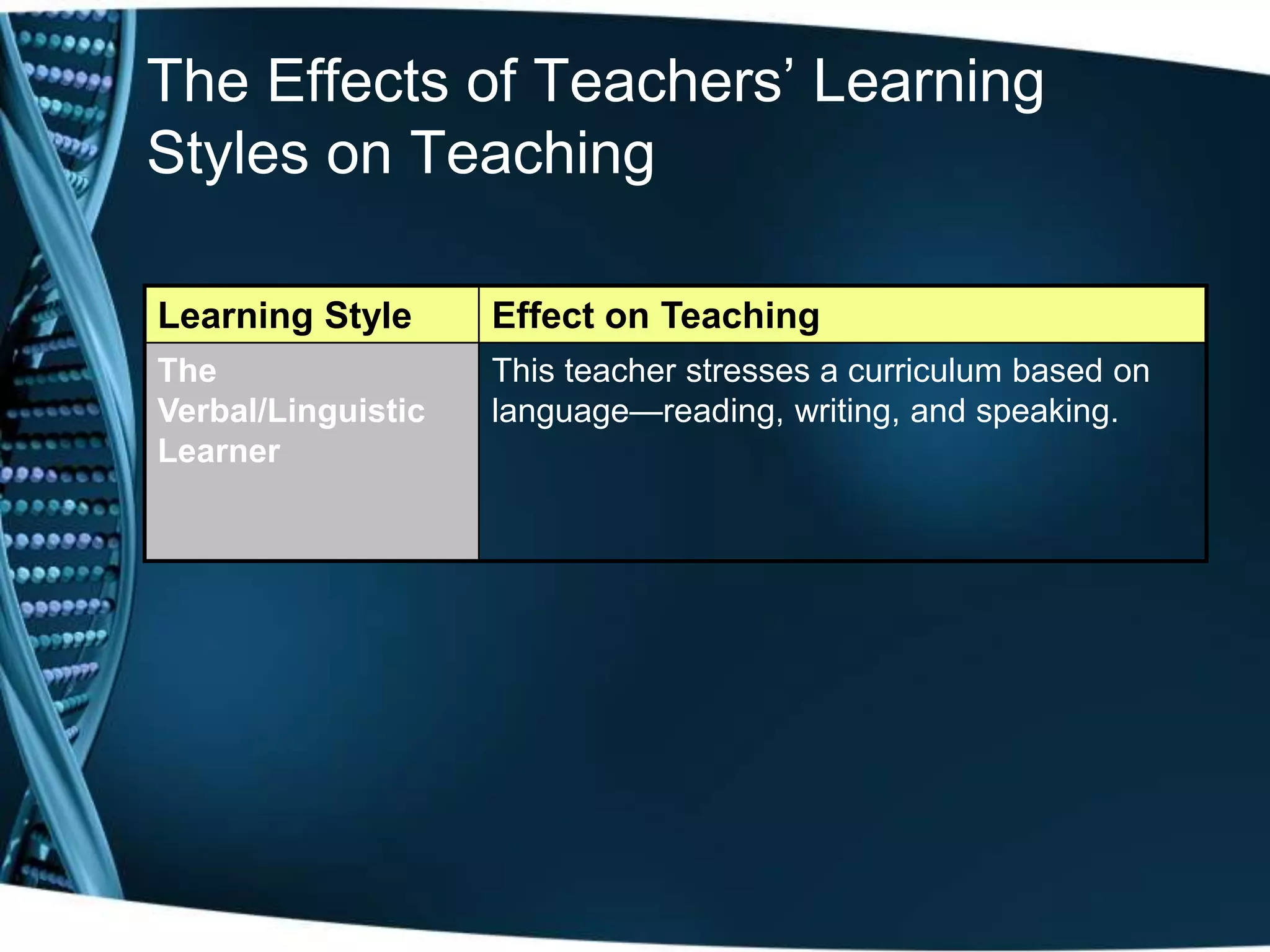
The Effects of Teachers’ Learning
Styles on Teaching
Learning Style Effect on Teaching
The
Verbal/Linguistic
Learner
This teacher stresses a curriculum based on
language—reading, writing, and speaking.
The Effects of Teachers’ Learning
Styles on Teaching
Learning Style Effect on Teaching
The Logical/Mathematical
Learner
This teacher tends to concentrate
on concepts that are both logical
and abstract.
Make a deliberate effort to focus on the fact that it is
appropriate for students to be artistic and to think in
intuitive leaps.
The Effects of Teachers’ Learning
Styles on Teaching
Learning Style Effect on Teaching
The Visual/Spatial Learner This teacher will provide a great
learning environment for visual
learners. The artistic students will do
well in this classroom.
Build in adequate opportunities for students who
are linguistic learners and for those who feel
artistically inhibited.
The Effects of Teachers’ Learning
Styles on Teaching
Learning Style Effect on Teaching
The Bodily/Kinesthetic
Learner
This teacher will encourage experiential
learning and have lots of movement in
class.
The Effects of Teachers’ Learning
Styles on Teaching
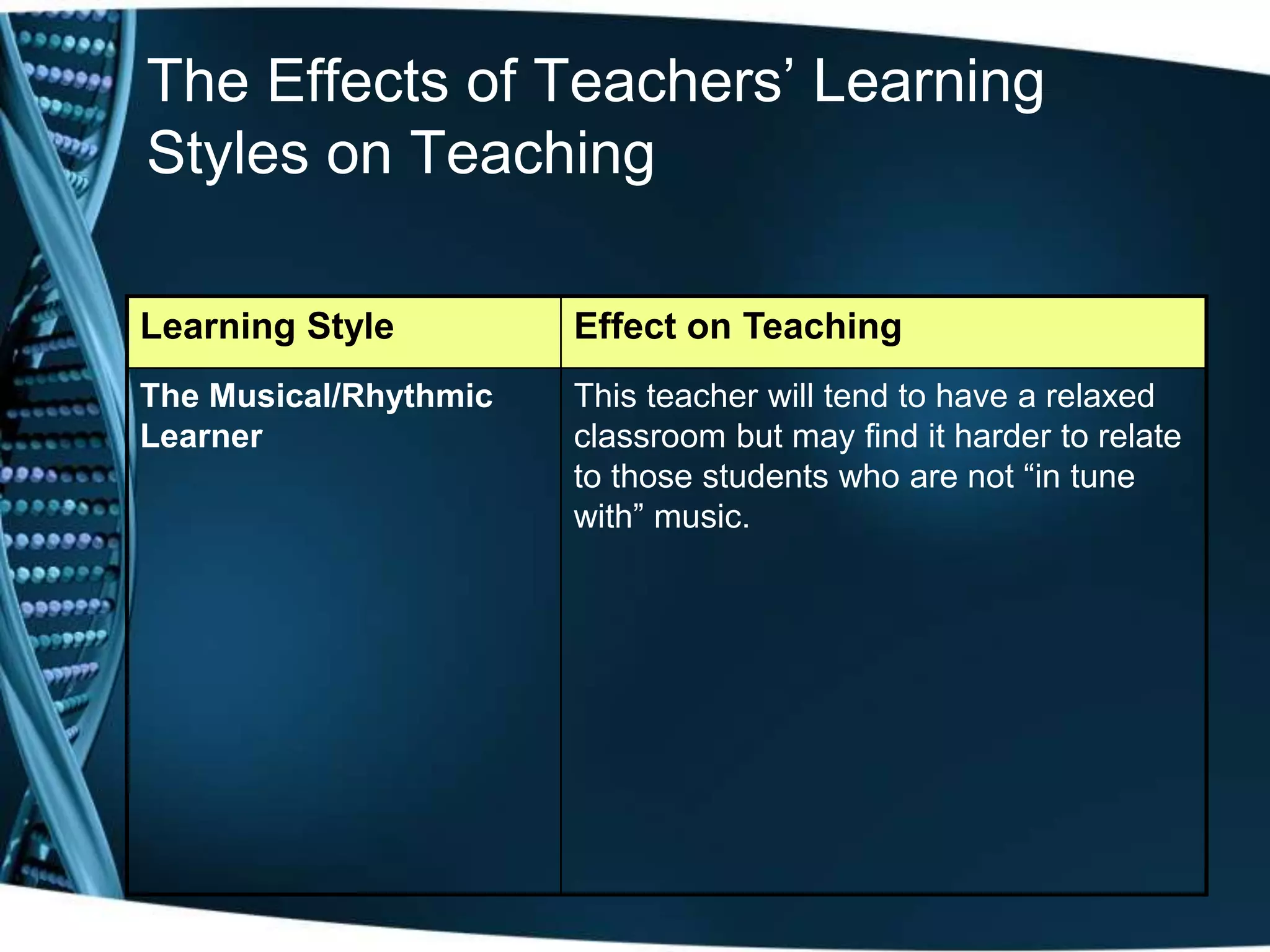
Learning Style Effect on Teaching
The Musical/Rhythmic
Learner
This teacher will tend to have a relaxed
classroom but may find it harder to relate
to those students who are not “in tune
with” music.
The Effects of Teachers’ Learning
Styles on Teaching
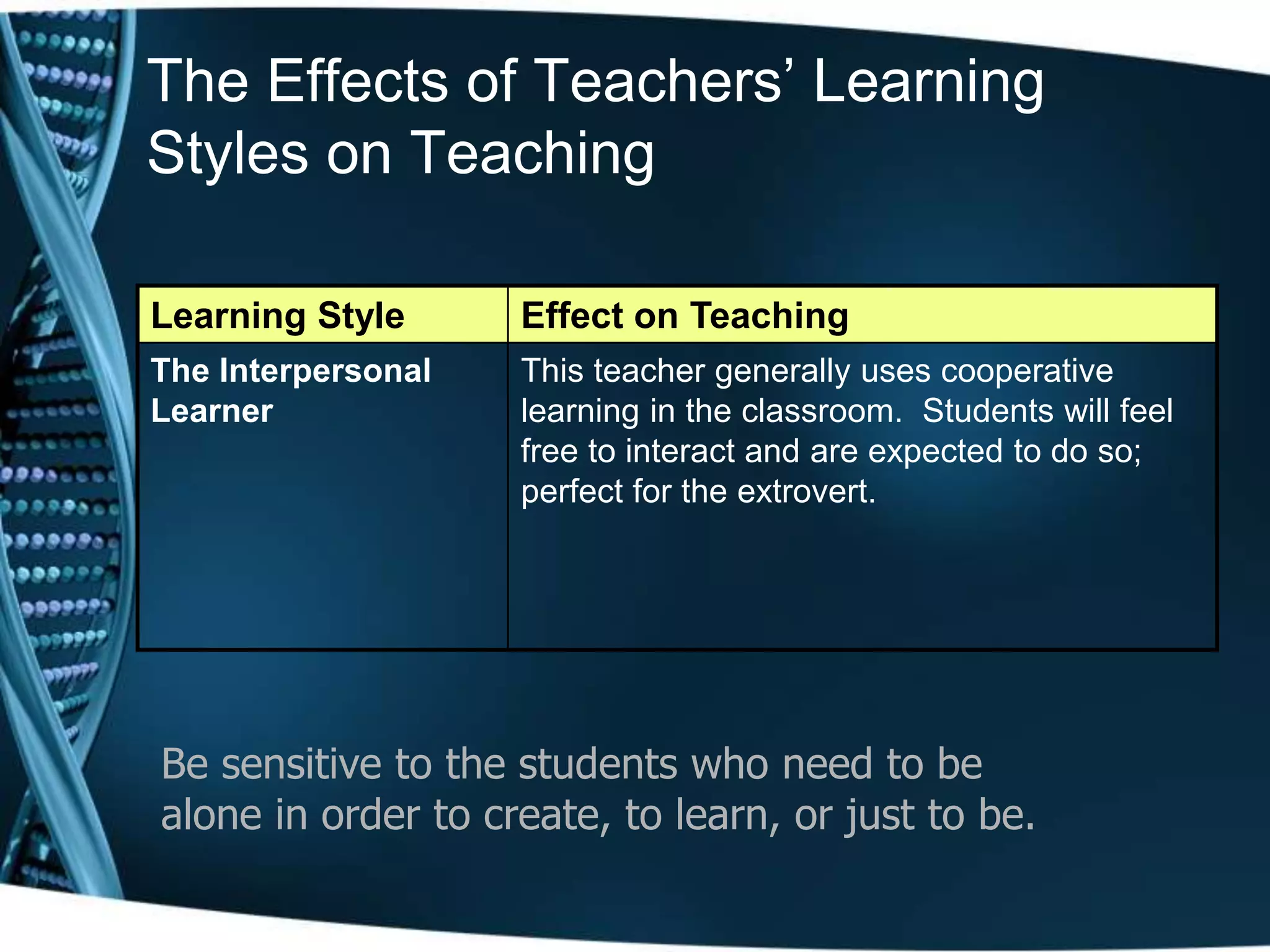
Learning Style Effect on Teaching
The Interpersonal
Learner
This teacher generally uses cooperative
learning in the classroom. Students will feel
free to interact and are expected to do so;
perfect for the extrovert.
Be sensitive to the students who need to be
alone in order to create, to learn, or just to be.
The Effects of Teachers’ Learning
Styles on Teaching
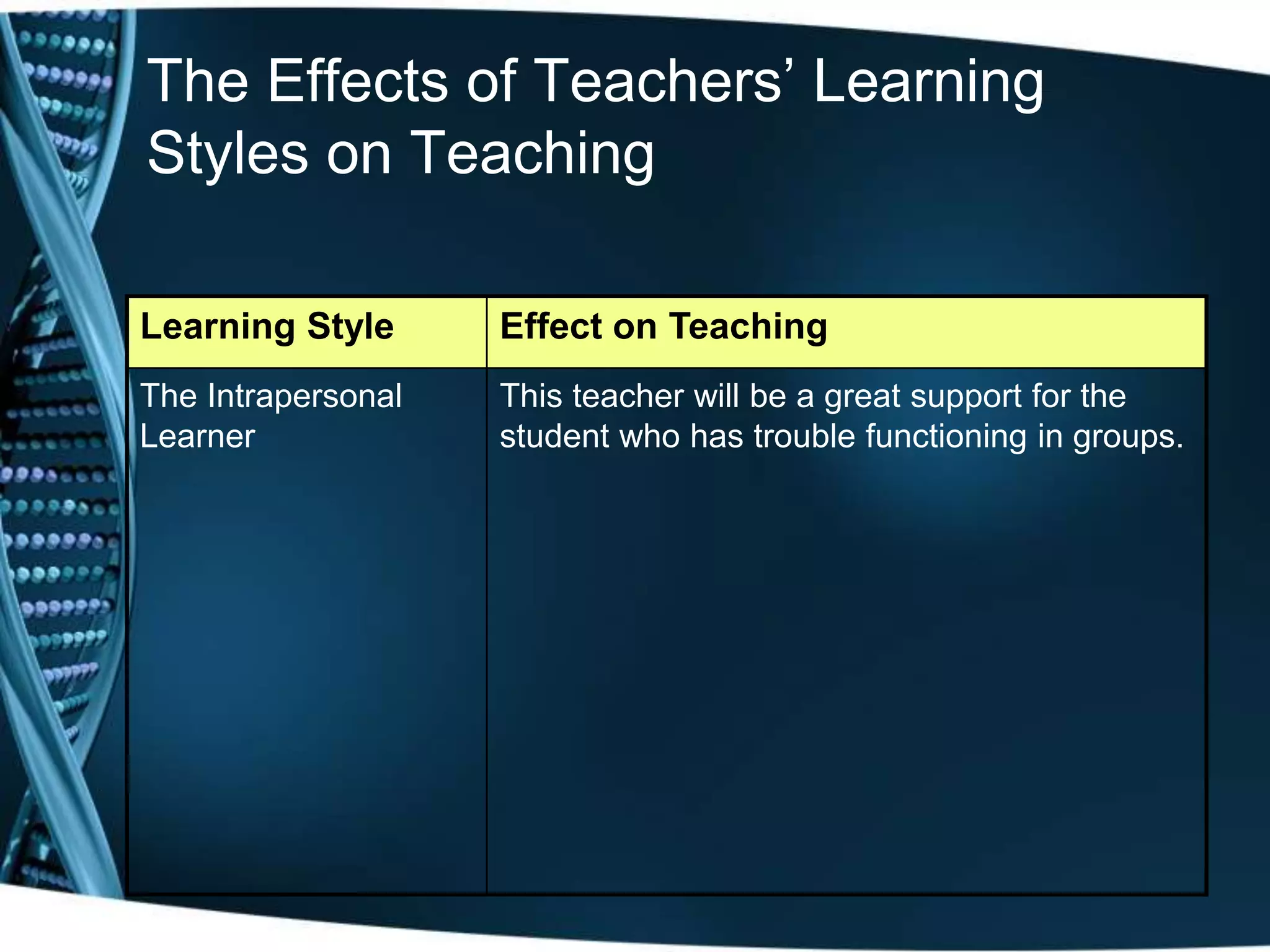
Learning Style Effect on Teaching
The Intrapersonal
Learner
This teacher will be a great support for the
student who has trouble functioning in groups.
THANK YOU VERY MUCH
and GOD BLESS
Teaching - MI Theory
Eight Ways of Teaching
by David Lazear
Study Tips for Students
• If he is indeed wise [the teacher] does not bid you
enter the house of his wisdom, but rather leads
you to the threshold of your own mind.
Kahlil Gibran in The Prophet
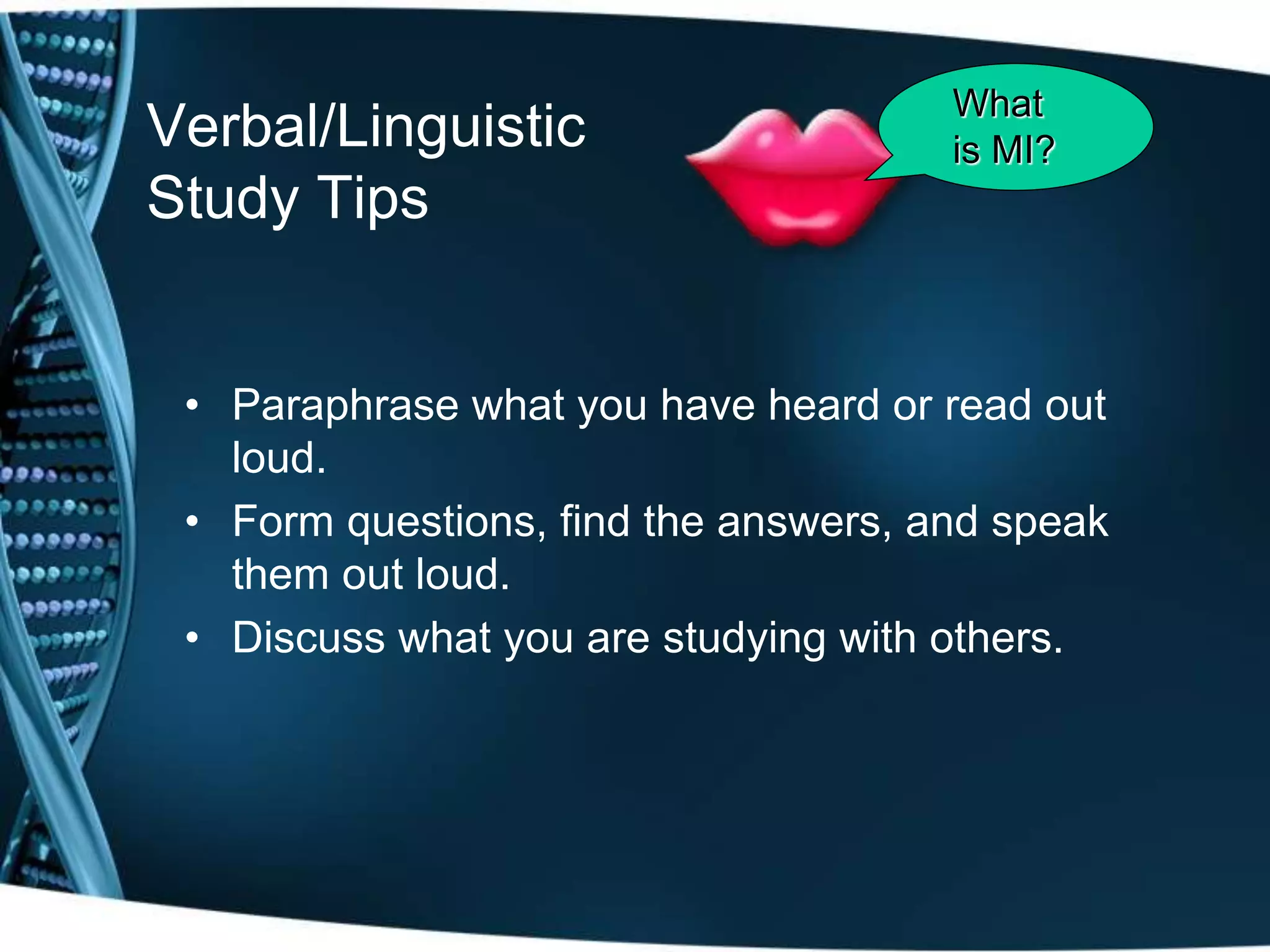
Verbal/Linguistic
Study Tips
• Paraphrase what you have heard or read out
loud.
• Form questions, find the answers, and speak
them out loud.
• Discuss what you are studying with others.
What
is MI?
Verbal/Linguistic
Study Tips
• Ask a lot of questions.
• Read aloud dramatically—
perhaps even with an
accent, and use
audiocassettes to record
and listen to lectures or to
record and listen to notes
you read.
Logical/Mathematical
Study Tips
• List the key points of what
you are learning in a
logical, numbered
sequence.
• Make a flow chart or
diagram that expresses
what you are learning in a
step-by-step manner.
Bodily/Kinesthetic
Study Tips
• Act out or role play what
you are learning.
• Practice a skill as soon as
it is learned—hands-on
experience.
Bodily/Kinesthetic
Study Tips
• Walk around while
reading.
• Listen to tapes while
exercising.
Bodily/Kinesthetic
Study Tips
• Take notes on
postcards and then
arrange the topics so
that they make better
sense to you or make
new relationships.
Bodily/Kinesthetic
Study Tips
• Make notes by
paraphrasing the
material instead of just
taking notes on what
the author or teacher
is saying.
Bodily/Kinesthetic
Study Tips
• Let the information
sink in while you
take a walk or go
do something else.
• Use a buddy to
help you study.
– E-mail/phone
Visual/Spatial
Study Tips
• Create a learning map
using key words, primarily
nouns
• Create a poster, cartoon, a
video, or time line.
• Use symbols instead of
words.
Multiple Intelligences
Visual/Spatial
Study Tips
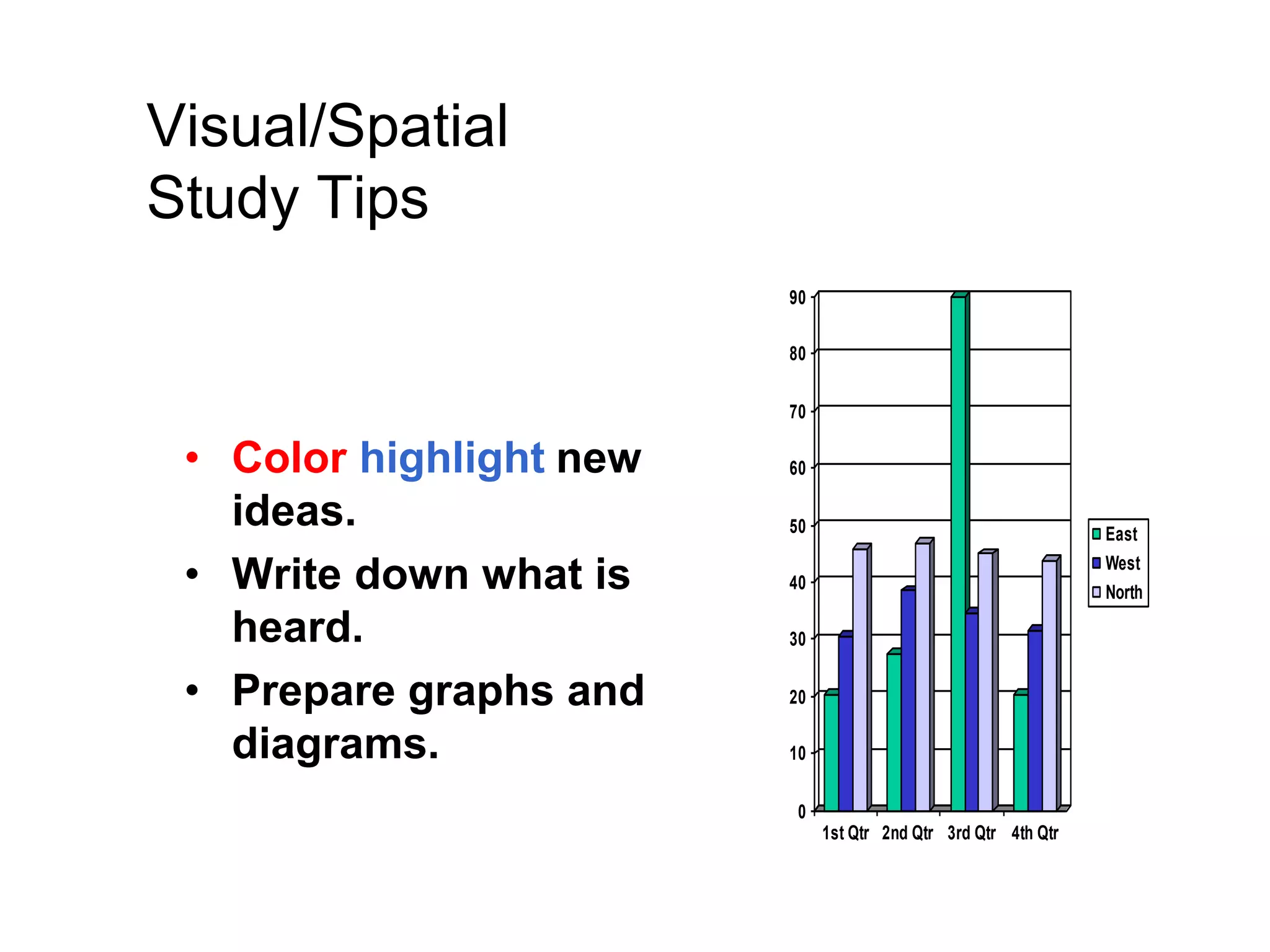
• Color highlight new
ideas.
• Write down what is
heard.
• Prepare graphs and
diagrams.
0
10
20
30
40
50
60
70
80
90
1st Qtr 2nd Qtr 3rd Qtr 4th Qtr
East
West
North
Musical Study Tips
• Write a song, jingle or rap.
• Play appropriate
background music as you
think about the topic. Try
to choose music that
represents what you are
learning. Quiet classical
music has proven to
stimulate the emotional
center of the brain.
Interpersonal
Study Tips
• Discuss topic with
someone else.
• Teach what you are
learning to someone else.
• Compare notes with
someone else taking the
course.
Intrapersonal
Study Tips
• Look for something of personal significance in
whatever you are studying.
• Try to answer questions about why it matters to
you and how you can use the information.
Naturalist Study Tips
• What are the environmental implications of what
you are learning?
• Has it any implication for conservation of
resources?
• Will it help or hinder social fairness?
• Does it have anything to say on solving any of the
major social problems of our times?
Naturalist Study Tips
• Does it help you better understand the mind of
individuals or social behavior?
• Does it exploit or harm anyone or anything else?
• Does it guide you to any action or social purpose.
Become a multi-sensory
learner
If you . . .
• Read and visualize the material, you have seen
it.
• Read key points out loud, make up questions and
answer them, you have heard it.
• Write out the answer to your question and circle
the major point, you have done it.
Become a multi-sensory learner
• Do something extra that helps you learn using
multiple senses.
• Activate your memory for seeing, hearing, and
doing, and your ability to remember the
information will go up several hundred percentage
points.
Visual study techniques
• Create learning maps.
• Color highlight new ideas.
• Write down what is heard.
• Prepare graphs and diagrams.
Auditory study techniques
• Ask a lot of questions.
• Read aloud dramatically—perhaps even with an
accent, and use audiocassettes to record and
listen to lectures or to record and listen to notes
you read.
Physical study techniques
• Practice a skill as soon as it is learned—hands-on
experience.
• Walk around while reading.
• Take notes on post-it notes and arrange the ideas
on a large surface.
• Take notes on postcards and then arrange the
topics so that they make better sense to your or
make new relationships.
Physical study techniques
• Make notes by paraphrasing the material instead
of just taking notes on what the author or teacher
is saying.
• Let the information sink in while you take a walk
or go do something else.
• Use a buddy to help you study.
What Students Say . . .
Accelerated Teaching
The Right State of Mind
Helping Students
Reach Their Potential

MULTIPLEINTELLIGENCES (1).ppt

  • 1.
    Psychological Foundation ofEducation; MULTIPLE INTELLIGENCES by Howard Gardner and Learning Styles Clarence Michelle Sordilla
  • 2.
    Psychological Foundation of Education •presents some of the principles of psychology that are relevant to learning and teaching. • It provides the basis for understanding how the learners learn • Behavioral Psychology and Cognitive Development
  • 3.
    • Are mystudents’ smart? • What's a smart person like? • What type of smart are they?
  • 4.
    How smart areyou? • Stanford-Binet IQ test • Scholastic Aptitude Test
  • 5.
    • Stanford-Binet - togauge intelligence through five factors of cognitive ability. - fluid reasoning, knowledge, quantitative reasoning, visual- spatial processing and working memory. - Both verbal and nonverbal responses are measured. - Each of the five factors is given a weight and the combined score is often reduced to a ratio known commonly as the intelligence quotient, or IQ.
  • 6.
    • Scholastic Aptitudetest - An aptitude test is an exam used to determine an individual's propensity to succeed in a given activity. - Aptitude tests assume that individuals have inherent strengths and weaknesses, and have a natural inclination toward success or failure in specific areas based on their innate characteristics. - The SAT is a standardized test widely used for college admissions in the United States.
  • 7.
  • 8.
    Howard Gardner • Americancognitive psychologist • Harvard Graduate School of Education • Professor of Cognition and Education • Co-Director of Project Zero Boston University School of Medicine • Adjunct Prof. Of Neurology • Author of 16 books
  • 9.
    What is intelligence? •“The ability to solve problems or to create products that are valued within one or more cultural settings.” Frames of Mind: The Theory of Multiple Intelligences (1983) • “A biopsychological potential to process information that can be activated in a cultural setting to solve problems or create products that are of value in a culture.” Intelligence Reframed (1999)
  • 11.
  • 12.
    Verbal/Linguistic Intelligence • Listensand responds to the spoken word. • Enjoys reading, writing, and discussing. • Remembers what has been said. • Remembers what has been read. • Speaks and writes effectively. • Can learn other languages.
  • 13.
    Logical/Mathematical Intelligence • Is familiarwith the concepts of quantity, time, and cause and effect. • Uses abstract symbols to represent concrete objects and concepts. • Likes math and using technology to solve complex problems. • Expresses interest in careers such as accounting, computer technology, and law.
  • 14.
    Bodily/Kinesthetic Intelligence • Prefers totouch, handle, or manipulate what is to be learned. • Develops coordination and a sense of timing. • Learns best by direct involvement and participation. • Remembers most clearly what was done, rather than what was said or observed.
  • 15.
    Bodily/Kinesthetic Intelligence • Enjoys concretelearning experiences such as field trips, model building, or participating in role play, games, assembling objects, or physical exercise. • Demonstrates skill in acting, athletics, dancing, sewing, carving, or keyboarding.
  • 16.
    Visual/Spatial Intelligence • Learns byseeing and observing. Recognizes faces, objects, shapes, colors, details, and scenes. • Thinks in pictures and visualizes detail. • Uses visual images as an aid in recalling information. • Enjoys doodling, drawing, painting, sculpting, or otherwise reproducing objects in visible form.
  • 17.
    Musical Intelligence • Listensand responds with interest to a variety of sounds including the human voice, environmental sounds, and music, and organizes such sounds into meaningful patterns. • Is eager to be around and learn from music and musicians. • Develops the ability to sing and/or play an instrument.
  • 18.
    Interpersonal Intelligence • Bonds withparents and interacts with others. • Forms and maintains social relationships. • Perceives the feelings, thoughts, motivations, behaviors, and lifestyles of others. • Expresses an interest in interpersonally-oriented careers such as teaching, social work, counseling, management, or politics.
  • 19.
    Intrapersonal Intelligence • Is awareof his range of emotions. • Is motivated to identify and pursue goals. • Works independently. • Establishes and lives by an ethical value system. • Strives for self-actualization.
  • 20.
    Naturalist Intelligence • Recognizesand can name many different types of trees, flowers, and plants. • Has an interest in and good knowledge of how the body works and keeps abreast of health issues. • Is conscious of tracks, nests, and wildlife on a walk and can “read” weather signs. • Has an understanding of, and interest in, the main global environmental issues.
  • 21.
    How you aresmart . . . impacts the way you teach.
  • 22.
    The Effects ofTeachers’ Learning Styles on Teaching Learning Style Effect on Teaching The Verbal/Linguistic Learner This teacher stresses a curriculum based on language—reading, writing, and speaking.
  • 23.
    The Effects ofTeachers’ Learning Styles on Teaching Learning Style Effect on Teaching The Logical/Mathematical Learner This teacher tends to concentrate on concepts that are both logical and abstract. Make a deliberate effort to focus on the fact that it is appropriate for students to be artistic and to think in intuitive leaps.
  • 24.
    The Effects ofTeachers’ Learning Styles on Teaching Learning Style Effect on Teaching The Visual/Spatial Learner This teacher will provide a great learning environment for visual learners. The artistic students will do well in this classroom. Build in adequate opportunities for students who are linguistic learners and for those who feel artistically inhibited.
  • 25.
    The Effects ofTeachers’ Learning Styles on Teaching Learning Style Effect on Teaching The Bodily/Kinesthetic Learner This teacher will encourage experiential learning and have lots of movement in class.
  • 26.
    The Effects ofTeachers’ Learning Styles on Teaching Learning Style Effect on Teaching The Musical/Rhythmic Learner This teacher will tend to have a relaxed classroom but may find it harder to relate to those students who are not “in tune with” music.
  • 27.
    The Effects ofTeachers’ Learning Styles on Teaching Learning Style Effect on Teaching The Interpersonal Learner This teacher generally uses cooperative learning in the classroom. Students will feel free to interact and are expected to do so; perfect for the extrovert. Be sensitive to the students who need to be alone in order to create, to learn, or just to be.
  • 28.
    The Effects ofTeachers’ Learning Styles on Teaching Learning Style Effect on Teaching The Intrapersonal Learner This teacher will be a great support for the student who has trouble functioning in groups.
  • 29.
    THANK YOU VERYMUCH and GOD BLESS
  • 30.
    Teaching - MITheory Eight Ways of Teaching by David Lazear
  • 31.
    Study Tips forStudents • If he is indeed wise [the teacher] does not bid you enter the house of his wisdom, but rather leads you to the threshold of your own mind. Kahlil Gibran in The Prophet
  • 32.
    Verbal/Linguistic Study Tips • Paraphrasewhat you have heard or read out loud. • Form questions, find the answers, and speak them out loud. • Discuss what you are studying with others. What is MI?
  • 33.
    Verbal/Linguistic Study Tips • Aska lot of questions. • Read aloud dramatically— perhaps even with an accent, and use audiocassettes to record and listen to lectures or to record and listen to notes you read.
  • 34.
    Logical/Mathematical Study Tips • Listthe key points of what you are learning in a logical, numbered sequence. • Make a flow chart or diagram that expresses what you are learning in a step-by-step manner.
  • 35.
    Bodily/Kinesthetic Study Tips • Actout or role play what you are learning. • Practice a skill as soon as it is learned—hands-on experience.
  • 36.
    Bodily/Kinesthetic Study Tips • Walkaround while reading. • Listen to tapes while exercising.
  • 37.
    Bodily/Kinesthetic Study Tips • Takenotes on postcards and then arrange the topics so that they make better sense to you or make new relationships.
  • 38.
    Bodily/Kinesthetic Study Tips • Makenotes by paraphrasing the material instead of just taking notes on what the author or teacher is saying.
  • 39.
    Bodily/Kinesthetic Study Tips • Letthe information sink in while you take a walk or go do something else. • Use a buddy to help you study. – E-mail/phone
  • 40.
    Visual/Spatial Study Tips • Createa learning map using key words, primarily nouns • Create a poster, cartoon, a video, or time line. • Use symbols instead of words.
  • 41.
  • 42.
    Visual/Spatial Study Tips • Colorhighlight new ideas. • Write down what is heard. • Prepare graphs and diagrams. 0 10 20 30 40 50 60 70 80 90 1st Qtr 2nd Qtr 3rd Qtr 4th Qtr East West North
  • 43.
    Musical Study Tips •Write a song, jingle or rap. • Play appropriate background music as you think about the topic. Try to choose music that represents what you are learning. Quiet classical music has proven to stimulate the emotional center of the brain.
  • 44.
    Interpersonal Study Tips • Discusstopic with someone else. • Teach what you are learning to someone else. • Compare notes with someone else taking the course.
  • 45.
    Intrapersonal Study Tips • Lookfor something of personal significance in whatever you are studying. • Try to answer questions about why it matters to you and how you can use the information.
  • 46.
    Naturalist Study Tips •What are the environmental implications of what you are learning? • Has it any implication for conservation of resources? • Will it help or hinder social fairness? • Does it have anything to say on solving any of the major social problems of our times?
  • 47.
    Naturalist Study Tips •Does it help you better understand the mind of individuals or social behavior? • Does it exploit or harm anyone or anything else? • Does it guide you to any action or social purpose.
  • 48.
    Become a multi-sensory learner Ifyou . . . • Read and visualize the material, you have seen it. • Read key points out loud, make up questions and answer them, you have heard it. • Write out the answer to your question and circle the major point, you have done it.
  • 49.
    Become a multi-sensorylearner • Do something extra that helps you learn using multiple senses. • Activate your memory for seeing, hearing, and doing, and your ability to remember the information will go up several hundred percentage points.
  • 50.
    Visual study techniques •Create learning maps. • Color highlight new ideas. • Write down what is heard. • Prepare graphs and diagrams.
  • 51.
    Auditory study techniques •Ask a lot of questions. • Read aloud dramatically—perhaps even with an accent, and use audiocassettes to record and listen to lectures or to record and listen to notes you read.
  • 52.
    Physical study techniques •Practice a skill as soon as it is learned—hands-on experience. • Walk around while reading. • Take notes on post-it notes and arrange the ideas on a large surface. • Take notes on postcards and then arrange the topics so that they make better sense to your or make new relationships.
  • 53.
    Physical study techniques •Make notes by paraphrasing the material instead of just taking notes on what the author or teacher is saying. • Let the information sink in while you take a walk or go do something else. • Use a buddy to help you study.
  • 54.
  • 55.
    Accelerated Teaching The RightState of Mind Helping Students Reach Their Potential