ED 401 CLASSROOM MANAGEMENT
Multiple Intelligence in ELT
Chameleons
Share our similarities,
celebrate our differences!
M.Scott Peck
Tuğba Süğüt
Zelal Öncel
Burcu Doğan
Esma Sezen
We meet every
Thursday at
5.30 pm at
study.
- http://needcoffee.cachefly.net/needcoffee/uploads/2012/05/chameleon.jpg
- http://picture-book.com/wp-content/uploads/2013/06/chameleons.jpg
 Private Etiler Açı Primary School
 Istanbul High School
 Boğazhisar Private School
 Rüştü Akın Vocational High School
 Sezin Schools
 Fatih College
Observation Schools
 Introduction
 Literature Review
 Fishbone
 Matrix Diagram
 Gantt card
 Methodology
 Survey Results
 Suggestions and Conclusion
 References
Content
INTRODUCTION
 American psychologist, Howard Gardner
developed a theory of Multiple Intelligences
(1983) which can go some way towards
explaining different learner styles. According
to Gardner there are eight different types of
intelligences.
http://www.teachingenglish.org.uk/article/multiple-intelligences
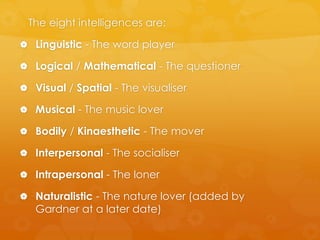
The eight intelligences are:
 Linguistic - The word player
 Logical / Mathematical - The questioner
 Visual / Spatial - The visualiser
 Musical - The music lover
 Bodily / Kinaesthetic - The mover
 Interpersonal - The socialiser
 Intrapersonal - The loner
 Naturalistic - The nature lover (added by
Gardner at a later date)
What Kind Of Learner Are You?
1. How can other people best interpret your emotions?
a. through your facial expressions
b. from the quality of your voice
c. through your general body language
2. How do you manage to keep up with current events?
a. by reading the newspaper thoroughly when you have the
time
b. by listening to the radio or watching the TV news
c. by quickly reading the paper or spending just a few
minutes
watching the TV news
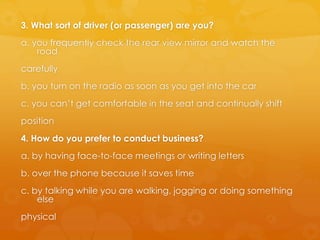
3. What sort of driver (or passenger) are you?
a. you frequently check the rear view mirror and watch the
road
carefully
b. you turn on the radio as soon as you get into the car
c. you can’t get comfortable in the seat and continually shift
position
4. How do you prefer to conduct business?
a. by having face-to-face meetings or writing letters
b. over the phone because it saves time
c. by talking while you are walking, jogging or doing something
else
physical
5. How do you react when you’re angry?
a. by clamming up and giving others the silent treatment
b. by quickly letting others know when you’re angry
c. by clenching your fists, grasping something tightly or
storming
off
6. How would you describe the way you dress?
a. a neat and tidy dresser
b. a sensible dresser
c. a comfortable dresser
7. What do you think the best way is to discipline a
child?
a. to isolate the child by separating him/her from
the group
b. to reason with the child and discuss the situation
c. to use acceptable forms of corporal punishment
8. How do you behave at meetings?
a. you come prepared with notes and displays
b. you enjoy discussing issues and hearing other
points of view
c. you would rather be somewhere else and so
spend your time
doodling
9. What do you like doing in your free time?
a. watching TV or going to the cinema
b. listening to the radio, going to a concert or playing a musical
instrument
c. engaging in a physical activity of some kind
10.What do you consider to be the best way of rewarding
students?
a. writing positive comments on their work
b. giving oral praise to the student
c. a pat on the back, a hug, or some other appropriate
physical
action
LITERATURE REVIEW
 The teaching of English to children has become
especially important in recent years. One reason for
this has been the introduction of primary EFL/ESL
teaching in a number of European countries – but it is
also a world-wide phenomenon. There is a lot of very
good teaching in primary English classrooms. One of
the recent approaches in primary English language
teaching methods is "the Theory of Multİple
Intelligences" (Gardner, 1993, 2000).
 The theory of Multiple Intelligences offers eight ways
of teaching and learning styles. In this regard, armed
with the knowledge and application of the multiple
intelligences, teachers can ensure they provide
enough variety in the activities they use so that as
much of their pupils’ learning potential can be
tapped as possible (Berman, 1998).
 It is well known that schools have emphasized reading and
writing in language teaching.There are many students that
function well in that kind of learning environmnet but there
are also students who don’t.The multiple Intelligence
theory opens the door to a variety of teaching strategıes
which can easily be applied in the language classroom.It
gıves teachers opportunities to widen modern teaching
strategies by using various assıgnmnets and activities.
(Armstrong 2000: 51)
 MI Theory-related materials have the strong potential to
improve foreign language(FL) instruction because they
engage learners’ innate abilities. By applying MI Theory
EFL/ ESL teachers can address the great diversity in
learners, develop learners’ intelligences and create an
individualized learning environment.(Christison,1996)
Why isn’t the
necessary importance
given to multiple
intelligences in ELT?
https://www.google.com.tr/search?q=cartoon+fishbone&rlz=1C2CHIK_trTR509TR509&tbm=isch&tbo=u&source=univ&sa=X&ei=-WJOU-
yJJKOJ7Abx5YFo&ved=0CCoQsAQ&biw=1366&bih=662#q=cartoon+fish&tbm=isch&facrc=_&imgdii=_&imgrc=Qa5rsue1w_IPWM%253A%3BOaFp39
OQHAqe5M%3Bhttp%253A%252F%252F66.55.90.3%252Fimg_articles%252F9600%252Ffish_08.jpg%3Bhttp%253A%252F%252F66.55.90.3%252Fphotos
hop%252Fdrawing-techniques%252Fdrawing-a-cartoon-fish.9600.html%3B308%3B261
Matrix Diagram
System School Materials Environment
Burcu 6 7 4 3
Zelal 6 7 5 4
Tuğba 7 5 4 3
Esma 6 7 5 4
Total 25 26 18 14
% 25 26 18 14
STEPS WEEKS March
20
March
27
April 3 April 10 April 17 April 29 May 3-6
PLAN
Identify topic
Approval
Literature review
and target
identification
Cause-affect
analysis
Approval of the
main cause
Solutions for the
future
Determined
solution tactic
DO Preparing
Survey & Starting
Data Collection
CHECK Analysis of data
ACT Conclusion &
Suggestions
Preparing PPT &
Report
Self-assessment
PRESENTATION
GANTT CARD
Expected
Observed
Methodology
 We carried out a survey in our practicum
schools.
 We delivered our survey questions to our
mentor teachers. (5 teachers from state
schools, 5 teachers from private schools
SURVEY RESULTS
1. I think that our school policy takes multiple intelligence theory
into consideration
30%
30%
10%
10%
20%
Question 1
Strongly
Agree
Agree
Neutral
Disagree
Strongly
Disagree
20%
20%
0%
20%
40%
State School
40%
40%
20%
0% 0%
Private School
2. ELT curriculum content is formed by regarding multiple
intelligences.
10%
30%
10%
30%
20%
Sales
Strongly
Agree
Agree
Neutral
Disagree
Strongly
Disagree
0%0% 0%
60%
40%
State
20
%
60
%
20
%
0% 0%
Private
3. I prepare the class activities based on multiple intelligence
theory.
20%
50%
20%
10% 0%
Question 3
Strongly
Agree
Agree
Neutral
Disagree
Strongly
Disagree
20%
20%
40%
20%
0%
State
20%
80%
0% 0% 0%
Private
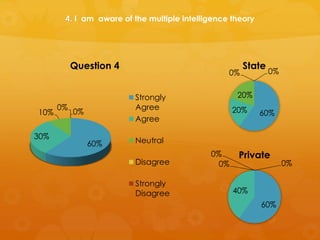
4. I am aware of the multiple intelligence theory
60%
30%
10%
0%
0%
Question 4
Strongly
Agree
Agree
Neutral
Disagree
Strongly
Disagree
60%20%
20%
0% 0%
State
60%
40%
0%
0%
0%
Private
5. I believe in the importance of integrating multiple intelligence
theory into ELT classes.
50%
40%
10% 0% 0%
Question 5
Strongly
Agree
Agree
Neutral
Disagree
Strongly
Disagree
40%
40%
20%
0%
0%
State
60%
40%
0%
0%
0%
Private
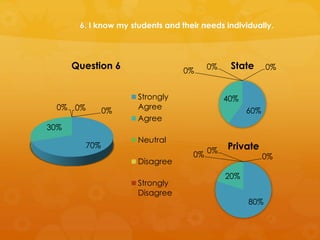
6. I know my students and their needs individually.
70%
30%
0% 0% 0%
Question 6
Strongly
Agree
Agree
Neutral
Disagree
Strongly
Disagree
60%
40%
0% 0% 0%State
80%
20%
0%
0%
0%
Private
7. I conduct multiple intelligence test at the beginning of the year.
10%
30%
10%
30%
20%
Question 7
Strongly
Agree
Agree
Neutral
Disagree
Strongly
Disagree
0%
20%
20%
20%
40%
State
20%
40%
0%
40%
0%
Private
8. I pay attention to this theory when choosing the course
materials.
20%
40%
10%
10% 20%
Question 8
Strongly
Agree
Agree
Neutral
Disagree
Strongly
Disagree
20%
20%
0%
20%
40%
State
20%
60%
20%
0% 0%
Private
9. Our school collaborates with parents considering the
importance of applying multiple intelligence theory
20%
20%
20%
10%
30%
Question 9
Strongly
Agree
Agree
Neutral
Disagree
Strongly
Disagree
0% 0%
20%
20%60%
State
40%
40%
20%
0%
0%
Private
10. I enable my students to be aware of their own learning types.
40%
30%
20%
10% 0%
Question 10
Strongly
Agree
Agree
Neutral
Disagree
Strongly
Disagree
40%
0%
40%
20%
0%
State
40%
60%
0% 0%
0%
0%
Private
11. The system of education is mostly exam-based. It values
competition rather than cooperation.
70%
20%
10%
0%
0%
Question 11
Strongly
Agree
Agree
Neutral
Disagree
Strongly
Disagree
80%
20%
0%
0%
0%
State
60%20%
20%
0% 0%
Private
12. The system of education prevents applying multiple
intelligence theory.
40%
40%
20%
0% 0%
Question 12
Strongly
Agree
Agree
Neutral
Disagree
Strongly
Disagree
60%
40%
0%
0%
0%
State
20%
40%
40%
0% 0%
Private
General Findings
 As we conclude from our survey, almost all
the teachers state that they are aware of
the multiple intelligence theory and its
importance in ELT classes. However,
generally they do not prefer to apply it in
their classes. This situation is more obviously
observed in state schools.
 As a reason of not implementing the theory
in their classes, teachers claim that the
content of curriculum and exam-based
system do not allow them to apply it.
 Because materials cannot be chosen by
teachers in state schools, they do not have a
chance to choose a book dealing with the
multiple intelligence theory. On the other hand,
teachers in private schools choose their own
course materials, but only some of them take this
issue into consideration.
 Another finding we get from survey is that
multiple intelligence test is not widely known by
teachers. Accordingly, most of the teachers do
not conduct the test in their classes.
 According to survey results, while private
school teachers mostly care about the
theory while preparing classroom activities,
state school teachers do not.
Suggestions
 Because problems and results are highly related to
school, environment and system, these should be
reassessed and rearranged for being more suitable for
each and every individual. Materials should be more
appropriate for multiple intelligence theory not just in
private schools but state schools.
 Teachers should be more aware and well-informed
about how to use multiple intelligence in ELT classes and
they should use authentic group activities more to be
able to address each students.
 School, teacher, students and even parents should
support each other for increasing the use of multiple
intelligence in ELT.
Conclusion
In our project, in terms of multiple intelligences in ELT, we
focused on reviewing the literature on the subject and
finding and understanding why enough attention is not given
to multiple intelligences in our schools. We conducted a
survey to understand the causes and situation better and
find answers.
Conclusion
When we look at our survey results, we concluded that
although most of the teachers are aware of the
importance of multiple intelligence theory, they cannot
apply it mostly because of the problems caused by
environment, materials or system. Plus, we could see the
difference between state schools and private schools in
the results. By looking at the results of this project, we can
say that by improving environment, materials and
schools accordingly, the importance given to multiple
intelligence theory should be increased for a high-quality
education that gives importance to every individual.
References Imece Circles by Dr. Hayal Köksal
 Bas,G. Integrating Multiple Intelligences in ESL/EFL Classrooms.
 Berman, M. 1998. A Multiple Intelligences Road to an ELT Classroom. Bencyfelin:
Crown House
 Checkly, K. 1997. "The First Seven....and the Eight: A Conversation with Howard
Gardner". Educational Leadership. 55(1), 8-13.
 Currie,K. Multiple Intelligence Theory and the ESL Classroom -- Preliminary
Considerations.
 Gardner, H. 1993. Frames of Mind: The Theory of Multiple Intelligences. (Second
Edition). London: Falmer Press.
 Gardner, H. 2000. Multiple Intelligences: The Theory in Practice. (Second Edition).
Alexandria, VA: ASCD
 Krashen, S. 1981. Second language Acquisition and Second Language Learning.
Oxford: Pergamon.
 http://www.teachingenglish.org.uk/article/multiple-intelligences
Special Thanks to Dr. Hayal Köksal

Multiple intelligences

  • 1.
    ED 401 CLASSROOMMANAGEMENT Multiple Intelligence in ELT
  • 2.
    Chameleons Share our similarities, celebrateour differences! M.Scott Peck Tuğba Süğüt Zelal Öncel Burcu Doğan Esma Sezen We meet every Thursday at 5.30 pm at study. - http://needcoffee.cachefly.net/needcoffee/uploads/2012/05/chameleon.jpg - http://picture-book.com/wp-content/uploads/2013/06/chameleons.jpg
  • 3.
     Private EtilerAçı Primary School  Istanbul High School  Boğazhisar Private School  Rüştü Akın Vocational High School  Sezin Schools  Fatih College Observation Schools
  • 4.
     Introduction  LiteratureReview  Fishbone  Matrix Diagram  Gantt card  Methodology  Survey Results  Suggestions and Conclusion  References Content
  • 5.
    INTRODUCTION  American psychologist,Howard Gardner developed a theory of Multiple Intelligences (1983) which can go some way towards explaining different learner styles. According to Gardner there are eight different types of intelligences. http://www.teachingenglish.org.uk/article/multiple-intelligences
  • 6.
    The eight intelligencesare:  Linguistic - The word player  Logical / Mathematical - The questioner  Visual / Spatial - The visualiser  Musical - The music lover  Bodily / Kinaesthetic - The mover  Interpersonal - The socialiser  Intrapersonal - The loner  Naturalistic - The nature lover (added by Gardner at a later date)
  • 7.
    What Kind OfLearner Are You? 1. How can other people best interpret your emotions? a. through your facial expressions b. from the quality of your voice c. through your general body language 2. How do you manage to keep up with current events? a. by reading the newspaper thoroughly when you have the time b. by listening to the radio or watching the TV news c. by quickly reading the paper or spending just a few minutes watching the TV news
  • 8.
    3. What sortof driver (or passenger) are you? a. you frequently check the rear view mirror and watch the road carefully b. you turn on the radio as soon as you get into the car c. you can’t get comfortable in the seat and continually shift position 4. How do you prefer to conduct business? a. by having face-to-face meetings or writing letters b. over the phone because it saves time c. by talking while you are walking, jogging or doing something else physical
  • 9.
    5. How doyou react when you’re angry? a. by clamming up and giving others the silent treatment b. by quickly letting others know when you’re angry c. by clenching your fists, grasping something tightly or storming off 6. How would you describe the way you dress? a. a neat and tidy dresser b. a sensible dresser c. a comfortable dresser
  • 10.
    7. What doyou think the best way is to discipline a child? a. to isolate the child by separating him/her from the group b. to reason with the child and discuss the situation c. to use acceptable forms of corporal punishment 8. How do you behave at meetings? a. you come prepared with notes and displays b. you enjoy discussing issues and hearing other points of view c. you would rather be somewhere else and so spend your time doodling
  • 11.
    9. What doyou like doing in your free time? a. watching TV or going to the cinema b. listening to the radio, going to a concert or playing a musical instrument c. engaging in a physical activity of some kind 10.What do you consider to be the best way of rewarding students? a. writing positive comments on their work b. giving oral praise to the student c. a pat on the back, a hug, or some other appropriate physical action
  • 12.
    LITERATURE REVIEW  Theteaching of English to children has become especially important in recent years. One reason for this has been the introduction of primary EFL/ESL teaching in a number of European countries – but it is also a world-wide phenomenon. There is a lot of very good teaching in primary English classrooms. One of the recent approaches in primary English language teaching methods is "the Theory of Multİple Intelligences" (Gardner, 1993, 2000).  The theory of Multiple Intelligences offers eight ways of teaching and learning styles. In this regard, armed with the knowledge and application of the multiple intelligences, teachers can ensure they provide enough variety in the activities they use so that as much of their pupils’ learning potential can be tapped as possible (Berman, 1998).
  • 13.
     It iswell known that schools have emphasized reading and writing in language teaching.There are many students that function well in that kind of learning environmnet but there are also students who don’t.The multiple Intelligence theory opens the door to a variety of teaching strategıes which can easily be applied in the language classroom.It gıves teachers opportunities to widen modern teaching strategies by using various assıgnmnets and activities. (Armstrong 2000: 51)  MI Theory-related materials have the strong potential to improve foreign language(FL) instruction because they engage learners’ innate abilities. By applying MI Theory EFL/ ESL teachers can address the great diversity in learners, develop learners’ intelligences and create an individualized learning environment.(Christison,1996)
  • 14.
    Why isn’t the necessaryimportance given to multiple intelligences in ELT? https://www.google.com.tr/search?q=cartoon+fishbone&rlz=1C2CHIK_trTR509TR509&tbm=isch&tbo=u&source=univ&sa=X&ei=-WJOU- yJJKOJ7Abx5YFo&ved=0CCoQsAQ&biw=1366&bih=662#q=cartoon+fish&tbm=isch&facrc=_&imgdii=_&imgrc=Qa5rsue1w_IPWM%253A%3BOaFp39 OQHAqe5M%3Bhttp%253A%252F%252F66.55.90.3%252Fimg_articles%252F9600%252Ffish_08.jpg%3Bhttp%253A%252F%252F66.55.90.3%252Fphotos hop%252Fdrawing-techniques%252Fdrawing-a-cartoon-fish.9600.html%3B308%3B261
  • 15.
    Matrix Diagram System SchoolMaterials Environment Burcu 6 7 4 3 Zelal 6 7 5 4 Tuğba 7 5 4 3 Esma 6 7 5 4 Total 25 26 18 14 % 25 26 18 14
  • 16.
    STEPS WEEKS March 20 March 27 April3 April 10 April 17 April 29 May 3-6 PLAN Identify topic Approval Literature review and target identification Cause-affect analysis Approval of the main cause Solutions for the future Determined solution tactic DO Preparing Survey & Starting Data Collection CHECK Analysis of data ACT Conclusion & Suggestions Preparing PPT & Report Self-assessment PRESENTATION GANTT CARD Expected Observed
  • 17.
    Methodology  We carriedout a survey in our practicum schools.  We delivered our survey questions to our mentor teachers. (5 teachers from state schools, 5 teachers from private schools
  • 18.
  • 19.
    1. I thinkthat our school policy takes multiple intelligence theory into consideration 30% 30% 10% 10% 20% Question 1 Strongly Agree Agree Neutral Disagree Strongly Disagree 20% 20% 0% 20% 40% State School 40% 40% 20% 0% 0% Private School
  • 20.
    2. ELT curriculumcontent is formed by regarding multiple intelligences. 10% 30% 10% 30% 20% Sales Strongly Agree Agree Neutral Disagree Strongly Disagree 0%0% 0% 60% 40% State 20 % 60 % 20 % 0% 0% Private
  • 21.
    3. I preparethe class activities based on multiple intelligence theory. 20% 50% 20% 10% 0% Question 3 Strongly Agree Agree Neutral Disagree Strongly Disagree 20% 20% 40% 20% 0% State 20% 80% 0% 0% 0% Private
  • 22.
    4. I amaware of the multiple intelligence theory 60% 30% 10% 0% 0% Question 4 Strongly Agree Agree Neutral Disagree Strongly Disagree 60%20% 20% 0% 0% State 60% 40% 0% 0% 0% Private
  • 23.
    5. I believein the importance of integrating multiple intelligence theory into ELT classes. 50% 40% 10% 0% 0% Question 5 Strongly Agree Agree Neutral Disagree Strongly Disagree 40% 40% 20% 0% 0% State 60% 40% 0% 0% 0% Private
  • 24.
    6. I knowmy students and their needs individually. 70% 30% 0% 0% 0% Question 6 Strongly Agree Agree Neutral Disagree Strongly Disagree 60% 40% 0% 0% 0%State 80% 20% 0% 0% 0% Private
  • 25.
    7. I conductmultiple intelligence test at the beginning of the year. 10% 30% 10% 30% 20% Question 7 Strongly Agree Agree Neutral Disagree Strongly Disagree 0% 20% 20% 20% 40% State 20% 40% 0% 40% 0% Private
  • 26.
    8. I payattention to this theory when choosing the course materials. 20% 40% 10% 10% 20% Question 8 Strongly Agree Agree Neutral Disagree Strongly Disagree 20% 20% 0% 20% 40% State 20% 60% 20% 0% 0% Private
  • 27.
    9. Our schoolcollaborates with parents considering the importance of applying multiple intelligence theory 20% 20% 20% 10% 30% Question 9 Strongly Agree Agree Neutral Disagree Strongly Disagree 0% 0% 20% 20%60% State 40% 40% 20% 0% 0% Private
  • 28.
    10. I enablemy students to be aware of their own learning types. 40% 30% 20% 10% 0% Question 10 Strongly Agree Agree Neutral Disagree Strongly Disagree 40% 0% 40% 20% 0% State 40% 60% 0% 0% 0% 0% Private
  • 29.
    11. The systemof education is mostly exam-based. It values competition rather than cooperation. 70% 20% 10% 0% 0% Question 11 Strongly Agree Agree Neutral Disagree Strongly Disagree 80% 20% 0% 0% 0% State 60%20% 20% 0% 0% Private
  • 30.
    12. The systemof education prevents applying multiple intelligence theory. 40% 40% 20% 0% 0% Question 12 Strongly Agree Agree Neutral Disagree Strongly Disagree 60% 40% 0% 0% 0% State 20% 40% 40% 0% 0% Private
  • 31.
    General Findings  Aswe conclude from our survey, almost all the teachers state that they are aware of the multiple intelligence theory and its importance in ELT classes. However, generally they do not prefer to apply it in their classes. This situation is more obviously observed in state schools.  As a reason of not implementing the theory in their classes, teachers claim that the content of curriculum and exam-based system do not allow them to apply it.
  • 32.
     Because materialscannot be chosen by teachers in state schools, they do not have a chance to choose a book dealing with the multiple intelligence theory. On the other hand, teachers in private schools choose their own course materials, but only some of them take this issue into consideration.  Another finding we get from survey is that multiple intelligence test is not widely known by teachers. Accordingly, most of the teachers do not conduct the test in their classes.
  • 33.
     According tosurvey results, while private school teachers mostly care about the theory while preparing classroom activities, state school teachers do not.
  • 34.
    Suggestions  Because problemsand results are highly related to school, environment and system, these should be reassessed and rearranged for being more suitable for each and every individual. Materials should be more appropriate for multiple intelligence theory not just in private schools but state schools.  Teachers should be more aware and well-informed about how to use multiple intelligence in ELT classes and they should use authentic group activities more to be able to address each students.  School, teacher, students and even parents should support each other for increasing the use of multiple intelligence in ELT.
  • 35.
    Conclusion In our project,in terms of multiple intelligences in ELT, we focused on reviewing the literature on the subject and finding and understanding why enough attention is not given to multiple intelligences in our schools. We conducted a survey to understand the causes and situation better and find answers.
  • 36.
    Conclusion When we lookat our survey results, we concluded that although most of the teachers are aware of the importance of multiple intelligence theory, they cannot apply it mostly because of the problems caused by environment, materials or system. Plus, we could see the difference between state schools and private schools in the results. By looking at the results of this project, we can say that by improving environment, materials and schools accordingly, the importance given to multiple intelligence theory should be increased for a high-quality education that gives importance to every individual.
  • 37.
    References Imece Circlesby Dr. Hayal Köksal  Bas,G. Integrating Multiple Intelligences in ESL/EFL Classrooms.  Berman, M. 1998. A Multiple Intelligences Road to an ELT Classroom. Bencyfelin: Crown House  Checkly, K. 1997. "The First Seven....and the Eight: A Conversation with Howard Gardner". Educational Leadership. 55(1), 8-13.  Currie,K. Multiple Intelligence Theory and the ESL Classroom -- Preliminary Considerations.  Gardner, H. 1993. Frames of Mind: The Theory of Multiple Intelligences. (Second Edition). London: Falmer Press.  Gardner, H. 2000. Multiple Intelligences: The Theory in Practice. (Second Edition). Alexandria, VA: ASCD  Krashen, S. 1981. Second language Acquisition and Second Language Learning. Oxford: Pergamon.  http://www.teachingenglish.org.uk/article/multiple-intelligences
  • 38.
    Special Thanks toDr. Hayal Köksal