

Multiple Intelligence                         Multiple IntelligenceMultiple Intelligence Rajeev Ranjan
Multiple Intelligences2/16/20112
Rajeev Ranjan2/16/20113
Prepared by: Rajeev RanjanRajeev RanjanEnglish Language Teacher           B.ED(ENG)& PGDTEEnglish and Foreign Languages University, HyderabadEmail. Id:- rajeevbhuvns@gmail.com2/16/20114
Multiple Intelligences is an approach of  teaching and learning. "If a child is not learning the way you are teaching, then you must teach in the way the child learns."     Rita Dunn, (from Anne Bruetsch'sMultiple Intelligences Lesson Plan Book)2/16/20115
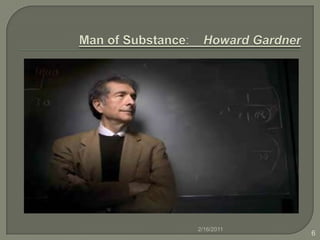
Man of Substance:    Howard Gardner2/16/20116
An introductionHoward Gardner is an American Developmental Psychologist. He defined “Multiple Intelligence” in  the “Frames of Mind” (1983). HG included the last two intelligences in “ Intelligence Reframed” (1999)2/16/20117
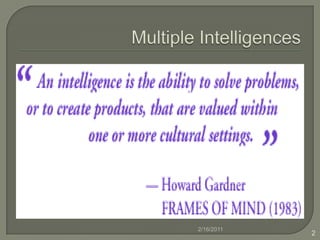
Howard Gardner states that---     I now conceptualize an intelligence as a bio-psychological potential to process information that can be activated in a cultural setting to solve problems or create products that are of value in a culture...intelligences are not things that can be seen or counted. Instead, they are potentials—presumably, neural ones—that will or will not be activated, depending upon the value of a particular culture, the opportunities available in that culture, and the personal decisions made by individuals and/or their families, school-teachers, and others. (Gardner 1999) 2/16/20118
Intelligences are “part of our birthright."   “No two people have exactly the same intelligences in the same combination.“&    “Our heroes teach us the way of courage. They look straight into the eyes of what others fear and speak out with their best voice.They listen intently to those whose voice is at times unsure. Our greatest heroes, with fearless eyes and caring heart, show us that there is power within us all.”2/16/20119
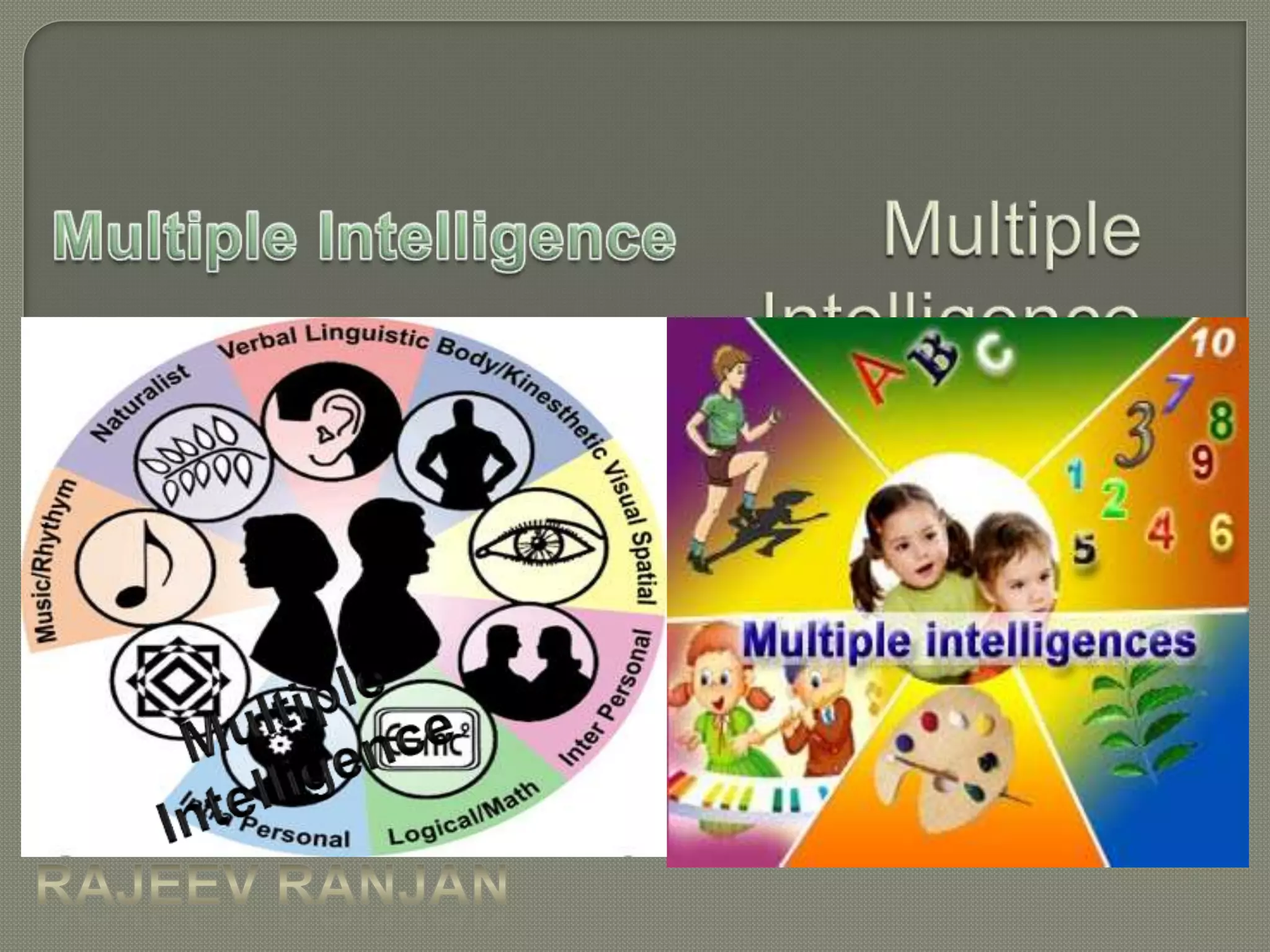
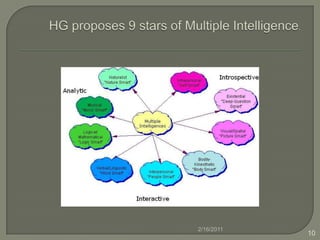
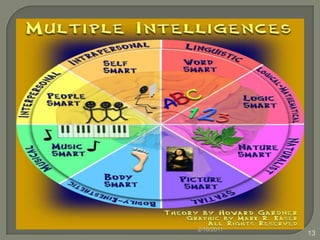
HG proposes 9 stars of Multiple Intelligence.2/16/201110
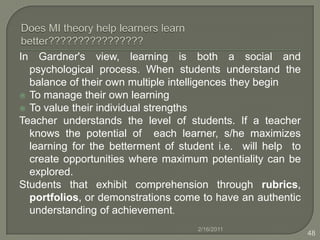
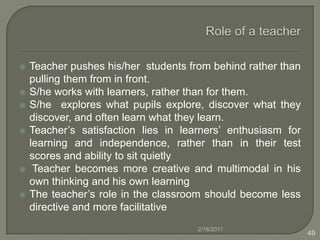
 According to Gardner:All human beings possess all nine intelligences in varying amounts. Each person has a different intellectual composition. We can improve education by addressing the multiple intelligences of our students. These intelligences are located in different areas of the brain and can either work independently or together. These intelligences may define the human species.Drawing a picture, composing, or listening to music, watching a performance -- these activities can be a vital door to learning -- as important as writing and mathematics. 2/16/201111
Nine Stars of MIVerbal-LinguisticLogical/MathematicalVisual/SpatialBodily/KinestheticMusical/RhythmicIntrapersonalInterpersonalNaturalistExistentialist2/16/201112
2/16/201113
Have a look on 9 stars  Verbal – Linguistic :  intelligence of words”The capacity to use words effectively, either orally or in writingVL learners: Shows  attention to word, syntax and style
Think in words, learn by listening, reading and verbalizing
Enjoy writing, reading, telling stories, poetry, books, records, tapes
Learn best by saying, hearing and seeing words2/16/201114
Learning Activities of Verbal- LinguisticPerforming poetry read aloud. Dictionary Game (find an unfamiliar word, challenge everyone to write imaginary definitions, read imaginary definitions along with real ones). Exploring a dictionary of synonyms to attune writers to fine differences in word meanings. Write critical analyses of famous art, music or drama. Debate controversial political or historical decisions, for example, High Court , Supreme Court decision, Government Decision  2/16/201115
Verbal- LinguisticWrite math story problems for others to solve. Write poetry . Write an imaginative dialogue between two opposing political factions (current or historical). Class discussions of historical and contemporary issues in areas ranging from science, history, politics, etc. 2/16/201116
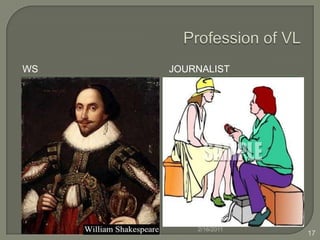
Profession of VLWSJournalist2/16/201117
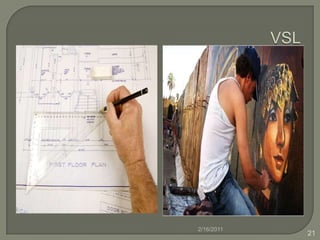
Visual/Spatial Linguistic: “Intelligence of pictures and images” VSL Intelligence: The ability to comprehend shapes and images in three dimensionsEnjoys reading and writingGood at putting puzzles togetherGood at interpreting pictures, graphs and chartsEnjoys drawing, painting and the visual artsRecognizes patterns easily2/16/201118
Learning Activities of VSL Intelligence Examine alternate endings to a story to see which one gives a "sense of wholeness". Examine the language of architects, sculptors and other visual thinkers to see how it differs from common usage. Observe, discuss and write about slides showing scenery, architectural landmarks, art works, advertisements, cultural artifacts and people. Analyze the "spatial dimensions" of our language (under the weather, beside himself, feeling low, etc.). Observe the effect of font and typeface on the mood of expressive qualities of a piece. 2/16/201119
VSL IntelligenceHave an artist talk to the class about his or her work. Visit a work of architecture that creates a special space. Students take notes using visual organizers such as flow charts, Venn Diagrams, caricature and matrices. Students create visual metaphors (charts, posters, etc.), representing historical and current events. Analyze art, posters and other visual media for evidence of political distortion, faulty logic, etc. 2/16/201120
VSL2/16/201121
Logical/Mathematical: Intelligence of numbers and reasoningLM Intelligence: The ability to mentally process logical problems and mathematical equations.
Logical-mathematical intelligence are good at reasoning, recognizing patterns and logically analyze problems
Excellent problem-solving skills
Enjoys thinking about abstract ideas
Likes conducting scientific experiments
Good and solving complex computations2/16/201122
Learning Activities of L/M Intelligence Have students write about the use of logical/mathematical thinking on the news and in science reporting. Writing exercises that focus on precision, fact checking, organization, focus, revision, outlining and analytical writing. Trace the patterns of historical development in, for example, the Old West. Predict what will happen next in a story. Use the scientific method for discovery (science lab). Analyze a culture’ development chronologically. Use a graphic organizer to analyze a scene/character in a play. . 2/16/201123
 L/M IntelligenceStudents are given geographic, demographic, topographic and other data and are told to create a city on a given site, or even choose the site of a city based on these and other factors. Students construct a timeline of historical events. Students are asked to graph and analyze a process (economic trends/processes, natural processes such as chemical reactions, population changes, etc.). Students devise experiments to learn about everything from basic electricity to Einstein’s special relativity theory (mind experiments). Students conduct chemistry experiments involving prediction, detection of patterns, precise charting of results and careful titration and measurement techniques.2/16/201124
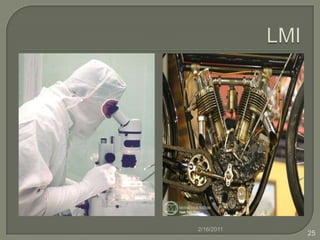
LMI2/16/201125
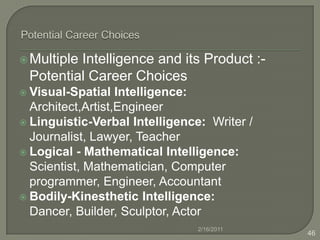
Bodily- Kinesthetic Intelligence:  The intelligence of the whole body and the hands.BK Intelligence: Expertise in using one’s body to express ideas and feelings as well as the facility to handle objects skilfully.It involves a natural sense of how one’s body should act and react in a demanding physical situation, including a sense of timing, a clear sense of goal.
Good at dancing and sports
Enjoy creating things with their hands
Excellent physical coordination
Tends to remember by doing, rather than hearing or seeing2/16/201126
Learning Activities of B-K Intelligence Writing that closely describes an action or characterizes a person through gesture, rhythm and ways of moving. Use improvisation or mime to display an imaginary object to the class, then pass it on to the next person who will then transform it into a different object Interview people with kinaesthetic gifts such as athletes, gymnasts, dance artists, etc. Act out great moments or historical events from the past. Act out sun/lunar/planetary rotation/revolution. 2/16/201127
B-K IntelligenceLearn to play games that are popular in different cultures. Physically embody geometry formula/fractions. Create a living painting/sculpture of an idea or feeling. Students setup a mock court or legislative assembly in the classroom, organizing in necessary subgroups and moving about the room to transact business, initiate discussion, get signatures, etc. Students play the game Scissors, Rock, Paper to simulate the development of capitalism and the Marxist critique of that system.2/16/201128
BKI2/16/201129
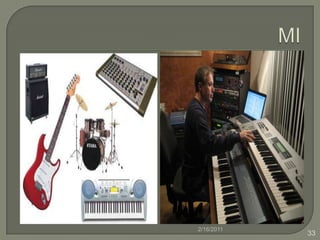
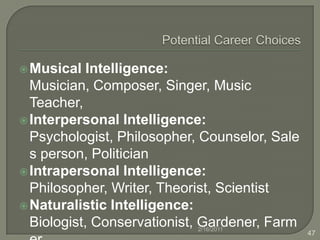
Musical Intelligence :  The intelligence of tone, rhythm, and timbre.M Intelligence: The capacity to perceive, compose, discriminate, transform and express musical forms (rhythm, pitch, harmony, timbre, etc.). Enjoy singing and playing musical instrumentsRecognizes musical patterns and tones easilyGood at remembering songs and melodiesRich understanding of musical structure, rhythm and notes2/16/201130
Learning Activities of Musical Intelligence Have students compare and contrast different recordings of a single piece of classical music, for example, Beethoven’s 5th Symphony. Intersperse music while students write about personal moments and themes in their life. Compare their writing before and after the musical "interlude". Have students interview several kinds of musicians and compare how these people think musically and create music. Learn about different periods of history by analyzing their music. Illustrate a piece of literature with music, sound and rhythm. Make a music tape to accompany different natural processes. 2/16/201131
Learning Activities of Musical Intelligence Write math operations, formulas and problem solving raps. Learn about math concepts embedded in musical/dance pieces. A music learning center where students listen to music while studying spelling words. Study songs and their uses from different cultures. Analyze and study song lyrics to gain greater cultural and historical understanding. Listen to music from various periods and cultures and analyze its elements as well as historical context. Create advertising jingles to sell a product and relate the jingle to the product/company image and target audience.2/16/201132
MI2/16/201133
Interpersonal Intelligence :  The intelligence of social interactionsI Intelligence: The ability to perceive and make distinctions in the moods, intentions, motivations and feelings of other people. The ability to interact with others, understand them and interpret their behaviour.
Good at communicating verbally
Skilled nonverbal communicators
See situations from different perspectives
Create positive relationships with others
Good at resolving conflict in groups2/16/201134
Learning Activities of Interpersonal Intelligence Writing from personal experience (journals), writing about another person, writing to a specific audience and presenting an issue in terms of its impact on a single person. Composing of notebooks, diaries, journals for personal reflection and coming to terms with other’s behaviours. A learning centre where children work together to read material and complete a worksheet or answer a group of questions. Jigs awing, STADS, cooperative learning, group investigation, numbered heads, etc. Joint story telling with a partner. Conduct interviews with people from different cultures. 2/16/201135
Interpersonal IntelligencePanel discussions where students assume the role/perspective of a societal group (feminists, business executives, gays, etc.). Students create dramatic presentations to "bring to life" term such as totalitarianism, democracy, etc. Students create their own classroom bill of rights and rules. Students participate in Center Circles, problem solving class meetings, etc. Students are encouraged, for example through literature circles, to work collaboratively in small groups. 2/16/201136
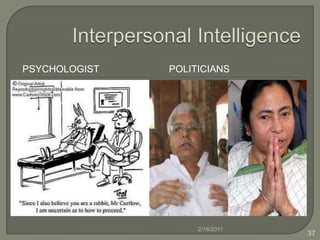
Interpersonal IntelligencePsychologistPoliticians2/16/201137
 Interpersonal intelligence and intrapersonal intelligence are "inextricably" interconnected since true self knowledge requires a sensitivity to others and vice versa2/16/201138
Intrapersonal:  The intelligence of self-knowledge   Intrapersonal Intelligence: The cognitive ability to understand our self- access to one’s own feeling life, the capacity to discriminate feelings, to find symbols for them and to draw upon them to guide one’s own lifeGood at analyzing their strengths and weaknessesEnjoys analyzing theories and ideasExcellent self-awarenessClearly understands the basis for their own motivations and feelings2/16/201139
Learning Activities of Intrapersonal Intelligence All activities listed for interpersonal intelligence. Imagine having dialogues with past historical figures. Write a reflection on a life lesson derived from some piece of class literature or reading.  Think and write about how math concepts help in daily living. Write a reflection on personal tastes in art, music, dance and/or drama. A learning center involving a fantasy writing activity, for example, a journey to Mars or a journey to the center of the Earth. Mock trial, for example, the Spanish Inquisition, where students would act out roles as jury, juror, accuser and accused. 2/16/201140
Intrapersonal IntelligenceStudents create their own classroom bill of rights and rules. Students participate in Center Circles, problem solving class meetings, etc. Students experience the sting of discrimination during a simulation of a "separate but equal" classroom in the American South during the 1950s. Students are asked to do a cultural portrait that involves interviewing a cultural role model and reporting on a culture’s "salient" characteristics. Students are asked to examine and discuss gender stereotypes found in their favourite music. 2/16/201141
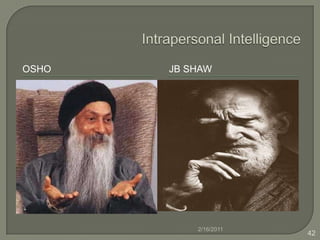
Intrapersonal IntelligenceOshoJB Shaw2/16/201142
Naturalistic Intelligence: Finding Patters and Relationships to NatureAccording to Gardner, individuals who are high in this type of intelligence are more in tune with nature and are often interesting in nurturing, exploring the environment and learning about other species. These individuals are said to be highly aware of even subtle changes to their environments.Interested in subjects such as botany, biology and zoology
Good at categorizing and cataloguing information easily

Multiple intelligence

  • 1.
    Multiple Intelligence Multiple IntelligenceMultiple Intelligence Rajeev Ranjan
  • 2.
  • 3.
  • 4.
    Prepared by: RajeevRanjanRajeev RanjanEnglish Language Teacher B.ED(ENG)& PGDTEEnglish and Foreign Languages University, HyderabadEmail. Id:- rajeevbhuvns@gmail.com2/16/20114
  • 5.
    Multiple Intelligences isan approach of teaching and learning. "If a child is not learning the way you are teaching, then you must teach in the way the child learns." Rita Dunn, (from Anne Bruetsch'sMultiple Intelligences Lesson Plan Book)2/16/20115
  • 6.
    Man of Substance: Howard Gardner2/16/20116
  • 7.
    An introductionHoward Gardneris an American Developmental Psychologist. He defined “Multiple Intelligence” in the “Frames of Mind” (1983). HG included the last two intelligences in “ Intelligence Reframed” (1999)2/16/20117
  • 8.
    Howard Gardner statesthat--- I now conceptualize an intelligence as a bio-psychological potential to process information that can be activated in a cultural setting to solve problems or create products that are of value in a culture...intelligences are not things that can be seen or counted. Instead, they are potentials—presumably, neural ones—that will or will not be activated, depending upon the value of a particular culture, the opportunities available in that culture, and the personal decisions made by individuals and/or their families, school-teachers, and others. (Gardner 1999) 2/16/20118
  • 9.
    Intelligences are “partof our birthright." “No two people have exactly the same intelligences in the same combination.“& “Our heroes teach us the way of courage. They look straight into the eyes of what others fear and speak out with their best voice.They listen intently to those whose voice is at times unsure. Our greatest heroes, with fearless eyes and caring heart, show us that there is power within us all.”2/16/20119
  • 10.
    HG proposes 9stars of Multiple Intelligence.2/16/201110
  • 11.
    According toGardner:All human beings possess all nine intelligences in varying amounts. Each person has a different intellectual composition. We can improve education by addressing the multiple intelligences of our students. These intelligences are located in different areas of the brain and can either work independently or together. These intelligences may define the human species.Drawing a picture, composing, or listening to music, watching a performance -- these activities can be a vital door to learning -- as important as writing and mathematics. 2/16/201111
  • 12.
    Nine Stars ofMIVerbal-LinguisticLogical/MathematicalVisual/SpatialBodily/KinestheticMusical/RhythmicIntrapersonalInterpersonalNaturalistExistentialist2/16/201112
  • 13.
  • 14.
    Have a lookon 9 stars Verbal – Linguistic : intelligence of words”The capacity to use words effectively, either orally or in writingVL learners: Shows attention to word, syntax and style
  • 15.
    Think in words,learn by listening, reading and verbalizing
  • 16.
    Enjoy writing, reading,telling stories, poetry, books, records, tapes
  • 17.
    Learn best bysaying, hearing and seeing words2/16/201114
  • 18.
    Learning Activities ofVerbal- LinguisticPerforming poetry read aloud. Dictionary Game (find an unfamiliar word, challenge everyone to write imaginary definitions, read imaginary definitions along with real ones). Exploring a dictionary of synonyms to attune writers to fine differences in word meanings. Write critical analyses of famous art, music or drama. Debate controversial political or historical decisions, for example, High Court , Supreme Court decision, Government Decision 2/16/201115
  • 19.
    Verbal- LinguisticWrite mathstory problems for others to solve. Write poetry . Write an imaginative dialogue between two opposing political factions (current or historical). Class discussions of historical and contemporary issues in areas ranging from science, history, politics, etc. 2/16/201116
  • 20.
  • 21.
    Visual/Spatial Linguistic: “Intelligenceof pictures and images” VSL Intelligence: The ability to comprehend shapes and images in three dimensionsEnjoys reading and writingGood at putting puzzles togetherGood at interpreting pictures, graphs and chartsEnjoys drawing, painting and the visual artsRecognizes patterns easily2/16/201118
  • 22.
    Learning Activities ofVSL Intelligence Examine alternate endings to a story to see which one gives a "sense of wholeness". Examine the language of architects, sculptors and other visual thinkers to see how it differs from common usage. Observe, discuss and write about slides showing scenery, architectural landmarks, art works, advertisements, cultural artifacts and people. Analyze the "spatial dimensions" of our language (under the weather, beside himself, feeling low, etc.). Observe the effect of font and typeface on the mood of expressive qualities of a piece. 2/16/201119
  • 23.
    VSL IntelligenceHave anartist talk to the class about his or her work. Visit a work of architecture that creates a special space. Students take notes using visual organizers such as flow charts, Venn Diagrams, caricature and matrices. Students create visual metaphors (charts, posters, etc.), representing historical and current events. Analyze art, posters and other visual media for evidence of political distortion, faulty logic, etc. 2/16/201120
  • 24.
  • 25.
    Logical/Mathematical: Intelligence ofnumbers and reasoningLM Intelligence: The ability to mentally process logical problems and mathematical equations.
  • 26.
    Logical-mathematical intelligence aregood at reasoning, recognizing patterns and logically analyze problems
  • 27.
  • 28.
    Enjoys thinking aboutabstract ideas
  • 29.
  • 30.
    Good and solvingcomplex computations2/16/201122
  • 31.
    Learning Activities ofL/M Intelligence Have students write about the use of logical/mathematical thinking on the news and in science reporting. Writing exercises that focus on precision, fact checking, organization, focus, revision, outlining and analytical writing. Trace the patterns of historical development in, for example, the Old West. Predict what will happen next in a story. Use the scientific method for discovery (science lab). Analyze a culture’ development chronologically. Use a graphic organizer to analyze a scene/character in a play. . 2/16/201123
  • 32.
    L/M IntelligenceStudentsare given geographic, demographic, topographic and other data and are told to create a city on a given site, or even choose the site of a city based on these and other factors. Students construct a timeline of historical events. Students are asked to graph and analyze a process (economic trends/processes, natural processes such as chemical reactions, population changes, etc.). Students devise experiments to learn about everything from basic electricity to Einstein’s special relativity theory (mind experiments). Students conduct chemistry experiments involving prediction, detection of patterns, precise charting of results and careful titration and measurement techniques.2/16/201124
  • 33.
  • 34.
    Bodily- Kinesthetic Intelligence: The intelligence of the whole body and the hands.BK Intelligence: Expertise in using one’s body to express ideas and feelings as well as the facility to handle objects skilfully.It involves a natural sense of how one’s body should act and react in a demanding physical situation, including a sense of timing, a clear sense of goal.
  • 35.
    Good at dancingand sports
  • 36.
    Enjoy creating thingswith their hands
  • 37.
  • 38.
    Tends to rememberby doing, rather than hearing or seeing2/16/201126
  • 39.
    Learning Activities ofB-K Intelligence Writing that closely describes an action or characterizes a person through gesture, rhythm and ways of moving. Use improvisation or mime to display an imaginary object to the class, then pass it on to the next person who will then transform it into a different object Interview people with kinaesthetic gifts such as athletes, gymnasts, dance artists, etc. Act out great moments or historical events from the past. Act out sun/lunar/planetary rotation/revolution. 2/16/201127
  • 40.
    B-K IntelligenceLearn toplay games that are popular in different cultures. Physically embody geometry formula/fractions. Create a living painting/sculpture of an idea or feeling. Students setup a mock court or legislative assembly in the classroom, organizing in necessary subgroups and moving about the room to transact business, initiate discussion, get signatures, etc. Students play the game Scissors, Rock, Paper to simulate the development of capitalism and the Marxist critique of that system.2/16/201128
  • 41.
  • 42.
    Musical Intelligence : The intelligence of tone, rhythm, and timbre.M Intelligence: The capacity to perceive, compose, discriminate, transform and express musical forms (rhythm, pitch, harmony, timbre, etc.). Enjoy singing and playing musical instrumentsRecognizes musical patterns and tones easilyGood at remembering songs and melodiesRich understanding of musical structure, rhythm and notes2/16/201130
  • 43.
    Learning Activities ofMusical Intelligence Have students compare and contrast different recordings of a single piece of classical music, for example, Beethoven’s 5th Symphony. Intersperse music while students write about personal moments and themes in their life. Compare their writing before and after the musical "interlude". Have students interview several kinds of musicians and compare how these people think musically and create music. Learn about different periods of history by analyzing their music. Illustrate a piece of literature with music, sound and rhythm. Make a music tape to accompany different natural processes. 2/16/201131
  • 44.
    Learning Activities ofMusical Intelligence Write math operations, formulas and problem solving raps. Learn about math concepts embedded in musical/dance pieces. A music learning center where students listen to music while studying spelling words. Study songs and their uses from different cultures. Analyze and study song lyrics to gain greater cultural and historical understanding. Listen to music from various periods and cultures and analyze its elements as well as historical context. Create advertising jingles to sell a product and relate the jingle to the product/company image and target audience.2/16/201132
  • 45.
  • 46.
    Interpersonal Intelligence : The intelligence of social interactionsI Intelligence: The ability to perceive and make distinctions in the moods, intentions, motivations and feelings of other people. The ability to interact with others, understand them and interpret their behaviour.
  • 47.
  • 48.
  • 49.
    See situations fromdifferent perspectives
  • 50.
  • 51.
    Good at resolvingconflict in groups2/16/201134
  • 52.
    Learning Activities ofInterpersonal Intelligence Writing from personal experience (journals), writing about another person, writing to a specific audience and presenting an issue in terms of its impact on a single person. Composing of notebooks, diaries, journals for personal reflection and coming to terms with other’s behaviours. A learning centre where children work together to read material and complete a worksheet or answer a group of questions. Jigs awing, STADS, cooperative learning, group investigation, numbered heads, etc. Joint story telling with a partner. Conduct interviews with people from different cultures. 2/16/201135
  • 53.
    Interpersonal IntelligencePanel discussionswhere students assume the role/perspective of a societal group (feminists, business executives, gays, etc.). Students create dramatic presentations to "bring to life" term such as totalitarianism, democracy, etc. Students create their own classroom bill of rights and rules. Students participate in Center Circles, problem solving class meetings, etc. Students are encouraged, for example through literature circles, to work collaboratively in small groups. 2/16/201136
  • 54.
  • 55.
    Interpersonal intelligenceand intrapersonal intelligence are "inextricably" interconnected since true self knowledge requires a sensitivity to others and vice versa2/16/201138
  • 56.
    Intrapersonal:  The intelligenceof self-knowledge Intrapersonal Intelligence: The cognitive ability to understand our self- access to one’s own feeling life, the capacity to discriminate feelings, to find symbols for them and to draw upon them to guide one’s own lifeGood at analyzing their strengths and weaknessesEnjoys analyzing theories and ideasExcellent self-awarenessClearly understands the basis for their own motivations and feelings2/16/201139
  • 57.
    Learning Activities ofIntrapersonal Intelligence All activities listed for interpersonal intelligence. Imagine having dialogues with past historical figures. Write a reflection on a life lesson derived from some piece of class literature or reading. Think and write about how math concepts help in daily living. Write a reflection on personal tastes in art, music, dance and/or drama. A learning center involving a fantasy writing activity, for example, a journey to Mars or a journey to the center of the Earth. Mock trial, for example, the Spanish Inquisition, where students would act out roles as jury, juror, accuser and accused. 2/16/201140
  • 58.
    Intrapersonal IntelligenceStudents createtheir own classroom bill of rights and rules. Students participate in Center Circles, problem solving class meetings, etc. Students experience the sting of discrimination during a simulation of a "separate but equal" classroom in the American South during the 1950s. Students are asked to do a cultural portrait that involves interviewing a cultural role model and reporting on a culture’s "salient" characteristics. Students are asked to examine and discuss gender stereotypes found in their favourite music. 2/16/201141
  • 59.
  • 60.
    Naturalistic Intelligence: FindingPatters and Relationships to NatureAccording to Gardner, individuals who are high in this type of intelligence are more in tune with nature and are often interesting in nurturing, exploring the environment and learning about other species. These individuals are said to be highly aware of even subtle changes to their environments.Interested in subjects such as botany, biology and zoology
  • 61.
    Good at categorizingand cataloguing information easily