Constructivist
Approach
Reinze L. Vito
Jhonalyn Gonowon
ou cannot teach a man anything;
ou can only help him find it within himself
YY
“
”
Is group activity a reliable
assessment method?“ ”
THE ARGUMENT
Constructivism
Constructivism says that people
construct their own understanding
and knowledge of the world through
experiencing things and reflecting
on those experiences.
Constructivism
based on the belief that learning occurs
as learners are actively involved in a
process of meaning and knowledge
construction rather than passively
receiving information
Constructivism
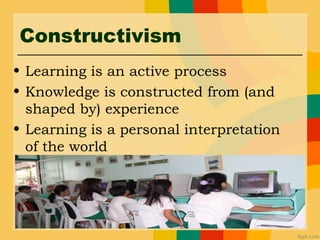
• Learning is an active process
• Knowledge is constructed from (and
shaped by) experience
• Learning is a personal interpretation
of the world
Characteristics
• According to Audrey Gray
– the learners are actively involved
– the environment is democratic
– the activities are interactive and student-
centered
– the teacher facilitates a process of
learning in which students are
encouraged to be responsible and
autonomous
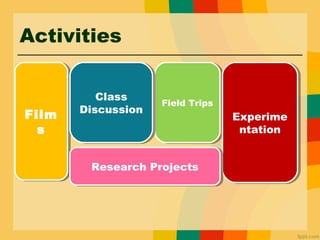
Activities
Film
s
Film
s
Field TripsField Trips
Class
Discussion
Class
Discussion
Experime
ntation
Experime
ntation
Research ProjectsResearch Projects
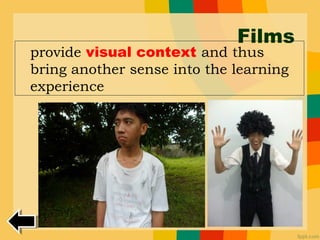
Films
provide visual context and thus
bring another sense into the learning
experience
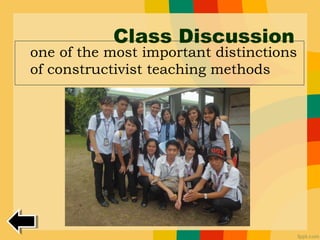
Class Discussion
one of the most important distinctions
of constructivist teaching methods
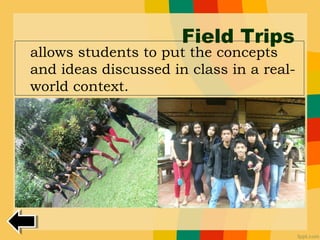
Field Trips
allows students to put the concepts
and ideas discussed in class in a real-
world context.
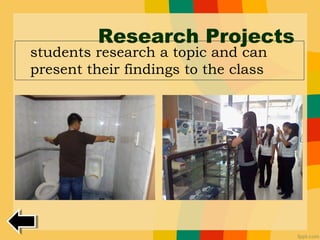
Research Projects
students research a topic and can
present their findings to the class
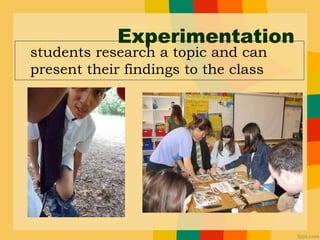
Experimentation
students research a topic and can
present their findings to the class
Traditional Classroom
vs.
Constructivist Classroom
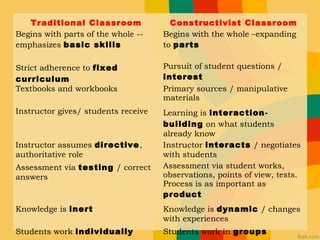
Traditional Classroom Constructivist Classroom
Begins with parts of the whole --
emphasizes basic skills
Begins with the whole –expanding
to parts
Strict adherence to fixed
curriculum
Pursuit of student questions /
interest
Textbooks and workbooks Primary sources / manipulative
materials
Instructor gives/ students receive Learning is interaction‐
building on what students
already know
Instructor assumes directive,
authoritative role
Instructor interacts / negotiates
with students
Assessment via testing / correct
answers
Assessment via student works,
observations, points of view, tests.
Process is as important as
product
Knowledge is inert Knowledge is dynamic / changes
with experiences
Students work individually Students work in groups
Role of Teachers
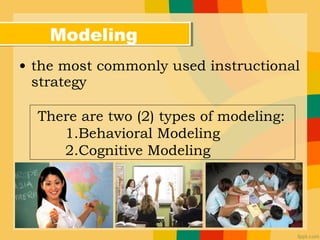
• the most commonly used instructional
strategy
ModelingModeling
There are two (2) types of modeling:
1.Behavioral Modeling
2.Cognitive Modeling
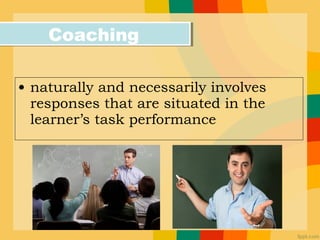
• naturally and necessarily involves
responses that are situated in the
learner’s task performance
CoachingCoaching
• a more systemic approach to
supporting the learner, focusing on
the task, the environment, the
teacher, and the learner
ScaffoldingScaffolding
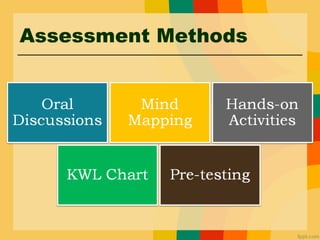
Assessment Methods
Summary
1.Shifts emphasis from teaching to learning
2.Individualizes and contextualizes students’
learning experiences
3.Helps students develop processes, skills
and attitudes
4.Considers students’ learning styles
5.Focuses on knowledge construction, not
reproduction
6.Uses authentic tasks to engage learners
7. Provides for meaningful, problem based‐
thinking
8. Requires negotiation of meaning
9. Requires reflection of prior and new
knowledge
10.Extends students beyond content
presented to them
END

Contructivism Approach

  • 1.
  • 2.
    ou cannot teacha man anything; ou can only help him find it within himself YY “ ”
  • 3.
    Is group activitya reliable assessment method?“ ” THE ARGUMENT
  • 4.
    Constructivism Constructivism says thatpeople construct their own understanding and knowledge of the world through experiencing things and reflecting on those experiences.
  • 5.
    Constructivism based on thebelief that learning occurs as learners are actively involved in a process of meaning and knowledge construction rather than passively receiving information
  • 7.
    Constructivism • Learning isan active process • Knowledge is constructed from (and shaped by) experience • Learning is a personal interpretation of the world
  • 8.
    Characteristics • According toAudrey Gray – the learners are actively involved – the environment is democratic – the activities are interactive and student- centered – the teacher facilitates a process of learning in which students are encouraged to be responsible and autonomous
  • 9.
  • 10.
    Films provide visual contextand thus bring another sense into the learning experience
  • 11.
    Class Discussion one ofthe most important distinctions of constructivist teaching methods
  • 12.
    Field Trips allows studentsto put the concepts and ideas discussed in class in a real- world context.
  • 13.
    Research Projects students researcha topic and can present their findings to the class
  • 14.
    Experimentation students research atopic and can present their findings to the class
  • 15.
  • 16.
    Traditional Classroom ConstructivistClassroom Begins with parts of the whole -- emphasizes basic skills Begins with the whole –expanding to parts Strict adherence to fixed curriculum Pursuit of student questions / interest Textbooks and workbooks Primary sources / manipulative materials Instructor gives/ students receive Learning is interaction‐ building on what students already know Instructor assumes directive, authoritative role Instructor interacts / negotiates with students Assessment via testing / correct answers Assessment via student works, observations, points of view, tests. Process is as important as product Knowledge is inert Knowledge is dynamic / changes with experiences Students work individually Students work in groups
  • 18.
  • 19.
    • the mostcommonly used instructional strategy ModelingModeling There are two (2) types of modeling: 1.Behavioral Modeling 2.Cognitive Modeling
  • 20.
    • naturally andnecessarily involves responses that are situated in the learner’s task performance CoachingCoaching
  • 21.
    • a moresystemic approach to supporting the learner, focusing on the task, the environment, the teacher, and the learner ScaffoldingScaffolding
  • 22.
  • 23.
    Summary 1.Shifts emphasis fromteaching to learning 2.Individualizes and contextualizes students’ learning experiences 3.Helps students develop processes, skills and attitudes 4.Considers students’ learning styles 5.Focuses on knowledge construction, not reproduction 6.Uses authentic tasks to engage learners
  • 24.
    7. Provides formeaningful, problem based‐ thinking 8. Requires negotiation of meaning 9. Requires reflection of prior and new knowledge 10.Extends students beyond content presented to them
  • 25.