This section reviews models of curriculum development by Brown (1995) and
Richards (2001),
and from them forms a summary of the curriculum development processes that
should be in evidence
at any particular institution.
Brown describes curriculum development as “a
series of activities that contribute to the growth
of consensus among staff, faculty, administration
and students.”
He further explains that this “series
of curriculum activities will provide a framework
that helps teachers to accomplish whatever
combination of teaching activities is most suitable
… that is, a framework that helps students learn
as efficiently and effectively as possible in a given
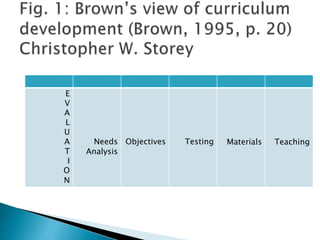
situation” (Brown, 1995, p. 19). Figure 1 shows
the curriculum development model suggested by
Brown
TeachingMaterialsTestingObjectivesNeeds
Analysis
E
V
A
L
U
A
T
I
O
N
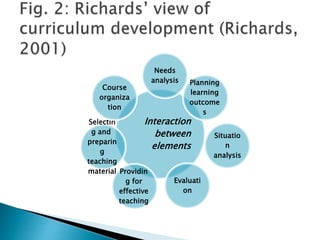
Richards describes curriculum development as “the
range of planning and implementation
processes involved in developing or renewing a
curriculum” (Richards, 2001, p. 41). He defines
the processes as focusing on “needs analysis,
situational analysis, planning learning outcomes,
course organization, selecting and preparing
teaching materials, providing for effective
teaching
and evaluation” (Richards, 2001, p. 41). The
author’s representation of Richards’ view of
curriculum
development is shown in Figure 2.
Interaction
between
elements
Needs
analysis Planning
learning
outcome
s
Situatio
n
analysis
Evaluati
on
Providin
g for
effective
teaching
Selectin
g and
preparin
g
teaching
material
Course
organiza
tion
Looking at the similarities between the models we see
that both include needs analysis, setting
of objectives or outcomes, materials selection and
preparation, teaching and evaluation. In contrast,
Brown’s model differs from Richards’ in that it includes
testing which is described as “very crucial
element in the curriculum development process”
(Brown, 1995, p. 22).
Looking at Richards’
model he includes the additional elements of situation
analysis and course organization as distinctly
separate elements of curriculum development
processes.
Brown (1995) does make reference to these
activities but groups the former into needs
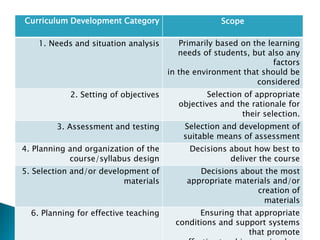
analysis and the latter into materials. Table
1 provides a summary of the combined models
and represents processes we should expect
to
find as part of curriculum development.
ScopeCurriculum Development Category
Primarily based on the learning
needs of students, but also any
factors
in the environment that should be
considered
1. Needs and situation analysis
Selection of appropriate
objectives and the rationale for
their selection.
2. Setting of objectives
Selection and development of
suitable means of assessment
3. Assessment and testing
Decisions about how best to
deliver the course
4. Planning and organization of the
course/syllabus design
Decisions about the most
appropriate materials and/or
creation of
materials
5. Selection and/or development of
materials
Ensuring that appropriate
conditions and support systems
that promote
6. Planning for effective teaching

Theory based models of curriculum development

  • 1.
    This section reviewsmodels of curriculum development by Brown (1995) and Richards (2001), and from them forms a summary of the curriculum development processes that should be in evidence at any particular institution.
  • 2.
    Brown describes curriculumdevelopment as “a series of activities that contribute to the growth of consensus among staff, faculty, administration and students.” He further explains that this “series of curriculum activities will provide a framework that helps teachers to accomplish whatever combination of teaching activities is most suitable … that is, a framework that helps students learn as efficiently and effectively as possible in a given situation” (Brown, 1995, p. 19). Figure 1 shows the curriculum development model suggested by Brown
  • 3.
  • 4.
    Richards describes curriculumdevelopment as “the range of planning and implementation processes involved in developing or renewing a curriculum” (Richards, 2001, p. 41). He defines the processes as focusing on “needs analysis, situational analysis, planning learning outcomes, course organization, selecting and preparing teaching materials, providing for effective teaching and evaluation” (Richards, 2001, p. 41). The author’s representation of Richards’ view of curriculum development is shown in Figure 2.
  • 5.
  • 6.
    Looking at thesimilarities between the models we see that both include needs analysis, setting of objectives or outcomes, materials selection and preparation, teaching and evaluation. In contrast, Brown’s model differs from Richards’ in that it includes testing which is described as “very crucial element in the curriculum development process” (Brown, 1995, p. 22). Looking at Richards’ model he includes the additional elements of situation analysis and course organization as distinctly separate elements of curriculum development processes.
  • 7.
    Brown (1995) doesmake reference to these activities but groups the former into needs analysis and the latter into materials. Table 1 provides a summary of the combined models and represents processes we should expect to find as part of curriculum development.
  • 8.
    ScopeCurriculum Development Category Primarilybased on the learning needs of students, but also any factors in the environment that should be considered 1. Needs and situation analysis Selection of appropriate objectives and the rationale for their selection. 2. Setting of objectives Selection and development of suitable means of assessment 3. Assessment and testing Decisions about how best to deliver the course 4. Planning and organization of the course/syllabus design Decisions about the most appropriate materials and/or creation of materials 5. Selection and/or development of materials Ensuring that appropriate conditions and support systems that promote 6. Planning for effective teaching

Editor's Notes

  • #5 CW Storey - Electronic Journal of Foreign Language Teaching, 2007‏ - e-flt.nus.edu.sg-