MULTIPLE INTELLIGENCESMULTIPLE INTELLIGENCES
ContentsContents
• IntroductionIntroduction
• The differences between traditional viewThe differences between traditional view
and MI theoryand MI theory
• Principles of MI theoryPrinciples of MI theory
• The 8 intelligencesThe 8 intelligences
• ConclusionConclusion
IntroductionIntroduction
• The theory of Multiple Intelligences wasThe theory of Multiple Intelligences was
developed in 1983 by Dr. Howard Gardnerdeveloped in 1983 by Dr. Howard Gardner
and first published in his book, ‘Frames ofand first published in his book, ‘Frames of
Mind.’ The book strongly suggests thatMind.’ The book strongly suggests that
everybody has a different mind, and noeverybody has a different mind, and no
two profiles of intelligence are the same.two profiles of intelligence are the same.
Therefore, the traditional concept ofTherefore, the traditional concept of
measuring intelligence by I.Q testing is farmeasuring intelligence by I.Q testing is far
too restricted.too restricted.
IntroductionIntroduction
• From theFrom the 8 primary intelligences8 primary intelligences , an, an
individual may excel in one, two or evenindividual may excel in one, two or even
three of these, but nobody’s good at themthree of these, but nobody’s good at them
all. Equally the same rule applies to a childall. Equally the same rule applies to a child
prodigy or mentally/physicallyprodigy or mentally/physically
disadvantaged person. A brain damageddisadvantaged person. A brain damaged
child could have a severely impaired usechild could have a severely impaired use
of language, but be able to paint or playof language, but be able to paint or play
music magnificently.music magnificently.
According to Gardner, intelligenceAccording to Gardner, intelligence
is:is:
1.1. The ability to create an effective productThe ability to create an effective product
or offer a service that is valued in aor offer a service that is valued in a
cultureculture
2.2. A set of skills that make it possible for aA set of skills that make it possible for a
person to solve problems in lifeperson to solve problems in life
3.3. The potential for finding or creatingThe potential for finding or creating
solutions for problems, which involvessolutions for problems, which involves
gathering new knowledgegathering new knowledge
Traditional View of “Intelligence”Traditional View of “Intelligence”
 PPeople are born with a fixed amount ofeople are born with a fixed amount of
intelligence.intelligence.
 Intelligence level does not change over aIntelligence level does not change over a
lifetime.lifetime.
 Intelligence consists of ability in logic andIntelligence consists of ability in logic and
language.language.
 In traditional practice, teachers teach theIn traditional practice, teachers teach the
same material tosame material to everyone.everyone.
 Teachers teach a topic or "subject."Teachers teach a topic or "subject."
MI TheoryMI Theory
 Human beings have all of theHuman beings have all of the intelligences,intelligences,
but each person has a unique combination,but each person has a unique combination,
or profile.or profile.
 We can all improve each of theWe can all improve each of the
intelligences, though some people willintelligences, though some people will
improve more readily in one intelligenceimprove more readily in one intelligence
area than in others.area than in others.
 There are many more types of intelligenceThere are many more types of intelligence
which reflect different ways of interactingwhich reflect different ways of interacting
with the worldwith the world
MI TheoryMI Theory
 M.I. pedagogy implies that teachers teach andM.I. pedagogy implies that teachers teach and
assess differently based on individual intellectualassess differently based on individual intellectual
strengths and weaknesses.strengths and weaknesses.
 Teachers structure learning activities around anTeachers structure learning activities around an
issue or question and connect subjects.issue or question and connect subjects.
Teachers develop strategies that allow forTeachers develop strategies that allow for
students to demonstrate multiple ways ofstudents to demonstrate multiple ways of
understanding and value their uniqueness.understanding and value their uniqueness.
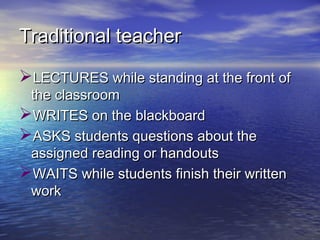
Traditional teacherTraditional teacher
LECTURES while standing at the front ofLECTURES while standing at the front of
the classroomthe classroom
WRITES on the blackboardWRITES on the blackboard
ASKS students questions about theASKS students questions about the
assigned reading or handoutsassigned reading or handouts
WWAITS while students finish their writtenAITS while students finish their written
workwork
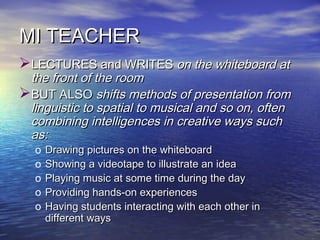
MI TEACHERMI TEACHER
LECTURES and WRITESLECTURES and WRITES on the whiteboard aton the whiteboard at
the front of the roomthe front of the room
BUT ALSOBUT ALSO shifts methods of presentation fromshifts methods of presentation from
linguistic to spatial to musical and so on, oftenlinguistic to spatial to musical and so on, often
combining intelligences in crcombining intelligences in creeative ways suchative ways such
as:as:
o Drawing pictures on the whiteboardDrawing pictures on the whiteboard
o Showing a videotape to illustrate an ideaShowing a videotape to illustrate an idea
o Playing music at some time during the dayPlaying music at some time during the day
o Providing hands-on experiencesProviding hands-on experiences
o Having students interacting with each other inHaving students interacting with each other in
different waysdifferent ways
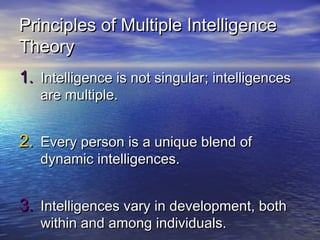
Principles of Multiple IntelligencePrinciples of Multiple Intelligence
TheoryTheory
1.1. Intelligence is not singularIntelligence is not singular;; intelligencesintelligences
are multiple.are multiple.
2.2. Every person is a unique blend ofEvery person is a unique blend of
dynamic intelligences.dynamic intelligences.
3.3. Intelligences vary in development, bothIntelligences vary in development, both
within and among individuals.within and among individuals.
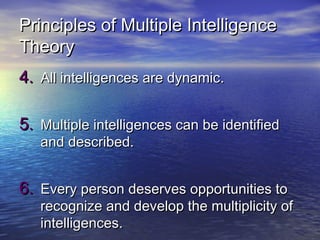
Principles of Multiple IntelligencePrinciples of Multiple Intelligence
TheoryTheory
4.4. All intelligences are dynamicAll intelligences are dynamic..
5.5. Multiple intelligences can be identifiedMultiple intelligences can be identified
and described.and described.
6.6. Every person deserves opportunities toEvery person deserves opportunities to
recognize and develop the multiplicity ofrecognize and develop the multiplicity of
intelligencesintelligences..
Principles of Multiple IntelligencePrinciples of Multiple Intelligence
TheoryTheory
7.7. The use of one of the intelligences canThe use of one of the intelligences can
be used to enhance another intelligencebe used to enhance another intelligence..
8.8. Personal background density andPersonal background density and
dispersion are critical to knowledge,dispersion are critical to knowledge,
beliefs, and skills in all intelligencesbeliefs, and skills in all intelligences..
Dr. Gardner proposes eightDr. Gardner proposes eight
different intelligences:different intelligences:
1.1. Verbal/Linguistic intelligenceVerbal/Linguistic intelligence
("word smart")("word smart")
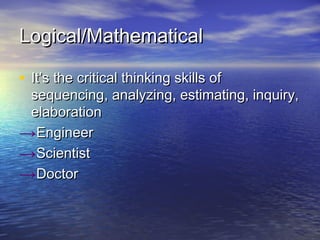
2.2. Logical/Mathematical intelligenceLogical/Mathematical intelligence
("number/reasoning smart")("number/reasoning smart")
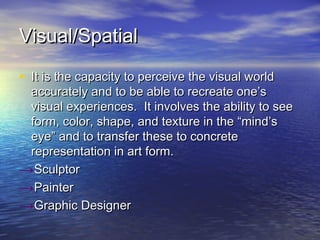
3.3. Visual/Spatial intelligenceVisual/Spatial intelligence ("picture("picture
smart")smart")
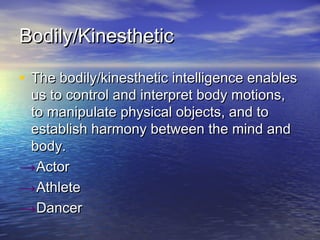
4.4. Bodily/Kinesthetic intelligenceBodily/Kinesthetic intelligence
("body smart")("body smart")
Dr. Gardner proposes eightDr. Gardner proposes eight
different intelligences:different intelligences:
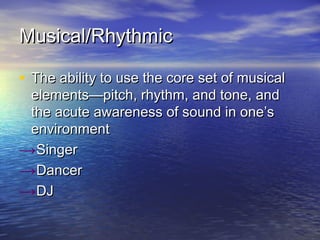
5.5. Musical/Rhythmic intelligenceMusical/Rhythmic intelligence
("music smart")("music smart")
6.6. Interpersonal intelligenceInterpersonal intelligence ("people("people
smart")smart")
7.7. Intrapersonal intelligenceIntrapersonal intelligence ("self("self
smart")smart")
8.8. Naturalist intelligenceNaturalist intelligence ("nature("nature
smart")smart")
Verbal/LinguisticVerbal/Linguistic
• It is the ability to use with clarity the coreIt is the ability to use with clarity the core
operations of language. Theoperations of language. The
communicating of humans by reading,communicating of humans by reading,
writing, listening, speaking, and linkingwriting, listening, speaking, and linking..
→AuthorAuthor
→SpeakerSpeaker
→Talk-Show HostTalk-Show Host
Logical/MathematicalLogical/Mathematical
• It’s the cIt’s the criticalritical tthinkinghinking sskills ofkills of
ssequencingequencing, analyzing, estimating, inquiry,, analyzing, estimating, inquiry,
elaborationelaboration
→EngineerEngineer
→ScientistScientist
→DoctorDoctor
Visual/SpatialVisual/Spatial
• ItIt is the capacity to perceive the visual worldis the capacity to perceive the visual world
accurately and to be able to recreate one’saccurately and to be able to recreate one’s
visual experiences. It involves the ability to seevisual experiences. It involves the ability to see
form, color, shape, and texture in the “mind’sform, color, shape, and texture in the “mind’s
eye” and to transfer these to concreteeye” and to transfer these to concrete
representation in art form.representation in art form.
→SculptorSculptor
→PainterPainter
→Graphic DesignerGraphic Designer
Bodily/KinestheticBodily/Kinesthetic
• The bodily/kinesthetic intelligence enablesThe bodily/kinesthetic intelligence enables
us to control and interpret body motions,us to control and interpret body motions,
to manipulate physical objects, and toto manipulate physical objects, and to
establish harmony between the mind andestablish harmony between the mind and
body.body.
→ActorActor
→AthleteAthlete
→DancerDancer
Musical/RhythmicMusical/Rhythmic
• The ability to use the core set of musicalThe ability to use the core set of musical
elements—pitch, rhythm, and tone, andelements—pitch, rhythm, and tone, and
the acute awareness of sound in one’sthe acute awareness of sound in one’s
environmentenvironment
→SingerSinger
→DancerDancer
→DJDJ
InterpersonalInterpersonal
• The interpersonal intelligence is the ability to getThe interpersonal intelligence is the ability to get
along with, interact with, work with, and motivatealong with, interact with, work with, and motivate
others toward a common goal. It involves theothers toward a common goal. It involves the
capacity to understand and interpret others’capacity to understand and interpret others’
moods, temperaments, motivations, andmoods, temperaments, motivations, and
intentions.intentions.
→TeacherTeacher
→SalespersonSalesperson
→Political LeaderPolitical Leader
IntrapersonalIntrapersonal
• Intrapersonal intelligence is the ability toIntrapersonal intelligence is the ability to
form an accurate model of oneself, and toform an accurate model of oneself, and to
use that model to operate effectively inuse that model to operate effectively in
life. It is the ability to know oneself andlife. It is the ability to know oneself and
assume responsibility for one’s life andassume responsibility for one’s life and
learning.learning.
→AuthorAuthor
→PsychologistPsychologist
→PhilosopherPhilosopher
NaturalistNaturalist
• To understand the natural world includingTo understand the natural world including
plants, animals and scientific studies. Toplants, animals and scientific studies. To
be able to recognize and classifybe able to recognize and classify
individuals, species and ecologicalindividuals, species and ecological
relationships.relationships.
→VeterinarianVeterinarian
→FarmerFarmer
→ExplorerExplorer
ConclusionConclusion
• The idea of Multiple Intelligences hasThe idea of Multiple Intelligences has
attracted the interest of many educatorsattracted the interest of many educators
as well as the general public. Schools thatas well as the general public. Schools that
use MI theory encourage learning thatuse MI theory encourage learning that
goes beyond traditional books, pens, andgoes beyond traditional books, pens, and
pencils.pencils.
ConclusionConclusion
• Teacher and parents who recognize theirTeacher and parents who recognize their
learners’/children’s particular gifts andlearners’/children’s particular gifts and
talents can provide learning activities thattalents can provide learning activities that
build on those inherent gifts. As a result ofbuild on those inherent gifts. As a result of
strengthening such differences, individualsstrengthening such differences, individuals
are free to be intelligent in their own ways.are free to be intelligent in their own ways.
It's not how smart you are, It's not how smart you are, 
               it's how you are smart!it's how you are smart!
Howard Gardner Interview, "Common Miracles" ABC 1993
True or FalseTrue or False
According to MI theory, iAccording to MI theory, intelligence levelntelligence level
does not change over a lifetime.does not change over a lifetime. TT//FF
MI teacher oftenMI teacher often combincombineses intelligencesintelligences
in crin creeative waysative ways.. TT//FF
TheThe ability to use with clarity the coreability to use with clarity the core
operations of languageoperations of language is interpersonalis interpersonal
intelligenceintelligence.. TT//FF
ResourcesResources
• http://www.multipleintelligencetheorhttp://www.multipleintelligencetheor
y.co.uk/y.co.uk/
• http://www.thomasarmstrong.com/mhttp://www.thomasarmstrong.com/m
ultiple_intelligences.htmultiple_intelligences.htm
TRUETRUE
FALSEFALSE

M itheory

  • 1.
  • 2.
    ContentsContents • IntroductionIntroduction • Thedifferences between traditional viewThe differences between traditional view and MI theoryand MI theory • Principles of MI theoryPrinciples of MI theory • The 8 intelligencesThe 8 intelligences • ConclusionConclusion
  • 3.
    IntroductionIntroduction • The theoryof Multiple Intelligences wasThe theory of Multiple Intelligences was developed in 1983 by Dr. Howard Gardnerdeveloped in 1983 by Dr. Howard Gardner and first published in his book, ‘Frames ofand first published in his book, ‘Frames of Mind.’ The book strongly suggests thatMind.’ The book strongly suggests that everybody has a different mind, and noeverybody has a different mind, and no two profiles of intelligence are the same.two profiles of intelligence are the same. Therefore, the traditional concept ofTherefore, the traditional concept of measuring intelligence by I.Q testing is farmeasuring intelligence by I.Q testing is far too restricted.too restricted.
  • 4.
    IntroductionIntroduction • From theFromthe 8 primary intelligences8 primary intelligences , an, an individual may excel in one, two or evenindividual may excel in one, two or even three of these, but nobody’s good at themthree of these, but nobody’s good at them all. Equally the same rule applies to a childall. Equally the same rule applies to a child prodigy or mentally/physicallyprodigy or mentally/physically disadvantaged person. A brain damageddisadvantaged person. A brain damaged child could have a severely impaired usechild could have a severely impaired use of language, but be able to paint or playof language, but be able to paint or play music magnificently.music magnificently.
  • 5.
    According to Gardner,intelligenceAccording to Gardner, intelligence is:is: 1.1. The ability to create an effective productThe ability to create an effective product or offer a service that is valued in aor offer a service that is valued in a cultureculture 2.2. A set of skills that make it possible for aA set of skills that make it possible for a person to solve problems in lifeperson to solve problems in life 3.3. The potential for finding or creatingThe potential for finding or creating solutions for problems, which involvessolutions for problems, which involves gathering new knowledgegathering new knowledge
  • 6.
    Traditional View of“Intelligence”Traditional View of “Intelligence”  PPeople are born with a fixed amount ofeople are born with a fixed amount of intelligence.intelligence.  Intelligence level does not change over aIntelligence level does not change over a lifetime.lifetime.  Intelligence consists of ability in logic andIntelligence consists of ability in logic and language.language.  In traditional practice, teachers teach theIn traditional practice, teachers teach the same material tosame material to everyone.everyone.  Teachers teach a topic or "subject."Teachers teach a topic or "subject."
  • 7.
    MI TheoryMI Theory Human beings have all of theHuman beings have all of the intelligences,intelligences, but each person has a unique combination,but each person has a unique combination, or profile.or profile.  We can all improve each of theWe can all improve each of the intelligences, though some people willintelligences, though some people will improve more readily in one intelligenceimprove more readily in one intelligence area than in others.area than in others.  There are many more types of intelligenceThere are many more types of intelligence which reflect different ways of interactingwhich reflect different ways of interacting with the worldwith the world
  • 8.
    MI TheoryMI Theory M.I. pedagogy implies that teachers teach andM.I. pedagogy implies that teachers teach and assess differently based on individual intellectualassess differently based on individual intellectual strengths and weaknesses.strengths and weaknesses.  Teachers structure learning activities around anTeachers structure learning activities around an issue or question and connect subjects.issue or question and connect subjects. Teachers develop strategies that allow forTeachers develop strategies that allow for students to demonstrate multiple ways ofstudents to demonstrate multiple ways of understanding and value their uniqueness.understanding and value their uniqueness.
  • 9.
    Traditional teacherTraditional teacher LECTURESwhile standing at the front ofLECTURES while standing at the front of the classroomthe classroom WRITES on the blackboardWRITES on the blackboard ASKS students questions about theASKS students questions about the assigned reading or handoutsassigned reading or handouts WWAITS while students finish their writtenAITS while students finish their written workwork
  • 10.
    MI TEACHERMI TEACHER LECTURESand WRITESLECTURES and WRITES on the whiteboard aton the whiteboard at the front of the roomthe front of the room BUT ALSOBUT ALSO shifts methods of presentation fromshifts methods of presentation from linguistic to spatial to musical and so on, oftenlinguistic to spatial to musical and so on, often combining intelligences in crcombining intelligences in creeative ways suchative ways such as:as: o Drawing pictures on the whiteboardDrawing pictures on the whiteboard o Showing a videotape to illustrate an ideaShowing a videotape to illustrate an idea o Playing music at some time during the dayPlaying music at some time during the day o Providing hands-on experiencesProviding hands-on experiences o Having students interacting with each other inHaving students interacting with each other in different waysdifferent ways
  • 11.
    Principles of MultipleIntelligencePrinciples of Multiple Intelligence TheoryTheory 1.1. Intelligence is not singularIntelligence is not singular;; intelligencesintelligences are multiple.are multiple. 2.2. Every person is a unique blend ofEvery person is a unique blend of dynamic intelligences.dynamic intelligences. 3.3. Intelligences vary in development, bothIntelligences vary in development, both within and among individuals.within and among individuals.
  • 12.
    Principles of MultipleIntelligencePrinciples of Multiple Intelligence TheoryTheory 4.4. All intelligences are dynamicAll intelligences are dynamic.. 5.5. Multiple intelligences can be identifiedMultiple intelligences can be identified and described.and described. 6.6. Every person deserves opportunities toEvery person deserves opportunities to recognize and develop the multiplicity ofrecognize and develop the multiplicity of intelligencesintelligences..
  • 13.
    Principles of MultipleIntelligencePrinciples of Multiple Intelligence TheoryTheory 7.7. The use of one of the intelligences canThe use of one of the intelligences can be used to enhance another intelligencebe used to enhance another intelligence.. 8.8. Personal background density andPersonal background density and dispersion are critical to knowledge,dispersion are critical to knowledge, beliefs, and skills in all intelligencesbeliefs, and skills in all intelligences..
  • 14.
    Dr. Gardner proposeseightDr. Gardner proposes eight different intelligences:different intelligences: 1.1. Verbal/Linguistic intelligenceVerbal/Linguistic intelligence ("word smart")("word smart") 2.2. Logical/Mathematical intelligenceLogical/Mathematical intelligence ("number/reasoning smart")("number/reasoning smart") 3.3. Visual/Spatial intelligenceVisual/Spatial intelligence ("picture("picture smart")smart") 4.4. Bodily/Kinesthetic intelligenceBodily/Kinesthetic intelligence ("body smart")("body smart")
  • 15.
    Dr. Gardner proposeseightDr. Gardner proposes eight different intelligences:different intelligences: 5.5. Musical/Rhythmic intelligenceMusical/Rhythmic intelligence ("music smart")("music smart") 6.6. Interpersonal intelligenceInterpersonal intelligence ("people("people smart")smart") 7.7. Intrapersonal intelligenceIntrapersonal intelligence ("self("self smart")smart") 8.8. Naturalist intelligenceNaturalist intelligence ("nature("nature smart")smart")
  • 16.
    Verbal/LinguisticVerbal/Linguistic • It isthe ability to use with clarity the coreIt is the ability to use with clarity the core operations of language. Theoperations of language. The communicating of humans by reading,communicating of humans by reading, writing, listening, speaking, and linkingwriting, listening, speaking, and linking.. →AuthorAuthor →SpeakerSpeaker →Talk-Show HostTalk-Show Host
  • 17.
    Logical/MathematicalLogical/Mathematical • It’s thecIt’s the criticalritical tthinkinghinking sskills ofkills of ssequencingequencing, analyzing, estimating, inquiry,, analyzing, estimating, inquiry, elaborationelaboration →EngineerEngineer →ScientistScientist →DoctorDoctor
  • 18.
    Visual/SpatialVisual/Spatial • ItIt isthe capacity to perceive the visual worldis the capacity to perceive the visual world accurately and to be able to recreate one’saccurately and to be able to recreate one’s visual experiences. It involves the ability to seevisual experiences. It involves the ability to see form, color, shape, and texture in the “mind’sform, color, shape, and texture in the “mind’s eye” and to transfer these to concreteeye” and to transfer these to concrete representation in art form.representation in art form. →SculptorSculptor →PainterPainter →Graphic DesignerGraphic Designer
  • 19.
    Bodily/KinestheticBodily/Kinesthetic • The bodily/kinestheticintelligence enablesThe bodily/kinesthetic intelligence enables us to control and interpret body motions,us to control and interpret body motions, to manipulate physical objects, and toto manipulate physical objects, and to establish harmony between the mind andestablish harmony between the mind and body.body. →ActorActor →AthleteAthlete →DancerDancer
  • 20.
    Musical/RhythmicMusical/Rhythmic • The abilityto use the core set of musicalThe ability to use the core set of musical elements—pitch, rhythm, and tone, andelements—pitch, rhythm, and tone, and the acute awareness of sound in one’sthe acute awareness of sound in one’s environmentenvironment →SingerSinger →DancerDancer →DJDJ
  • 21.
    InterpersonalInterpersonal • The interpersonalintelligence is the ability to getThe interpersonal intelligence is the ability to get along with, interact with, work with, and motivatealong with, interact with, work with, and motivate others toward a common goal. It involves theothers toward a common goal. It involves the capacity to understand and interpret others’capacity to understand and interpret others’ moods, temperaments, motivations, andmoods, temperaments, motivations, and intentions.intentions. →TeacherTeacher →SalespersonSalesperson →Political LeaderPolitical Leader
  • 22.
    IntrapersonalIntrapersonal • Intrapersonal intelligenceis the ability toIntrapersonal intelligence is the ability to form an accurate model of oneself, and toform an accurate model of oneself, and to use that model to operate effectively inuse that model to operate effectively in life. It is the ability to know oneself andlife. It is the ability to know oneself and assume responsibility for one’s life andassume responsibility for one’s life and learning.learning. →AuthorAuthor →PsychologistPsychologist →PhilosopherPhilosopher
  • 23.
    NaturalistNaturalist • To understandthe natural world includingTo understand the natural world including plants, animals and scientific studies. Toplants, animals and scientific studies. To be able to recognize and classifybe able to recognize and classify individuals, species and ecologicalindividuals, species and ecological relationships.relationships. →VeterinarianVeterinarian →FarmerFarmer →ExplorerExplorer
  • 24.
    ConclusionConclusion • The ideaof Multiple Intelligences hasThe idea of Multiple Intelligences has attracted the interest of many educatorsattracted the interest of many educators as well as the general public. Schools thatas well as the general public. Schools that use MI theory encourage learning thatuse MI theory encourage learning that goes beyond traditional books, pens, andgoes beyond traditional books, pens, and pencils.pencils.
  • 25.
    ConclusionConclusion • Teacher andparents who recognize theirTeacher and parents who recognize their learners’/children’s particular gifts andlearners’/children’s particular gifts and talents can provide learning activities thattalents can provide learning activities that build on those inherent gifts. As a result ofbuild on those inherent gifts. As a result of strengthening such differences, individualsstrengthening such differences, individuals are free to be intelligent in their own ways.are free to be intelligent in their own ways.
  • 26.
    It's not howsmart you are, It's not how smart you are,                 it's how you are smart!it's how you are smart! Howard Gardner Interview, "Common Miracles" ABC 1993
  • 27.
    True or FalseTrueor False According to MI theory, iAccording to MI theory, intelligence levelntelligence level does not change over a lifetime.does not change over a lifetime. TT//FF MI teacher oftenMI teacher often combincombineses intelligencesintelligences in crin creeative waysative ways.. TT//FF TheThe ability to use with clarity the coreability to use with clarity the core operations of languageoperations of language is interpersonalis interpersonal intelligenceintelligence.. TT//FF
  • 28.
  • 29.
  • 30.