Jerome S. Bruner
COGNITIVE DEVELOPMENT
Ani Vadakke Purayil
M.Com, M.Ed. NET(Com),NET(Edu),SET
Faculty
Department of Teacher Education
Kannur University
Kannur, Kerala.
anivpknr@gmail.com
Jerome S. Bruner
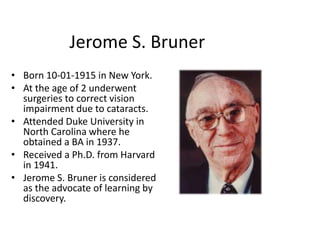
• Born 10-01-1915 in New York.
• At the age of 2 underwent
surgeries to correct vision
impairment due to cataracts.
• Attended Duke University in
North Carolina where he
obtained a BA in 1937.
• Received a Ph.D. from Harvard
in 1941.
• Jerome S. Bruner is considered
as the advocate of learning by
discovery.
According to Bruner the outcome of cognitive
development is thinking.
According to Bruner (1960), effective learning occurs
when students acquire a general understanding of a
subject; that, when they understand the structure of a
subject, they see it as a related whole. According to
Bruner, mind organises knowledge in a hierarchical
fashion, with the more general, all encompassing ideas
at the top of hierarchy, and the more concrete,
factorial ideas toward the bottom.
Bruner believes that important outcomes of learning
include not only just the concepts, categories, and
problem-solving procedures invented previously in the
culture, but also the ability to “invent” these things for
one’s self.
According to Bruner, one’s intellectual ability
evolves as a result of maturation, training and
experiences through a series of three sequential
stages –the enactive ,iconic and symbolic.
Enactive Stage
Knowledge is primarily stored in the form of
motor responses. This is not just limited to
children. A baby represents world through
actions - Our knowledge for motor skills (eg
riding a bike) are represented in the enactive
mode. They become automatic through
repetition
• Many adults can perform a variety of motor
tasks such as typing, sewing etc.
Iconic Stage
Knowledge is stored primarily in the form of
visual images. knowledge represented
through visual or auditory images – icons. This
may explain why, when we are learning a
new subject, it is often helpful to have
diagrams or illustrations to accompany verbal
information.
Symbolic Stage
Knowledge is stored primarily as words,
mathematical symbols, or into other symbol
systems. major change at 6/7 yrs – language
starts to influence thought. Not so dominated
by appearance of things children can think
beyond images and use symbols such as
words or numbers.
BASES OF BRUNER'S THEORY OF COGNITIVE GROWTH
Bruner believes that cognitive development takes into account the following
points.
INDEPENDENCE OF RESPONSE FROM STIMULUS
Intellectual growth in children is influenced by increasing independence of
responses from stimulus. In sensory-motor stage, the responses of children are
mainly governed by various stimuli. As children grow and acquire language
ability, they respond to different situations independent of the presence of
stimuli.
MENTAL REPRESENTATIONS
Children develop mental representations of the outside reality through internal
information processing and storage system. These mental representations may
be verbal, visual, mathematical or musical. Language helps a child form mental
representations of the realities outside.
SELF-CONSCIOUSNESS
Intellectual development involves an increasing capacity to say to ourselves and
others, in words or with symbols, what we have done and what we will do. This
point deals with self consciousness. (Gage and Berliner, 1984).
TUTOR-LEARNER INTERACTIONS
Cognitive growth, according to Bruner, depends on
constant interactions between tutor and learners. A
tutor can be teacher, mother, father, friend or any
other person who can teach a child.
LANGUAGE AS THE KEY
Language is a key symbol, which plays an important role
in cognitive development. It helps a child to
communicate her conceptions of the world. It mediates
various events occurring in the world.
SIMULTANEITY IN COGNITION
Cognitive growth in children is characterized by their
ability to engage in simultaneous cognition. They can
perform concurrent activities and pay attention to
various learning situations.
Discovering learning
Teacher plans and arranges activities in such a way
that students search, manipulate, explore, and
investigate. Students learn new knowledge
relevant to the domain and such general
problem-solving skills as formulating rules,
testing and gathering information.
Most discovery does not happen by chance.
Students require background preparation. Once
students possess prerequisite knowledge careful
structuring of material allows them to discover
important principles.
Spiral Curriculum
Bruner introduced the doctrine of the spiral
curriculum, that all topics -in some form -must be
introduced at an early age, but cannot be
exhausted at any age, and thus must be returned
to in increasing depth.
In order for a student to develop from simple to
more complex lessons, certain basic knowledge
and skills must first be mastered. This provides
linkages between each lesson as student spirals
upwards in a course of a study.
As new knowledge and skills are introduced, they
reinforce what is already learned and become
related to previously learned information.
Indicators of cognitive development
1) Respond to situations in varied ways.
2) Internalize the events into a storage system (that
corresponds to the environment).
3) Have increased capacity for language.
4) Interact systematically with the tutor.
5) Use language as an isntrument for ordering the
environment.
6) Have increasing capacity to deal with multiple
demands.
Bruner (1996) states that a theory of instruction should address four major aspects
1. Predisposition to learn.
He introduced the ideas of “readiness for learning”. Instruction must be
concerned with the experiences and context that make the student
willing and able to learn.
2. Structure of Learning
Instruction must be structured so that it can be easily grasped by
the students. The ways in which a body of knowledge can be structured so that
it can be most readily grasped by the leaner.
3. Effective Sequencing
. Instruction should be designed to facilitate extrapolation and or
fill in the gaps. No one sequencing will fit every learner, but in general, the
lesson can be presented in increasng difficulty.
4. Reinforcement
Rewards and punishment should be selected and paced
appropriately.
Bruner’s theory - key points
• Development involves mastery of increasingly more
complex modes of thinking from enactive to Symbolic
• As skills learned they become automatic and become
units that can be combined to build up a new set of
skilled behaviours
• Learning not a gradual process
• Stresses role of language & interpersonal
communication.
• Emphasizes need for active involvement by experts.
• Instruction = essential part of learning process in
natural and educational settings.
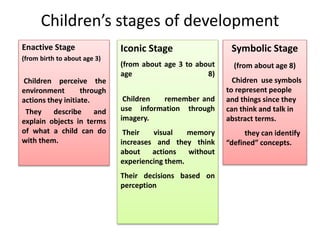
Children’s stages of development
Enactive Stage
(from birth to about age 3)
Children perceive the
environment through
actions they initiate.
They describe and
explain objects in terms
of what a child can do
with them.
Iconic Stage
(from about age 3 to about
age 8)
Children remember and
use information through
imagery.
Their visual memory
increases and they think
about actions without
experiencing them.
Their decisions based on
perception
Symbolic Stage
(from about age 8)
Chidren use symbols
to represent people
and things since they
can think and talk in
abstract terms.
they can identify
“defined” concepts.

Cognitive development jerome s bruner

  • 1.
    Jerome S. Bruner COGNITIVEDEVELOPMENT Ani Vadakke Purayil M.Com, M.Ed. NET(Com),NET(Edu),SET Faculty Department of Teacher Education Kannur University Kannur, Kerala. anivpknr@gmail.com
  • 2.
    Jerome S. Bruner •Born 10-01-1915 in New York. • At the age of 2 underwent surgeries to correct vision impairment due to cataracts. • Attended Duke University in North Carolina where he obtained a BA in 1937. • Received a Ph.D. from Harvard in 1941. • Jerome S. Bruner is considered as the advocate of learning by discovery.
  • 3.
    According to Brunerthe outcome of cognitive development is thinking. According to Bruner (1960), effective learning occurs when students acquire a general understanding of a subject; that, when they understand the structure of a subject, they see it as a related whole. According to Bruner, mind organises knowledge in a hierarchical fashion, with the more general, all encompassing ideas at the top of hierarchy, and the more concrete, factorial ideas toward the bottom. Bruner believes that important outcomes of learning include not only just the concepts, categories, and problem-solving procedures invented previously in the culture, but also the ability to “invent” these things for one’s self.
  • 4.
    According to Bruner,one’s intellectual ability evolves as a result of maturation, training and experiences through a series of three sequential stages –the enactive ,iconic and symbolic.
  • 5.
    Enactive Stage Knowledge isprimarily stored in the form of motor responses. This is not just limited to children. A baby represents world through actions - Our knowledge for motor skills (eg riding a bike) are represented in the enactive mode. They become automatic through repetition • Many adults can perform a variety of motor tasks such as typing, sewing etc.
  • 6.
    Iconic Stage Knowledge isstored primarily in the form of visual images. knowledge represented through visual or auditory images – icons. This may explain why, when we are learning a new subject, it is often helpful to have diagrams or illustrations to accompany verbal information.
  • 7.
    Symbolic Stage Knowledge isstored primarily as words, mathematical symbols, or into other symbol systems. major change at 6/7 yrs – language starts to influence thought. Not so dominated by appearance of things children can think beyond images and use symbols such as words or numbers.
  • 8.
    BASES OF BRUNER'STHEORY OF COGNITIVE GROWTH Bruner believes that cognitive development takes into account the following points. INDEPENDENCE OF RESPONSE FROM STIMULUS Intellectual growth in children is influenced by increasing independence of responses from stimulus. In sensory-motor stage, the responses of children are mainly governed by various stimuli. As children grow and acquire language ability, they respond to different situations independent of the presence of stimuli. MENTAL REPRESENTATIONS Children develop mental representations of the outside reality through internal information processing and storage system. These mental representations may be verbal, visual, mathematical or musical. Language helps a child form mental representations of the realities outside. SELF-CONSCIOUSNESS Intellectual development involves an increasing capacity to say to ourselves and others, in words or with symbols, what we have done and what we will do. This point deals with self consciousness. (Gage and Berliner, 1984).
  • 9.
    TUTOR-LEARNER INTERACTIONS Cognitive growth,according to Bruner, depends on constant interactions between tutor and learners. A tutor can be teacher, mother, father, friend or any other person who can teach a child. LANGUAGE AS THE KEY Language is a key symbol, which plays an important role in cognitive development. It helps a child to communicate her conceptions of the world. It mediates various events occurring in the world. SIMULTANEITY IN COGNITION Cognitive growth in children is characterized by their ability to engage in simultaneous cognition. They can perform concurrent activities and pay attention to various learning situations.
  • 10.
    Discovering learning Teacher plansand arranges activities in such a way that students search, manipulate, explore, and investigate. Students learn new knowledge relevant to the domain and such general problem-solving skills as formulating rules, testing and gathering information. Most discovery does not happen by chance. Students require background preparation. Once students possess prerequisite knowledge careful structuring of material allows them to discover important principles.
  • 11.
    Spiral Curriculum Bruner introducedthe doctrine of the spiral curriculum, that all topics -in some form -must be introduced at an early age, but cannot be exhausted at any age, and thus must be returned to in increasing depth. In order for a student to develop from simple to more complex lessons, certain basic knowledge and skills must first be mastered. This provides linkages between each lesson as student spirals upwards in a course of a study. As new knowledge and skills are introduced, they reinforce what is already learned and become related to previously learned information.
  • 12.
    Indicators of cognitivedevelopment 1) Respond to situations in varied ways. 2) Internalize the events into a storage system (that corresponds to the environment). 3) Have increased capacity for language. 4) Interact systematically with the tutor. 5) Use language as an isntrument for ordering the environment. 6) Have increasing capacity to deal with multiple demands.
  • 13.
    Bruner (1996) statesthat a theory of instruction should address four major aspects 1. Predisposition to learn. He introduced the ideas of “readiness for learning”. Instruction must be concerned with the experiences and context that make the student willing and able to learn. 2. Structure of Learning Instruction must be structured so that it can be easily grasped by the students. The ways in which a body of knowledge can be structured so that it can be most readily grasped by the leaner. 3. Effective Sequencing . Instruction should be designed to facilitate extrapolation and or fill in the gaps. No one sequencing will fit every learner, but in general, the lesson can be presented in increasng difficulty. 4. Reinforcement Rewards and punishment should be selected and paced appropriately.
  • 14.
    Bruner’s theory -key points • Development involves mastery of increasingly more complex modes of thinking from enactive to Symbolic • As skills learned they become automatic and become units that can be combined to build up a new set of skilled behaviours • Learning not a gradual process • Stresses role of language & interpersonal communication. • Emphasizes need for active involvement by experts. • Instruction = essential part of learning process in natural and educational settings.
  • 15.
    Children’s stages ofdevelopment Enactive Stage (from birth to about age 3) Children perceive the environment through actions they initiate. They describe and explain objects in terms of what a child can do with them. Iconic Stage (from about age 3 to about age 8) Children remember and use information through imagery. Their visual memory increases and they think about actions without experiencing them. Their decisions based on perception Symbolic Stage (from about age 8) Chidren use symbols to represent people and things since they can think and talk in abstract terms. they can identify “defined” concepts.