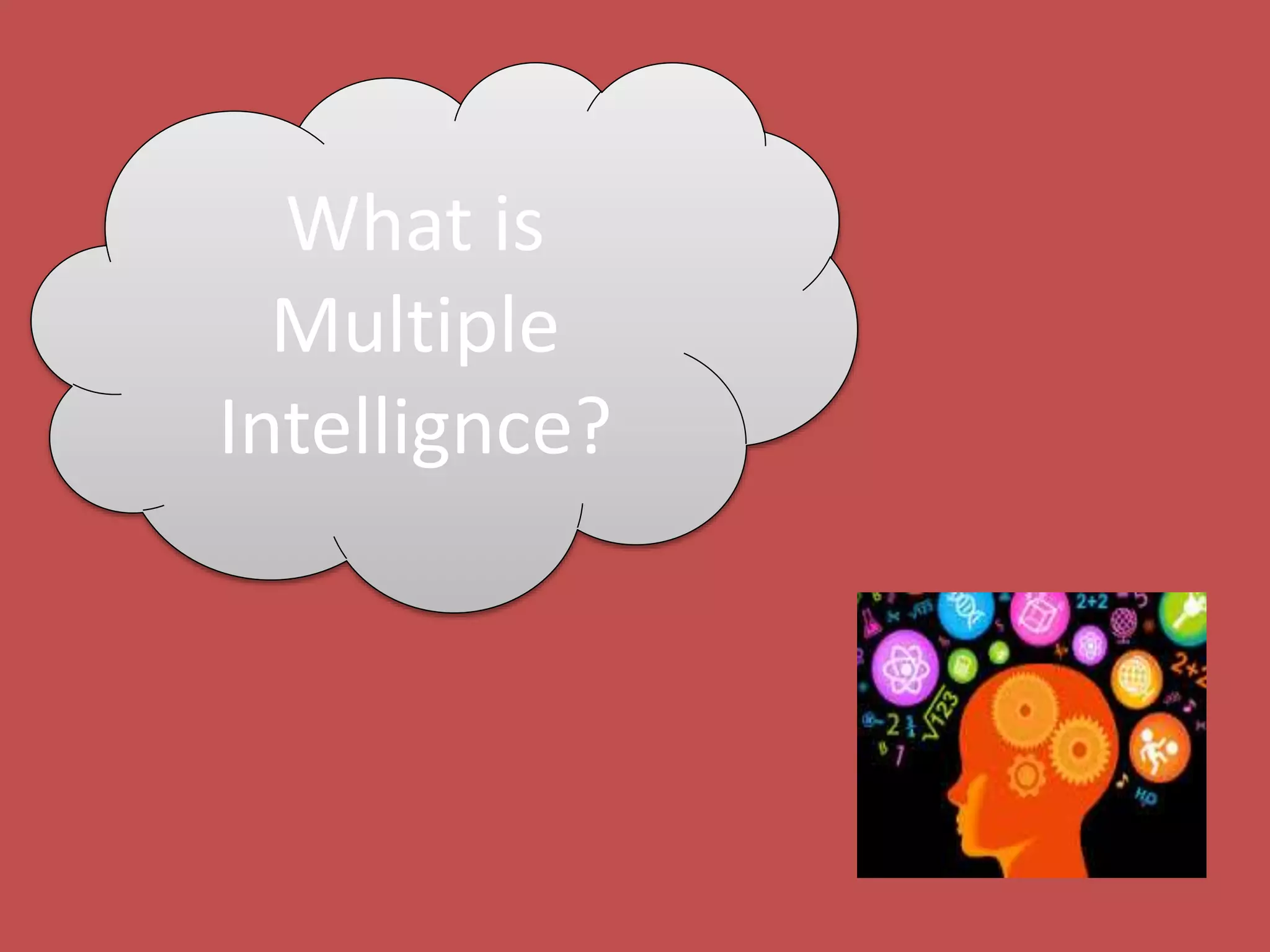
What is
Multiple
Intellignce?
What is Multiple Intellignce?
 The theory of multiple intelligences is Howard
Gardner's theory that proposes that people are not
born with all of the intelligence they will ever have.
 It says that Everyone is intelligent in at least nine
different ways and can develop each aspect of
intelligence to an average level of competency.
 Intelligence , as defined by Gardner, is the ability to
solve problems that are valuable in one or more
cultural settings.
What is this theory?
 Breaks down in different "intelligences" to categorize
talents and skills.
 Gardner: “ The kinds of intelligence would allow
different ways to teach, rather than one."
The Type of Multiple intelligences
 Logical-Mathematical Intelligence.
 Intrapersonal Intelligence.
 Interpersonal Intelligence
 Linguistic Intelligence.
 Bodily-Kinesthetic Intelligence.
 Visual-Spatial Intelligence.
 Musical Intelligence.
 Naturalist Intelligence.
 Existential Intelligence
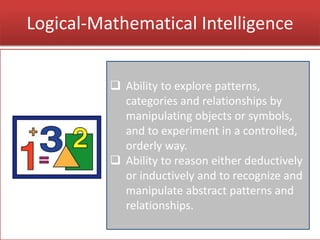
Logical-Mathematical Intelligence
 Ability to explore patterns,
categories and relationships by
manipulating objects or symbols,
and to experiment in a controlled,
orderly way.
 Ability to reason either deductively
or inductively and to recognize and
manipulate abstract patterns and
relationships.
Intrapersonal Intelligence
 Ability to gain access to understand
one's inner feelings, dreams and
ideas.
 Personal knowledge turned inward
to the self. This form of intellect
entails the ability to understand
one's own emotions, goals and
intentions.
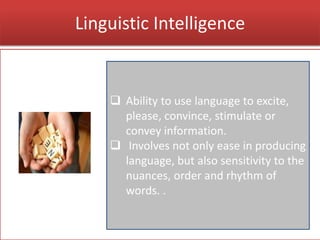
Linguistic Intelligence
 Ability to use language to excite,
please, convince, stimulate or
convey information.
 Involves not only ease in producing
language, but also sensitivity to the
nuances, order and rhythm of
words. .
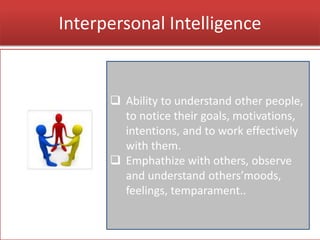
Interpersonal Intelligence
 Ability to understand other people,
to notice their goals, motivations,
intentions, and to work effectively
with them.
 Emphathize with others, observe
and understand others’moods,
feelings, temparament..
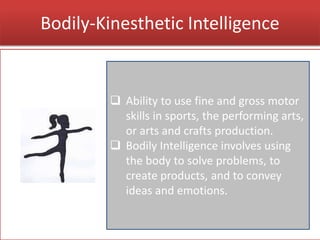
Bodily-Kinesthetic Intelligence
 Ability to use fine and gross motor
skills in sports, the performing arts,
or arts and crafts production.
 Bodily Intelligence involves using
the body to solve problems, to
create products, and to convey
ideas and emotions.
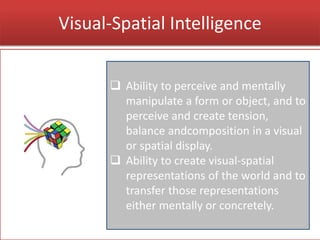
Visual-Spatial Intelligence
 Ability to perceive and mentally
manipulate a form or object, and to
perceive and create tension,
balance andcomposition in a visual
or spatial display.
 Ability to create visual-spatial
representations of the world and to
transfer those representations
either mentally or concretely.
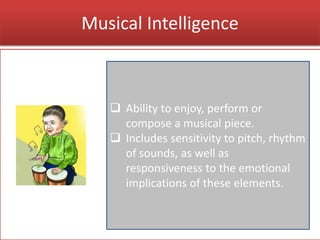
Musical Intelligence
 Ability to enjoy, perform or
compose a musical piece.
 Includes sensitivity to pitch, rhythm
of sounds, as well as
responsiveness to the emotional
implications of these elements.
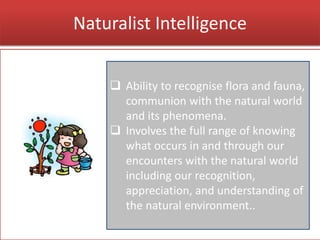
Naturalist Intelligence
 Ability to recognise flora and fauna,
communion with the natural world
and its phenomena.
 Involves the full range of knowing
what occurs in and through our
encounters with the natural world
including our recognition,
appreciation, and understanding of
the natural environment..
Existential Intelligence
 Existential Intelligence is concerned
with the inner life of mind and
spirit and its relationship to being
in the world.
 It implies a capacity for a deep
understanding of existential
questions and insight into multiple
levels of consciousness; and also
implies awareness of spirit as the
creative life force of evolution.
Concusion
“Multiple Intelligence as a Diagnostic Tool”
Asks “how are you smart?” rather than
“how smart are you?”
Helps teachers see how students learn
No competition and does not injure the
child’s self-esteem
Helps parents know how to help their
kids learn
SEEMAS ACAEMY
Thank
You !!!
WWW.seemasacademy.com

Howard Gardner: Multiple Intelligences Theory

  • 1.
  • 2.
    What is MultipleIntellignce?  The theory of multiple intelligences is Howard Gardner's theory that proposes that people are not born with all of the intelligence they will ever have.  It says that Everyone is intelligent in at least nine different ways and can develop each aspect of intelligence to an average level of competency.  Intelligence , as defined by Gardner, is the ability to solve problems that are valuable in one or more cultural settings.
  • 3.
    What is thistheory?  Breaks down in different "intelligences" to categorize talents and skills.  Gardner: “ The kinds of intelligence would allow different ways to teach, rather than one."
  • 4.
    The Type ofMultiple intelligences  Logical-Mathematical Intelligence.  Intrapersonal Intelligence.  Interpersonal Intelligence  Linguistic Intelligence.  Bodily-Kinesthetic Intelligence.  Visual-Spatial Intelligence.  Musical Intelligence.  Naturalist Intelligence.  Existential Intelligence
  • 5.
    Logical-Mathematical Intelligence  Abilityto explore patterns, categories and relationships by manipulating objects or symbols, and to experiment in a controlled, orderly way.  Ability to reason either deductively or inductively and to recognize and manipulate abstract patterns and relationships.
  • 6.
    Intrapersonal Intelligence  Abilityto gain access to understand one's inner feelings, dreams and ideas.  Personal knowledge turned inward to the self. This form of intellect entails the ability to understand one's own emotions, goals and intentions.
  • 7.
    Linguistic Intelligence  Abilityto use language to excite, please, convince, stimulate or convey information.  Involves not only ease in producing language, but also sensitivity to the nuances, order and rhythm of words. .
  • 8.
    Interpersonal Intelligence  Abilityto understand other people, to notice their goals, motivations, intentions, and to work effectively with them.  Emphathize with others, observe and understand others’moods, feelings, temparament..
  • 9.
    Bodily-Kinesthetic Intelligence  Abilityto use fine and gross motor skills in sports, the performing arts, or arts and crafts production.  Bodily Intelligence involves using the body to solve problems, to create products, and to convey ideas and emotions.
  • 10.
    Visual-Spatial Intelligence  Abilityto perceive and mentally manipulate a form or object, and to perceive and create tension, balance andcomposition in a visual or spatial display.  Ability to create visual-spatial representations of the world and to transfer those representations either mentally or concretely.
  • 11.
    Musical Intelligence  Abilityto enjoy, perform or compose a musical piece.  Includes sensitivity to pitch, rhythm of sounds, as well as responsiveness to the emotional implications of these elements.
  • 12.
    Naturalist Intelligence  Abilityto recognise flora and fauna, communion with the natural world and its phenomena.  Involves the full range of knowing what occurs in and through our encounters with the natural world including our recognition, appreciation, and understanding of the natural environment..
  • 13.
    Existential Intelligence  ExistentialIntelligence is concerned with the inner life of mind and spirit and its relationship to being in the world.  It implies a capacity for a deep understanding of existential questions and insight into multiple levels of consciousness; and also implies awareness of spirit as the creative life force of evolution.
  • 14.
    Concusion “Multiple Intelligence asa Diagnostic Tool” Asks “how are you smart?” rather than “how smart are you?” Helps teachers see how students learn No competition and does not injure the child’s self-esteem Helps parents know how to help their kids learn
  • 15.