Hemophilia


                                   Dr. Kalpana Malla
                                       MD Pediatrics
                           Manipal Teaching Hospital

Download more documents and slide shows on The Medical Post [ www.themedicalpost.net ]
Introduction:HAEMOPHILIA
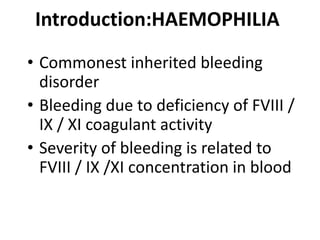
• Commonest inherited bleeding
  disorder
• Bleeding due to deficiency of FVIII /
  IX / XI coagulant activity
• Severity of bleeding is related to
  FVIII / IX /XI concentration in blood
INCIDENCE
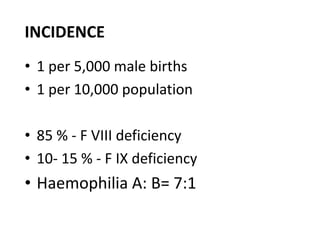
• 1 per 5,000 male births
• 1 per 10,000 population

• 85 % - F VIII deficiency
• 10- 15 % - F IX deficiency
• Haemophilia A: B= 7:1
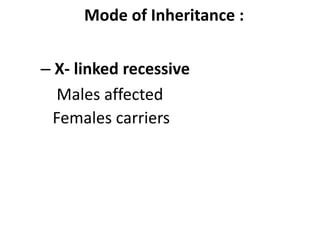
Mode of Inheritance :


– X- linked recessive
   Males affected
  Females carriers
INHERITANCE
INHERITANCE

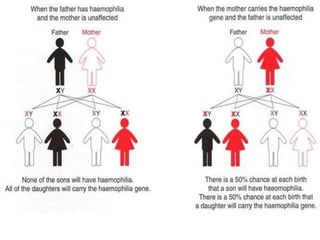
• Father with Haemophilia:
      Daughters are carriers Sons normal

• Mother with haemophilia gene (carrier)
     Sons     50:50 normal or affected
     Daughters 50:50 normal or carriers
FEMALES AFFECTED ONLY WHEN:

           1) TURNERS SYNDROME
         2) MOSAICISM/LYONISATION
          3) MOTHER TO DAUGHTER
            TRANSMISSION (POSSIBLE
          THEORETICALLY BUT EXTREMLY
                    RARE)
Types:

• Haemophilia A – deficiency of Factor VIII
• Haemophilia B – deficiency of Factor IX
• Haemophilia C – deficiency of Factor XI
HAEMOPHILIA A & B:
• Basic abnormality :
1. Reduction in amount of protein in
  factor
2. Dysfunctional protein
         5-10 % Haemophilia A
         40-50 % ” ”       B
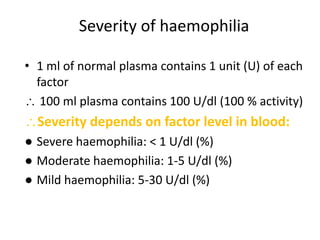
Severity of haemophilia

• 1 ml of normal plasma contains 1 unit (U) of each
  factor
   100 ml plasma contains 100 U/dl (100 % activity)
  Severity depends on factor level in blood:
● Severe haemophilia: < 1 U/dl (%)
● Moderate haemophilia: 1-5 U/dl (%)
● Mild haemophilia: 5-30 U/dl (%)
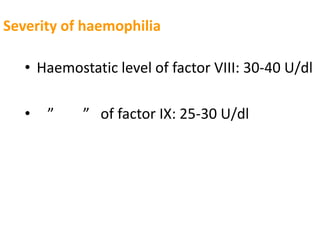
Severity of haemophilia

   • Haemostatic level of factor VIII: 30-40 U/dl

   •   ”    ” of factor IX: 25-30 U/dl
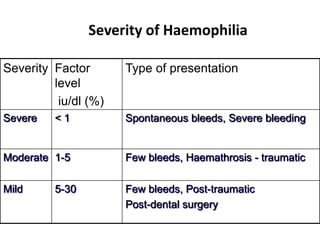
Severity of Haemophilia

Severity Factor       Type of presentation
         level
          iu/dl (%)
Severe   <1           Spontaneous bleeds, Severe bleeding


Moderate 1-5          Few bleeds, Haemathrosis - traumatic

Mild     5-30         Few bleeds, Post-traumatic
                      Post-dental surgery
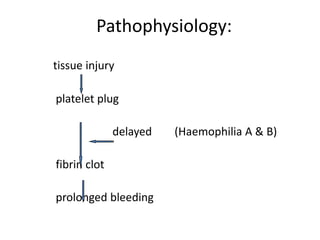
Pathophysiology:
tissue injury

platelet plug

              delayed   (Haemophilia A & B)

fibrin clot

prolonged bleeding
CLINICAL FEATURES – SUBTLE

• Bleeding as a baby rare
• Prolonged bleed from umbilical cord
• Muscle hematoma during immunisation
• Bleeding during circumcision
CLINICAL FEATURES – SUBTLE
• Toddlers - Large and prolonged bleed to
  trivial injury/cuts/abrasions
• Lip bleeds (hematomas)
• First bleeding in childhood
    Tooth extraction
    Trauma with walking
Gum bleeds while brushing teeth
SIGNIFICANT HEMORRHAGES

• RETROPERITONEAL H’GE: severe abd
   pain, anemia and shock
• HEMATURIA
• GI BLEED : difficult to control, severe
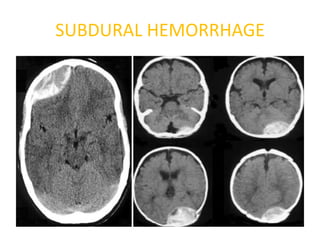
• INTRACRANIAL:
   extradural, subdural, intracerebral
 - Headache, vomiting, altered sensorium ->
   coma
• May be seen in neonates
SUBDURAL HEMORRHAGE
CLINICAL FEATURES - FRANK
HEMARTHROSIS (joint bleed) – hallmark of
  hemophilia
• Joints affected:
• in toddlers - ankle (most common) – earliest jt
  involved due to lack of stability as they assume
  upright posture
• Older child – knee, elbow (most common)
** Target joint – recurrent bleeding at a same
  joint
• LL > UL
CLINICAL FEATURES - FRANK
• Later : all joints
• Contact sports can provoke
• Recurrent – may be unprovoked,
  spontaneous

LARGE HEMATOMAS & EXTENSIVE
  ECCHYMOSES
BLEEDING INTO JOINTS


• First haemorrhage : Swelling >> Pain

• Subsequent haemorrhages: Pain >>
  Swelling
Bleeding in Haemophilia


•   Acute Haemarthrosis
•   Chronic haemophilic arthropathy
•   Bleeding into muscles
•   Haemophilic pseudo tumour - cysts
•   Haematuria
•   Gastrointestinal bleeding
•   Intracranial bleeding
Bleeding in Haemophilia


BLEEDING IN CARRIERS
• Reduced FVIII (IX) levels
• Mild bleeding tendency
• Childbirth
C/F OF ACUTE HAEMARTHROSIS

• Abnormal sensation
• Pain and swelling of joint
• Limitation of movement - especially
  flexion
• Tenderness and heat in the joint
Acute symptoms last 3-4 days; full recovery
  takes weeks
STAGES

• Initial bleed into joint - haemarthrosis
• Inflammatory stage affecting
       Synovium (synovial hypertrophy)
       Cartilage - Bone
• Final Stage
       Permanent joint changes
       Erosion & destruction Cartilage, Bone -
       Knees** ,Ankles** , Elbows*
        Wrists
         Shoulders           less common
         Hips
Chronic Haemophilic Arthropathy
 • Repeated bleeds - many years 
   Chronic degenerative changes
 • Chronic haemophilic arthritis → Loss
   of joint movement → Fixed flexion
   contractures → Severe muscle wasting
   → Muscle action imbalance →Valgus
   deformities → Crippling deformities →
      Wheel chair-bound
Chronic Haemophilic Arthropathy – Radiological
                  Changes
•   Epiphyseal overgrowth
•   Enlargement of bone ends
•   Loss of cartilage (joint space)
•   Gross irregularity articular surface
     –Subchondral collapse
     –Subchondral cysts
     –Osteophyte formation
     –Osteoporosis
     –Changes in joint alignment
HAEMOPHILIC PSEUDO TUMOURS (BLOOD
 CYSTS)

• Cysts within the fascial muscle envelope
• Cysts arising in muscles
• Cysts arising from sub-periosteal
  haemorrhage
• Pseudo tumours in bone
• Gross destruction of normal architecture
  of bone
• Large bone cysts
• Pathological fracture
Complications :
• Pain
• Anaemia (proportionate to bleeding)
• Constitutional disturbances:
    fever < 24 hrs
    anorexia, malaise
• Chronic arthritis
• Pressure effects of large haematomas
• Transfusion acquired infections
• Inhibitors
Lab findings:
•   Hb low – proportional to blood loss
•   Platelets- normal
•   Bleeding time -normal
•   PT normal
•   APTT prolonged > 2-3 times ULN
•   CT prolonged
•   Low levels of F VIII / IX
•   Factor VIII and IX assay : mixing studies
•   Genetic analysis
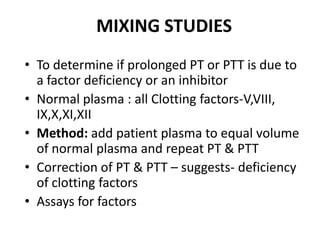
MIXING STUDIES
• To determine if prolonged PT or PTT is due to
  a factor deficiency or an inhibitor
• Normal plasma : all Clotting factors-V,VIII,
  IX,X,XI,XII
• Method: add patient plasma to equal volume
  of normal plasma and repeat PT & PTT
• Correction of PT & PTT – suggests- deficiency
  of clotting factors
• Assays for factors
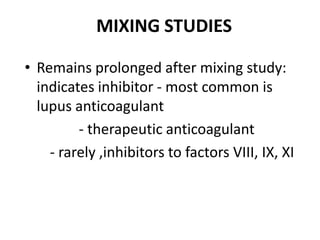
MIXING STUDIES

• Remains prolonged after mixing study:
  indicates inhibitor - most common is
  lupus anticoagulant
         - therapeutic anticoagulant
    - rarely ,inhibitors to factors VIII, IX, XI
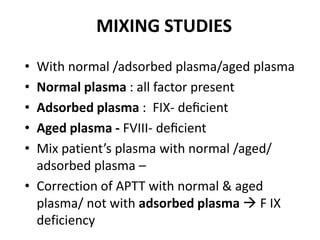
MIXING STUDIES
• With normal /adsorbed plasma/aged plasma
• Normal plasma : all factor present
• Adsorbed plasma : FIX- deficient
• Aged plasma - FVIII- deficient
• Mix patient’s plasma with normal /aged/
  adsorbed plasma –
• Correction of APTT with normal & aged
  plasma/ not with adsorbed plasma  F IX
  deficiency
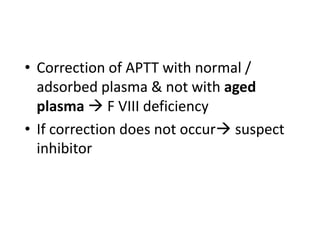
• Correction of APTT with normal /
  adsorbed plasma & not with aged
  plasma  F VIII deficiency
• If correction does not occur suspect
  inhibitor
Inhibitors:
• Antibodies against factors blocks clotting
  activity
• 14-25 % patients who receive factors (VIII/ IX)
• Failure of a bleeding episode to respond to
  appropriate replacement therapy 1st sign of
  inhibitor
• Others develop higher titres 
  desensitisation- higher doses of factors given
RADIOLOGICAL INVESTIGATIONS
•   Radiographs of joints
•   USG joints for effusions
•   MRI joints/ abdomen
•   CT head
MANAGEMENT -PRINICIPLES
• Control bleeding episodes – replacement
  therapy
• Prophylaxis and prevention
• Life style modifications
• Treatment of complications
• Rehabilitation
• Antenatal diagnosis and counselling
• Team effort : pediatrician, hematologist,
  orthopedician, physiotherapist, dentist
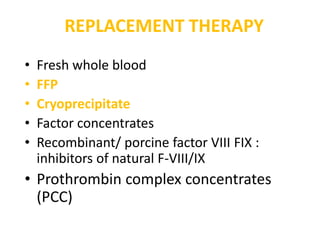
REPLACEMENT THERAPY
•   Fresh whole blood
•   FFP
•   Cryoprecipitate
•   Factor concentrates
•   Recombinant/ porcine factor VIII FIX :
    inhibitors of natural F-VIII/IX
• Prothrombin complex concentrates
  (PCC)
FFP AND CRYOPPT
• FFP contains F VIII and IX
• CRYOPPT contains F-VIII, fibrinogen, VWF
• 1 unit FFP = 200 units factor VIII/IX
• 1 unit cryoppt = 100 units factor VIII
• FVIII 1u/kg Increase plasma factor VIII by 2% (
  2 iu/dl) - t ½ = 8 hrs
• FIX 1u/kg Increase plasma factor IX by 1%
  (1iu/dl) - t ½ = 18-20 hrs
• Risk of HIV, HBV, HCV, CMV transmission
FACTOR CONCENTRATES
• Prothrombin complex concentrates
  (PCC) - Contain F IX & Vitamin K
  dependent factors I.e. II, VII, IX, X – high
  cost
• Pure factor IX concentrates available
  – Currently high cost
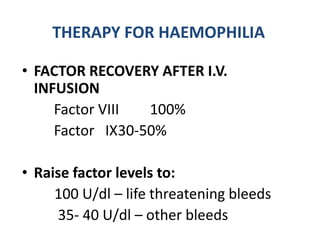
THERAPY FOR HAEMOPHILIA

• FACTOR RECOVERY AFTER I.V.
  INFUSION
     Factor VIII  100%
     Factor IX30-50%

• Raise factor levels to:
     100 U/dl – life threatening bleeds
      35- 40 U/dl – other bleeds
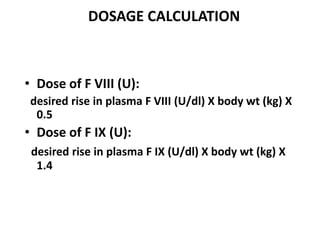
DOSAGE CALCULATION


• Dose of F VIII (U):
 desired rise in plasma F VIII (U/dl) X body wt (kg) X
  0.5
• Dose of F IX (U):
 desired rise in plasma F IX (U/dl) X body wt (kg) X
  1.4
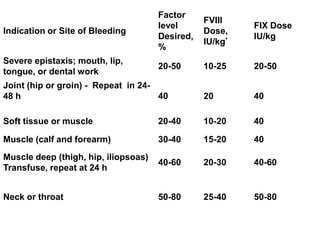
Factor
                                                 FVIII
                                      level               FIX Dose
Indication or Site of Bleeding                   Dose,
                                      Desired,            IU/kg
                                                 IU/kg*
                                      %
Severe epistaxis; mouth, lip,
                                      20-50      10-25    20-50
tongue, or dental work
Joint (hip or groin) - Repeat in 24-
48 h                                 40          20       40

Soft tissue or muscle                 20-40      10-20    40

Muscle (calf and forearm)             30-40      15-20    40
Muscle deep (thigh, hip, iliopsoas)
                                      40-60      20-30    40-60
Transfuse, repeat at 24 h


Neck or throat                        50-80      25-40    50-80
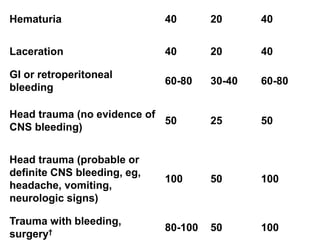
Hematuria                    40       20      40


Laceration                   40       20      40

GI or retroperitoneal
                             60-80    30-40   60-80
bleeding

Head trauma (no evidence of
                            50        25      50
CNS bleeding)


Head trauma (probable or
definite CNS bleeding, eg,
                             100      50      100
headache, vomiting,
neurologic signs)

Trauma with bleeding,
                             80-100   50      100
surgery†
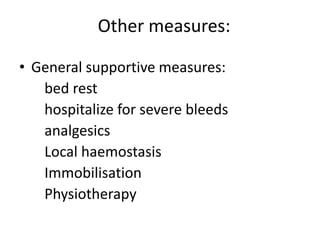
Other measures:

• General supportive measures:
   bed rest
   hospitalize for severe bleeds
   analgesics
   Local haemostasis
   Immobilisation
   Physiotherapy
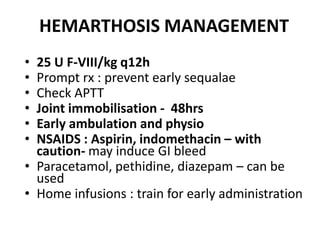
HEMARTHOSIS MANAGEMENT
• 25 U F-VIII/kg q12h
• Prompt rx : prevent early sequalae
• Check APTT
• Joint immobilisation - 48hrs
• Early ambulation and physio
• NSAIDS : Aspirin, indomethacin – with
  caution- may induce GI bleed
• Paracetamol, pethidine, diazepam – can be
  used
• Home infusions : train for early administration
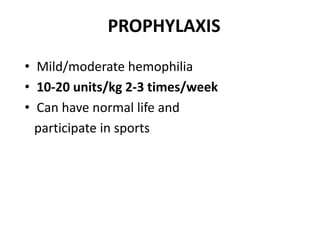
PROPHYLAXIS
• Mild/moderate hemophilia
• 10-20 units/kg 2-3 times/week
• Can have normal life and
  participate in sports
PREVENTION

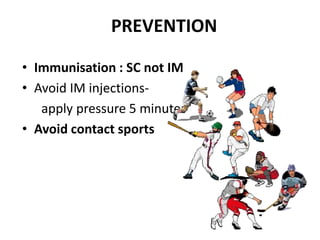
• Immunisation : SC not IM
• Avoid IM injections-
   apply pressure 5 minutes
• Avoid contact sports
PREVENTION

• Orthopaedic care- traction, splinting,
  reconstructive surgery
• Regular dental exam and hygiene
• Prophylactic immunization- hep B
• Counselling
DRUGS

• EACA - aminocaproic acid
• Tranexemic acid: 25mg/kg/day
• C/I in hematuria- ppt renal failure
• Desmopressin acetate: increases levels for
  first 2 days from body stores
• Danazol
• Fibrin glue : tooth extraction
Other agents used:
• Tranexamic acid
     Used for external bleeding
     eg. teeth extraction
     Not for internal bleedings
     Inhibits fibrinolysis
     decreases F VIII requirement
• DDAVP D-amino D-arginine Vasopressin
   Found to raise FVIII levels
   Mild haemophilia- releases F VIII from storage
   sites
   Moderate to severe cases- no endogenous
   stores treatment ineffective
   Mild von Willebrand’s disease
   Not effective in Haemophilia B
• Danazol:
    Androgen
    Elevates levels of protein in factors
    Increases levels of F VIII & F IX
• Prednisolone
    Acute synovitis
ANTENATAL DIAGNOSIS

•   18-20 weeks
•   Male fetuses
•   Fetal blood :
•   Amniotic fluid fibroblasts :DNA probe
•   Chorionic villous sampling :PCR
CARRIER DETECTION

• FVIII-C: FVIIIAg = 1:1 normally
• In carriers FVIII-C is low
• Hence ratio: 0.6:1
ACQUIRED HEMOPHILIA
• 5-20% of hemophiliacs develop antibodies against
   factor VIII/IX with time - alloantibodies
• Hemophilia A > Hemophilia B
• Suspect when failure of therapy
• Manage:
1) porcine FVIII
2) activated prothrombin complex
3) activated FVII
4) plasmapheresis
5) immunosuppresants
6) recombinant FVIII/IX
THERAPY FOR HAEMOPHILIA


• DEMAND THERAPY            Hospital
                            Home
  Long standing approach to haemophilia
     Patient treats when bleeds
     Arrest acute bleed
     No arrest, long term sequelae
• PROPHYLACTIC THERAPY
PROPHYLACTIC THERAPY

• Initiated with the 1st bleed
• Home - self or patient infused
• Small dose FVIII (FIX) 2-3 X /week ( 20%-
  30%)
      Prevents bleeds
      Prevents long term sequelae
THERAPY FOR SURGERY/ DENTISTRY
• Prophylactic
• Enables major procedures - 10 days cover
Thank you
Download more documents and slide shows on The
    Medical Post [ www.themedicalpost.net ]

Hemophilia

  • 1.
    Hemophilia Dr. Kalpana Malla MD Pediatrics Manipal Teaching Hospital Download more documents and slide shows on The Medical Post [ www.themedicalpost.net ]
  • 2.
    Introduction:HAEMOPHILIA • Commonest inheritedbleeding disorder • Bleeding due to deficiency of FVIII / IX / XI coagulant activity • Severity of bleeding is related to FVIII / IX /XI concentration in blood
  • 3.
    INCIDENCE • 1 per5,000 male births • 1 per 10,000 population • 85 % - F VIII deficiency • 10- 15 % - F IX deficiency • Haemophilia A: B= 7:1
  • 4.
    Mode of Inheritance: – X- linked recessive Males affected Females carriers
  • 5.
  • 6.
    INHERITANCE • Father withHaemophilia: Daughters are carriers Sons normal • Mother with haemophilia gene (carrier) Sons 50:50 normal or affected Daughters 50:50 normal or carriers
  • 7.
    FEMALES AFFECTED ONLYWHEN: 1) TURNERS SYNDROME 2) MOSAICISM/LYONISATION 3) MOTHER TO DAUGHTER TRANSMISSION (POSSIBLE THEORETICALLY BUT EXTREMLY RARE)
  • 8.
    Types: • Haemophilia A– deficiency of Factor VIII • Haemophilia B – deficiency of Factor IX • Haemophilia C – deficiency of Factor XI
  • 9.
    HAEMOPHILIA A &B: • Basic abnormality : 1. Reduction in amount of protein in factor 2. Dysfunctional protein 5-10 % Haemophilia A 40-50 % ” ” B
  • 10.
    Severity of haemophilia •1 ml of normal plasma contains 1 unit (U) of each factor 100 ml plasma contains 100 U/dl (100 % activity) Severity depends on factor level in blood: ● Severe haemophilia: < 1 U/dl (%) ● Moderate haemophilia: 1-5 U/dl (%) ● Mild haemophilia: 5-30 U/dl (%)
  • 11.
    Severity of haemophilia • Haemostatic level of factor VIII: 30-40 U/dl • ” ” of factor IX: 25-30 U/dl
  • 12.
    Severity of Haemophilia SeverityFactor Type of presentation level iu/dl (%) Severe <1 Spontaneous bleeds, Severe bleeding Moderate 1-5 Few bleeds, Haemathrosis - traumatic Mild 5-30 Few bleeds, Post-traumatic Post-dental surgery
  • 13.
    Pathophysiology: tissue injury platelet plug delayed (Haemophilia A & B) fibrin clot prolonged bleeding
  • 14.
    CLINICAL FEATURES –SUBTLE • Bleeding as a baby rare • Prolonged bleed from umbilical cord • Muscle hematoma during immunisation • Bleeding during circumcision
  • 15.
    CLINICAL FEATURES –SUBTLE • Toddlers - Large and prolonged bleed to trivial injury/cuts/abrasions • Lip bleeds (hematomas) • First bleeding in childhood Tooth extraction Trauma with walking Gum bleeds while brushing teeth
  • 16.
    SIGNIFICANT HEMORRHAGES • RETROPERITONEALH’GE: severe abd pain, anemia and shock • HEMATURIA • GI BLEED : difficult to control, severe • INTRACRANIAL: extradural, subdural, intracerebral - Headache, vomiting, altered sensorium -> coma • May be seen in neonates
  • 17.
  • 18.
    CLINICAL FEATURES -FRANK HEMARTHROSIS (joint bleed) – hallmark of hemophilia • Joints affected: • in toddlers - ankle (most common) – earliest jt involved due to lack of stability as they assume upright posture • Older child – knee, elbow (most common) ** Target joint – recurrent bleeding at a same joint • LL > UL
  • 19.
    CLINICAL FEATURES -FRANK • Later : all joints • Contact sports can provoke • Recurrent – may be unprovoked, spontaneous LARGE HEMATOMAS & EXTENSIVE ECCHYMOSES
  • 20.
    BLEEDING INTO JOINTS •First haemorrhage : Swelling >> Pain • Subsequent haemorrhages: Pain >> Swelling
  • 21.
    Bleeding in Haemophilia • Acute Haemarthrosis • Chronic haemophilic arthropathy • Bleeding into muscles • Haemophilic pseudo tumour - cysts • Haematuria • Gastrointestinal bleeding • Intracranial bleeding
  • 22.
    Bleeding in Haemophilia BLEEDINGIN CARRIERS • Reduced FVIII (IX) levels • Mild bleeding tendency • Childbirth
  • 23.
    C/F OF ACUTEHAEMARTHROSIS • Abnormal sensation • Pain and swelling of joint • Limitation of movement - especially flexion • Tenderness and heat in the joint Acute symptoms last 3-4 days; full recovery takes weeks
  • 24.
    STAGES • Initial bleedinto joint - haemarthrosis • Inflammatory stage affecting Synovium (synovial hypertrophy) Cartilage - Bone • Final Stage Permanent joint changes Erosion & destruction Cartilage, Bone - Knees** ,Ankles** , Elbows* Wrists Shoulders less common Hips
  • 25.
    Chronic Haemophilic Arthropathy • Repeated bleeds - many years  Chronic degenerative changes • Chronic haemophilic arthritis → Loss of joint movement → Fixed flexion contractures → Severe muscle wasting → Muscle action imbalance →Valgus deformities → Crippling deformities → Wheel chair-bound
  • 26.
    Chronic Haemophilic Arthropathy– Radiological Changes • Epiphyseal overgrowth • Enlargement of bone ends • Loss of cartilage (joint space) • Gross irregularity articular surface –Subchondral collapse –Subchondral cysts –Osteophyte formation –Osteoporosis –Changes in joint alignment
  • 27.
    HAEMOPHILIC PSEUDO TUMOURS(BLOOD CYSTS) • Cysts within the fascial muscle envelope • Cysts arising in muscles • Cysts arising from sub-periosteal haemorrhage • Pseudo tumours in bone • Gross destruction of normal architecture of bone • Large bone cysts • Pathological fracture
  • 28.
    Complications : • Pain •Anaemia (proportionate to bleeding) • Constitutional disturbances: fever < 24 hrs anorexia, malaise • Chronic arthritis • Pressure effects of large haematomas • Transfusion acquired infections • Inhibitors
  • 29.
    Lab findings: • Hb low – proportional to blood loss • Platelets- normal • Bleeding time -normal • PT normal • APTT prolonged > 2-3 times ULN • CT prolonged • Low levels of F VIII / IX • Factor VIII and IX assay : mixing studies • Genetic analysis
  • 30.
    MIXING STUDIES • Todetermine if prolonged PT or PTT is due to a factor deficiency or an inhibitor • Normal plasma : all Clotting factors-V,VIII, IX,X,XI,XII • Method: add patient plasma to equal volume of normal plasma and repeat PT & PTT • Correction of PT & PTT – suggests- deficiency of clotting factors • Assays for factors
  • 31.
    MIXING STUDIES • Remainsprolonged after mixing study: indicates inhibitor - most common is lupus anticoagulant - therapeutic anticoagulant - rarely ,inhibitors to factors VIII, IX, XI
  • 32.
    MIXING STUDIES • Withnormal /adsorbed plasma/aged plasma • Normal plasma : all factor present • Adsorbed plasma : FIX- deficient • Aged plasma - FVIII- deficient • Mix patient’s plasma with normal /aged/ adsorbed plasma – • Correction of APTT with normal & aged plasma/ not with adsorbed plasma  F IX deficiency
  • 33.
    • Correction ofAPTT with normal / adsorbed plasma & not with aged plasma  F VIII deficiency • If correction does not occur suspect inhibitor
  • 34.
    Inhibitors: • Antibodies againstfactors blocks clotting activity • 14-25 % patients who receive factors (VIII/ IX) • Failure of a bleeding episode to respond to appropriate replacement therapy 1st sign of inhibitor • Others develop higher titres  desensitisation- higher doses of factors given
  • 35.
    RADIOLOGICAL INVESTIGATIONS • Radiographs of joints • USG joints for effusions • MRI joints/ abdomen • CT head
  • 37.
    MANAGEMENT -PRINICIPLES • Controlbleeding episodes – replacement therapy • Prophylaxis and prevention • Life style modifications • Treatment of complications • Rehabilitation • Antenatal diagnosis and counselling • Team effort : pediatrician, hematologist, orthopedician, physiotherapist, dentist
  • 38.
    REPLACEMENT THERAPY • Fresh whole blood • FFP • Cryoprecipitate • Factor concentrates • Recombinant/ porcine factor VIII FIX : inhibitors of natural F-VIII/IX • Prothrombin complex concentrates (PCC)
  • 39.
    FFP AND CRYOPPT •FFP contains F VIII and IX • CRYOPPT contains F-VIII, fibrinogen, VWF • 1 unit FFP = 200 units factor VIII/IX • 1 unit cryoppt = 100 units factor VIII • FVIII 1u/kg Increase plasma factor VIII by 2% ( 2 iu/dl) - t ½ = 8 hrs • FIX 1u/kg Increase plasma factor IX by 1% (1iu/dl) - t ½ = 18-20 hrs • Risk of HIV, HBV, HCV, CMV transmission
  • 40.
    FACTOR CONCENTRATES • Prothrombincomplex concentrates (PCC) - Contain F IX & Vitamin K dependent factors I.e. II, VII, IX, X – high cost • Pure factor IX concentrates available – Currently high cost
  • 41.
    THERAPY FOR HAEMOPHILIA •FACTOR RECOVERY AFTER I.V. INFUSION Factor VIII 100% Factor IX30-50% • Raise factor levels to: 100 U/dl – life threatening bleeds 35- 40 U/dl – other bleeds
  • 42.
    DOSAGE CALCULATION • Doseof F VIII (U): desired rise in plasma F VIII (U/dl) X body wt (kg) X 0.5 • Dose of F IX (U): desired rise in plasma F IX (U/dl) X body wt (kg) X 1.4
  • 43.
    Factor FVIII level FIX Dose Indication or Site of Bleeding Dose, Desired, IU/kg IU/kg* % Severe epistaxis; mouth, lip, 20-50 10-25 20-50 tongue, or dental work Joint (hip or groin) - Repeat in 24- 48 h 40 20 40 Soft tissue or muscle 20-40 10-20 40 Muscle (calf and forearm) 30-40 15-20 40 Muscle deep (thigh, hip, iliopsoas) 40-60 20-30 40-60 Transfuse, repeat at 24 h Neck or throat 50-80 25-40 50-80
  • 44.
    Hematuria 40 20 40 Laceration 40 20 40 GI or retroperitoneal 60-80 30-40 60-80 bleeding Head trauma (no evidence of 50 25 50 CNS bleeding) Head trauma (probable or definite CNS bleeding, eg, 100 50 100 headache, vomiting, neurologic signs) Trauma with bleeding, 80-100 50 100 surgery†
  • 45.
    Other measures: • Generalsupportive measures: bed rest hospitalize for severe bleeds analgesics Local haemostasis Immobilisation Physiotherapy
  • 46.
    HEMARTHOSIS MANAGEMENT • 25U F-VIII/kg q12h • Prompt rx : prevent early sequalae • Check APTT • Joint immobilisation - 48hrs • Early ambulation and physio • NSAIDS : Aspirin, indomethacin – with caution- may induce GI bleed • Paracetamol, pethidine, diazepam – can be used • Home infusions : train for early administration
  • 47.
    PROPHYLAXIS • Mild/moderate hemophilia •10-20 units/kg 2-3 times/week • Can have normal life and participate in sports
  • 48.
    PREVENTION • Immunisation :SC not IM • Avoid IM injections- apply pressure 5 minutes • Avoid contact sports
  • 49.
    PREVENTION • Orthopaedic care-traction, splinting, reconstructive surgery • Regular dental exam and hygiene • Prophylactic immunization- hep B • Counselling
  • 50.
    DRUGS • EACA -aminocaproic acid • Tranexemic acid: 25mg/kg/day • C/I in hematuria- ppt renal failure • Desmopressin acetate: increases levels for first 2 days from body stores • Danazol • Fibrin glue : tooth extraction
  • 51.
    Other agents used: •Tranexamic acid Used for external bleeding eg. teeth extraction Not for internal bleedings Inhibits fibrinolysis decreases F VIII requirement
  • 52.
    • DDAVP D-aminoD-arginine Vasopressin Found to raise FVIII levels Mild haemophilia- releases F VIII from storage sites Moderate to severe cases- no endogenous stores treatment ineffective Mild von Willebrand’s disease Not effective in Haemophilia B
  • 53.
    • Danazol: Androgen Elevates levels of protein in factors Increases levels of F VIII & F IX • Prednisolone Acute synovitis
  • 54.
    ANTENATAL DIAGNOSIS • 18-20 weeks • Male fetuses • Fetal blood : • Amniotic fluid fibroblasts :DNA probe • Chorionic villous sampling :PCR
  • 55.
    CARRIER DETECTION • FVIII-C:FVIIIAg = 1:1 normally • In carriers FVIII-C is low • Hence ratio: 0.6:1
  • 56.
    ACQUIRED HEMOPHILIA • 5-20%of hemophiliacs develop antibodies against factor VIII/IX with time - alloantibodies • Hemophilia A > Hemophilia B • Suspect when failure of therapy • Manage: 1) porcine FVIII 2) activated prothrombin complex 3) activated FVII 4) plasmapheresis 5) immunosuppresants 6) recombinant FVIII/IX
  • 57.
    THERAPY FOR HAEMOPHILIA •DEMAND THERAPY Hospital Home Long standing approach to haemophilia Patient treats when bleeds Arrest acute bleed No arrest, long term sequelae • PROPHYLACTIC THERAPY
  • 58.
    PROPHYLACTIC THERAPY • Initiatedwith the 1st bleed • Home - self or patient infused • Small dose FVIII (FIX) 2-3 X /week ( 20%- 30%) Prevents bleeds Prevents long term sequelae THERAPY FOR SURGERY/ DENTISTRY • Prophylactic • Enables major procedures - 10 days cover
  • 59.
    Thank you Download moredocuments and slide shows on The Medical Post [ www.themedicalpost.net ]