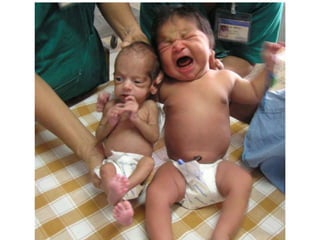
Prematurity and IUGR


                                   Dr. Kalpana Malla
                                       MD Pediatrics
                           Manipal Teaching Hospital

Download more documents and slide shows on The Medical Post [ www.themedicalpost.net ]
• Preterm – born before 37 completed
        weeks of gestation
• IUGR - birth weight is <10TH CENTILE
              FOR GESTATIONAL AGE
         or > 2 SDs below mean for GA.
Types of IUGR

• Symmetric IUGR: weight,length and head
  circumference are all below the 10 th
  percentile. (33 % of IUGR Infants)
• Asymmetric IUGR: weight is below the 10
  th percentile and head circumference and
  length are preserved. (55 % IUGR)
• Combined type IUGR: Infant may have
  skeletal shortening, some reduction of soft
  tissue mass. (12 % of IUGR)
Characteristics of IUGR
Symmetric (chronic)
• Early onset - Due to
  1. intrinsic cong infection or chromosomal genetic
   defects
  2. Extrinsic factor (early gestational life) – maternal
   malnutrition, alcohol, smoking
• Normal ponderal index
• Brain symmetrical to body
• Decreased growth potential
Examples - Genetic causes, chromosomal
             - TORCH infections
             - Anomalad Syndromes
Characteristics of IUGR
Asymmetric (acute)
• Late onset- Environmental factors
• Brain sparing
• Has better prognosis
Examples
• Hypoxia
• Preeclampsia (PIH, PET)
• Chronic hypertension
Ponderal Index
• Way of characterizing the relationship of height to
  mass for an individual.

                   3
• PI = 1000 x          Mass (kgs)
                       Height (cms)
• Typical values are 20 to 25.
• PI is normal in symmetric IUGR.
• PI is low in asymmetric IUGR.
Causes of Preterm Birth
FETAL
• Fetal distress
• Multiple gestation
• Erythroblastosis
• Nonimmune hydrops

PLACENTAL
• Placental dysfunction
• Placenta previa
• Abruptio placentae
Causes of Preterm Birth

UTERINE
• Bicornuate uterus
• Incompetent cervix (premature
  dilatation)
Causes of Preterm Birth
MATERNAL
• Preeclampsia
• Chronic medical illness (e.g., cyanotic
  heart disease, renal disease)
• Infection (e.g., Listeria monocytogenes,
  group B streptococcus, urinary tract
  infection, bacterial vaginosis,
  chorioamnionitis)
• Drug abuse (e.g.cocaine)
Causes of Preterm Birth
OTHER
• Premature rupture of membranes
• Polyhydramnios
• Trauma
Factors Associated with IUGR
FETAL
• Chromosomal disorders
• Chronic fetal infections (e.g.,
  cytomegalic inclusion disease, congenital
  rubella, syphilis)
• Congenital anomalies–syndrome
  complexes
• Irradiation
Factors Associated with IUGR
FETAL
• Multiple gestation
• Pancreatic hypoplasia
• Insulin deficiency
• Insulin-like growth factor type I
  deficiency
Factors Associated with IUGR
PLACENTAL FACTORS
•   Placental insufficiency ( most imp in 3rd trimester)
•   Villous placentitis (bacterial, viral, parasitic)
•   Infarction
•   Tumor (chorioangioma, hydatidiform mole)
•   Premature placental separation
•   Small Placenta
•   Twin transfusion syndrome
Factors Associated with IUGR
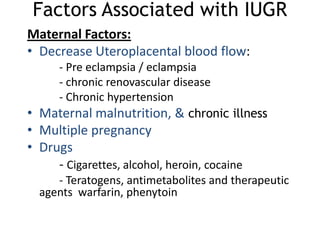
Maternal Factors:
• Decrease Uteroplacental blood flow:
    - Pre eclampsia / eclampsia
    - chronic renovascular disease
    - Chronic hypertension
• Maternal malnutrition, & chronic illness
• Multiple pregnancy
• Drugs
     - Cigarettes, alcohol, heroin, cocaine
     - Teratogens, antimetabolites and therapeutic
  agents warfarin, phenytoin
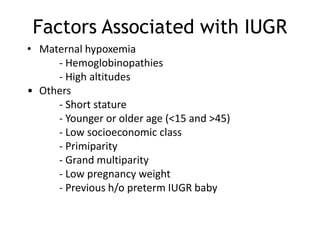
Factors Associated with IUGR
• Maternal hypoxemia
     - Hemoglobinopathies
     - High altitudes
• Others
     - Short stature
     - Younger or older age (<15 and >45)
     - Low socioeconomic class
     - Primiparity
     - Grand multiparity
     - Low pregnancy weight
     - Previous h/o preterm IUGR baby
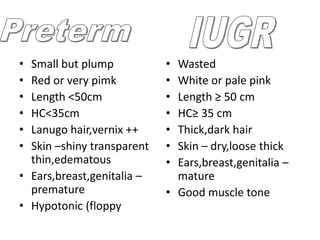
• Small but plump           • Wasted
• Red or very pimk          • White or pale pink
• Length <50cm              • Length ≥ 50 cm
• HC<35cm                   • HC≥ 35 cm
• Lanugo hair,vernix ++     • Thick,dark hair
• Skin –shiny transparent   • Skin – dry,loose thick
  thin,edematous            • Ears,breast,genitalia –
• Ears,breast,genitalia –     mature
  premature                 • Good muscle tone
• Hypotonic (floppy
IUGR
• Heads are disproportionately large for their
  trunks and extremities
• Facial appearance has been likened to that of
  a “wizened old man”.
Problems of IUGR (SGA) Infants
• Hypoxia
        - Perinatal asphyxia
       - Persistent pulmonary hypertension
       - Meconium aspiration


• Thermoregulation
 - Hypothermia due to diminished subcutaneous fat
 and elevated surface/volume ratio
Problems of IUGR (SGA) Infants
• Metabolic
 - Hypoglycemia
     - result from inadequate glycogen stores.
     - diminished gluconeogenesis.
     - increased BMR
        - Glucose needs of hypoxia
        - Hypothermia
        - Large brain
 - Hypocalcemia
     - due to high serum glucagon level, which
 stimulate calcitonin excretion
Problems of IUGR (SGA) Infants
• Hematologic
 - hyperviscosity and polycythemia due to
 increase erythropoietin level sec. to hypoxia
• Immunologic
 - IUGR have increased protein catabolism
 and decreased in protein, prealbumin and
 immunoglobulins, which decreased humoral
 and cellular immunity.
Problems of IUGR (SGA) Infants
• Skeletal: Decreased ossification of
  endochondral & membranous cartilage.
• Malformations: Increased incidence of
  Cong.malformations.
Problems of IUGR (SGA) Infants
Dysmorphology
• Syndrome anomalads
• chromosomal-genetic disorders
• Oligohydramnios-induced deformations
• TORCH infection
• Pulmonary hemorrhage
Problems with Premature Infants
RESPIRATORY
• Respiratory distress syndrome (hyaline
  membrane disease)
• Bronchopulmonary dysplasia
• Pneumothorax, pneumomediastinum;
  interstitial emphysema
• Congenital pneumonia
• Pulmonary hypoplasia
• Pulmonary hemorrhage
• Apnea
Problems with Premature Infants
CARDIOVASCULAR
• Patent ductus arteriosus
• Hypotension
• Hypertension
• Bradycardia (with apnea)
• Congenital malformations
Problems with Premature Infants
HEMATOLOGIC
• Anemia (early or late onset)
• Hyperbilirubinemia–indirect
• Subcutaneous, organ (liver, adrenal)
  hemorrhage
• Disseminated intravascular coagulopathy
• Vitamin K deficiency
Problems with Premature Infants
GASTROINTESTINAL
• Poor gastrointestinal function–poor
  motility
• Necrotizing enterocolitis
• Congenital anomalies producing
  polyhydramnios
• Spontaneous gastrointestinal isolated
  perforation
Problems with Premature Infants

METABOLIC-ENDOCRINE
• Hypocalcemia
• Hypoglycemia
• Hyperglycemia
• Late metabolic acidosis
Problems with Premature Infants

RENAL
• Dyselectrolytemia – hyponatremia,
  hypernatremia,hyperkalemia
• Renal tubular acidosis
Problems with Premature Infants
CENTRAL NERVOUS SYSTEM
• Intraventricular hemorrhage
• Periventricular leukomalacia
• Hypoxic-ischemic encephalopathy
• Seizures
• Retinopathy of prematurity
• Deafness
• Hypotonia
Problems with Premature Infants
• Congenital malformations
• Kernicterus (bilirubin encephalopathy)
• Drug (narcotic) withdrawal

OTHER
• Infections (congenital, perinatal,
  nosocomial: bacterial, viral, fungal,
  protozoal)
Management of IUGR
• Delivery and Resuscitation
• Hypoglycemia
  - close monitoring of blood glucose
  - early treatment ( IV dextrose, early feeding )
• Hematological Disorder - Hct to detect polycythemia
• Congenital infection
  - TORCH titer screening
  - Viral cx of urine, nasopharynx
  - Head CT to r/o calcification
Management of IUGR
• Genetic anomalies
  - screening- chromosomal analysis
• Others
  - serum calcium to r/o hypocalcemia
  - Mx - meconium aspiration
Management-PRETERM /LBW DELIVERY
           ROOM CARE
• Warmth and drying
• Resuscitation / Respiratory support
     • Oxygen blow-by
     • Bag-and-mask ventilation
     • Endotracheal intubation and ventilation
     • Exogenous surfactant
     • Nasal CPAP if required
• Transfer to NICU in transport incubator
CRITERIA FOR NICU ADMISSION OF
              LBW BABIES *

•   Gestational age <34 weeks
•   Birth weight < 1800 g
•   SGA with birth weight <3rd percentile
•   Any sick neonate, irrespective of BW and
    gestational age

    *   Recommendations of the National Neonatology Forum
NICU CARE
•   Temperature control
•   Respiratory support
•   Fluids and electrolytes
•   Nutritional support
•   Infection control
•   Cardiovascular support
•   Others- Skin care, Hyperbilirubinemia
•   Suplement
1. TEMPERATURE CONTROL
• Aim: a) Maintaining temperature
       b) Prevent cold stress
       c) Reduce insensible water loss
• Methods:
       –  Radiant warmer (290 C-310 C)
       –  Pre warmed incubator ( 320C- 350C)
       –  Warm room – ( 210 C)
       –  Heat shield
       –  Warm clothing-cap, socks
       –  KMC
       –  Bath postponed
KANGAROO MOTHER CARE
• Benefits
  – Thermoregulation
  – Exclusive breast feeding
  – Physiologic stability
  – Decreased incidence of infection
  – Infant-mother bonding
  – Cost effective
2. RESPIRATORY SUPPORT


• Free flow oxygen
• Ventilatory support
• Surfactant therapy
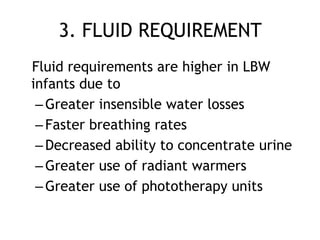
3. FLUID REQUIREMENT
Fluid requirements are higher in LBW
infants due to
 – Greater insensible water losses
 – Faster breathing rates
 – Decreased ability to concentrate urine
 – Greater use of radiant warmers
 – Greater use of phototherapy units
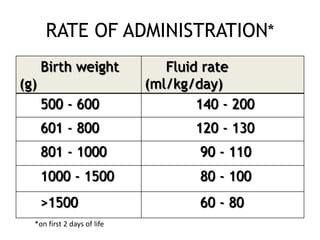
RATE OF ADMINISTRATION*
      Birth weight              Fluid rate
(g)                          (ml/kg/day)
      500 - 600                      140 - 200
      601 - 800                     120 - 130
      801 - 1000                     90 - 110
      1000 - 1500                    80 - 100
      >1500                          60 - 80
  *on first 2 days of life
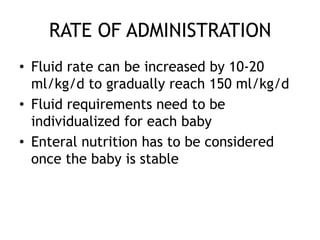
RATE OF ADMINISTRATION
• Fluid rate can be increased by 10-20
  ml/kg/d to gradually reach 150 ml/kg/d
• Fluid requirements need to be
  individualized for each baby
• Enteral nutrition has to be considered
  once the baby is stable
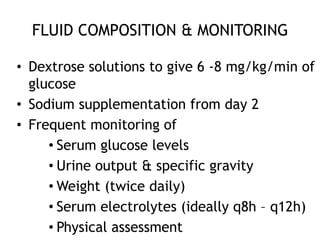
FLUID COMPOSITION & MONITORING

• Dextrose solutions to give 6 -8 mg/kg/min of
  glucose
• Sodium supplementation from day 2
• Frequent monitoring of
     • Serum glucose levels
     • Urine output & specific gravity
     • Weight (twice daily)
     • Serum electrolytes (ideally q8h – q12h)
     • Physical assessment
4. TOTAL PARENTERAL NUTRITION
• Indications
   – Infants with BW ≤ 1000 g
   – Infants with BW ≤ 1500 g, done in
     conjunction with slowly advancing enteral
     nutrition
   – Infants with BW 1501-1800 g for whom
     enteral intake is not expected for > 3
     days
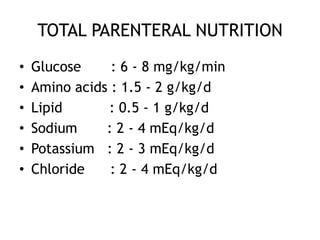
TOTAL PARENTERAL NUTRITION
•   Glucose     : 6 - 8 mg/kg/min
•   Amino acids : 1.5 - 2 g/kg/d
•   Lipid      : 0.5 - 1 g/kg/d
•   Sodium     : 2 - 4 mEq/kg/d
•   Potassium : 2 - 3 mEq/kg/d
•   Chloride    : 2 - 4 mEq/kg/d
TOTAL PARENTERAL NUTRITION
•   Calcium
•   Phosphorous
•   Magnesium
•   Others:
     – Zinc
     – Copper
     – Chromium
     – Selenium
     – Molybdenum
EARLY ENTERAL NUTRITION
Trophic feeding/ Gut priming
  Practice of feeding very small amounts of
  enteral nourishment to stimulate
  development of the immature GIT
Adv:
 Improves GI motility
 Enhances enzyme maturation
 Improves mineral absorption
 Lowers incidence of cholestasis
 Shortens time to regain birth weight
ENTERAL NUTRITION
• Breast milk or ½ or full strength preterm
  formula at 10ml/kg/d by intermittent
  gavage/ continuous nasogastric drip
• Increase by 10-15 ml/kg/d to reach
  150ml/kg/d
• Increments not >20 ml/kg/d
• IV fluids can be stopped once 120ml/kg/d
  is reached
• On reaching 150ml/kg/d,calorie density
  can be increased
FEEDING GUIDELINES
PRETERMS
• <1200 g/ <32 wks: IV fluids for first 2-3
  days, once stable start gavage feeding
• 1200-1800 g/ 32-34 wks: Start gavage
  feeding, once vigorous start spoon/
  breast feeding
FEEDING GUIDELINES
• >1800 g/ >34 wks: Start breast
  feeding directly; if trial feed
  takes>20 mins or intake is less than
  required, switch to gavage feeding
TERM IUGRs/ SGA
• Breast feeding
PRETERM HUMAN MILK
Advantages:
  – Higher concentrations of amino acids
  – Higher concentrations of essential fatty
    acids
  – Lower renal solute load
  – Specific bio-active factors provide
    immunity
  – Promotes intestinal maturation
PRETERM HUMAN MILK

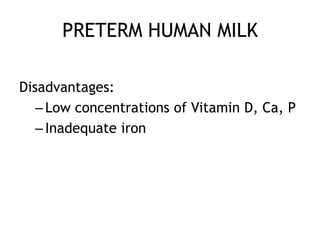
Disadvantages:
   – Low concentrations of Vitamin D, Ca, P
   – Inadequate iron
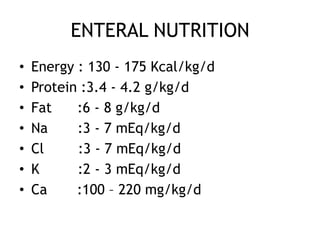
ENTERAL NUTRITION
•   Energy : 130 - 175 Kcal/kg/d
•   Protein :3.4 - 4.2 g/kg/d
•   Fat    :6 - 8 g/kg/d
•   Na     :3 - 7 mEq/kg/d
•   Cl     :3 - 7 mEq/kg/d
•   K      :2 - 3 mEq/kg/d
•   Ca     :100 – 220 mg/kg/d
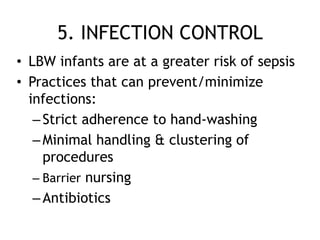
5. INFECTION CONTROL
• LBW infants are at a greater risk of sepsis
• Practices that can prevent/minimize
  infections:
   – Strict adherence to hand-washing
   – Minimal handling & clustering of
     procedures
   – Barrier nursing
   – Antibiotics
5. INFECTION CONTROL
– Practices that can prevent/minimize
  infection:
– Restriction of broad spectrum antibiotics
  use
– Minimizing duration of mechanical
  ventilation
– Early initiation of enteral feeds
– Central & peripheral venous catheter care
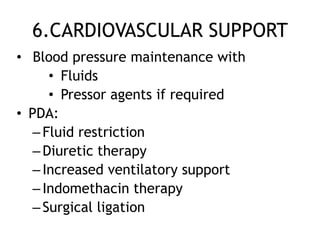
6.CARDIOVASCULAR SUPPORT
• Blood pressure maintenance with
      • Fluids
      • Pressor agents if required
• PDA:
   – Fluid restriction
   – Diuretic therapy
   – Increased ventilatory support
   – Indomethacin therapy
   – Surgical ligation
7. SKIN CARE
• Stratum corneum is deficient in preterms
• Mature epidermal barrier is established by 2
  weeks post natal age
• Limited use of adhesives
• Frequent repositioning of infant
• Use of soft bedding or water mattress
• Prophylactic use of emollients is no longer
  recommended
• Jaundice – early management
8. SUPPLEMENTATION
• Human Milk Fortifiers
• Calcium:50-100 mg/kg/d from end of 1st week
  to 40 weeks post-conceptional age
• Iron:2-2.5 mg/kg/d from 6-8 wks of age till 12
  months of age
• Vitamins
   – Vitamin A(1000U/d) & Vitamin D(400U/d) ,Vit
     C – 50mg/d from 2 weeks of age
   – Vitamin E -15 IU/d for VLBW infants till 37
     weeks
Outcome
• Symmetric vs. Asymmetric IUGR
  - symmetric has poor outcome compare to asymmetric
• Preterm IUGR has high incidence of abnormalities
• IUGR with chromosomal disease has 100% incidence
  of handicap
• Congenital infection has poor outcome - handicap
  rate > 50%
• IUGR has higher rate of learning disability.
“Long term” Morbidity of IUGR
  Factors associated with abnormal
              outcome ?
             Microcephaly
   Hypoxic ischemic encephalopathy
      Symptomatic hypoglycemia
      Symptomatic hyperviscosity
Fetal Origins of Adult Diseases ?
  • Coronary artery disease correlates
    inversely with birth weight
  • Rate of non-insulin dependent diabetes
    mellitus is highest in the “thinnest” babies
    at birth (low ponderal index)
  • High serum cholesterol are linked to
    disproportionate size at birth (body
    smaller than head)
  • Increased rate of hypertension in infants
    who were thin, short, &/or
    proportionately small at birth
Sequelae of Low Birth weight
•   Mental retardation
•   Poor school performance
•   Spasticity
•   Seizures
•   Hydrocephalus
•   Sensorineural injury-Hearing
•    Short-bowel syndrome
•   Malabsorption
Sequelae of Low Birth weight
•   Visual impairment
•   Retinopathy of prematurity
•   Strabismus, myopia
•   Bronchopulmonary dysplasia,
•   Bronchospasm
•   Recurrent pneumonia
Sequelae of Low Birthweight
•   Growth failure - Failure to thrive
•   Gastroesophageal reflux
•   PEM
•   Osteopenia, fractures,
•   Anemia
Follow-up

•   Anemia
•   Retinopathy of prematurity
•   Hearing screenings
•   Cholestasis
•   Stable temperature regulation
•   Gaining weight on oral feedings
•   Nutritional support
Follow-up
• Breast-feeding
• Appropriate immunizations
• Ophthalmologic examination if <27 wk
  or <1,250?g at birth
Thank you
Download more documents and slide shows on The
    Medical Post [ www.themedicalpost.net ]

Prematurity and IUGR

  • 1.
    Prematurity and IUGR Dr. Kalpana Malla MD Pediatrics Manipal Teaching Hospital Download more documents and slide shows on The Medical Post [ www.themedicalpost.net ]
  • 3.
    • Preterm –born before 37 completed weeks of gestation • IUGR - birth weight is <10TH CENTILE FOR GESTATIONAL AGE or > 2 SDs below mean for GA.
  • 4.
    Types of IUGR •Symmetric IUGR: weight,length and head circumference are all below the 10 th percentile. (33 % of IUGR Infants) • Asymmetric IUGR: weight is below the 10 th percentile and head circumference and length are preserved. (55 % IUGR) • Combined type IUGR: Infant may have skeletal shortening, some reduction of soft tissue mass. (12 % of IUGR)
  • 5.
    Characteristics of IUGR Symmetric(chronic) • Early onset - Due to 1. intrinsic cong infection or chromosomal genetic defects 2. Extrinsic factor (early gestational life) – maternal malnutrition, alcohol, smoking • Normal ponderal index • Brain symmetrical to body • Decreased growth potential Examples - Genetic causes, chromosomal - TORCH infections - Anomalad Syndromes
  • 6.
    Characteristics of IUGR Asymmetric(acute) • Late onset- Environmental factors • Brain sparing • Has better prognosis Examples • Hypoxia • Preeclampsia (PIH, PET) • Chronic hypertension
  • 7.
    Ponderal Index • Wayof characterizing the relationship of height to mass for an individual. 3 • PI = 1000 x Mass (kgs) Height (cms) • Typical values are 20 to 25. • PI is normal in symmetric IUGR. • PI is low in asymmetric IUGR.
  • 8.
    Causes of PretermBirth FETAL • Fetal distress • Multiple gestation • Erythroblastosis • Nonimmune hydrops PLACENTAL • Placental dysfunction • Placenta previa • Abruptio placentae
  • 9.
    Causes of PretermBirth UTERINE • Bicornuate uterus • Incompetent cervix (premature dilatation)
  • 10.
    Causes of PretermBirth MATERNAL • Preeclampsia • Chronic medical illness (e.g., cyanotic heart disease, renal disease) • Infection (e.g., Listeria monocytogenes, group B streptococcus, urinary tract infection, bacterial vaginosis, chorioamnionitis) • Drug abuse (e.g.cocaine)
  • 11.
    Causes of PretermBirth OTHER • Premature rupture of membranes • Polyhydramnios • Trauma
  • 12.
    Factors Associated withIUGR FETAL • Chromosomal disorders • Chronic fetal infections (e.g., cytomegalic inclusion disease, congenital rubella, syphilis) • Congenital anomalies–syndrome complexes • Irradiation
  • 13.
    Factors Associated withIUGR FETAL • Multiple gestation • Pancreatic hypoplasia • Insulin deficiency • Insulin-like growth factor type I deficiency
  • 14.
    Factors Associated withIUGR PLACENTAL FACTORS • Placental insufficiency ( most imp in 3rd trimester) • Villous placentitis (bacterial, viral, parasitic) • Infarction • Tumor (chorioangioma, hydatidiform mole) • Premature placental separation • Small Placenta • Twin transfusion syndrome
  • 15.
    Factors Associated withIUGR Maternal Factors: • Decrease Uteroplacental blood flow: - Pre eclampsia / eclampsia - chronic renovascular disease - Chronic hypertension • Maternal malnutrition, & chronic illness • Multiple pregnancy • Drugs - Cigarettes, alcohol, heroin, cocaine - Teratogens, antimetabolites and therapeutic agents warfarin, phenytoin
  • 16.
    Factors Associated withIUGR • Maternal hypoxemia - Hemoglobinopathies - High altitudes • Others - Short stature - Younger or older age (<15 and >45) - Low socioeconomic class - Primiparity - Grand multiparity - Low pregnancy weight - Previous h/o preterm IUGR baby
  • 19.
    • Small butplump • Wasted • Red or very pimk • White or pale pink • Length <50cm • Length ≥ 50 cm • HC<35cm • HC≥ 35 cm • Lanugo hair,vernix ++ • Thick,dark hair • Skin –shiny transparent • Skin – dry,loose thick thin,edematous • Ears,breast,genitalia – • Ears,breast,genitalia – mature premature • Good muscle tone • Hypotonic (floppy
  • 20.
    IUGR • Heads aredisproportionately large for their trunks and extremities • Facial appearance has been likened to that of a “wizened old man”.
  • 21.
    Problems of IUGR(SGA) Infants • Hypoxia - Perinatal asphyxia - Persistent pulmonary hypertension - Meconium aspiration • Thermoregulation - Hypothermia due to diminished subcutaneous fat and elevated surface/volume ratio
  • 22.
    Problems of IUGR(SGA) Infants • Metabolic - Hypoglycemia - result from inadequate glycogen stores. - diminished gluconeogenesis. - increased BMR - Glucose needs of hypoxia - Hypothermia - Large brain - Hypocalcemia - due to high serum glucagon level, which stimulate calcitonin excretion
  • 23.
    Problems of IUGR(SGA) Infants • Hematologic - hyperviscosity and polycythemia due to increase erythropoietin level sec. to hypoxia • Immunologic - IUGR have increased protein catabolism and decreased in protein, prealbumin and immunoglobulins, which decreased humoral and cellular immunity.
  • 24.
    Problems of IUGR(SGA) Infants • Skeletal: Decreased ossification of endochondral & membranous cartilage. • Malformations: Increased incidence of Cong.malformations.
  • 25.
    Problems of IUGR(SGA) Infants Dysmorphology • Syndrome anomalads • chromosomal-genetic disorders • Oligohydramnios-induced deformations • TORCH infection • Pulmonary hemorrhage
  • 26.
    Problems with PrematureInfants RESPIRATORY • Respiratory distress syndrome (hyaline membrane disease) • Bronchopulmonary dysplasia • Pneumothorax, pneumomediastinum; interstitial emphysema • Congenital pneumonia • Pulmonary hypoplasia • Pulmonary hemorrhage • Apnea
  • 27.
    Problems with PrematureInfants CARDIOVASCULAR • Patent ductus arteriosus • Hypotension • Hypertension • Bradycardia (with apnea) • Congenital malformations
  • 28.
    Problems with PrematureInfants HEMATOLOGIC • Anemia (early or late onset) • Hyperbilirubinemia–indirect • Subcutaneous, organ (liver, adrenal) hemorrhage • Disseminated intravascular coagulopathy • Vitamin K deficiency
  • 29.
    Problems with PrematureInfants GASTROINTESTINAL • Poor gastrointestinal function–poor motility • Necrotizing enterocolitis • Congenital anomalies producing polyhydramnios • Spontaneous gastrointestinal isolated perforation
  • 30.
    Problems with PrematureInfants METABOLIC-ENDOCRINE • Hypocalcemia • Hypoglycemia • Hyperglycemia • Late metabolic acidosis
  • 31.
    Problems with PrematureInfants RENAL • Dyselectrolytemia – hyponatremia, hypernatremia,hyperkalemia • Renal tubular acidosis
  • 32.
    Problems with PrematureInfants CENTRAL NERVOUS SYSTEM • Intraventricular hemorrhage • Periventricular leukomalacia • Hypoxic-ischemic encephalopathy • Seizures • Retinopathy of prematurity • Deafness • Hypotonia
  • 33.
    Problems with PrematureInfants • Congenital malformations • Kernicterus (bilirubin encephalopathy) • Drug (narcotic) withdrawal OTHER • Infections (congenital, perinatal, nosocomial: bacterial, viral, fungal, protozoal)
  • 34.
    Management of IUGR •Delivery and Resuscitation • Hypoglycemia - close monitoring of blood glucose - early treatment ( IV dextrose, early feeding ) • Hematological Disorder - Hct to detect polycythemia • Congenital infection - TORCH titer screening - Viral cx of urine, nasopharynx - Head CT to r/o calcification
  • 35.
    Management of IUGR •Genetic anomalies - screening- chromosomal analysis • Others - serum calcium to r/o hypocalcemia - Mx - meconium aspiration
  • 36.
    Management-PRETERM /LBW DELIVERY ROOM CARE • Warmth and drying • Resuscitation / Respiratory support • Oxygen blow-by • Bag-and-mask ventilation • Endotracheal intubation and ventilation • Exogenous surfactant • Nasal CPAP if required • Transfer to NICU in transport incubator
  • 37.
    CRITERIA FOR NICUADMISSION OF LBW BABIES * • Gestational age <34 weeks • Birth weight < 1800 g • SGA with birth weight <3rd percentile • Any sick neonate, irrespective of BW and gestational age * Recommendations of the National Neonatology Forum
  • 38.
    NICU CARE • Temperature control • Respiratory support • Fluids and electrolytes • Nutritional support • Infection control • Cardiovascular support • Others- Skin care, Hyperbilirubinemia • Suplement
  • 39.
    1. TEMPERATURE CONTROL •Aim: a) Maintaining temperature b) Prevent cold stress c) Reduce insensible water loss • Methods: – Radiant warmer (290 C-310 C) – Pre warmed incubator ( 320C- 350C) – Warm room – ( 210 C) – Heat shield – Warm clothing-cap, socks – KMC – Bath postponed
  • 40.
    KANGAROO MOTHER CARE •Benefits – Thermoregulation – Exclusive breast feeding – Physiologic stability – Decreased incidence of infection – Infant-mother bonding – Cost effective
  • 41.
    2. RESPIRATORY SUPPORT •Free flow oxygen • Ventilatory support • Surfactant therapy
  • 42.
    3. FLUID REQUIREMENT Fluidrequirements are higher in LBW infants due to – Greater insensible water losses – Faster breathing rates – Decreased ability to concentrate urine – Greater use of radiant warmers – Greater use of phototherapy units
  • 43.
    RATE OF ADMINISTRATION* Birth weight Fluid rate (g) (ml/kg/day) 500 - 600 140 - 200 601 - 800 120 - 130 801 - 1000 90 - 110 1000 - 1500 80 - 100 >1500 60 - 80 *on first 2 days of life
  • 44.
    RATE OF ADMINISTRATION •Fluid rate can be increased by 10-20 ml/kg/d to gradually reach 150 ml/kg/d • Fluid requirements need to be individualized for each baby • Enteral nutrition has to be considered once the baby is stable
  • 45.
    FLUID COMPOSITION &MONITORING • Dextrose solutions to give 6 -8 mg/kg/min of glucose • Sodium supplementation from day 2 • Frequent monitoring of • Serum glucose levels • Urine output & specific gravity • Weight (twice daily) • Serum electrolytes (ideally q8h – q12h) • Physical assessment
  • 46.
    4. TOTAL PARENTERALNUTRITION • Indications – Infants with BW ≤ 1000 g – Infants with BW ≤ 1500 g, done in conjunction with slowly advancing enteral nutrition – Infants with BW 1501-1800 g for whom enteral intake is not expected for > 3 days
  • 47.
    TOTAL PARENTERAL NUTRITION • Glucose : 6 - 8 mg/kg/min • Amino acids : 1.5 - 2 g/kg/d • Lipid : 0.5 - 1 g/kg/d • Sodium : 2 - 4 mEq/kg/d • Potassium : 2 - 3 mEq/kg/d • Chloride : 2 - 4 mEq/kg/d
  • 48.
    TOTAL PARENTERAL NUTRITION • Calcium • Phosphorous • Magnesium • Others: – Zinc – Copper – Chromium – Selenium – Molybdenum
  • 49.
    EARLY ENTERAL NUTRITION Trophicfeeding/ Gut priming Practice of feeding very small amounts of enteral nourishment to stimulate development of the immature GIT Adv:  Improves GI motility  Enhances enzyme maturation  Improves mineral absorption  Lowers incidence of cholestasis  Shortens time to regain birth weight
  • 50.
    ENTERAL NUTRITION • Breastmilk or ½ or full strength preterm formula at 10ml/kg/d by intermittent gavage/ continuous nasogastric drip • Increase by 10-15 ml/kg/d to reach 150ml/kg/d • Increments not >20 ml/kg/d • IV fluids can be stopped once 120ml/kg/d is reached • On reaching 150ml/kg/d,calorie density can be increased
  • 51.
    FEEDING GUIDELINES PRETERMS • <1200g/ <32 wks: IV fluids for first 2-3 days, once stable start gavage feeding • 1200-1800 g/ 32-34 wks: Start gavage feeding, once vigorous start spoon/ breast feeding
  • 52.
    FEEDING GUIDELINES • >1800g/ >34 wks: Start breast feeding directly; if trial feed takes>20 mins or intake is less than required, switch to gavage feeding TERM IUGRs/ SGA • Breast feeding
  • 53.
    PRETERM HUMAN MILK Advantages: – Higher concentrations of amino acids – Higher concentrations of essential fatty acids – Lower renal solute load – Specific bio-active factors provide immunity – Promotes intestinal maturation
  • 54.
    PRETERM HUMAN MILK Disadvantages: – Low concentrations of Vitamin D, Ca, P – Inadequate iron
  • 55.
    ENTERAL NUTRITION • Energy : 130 - 175 Kcal/kg/d • Protein :3.4 - 4.2 g/kg/d • Fat :6 - 8 g/kg/d • Na :3 - 7 mEq/kg/d • Cl :3 - 7 mEq/kg/d • K :2 - 3 mEq/kg/d • Ca :100 – 220 mg/kg/d
  • 56.
    5. INFECTION CONTROL •LBW infants are at a greater risk of sepsis • Practices that can prevent/minimize infections: – Strict adherence to hand-washing – Minimal handling & clustering of procedures – Barrier nursing – Antibiotics
  • 57.
    5. INFECTION CONTROL –Practices that can prevent/minimize infection: – Restriction of broad spectrum antibiotics use – Minimizing duration of mechanical ventilation – Early initiation of enteral feeds – Central & peripheral venous catheter care
  • 58.
    6.CARDIOVASCULAR SUPPORT • Bloodpressure maintenance with • Fluids • Pressor agents if required • PDA: – Fluid restriction – Diuretic therapy – Increased ventilatory support – Indomethacin therapy – Surgical ligation
  • 59.
    7. SKIN CARE •Stratum corneum is deficient in preterms • Mature epidermal barrier is established by 2 weeks post natal age • Limited use of adhesives • Frequent repositioning of infant • Use of soft bedding or water mattress • Prophylactic use of emollients is no longer recommended • Jaundice – early management
  • 60.
    8. SUPPLEMENTATION • HumanMilk Fortifiers • Calcium:50-100 mg/kg/d from end of 1st week to 40 weeks post-conceptional age • Iron:2-2.5 mg/kg/d from 6-8 wks of age till 12 months of age • Vitamins – Vitamin A(1000U/d) & Vitamin D(400U/d) ,Vit C – 50mg/d from 2 weeks of age – Vitamin E -15 IU/d for VLBW infants till 37 weeks
  • 61.
    Outcome • Symmetric vs.Asymmetric IUGR - symmetric has poor outcome compare to asymmetric • Preterm IUGR has high incidence of abnormalities • IUGR with chromosomal disease has 100% incidence of handicap • Congenital infection has poor outcome - handicap rate > 50% • IUGR has higher rate of learning disability.
  • 62.
    “Long term” Morbidityof IUGR Factors associated with abnormal outcome ? Microcephaly Hypoxic ischemic encephalopathy Symptomatic hypoglycemia Symptomatic hyperviscosity
  • 63.
    Fetal Origins ofAdult Diseases ? • Coronary artery disease correlates inversely with birth weight • Rate of non-insulin dependent diabetes mellitus is highest in the “thinnest” babies at birth (low ponderal index) • High serum cholesterol are linked to disproportionate size at birth (body smaller than head) • Increased rate of hypertension in infants who were thin, short, &/or proportionately small at birth
  • 64.
    Sequelae of LowBirth weight • Mental retardation • Poor school performance • Spasticity • Seizures • Hydrocephalus • Sensorineural injury-Hearing • Short-bowel syndrome • Malabsorption
  • 65.
    Sequelae of LowBirth weight • Visual impairment • Retinopathy of prematurity • Strabismus, myopia • Bronchopulmonary dysplasia, • Bronchospasm • Recurrent pneumonia
  • 66.
    Sequelae of LowBirthweight • Growth failure - Failure to thrive • Gastroesophageal reflux • PEM • Osteopenia, fractures, • Anemia
  • 67.
    Follow-up • Anemia • Retinopathy of prematurity • Hearing screenings • Cholestasis • Stable temperature regulation • Gaining weight on oral feedings • Nutritional support
  • 68.
    Follow-up • Breast-feeding • Appropriateimmunizations • Ophthalmologic examination if <27 wk or <1,250?g at birth
  • 69.
    Thank you Download moredocuments and slide shows on The Medical Post [ www.themedicalpost.net ]