myopathiesDR.PRAVEENNAGULA
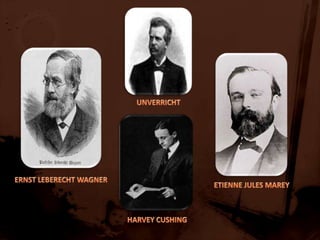
      UNVERRICHTERNST LEBERECHT WAGNERETIENNE JULES MAREYHARVEY CUSHING
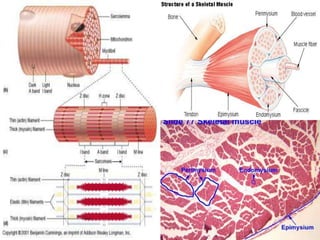
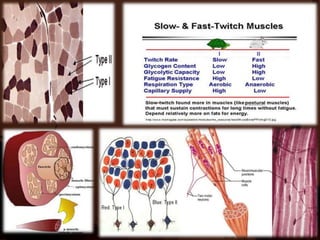
Basic muscle anatomy.physiology
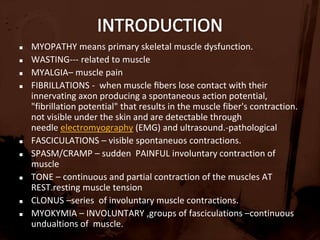
INTRODUCTIONMYOPATHY means primary skeletal muscle dysfunction.WASTING--- related to muscle MYALGIA– muscle painFIBRILLATIONS -  when muscle fibers lose contact with their innervating axon producing a spontaneous action potential, "fibrillation potential" that results in the muscle fiber's contraction.  not visible under the skin and are detectable through needle electromyography (EMG) and ultrasound.-pathologicalFASCICULATIONS – visible spontaneuos contractions. SPASM/CRAMP – sudden  PAINFUL involuntary contraction of muscleTONE – continuous and partial contraction of the muscles AT REST.resting muscle tensionCLONUS –series  of involuntary muscle contractions.MYOKYMIA – INVOLUNTARY ,groups of fasciculations –continuous undualtions of  muscle.
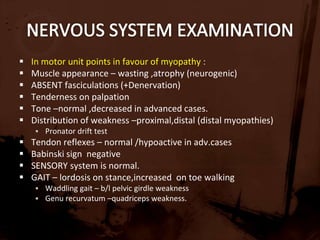
NERVOUS SYSTEM EXAMINATIONIn motor unit points in favour of myopathy:
Muscle appearance – wasting ,atrophy (neurogenic)
ABSENT fasciculations (+Denervation)
Tenderness on palpation
Tone –normal ,decreased in advanced cases.
Distribution of weakness –proximal,distal (distal myopathies)
Pronator drift test
Tendon reflexes – normal /hypoactive in adv.cases
Babinski sign  negative
SENSORY system is normal.
GAIT – lordosis on stance,increased  on toe walking
Waddling gait – b/l pelvic girdle weakness
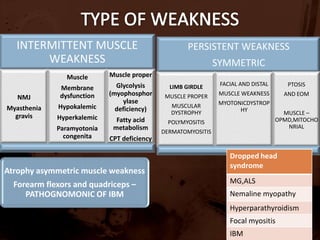
Genurecurvatum –quadriceps weakness.TYPE OF WEAKNESS
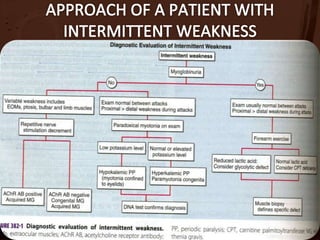
APPROACH OF A PATIENT WITH INTERMITTENT WEAKNESS
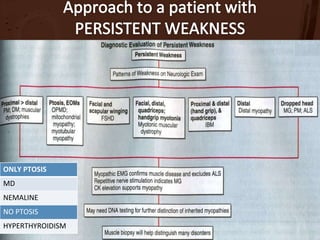
Approach to a patient with PERSISTENT WEAKNESS
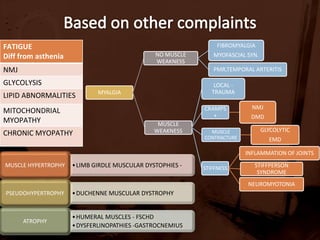
Based on other complaints
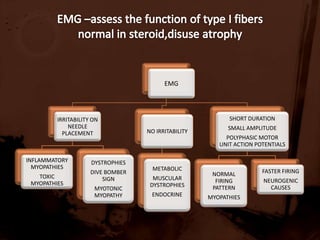
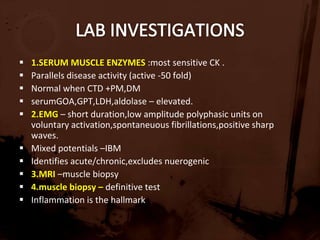
EMG –assess the function of type I fibersnormal in steroid,disuse atrophy
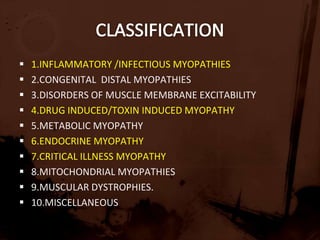
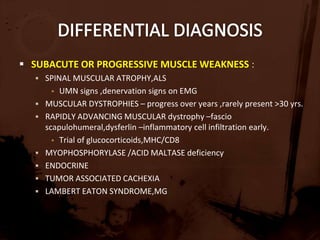
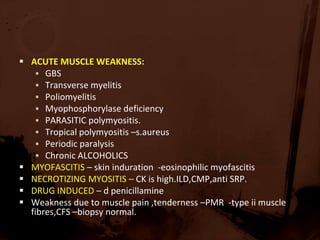
CLASSIFICATION1.INFLAMMATORY /INFECTIOUS MYOPATHIES
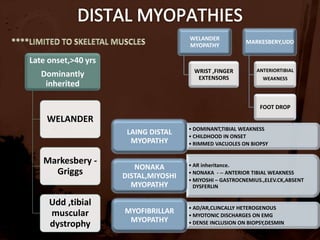
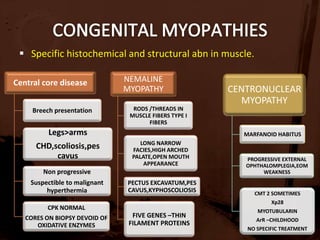
2.CONGENITAL  DISTAL MYOPATHIES
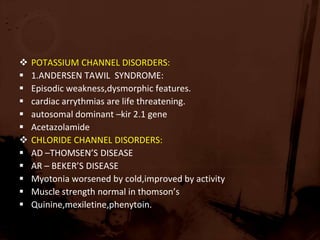
3.DISORDERS OF MUSCLE MEMBRANE EXCITABILITY
4.DRUG INDUCED/TOXIN INDUCED MYOPATHY
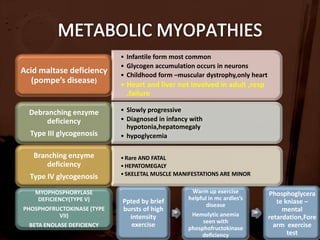
5.METABOLIC MYOPATHY
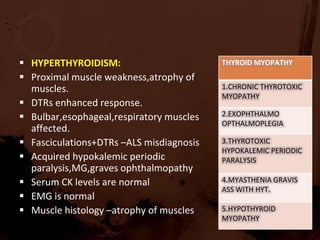
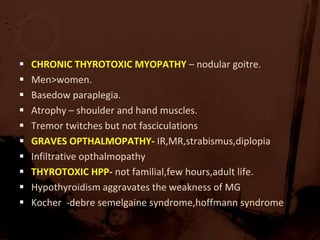
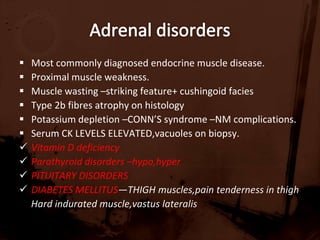
6.ENDOCRINE MYOPATHY
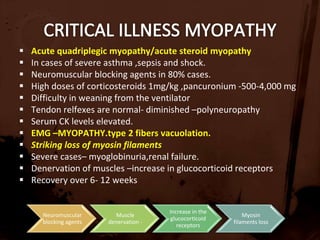
7.CRITICAL ILLNESS MYOPATHY
8.MITOCHONDRIAL MYOPATHIES
9.MUSCULAR DYSTROPHIES.
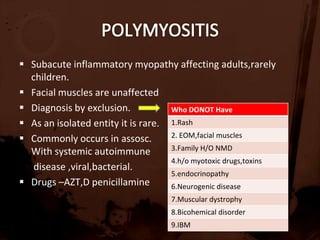
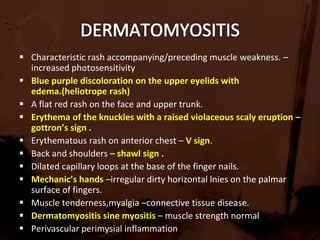
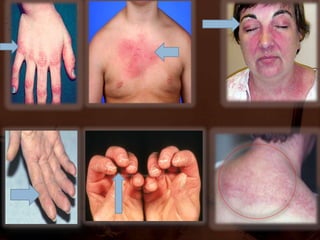
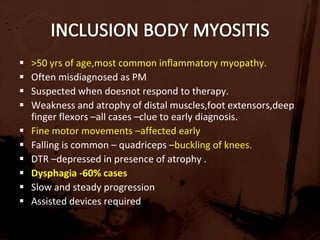
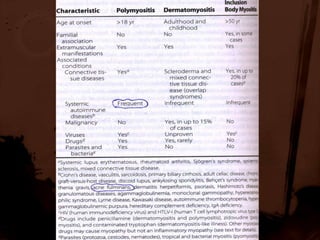
10.MISCELLANEOUSINFLAMMATORY MYOPATIHESLargest group of acquired and potentially treatable causes of skeletal muscle weakness .POLYMYOSITIS (PM)DERMATOMYOSITIS (DM)INCLUSION BODY MYOSITIS (IBM)1 :1,00,000 PM – as alone is a rare disease affecting ADULTS.DM – affects both children,adults  W>MIBM – M:F –3:1 ,caucasians,>50yrs.
PATHOGENESISAutoimmune etiology  - assosciation with other autoimmune CTD ,various Auto Ab, MHC ,T CELL myotoxicity,complement, response to immunotherapy.
AUTOANTIBODIES AND IMMUNOGENETICS:
20% cases – ANA,anticytoplasmic antigens
Anticytoplasmic – anti RNP(anti synthetase),
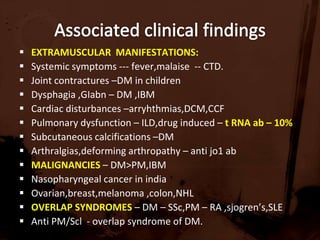
Anti jo 1 – 75% cases -80% assosciation with ILD.
Anti Jo 1 –ILD ,RP,non erosive arthritis,MHCDR3,DRw52.
DRB1 *0301,DQB1*0201 --- 75% PM,IBM
DQA1*0501 –juvenile DM IMMUNOPATHOGENIC MECHANISMSDERMATOMYOSITIS:
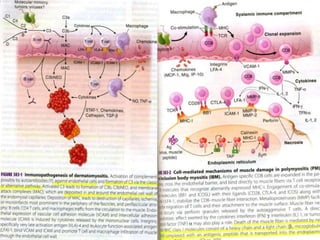
humoral immune mechanisms – microangiopathy.
Endomysial inflammatory infiltrates  -B cells
auto AB  -- complement pathway – C5b-9 membranolytic complex- release of proinflammatory cytokines – VCAM1,ICAM 1  on endothelial cells – migration of lymphoid cells to perimysial and endomysial spaces---necrosis,microinfarcts.
Remaining capillaries dilated due to ischemia
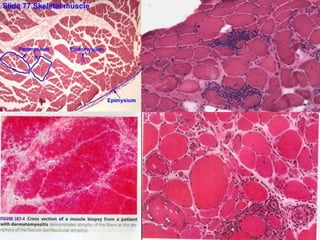
Perifascicular atrophy due to endofascicularhypoperfusion –periphery of muscle fascicles.
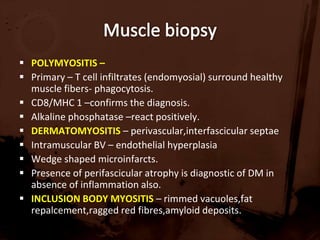
IMMUNOPATHOGENIC MECHANISMSPOLYMYOSITIS,IBM :
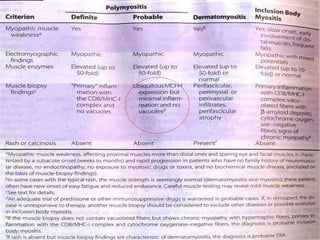
T cell mediated cytotoxicity
CD8 T cells,macrophages –invade and destroy MHC 1 muscle fibres(absent usually )
CD8/MHC 1 complex is characteristic of PM,IBM
These cells have perforin,granzyme granules –myonecrosis.
Antigen driven T cell response (auto AB in DM )
Antigens – endogenous (muscle),exogenous (viral)
Co stimulatory molecules are upregulated . ROLE OF NON IMMUNE FACTORSIBM :
Degenerative process in addition to autoimmune process.
B amyloid deposits within vacuolated muscle fibres,cyto ox –ve mitochondria.
Amyloid is APP,chymotrypsin,apoE,tau
?directly pathogenic /secondary
MHC I upregulation – ER stress – accumulation of misfoldedglycoproteins ,NFkB –cytokine activation .Association with viral infectionsCoxsackie,influenza,paramyxoviruses,mumps,CMV,EBV.

Myopathies