Short Summary ofMD:
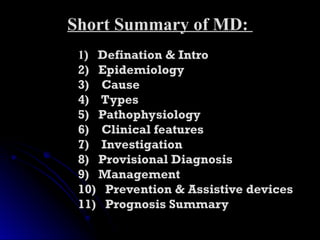
Short Summary of MD:
1
1) Defination & Intro
) Defination & Intro
2) Epidemiology
2) Epidemiology
3) Cause
3) Cause
4) Types
4) Types
5) Pathophysiology
5) Pathophysiology
6) Clinical features
6) Clinical features
7) Investigation
7) Investigation
8) Provisional Diagnosis
8) Provisional Diagnosis
9) Management
9) Management
10) Prevention & Assistive devices
10) Prevention & Assistive devices
11) Prognosis Summary
11) Prognosis Summary
3.
Definition:
Definition:
Muscular dystrophyis defined as a
Muscular dystrophy is defined as a
genetically determined disease characterised
genetically determined disease characterised
by progressive degeneration of group of
by progressive degeneration of group of
muscle or degenerative myopathy.
muscle or degenerative myopathy.
(i.e it is disorder of muscle producing
(i.e it is disorder of muscle producing
weakness and resulting from many cause)
weakness and resulting from many cause)
4.
Introduction:
Introduction:
Musculardystrophy (MD) is a group of rare
Muscular dystrophy (MD) is a group of rare
inherited muscle diseases in which muscle
inherited muscle diseases in which muscle
fibers are unusually susceptible to damage.
fibers are unusually susceptible to damage.
Muscles, primarily voluntary muscles, become
Muscles, primarily voluntary muscles, become
progressively weaker.
progressively weaker.
In the late stages of muscular dystrophy, fat
In the late stages of muscular dystrophy, fat
and connective tissue often replace muscle
and connective tissue often replace muscle
fibers.
fibers.
In some types of muscular dystrophy, heart
In some types of muscular dystrophy, heart
muscles, other involuntary muscles and other
muscles, other involuntary muscles and other
organs are affected
organs are affected
5.
The mostcommon types of muscular
The most common types of muscular
dystrophy appear to be due to a genetic
dystrophy appear to be due to a genetic
deficiency of the muscle protein
deficiency of the muscle protein Dystrophin.
Dystrophin.
There's no cure for muscular dystrophy, but
There's no cure for muscular dystrophy, but
medications and therapy can slow the
medications and therapy can slow the
course of the disease.
course of the disease.
Introduction:
Introduction:
Lesssevere from than Duchene MD.
Less severe from than Duchene MD.
Benign form.
Benign form.
X-linked recessive.
X-linked recessive.
Onset 10-30 year
Onset 10-30 year
BMD is less common, BMD is associated with
BMD is less common, BMD is associated with
the same muscle weakness that DMD is but
the same muscle weakness that DMD is but
with a much later onset age and slower rate of
with a much later onset age and slower rate of
progression.
progression.
The abnormal gene for DMD and BMD is on
The abnormal gene for DMD and BMD is on
the short arm of the X chromosome at position
the short arm of the X chromosome at position
Xp21.
Xp21.
15.
Transmission:
Transmission:
Thedisease may be transmitted by
The disease may be transmitted by
affected males
affected males
then carrier
then carrier daughter
daughter
to their grandsons.
to their grandsons.
16.
Clinical features
Clinical features
Muscle wasting is same as DMD but in milder
Muscle wasting is same as DMD but in milder
form Pectoralis Major, Biceps, Lat. Dorsi, thigh
form Pectoralis Major, Biceps, Lat. Dorsi, thigh
muscle.
muscle.
Proximal muscle esp. of lower extremities are
Proximal muscle esp. of lower extremities are
predominantly involved and as the disease
predominantly involved and as the disease
progresses weakness become more
progresses weakness become more
generalized
generalized
Hypertrophy of muscle particularly calf is an
Hypertrophy of muscle particularly calf is an
early and prominent finding.
early and prominent finding.
17.
The majorityof muscle 1
The majority of muscle 1st
st
experience difficulties
experience difficulties
between ages of 5-25 yrs other onset is 3
between ages of 5-25 yrs other onset is 3rd
rd
decade or
decade or
even later can occur.
even later can occur.
Most pt becomes unable to walk at 25 year or more
Most pt becomes unable to walk at 25 year or more
after the onset.
after the onset.
Becker's dystrophy pt. Have a reduced life but
Becker's dystrophy pt. Have a reduced life but
majority survive into fourth or fifth decade.
majority survive into fourth or fifth decade.
MR is < DMD.
MR is < DMD.
Early contracture and deformity develop.
Early contracture and deformity develop.
Myocardial and intellectual impairment is much less
Myocardial and intellectual impairment is much less
common.
common.
18.
Associated problems:
Associated problems:
Intellect:
Intellect: mean IQ in DMD is between 70-85
mean IQ in DMD is between 70-85
with some boys having very low intelligence.
with some boys having very low intelligence.
the intelligence does not deteriorate with
the intelligence does not deteriorate with
age.
age.
Skeletal abnormalities
Skeletal abnormalities: reference has already
: reference has already
made to the development of a variety of joint
made to the development of a variety of joint
contractures.
contractures.
Bowels:
Bowels: constipation is major problem for many,
constipation is major problem for many,
Bladder infection
Bladder infection: urinary
: urinary incontinence is not a
incontinence is not a
specific feature of DMD but it does occur
specific feature of DMD but it does occur
sometimes.
sometimes.
Vomiting:
Vomiting: uncontrolled vomiting occur
uncontrolled vomiting occur
Obesity:
Obesity:
Pressure sores:
Pressure sores:
Emotional difficulty:
Emotional difficulty:
20.
Aetiology
Aetiology
Occur ineither sex
Occur in either sex
Onset usually in adolescence
Onset usually in adolescence
Facioscapulohumeral muscular dystrophy
Facioscapulohumeral muscular dystrophy
(FSHD) initially affects the muscles of the
(FSHD) initially affects the muscles of the
face, shoulders, and upper arms with
face, shoulders, and upper arms with
progressive weakness.
progressive weakness.
Symptoms usually develop in the teenage
Symptoms usually develop in the teenage
years.
years.
Some affected individuals become severely
Some affected individuals become severely
disabled.
disabled.
21.
Clinical features
Clinical features
Facial involvement is apparent at early stage and is
Facial involvement is apparent at early stage and is
gradually decompenced by weakness of shoulder girdle
gradually decompenced by weakness of shoulder girdle
muscle.
muscle.
There may be followed by weakness of ant. Tibial and
There may be followed by weakness of ant. Tibial and
peroneal muscle usually which spread within 20-30 yrs
peroneal muscle usually which spread within 20-30 yrs
to pelvic muscle.
to pelvic muscle.
Profound facial weakness produces pouting of the lips
Profound facial weakness produces pouting of the lips
and a transverse smile.
and a transverse smile.
slow insidious progression with period of long arrest
slow insidious progression with period of long arrest
of the Dz.
of the Dz.
biceps and brachioradialis are often involved.
biceps and brachioradialis are often involved.
there is difficulty in raising arm above head.
there is difficulty in raising arm above head.
22.
Muscular hypertrophyis common in
Muscular hypertrophy is common in
deltoid and calf muscle.
deltoid and calf muscle.
Mostly affected pt. survive and remain
Mostly affected pt. survive and remain
active until a normal age.
active until a normal age.
23.
4) Congenital M.Dystrophy:
4)Congenital M.Dystrophy:
Age at onset: birth; symptoms include general
Age at onset: birth; symptoms include general
muscle weakness and possible joint
muscle weakness and possible joint
deformities, disease progresses slowly;
deformities, disease progresses slowly;
shortened life span.
shortened life span.
Congenital muscular dystrophy includes
Congenital muscular dystrophy includes
several disorders with a range of symptoms.
several disorders with a range of symptoms.
Muscle degeneration may be mild or severe.
Muscle degeneration may be mild or severe.
Problems may be restricted to skeletal
Problems may be restricted to skeletal
muscle, or muscle degeneration may be
muscle, or muscle degeneration may be
paired with effects on the brain and other
paired with effects on the brain and other
organ systems.
organ systems.
24.
A numberof the forms of the congenital
A number of the forms of the congenital
muscular dystrophies are caused by defects
muscular dystrophies are caused by defects
in proteins that are thought to have some
in proteins that are thought to have some
relationship to the dystrophin-glycoprotein
relationship to the dystrophin-glycoprotein
complex and to the connections between
complex and to the connections between
muscle cells and their surrounding cellular
muscle cells and their surrounding cellular
structure.
structure.
Some forms of congenital muscular
Some forms of congenital muscular
dystrophy show severe brain malformations,
dystrophy show severe brain malformations,
such as
such as lissencephaly and
and hydrocephalus
25.
5) Distal M.Dystrophy
5)Distal M.Dystrophy
Distal muscular dystrophies' age at onset: 20
Distal muscular dystrophies' age at onset: 20
to 60 years;
to 60 years;
symptoms include weakness and wasting of
symptoms include weakness and wasting of
muscles of the hands, forearms, and lower
muscles of the hands, forearms, and lower
legs;
legs;
progress is slow and not life-threatening.
progress is slow and not life-threatening.
26.
6) Limb GirdleM.Dystrophy
6) Limb Girdle M.Dystrophy
Limb-girdle muscular dystrophy is also called
Limb-girdle muscular dystrophy is also called
LGMD.
LGMD.
Affects both boys and girls. LGMDs all show
Affects both boys and girls. LGMDs all show
a similar distribution of muscle weakness,
a similar distribution of muscle weakness,
affecting both upper arms and legs.
affecting both upper arms and legs.
Though a person normally leads a normal life
Though a person normally leads a normal life
with some assistance, in some extreme
with some assistance, in some extreme
cases, death from LGMD occurs due to
cases, death from LGMD occurs due to
cardiopulmonary complications
cardiopulmonary complications
27.
7) Myotonic M.Dystrophy
7)Myotonic M.Dystrophy
Myotonic muscular dystrophy is an autosomal
Myotonic muscular dystrophy is an autosomal
dominant condition that presents with
dominant condition that presents with
myotonia (delayed relaxation of muscles) as
(delayed relaxation of muscles) as
well as muscle wasting and weakness.
well as muscle wasting and weakness.
Myotonic dystrophy varies in severity and
Myotonic dystrophy varies in severity and
manifestations and affects many body
manifestations and affects many body
systems in addition to skeletal muscles,
systems in addition to skeletal muscles,
including the heart, endocrine organs, eyes,
including the heart, endocrine organs, eyes,
and gastrointestinal tract
and gastrointestinal tract
28.
8) Oculopharyngeal M.Dystrophy
8)Oculopharyngeal M.Dystrophy
Oculopharyngeal MD's age at onset: 40 to 70
Oculopharyngeal MD's age at onset: 40 to 70
years; symptoms affect muscles of eyelids,
years; symptoms affect muscles of eyelids,
face, and throat followed by pelvic and
face, and throat followed by pelvic and
shoulder muscle weakness
shoulder muscle weakness
29.
9) Emery DreifussM.Dystrophy:
9) Emery Dreifuss M.Dystrophy:
Emery-Dreifuss Muscular Dystrophy patients
Emery-Dreifuss Muscular Dystrophy patients
normally present in childhood and the early
normally present in childhood and the early
teenage years with contractures.
teenage years with contractures.
Clinical signs include muscle weakness and
Clinical signs include muscle weakness and
wasting, starting in the distal limb muscles
wasting, starting in the distal limb muscles
and progressing to involve the limb-girdle
and progressing to involve the limb-girdle
muscles.
muscles.
Most patients also suffer from cardiac
Most patients also suffer from cardiac
conduction defects and arrhythmias which, if
conduction defects and arrhythmias which, if
left untreated, increase the risk of stroke and
left untreated, increase the risk of stroke and
sudden death.
sudden death.
30.
DEFINITION
DEFINITION
It wasfirst described by French neurologist
It was first described by French neurologist
DUCHENNE in 1968.
DUCHENNE in 1968.
It is not only the most common but also
It is not only the most common but also
severe type of muscular dystrophy.
severe type of muscular dystrophy.
It is X-linked muscle disorder which is
It is X-linked muscle disorder which is
heredofamilial, progressive, & genetically
heredofamilial, progressive, & genetically
determined disease.
determined disease.
It mostly occurs in cardiac and smooth
It mostly occurs in cardiac and smooth
muscle
muscle
31.
Aetiology
Aetiology
M>F
M>F
Ageof onset 3-10 year.
Age of onset 3-10 year.
Incidence : 1 in every 3000-3500 men births.
Incidence : 1 in every 3000-3500 men births.
It is sex linked so occurs only in males
It is sex linked so occurs only in males
although transmitted by carrier females.
although transmitted by carrier females.
The female carrier transmits the disease
The female carrier transmits the disease
through genes to a male child.
through genes to a male child.
32.
Major causeis Muscle protein “Dystrophin”
Major cause is Muscle protein “Dystrophin”
is absent in DMD.
is absent in DMD.
Dystrophin stabilizes the sarcolemma
Dystrophin stabilizes the sarcolemma
during muscle contractions.
during muscle contractions.
Without dystrophin, the sarcolemma is
Without dystrophin, the sarcolemma is
unstable, cell homeostasis is impaired, and,
unstable, cell homeostasis is impaired, and,
ultimately, the myofiber deteriorates.
ultimately, the myofiber deteriorates.
Dystrophin, a large cell wall (sarcolemma)
Dystrophin, a large cell wall (sarcolemma)
structural protein, is
structural protein, is absent in DMD
absent in DMD and of
and of
abnormal molecular weight or of
abnormal molecular weight or of reduced
reduced
amounts in BMD.
amounts in BMD.
33.
Despite someregeneration, the repair
Despite some regeneration, the repair
capacity is rendered insufficient, and the
capacity is rendered insufficient, and the
muscle is replaced by fat and connective
muscle is replaced by fat and connective
tissue
tissue
Only a few decades ago, boys with DMD
Only a few decades ago, boys with DMD
rarely lived to be older than 20 years.
rarely lived to be older than 20 years.
Life expectancy has risen considerably over
Life expectancy has risen considerably over
the past decade because of better
the past decade because of better
management of respiratory or cardiac
management of respiratory or cardiac
complications.
complications.
34.
Pathology
Pathology
Duchenne muscular dystrophyis the most
is the most
common childhood form of the disease; it
common childhood form of the disease; it
occurs in one of every 3,300 male births.
occurs in one of every 3,300 male births.
It is a sex-linked disorder, meaning that it
It is a sex-linked disorder, meaning that it
strikes males almost exclusively.
strikes males almost exclusively.
The disease is caused by a defective gene
The disease is caused by a defective gene
on the 23rd, or X, chromosome that results
on the 23rd, or X, chromosome that results
in the failure of the body to produce a
in the failure of the body to produce a
functional muscle
functional muscle protein called dystrophin.
called dystrophin.
35.
Most femaleswho carry the genetic defect are
Most females who carry the genetic defect are
unaffected, but they have a 50 percent
unaffected, but they have a 50 percent
probability of passing the disease to each of
probability of passing the disease to each of
their sons.
their sons.
Early symptoms, which usually occur between
Early symptoms, which usually occur between
the ages of 2-6 yr, include a waddling gait,
the ages of 2-6 yr, include a waddling gait,
frequent falling, difficulty in getting up from a
frequent falling, difficulty in getting up from a
lying or sitting position, enlargement of the calf
lying or sitting position, enlargement of the calf
muscles, inability to raise the knees, and
muscles, inability to raise the knees, and
disappearance of a normal knee or ankle jerk;
disappearance of a normal knee or ankle jerk;
Symptoms become more obvious as the child
Symptoms become more obvious as the child
ages.
ages.
36.
Some muscleatrophy where others increase
Some muscle atrophy where others increase
in size but this hypertrophy dose not make it
in size but this hypertrophy dose not make it
stronger, b’oz their enlargement is due to
stronger, b’oz their enlargement is due to
increase intestitial sub. (fat) In all of these
increase intestitial sub. (fat) In all of these
there is usually early evidence of
there is usually early evidence of
degeneration and then regeneration of some
degeneration and then regeneration of some
muscle fibres.
fibres.
Those fibres that regenerate become larger
Those fibres that regenerate become larger
than normal, and eventually the muscles are
than normal, and eventually the muscles are
totally replaced by fibrous scar tissue and fat
totally replaced by fibrous scar tissue and fat
37.
Stairs eventuallybecome impossible to climb,
Stairs eventually become impossible to climb,
and by early adolescence the child is unable
and by early adolescence the child is unable
to walk.
to walk.
Muscle wasting progresses upward from the
Muscle wasting progresses upward from the
legs, and the arms are eventually affected.
legs, and the arms are eventually affected.
Ultimately, muscle wasting affects the
Ultimately, muscle wasting affects the
muscles of the
muscles of the diaphragm, and breathing
, and breathing
becomes shallow.
becomes shallow.
Life-threatening pulmonary infections or
Life-threatening pulmonary infections or
respiratory failure usually occurs before the
respiratory failure usually occurs before the
age of 20.
age of 20.
38.
Stages of DMD
Stagesof DMD:
:
I.
I. Ambulatory
Ambulatory
II.
II. Ambulatory but climbs stairs with support.
Ambulatory but climbs stairs with support.
III.
III. Can come to stand from sitting and dependent
Can come to stand from sitting and dependent
but walk with support.
but walk with support.
IV.
IV. Needs to be lifted to come to stand but can walk
Needs to be lifted to come to stand but can walk
with support.
with support.
V.
V. WC independent
WC independent
VI.
VI. WC dependent
WC dependent
VII.
VII. Confined to bed (independent)
Confined to bed (independent)
VIII.
VIII. Confined to bed (dependent for all ADLs)
Confined to bed (dependent for all ADLs)
39.
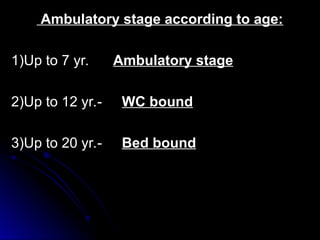
Ambulatory stage accordingto age:
Ambulatory stage according to age:
1)Up to 7 yr.
1)Up to 7 yr. Ambulatory stage
Ambulatory stage
2)Up to 12 yr.-
2)Up to 12 yr.- WC bound
WC bound
3)Up to 20 yr.-
3)Up to 20 yr.- Bed bound
Bed bound
40.
Clinical Features:
Clinical Features:
Depends on which muscle are 1
Depends on which muscle are 1st
st
involved &
involved &
rate of progression of disease.
rate of progression of disease.
Condition become apparent by 3-5 year of
Condition become apparent by 3-5 year of
age.
age.
Milestone are delayed.
Milestone are delayed.
Child starts walking after 18 months.
Child starts walking after 18 months.
41.
1)
1) Onset:
Onset:
Thedisease is usually noticed about 3 years
of age.
Gradual, clumsiness in walking & frequent
Gradual, clumsiness in walking & frequent
falls.
falls.
Climbing upstairs is laborious work and
Climbing upstairs is laborious work and
cannot be attained without any support.
cannot be attained without any support.
Gower’s sign positive-
Gower’s sign positive- while getting up,
while getting up,
child climbs on himself.
child climbs on himself.
42.
2)
2) Muscle Weakness:
Muscle Weakness :
Usually weakness is symmetrically involved
Usually weakness is symmetrically involved
It is mostly of LMN type
It is mostly of LMN type
A)Weakness of :
A)Weakness of :
LL - planter flexors, evertors, quads, gleutii
LL - planter flexors, evertors, quads, gleutii
UL- long extensors of hand, biceps, triceps,
UL- long extensors of hand, biceps, triceps,
deltoid, pectoralis, lattismus, and shouder girdle
deltoid, pectoralis, lattismus, and shouder girdle
muscles
muscles
- deltoid, quadriceps, calf & glutei ( more )
deltoid, quadriceps, calf & glutei ( more )
- Supraspinatus, biceps, triceps, serratus ant (less
Supraspinatus, biceps, triceps, serratus ant (less
)
)
- Massetors & forearm muscle. (rare)
Massetors & forearm muscle. (rare)
43.
(b)
(b) Atrophy of
Atrophyof
- pectoralis major, lat. Dorsi & thigh muscle
pectoralis major, lat. Dorsi & thigh muscle
(c)
(c) Muscle not affected
Muscle not affected
- Hands and feet small muscle
- Hands and feet small muscle
44.
3) Pseudohypertrophy:
3)Pseudohypertrophy:
DMD will show hypertrophy of certain
DMD will show hypertrophy of certain
muscles like planter flexors, quads, deltoid,
muscles like planter flexors, quads, deltoid,
temporalis, hip extensors, and even
temporalis, hip extensors, and even
pectoralis.
pectoralis.
This hypertrophies is called as Pseudo-
This hypertrophies is called as Pseudo-
hypertrophy as it is caused due to abnormal
hypertrophy as it is caused due to abnormal
deposition of fatty tissue and fibrous tissue in
deposition of fatty tissue and fibrous tissue in
muscle mass.
muscle mass.
45.
4)
4) Posture:
Posture:
Attitudeof standing
Attitude of standing
Marked lordosis of lumber spine.
Marked lordosis of lumber spine.
Scapula protracted & shoulder held far.
Scapula protracted & shoulder held far.
Large size of buttocks.
Large size of buttocks.
Abdomen protuberant. (obese)
Abdomen protuberant. (obese)
Kyphosis in sitting.
Kyphosis in sitting.
46.
5)
5) Gait:
Gait:
- Waddlinggait
Waddling gait
- hand and trunk are usually kept erect.
hand and trunk are usually kept erect.
- In standing lordosis become Kyphosis.
In standing lordosis become Kyphosis.
- Slowness in walking.
Slowness in walking.
- Inability to run.
Inability to run.
- Frequent falling.
Frequent falling.
- Inability/difficulty in climbing stairs.
Inability/difficulty in climbing stairs.
- Later frog gait creeping on toes and hand.
Later frog gait creeping on toes and hand.
47.
6)
6) Raising fromthe ground:
Raising from the ground:
- GOWER’S SIGN:
GOWER’S SIGN:
- The child attempts to rise by walking up his legs.
The child attempts to rise by walking up his legs.
to get up from
to get up from prone position
prone position turn on his side
turn on his side
flexes his hip and knee and arm extended raised
flexes his hip and knee and arm extended raised
his trunk to assume a position of
his trunk to assume a position of kneeling.
kneeling.
The feet are brought forward and leg extended at
The feet are brought forward and leg extended at
knee.
knee.
Then by bringing hands, knee and thigh.
Then by bringing hands, knee and thigh.
He climbs up his own legs and pushes his body to
He climbs up his own legs and pushes his body to
upright position
upright position
48.
7)
7) Contracture andDeformity:
Contracture and Deformity:
- At age of 12-15 year the pt. is confined to
At age of 12-15 year the pt. is confined to
wheelchair.
wheelchair.
- Deformity and contracture develop.
Deformity and contracture develop.
- Skeletal distortion and atrophy occurs this resulting
Skeletal distortion and atrophy occurs this resulting
in death.
in death.
- Cardiac failure at the age of 2
Cardiac failure at the age of 2nd
nd
decade.
decade.
- Respiratory infection may occur.
Respiratory infection may occur.
49.
8) Reflexes:
8)Reflexes:
Superficial as well as the deep reflexes are
Superficial as well as the deep reflexes are
lost
lost
9) Respiratory Insufficiency:
9) Respiratory Insufficiency:
Although diaphragm is the only muscle which
Although diaphragm is the only muscle which
is never involved in DMD, respi complication
is never involved in DMD, respi complication
occurs due to total inactivity.
occurs due to total inactivity.
The child may get respiratory infection due to
The child may get respiratory infection due to
lack of mobility and inadequate chest
lack of mobility and inadequate chest
expansion and Death occurs due to
expansion and Death occurs due to
respiratory complications.
respiratory complications.
50.
10) GITAbnormalities:
10) GIT Abnormalities:
Due to immobility, the child may face
Due to immobility, the child may face
problem of constipation
problem of constipation
11) Obese:
11) Obese:
Due to total inactivity and compensatory over
Due to total inactivity and compensatory over
eating, child may put on weight if not guided
eating, child may put on weight if not guided
properly.
properly.
51.
12) Intelligence:
12)Intelligence:
The average IQ of the children is around 80%
The average IQ of the children is around 80%
It doesn’t deteriorate with age
It doesn’t deteriorate with age
13) Emotional disturbance:
13) Emotional disturbance:
The constant deterioration of the child comes
The constant deterioration of the child comes
as a shock to the family member who needs
as a shock to the family member who needs
sometime to understand the situation
sometime to understand the situation
completely and cope up with it.
completely and cope up with it.
Both parents and child are helpless with the
Both parents and child are helpless with the
situation.
situation.
52.
14) FunctionalIndependency:
14) Functional Independency:
It deteriorates day by day
It deteriorates day by day
Eventually child will be totally dependent for
Eventually child will be totally dependent for
dressing, bathing, toileting and even rolling
dressing, bathing, toileting and even rolling
in bed at night
in bed at night
53.
15) Absence ofincision teeth may be present.
15) Absence of incision teeth may be present.
16) Mild MR, low intelligence.
16) Mild MR, low intelligence.
17) Marked skeletal atrophy and deformity detect
17) Marked skeletal atrophy and deformity detect
occur in shaft of long bones.
occur in shaft of long bones.
18) Tachycardia is common.
18) Tachycardia is common.
19) Sexual life remains unaffected in DMD
19) Sexual life remains unaffected in DMD
1)Blood tests:
1)Blood tests :
Damaged muscles release enzymes such as
Damaged muscles release enzymes such as
Creatine Kinase (CK) into the blood.
Creatine Kinase (CK) into the blood.
High blood levels of CK suggest a muscle
High blood levels of CK suggest a muscle
disease such as muscular dystrophy.
disease such as muscular dystrophy.
A careful review of the family's history of
A careful review of the family's history of
muscle disease can help doctors reach a
muscle disease can help doctors reach a
diagnosis.
diagnosis.
In addition to a medical history review and
In addition to a medical history review and
physical examination, doctor may rely on the
physical examination, doctor may rely on the
following in diagnosing muscular dystrophy:
following in diagnosing muscular dystrophy:
56.
2) Electromyography:
2) Electromyography :
A thin-needle electrode is inserted through the
A thin-needle electrode is inserted through the
skin into the muscle to be tested.
skin into the muscle to be tested.
Electrical activity is measured when relaxing and
Electrical activity is measured when relaxing and
gently tighten the muscle.
gently tighten the muscle.
Changes in the pattern of electrical activity can
Changes in the pattern of electrical activity can
confirm a muscle disease-It shows typical
confirm a muscle disease-It shows typical
myogenic pictures with small amplitudes.
myogenic pictures with small amplitudes.
The distribution of the disease can be determined
The distribution of the disease can be determined
by testing different muscles.
by testing different muscles.
57.
3) Ultrasonography.
3) Ultrasonography .
High-frequency sound waves are
High-frequency sound waves are used to
used to
produce precise images of tissues and
produce precise images of tissues and
structures within the body.
structures within the body.
An ultrasound is a noninvasive way of
An ultrasound is a noninvasive way of
detecting certain muscle abnormalities, even in
detecting certain muscle abnormalities, even in
the early stages of the disease.
the early stages of the disease.
A small piece of muscle is taken for laboratory
A small piece of muscle is taken for laboratory
analysis.
analysis.
58.
The analysisdistinguishes muscular
The analysis distinguishes muscular
dystrophies from other muscle diseases.
dystrophies from other muscle diseases.
Special tests can identify dystrophin and
Special tests can identify dystrophin and
other markers associated with specific forms
other markers associated with specific forms
of muscular dystrophy
of muscular dystrophy
59.
4) Musclebiopsy:
4) Muscle biopsy:
It will show extensive variation in the size of
It will show extensive variation in the size of
the fibres with increased infiltration of fatty
the fibres with increased infiltration of fatty
tissues and fibrous tissues.
tissues and fibrous tissues.
60.
5) Genetictesting :
5) Genetic testing :
Blood samples are examined for mutations in
Blood samples are examined for mutations in
the gene that produces dystrophin.
the gene that produces dystrophin.
Standard tests examine just the portions of the
Standard tests examine just the portions of the
dystrophin gene responsible for most cases of
dystrophin gene responsible for most cases of
Duchenne and Becker's muscular dystrophies.
Duchenne and Becker's muscular dystrophies.
These tests identify deletions or duplications
These tests identify deletions or duplications
on the dystrophin gene in about two-thirds of
on the dystrophin gene in about two-thirds of
people with Duchenne and Becker's MDs.
people with Duchenne and Becker's MDs.
61.
Physical Examinations:
PhysicalExaminations:
A physical examination and the patient's
A physical examination and the patient's
medical history will help the doctor determine
medical history will help the doctor determine
the type of muscular dystrophy.
the type of muscular dystrophy.
Specific muscle groups are affected by
Specific muscle groups are affected by
different types of muscular dystrophy.
different types of muscular dystrophy.
Often, there is a loss of muscle mass
Often, there is a loss of muscle mass
(wasting), which may be hard to see because
(wasting), which may be hard to see because
some types of muscular dystrophy cause a
some types of muscular dystrophy cause a
build up of fat and connective tissue that
build up of fat and connective tissue that
makes the muscle appear larger. This is
makes the muscle appear larger. This is
called
called pseudohypertrophy.
.
62.
Management:
Management:
1) Generaltreatment
1) General treatment
2) Medical treatment
2) Medical treatment
3) Surgical treatmnent
3) Surgical treatmnent
4)
4) Physiotherapy treatment
Physiotherapy treatment
63.
Treatment
Treatment
1) General:
1) General :
1.
1. Effort to made make pt. enable to live an
Effort to made make pt. enable to live an
active and happy life.
active and happy life.
2.
2. To treat complications like respiratory
To treat complications like respiratory
and urinary tract infection.
and urinary tract infection.
3.
3. To avoid trauma otherwise it result in #.
To avoid trauma otherwise it result in #.
64.
2) MedicalMx:
2) Medical Mx:
Heavy doses of:
Heavy doses of:
Multivitamin tablets
Multivitamin tablets
Calcium tablets
Calcium tablets
65.
3)Surgery andorthosis
3)Surgery and orthosis:
:
Percutaneous Tenotomy:
Percutaneous Tenotomy:
It is performed in order to lengthen a
It is performed in order to lengthen a
muscle that has developed improperly or
muscle that has developed improperly or
become shortened and is resistent to
become shortened and is resistent to
stretch
stretch
Stem cell therapy
Stem cell therapy
Knee-ankle-foot orthosis
Knee-ankle-foot orthosis
66.
4) PhysiotherapyManagement:
4) Physiotherapy Management:
AIMS:
AIMS:
A) Preventive Mx:
A) Preventive Mx:
Prevention of respi complications
Prevention of respi complications
Prevention of immobility and inactivity
Prevention of immobility and inactivity
Prevention of contracture and deformities
Prevention of contracture and deformities
B) Supportive Mx:
B) Supportive Mx:
For parents
For parents
For children
For children
67.
MEANS:
MEANS:
A) PreventiveMx:
A) Preventive Mx:
1)
1) Prevention of respi complications:
Prevention of respi complications:
Respi failures is most imp complication.
Respi failures is most imp complication.
Death occurs due to paralysis of respi muscles
Death occurs due to paralysis of respi muscles
So difficulty in removing mucous
So difficulty in removing mucous
- Daily deep breathing Ex:
Daily deep breathing Ex:
Localized costal breathing
Localized costal breathing
Diaphragmatic breathing
Diaphragmatic breathing
68.
Good chestexpansion ex
Good chest expansion ex
Incentive Spirometry
Incentive Spirometry
Encourage child to play with wind
Encourage child to play with wind
instruments
instruments
PD can be given for 15 min
PD can be given for 15 min
If child is bed ridden then suctioning can be
If child is bed ridden then suctioning can be
done.
done.
69.
2)
2) Preventionof Soft-tissue contractures
Prevention of Soft-tissue contractures
and deformities:
and deformities:
Contractures and deformities occurs due to
Contractures and deformities occurs due to
muscle imbablance and immobility so,
muscle imbablance and immobility so,
Positioning can be given if bedridden
Positioning can be given if bedridden
Stretching and strengthening Ex
Stretching and strengthening Ex
Passive movt, Active and AA movts
Passive movt, Active and AA movts
Maintainance of erect posture
Maintainance of erect posture
Night Splints
Night Splints
Home Exs
Home Exs
70.
PLANS:
PLANS:
This DMDcan not be cured but may be delayed by Rx
This DMD can not be cured but may be delayed by Rx
1.
1. massage:
massage: effleuragge, kneading, picking up can be given
effleuragge, kneading, picking up can be given
but gentally to increase circulation.
but gentally to increase circulation.
2.
2. Passive movt:
Passive movt: to maintain joint ROM &
to maintain joint ROM &
normal length of muscle
normal length of muscle
: to prevent contracture
: to prevent contracture
: to provide relaxation
: to provide relaxation
3.
3. Exercise
Exercise : it is being made to all affected muscle.
: it is being made to all affected muscle.
: initially light x’s then progression
: initially light x’s then progression
4.
4. Gait training
Gait training: for lordosis walk is needed.
: for lordosis walk is needed.
: training of wt. bearing and balance.
: training of wt. bearing and balance.
: walking on slop.stepping is needed.
: walking on slop.stepping is needed.
71.
6
6. Postural correction:
.Postural correction:
- Lordosis should not be permitted.
Lordosis should not be permitted.
- If development of scoliosis or Kyphosis then correction is
If development of scoliosis or Kyphosis then correction is
needed.
needed.
- Abdominal x’s is done.
Abdominal x’s is done.
- Trunk flex. And ext. x’s for mobility.
Trunk flex. And ext. x’s for mobility.
7
7. Electrical Rx:
. Electrical Rx:
- To give generalized heat UVR :
To give generalized heat UVR :
- E1 dose can be given.
E1 dose can be given.
72.
Stretching andsplinting:
Stretching and splinting:
- Teach parents how to stretch hip, knee and tendo
Teach parents how to stretch hip, knee and tendo
calcanei and later shoulder, elbow and wrist stretch
calcanei and later shoulder, elbow and wrist stretch
to prevent contracture.
to prevent contracture.
- It is done daily and carefully to maintain full ROM.
It is done daily and carefully to maintain full ROM.
- Walking continued as long as possible.
Walking continued as long as possible.
- As the condition progress flex. Of hip and forward
As the condition progress flex. Of hip and forward
tilting of pelvis occur and then feet take on equinus
tilting of pelvis occur and then feet take on equinus
position so,
position so,
Splinting may take the form of:
Splinting may take the form of:
Serial plaster to increase the range gradually,
Serial plaster to increase the range gradually,
Plaster of Paris night splint
Plaster of Paris night splint
By polypropylene AFO for day or night wear.
By polypropylene AFO for day or night wear.
- Other position that is 20-30 min prone position with
- Other position that is 20-30 min prone position with
hip flex and foot dorsiflexion.
hip flex and foot dorsiflexion.
73.
3) Toprevent immobility and inactivity:
3) To prevent immobility and inactivity:
Child should be made as active as possible
Child should be made as active as possible
Individual day is imp for the Ex.
Individual day is imp for the Ex.
Same day the power which is gained, will
Same day the power which is gained, will
lose till the end of the day
lose till the end of the day
New day, and new workout for gaining the
New day, and new workout for gaining the
muscle power
muscle power
Encourage games and activity,
Encourage games and activity,
Swimming and Pool ex
Swimming and Pool ex
Basketball, Dancing, Football
Basketball, Dancing, Football
74.
Playing withclay
Playing with clay
Boxing on mat
Boxing on mat
Group therapy can be given
Group therapy can be given
Suspension therapy for strengthening of
Suspension therapy for strengthening of
proximal Muscles
proximal Muscles
If patient is walking then make him walk with
If patient is walking then make him walk with
walkers regularly.
walkers regularly.
75.
OTHER MEANS:
OTHER MEANS:
Exercises:
Exercises:
- It was thought that x’s will accelerate the condition in pt. with
It was thought that x’s will accelerate the condition in pt. with
MD but resisted x’s is beneficial for this pt.
MD but resisted x’s is beneficial for this pt.
- Pt. is allow to do all ADL so condition will not be decline
Pt. is allow to do all ADL so condition will not be decline
- X’s using balance and strengthening technique in standing,
X’s using balance and strengthening technique in standing,
sitting, kneeling and lying can be used.
sitting, kneeling and lying can be used.
- All daily living activities such as feeding, dressing, and
All daily living activities such as feeding, dressing, and
toileting must be watched so that the parents can be
toileting must be watched so that the parents can be
encouraged to let the child do as much for himself at each
encouraged to let the child do as much for himself at each
stage and for as long as possible.
stage and for as long as possible.
- Height of chair, toilet, and bed will increase so movement
Height of chair, toilet, and bed will increase so movement
take place easier.
take place easier.
- Raising from the floor is achieved by the child walking his
Raising from the floor is achieved by the child walking his
hands up his leg and this should be encouraged.
hands up his leg and this should be encouraged.
76.
Recreation :
Recreation:
- Suitable leisure activities must be teach so
Suitable leisure activities must be teach so
that they can be cont. when child become
that they can be cont. when child become
WC bound.
WC bound.
- In later stage they may also have difficulty
In later stage they may also have difficulty
in due to lack of balance and poor chest
in due to lack of balance and poor chest
expansion so recreational activities must
expansion so recreational activities must
be teach.
be teach.
- Other activities like stamp collection, TV
Other activities like stamp collection, TV
game watching, photography must be
game watching, photography must be
teach.
teach.
77.
Home adaptation:
Homeadaptation:
- it need to be considered before problems may
it need to be considered before problems may
occur and walking is abandoned.
occur and walking is abandoned.
- The height of chair , toilet and bed is difficult for
The height of chair , toilet and bed is difficult for
parents when lifting so check.
parents when lifting so check.
- A board with a firm mattress under it can make
A board with a firm mattress under it can make
movt. And handling easier.
movt. And handling easier.
- Some of the large modification to home is
Some of the large modification to home is
necessary for the therapist, social worker, and
necessary for the therapist, social worker, and
local housing authority to be involved in planning
local housing authority to be involved in planning
with family.
with family.
- The width of doorways and obstruction caused by
The width of doorways and obstruction caused by
steps or stairs , the accessibility to living room,
steps or stairs , the accessibility to living room,
kitchen, bedroom, bathroom, and toilet all need to
kitchen, bedroom, bathroom, and toilet all need to
be considered.
be considered.
78.
- Discussion shouldtake place provision of hoist ,
Discussion should take place provision of hoist ,
ramps, lifts, rails, bath insert, support bars around
ramps, lifts, rails, bath insert, support bars around
the toileted possibly in the later stage some form of
the toileted possibly in the later stage some form of
molded seat.
molded seat.
- There are special secretion bead mattresses
There are special secretion bead mattresses
available that will relieve pressure areas and
available that will relieve pressure areas and
minimize the number of times the parents will
minimize the number of times the parents will
called to turn their son during the night.
called to turn their son during the night.
- The provision of an alarm can also make night care
The provision of an alarm can also make night care
easier.
easier.
- Parents need to be aware of all modification, and
Parents need to be aware of all modification, and
discussion must be done with therapist.
discussion must be done with therapist.
79.
Schooling:
Schooling:
- Supportfrom staff is given
Support from staff is given
- Provide recreational periods to children.
Provide recreational periods to children.
- Special school is preferable for this child.
Special school is preferable for this child.
80.
Prolongation ofambulation:
Prolongation of ambulation:
- Walking become impossible at the age of 7-
Walking become impossible at the age of 7-
13 yr of age.
13 yr of age.
- As longer child is on his feet less chances of
As longer child is on his feet less chances of
contracture and spinal deformity.
contracture and spinal deformity.
- Prolongation of walking may be obtain by
Prolongation of walking may be obtain by
releasing the tendocalcanie which allow feet
releasing the tendocalcanie which allow feet
to put in right angle and support the LL.
to put in right angle and support the LL.
81.
Scoliosis:
Scoliosis:
- forthis light wt. polypropylene thoraco-lumber-sacral
for this light wt. polypropylene thoraco-lumber-sacral
orthosis made from plaster cast with lumber spine in
orthosis made from plaster cast with lumber spine in
lordotic positions given.
lordotic positions given.
- TLSO needs to be reviewed every three months.
TLSO needs to be reviewed every three months.
- Some times pad should introduce to correct the
Some times pad should introduce to correct the
position of the spine inside the TLSO at the apex of
position of the spine inside the TLSO at the apex of
curve.
curve.
- Orthosis must be worn all day.
Orthosis must be worn all day.
- Orthosis can be ventilated by cut out air holes.
Orthosis can be ventilated by cut out air holes.
- Some times head piece can be fit with TLSO to
Some times head piece can be fit with TLSO to
control head movts.
control head movts.
82.
● Fractures:
Fractures:
- Thispt. fall frequently so head # may
This pt. fall frequently so head # may
occur so helmet can Px this.
occur so helmet can Px this.
-
83.
Obesity :
Obesity :
-It may occur due to diet and child may put on weight. This
It may occur due to diet and child may put on weight. This
may occur boz this child are less active or WC bound.
may occur boz this child are less active or WC bound.
● Chest Cx:
Chest Cx:
- Teach child how to clear chest secretion by his own.
Teach child how to clear chest secretion by his own.
- Breathing x’s. postural drainage is taught to parents.
Breathing x’s. postural drainage is taught to parents.
● Clothing:
Clothing:
- It should be light, loose & warm with minimum amount of
It should be light, loose & warm with minimum amount of
fastening.
fastening.
- Light wt. waterproof capes are available.
Light wt. waterproof capes are available.
- If LL are wk. than sheepskin muffs & leg bags are used.
If LL are wk. than sheepskin muffs & leg bags are used.
- Footwear may cause problem when the feet are in
Footwear may cause problem when the feet are in
equinovarus but special boot may help.
equinovarus but special boot may help.
84.
B) Supportive Mx:
B)Supportive Mx:
For Parents:
For Parents:
Parents play an imp role in DMD
Parents play an imp role in DMD
Good Therapist-parents realtionship
Good Therapist-parents realtionship
Should solve emotional problems of the child
Should solve emotional problems of the child
Home visits by the therapist to see improvement in
Home visits by the therapist to see improvement in
child’s condition
child’s condition
85.
For Child:
ForChild:
If child is not able to stand, WC should be
If child is not able to stand, WC should be
given to the child
given to the child
WHEELCHAIR
WHEELCHAIR
- When walking become difficult at that time WC
When walking become difficult at that time WC
is prescribe for this pt. with or without orthosis
is prescribe for this pt. with or without orthosis
for mobility.
for mobility.
- A self propelled WC is used, the child is
A self propelled WC is used, the child is
encouraged to do so as much as possible so it
encouraged to do so as much as possible so it
can help in improving chest expansion and
can help in improving chest expansion and
muscle power as long as possible.
muscle power as long as possible.
- If child is still on feet than he shouldn’t in sitting
If child is still on feet than he shouldn’t in sitting
position during day as contracture can develop.
position during day as contracture can develop.
86.
- When selfpropelled WC become difficult than power
When self propelled WC become difficult than power
propelling WC is used.
propelling WC is used.
- Powered WC for use indoors supplied by the local artificial
Powered WC for use indoors supplied by the local artificial
limb and appliance centre on prescription from the
limb and appliance centre on prescription from the
consultant.
consultant.
- For the outdoor use there is a range of powered wheelchairs
For the outdoor use there is a range of powered wheelchairs
which are supplied by private firms.
which are supplied by private firms.
- It is imp that correct fitting of WC to maintain correct sitting
It is imp that correct fitting of WC to maintain correct sitting
with minimal room on either side of the chair to prevent the
with minimal room on either side of the chair to prevent the
child sitting more to one side then the other. The feet should
child sitting more to one side then the other. The feet should
be supported at right angle to discourage the equinus
be supported at right angle to discourage the equinus
position as long as possible.
position as long as possible.
- The seat sides of the chair should be such that the elbow
The seat sides of the chair should be such that the elbow
can be rested comfortably on them with the shoulder In
can be rested comfortably on them with the shoulder In
relaxed position to discourage side flex of the spine and a
relaxed position to discourage side flex of the spine and a
slumped position.
slumped position.
- A safety waist strap should be fitted.
A safety waist strap should be fitted.
- Encouragement to child is given.
Encouragement to child is given.
87.
- It iseasier and quicker for parents and school friends to
It is easier and quicker for parents and school friends to
help the child.
help the child.
- As independence lessens the child can still help with
As independence lessens the child can still help with
transferring as long as support is given and he can maintain
transferring as long as support is given and he can maintain
his balance while the movt. Is performed.
his balance while the movt. Is performed.
- Rolling movt on to bed are useful to encourage and sliding
Rolling movt on to bed are useful to encourage and sliding
boards may be helpful to encourage and sliding board may
boards may be helpful to encourage and sliding board may
be of help.
be of help.
- The heights to be transferred to and from must be checked
The heights to be transferred to and from must be checked
constantly.
constantly.
88.
Psycological councellingto the child:
Psycological councelling to the child:
By the parents
By the parents
By the therapists
By the therapists
89.
PRECAUTIONS:
PRECAUTIONS:
Do notmake pt fatigue.
Do not make pt fatigue.
Make body warm during all time but if
Make body warm during all time but if
excessive warm then care must be taken.
excessive warm then care must be taken.
90.
Prognosis:
Prognosis:
Theprognosis for people with muscular
The prognosis for people with muscular
dystrophy varies according to the type and
dystrophy varies according to the type and
progression of the disorder.
progression of the disorder.
Some cases may be mild and progress very
Some cases may be mild and progress very
slowly over a normal lifespan, while others
slowly over a normal lifespan, while others
produce severe muscle weakness, functional
produce severe muscle weakness, functional
disability, and loss of the ability to walk.
disability, and loss of the ability to walk.
Some children with muscular dystrophy die in
Some children with muscular dystrophy die in
infancy while others live into adulthood with
infancy while others live into adulthood with
only moderate disability
only moderate disability
91.
. Themuscles affected vary, but can be
. The muscles affected vary, but can be
around the pelvis, shoulder, face or
around the pelvis, shoulder, face or
elsewhere. Muscular dystrophy can affect
elsewhere. Muscular dystrophy can affect
adults, but the more severe forms tend to
adults, but the more severe forms tend to
occur in early childhood.
occur in early childhood.