Neuroblastoma and
               Nephroblastoma


                                   Dr. Kalpana Malla
                                       MD Pediatrics
                           Manipal Teaching Hospital

Download more documents and slide shows on The Medical Post [ www.themedicalpost.net ]
NEUROBLASTOMA (NB)

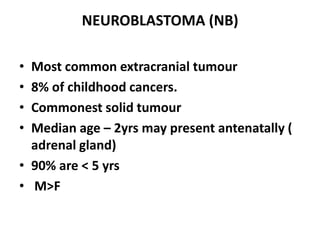
• Most common extracranial tumour
• 8% of childhood cancers.
• Commonest solid tumour
• Median age – 2yrs may present antenatally (
  adrenal gland)
• 90% are < 5 yrs
• M>F
NEUROBLASTOMA (NB)

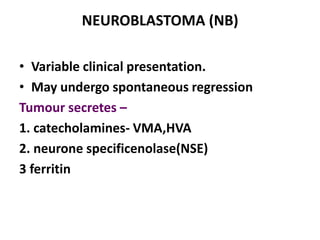
• Variable clinical presentation.
• May undergo spontaneous regression
Tumour secretes –
1. catecholamines- VMA,HVA
2. neurone specificenolase(NSE)
3 ferritin
NEUROBLASTOMA (NB)

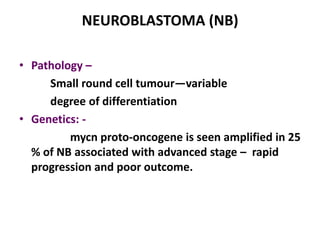
• Pathology –
     Small round cell tumour—variable
     degree of differentiation
• Genetics: -
         mycn proto-oncogene is seen amplified in 25
  % of NB associated with advanced stage – rapid
  progression and poor outcome.
Clinical Features

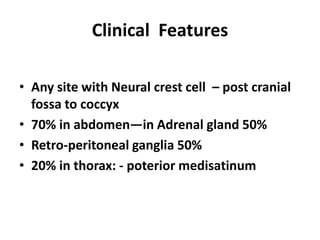
• Any site with Neural crest cell – post cranial
  fossa to coccyx
• 70% in abdomen—in Adrenal gland 50%
• Retro-peritoneal ganglia 50%
• 20% in thorax: - poterior medisatinum
Clinical Features
• Infants: -
        More localized –in cervical or
  intrathoracic areas.
• Older : -
     Abdomen with disseminated disease.
Clinical Features
• Appears chronically ill- Fever, irritability, FTT
• Bone pain
• Bluish subcutaneous nodules-blueberry muffins -
  mainly in neonates and infants
• Periorbital ecchymosis – Racoon eye & proptosis
Clinical Features
•   Epidural: -featurs of raised intracranial pressure
•   Paraspinal –limb paresis
•   Primary in nasopharynx - epistaxis
•   Acute cerebellar encephalopathy- cerebellar ataxia
•   Neural foramina: -
          Spinal and Root compression
Clinical Features
• Opsoclonus-Myoclonus: " dancing eyes, dancing feet
  syndrome"—better prognosis 4%

• Cervical involvement: -
                Horner's syndrome

Thorax:-
     Respiratory distress
• Abdomen: -
        Hard mass, fixed, abdominal
  Discomfort, Massive hepatomegaly
Clinical Features
• Vasoactive intestinal peptides -
  diarrhoea, hypokalemia
• increased catecholamines -
  flushing, tachycardia, inc
  sweating,hypertension
• Metastatic: -
          BM, bone, liver and skin.
Diagnosis:
•   Hemoblobin ↓
•   Platelets↓
•   LDH 
•   NSE 
•   Urea, creatinine 
•   Inc. HVA, VMA.
Imaging
•   CXR
•   USG
•   CT
•   MRI
•   Bone scan
Confirm
•   Tissue biopsy
•   Bone marrow aspiration
•    urine & S. catecholamine
•    DNA content- mycn amplification
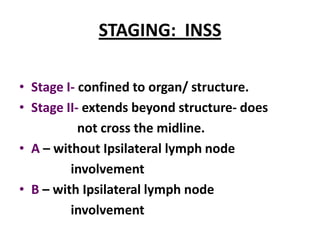
STAGING: INSS

• Stage I- confined to organ/ structure.
• Stage II- extends beyond structure- does
           not cross the midline.
• A – without Ipsilateral lymph node
         involvement
• B – with Ipsilateral lymph node
         involvement
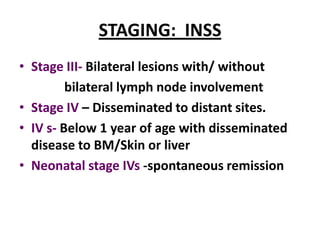
STAGING: INSS
• Stage III- Bilateral lesions with/ without
         bilateral lymph node involvement
• Stage IV – Disseminated to distant sites.
• IV s- Below 1 year of age with disseminated
  disease to BM/Skin or liver
• Neonatal stage IVs -spontaneous remission
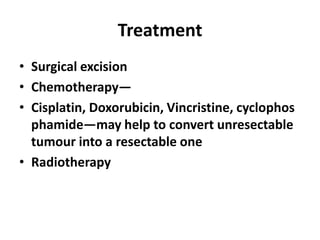
Treatment
• Surgical excision
• Chemotherapy—
• Cisplatin, Doxorubicin, Vincristine, cyclophos
  phamide—may help to convert unresectable
  tumour into a resectable one
• Radiotherapy
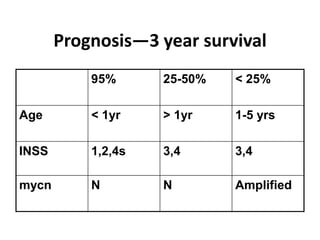
Prognosis—3 year survival
           95%      25-50%   < 25%

Age        < 1yr    > 1yr    1-5 yrs

INSS       1,2,4s   3,4      3,4

mycn       N        N        Amplified
Risk Directed: -

• Low risk—
         Infants with 4s, Stage I INSS
                     - Surgery alone
          2A,B or 3 < 1yr
                    —Surgery and Chemotherapy
• Intermediate risk: -
         II B > 1yr
                  —Surgery+ Chemo
Intermediate risk: -

• Intermediate risk: -
        stage – III
            – Chemo+Surgery+ Radiation
      stage IV < 1 yr
          - Surgery followed by Chemo
• High risk —IV > 1yr
            —Chemo+ Surgery+ BMT
Metastasis
• Local invasion- most common.invades
  surrounding tissue
• Lymphatics – regional lymph nodes
• Hematogenous – bone marrow,skeleton and
  liver
• Rare- brain,lungs
WILM'S TUMOUR—
             NEPHROBLASTOMA

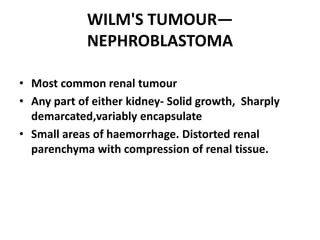
• Most common renal tumour
• Any part of either kidney- Solid growth, Sharply
  demarcated,variably encapsulate
• Small areas of haemorrhage. Distorted renal
  parenchyma with compression of renal tissue.
Histology: -
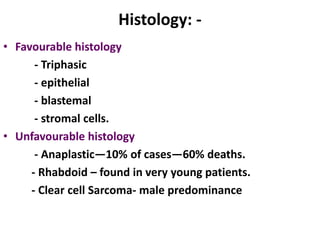
• Favourable histology
      - Triphasic
      - epithelial
      - blastemal
      - stromal cells.
• Unfavourable histology
      - Anaplastic—10% of cases—60% deaths.
     - Rhabdoid – found in very young patients.
     - Clear cell Sarcoma- male predominance
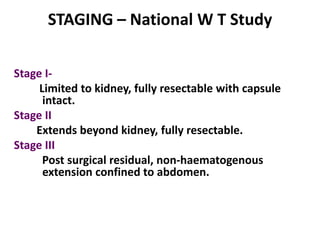
STAGING – National W T Study

Stage I-
     Limited to kidney, fully resectable with capsule
      intact.
Stage II
    Extends beyond kidney, fully resectable.
Stage III
      Post surgical residual, non-haematogenous
      extension confined to abdomen.
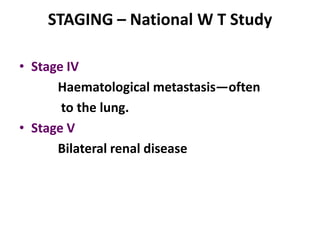
STAGING – National W T Study

• Stage IV
      Haematological metastasis—often
       to the lung.
• Stage V
      Bilateral renal disease
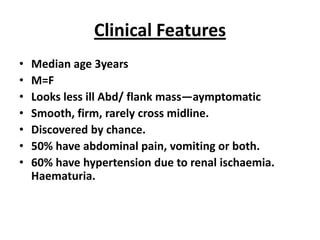
Clinical Features
•   Median age 3years
•   M=F
•   Looks less ill Abd/ flank mass—aymptomatic
•   Smooth, firm, rarely cross midline.
•   Discovered by chance.
•   50% have abdominal pain, vomiting or both.
•   60% have hypertension due to renal ischaemia.
    Haematuria.
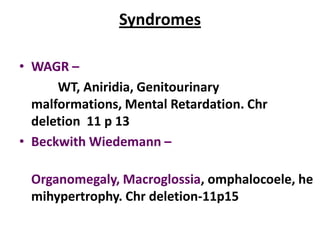
Syndromes

• WAGR –
      WT, Aniridia, Genitourinary
  malformations, Mental Retardation. Chr
  deletion 11 p 13
• Beckwith Wiedemann –

 Organomegaly, Macroglossia, omphalocoele, he
 mihypertrophy. Chr deletion-11p15
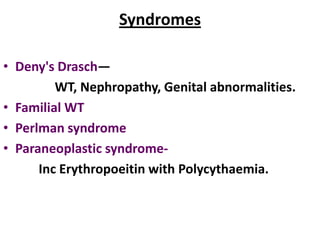
Syndromes

• Deny's Drasch—
         WT, Nephropathy, Genital abnormalities.
• Familial WT
• Perlman syndrome
• Paraneoplastic syndrome-
      Inc Erythropoeitin with Polycythaemia.
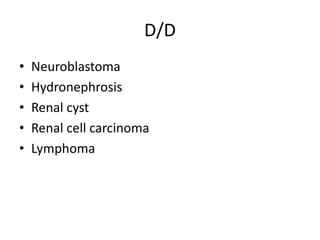
D/D
•   Neuroblastoma
•   Hydronephrosis
•   Renal cyst
•   Renal cell carcinoma
•   Lymphoma
Diagnosis
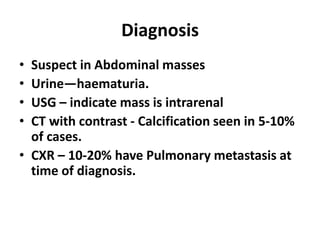
• Suspect in Abdominal masses
• Urine—haematuria.
• USG – indicate mass is intrarenal
• CT with contrast - Calcification seen in 5-10%
  of cases.
• CXR – 10-20% have Pulmonary metastasis at
  time of diagnosis.
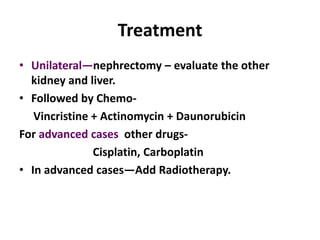
Treatment
• Unilateral—nephrectomy – evaluate the other
  kidney and liver.
• Followed by Chemo-
   Vincristine + Actinomycin + Daunorubicin
For advanced cases other drugs-
               Cisplatin, Carboplatin
• In advanced cases—Add Radiotherapy.
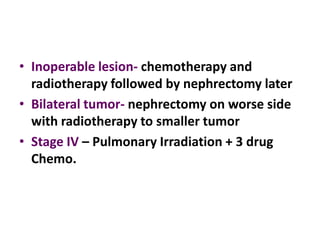
• Inoperable lesion- chemotherapy and
  radiotherapy followed by nephrectomy later
• Bilateral tumor- nephrectomy on worse side
  with radiotherapy to smaller tumor
• Stage IV – Pulmonary Irradiation + 3 drug
  Chemo.
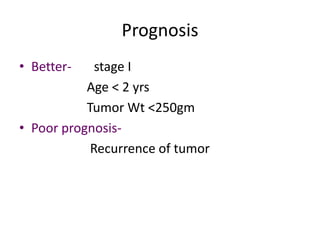
Prognosis
• Better-    stage I
           Age < 2 yrs
           Tumor Wt <250gm
• Poor prognosis-
            Recurrence of tumor
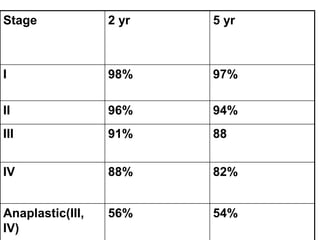
Stage             2 yr   5 yr


I                 98%    97%

II                96%    94%
III               91%    88


IV                88%    82%


Anaplastic(III,   56%    54%
IV)
Thank you
Download more documents and slide shows on The
    Medical Post [ www.themedicalpost.net ]

Neuroblastoma and Nephroblastoma

  • 1.
    Neuroblastoma and Nephroblastoma Dr. Kalpana Malla MD Pediatrics Manipal Teaching Hospital Download more documents and slide shows on The Medical Post [ www.themedicalpost.net ]
  • 2.
    NEUROBLASTOMA (NB) • Mostcommon extracranial tumour • 8% of childhood cancers. • Commonest solid tumour • Median age – 2yrs may present antenatally ( adrenal gland) • 90% are < 5 yrs • M>F
  • 3.
    NEUROBLASTOMA (NB) • Variableclinical presentation. • May undergo spontaneous regression Tumour secretes – 1. catecholamines- VMA,HVA 2. neurone specificenolase(NSE) 3 ferritin
  • 4.
    NEUROBLASTOMA (NB) • Pathology– Small round cell tumour—variable degree of differentiation • Genetics: - mycn proto-oncogene is seen amplified in 25 % of NB associated with advanced stage – rapid progression and poor outcome.
  • 5.
    Clinical Features • Anysite with Neural crest cell – post cranial fossa to coccyx • 70% in abdomen—in Adrenal gland 50% • Retro-peritoneal ganglia 50% • 20% in thorax: - poterior medisatinum
  • 6.
    Clinical Features • Infants:- More localized –in cervical or intrathoracic areas. • Older : - Abdomen with disseminated disease.
  • 7.
    Clinical Features • Appearschronically ill- Fever, irritability, FTT • Bone pain • Bluish subcutaneous nodules-blueberry muffins - mainly in neonates and infants • Periorbital ecchymosis – Racoon eye & proptosis
  • 8.
    Clinical Features • Epidural: -featurs of raised intracranial pressure • Paraspinal –limb paresis • Primary in nasopharynx - epistaxis • Acute cerebellar encephalopathy- cerebellar ataxia • Neural foramina: - Spinal and Root compression
  • 9.
    Clinical Features • Opsoclonus-Myoclonus:" dancing eyes, dancing feet syndrome"—better prognosis 4% • Cervical involvement: - Horner's syndrome Thorax:- Respiratory distress • Abdomen: - Hard mass, fixed, abdominal Discomfort, Massive hepatomegaly
  • 10.
    Clinical Features • Vasoactiveintestinal peptides - diarrhoea, hypokalemia • increased catecholamines - flushing, tachycardia, inc sweating,hypertension • Metastatic: - BM, bone, liver and skin.
  • 11.
    Diagnosis: • Hemoblobin ↓ • Platelets↓ • LDH  • NSE  • Urea, creatinine  • Inc. HVA, VMA.
  • 12.
    Imaging • CXR • USG • CT • MRI • Bone scan
  • 13.
    Confirm • Tissue biopsy • Bone marrow aspiration •  urine & S. catecholamine • DNA content- mycn amplification
  • 14.
    STAGING: INSS • StageI- confined to organ/ structure. • Stage II- extends beyond structure- does not cross the midline. • A – without Ipsilateral lymph node involvement • B – with Ipsilateral lymph node involvement
  • 15.
    STAGING: INSS • StageIII- Bilateral lesions with/ without bilateral lymph node involvement • Stage IV – Disseminated to distant sites. • IV s- Below 1 year of age with disseminated disease to BM/Skin or liver • Neonatal stage IVs -spontaneous remission
  • 16.
    Treatment • Surgical excision •Chemotherapy— • Cisplatin, Doxorubicin, Vincristine, cyclophos phamide—may help to convert unresectable tumour into a resectable one • Radiotherapy
  • 17.
    Prognosis—3 year survival 95% 25-50% < 25% Age < 1yr > 1yr 1-5 yrs INSS 1,2,4s 3,4 3,4 mycn N N Amplified
  • 18.
    Risk Directed: - •Low risk— Infants with 4s, Stage I INSS - Surgery alone 2A,B or 3 < 1yr —Surgery and Chemotherapy • Intermediate risk: - II B > 1yr —Surgery+ Chemo
  • 19.
    Intermediate risk: - •Intermediate risk: - stage – III – Chemo+Surgery+ Radiation stage IV < 1 yr - Surgery followed by Chemo • High risk —IV > 1yr —Chemo+ Surgery+ BMT
  • 20.
    Metastasis • Local invasion-most common.invades surrounding tissue • Lymphatics – regional lymph nodes • Hematogenous – bone marrow,skeleton and liver • Rare- brain,lungs
  • 22.
    WILM'S TUMOUR— NEPHROBLASTOMA • Most common renal tumour • Any part of either kidney- Solid growth, Sharply demarcated,variably encapsulate • Small areas of haemorrhage. Distorted renal parenchyma with compression of renal tissue.
  • 23.
    Histology: - • Favourablehistology - Triphasic - epithelial - blastemal - stromal cells. • Unfavourable histology - Anaplastic—10% of cases—60% deaths. - Rhabdoid – found in very young patients. - Clear cell Sarcoma- male predominance
  • 24.
    STAGING – NationalW T Study Stage I- Limited to kidney, fully resectable with capsule intact. Stage II Extends beyond kidney, fully resectable. Stage III Post surgical residual, non-haematogenous extension confined to abdomen.
  • 25.
    STAGING – NationalW T Study • Stage IV Haematological metastasis—often to the lung. • Stage V Bilateral renal disease
  • 26.
    Clinical Features • Median age 3years • M=F • Looks less ill Abd/ flank mass—aymptomatic • Smooth, firm, rarely cross midline. • Discovered by chance. • 50% have abdominal pain, vomiting or both. • 60% have hypertension due to renal ischaemia. Haematuria.
  • 27.
    Syndromes • WAGR – WT, Aniridia, Genitourinary malformations, Mental Retardation. Chr deletion 11 p 13 • Beckwith Wiedemann – Organomegaly, Macroglossia, omphalocoele, he mihypertrophy. Chr deletion-11p15
  • 28.
    Syndromes • Deny's Drasch— WT, Nephropathy, Genital abnormalities. • Familial WT • Perlman syndrome • Paraneoplastic syndrome- Inc Erythropoeitin with Polycythaemia.
  • 29.
    D/D • Neuroblastoma • Hydronephrosis • Renal cyst • Renal cell carcinoma • Lymphoma
  • 30.
    Diagnosis • Suspect inAbdominal masses • Urine—haematuria. • USG – indicate mass is intrarenal • CT with contrast - Calcification seen in 5-10% of cases. • CXR – 10-20% have Pulmonary metastasis at time of diagnosis.
  • 31.
    Treatment • Unilateral—nephrectomy –evaluate the other kidney and liver. • Followed by Chemo- Vincristine + Actinomycin + Daunorubicin For advanced cases other drugs- Cisplatin, Carboplatin • In advanced cases—Add Radiotherapy.
  • 32.
    • Inoperable lesion-chemotherapy and radiotherapy followed by nephrectomy later • Bilateral tumor- nephrectomy on worse side with radiotherapy to smaller tumor • Stage IV – Pulmonary Irradiation + 3 drug Chemo.
  • 33.
    Prognosis • Better- stage I Age < 2 yrs Tumor Wt <250gm • Poor prognosis- Recurrence of tumor
  • 34.
    Stage 2 yr 5 yr I 98% 97% II 96% 94% III 91% 88 IV 88% 82% Anaplastic(III, 56% 54% IV)
  • 35.
    Thank you Download moredocuments and slide shows on The Medical Post [ www.themedicalpost.net ]