ATAXIA
DEFINITION
• Ataxia (Greek word=“lack of order”) is a neurological
disorder consisting of lack of voluntary coordination
of muscle movements
 Ataxia is a non specific
clinical manifestation
implying dysfunction of
parts of nervous system
that coordinate movement
such as CEREBELLUM.
TYPES OF ATAXIA
• There are over 50 to 100 types of ataxia but can be
classified under 3 broad headings:
1. HEREDITARY ATAXIA– one that runs in the family and is
inherited genetically
2. IDIOPATHIC LATE ONSET CEREBELLAR ATAXIA (ILOA)–
cerebellum is progressively damage due to unexplained
cause
3. ACQUIRED ATAXIA– ataxia due to stroke or other brain
disease.
HEREDITARY ATAXIA
• FRIEDREICH’S ATAXIA- This is the commonest type of ataxia having
half of all its cases.
• Symptoms usually begins to appear in childhood between 8 to 15
years
• It is transmitted by autosomal recessive inheritance and is due to an
expanded GAA trinucleotide repeat in a non coding region of an gene
of chromosome 9
CLINICAL FINDINGS
• Initial symptom is progressive gait ataxia followed by
ataxia of all limb within 2 yrs.
• During the same early period, knee and ankle tendon
reflexes are lost and cerebeller dysarthria.
• Joint position sense (proprioception) and vibration
are impaired in the legs, typically adding sensory
component to gait ataxia
• Weakness of legs and less often in arms-is a later
development and may be of UMN and LMN variety
or both
Contd.
• Extensors planter responses appear during first 5 years
• Pes cavus is widely recognized
• Severe progressive kyphoscolosis contributes to functional disabilities
and may lead to chronic restrictive lung disease.
• Cardiomyopathy is sometimes detectable
• Other abnormalities includes visual impairments including optic
atropy, nystagmus, paresthesia, tremor, hearing loss, vertigo,
spasticity, leg pains and DM
ATAXIA DUE TO VITAMIN-E DEFICIENCY
• Rare form of ataxia also begin in childhood.
• Lack of vitamin E leads to nerve damage.
• Symptom are similar to Friedreich’s ataxia but symptoms may be
relieved by providing vitamin E as supplements
ATAXIA -TELANGIECTASIA
• This is rare type of
ataxia seen in 1 in
100,000 babies.
• Symptoms usually
begin in early childhood
and progressively
worsen with age
ATAXIA -TELANGIECTASIA
• The name is derived from small, spider like clusters of
red blood vessels in the corner of their eyes and on
their cheeks called telangiectases.
 This usually co-exists
with a weak immune
system making the
children more
vulnerable to
infections.
SENSORY ATAXIA
Results from disorders that affects the propioceptive pathways in peripheral
sensory nerves, sensory roots, posterior column of SC, or medial lemniscus.
Sensory ataxia from polyneuropathy or posterior column lesion typically
affects the gait and legs in symmetric fashion: the arms are involved to a
lesser extent.
Examination reveals impaired sensations of joint position and movement in
the affected limbs, and vibratory sense is also commonly distributed.
Vertigo, nystagmus, and dysarthria are characteristically absent.
CEREBELLAR ATAXIA
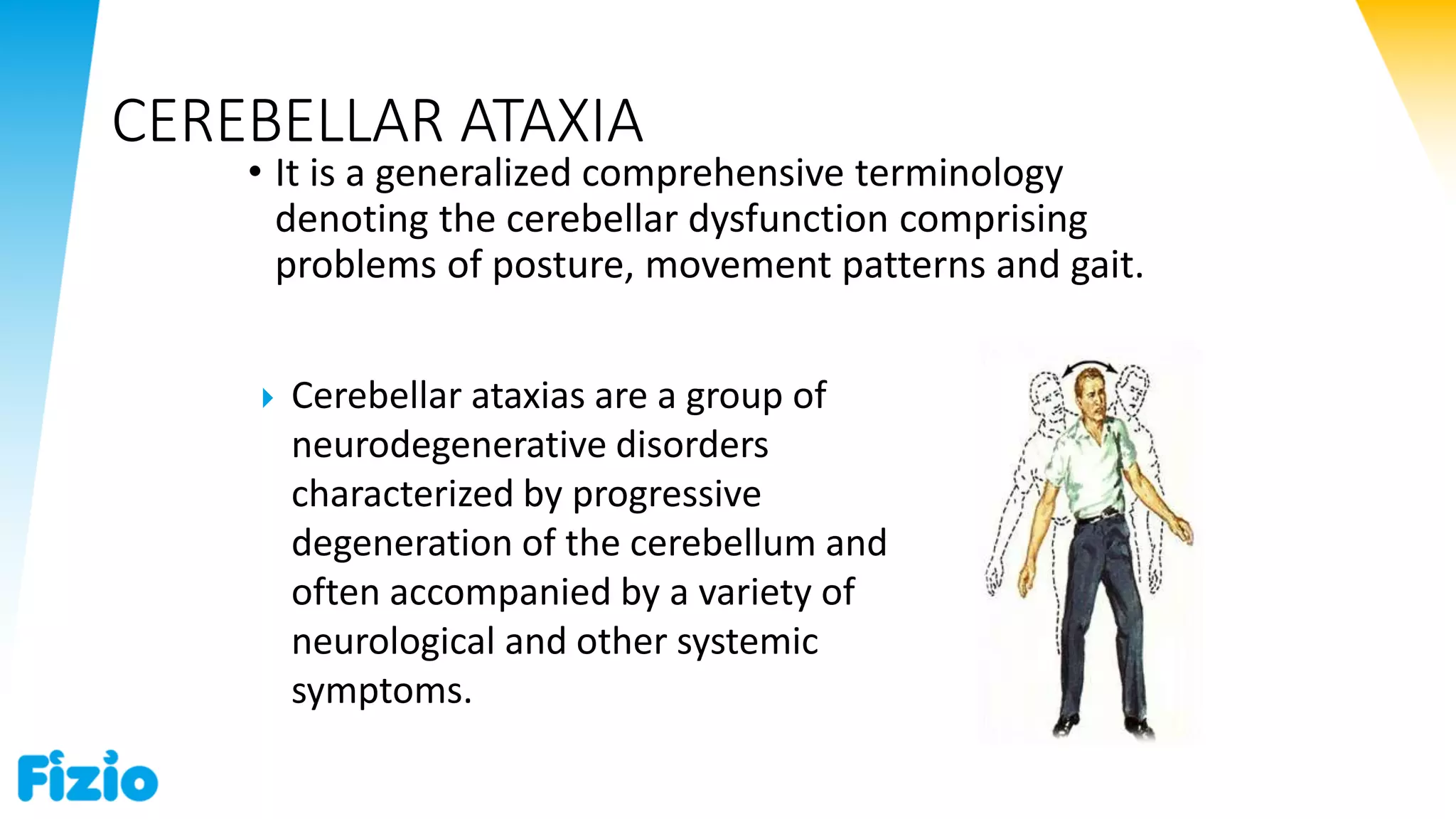
• It is a generalized comprehensive terminology
denoting the cerebellar dysfunction comprising
problems of posture, movement patterns and gait.
 Cerebellar ataxias are a group of
neurodegenerative disorders
characterized by progressive
degeneration of the cerebellum and
often accompanied by a variety of
neurological and other systemic
symptoms.
CLASSIFICATION OF CEREBELLAR ATAXIA
• 1.HEREDITARY CEREBELLAR ATAXIA
• A.AUTOSOMAL DOMINANT CEREBELLAR ATAXIA(ADCA)
• -EPISODIC ATAXIAS (types 1-6)
• -SPINOCEREBELLAR ATAXIA(SCA)subtypes 1-28
• -DENTATATORUBRAL-PALLIDOLUYSIAN ATROPHY(DRPLA)
CAUSES
• Hemorrhagic or ischaemic leisons
• Tumours (Cerebellopontine angle tumors)
• Progressive sclerosis of cerebellum
• Trauma involving cerebellum (ex-head injury)
• Cerebrovascular disease
• Pontoneocerebellar hypoplasia
• Granule cell layer hypoplasia
• Hypoplasia of cerebellar vermis
Contd.
• B.AUTOSOMAL RECESSIVE CEREBELLAR ATAXIAS
• -With identified gene defect
• -with identified gene locus
• -As part of metabolic disorder
• -Other metabolic degenerative disease with congenital or childhood
onset
Contd.
• X-linked cerebellar ataxia
• -Adrenoleukodystophy
• -fragile x-tremor ataxia syndrome(FXTAS)
• -Hereditary sideroblastic anemia and ataxia
• -other x-linked congenital and childhood ataxias
• D.MITOCHONDRIAL CEREBELLAR ATAXIA
2.SPORADIC CEREBELLAR ATAXIA
A.SYMPTOMATIC CEREBELLAR ATAXIA
-STRUCTURAL LEISONS,MALFORMATION
-TOXIC
.ALCOHOL
.DRUGS
 Antiepileptic drugs
 Benzodiazepines
 Lithium
 Antineoplastics
 Others
i. Heavy metals (mercury,lead)
ii. chemicals (solvents,pesticides)
Contd.
• -ENDOCRINE
Hypothyriodism
-MALABSORPTION
celiac disease (gluten ataxia)
vitamin deficiency
-MISCELLANEOUS
Paraneoplastic syndromes
Demyelinating disorders
-INFLAMMATORY
whipple disease
Contd.
• IDIOPATHIC
• -Multiple system atrophy (MSA)
• -Idiopathic late onset cerebellar ataxia (ILOSCA)
CLINICAL FEATURES
• Aesthenia
• Heavinessin limbs
• Hypotonicity
• Diminished DTR
• Movement
decomposition
• Dysmetria
• Rebound phenomenon
• Dysdiadochokinesia
• Intentional tremors
• Scanning speech
• Dysphagia
• Nystagmus
• CARDINAL FEATURES-
NYSTAGMUS, SCANNING
SPEECH AND
INTENTIONAL TREMORS
CLINICAL FEATURES - Gait
• wide BOS, Step and stride length are unequal, absent or reduced arm
swinging, can’t turn around, can’t walk in straight line, can’t step over the
obstacle, stair climbing difficult, can’t walk slippery surfaces or unequal
terrain.
SPINOCEREBELLAR ATAXIA
• Any of a group of inherited neurodegenerative
disorders that are characterized by cerebellar
dysfunction manifested especially by progressive
ataxia.
• In addition, they are often associated with poor
coordination of hand movements, eye movements,
and speech.
• The onset of symptoms usually occurs after the age of
18.
SPINOCEREBELLAR ATAXIA
• INHERITANCE OF DOMINANT SCA
 It is autosomal
dominant.
 Affects males and
females equally.
SPINOCEREBELLAR ATAXIA
• Anticipation and penetrance
 Many types of SCA are characterized by a
phenomenon called anticipation.
 Anticipation refers to an earlier age of symptoms and
increasing severity of disease from generation to
generation in a family.
 In other words, an affected child can have more
severe disease symptoms than his or her affected
parent.
SPINOCEREBELLAR ATAXIA
• Anticipation and penetrance
 The term penetrance refers to the proportion of
individuals with the gene for SCA who will actually
develop symptoms.
 In all types of SCA, penetrance is very high, meaning
that almost everyone will develop symptoms of SCA
at some point in their lifetime.
 In some cases, however, a may die of other causes
before showing symptoms of SCA.
General description of the types of SCA
(The number 9 is not used.)
General description of the types of SCA
(The number 9 is not used.)
 MRI scans of two brains. The brain on the left shows
atrophy of the cerebellum in a person with SCA. The brain
on the right shows a normal cerebellum.
EPISODIC ATAXIAS
• These are also known as PAROXYSMAL ATAXIAS
• They are characterized by episodes of ataxia including dysarthria, tremor
and nystagmus lasting minutes to hours.
• The episodic ataxias are subdivided into two disorders on clinical and
genetic grounds
• In both disorders episodes are suppressed by acetazolamide.
• Patients need to be warned about the risk of nephrolithiasis on long term
acetazolamide therapy, the incidence of this complication is estimated at
20%.
• Some patients may experience a progressive ataxia underlying the short
lived episodes
INVESTIGATIVE STUDIES
• BLOOD STUDIES
• Blood studies may disclose the hematologic abnormalities
associated with vitamin B12 deficiency, the decreased levels
of thyroid hormones in hypothyrodism, the elevated hepatic
enzymes and low ceruloplasmin and copper concentrations in
Wilson's disease, immunoglobulin deficiency and elevated
alpha-fetoprotein in ataxia-telangiectasia, antibodies to
Purkinje cell, antigens in paraneoplastic cerebellar
degenerations, or genetic abnormalities associated with
hereditary spinocerebellar degenerations.
CEREBROSPINAL FLUID STUDIES
• The CSF show elevated protein with cerebellopontine angle tumors
(Ex-acoustic neuroma), brainstem or spinal cord tumors,
hypothyroidism, and some polyneuropathies.
• Increased protein with pleocytosis is commonly found with infectious
or parainfectious encephalitis, paraneoplastic cerebellar
degeneration, and neurosyphilis.
IMAGING
• The CT Scan is useful for demonstrating posterior fossa tumors or
malformations, cerebellar infarction or hemorrhage, and cerebellar
atrophy associated with degenerative disorders.
• MRI-Provides better visualization of posterior fossa lesions, including
cerebellopontine angle tumors, and is superior to CT scanning for
detecting the lesions of multiple sclerosis.
EVOKED POTENTIAL TESTING
• Evoked potential testing, especially of optic pathways(visual evoked
potentials),may be helpful in evaluating patients with suspected
multiple sclerosis.
• Brainstem auditory evoked potentials may be abnormal in patients
with cerebellopontine angle tumors even though CT Scans show no
abnormality.
CHEST X-RAY & ECHOCARDIOGRAPHY
• The chest x-ray or echocardiogram may provide evidence of
cardiomyopathy associated with Friedreich’s ataxia.
• The chest x-ray may also show a lung tumor in paraneoplastic
cerebellar degeneration.
SPECIAL STUDIES
• In vestibular disorders, three additional special investigations may be of
help.
• A. Audiometery-is useful when vestibular disorders are associated with
auditory impairment, such testing can distinguish conductive, labyrinthine,
acoustic nerve and brainstem disease.
• Tests of pure tone hearing are abnormal when sounds are transmitted
through air with conductive hearing loss and when transmitted through air
with conductive hearing loss and when transmitted through either air or
bone with labyrinthine or acoustic nerve disorders.
• Speech discrimination is markedly impaired with acoustic nerve lesions,
less so with disorders of the labyrinth. speech discrimination is normal in
conductive or brainstem involvement.
B.ELECTRONYSTAGMOGRAPHY (ENG)
• This test can be used to detect and characterize nystagmus, including
and elicited by caloric stimulation.
c.AUDITORY EVOKED RESPONSE
• This is test can localize vestibular disease to the peripheral vestibular
pathways
MANAGEMENT
• Intoxications have to be cleared
• Vitamin deficiencies have to be recovered
• Endocrine disorders have to be dealt with
• Levo hydroxy tryptophan and iron chelation
• Genetic counseling
• PT and OT
• In autosomal dominant acetazolamide is very effective

Ataxia

  • 1.
  • 2.
    DEFINITION • Ataxia (Greekword=“lack of order”) is a neurological disorder consisting of lack of voluntary coordination of muscle movements  Ataxia is a non specific clinical manifestation implying dysfunction of parts of nervous system that coordinate movement such as CEREBELLUM.
  • 3.
    TYPES OF ATAXIA •There are over 50 to 100 types of ataxia but can be classified under 3 broad headings: 1. HEREDITARY ATAXIA– one that runs in the family and is inherited genetically 2. IDIOPATHIC LATE ONSET CEREBELLAR ATAXIA (ILOA)– cerebellum is progressively damage due to unexplained cause 3. ACQUIRED ATAXIA– ataxia due to stroke or other brain disease.
  • 4.
    HEREDITARY ATAXIA • FRIEDREICH’SATAXIA- This is the commonest type of ataxia having half of all its cases. • Symptoms usually begins to appear in childhood between 8 to 15 years • It is transmitted by autosomal recessive inheritance and is due to an expanded GAA trinucleotide repeat in a non coding region of an gene of chromosome 9
  • 5.
    CLINICAL FINDINGS • Initialsymptom is progressive gait ataxia followed by ataxia of all limb within 2 yrs. • During the same early period, knee and ankle tendon reflexes are lost and cerebeller dysarthria. • Joint position sense (proprioception) and vibration are impaired in the legs, typically adding sensory component to gait ataxia • Weakness of legs and less often in arms-is a later development and may be of UMN and LMN variety or both
  • 6.
    Contd. • Extensors planterresponses appear during first 5 years • Pes cavus is widely recognized • Severe progressive kyphoscolosis contributes to functional disabilities and may lead to chronic restrictive lung disease. • Cardiomyopathy is sometimes detectable • Other abnormalities includes visual impairments including optic atropy, nystagmus, paresthesia, tremor, hearing loss, vertigo, spasticity, leg pains and DM
  • 7.
    ATAXIA DUE TOVITAMIN-E DEFICIENCY • Rare form of ataxia also begin in childhood. • Lack of vitamin E leads to nerve damage. • Symptom are similar to Friedreich’s ataxia but symptoms may be relieved by providing vitamin E as supplements
  • 8.
    ATAXIA -TELANGIECTASIA • Thisis rare type of ataxia seen in 1 in 100,000 babies. • Symptoms usually begin in early childhood and progressively worsen with age
  • 9.
    ATAXIA -TELANGIECTASIA • Thename is derived from small, spider like clusters of red blood vessels in the corner of their eyes and on their cheeks called telangiectases.  This usually co-exists with a weak immune system making the children more vulnerable to infections.
  • 10.
    SENSORY ATAXIA Results fromdisorders that affects the propioceptive pathways in peripheral sensory nerves, sensory roots, posterior column of SC, or medial lemniscus. Sensory ataxia from polyneuropathy or posterior column lesion typically affects the gait and legs in symmetric fashion: the arms are involved to a lesser extent. Examination reveals impaired sensations of joint position and movement in the affected limbs, and vibratory sense is also commonly distributed. Vertigo, nystagmus, and dysarthria are characteristically absent.
  • 11.
    CEREBELLAR ATAXIA • Itis a generalized comprehensive terminology denoting the cerebellar dysfunction comprising problems of posture, movement patterns and gait.  Cerebellar ataxias are a group of neurodegenerative disorders characterized by progressive degeneration of the cerebellum and often accompanied by a variety of neurological and other systemic symptoms.
  • 12.
    CLASSIFICATION OF CEREBELLARATAXIA • 1.HEREDITARY CEREBELLAR ATAXIA • A.AUTOSOMAL DOMINANT CEREBELLAR ATAXIA(ADCA) • -EPISODIC ATAXIAS (types 1-6) • -SPINOCEREBELLAR ATAXIA(SCA)subtypes 1-28 • -DENTATATORUBRAL-PALLIDOLUYSIAN ATROPHY(DRPLA)
  • 13.
    CAUSES • Hemorrhagic orischaemic leisons • Tumours (Cerebellopontine angle tumors) • Progressive sclerosis of cerebellum • Trauma involving cerebellum (ex-head injury) • Cerebrovascular disease • Pontoneocerebellar hypoplasia • Granule cell layer hypoplasia • Hypoplasia of cerebellar vermis
  • 14.
    Contd. • B.AUTOSOMAL RECESSIVECEREBELLAR ATAXIAS • -With identified gene defect • -with identified gene locus • -As part of metabolic disorder • -Other metabolic degenerative disease with congenital or childhood onset
  • 15.
    Contd. • X-linked cerebellarataxia • -Adrenoleukodystophy • -fragile x-tremor ataxia syndrome(FXTAS) • -Hereditary sideroblastic anemia and ataxia • -other x-linked congenital and childhood ataxias • D.MITOCHONDRIAL CEREBELLAR ATAXIA
  • 16.
    2.SPORADIC CEREBELLAR ATAXIA A.SYMPTOMATICCEREBELLAR ATAXIA -STRUCTURAL LEISONS,MALFORMATION -TOXIC .ALCOHOL .DRUGS  Antiepileptic drugs  Benzodiazepines  Lithium  Antineoplastics  Others i. Heavy metals (mercury,lead) ii. chemicals (solvents,pesticides)
  • 17.
    Contd. • -ENDOCRINE Hypothyriodism -MALABSORPTION celiac disease(gluten ataxia) vitamin deficiency -MISCELLANEOUS Paraneoplastic syndromes Demyelinating disorders -INFLAMMATORY whipple disease
  • 18.
    Contd. • IDIOPATHIC • -Multiplesystem atrophy (MSA) • -Idiopathic late onset cerebellar ataxia (ILOSCA)
  • 19.
    CLINICAL FEATURES • Aesthenia •Heavinessin limbs • Hypotonicity • Diminished DTR • Movement decomposition • Dysmetria • Rebound phenomenon • Dysdiadochokinesia • Intentional tremors • Scanning speech • Dysphagia • Nystagmus • CARDINAL FEATURES- NYSTAGMUS, SCANNING SPEECH AND INTENTIONAL TREMORS
  • 20.
    CLINICAL FEATURES -Gait • wide BOS, Step and stride length are unequal, absent or reduced arm swinging, can’t turn around, can’t walk in straight line, can’t step over the obstacle, stair climbing difficult, can’t walk slippery surfaces or unequal terrain.
  • 21.
    SPINOCEREBELLAR ATAXIA • Anyof a group of inherited neurodegenerative disorders that are characterized by cerebellar dysfunction manifested especially by progressive ataxia. • In addition, they are often associated with poor coordination of hand movements, eye movements, and speech. • The onset of symptoms usually occurs after the age of 18.
  • 22.
    SPINOCEREBELLAR ATAXIA • INHERITANCEOF DOMINANT SCA  It is autosomal dominant.  Affects males and females equally.
  • 23.
    SPINOCEREBELLAR ATAXIA • Anticipationand penetrance  Many types of SCA are characterized by a phenomenon called anticipation.  Anticipation refers to an earlier age of symptoms and increasing severity of disease from generation to generation in a family.  In other words, an affected child can have more severe disease symptoms than his or her affected parent.
  • 24.
    SPINOCEREBELLAR ATAXIA • Anticipationand penetrance  The term penetrance refers to the proportion of individuals with the gene for SCA who will actually develop symptoms.  In all types of SCA, penetrance is very high, meaning that almost everyone will develop symptoms of SCA at some point in their lifetime.  In some cases, however, a may die of other causes before showing symptoms of SCA.
  • 25.
    General description ofthe types of SCA (The number 9 is not used.)
  • 26.
    General description ofthe types of SCA (The number 9 is not used.)
  • 27.
     MRI scansof two brains. The brain on the left shows atrophy of the cerebellum in a person with SCA. The brain on the right shows a normal cerebellum.
  • 28.
    EPISODIC ATAXIAS • Theseare also known as PAROXYSMAL ATAXIAS • They are characterized by episodes of ataxia including dysarthria, tremor and nystagmus lasting minutes to hours. • The episodic ataxias are subdivided into two disorders on clinical and genetic grounds • In both disorders episodes are suppressed by acetazolamide. • Patients need to be warned about the risk of nephrolithiasis on long term acetazolamide therapy, the incidence of this complication is estimated at 20%. • Some patients may experience a progressive ataxia underlying the short lived episodes
  • 29.
    INVESTIGATIVE STUDIES • BLOODSTUDIES • Blood studies may disclose the hematologic abnormalities associated with vitamin B12 deficiency, the decreased levels of thyroid hormones in hypothyrodism, the elevated hepatic enzymes and low ceruloplasmin and copper concentrations in Wilson's disease, immunoglobulin deficiency and elevated alpha-fetoprotein in ataxia-telangiectasia, antibodies to Purkinje cell, antigens in paraneoplastic cerebellar degenerations, or genetic abnormalities associated with hereditary spinocerebellar degenerations.
  • 30.
    CEREBROSPINAL FLUID STUDIES •The CSF show elevated protein with cerebellopontine angle tumors (Ex-acoustic neuroma), brainstem or spinal cord tumors, hypothyroidism, and some polyneuropathies. • Increased protein with pleocytosis is commonly found with infectious or parainfectious encephalitis, paraneoplastic cerebellar degeneration, and neurosyphilis.
  • 31.
    IMAGING • The CTScan is useful for demonstrating posterior fossa tumors or malformations, cerebellar infarction or hemorrhage, and cerebellar atrophy associated with degenerative disorders. • MRI-Provides better visualization of posterior fossa lesions, including cerebellopontine angle tumors, and is superior to CT scanning for detecting the lesions of multiple sclerosis.
  • 32.
    EVOKED POTENTIAL TESTING •Evoked potential testing, especially of optic pathways(visual evoked potentials),may be helpful in evaluating patients with suspected multiple sclerosis. • Brainstem auditory evoked potentials may be abnormal in patients with cerebellopontine angle tumors even though CT Scans show no abnormality.
  • 33.
    CHEST X-RAY &ECHOCARDIOGRAPHY • The chest x-ray or echocardiogram may provide evidence of cardiomyopathy associated with Friedreich’s ataxia. • The chest x-ray may also show a lung tumor in paraneoplastic cerebellar degeneration.
  • 34.
    SPECIAL STUDIES • Investibular disorders, three additional special investigations may be of help. • A. Audiometery-is useful when vestibular disorders are associated with auditory impairment, such testing can distinguish conductive, labyrinthine, acoustic nerve and brainstem disease. • Tests of pure tone hearing are abnormal when sounds are transmitted through air with conductive hearing loss and when transmitted through air with conductive hearing loss and when transmitted through either air or bone with labyrinthine or acoustic nerve disorders. • Speech discrimination is markedly impaired with acoustic nerve lesions, less so with disorders of the labyrinth. speech discrimination is normal in conductive or brainstem involvement.
  • 35.
    B.ELECTRONYSTAGMOGRAPHY (ENG) • Thistest can be used to detect and characterize nystagmus, including and elicited by caloric stimulation.
  • 36.
    c.AUDITORY EVOKED RESPONSE •This is test can localize vestibular disease to the peripheral vestibular pathways
  • 37.
    MANAGEMENT • Intoxications haveto be cleared • Vitamin deficiencies have to be recovered • Endocrine disorders have to be dealt with • Levo hydroxy tryptophan and iron chelation • Genetic counseling • PT and OT • In autosomal dominant acetazolamide is very effective