MUSCLE
CHANNELOPATHIES
IMRAN RIZVI
Department of Neurology
KGMU; Lko
Introduction
• The muscle channelopathies are a group of rare inherited
diseases caused by mutations in muscle ion channels.
• Ion channels: membrane-bound proteins.
• Ion channels regulate ion flow into and out of cells.
• Thus they are integral to the fundamental processes of
electrical signaling and excitation within the nervous
system.
Classification of ion channels
• Ion channels are classified as Voltage gated or ligand
gated.
• Voltage gated ion channels activates by change in
membrane potential.
• Ligand gated ion channels responds to specific
neurotransmitter (Ach, GABA).
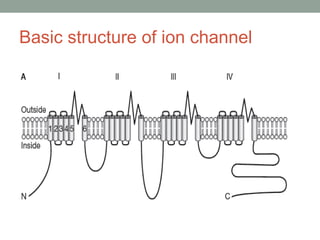
Basic structure
• Similar basic structure.
• Large pore-forming subunit, which is located within the
membrane.
• Pore forming unit = α subunit.
• Variable number of accessory subunits (β, ) are presentϒ
around pore forming subunit.
• α subunit typically determines ion selectivity and mediate
the voltage sensing function of the channel.
Basic structure of ion channel
Functions of major ion channels
• Sodium channels: membrane excitability.
• Calcium channels: couple membrane excitation to muscle
contraction.
• Chloride channel: stabilizing the resting membrane
potential and help in membrane repolarization after
excitation.
• Potassium channel: membrane repolarization
Cherian, et al.: Muscle channelopathies. Ann Indian Acad Neurol 2008;11:20-7
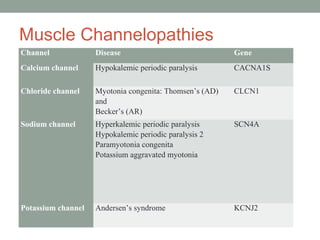
Muscle Channelopathies
Channel Disease Gene
Calcium channel Hypokalemic periodic paralysis CACNA1S
Chloride channel Myotonia congenita: Thomsen’s (AD)
and
Becker’s (AR)
CLCN1
Sodium channel Hyperkalemic periodic paralysis
Hypokalemic periodic paralysis 2
Paramyotonia congenita
Potassium aggravated myotonia
SCN4A
Potassium channel Andersen’s syndrome KCNJ2
Clinical characteristics of muscle
channelopathies
• Autosomal Dominant inheritance
• Episodic weakness/ muscle stiffness.
• Return to asymptomatic state.
• Exacerbation by environmental factors like fasting,
fatigue, carbohydrate rich diet etc.
• Response to carbonic anhydrase inhibitors.
Statland J et al. Neurol Clin 32 (2014) 801-15.
Muscle channelopathies
Non dystrophic myotonia
• Myotonia congenita
• Paramyotonia congenita
• Potassium aggravated
myotonia
Periodic paralysis
• Hypokalemic PP
• Hyperkalemic PP
• Andersen-Tawil
Non Dystrophic Myotonia
• Myotonia: Delayed muscle relaxation after voluntary or
evoked muscle contraction.
• NDM are clinically distinct from myotonic dystrophy as
there is absence of progressive muscle weakness and
systemic features.
• NDM comprise of myotonia congenita, paramyotonia
congenita and sodium channel myotonias.
Matthews E et al. Brain 2010: 133; 9–22
• Prevalence of NDM is approximately 1/100,000.
• Major presenting feature of NDM is muscle stiffness due
to myotonia.
• Other features can be transient weakness, muscle
hypertrophy, fatigue and pain.
•
Myotonia Congenita
• MC can be inherited as AD or AR trait.
• AD= Thomsen Disease.
• AR= Becker Myotonia
• AD was first described in 1876 by Danish physician Julius
Thomsen; who suffered from disease himself.
• MC is the most common inherited skeletal muscle
channelopathy.
Matthews E et al. Brain 2010: 133; 9–22
Clinical features of MC
• Age of onset: first decade (Thomsen), 10-14 years
(Becker)
• The most common complaint is muscle stiffness due to
myotonia.
• Forceful movements abruptly initiated after several
minutes of rest causes most pronounced stiffness.
• Patients classically have a hypertrophic and muscular
build.
• Myotonia displays Warm Up phenomenon.
• Myotonia decreases or vanishes when repeating the
same movement several time. (DD= PMC)
• Myotonia can affect all skeletal muscles but it is most
prominent in legs.
• Patients with AR form experience transient bouts of
muscle weakness after a period of rest. (improves with
exercise)
• Muscle hypertrophy and disease severity are greater in
AR form of disease.
Statland JM. Continuum (Minneap Minn) 2013;19(6):1598–1614.
Genetics/ pathophysiology
• Myotonia congenita is due to mutation in chloride channel
gene (CLCN-1).
• This gene is located on chromosome 7q35.
• This mutation causes decreased sarcolemmal chloride
conductance.
• This causes repeated depolarization of sarcolemma;
hence leading to muscle hyper excitability and clinical
myotonia.
Investigations
• Routine sensory and motor NCS are normal.
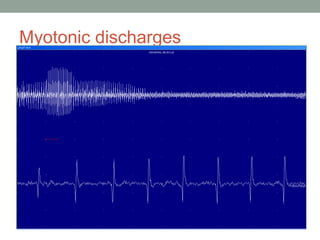
• Needle EMG: myotonic discharges are seen. Producing
characteristic dive bomber or reviving engine sound.
• MUAPs are characteristically normal.
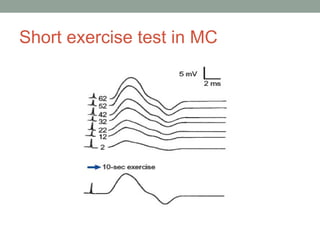
• Short exercise test: produces a drop in CMAP amplitude
immediately after exercise; which recovers rapidly over 1-
2 minutes.
• CK levels may be slightly elevated.
Fournier E, et al. Ann Neurol 2004;56:650-61.
Short exercise test in MC
Myotonic discharges
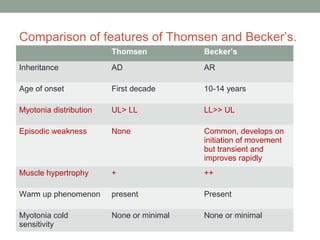
Comparison of features of Thomsen and Becker’s.
Thomsen Becker’s
Inheritance AD AR
Age of onset First decade 10-14 years
Myotonia distribution UL> LL LL>> UL
Episodic weakness None Common, develops on
initiation of movement
but transient and
improves rapidly
Muscle hypertrophy + ++
Warm up phenomenon present Present
Myotonia cold
sensitivity
None or minimal None or minimal
Paramyotonia congenita
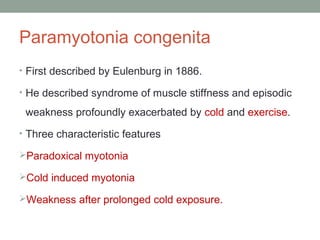
• First described by Eulenburg in 1886.
• He described syndrome of muscle stiffness and episodic
weakness profoundly exacerbated by cold and exercise.
• Three characteristic features
Paradoxical myotonia
Cold induced myotonia
Weakness after prolonged cold exposure.
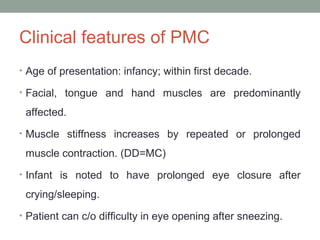
Clinical features of PMC
• Age of presentation: infancy; within first decade.
• Facial, tongue and hand muscles are predominantly
affected.
• Muscle stiffness increases by repeated or prolonged
muscle contraction. (DD=MC)
• Infant is noted to have prolonged eye closure after
crying/sleeping.
• Patient can c/o difficulty in eye opening after sneezing.
• Muscle stiffness is also triggered by exposure to cold.
• c/o difficulty in swimming in cold water; difficulty in
swallowing ice cream.
• Cold also induces weakness which can take hours to
normalize despite rewarming.
• Muscle hypertrophy is less common as compared to MC.
Matthews E et al. Neurology 2008b; 70: 50–3.
Investigations in PMC
• Routine motor and sensory NCS is normal.
• EMG: Myotonic discharges. MUAPs will be normal.
• Muscle cooling will increase myotonia which is
pathognomic of PMC. Cooling will also cause dense
fibrillation potential to appear.
• As the muscle cools down below 20 C all myotonic
discharges disappear completely giving way to paralysis.
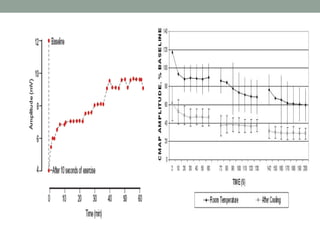
• Short exercise test: produces a drop in CMAP amplitude
post exercise; the recovery is delayed to often 60 minutes.
• The short exercise test after cooling may further enhance
drop in amplitude; recovery is also delayed after cooling.
Genetics of PMC
• Autosomal dominant.
• Point mutation in the SCN4A gene on chromosome 17q.
• Mutation in this gene causes defect in sodium channel
deactivation.
Sodium channel myotonia
• Also known as potassium aggravated myotonia.
• Autosomal dominant inheritance.
• Mutation in SCN4A gene located on chromosome 17q.
• This mutation causes disturbance in fast inactivation of
sodium channels.
• Three clinical variants
Myotonia fluctuans
Myotonia permanens
Actezolamide responsive myotonia.
Clinical features
• Patients presents with generalized stiffness due to
myotonia.
• Myotonia aggravates after potassium ingestion.
• No worsening of symptoms with cold.
• Patients do not experience episodic weakness.
• Delayed onset myotonia after exercise. (10-30 min)
Mankodi, et al. Neurology India 2008;56:298-304.
• Myotonia fluctuans: myotonia fluctuates in severity; is
aggravated by potassium ingestion and prolonged
exercise.
• Myotonia permanens: most serious form; severe and
protracted myotonia which can impair respiration.
• Actezolamide responsive myotonia: painful myotonia that
responds to carbonic anhydrase inhibitors.
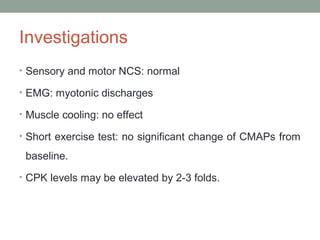
Investigations
• Sensory and motor NCS: normal
• EMG: myotonic discharges
• Muscle cooling: no effect
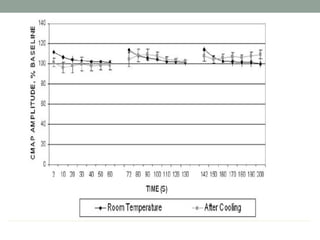
• Short exercise test: no significant change of CMAPs from
baseline.
• CPK levels may be elevated by 2-3 folds.
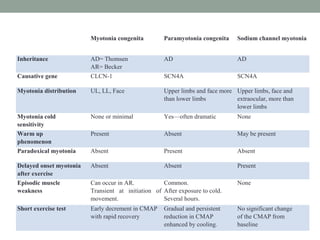
  Myotonia congenita Paramyotonia congenita Sodium channel myotonia
Inheritance  AD= Thomsen
AR= Becker
AD AD
Causative gene CLCN-1 SCN4A SCN4A
Myotonia distribution UL, LL, Face Upper limbs and face more
than lower limbs
Upper limbs, face and
extraocular, more than
lower limbs
Myotonia cold
sensitivity
None or minimal Yes—often dramatic None
Warm up
phenomenon
Present Absent May be present
Paradoxical myotonia  Absent Present Absent
Delayed onset myotonia
after exercise
Absent Absent Present
Episodic muscle
weakness
Can occur in AR.
Transient at initiation of
movement.
Common.
After exposure to cold.
Several hours.
None
Short exercise test Early decrement in CMAP
with rapid recovery
Gradual and persistent
reduction in CMAP
enhanced by cooling.
No significant change
of the CMAP from
baseline
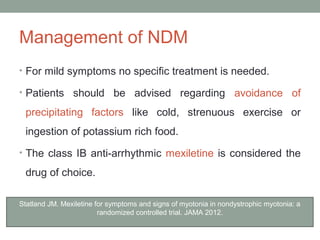
Management of NDM
• For mild symptoms no specific treatment is needed.
• Patients should be advised regarding avoidance of
precipitating factors like cold, strenuous exercise or
ingestion of potassium rich food.
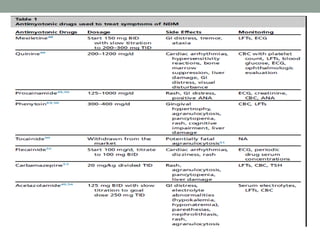
• The class IB anti-arrhythmic mexiletine is considered the
drug of choice.
Statland JM. Mexiletine for symptoms and signs of myotonia in nondystrophic myotonia: a
randomized controlled trial. JAMA 2012.
• Oral 200-mg mexiletine 3 times a day resulted in
improved patient-reported stiffness over 4 weeks of
treatment as compared to placebo.
• Mexiletine has pro-arrhythmic potential therefore ECG to
measure QT interval should be done.
• Other useful drugs are phenytoin, procainamide or
quinine; but they have unfavorable side effect profile.
Statland JM. Mexiletine for symptoms and signs of myotonia in nondystrophic
myotonia: a randomized controlled trial. JAMA 2012.
• Patients with sodium channel myotonia responds to
carbononic anhydrase inhibitors.
• Acetazolamide with starting dose 125 mg daily with
gradual titration up to 250 mg three times a day is found
be useful in decreasing severity of myotonia.
Mankodi, et al. Neurology India 2008;56:298-304.
Hypokalemic periodic paralysis
• HypoKPP is the most common PP.
• Prevalence: 1 in 100,000.
• Autosomal dominant inheritance.
• There is reduced penetrance in females (50%) in contrast
to the complete penetrance seen in males.
• Approximately one-third of cases may be new dominant
mutations.
Venance SL et al. Brain (2006), 129, 8–17
Clinical features
• Age of symptom onset: 1 or 2 decade.
• Usual time of attack: in the early morning or on awakening
in the night.
• Weakness can be generalized or focal.
• Facial and respiratory muscle are usually spared.
• Tendon reflexes are usually hypoactive.
• Typical attack lasts for few hours (occasionally days).
Venance SL et al. Brain (2006), 129, 8–17
• Frequency of individual attacks can vary from daily to a
few episodes in a lifetime.
• Attacks often decrease in frequency after 40 years.
• Usual triggers: rest after vigorous exercise, carbohydrate-
rich meal on the previous day.
• Other triggers: viral illness, lack of sleep, menstruation
and specific medications (e.g. beta agonists,
corticosteroids and insulin).
• Approximately two-thirds of the patients will develop
progressive fixed weakness later on in life.
Miller TM et al. Neurology 2004; 63: 1647–55.
Genetics
• Mutation in α subunit of skeletal muscle L-type calcium
channel gene CACN1AS. (chromosome 1q).
70 % of cases; HypoKPP 1.
• Mutation in α subunit of skeletal muscle sodium channel
gene SCN4A (chromosome 17q)
10-20 % of cases; HypoKPP 2.
Venance SL et al. Brain (2006), 129, 8–17
HypoKPP 2
• These pts differs from classical form in following aspects.
Myalgia following paralytic attacks.
Worsening of symptoms by acetazolamide.
Older age of onset.
Shorter duration of attacks.
Miller TM et al. Neurology 2004; 63: 1647–55.
Investigations
• Serum potassium concentration are usually low during an
attack. (K levels are normal in inter ictal period).
• ECG: T wave flattening, prominent U waves.
• Provocative testing (oral glucose load): not
recommended.
• NCS: during an attack CMAPs amplitude can be low.
• Motor and sensory NCS are normal between attacks.
• EMG: normal between attacks.
• During attacks there can be reduction in size and number
of MUAPs recruited.
• Fixed weakness: Myopathic MUAPs with early
recruitment.
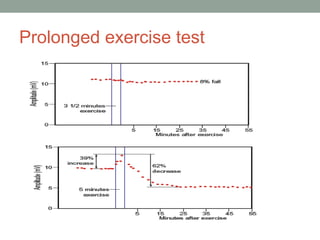
• Prolonged exercise test: immediate increase in CMAP
amplitude, followed by a drop of about 50% in CMAP
amplitude over 20-40 minutes.
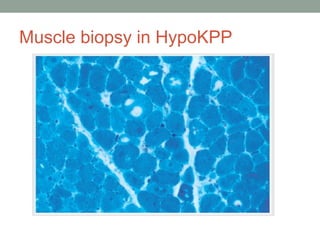
• Muscle biopsy: central vacuoles and chronic myopathic
changes.
Prolonged exercise test
Muscle biopsy in HypoKPP
Treatment
• Lifestyle and dietary modification.
• Acute pharmacological intervention.
• Chronic pharmacological intervention.
• Eat frequent small meals to avoid large carbohydrate
loads.
• Refrain from excessive exercise.
Treatment of acute attack
• Oral potassium 10-20 mEq every 15-30 minutes over 1-3
hours (not to exceed 200mEq in a 24 hour period).
• If the patient is not able to take orally IV potassium should
be given.
• IV potassium should be mixed with 5% mannitol.
• 35 mEq K with 1 L 5% mannitol @250ml/hour (not to
exceed 200mEq in a 24 hour period).
Statland J et al. Neurol Clin 32 (2014) 801-15.
Prevention of attacks
• Prophylactic use acetazolamide decreases the frequency
and severity of attacks.
• Starting dose is 125mg/day; to be up titrated as needed
up to a maximum of 1000-1500mg/day in divided doses.
• Dichlorphenamide is another carbonic anhydrase inhibitor
that effectively prevents attacks. (50-200mg/day)
Tawil et al. Ann Neurol 2000; 47: 46–53.
Thyrotoxic periodic paralysis
• TPP is seen most commonly in Asian men.
• Characterized by abrupt onset of hypokalemia and
paralysis.
• Patients present with acute onset of proximal symmetrical
ascending lower-extremity muscle weakness.
• Triggers: rest after exercise or high carbohydrate meals.
• Deep tendon reflexes are decreased or absent
• Hypokalemia results from an intracellular shift of K
induced by the thyroid hormone.
• Features s/o TPP are age>20 years, no family h/o of PP,
male sex, Asian origin.
• T/t: nonselective beta-blockade, correcting the underlying
hyperthyroid state, and replacing potassium.
• TPP is curable once a euthyroid state is achieved.
Venance SL et al. Brain (2006), 129, 8–17
Hyperkalemic periodic paralysis
• Age of symptom onset: early childhood (first decade)
• Attacks of periodic weakness are short lived (1-4 hours)
• Weakness commonly occurs in the morning after
awakening from sleep.
• Provoking factors: rest after exercise, fasting, emotional
stress, cold, and potassium loading.
• Weakness usually is generalized but spares the facial and
respiratory muscles.
• Hyporeflexia is present during weakness.
• Clinical myotonia is seen in about 20% of cases.
(myotonia on EMG is more common)
• Eyelid myotonia is common.
• The frequency of attacks generally lessens in middle age.
• A large proportion of subjects with HyperKPP develop a
progressive proximal myopathy.
Genetics
• Autosomal dominant.
• Mutation in gene encoding α subunit of voltage gated
sodium channel (SCN4A)
• Chromosome 17q
Investigations
• Serum potassium levels: may be elevated at the time of
weakness.
• K levels can be normal in about 50% of cases.
• NCS: normal between the attacks.
• Reduced CMAPs amplitude during attacks.
• EMG: reduction in size of MUAPs during attacks
• Myotonia in between attacks
• . Venance SL et al. Brain (2006), 129, 8–17
• Muscle cooling has no appreciable effect on the needle
EMG findings.
• Prolonged exercise test: immediate increase in the CMAP
amplitude, followed by a progressive drop in the CMAP
amplitude by about 50% over 20 to 40 minutes.
• Muscle biopsy: central vacuoles.
Treatment
• Lifestyle modification:
Avoidance of K rich foods
Avoidance of drugs that can increase K (spironolactone)
Avoidance of fasting.
Diet high in carbohydrates.
Treatment of acute attacks
• Acute attacks are often mild and brief therefore not
requiring treatment.
• In severe attacks aim at lowering EC K levels
• Mild exercise
• Eating high sugar load (candy bar)
• Inhalation of β agonist (1–2 puffs of 0.1 mg salbutamol or
albuterol)
• IV calcium gluconate in very severe cases.
Prevention of attacks
• Acetazolamide: start at 125mg/day. Titrate as needed to
1000-1500mg/day.
• Thiazide diuretics.
• Dichlorphenamide was found to be useful in reducing the
frequency of attacks in a recent RCT.
Tawil et al. Ann Neurol 2000; 47: 46–53.
Andersen-Tawil Syndrome
• Characterized by classic triad of
1.Periodic paralysis.
2.Ventricular arrhythmias.
3.Dysmorphic features.
• Age of symptom onset: 1-2 decade.
• Episodic weakness is usually the first presenting
symptom.
• Triggers for weakness: prolonged rest or rest following
exertion
Venance et al. Brain (2006), 129, 8–17
• Ictal K levels can be low, normal or elevated.
• permanent proximal weakness often develops later in the
course.
• Patients can present with palpitation, syncope or rarely
cardiac arrest.
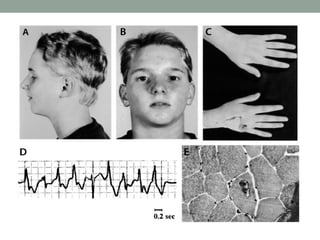
• ECG can show
Prolonged QTc
VPCs, ventricular bigeminy, polymorphic VT.
Bidirectional VT.
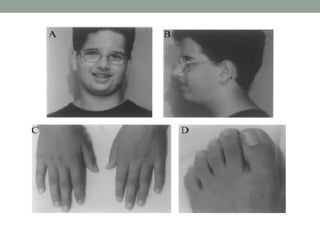
• Dysmorphic features can be any combination of
Short stature.
Low set ears.
Ocular hypertelorism.
 Broad nasal root.
Small mandible.
Fifth-digit clinodactyly (abnormally bent or curved finger),
and syndactyly.
Tristani-Firouzi et al. J Clin Invest 2002; 110: 381–8.
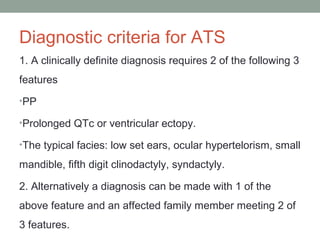
Diagnostic criteria for ATS
1. A clinically definite diagnosis requires 2 of the following 3
features
•PP
•Prolonged QTc or ventricular ectopy.
•The typical facies: low set ears, ocular hypertelorism, small
mandible, fifth digit clinodactyly, syndactyly.
2. Alternatively a diagnosis can be made with 1 of the
above feature and an affected family member meeting 2 of
3 features.
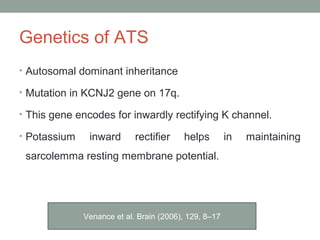
Genetics of ATS
• Autosomal dominant inheritance
• Mutation in KCNJ2 gene on 17q.
• This gene encodes for inwardly rectifying K channel.
• Potassium inward rectifier helps in maintaining
sarcolemma resting membrane potential.
Venance et al. Brain (2006), 129, 8–17
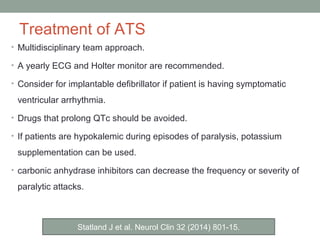
Treatment of ATS
• Multidisciplinary team approach.
• A yearly ECG and Holter monitor are recommended.
• Consider for implantable defibrillator if patient is having symptomatic
ventricular arrhythmia.
• Drugs that prolong QTc should be avoided.
• If patients are hypokalemic during episodes of paralysis, potassium
supplementation can be used.
• carbonic anhydrase inhibitors can decrease the frequency or severity of
paralytic attacks.
Statland J et al. Neurol Clin 32 (2014) 801-15.
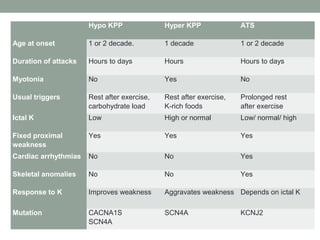
  Hypo KPP Hyper KPP ATS
Age at onset 1 or 2 decade. 1 decade 1 or 2 decade
Duration of attacks Hours to days Hours Hours to days
Myotonia  No Yes No
Usual triggers Rest after exercise,
carbohydrate load
Rest after exercise,
K-rich foods
Prolonged rest
after exercise
Ictal K Low High or normal Low/ normal/ high
Fixed proximal 
weakness
Yes Yes Yes
Cardiac arrhythmias No No Yes
Skeletal anomalies  No No Yes
Response to K Improves weakness Aggravates weakness Depends on ictal K
Mutation  CACNA1S
SCN4A
SCN4A KCNJ2
Take home message
• Muscle channelopathies can present as NDM or PP.
• Myotonia congenita typically displays warm up
phenomenon.
• Exposure to cold aggravates myotonia and weakness in
PMC.
• TPP is an important DD of HypoKPP in our setup.
• K levels can be normal in HyperKPP during attacks.
• ATS is a triad of PP, Ventricular arrhythmias and
dysmorphic features.
THANK YOU
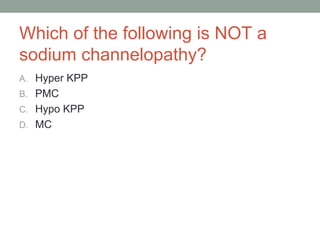
Which of the following is NOT a
sodium channelopathy?
A. Hyper KPP
B. PMC
C. Hypo KPP
D. MC
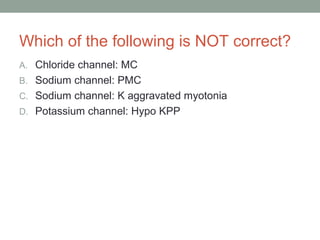
Which of the following is NOT correct?
A. Chloride channel: MC
B. Sodium channel: PMC
C. Sodium channel: K aggravated myotonia
D. Potassium channel: Hypo KPP
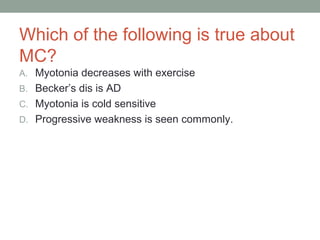
Which of the following is true about
MC?
A. Myotonia decreases with exercise
B. Becker’s dis is AD
C. Myotonia is cold sensitive
D. Progressive weakness is seen commonly.
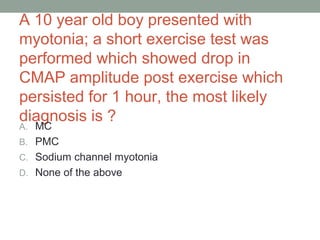
A 10 year old boy presented with
myotonia; a short exercise test was
performed which showed drop in
CMAP amplitude post exercise which
persisted for 1 hour, the most likely
diagnosis is ?
A. MC
B. PMC
C. Sodium channel myotonia
D. None of the above
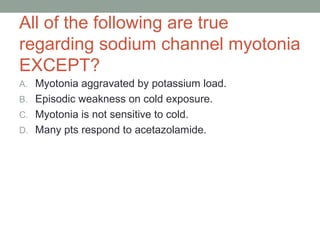
All of the following are true
regarding sodium channel myotonia
EXCEPT?
A. Myotonia aggravated by potassium load.
B. Episodic weakness on cold exposure.
C. Myotonia is not sensitive to cold.
D. Many pts respond to acetazolamide.
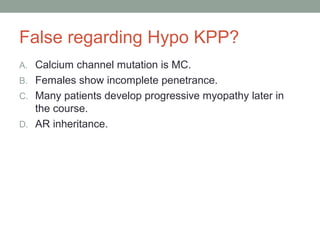
False regarding Hypo KPP?
A. Calcium channel mutation is MC.
B. Females show incomplete penetrance.
C. Many patients develop progressive myopathy later in
the course.
D. AR inheritance.
Which of the following is not a classical
feature of ATS?
A. PP
B. Myotonia
C. Dysmorphic face
D. Ventricular arrythmias
Myotonia on needle EMG is seen in
which of the following disorder?
A. Hypo KPP
B. ATS
C. Hyper KPP
D. None of the above
ATS is which type of
channelopathy?
A. Sodium
B. Chloride
C. Calcium
D. potassium

Muscle channelopathies

  • 1.
  • 2.
    Introduction • The musclechannelopathies are a group of rare inherited diseases caused by mutations in muscle ion channels. • Ion channels: membrane-bound proteins. • Ion channels regulate ion flow into and out of cells. • Thus they are integral to the fundamental processes of electrical signaling and excitation within the nervous system.
  • 3.
    Classification of ionchannels • Ion channels are classified as Voltage gated or ligand gated. • Voltage gated ion channels activates by change in membrane potential. • Ligand gated ion channels responds to specific neurotransmitter (Ach, GABA).
  • 4.
    Basic structure • Similarbasic structure. • Large pore-forming subunit, which is located within the membrane. • Pore forming unit = α subunit. • Variable number of accessory subunits (β, ) are presentϒ around pore forming subunit. • α subunit typically determines ion selectivity and mediate the voltage sensing function of the channel.
  • 5.
    Basic structure ofion channel
  • 6.
    Functions of majorion channels • Sodium channels: membrane excitability. • Calcium channels: couple membrane excitation to muscle contraction. • Chloride channel: stabilizing the resting membrane potential and help in membrane repolarization after excitation. • Potassium channel: membrane repolarization Cherian, et al.: Muscle channelopathies. Ann Indian Acad Neurol 2008;11:20-7
  • 7.
    Muscle Channelopathies Channel DiseaseGene Calcium channel Hypokalemic periodic paralysis CACNA1S Chloride channel Myotonia congenita: Thomsen’s (AD) and Becker’s (AR) CLCN1 Sodium channel Hyperkalemic periodic paralysis Hypokalemic periodic paralysis 2 Paramyotonia congenita Potassium aggravated myotonia SCN4A Potassium channel Andersen’s syndrome KCNJ2
  • 8.
    Clinical characteristics ofmuscle channelopathies • Autosomal Dominant inheritance • Episodic weakness/ muscle stiffness. • Return to asymptomatic state. • Exacerbation by environmental factors like fasting, fatigue, carbohydrate rich diet etc. • Response to carbonic anhydrase inhibitors. Statland J et al. Neurol Clin 32 (2014) 801-15.
  • 9.
    Muscle channelopathies Non dystrophicmyotonia • Myotonia congenita • Paramyotonia congenita • Potassium aggravated myotonia Periodic paralysis • Hypokalemic PP • Hyperkalemic PP • Andersen-Tawil
  • 10.
    Non Dystrophic Myotonia •Myotonia: Delayed muscle relaxation after voluntary or evoked muscle contraction. • NDM are clinically distinct from myotonic dystrophy as there is absence of progressive muscle weakness and systemic features. • NDM comprise of myotonia congenita, paramyotonia congenita and sodium channel myotonias. Matthews E et al. Brain 2010: 133; 9–22
  • 11.
    • Prevalence ofNDM is approximately 1/100,000. • Major presenting feature of NDM is muscle stiffness due to myotonia. • Other features can be transient weakness, muscle hypertrophy, fatigue and pain. •
  • 12.
    Myotonia Congenita • MCcan be inherited as AD or AR trait. • AD= Thomsen Disease. • AR= Becker Myotonia • AD was first described in 1876 by Danish physician Julius Thomsen; who suffered from disease himself. • MC is the most common inherited skeletal muscle channelopathy. Matthews E et al. Brain 2010: 133; 9–22
  • 13.
    Clinical features ofMC • Age of onset: first decade (Thomsen), 10-14 years (Becker) • The most common complaint is muscle stiffness due to myotonia. • Forceful movements abruptly initiated after several minutes of rest causes most pronounced stiffness. • Patients classically have a hypertrophic and muscular build.
  • 14.
    • Myotonia displaysWarm Up phenomenon. • Myotonia decreases or vanishes when repeating the same movement several time. (DD= PMC) • Myotonia can affect all skeletal muscles but it is most prominent in legs. • Patients with AR form experience transient bouts of muscle weakness after a period of rest. (improves with exercise) • Muscle hypertrophy and disease severity are greater in AR form of disease. Statland JM. Continuum (Minneap Minn) 2013;19(6):1598–1614.
  • 15.
    Genetics/ pathophysiology • Myotoniacongenita is due to mutation in chloride channel gene (CLCN-1). • This gene is located on chromosome 7q35. • This mutation causes decreased sarcolemmal chloride conductance. • This causes repeated depolarization of sarcolemma; hence leading to muscle hyper excitability and clinical myotonia.
  • 16.
    Investigations • Routine sensoryand motor NCS are normal. • Needle EMG: myotonic discharges are seen. Producing characteristic dive bomber or reviving engine sound. • MUAPs are characteristically normal. • Short exercise test: produces a drop in CMAP amplitude immediately after exercise; which recovers rapidly over 1- 2 minutes. • CK levels may be slightly elevated. Fournier E, et al. Ann Neurol 2004;56:650-61.
  • 17.
  • 18.
  • 19.
    Comparison of featuresof Thomsen and Becker’s. Thomsen Becker’s Inheritance AD AR Age of onset First decade 10-14 years Myotonia distribution UL> LL LL>> UL Episodic weakness None Common, develops on initiation of movement but transient and improves rapidly Muscle hypertrophy + ++ Warm up phenomenon present Present Myotonia cold sensitivity None or minimal None or minimal
  • 20.
    Paramyotonia congenita • Firstdescribed by Eulenburg in 1886. • He described syndrome of muscle stiffness and episodic weakness profoundly exacerbated by cold and exercise. • Three characteristic features Paradoxical myotonia Cold induced myotonia Weakness after prolonged cold exposure.
  • 21.
    Clinical features ofPMC • Age of presentation: infancy; within first decade. • Facial, tongue and hand muscles are predominantly affected. • Muscle stiffness increases by repeated or prolonged muscle contraction. (DD=MC) • Infant is noted to have prolonged eye closure after crying/sleeping. • Patient can c/o difficulty in eye opening after sneezing.
  • 22.
    • Muscle stiffnessis also triggered by exposure to cold. • c/o difficulty in swimming in cold water; difficulty in swallowing ice cream. • Cold also induces weakness which can take hours to normalize despite rewarming. • Muscle hypertrophy is less common as compared to MC. Matthews E et al. Neurology 2008b; 70: 50–3.
  • 23.
    Investigations in PMC •Routine motor and sensory NCS is normal. • EMG: Myotonic discharges. MUAPs will be normal. • Muscle cooling will increase myotonia which is pathognomic of PMC. Cooling will also cause dense fibrillation potential to appear. • As the muscle cools down below 20 C all myotonic discharges disappear completely giving way to paralysis.
  • 24.
    • Short exercisetest: produces a drop in CMAP amplitude post exercise; the recovery is delayed to often 60 minutes. • The short exercise test after cooling may further enhance drop in amplitude; recovery is also delayed after cooling.
  • 26.
    Genetics of PMC •Autosomal dominant. • Point mutation in the SCN4A gene on chromosome 17q. • Mutation in this gene causes defect in sodium channel deactivation.
  • 27.
    Sodium channel myotonia •Also known as potassium aggravated myotonia. • Autosomal dominant inheritance. • Mutation in SCN4A gene located on chromosome 17q. • This mutation causes disturbance in fast inactivation of sodium channels. • Three clinical variants Myotonia fluctuans Myotonia permanens Actezolamide responsive myotonia.
  • 28.
    Clinical features • Patientspresents with generalized stiffness due to myotonia. • Myotonia aggravates after potassium ingestion. • No worsening of symptoms with cold. • Patients do not experience episodic weakness. • Delayed onset myotonia after exercise. (10-30 min) Mankodi, et al. Neurology India 2008;56:298-304.
  • 29.
    • Myotonia fluctuans:myotonia fluctuates in severity; is aggravated by potassium ingestion and prolonged exercise. • Myotonia permanens: most serious form; severe and protracted myotonia which can impair respiration. • Actezolamide responsive myotonia: painful myotonia that responds to carbonic anhydrase inhibitors.
  • 30.
    Investigations • Sensory andmotor NCS: normal • EMG: myotonic discharges • Muscle cooling: no effect • Short exercise test: no significant change of CMAPs from baseline. • CPK levels may be elevated by 2-3 folds.
  • 32.
      Myotonia congenita Paramyotonia congenitaSodium channel myotonia Inheritance  AD= Thomsen AR= Becker AD AD Causative gene CLCN-1 SCN4A SCN4A Myotonia distribution UL, LL, Face Upper limbs and face more than lower limbs Upper limbs, face and extraocular, more than lower limbs Myotonia cold sensitivity None or minimal Yes—often dramatic None Warm up phenomenon Present Absent May be present Paradoxical myotonia  Absent Present Absent Delayed onset myotonia after exercise Absent Absent Present Episodic muscle weakness Can occur in AR. Transient at initiation of movement. Common. After exposure to cold. Several hours. None Short exercise test Early decrement in CMAP with rapid recovery Gradual and persistent reduction in CMAP enhanced by cooling. No significant change of the CMAP from baseline
  • 33.
    Management of NDM •For mild symptoms no specific treatment is needed. • Patients should be advised regarding avoidance of precipitating factors like cold, strenuous exercise or ingestion of potassium rich food. • The class IB anti-arrhythmic mexiletine is considered the drug of choice. Statland JM. Mexiletine for symptoms and signs of myotonia in nondystrophic myotonia: a randomized controlled trial. JAMA 2012.
  • 34.
    • Oral 200-mgmexiletine 3 times a day resulted in improved patient-reported stiffness over 4 weeks of treatment as compared to placebo. • Mexiletine has pro-arrhythmic potential therefore ECG to measure QT interval should be done. • Other useful drugs are phenytoin, procainamide or quinine; but they have unfavorable side effect profile. Statland JM. Mexiletine for symptoms and signs of myotonia in nondystrophic myotonia: a randomized controlled trial. JAMA 2012.
  • 35.
    • Patients withsodium channel myotonia responds to carbononic anhydrase inhibitors. • Acetazolamide with starting dose 125 mg daily with gradual titration up to 250 mg three times a day is found be useful in decreasing severity of myotonia. Mankodi, et al. Neurology India 2008;56:298-304.
  • 37.
    Hypokalemic periodic paralysis •HypoKPP is the most common PP. • Prevalence: 1 in 100,000. • Autosomal dominant inheritance. • There is reduced penetrance in females (50%) in contrast to the complete penetrance seen in males. • Approximately one-third of cases may be new dominant mutations. Venance SL et al. Brain (2006), 129, 8–17
  • 38.
    Clinical features • Ageof symptom onset: 1 or 2 decade. • Usual time of attack: in the early morning or on awakening in the night. • Weakness can be generalized or focal. • Facial and respiratory muscle are usually spared. • Tendon reflexes are usually hypoactive. • Typical attack lasts for few hours (occasionally days). Venance SL et al. Brain (2006), 129, 8–17
  • 39.
    • Frequency ofindividual attacks can vary from daily to a few episodes in a lifetime. • Attacks often decrease in frequency after 40 years. • Usual triggers: rest after vigorous exercise, carbohydrate- rich meal on the previous day. • Other triggers: viral illness, lack of sleep, menstruation and specific medications (e.g. beta agonists, corticosteroids and insulin). • Approximately two-thirds of the patients will develop progressive fixed weakness later on in life. Miller TM et al. Neurology 2004; 63: 1647–55.
  • 40.
    Genetics • Mutation inα subunit of skeletal muscle L-type calcium channel gene CACN1AS. (chromosome 1q). 70 % of cases; HypoKPP 1. • Mutation in α subunit of skeletal muscle sodium channel gene SCN4A (chromosome 17q) 10-20 % of cases; HypoKPP 2. Venance SL et al. Brain (2006), 129, 8–17
  • 41.
    HypoKPP 2 • Thesepts differs from classical form in following aspects. Myalgia following paralytic attacks. Worsening of symptoms by acetazolamide. Older age of onset. Shorter duration of attacks. Miller TM et al. Neurology 2004; 63: 1647–55.
  • 42.
    Investigations • Serum potassiumconcentration are usually low during an attack. (K levels are normal in inter ictal period). • ECG: T wave flattening, prominent U waves. • Provocative testing (oral glucose load): not recommended. • NCS: during an attack CMAPs amplitude can be low. • Motor and sensory NCS are normal between attacks.
  • 43.
    • EMG: normalbetween attacks. • During attacks there can be reduction in size and number of MUAPs recruited. • Fixed weakness: Myopathic MUAPs with early recruitment. • Prolonged exercise test: immediate increase in CMAP amplitude, followed by a drop of about 50% in CMAP amplitude over 20-40 minutes. • Muscle biopsy: central vacuoles and chronic myopathic changes.
  • 44.
  • 45.
  • 46.
    Treatment • Lifestyle anddietary modification. • Acute pharmacological intervention. • Chronic pharmacological intervention. • Eat frequent small meals to avoid large carbohydrate loads. • Refrain from excessive exercise.
  • 47.
    Treatment of acuteattack • Oral potassium 10-20 mEq every 15-30 minutes over 1-3 hours (not to exceed 200mEq in a 24 hour period). • If the patient is not able to take orally IV potassium should be given. • IV potassium should be mixed with 5% mannitol. • 35 mEq K with 1 L 5% mannitol @250ml/hour (not to exceed 200mEq in a 24 hour period). Statland J et al. Neurol Clin 32 (2014) 801-15.
  • 48.
    Prevention of attacks •Prophylactic use acetazolamide decreases the frequency and severity of attacks. • Starting dose is 125mg/day; to be up titrated as needed up to a maximum of 1000-1500mg/day in divided doses. • Dichlorphenamide is another carbonic anhydrase inhibitor that effectively prevents attacks. (50-200mg/day) Tawil et al. Ann Neurol 2000; 47: 46–53.
  • 49.
    Thyrotoxic periodic paralysis •TPP is seen most commonly in Asian men. • Characterized by abrupt onset of hypokalemia and paralysis. • Patients present with acute onset of proximal symmetrical ascending lower-extremity muscle weakness. • Triggers: rest after exercise or high carbohydrate meals. • Deep tendon reflexes are decreased or absent • Hypokalemia results from an intracellular shift of K induced by the thyroid hormone.
  • 50.
    • Features s/oTPP are age>20 years, no family h/o of PP, male sex, Asian origin. • T/t: nonselective beta-blockade, correcting the underlying hyperthyroid state, and replacing potassium. • TPP is curable once a euthyroid state is achieved. Venance SL et al. Brain (2006), 129, 8–17
  • 51.
    Hyperkalemic periodic paralysis •Age of symptom onset: early childhood (first decade) • Attacks of periodic weakness are short lived (1-4 hours) • Weakness commonly occurs in the morning after awakening from sleep. • Provoking factors: rest after exercise, fasting, emotional stress, cold, and potassium loading. • Weakness usually is generalized but spares the facial and respiratory muscles.
  • 52.
    • Hyporeflexia ispresent during weakness. • Clinical myotonia is seen in about 20% of cases. (myotonia on EMG is more common) • Eyelid myotonia is common. • The frequency of attacks generally lessens in middle age. • A large proportion of subjects with HyperKPP develop a progressive proximal myopathy.
  • 53.
    Genetics • Autosomal dominant. •Mutation in gene encoding α subunit of voltage gated sodium channel (SCN4A) • Chromosome 17q
  • 54.
    Investigations • Serum potassiumlevels: may be elevated at the time of weakness. • K levels can be normal in about 50% of cases. • NCS: normal between the attacks. • Reduced CMAPs amplitude during attacks. • EMG: reduction in size of MUAPs during attacks • Myotonia in between attacks • . Venance SL et al. Brain (2006), 129, 8–17
  • 55.
    • Muscle coolinghas no appreciable effect on the needle EMG findings. • Prolonged exercise test: immediate increase in the CMAP amplitude, followed by a progressive drop in the CMAP amplitude by about 50% over 20 to 40 minutes. • Muscle biopsy: central vacuoles.
  • 56.
    Treatment • Lifestyle modification: Avoidanceof K rich foods Avoidance of drugs that can increase K (spironolactone) Avoidance of fasting. Diet high in carbohydrates.
  • 57.
    Treatment of acuteattacks • Acute attacks are often mild and brief therefore not requiring treatment. • In severe attacks aim at lowering EC K levels • Mild exercise • Eating high sugar load (candy bar) • Inhalation of β agonist (1–2 puffs of 0.1 mg salbutamol or albuterol) • IV calcium gluconate in very severe cases.
  • 58.
    Prevention of attacks •Acetazolamide: start at 125mg/day. Titrate as needed to 1000-1500mg/day. • Thiazide diuretics. • Dichlorphenamide was found to be useful in reducing the frequency of attacks in a recent RCT. Tawil et al. Ann Neurol 2000; 47: 46–53.
  • 59.
    Andersen-Tawil Syndrome • Characterizedby classic triad of 1.Periodic paralysis. 2.Ventricular arrhythmias. 3.Dysmorphic features. • Age of symptom onset: 1-2 decade. • Episodic weakness is usually the first presenting symptom. • Triggers for weakness: prolonged rest or rest following exertion Venance et al. Brain (2006), 129, 8–17
  • 60.
    • Ictal Klevels can be low, normal or elevated. • permanent proximal weakness often develops later in the course. • Patients can present with palpitation, syncope or rarely cardiac arrest. • ECG can show Prolonged QTc VPCs, ventricular bigeminy, polymorphic VT. Bidirectional VT.
  • 61.
    • Dysmorphic featurescan be any combination of Short stature. Low set ears. Ocular hypertelorism.  Broad nasal root. Small mandible. Fifth-digit clinodactyly (abnormally bent or curved finger), and syndactyly. Tristani-Firouzi et al. J Clin Invest 2002; 110: 381–8.
  • 64.
    Diagnostic criteria forATS 1. A clinically definite diagnosis requires 2 of the following 3 features •PP •Prolonged QTc or ventricular ectopy. •The typical facies: low set ears, ocular hypertelorism, small mandible, fifth digit clinodactyly, syndactyly. 2. Alternatively a diagnosis can be made with 1 of the above feature and an affected family member meeting 2 of 3 features.
  • 65.
    Genetics of ATS •Autosomal dominant inheritance • Mutation in KCNJ2 gene on 17q. • This gene encodes for inwardly rectifying K channel. • Potassium inward rectifier helps in maintaining sarcolemma resting membrane potential. Venance et al. Brain (2006), 129, 8–17
  • 66.
    Treatment of ATS •Multidisciplinary team approach. • A yearly ECG and Holter monitor are recommended. • Consider for implantable defibrillator if patient is having symptomatic ventricular arrhythmia. • Drugs that prolong QTc should be avoided. • If patients are hypokalemic during episodes of paralysis, potassium supplementation can be used. • carbonic anhydrase inhibitors can decrease the frequency or severity of paralytic attacks. Statland J et al. Neurol Clin 32 (2014) 801-15.
  • 67.
      Hypo KPP Hyper KPPATS Age at onset 1 or 2 decade. 1 decade 1 or 2 decade Duration of attacks Hours to days Hours Hours to days Myotonia  No Yes No Usual triggers Rest after exercise, carbohydrate load Rest after exercise, K-rich foods Prolonged rest after exercise Ictal K Low High or normal Low/ normal/ high Fixed proximal  weakness Yes Yes Yes Cardiac arrhythmias No No Yes Skeletal anomalies  No No Yes Response to K Improves weakness Aggravates weakness Depends on ictal K Mutation  CACNA1S SCN4A SCN4A KCNJ2
  • 68.
    Take home message •Muscle channelopathies can present as NDM or PP. • Myotonia congenita typically displays warm up phenomenon. • Exposure to cold aggravates myotonia and weakness in PMC. • TPP is an important DD of HypoKPP in our setup. • K levels can be normal in HyperKPP during attacks. • ATS is a triad of PP, Ventricular arrhythmias and dysmorphic features.
  • 69.
  • 70.
    Which of thefollowing is NOT a sodium channelopathy? A. Hyper KPP B. PMC C. Hypo KPP D. MC
  • 71.
    Which of thefollowing is NOT correct? A. Chloride channel: MC B. Sodium channel: PMC C. Sodium channel: K aggravated myotonia D. Potassium channel: Hypo KPP
  • 72.
    Which of thefollowing is true about MC? A. Myotonia decreases with exercise B. Becker’s dis is AD C. Myotonia is cold sensitive D. Progressive weakness is seen commonly.
  • 73.
    A 10 yearold boy presented with myotonia; a short exercise test was performed which showed drop in CMAP amplitude post exercise which persisted for 1 hour, the most likely diagnosis is ? A. MC B. PMC C. Sodium channel myotonia D. None of the above
  • 74.
    All of thefollowing are true regarding sodium channel myotonia EXCEPT? A. Myotonia aggravated by potassium load. B. Episodic weakness on cold exposure. C. Myotonia is not sensitive to cold. D. Many pts respond to acetazolamide.
  • 75.
    False regarding HypoKPP? A. Calcium channel mutation is MC. B. Females show incomplete penetrance. C. Many patients develop progressive myopathy later in the course. D. AR inheritance.
  • 76.
    Which of thefollowing is not a classical feature of ATS? A. PP B. Myotonia C. Dysmorphic face D. Ventricular arrythmias
  • 77.
    Myotonia on needleEMG is seen in which of the following disorder? A. Hypo KPP B. ATS C. Hyper KPP D. None of the above
  • 78.
    ATS is whichtype of channelopathy? A. Sodium B. Chloride C. Calcium D. potassium