Presenter: Ms Shruti Shirke
MSN (Neurosciences)
Motor neuron
 A motor neuron is a neuron whose cell body is located
in the motor cortex, brainstem or the spinal cord and
whose axon projects to the spinal cord and outside of
the spinal cord to directly or indirectly control effecter
organs, mainly muscles and glands.
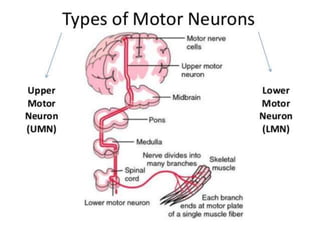
Types of motor neuron
Upper
motor
neuron
Lower
motor
neuron
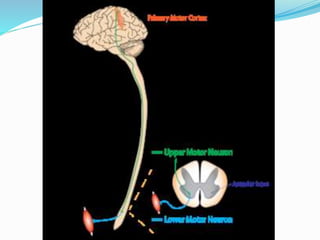
Upper motor neuron
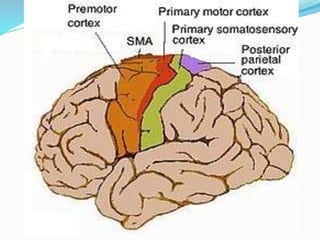
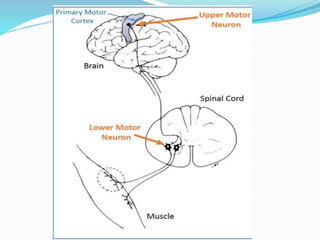
 Upper motor neuron that starts in the motor cortex of
the brain and terminates within the medulla or within
the spinal cord.
 Lower motor neuron;- they are located in either the
anterior grey column, anterior nerve root or the cranial
nerve nuclei of the brainstem and cranial nerves with
motor function.
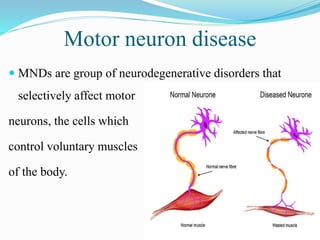
Motor neuron disease
 MNDs are group of neurodegenerative disorders that
selectively affect motor
neurons, the cells which
control voluntary muscles
of the body.
MND
 MND affect both children and adults. While each MND affects
patients differently, they all came with movement relate
symptoms, mainly muscle weakness.
 Sporadic degenerative disease involving only motor system
 Usual age is 40-60 years
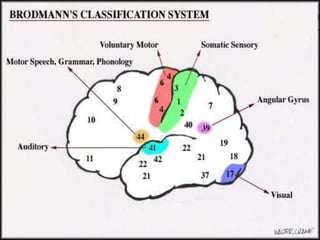
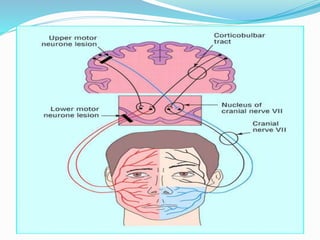
 CN are also controlled by upper motor neuron of the
contralateral side- these are known as cortico-bulbar tract
 When lesion is present in the CN nucleus it is called as
bulbar palsy (usually 9 10 11 12)(LMN)
 When lesion is present in the cortico-bulbar tract (UMN) it
is called as pseudobulbar palsy
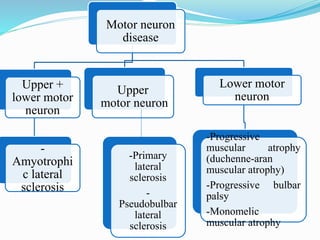
Motor neuron
disease
Upper +
lower motor
neuron
-
Amyotrophi
c lateral
sclerosis
Upper
motor neuron
Lower motor
neuron
-Progressive
muscular atrophy
(duchenne-aran
muscular atrophy)
-Progressive bulbar
palsy
-Monomelic
muscular atrophy
-Primary
lateral
sclerosis
-
Pseudobulbar
lateral
sclerosis
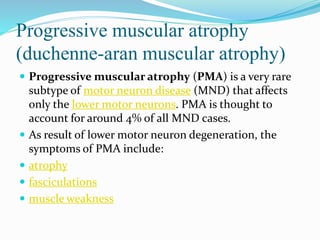
Progressive muscular atrophy
(duchenne-aran muscular atrophy)
 Progressive muscular atrophy (PMA) is a very rare
subtype of motor neuron disease (MND) that affects
only the lower motor neurons. PMA is thought to
account for around 4% of all MND cases.
 As result of lower motor neuron degeneration, the
symptoms of PMA include:
 atrophy
 fasciculations
 muscle weakness
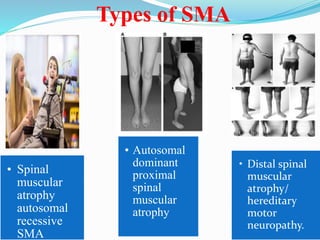
Types of SMA
• Spinal
muscular
atrophy
autosomal
recessive
SMA
• Autosomal
dominant
proximal
spinal
muscular
atrophy
• Distal spinal
muscular
atrophy/
hereditary
motor
neuropathy.
Pathophysiology
 Each individual has 2 SMN genes, SMN1 and SMN2.
 More than 95% of patients with SMA have a homozygous
disruption in the SMN1 gene on chromosome 5q, caused by
mutation, deletion, or rearrangement. However, all patients
with spinal muscular atrophy retain at least 1 copy of SMN2,
which generates only 10% of the amount of full-length SMN
protein versus SMN1. This genomic organization provides a
therapeutic pathway to promote SMN2, existing in all
patients, to function like the missing SMN1 gene.
Progressive bulbar palsy
 PBP is a disease that attacks the nerves supplying
the bulbar muscles. These disorders are characterized
by the degeneration of motor neurons in the cerebral
cortex, spinal cord, brain stem, and pyramidal tracts.
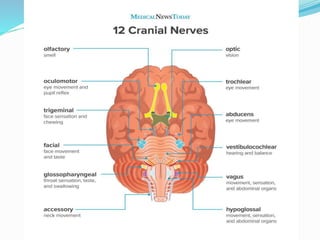
This specifically involves the glossopharyngeal
nerve (IX), vagus nerve (X), and hypoglossal
nerve (XII).
 Prognosis for PBP patients is poor. progressive
difficulty with talking and swallowing. Reduced gag
reflexes, weak palatal movements, fasciculations, and
weak movement of the facial muscles and tongue.
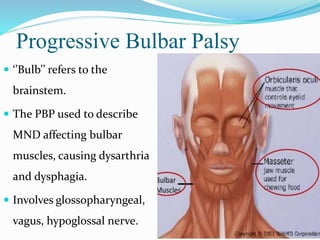
Progressive Bulbar Palsy
 ‘’Bulb’’ refers to the
brainstem.
 The PBP used to describe
MND affecting bulbar
muscles, causing dysarthria
and dysphagia.
 Involves glossopharyngeal,
vagus, hypoglossal nerve.
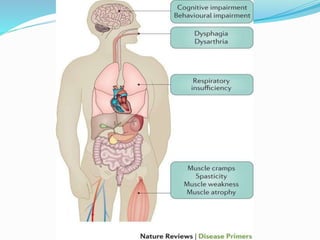
Clinical manifestation
 Progressive difficulty with talking and swallowing.
 Reduced gag reflexes, weak palatal movement, of facial
muscles and tongue.
 Unable to protrude tongue or manipulate food in their
mouth.
 Difficulty in pronunciation, drooling saliva.
 Due to difficulty in swallowing food and saliva, it can be
inhaled into the lungs. This can cause gagging and choking
and increase risk for pneumonia.
 Poor prognosis, death occur after 1-3 years of onset of
disease.
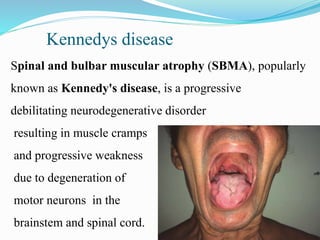
Kennedys disease
Spinal and bulbar muscular atrophy (SBMA), popularly
known as Kennedy's disease, is a progressive
debilitating neurodegenerative disorder
resulting in muscle cramps
and progressive weakness
due to degeneration of
motor neurons in the
brainstem and spinal cord.
Monomelic muscular atrophy
 Rare benign LMND restricted to one limb, usually an arm or
hand rather than a leg.
 Also k/a Hirayama syndrome.
 Affects men 10 times more then women.
 Starts at 20 years .
 Weakness involves he hand and forearm C7-T1 innervated
muscles.
 Condition progress to 1-2 years and then seems to become
arrested in most cases.
Monomelic muscular atrophy
 Monomelic amyotrophy (MMA) is characterized by
progressive degeneration and loss of motor neurons,
the nerve cells in the brain and spinal cord that are
responsible for controlling voluntary muscles. It is
characterized by weakness and wasting in a single
limb, usually an arm and hand rather than a foot and
leg.
Primary lateral sclerosis
 PLS affects the upper motor neurons (also called
corticospinal neurons) in the arms, legs, and face.
 It occurs when nerve cells in the motor regions of the
cerebral cortex gradually degenerate, causing
movements to be slow and effortful.
 The disorder often affects the legs first, followed by the
body, trunk, arms and hands, and, finally the bulbar
muscles (muscles that control speech, swallowing, and
chewing).
Primary lateral sclerosis
 PLS is similar to ALS, but it affect only UMN.
 Causes weakness, stiffness in arms legs, a slowed walk,
poor coordination and balance slow and slurred speech.
 Like ALS it usually starts in people 40-60 years old. The
muscle get stiffer and weaker with time. But unlike ALS,
people don’’t die from it.
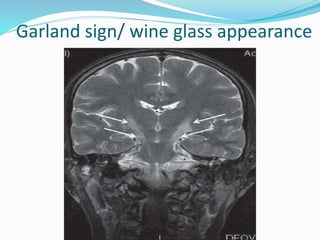
Garland sign/ wine glass appearance
PLS cont..
 Symptoms include weakness, muscle stiffness and
spasticity, clumsiness, slowing of movement, and
problems with balance and speech.
 PLS is not fatal. There is no cure and the progression
of symptoms varies. Some people may retain the
ability to walk without assistance, but others
eventually require wheelchairs, canes, or other
assistive devices.
Pseudobulbar lateral sclerosis
 The condition is usually caused by the bilateral
damage to corticobulbar pathways, which are upper
motor neuron pathways that course from the cerebral
cortex to nuclei of cranial nerves in the brain stem.
 characterized by the inability to control facial
movements (such as chewing and speaking) and
caused by a variety of neurological disorders. Patients
experience difficulty chewing and swallowing, have
increased reflexes and spasticity in tongue and
the bulbar region, and demonstrate slurred speech
Pseudobulbar palsy
 It is a UMND characterised by inability to control facial
movements (chewing, speaking) and caused by a variety
of neurological disorder.
 Patients experience difficulty in chewing and swallowing,
have increased reflexes and spasticity in tongue and the
bulbar region and demonstrate slurred speech .
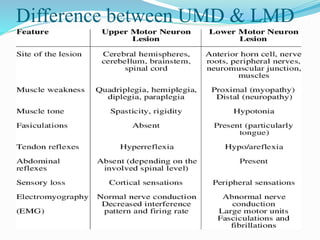
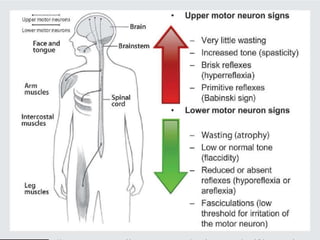
Difference between UMD & LMD
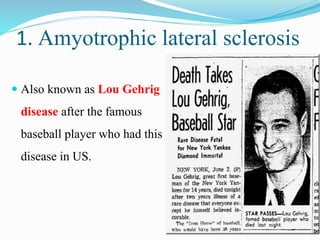
1. Amyotrophic lateral sclerosis
 Also known as Lou Gehrig
disease after the famous
baseball player who had this
disease in US.
•ALS is progressive MND that involves both upper and
lower motor neurons. ALS is defined by evidence of both
lower motor neuron disease (weakness, wasting and
fasciculation) and
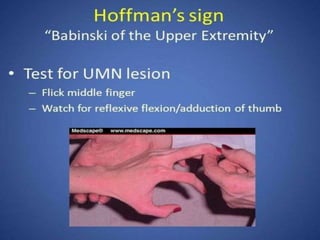
•upper motor neuron disease (spasticity, hyperactive
tendon reflex, Hoffmann signs, Babinski or donus) in the
same limbs.
Amyotrophic lateral sclerosis
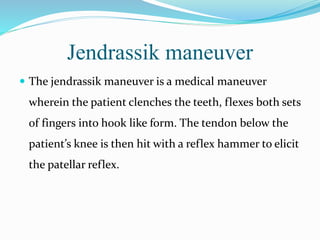
Jendrassik maneuver
 The jendrassik maneuver is a medical maneuver
wherein the patient clenches the teeth, flexes both sets
of fingers into hook like form. The tendon below the
patient’s knee is then hit with a reflex hammer to elicit
the patellar reflex.
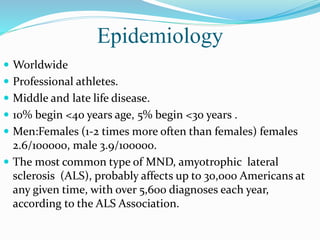
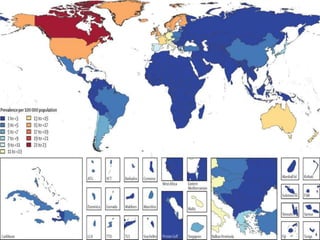
Epidemiology
 Worldwide
 Professional athletes.
 Middle and late life disease.
 10% begin <40 years age, 5% begin <30 years .
 Men:Females (1-2 times more often than females) females
2.6/100000, male 3.9/100000.
 The most common type of MND, amyotrophic lateral
sclerosis (ALS), probably affects up to 30,000 Americans at
any given time, with over 5,600 diagnoses each year,
according to the ALS Association.
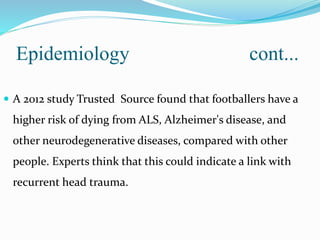
Epidemiology cont...
 A 2012 study Trusted Source found that footballers have a
higher risk of dying from ALS, Alzheimer's disease, and
other neurodegenerative diseases, compared with other
people. Experts think that this could indicate a link with
recurrent head trauma.
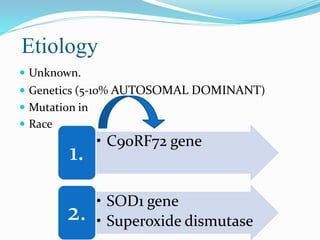
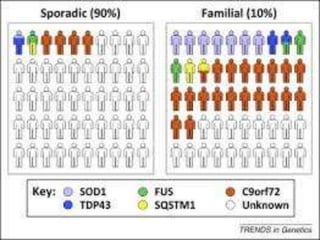
Etiology
 Unknown.
 Genetics (5-10% AUTOSOMAL DOMINANT)
 Mutation in
 Race
• C90RF72 gene
1.
• SOD1 gene
• Superoxide dismutase
2.
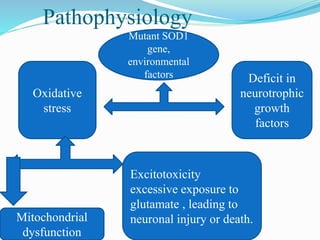
Pathophysiology
Excitotoxicity
excessive exposure to
glutamate , leading to
neuronal injury or death.
Mutant SOD1
gene,
environmental
factors
Oxidative
stress
Deficit in
neurotrophic
growth
factors
Mitochondrial
dysfunction
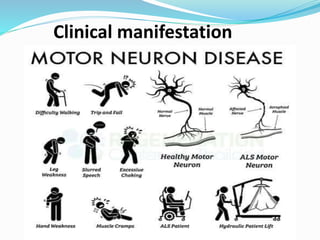
Clinical manifestation
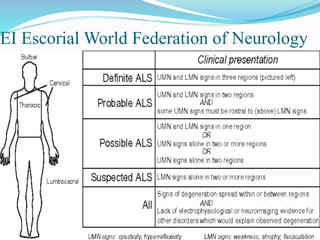
EI Escorial World Federation of Neurology
Clinical features
 Difficult body movements
 Bulbar palsy
 Difficulty in swallowing
 Breathing difficulty
 No sensory involvement
 Eye movement is not affected
 Bowel and bladder functions are normal
 Mentation is normal
 Normal sexual function
 Cognitive functions are normal
 Patients are very prone to aspiration pneumonia
 Weak cough is a poor prognostic feature
 Death after 3-5 years
 Terrible depression  great suicidal tendency
Diagnostic evaluation
CSF (Normal)
CT/MRI (Normal)
EMG & Nerve conduction study (confirmatory)
Tissue biopsy (Atrophy)
Management
 Medical management-
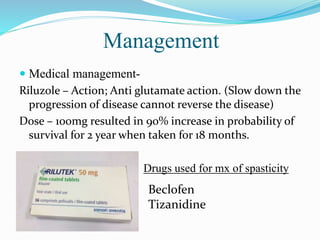
Riluzole – Action; Anti glutamate action. (Slow down the
progression of disease cannot reverse the disease)
Dose – 100mg resulted in 90% increase in probability of
survival for 2 year when taken for 18 months.
Drugs used for mx of spasticity
Beclofen
Tizanidine
Edaravone
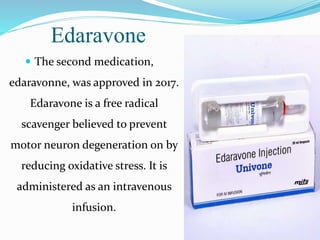
 The second medication,
edaravonne, was approved in 2017.
Edaravone is a free radical
scavenger believed to prevent
motor neuron degeneration on by
reducing oxidative stress. It is
administered as an intravenous
infusion.
 In a select patient population (≤2 years from first
amyotrophic lateral sclerosis symptom, minimal
respiratory involvement, and minimal disability based
on amyotrophic lateral sclerosis revised functional
rating scale), edaravone was associated with slower
decline over 6 months compared with placebo.
Nursing management
 Impaired Physical Mobility related to muscle wasting,
weakness, and spasticity
 Impaired Self-Care related to muscle wasting, weakness,
and spasticity
 Impaired Communications related to impairment of
muscles of speech
 High Risk for Aspiration related to impaired muscles of
swallowing
 Ineffective Breathing Pattern related to impairment of
respiratory muscles
 Altered Nutrition, Less Than Required, related to inability
to swallow
Supportive management
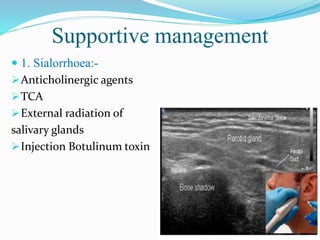
 1. Sialorrhoea:-
Anticholinergic agents
TCA
External radiation of
salivary glands
Injection Botulinum toxin
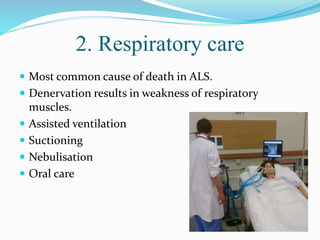
2. Respiratory care
 Most common cause of death in ALS.
 Denervation results in weakness of respiratory
muscles.
 Assisted ventilation
 Suctioning
 Nebulisation
 Oral care
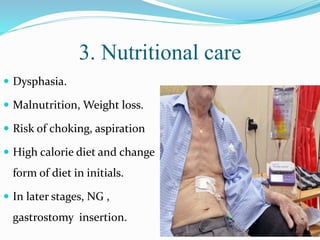
3. Nutritional care
 Dysphasia.
 Malnutrition, Weight loss.
 Risk of choking, aspiration
 High calorie diet and change
form of diet in initials.
 In later stages, NG ,
gastrostomy insertion.
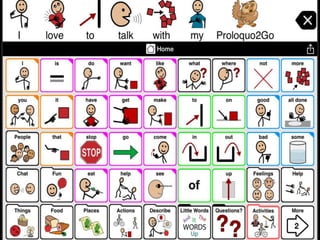
4. Speech and communication
management
 Serious factor reducing quality
of life.
 Energy conservation
techniques.
 Non verbal communication.
 Assisted and augmented
devices.
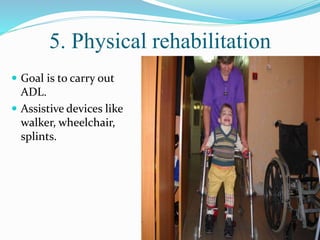
5. Physical rehabilitation
 Goal is to carry out
ADL.
 Assistive devices like
walker, wheelchair,
splints.
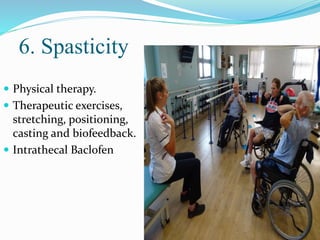
6. Spasticity
 Physical therapy.
 Therapeutic exercises,
stretching, positioning,
casting and biofeedback.
 Intrathecal Baclofen
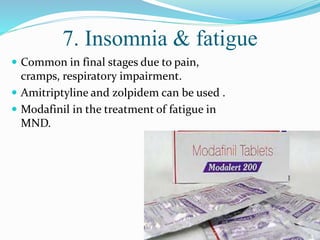
7. Insomnia & fatigue
 Common in final stages due to pain,
cramps, respiratory impairment.
 Amitriptyline and zolpidem can be used .
 Modafinil in the treatment of fatigue in
MND.
THANKU

Motor neuron disease

  • 2.
    Presenter: Ms ShrutiShirke MSN (Neurosciences)
  • 4.
    Motor neuron  Amotor neuron is a neuron whose cell body is located in the motor cortex, brainstem or the spinal cord and whose axon projects to the spinal cord and outside of the spinal cord to directly or indirectly control effecter organs, mainly muscles and glands.
  • 6.
    Types of motorneuron Upper motor neuron Lower motor neuron
  • 7.
    Upper motor neuron Upper motor neuron that starts in the motor cortex of the brain and terminates within the medulla or within the spinal cord.  Lower motor neuron;- they are located in either the anterior grey column, anterior nerve root or the cranial nerve nuclei of the brainstem and cranial nerves with motor function.
  • 12.
    Motor neuron disease MNDs are group of neurodegenerative disorders that selectively affect motor neurons, the cells which control voluntary muscles of the body.
  • 13.
    MND  MND affectboth children and adults. While each MND affects patients differently, they all came with movement relate symptoms, mainly muscle weakness.  Sporadic degenerative disease involving only motor system  Usual age is 40-60 years  CN are also controlled by upper motor neuron of the contralateral side- these are known as cortico-bulbar tract  When lesion is present in the CN nucleus it is called as bulbar palsy (usually 9 10 11 12)(LMN)  When lesion is present in the cortico-bulbar tract (UMN) it is called as pseudobulbar palsy
  • 14.
    Motor neuron disease Upper + lowermotor neuron - Amyotrophi c lateral sclerosis Upper motor neuron Lower motor neuron -Progressive muscular atrophy (duchenne-aran muscular atrophy) -Progressive bulbar palsy -Monomelic muscular atrophy -Primary lateral sclerosis - Pseudobulbar lateral sclerosis
  • 16.
    Progressive muscular atrophy (duchenne-aranmuscular atrophy)  Progressive muscular atrophy (PMA) is a very rare subtype of motor neuron disease (MND) that affects only the lower motor neurons. PMA is thought to account for around 4% of all MND cases.  As result of lower motor neuron degeneration, the symptoms of PMA include:  atrophy  fasciculations  muscle weakness
  • 17.
    Types of SMA •Spinal muscular atrophy autosomal recessive SMA • Autosomal dominant proximal spinal muscular atrophy • Distal spinal muscular atrophy/ hereditary motor neuropathy.
  • 18.
    Pathophysiology  Each individualhas 2 SMN genes, SMN1 and SMN2.  More than 95% of patients with SMA have a homozygous disruption in the SMN1 gene on chromosome 5q, caused by mutation, deletion, or rearrangement. However, all patients with spinal muscular atrophy retain at least 1 copy of SMN2, which generates only 10% of the amount of full-length SMN protein versus SMN1. This genomic organization provides a therapeutic pathway to promote SMN2, existing in all patients, to function like the missing SMN1 gene.
  • 19.
    Progressive bulbar palsy PBP is a disease that attacks the nerves supplying the bulbar muscles. These disorders are characterized by the degeneration of motor neurons in the cerebral cortex, spinal cord, brain stem, and pyramidal tracts. This specifically involves the glossopharyngeal nerve (IX), vagus nerve (X), and hypoglossal nerve (XII).  Prognosis for PBP patients is poor. progressive difficulty with talking and swallowing. Reduced gag reflexes, weak palatal movements, fasciculations, and weak movement of the facial muscles and tongue.
  • 20.
    Progressive Bulbar Palsy ‘’Bulb’’ refers to the brainstem.  The PBP used to describe MND affecting bulbar muscles, causing dysarthria and dysphagia.  Involves glossopharyngeal, vagus, hypoglossal nerve.
  • 22.
    Clinical manifestation  Progressivedifficulty with talking and swallowing.  Reduced gag reflexes, weak palatal movement, of facial muscles and tongue.  Unable to protrude tongue or manipulate food in their mouth.  Difficulty in pronunciation, drooling saliva.  Due to difficulty in swallowing food and saliva, it can be inhaled into the lungs. This can cause gagging and choking and increase risk for pneumonia.  Poor prognosis, death occur after 1-3 years of onset of disease.
  • 23.
    Kennedys disease Spinal andbulbar muscular atrophy (SBMA), popularly known as Kennedy's disease, is a progressive debilitating neurodegenerative disorder resulting in muscle cramps and progressive weakness due to degeneration of motor neurons in the brainstem and spinal cord.
  • 24.
    Monomelic muscular atrophy Rare benign LMND restricted to one limb, usually an arm or hand rather than a leg.  Also k/a Hirayama syndrome.  Affects men 10 times more then women.  Starts at 20 years .  Weakness involves he hand and forearm C7-T1 innervated muscles.  Condition progress to 1-2 years and then seems to become arrested in most cases.
  • 25.
    Monomelic muscular atrophy Monomelic amyotrophy (MMA) is characterized by progressive degeneration and loss of motor neurons, the nerve cells in the brain and spinal cord that are responsible for controlling voluntary muscles. It is characterized by weakness and wasting in a single limb, usually an arm and hand rather than a foot and leg.
  • 26.
    Primary lateral sclerosis PLS affects the upper motor neurons (also called corticospinal neurons) in the arms, legs, and face.  It occurs when nerve cells in the motor regions of the cerebral cortex gradually degenerate, causing movements to be slow and effortful.  The disorder often affects the legs first, followed by the body, trunk, arms and hands, and, finally the bulbar muscles (muscles that control speech, swallowing, and chewing).
  • 27.
    Primary lateral sclerosis PLS is similar to ALS, but it affect only UMN.  Causes weakness, stiffness in arms legs, a slowed walk, poor coordination and balance slow and slurred speech.  Like ALS it usually starts in people 40-60 years old. The muscle get stiffer and weaker with time. But unlike ALS, people don’’t die from it.
  • 28.
    Garland sign/ wineglass appearance
  • 29.
    PLS cont..  Symptomsinclude weakness, muscle stiffness and spasticity, clumsiness, slowing of movement, and problems with balance and speech.  PLS is not fatal. There is no cure and the progression of symptoms varies. Some people may retain the ability to walk without assistance, but others eventually require wheelchairs, canes, or other assistive devices.
  • 30.
    Pseudobulbar lateral sclerosis The condition is usually caused by the bilateral damage to corticobulbar pathways, which are upper motor neuron pathways that course from the cerebral cortex to nuclei of cranial nerves in the brain stem.  characterized by the inability to control facial movements (such as chewing and speaking) and caused by a variety of neurological disorders. Patients experience difficulty chewing and swallowing, have increased reflexes and spasticity in tongue and the bulbar region, and demonstrate slurred speech
  • 31.
    Pseudobulbar palsy  Itis a UMND characterised by inability to control facial movements (chewing, speaking) and caused by a variety of neurological disorder.  Patients experience difficulty in chewing and swallowing, have increased reflexes and spasticity in tongue and the bulbar region and demonstrate slurred speech .
  • 32.
  • 34.
    1. Amyotrophic lateralsclerosis  Also known as Lou Gehrig disease after the famous baseball player who had this disease in US.
  • 35.
    •ALS is progressiveMND that involves both upper and lower motor neurons. ALS is defined by evidence of both lower motor neuron disease (weakness, wasting and fasciculation) and •upper motor neuron disease (spasticity, hyperactive tendon reflex, Hoffmann signs, Babinski or donus) in the same limbs. Amyotrophic lateral sclerosis
  • 36.
    Jendrassik maneuver  Thejendrassik maneuver is a medical maneuver wherein the patient clenches the teeth, flexes both sets of fingers into hook like form. The tendon below the patient’s knee is then hit with a reflex hammer to elicit the patellar reflex.
  • 40.
    Epidemiology  Worldwide  Professionalathletes.  Middle and late life disease.  10% begin <40 years age, 5% begin <30 years .  Men:Females (1-2 times more often than females) females 2.6/100000, male 3.9/100000.  The most common type of MND, amyotrophic lateral sclerosis (ALS), probably affects up to 30,000 Americans at any given time, with over 5,600 diagnoses each year, according to the ALS Association.
  • 41.
    Epidemiology cont...  A2012 study Trusted Source found that footballers have a higher risk of dying from ALS, Alzheimer's disease, and other neurodegenerative diseases, compared with other people. Experts think that this could indicate a link with recurrent head trauma.
  • 43.
    Etiology  Unknown.  Genetics(5-10% AUTOSOMAL DOMINANT)  Mutation in  Race • C90RF72 gene 1. • SOD1 gene • Superoxide dismutase 2.
  • 45.
    Pathophysiology Excitotoxicity excessive exposure to glutamate, leading to neuronal injury or death. Mutant SOD1 gene, environmental factors Oxidative stress Deficit in neurotrophic growth factors Mitochondrial dysfunction
  • 47.
  • 49.
    EI Escorial WorldFederation of Neurology
  • 50.
    Clinical features  Difficultbody movements  Bulbar palsy  Difficulty in swallowing  Breathing difficulty  No sensory involvement  Eye movement is not affected  Bowel and bladder functions are normal  Mentation is normal  Normal sexual function  Cognitive functions are normal  Patients are very prone to aspiration pneumonia  Weak cough is a poor prognostic feature  Death after 3-5 years  Terrible depression  great suicidal tendency
  • 53.
    Diagnostic evaluation CSF (Normal) CT/MRI(Normal) EMG & Nerve conduction study (confirmatory) Tissue biopsy (Atrophy)
  • 54.
    Management  Medical management- Riluzole– Action; Anti glutamate action. (Slow down the progression of disease cannot reverse the disease) Dose – 100mg resulted in 90% increase in probability of survival for 2 year when taken for 18 months. Drugs used for mx of spasticity Beclofen Tizanidine
  • 55.
    Edaravone  The secondmedication, edaravonne, was approved in 2017. Edaravone is a free radical scavenger believed to prevent motor neuron degeneration on by reducing oxidative stress. It is administered as an intravenous infusion.
  • 56.
     In aselect patient population (≤2 years from first amyotrophic lateral sclerosis symptom, minimal respiratory involvement, and minimal disability based on amyotrophic lateral sclerosis revised functional rating scale), edaravone was associated with slower decline over 6 months compared with placebo.
  • 57.
    Nursing management  ImpairedPhysical Mobility related to muscle wasting, weakness, and spasticity  Impaired Self-Care related to muscle wasting, weakness, and spasticity  Impaired Communications related to impairment of muscles of speech  High Risk for Aspiration related to impaired muscles of swallowing  Ineffective Breathing Pattern related to impairment of respiratory muscles  Altered Nutrition, Less Than Required, related to inability to swallow
  • 58.
    Supportive management  1.Sialorrhoea:- Anticholinergic agents TCA External radiation of salivary glands Injection Botulinum toxin
  • 59.
    2. Respiratory care Most common cause of death in ALS.  Denervation results in weakness of respiratory muscles.  Assisted ventilation  Suctioning  Nebulisation  Oral care
  • 60.
    3. Nutritional care Dysphasia.  Malnutrition, Weight loss.  Risk of choking, aspiration  High calorie diet and change form of diet in initials.  In later stages, NG , gastrostomy insertion.
  • 61.
    4. Speech andcommunication management  Serious factor reducing quality of life.  Energy conservation techniques.  Non verbal communication.  Assisted and augmented devices.
  • 63.
    5. Physical rehabilitation Goal is to carry out ADL.  Assistive devices like walker, wheelchair, splints.
  • 64.
    6. Spasticity  Physicaltherapy.  Therapeutic exercises, stretching, positioning, casting and biofeedback.  Intrathecal Baclofen
  • 65.
    7. Insomnia &fatigue  Common in final stages due to pain, cramps, respiratory impairment.  Amitriptyline and zolpidem can be used .  Modafinil in the treatment of fatigue in MND.
  • 67.