Sickle cell anemia


                                   Dr. Kalpana Malla
                                       MD Pediatrics
                           Manipal Teaching Hospital

Download more documents and slide shows on The Medical Post [ www.themedicalpost.net ]
Introduction:
• Abnormal haemoglobin (HbS) which has a
  propensity for sickling and rapid haemolysis
  under adverse conditions
• Valine, a hydrophobic amino acid replaces
  glutamic, a hydrophilic amino acid at the sixth
  amino acid position in the beta polypeptide
  chain.
Genetics of Sickle Cell
EPIDEMIOLOGY
• Endemic malarial areas
• Central India, Sub-Saharan Africa,
  Mediterranean, North Africa, Middle East
• South America, Carribean, US: African
  descent…slave trade
• Incidence 1:625 in African Americans
The Proteins of Hemoglobin A
• There are 4 protein subunits of Hemoglobin A

                              Hemoglobin
                                  A


          Alpha       Alpha                Beta   Beta


 There will be different forms of Hemoglobin when there is a
                   mutation in the beta subunit.
A carrier for Sickle Cell Will
               have…
•An S mutation
in one copy of                  Hemoglobin
the hemoglobin
beta gene.
•Half of the beta   Alpha   Alpha
                                             Beta   Beta S
subunits are
replaced with
Beta S.
•This person has
the Sickle Cell
trait.
When a person is a carrier, they will have:
 25 % normal HbA               50 % HbS


                   25 % HbSS
Sickle Cell Disease:
•This results
              HbSS
when both
copies of the                  Hemoglobin
hemoglobin beta
gene have an S
mutation.          Alpha
                           Alpha            Beta S   Beta S
•All of this
person’s beta
subunits are
replaced by beta
S.
1.   It is Unknown why people with the Sickle Cell Trait are
                             RELATION TO MALARIA
     resistant to Malaria, but there are several theories…
2.   The carriers of Sickle Cell have some abnormal
     Hemoglobin, and when they come in contact with the
     Malaria parasite they become sickled. Then those cells
     go through the spleen, which eliminates the cells
     because of their sickle shape, so the Malaria would be
     eliminated as well.
3.   The Sickle Cell trait causes the malaria to stay in the
     body for an extended period of time, so it is able to
     build up a defense to it.
3. Because oxygen concentration is low in the
   spleen, and because infected cells often get
   trapped in the spleen, it is possible that they
   are destroyed in the spleen
• 4. The Malaria parasite produces an acid when
   it is inside of the red blood cells. This causes
   the red blood cells to polymerize, and the cells
   will sickle. These sickled cells are then
   destroyed when the blood cells go through the
   spleen.
RELATION TO MALARIA
Sickle cell “trait” (heterozygote Hb AS) have:
• 1. lower levels of Pl. falciparum parasitemia
• 2. higher hemoglobin counts
• 3. less severe reinfections than normal ppl
Why?
• 1. confounding factors in these areas that confer immunity/
   resistance:
   Duffy chemokine factor
   G6PD
   HLA-B53, HLA-DRB1
• 2. actual mechanism not known
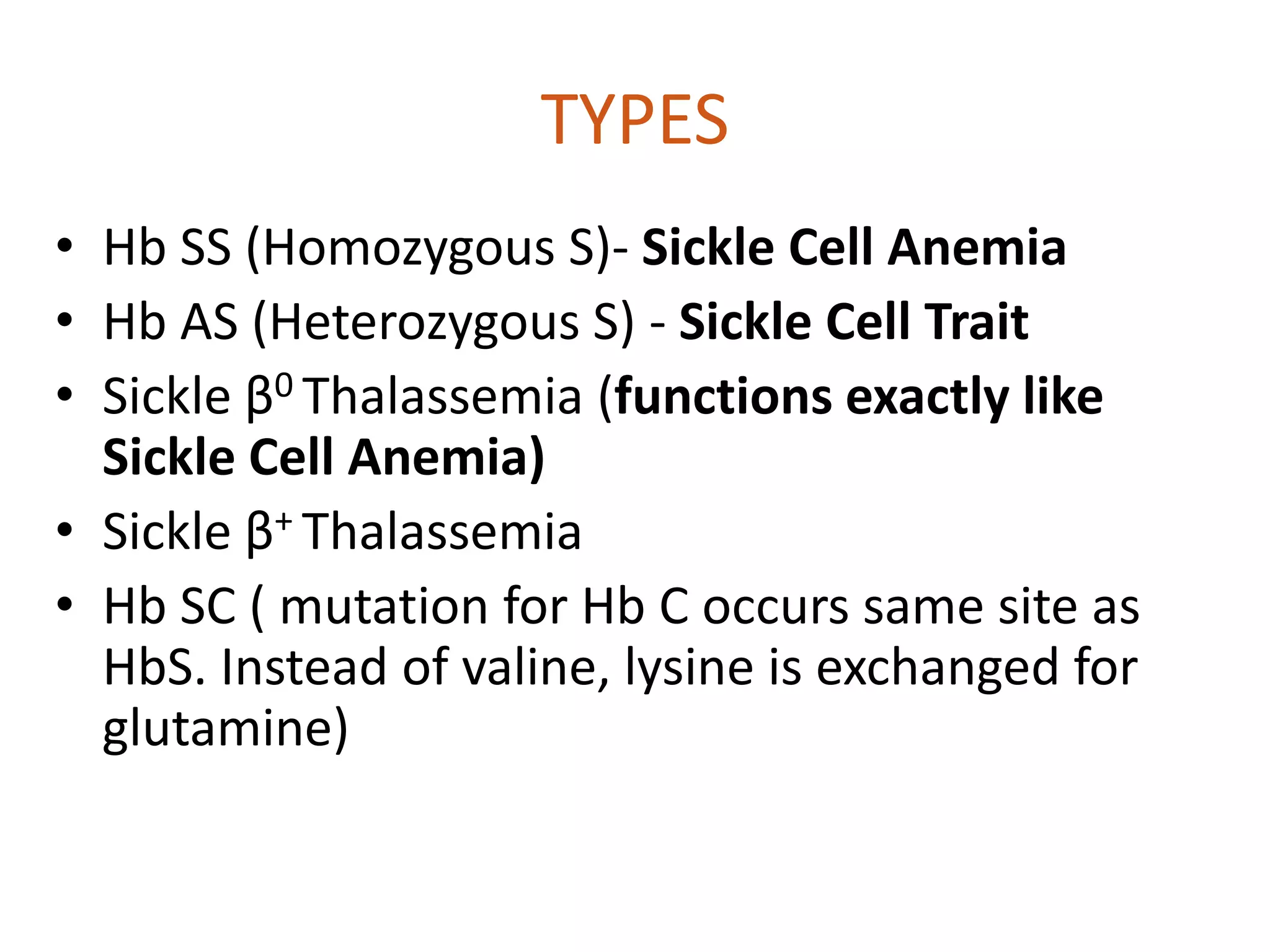
TYPES
• Hb SS (Homozygous S)- Sickle Cell Anemia
• Hb AS (Heterozygous S) - Sickle Cell Trait
• Sickle β0 Thalassemia (functions exactly like
  Sickle Cell Anemia)
• Sickle β+ Thalassemia
• Hb SC ( mutation for Hb C occurs same site as
  HbS. Instead of valine, lysine is exchanged for
  glutamine)
SEVERITY OF DISEASE
  Hb SS ≥ Sickle β 0 Thal >>
Hb SC >> Sickle β + Thal>> HbAS
PATHOPHYSIOLOGY
        • Single base pair exchange
        • Thymine for adenine in 6th
          codon of β gene
        • Encodes Valine instead of
          Glutamine
        • Charge at that site altered
        • Allows polymerization of Hb
          under hypoxia and acidosis
        • Inc 2,3-DPG and dec pH
          increases O2 affinity ->
          hypoxia
PATHOPHYSIOLOGY (CONTD…)
• Amount of polymerisation is dependant upon the other Hb (extent of
  homology with HbS)
• Copolymerization in this desc.order (S, C, D, O...so on and so forth)
• Polymerization -> RBC membrane alters-> sickling -> incr.adhesiveness ->
  capillaries blocked -> local anoxia -> infarction of organs
• Infarction of liver, kidney, spleen, brain, bones, joints
• Thrombotic coagulopathy
• If resp infections -> hypoxia worsens -> more sickling
• Sickle cells seq in spleen. So splenomegaly
• Paradoxically spleen undergoes rptd infarction -> autosplenectomy
• Long standing hemolysis -> biliary pigment stones
• Long standidng hypoxia -> clubbing, leg ulcers, growth retardation
• Long standing anemia -> compensatory hyperactivity of BM
CLINICAL FEATURES
• Newborns: do not manifest as there is high HbF
• By 5-6mo: many have functional asplenia.
  Hence bacterial sepsis
• By 5yr: 95 % functional asplenia
• Universally anemia and jaundice
• Thereafter CRISES EPISODES
CRISES EPISODES
•   1. HAND FOOT SYNDROME
•   2. ACUTE PAINFUL CRISIS
•   3. ACUTE CHEST SYNDROME
•   4. ACUTE SPLENIC SEQUESTRATION
•   5. STROKE
HAND FOOT SYNDROME
• Acute sickle dactylitis
• Painful, symmetric swelling of hand and feet
• Ischemic necrosis of small bones
• Blood supply choked off due to rapidly
  expanding bone marrow
• Xray: extensive bone destr. and repair
ACUTE PAINFUL CRISIS
•   Young children: mostly extremities
•   Older patients: abdomen, back, chest
•   Assoc with intercurrent illness
•   Vaso occlusive event
•   Abdominal organ infarctions
INFARCTS
ACUTE CHEST SYNDROME
• Pulmonary infarction
• Associated with pneumonia or microscopic fat
  emboli from BM infarction
• Acute chest pain
• Hemopytsis
• Cyanosis
• May lead to death
ACUTE SPLENIC SEQUESTRATION

• In infants and young children (6mo-3yrs)
• Distinct and episodic event
• Foll acute febrile illness
• For unknown reasons large amounts of blood
  become acutely pooled in spleen
• Massive enlargement of spleen
• Circulatory collapse
STROKE
• Catastrophic event
• >5yrs
• Hemiplegia
• 10% of patients affected
• 25-30% have occult strokes-
  school performance affected
• Trancranial doppler studies
OTHER MANIFESTATIONS
RENAL
 Progressive deterioration
 Glomerular and tubular fibrosis
 Polyuria >5yrs
 Renal papillary necrosis -> hematuria
 Nephrotic syndrome

PRIAPISM
 Pooling of blood into corpora cavernosa obstructing
  venous bloodflow
COMPLICATIONS
•   Bacterial sepsis – H. influenzae, pneumococci
•   Parvovirus B19 infection -> aplastic episodes
•   Acute chest syndrome –> pulmonary infarction
•   Chronic splenic sequestration
•   Severe anemia
•   Stroke -> hemiplegia
•   Priapism -> impotence
•   Chronic renal failure
•   Skin ulcers
•   Gall stones
•   Avascular necrosis -> hip pain
•   Retinopathy and Hyphema (more in HbSC d/s)
•   Salmonella osteomyelitis
•   UTI
•   Growth retardation , delay in puberty
•   Assoc Zn deficiency
•   Sickle cell cardiomyopathy
BONE NECROSIS
INVESTIGATIONS
•   Mild to moderate anemia (5-9gm/dl)
•   Inc. retics
•   Inc. TLC with sometimes Inc neutrophils
•   Normal to inc. platelets
•   Normal MCV (unless thalassemic Hb)
•   PS: sickle cells, nucl RBCS, target cells, HJ bodies
•   BM: hyperplastic marrow with erythroid predominance
•   Xray:Osteoporosis, sclerosis of long bones
•   Renal conc capacity decreased
•   Hb electrophoresis
•   Genetic / mutational analysis
•   Prenatal diagnosis
•   Transcranial doppler (TCD). If blood velocity >200cm/sec in brain, then
    transfuse to keep Hb S <30%
PAPPENHEIMER BODIES
SICKLE THALASSEMIA
• Presentation is same as Hb SS (SCA) if Sickle β0
  Thalassemia
• If Sickle β+ Thalassemia, then C/F are blunted
• Doubt if Hb electrophoresis shows HbSS
• But MCV <78fl or microcytosis in PS
SICKLE CELL TRAIT
•   Assoc with α thalassemia
•   Life span normal
•   Complications rare
•   Sudden death due to rigorous exercise
•   Splenic infarcts at high altitude
•   Hematuria
•   Hyphema with IO bleed and blindness
•   Renal medullary Ca predisposition
MANAGEMENT OF SCD
•   General
•   Prophylaxis
•   Febrile episodes
•   Analgesia
•   Blood transfusion
•   Drugs
•   Bone marrow transplant
•   Surgeries – splenectomy, cholecystectomy
GENERAL MANAGEMENT
• Vaccines
• Penicillin V prophylaxis
• Caretakers taught : temp, assess
  illness, spleen, anemia, stroke…and bring to
  hosp urgently
• Folic acid supplementation due to high red cell
  turnover
MANAGEMENT OF FEBRILE EPISODES

•   Hospitalise. Not OPD management <3yrs
•   Look for occult bacteremia
•   CBC, Blood culture, Urine culture, CXR
•   Monitor for Acute splenic sequestration crisis
•   Empirical Ceftriaxone (75-100mg/kg)
MANAGEMENT OF PAIN
• Paracetamol intially
• Later if relenteless pain : limited opiates –
  codeine
• Wean off opiates in 3-4days
• Avoid masking of disease progression with
  opiates
• >7-10 yr PCA (patient controlled analgesia)
  pump
• Look for cause of pain
BLOOD TRANSFUSION
• Indications:
  acute chest syndrome
  stroke
  severe anemia
  acute splenic sequestration

• BT doesn’t reverse ischemic damage
• Can continue to have CVD and AVN
• Preferably give leuco-poor packed cell
DRUG THERAPY
 Hydroxyurea : 15-30 mg/kg/day
 Increases Hb F


          BONE MARROW TRANSPLANT


 <16 yr with HLA matched sibling
 Only cure
Thank you
Download more documents and slide shows on The
    Medical Post [ www.themedicalpost.net ]

Siickle cell anemia

  • 1.
    Sickle cell anemia Dr. Kalpana Malla MD Pediatrics Manipal Teaching Hospital Download more documents and slide shows on The Medical Post [ www.themedicalpost.net ]
  • 2.
    Introduction: • Abnormal haemoglobin(HbS) which has a propensity for sickling and rapid haemolysis under adverse conditions • Valine, a hydrophobic amino acid replaces glutamic, a hydrophilic amino acid at the sixth amino acid position in the beta polypeptide chain.
  • 3.
  • 4.
    EPIDEMIOLOGY • Endemic malarialareas • Central India, Sub-Saharan Africa, Mediterranean, North Africa, Middle East • South America, Carribean, US: African descent…slave trade • Incidence 1:625 in African Americans
  • 6.
    The Proteins ofHemoglobin A • There are 4 protein subunits of Hemoglobin A Hemoglobin A Alpha Alpha Beta Beta There will be different forms of Hemoglobin when there is a mutation in the beta subunit.
  • 7.
    A carrier forSickle Cell Will have… •An S mutation in one copy of Hemoglobin the hemoglobin beta gene. •Half of the beta Alpha Alpha Beta Beta S subunits are replaced with Beta S. •This person has the Sickle Cell trait.
  • 8.
    When a personis a carrier, they will have: 25 % normal HbA 50 % HbS 25 % HbSS
  • 9.
    Sickle Cell Disease: •Thisresults HbSS when both copies of the Hemoglobin hemoglobin beta gene have an S mutation. Alpha Alpha Beta S Beta S •All of this person’s beta subunits are replaced by beta S.
  • 10.
    1. It is Unknown why people with the Sickle Cell Trait are RELATION TO MALARIA resistant to Malaria, but there are several theories… 2. The carriers of Sickle Cell have some abnormal Hemoglobin, and when they come in contact with the Malaria parasite they become sickled. Then those cells go through the spleen, which eliminates the cells because of their sickle shape, so the Malaria would be eliminated as well. 3. The Sickle Cell trait causes the malaria to stay in the body for an extended period of time, so it is able to build up a defense to it.
  • 11.
    3. Because oxygenconcentration is low in the spleen, and because infected cells often get trapped in the spleen, it is possible that they are destroyed in the spleen • 4. The Malaria parasite produces an acid when it is inside of the red blood cells. This causes the red blood cells to polymerize, and the cells will sickle. These sickled cells are then destroyed when the blood cells go through the spleen.
  • 12.
    RELATION TO MALARIA Sicklecell “trait” (heterozygote Hb AS) have: • 1. lower levels of Pl. falciparum parasitemia • 2. higher hemoglobin counts • 3. less severe reinfections than normal ppl Why? • 1. confounding factors in these areas that confer immunity/ resistance: Duffy chemokine factor G6PD HLA-B53, HLA-DRB1 • 2. actual mechanism not known
  • 13.
    TYPES • Hb SS(Homozygous S)- Sickle Cell Anemia • Hb AS (Heterozygous S) - Sickle Cell Trait • Sickle β0 Thalassemia (functions exactly like Sickle Cell Anemia) • Sickle β+ Thalassemia • Hb SC ( mutation for Hb C occurs same site as HbS. Instead of valine, lysine is exchanged for glutamine)
  • 14.
    SEVERITY OF DISEASE Hb SS ≥ Sickle β 0 Thal >> Hb SC >> Sickle β + Thal>> HbAS
  • 15.
    PATHOPHYSIOLOGY • Single base pair exchange • Thymine for adenine in 6th codon of β gene • Encodes Valine instead of Glutamine • Charge at that site altered • Allows polymerization of Hb under hypoxia and acidosis • Inc 2,3-DPG and dec pH increases O2 affinity -> hypoxia
  • 16.
    PATHOPHYSIOLOGY (CONTD…) • Amountof polymerisation is dependant upon the other Hb (extent of homology with HbS) • Copolymerization in this desc.order (S, C, D, O...so on and so forth) • Polymerization -> RBC membrane alters-> sickling -> incr.adhesiveness -> capillaries blocked -> local anoxia -> infarction of organs • Infarction of liver, kidney, spleen, brain, bones, joints • Thrombotic coagulopathy • If resp infections -> hypoxia worsens -> more sickling • Sickle cells seq in spleen. So splenomegaly • Paradoxically spleen undergoes rptd infarction -> autosplenectomy • Long standing hemolysis -> biliary pigment stones • Long standidng hypoxia -> clubbing, leg ulcers, growth retardation • Long standing anemia -> compensatory hyperactivity of BM
  • 19.
    CLINICAL FEATURES • Newborns:do not manifest as there is high HbF • By 5-6mo: many have functional asplenia. Hence bacterial sepsis • By 5yr: 95 % functional asplenia • Universally anemia and jaundice • Thereafter CRISES EPISODES
  • 20.
    CRISES EPISODES • 1. HAND FOOT SYNDROME • 2. ACUTE PAINFUL CRISIS • 3. ACUTE CHEST SYNDROME • 4. ACUTE SPLENIC SEQUESTRATION • 5. STROKE
  • 21.
    HAND FOOT SYNDROME •Acute sickle dactylitis • Painful, symmetric swelling of hand and feet • Ischemic necrosis of small bones • Blood supply choked off due to rapidly expanding bone marrow • Xray: extensive bone destr. and repair
  • 22.
    ACUTE PAINFUL CRISIS • Young children: mostly extremities • Older patients: abdomen, back, chest • Assoc with intercurrent illness • Vaso occlusive event • Abdominal organ infarctions
  • 23.
  • 24.
    ACUTE CHEST SYNDROME •Pulmonary infarction • Associated with pneumonia or microscopic fat emboli from BM infarction • Acute chest pain • Hemopytsis • Cyanosis • May lead to death
  • 25.
    ACUTE SPLENIC SEQUESTRATION •In infants and young children (6mo-3yrs) • Distinct and episodic event • Foll acute febrile illness • For unknown reasons large amounts of blood become acutely pooled in spleen • Massive enlargement of spleen • Circulatory collapse
  • 26.
    STROKE • Catastrophic event •>5yrs • Hemiplegia • 10% of patients affected • 25-30% have occult strokes- school performance affected • Trancranial doppler studies
  • 27.
    OTHER MANIFESTATIONS RENAL  Progressivedeterioration  Glomerular and tubular fibrosis  Polyuria >5yrs  Renal papillary necrosis -> hematuria  Nephrotic syndrome PRIAPISM  Pooling of blood into corpora cavernosa obstructing venous bloodflow
  • 28.
    COMPLICATIONS • Bacterial sepsis – H. influenzae, pneumococci • Parvovirus B19 infection -> aplastic episodes • Acute chest syndrome –> pulmonary infarction • Chronic splenic sequestration • Severe anemia • Stroke -> hemiplegia • Priapism -> impotence • Chronic renal failure • Skin ulcers • Gall stones • Avascular necrosis -> hip pain • Retinopathy and Hyphema (more in HbSC d/s) • Salmonella osteomyelitis • UTI • Growth retardation , delay in puberty • Assoc Zn deficiency • Sickle cell cardiomyopathy
  • 29.
  • 30.
    INVESTIGATIONS • Mild to moderate anemia (5-9gm/dl) • Inc. retics • Inc. TLC with sometimes Inc neutrophils • Normal to inc. platelets • Normal MCV (unless thalassemic Hb) • PS: sickle cells, nucl RBCS, target cells, HJ bodies • BM: hyperplastic marrow with erythroid predominance • Xray:Osteoporosis, sclerosis of long bones • Renal conc capacity decreased • Hb electrophoresis • Genetic / mutational analysis • Prenatal diagnosis • Transcranial doppler (TCD). If blood velocity >200cm/sec in brain, then transfuse to keep Hb S <30%
  • 31.
  • 32.
    SICKLE THALASSEMIA • Presentationis same as Hb SS (SCA) if Sickle β0 Thalassemia • If Sickle β+ Thalassemia, then C/F are blunted • Doubt if Hb electrophoresis shows HbSS • But MCV <78fl or microcytosis in PS
  • 33.
    SICKLE CELL TRAIT • Assoc with α thalassemia • Life span normal • Complications rare • Sudden death due to rigorous exercise • Splenic infarcts at high altitude • Hematuria • Hyphema with IO bleed and blindness • Renal medullary Ca predisposition
  • 34.
    MANAGEMENT OF SCD • General • Prophylaxis • Febrile episodes • Analgesia • Blood transfusion • Drugs • Bone marrow transplant • Surgeries – splenectomy, cholecystectomy
  • 35.
    GENERAL MANAGEMENT • Vaccines •Penicillin V prophylaxis • Caretakers taught : temp, assess illness, spleen, anemia, stroke…and bring to hosp urgently • Folic acid supplementation due to high red cell turnover
  • 36.
    MANAGEMENT OF FEBRILEEPISODES • Hospitalise. Not OPD management <3yrs • Look for occult bacteremia • CBC, Blood culture, Urine culture, CXR • Monitor for Acute splenic sequestration crisis • Empirical Ceftriaxone (75-100mg/kg)
  • 37.
    MANAGEMENT OF PAIN •Paracetamol intially • Later if relenteless pain : limited opiates – codeine • Wean off opiates in 3-4days • Avoid masking of disease progression with opiates • >7-10 yr PCA (patient controlled analgesia) pump • Look for cause of pain
  • 38.
    BLOOD TRANSFUSION • Indications: acute chest syndrome stroke severe anemia acute splenic sequestration • BT doesn’t reverse ischemic damage • Can continue to have CVD and AVN • Preferably give leuco-poor packed cell
  • 39.
    DRUG THERAPY  Hydroxyurea: 15-30 mg/kg/day  Increases Hb F BONE MARROW TRANSPLANT  <16 yr with HLA matched sibling  Only cure
  • 40.
    Thank you Download moredocuments and slide shows on The Medical Post [ www.themedicalpost.net ]