Approach to a bleeding disorder,
 Approach to thrombocytopenia,
Idiopathic thrombocytopenia (ITP)


                                   Dr. Kalpana Malla
                                       MD Pediatrics
                           Manipal Teaching Hospital

Download more documents and slide shows on The Medical Post [ www.themedicalpost.net ]
HEMOSTASIS
1. VASCULAR PHASE
2. PLATELET PHASE
3. COAGULATION PHASE
4. FIBRINOLYTIC PHASE
VASCULAR PHASE

 WHEN A BLOOD VESSEL IS
       DAMAGED -
   VASOCONSTRICTION
PLATELET PHASE

 PLATELETS ADHERE TO THE
  DAMAGED SURFACE AND
 FORM A TEMPORARY PLUG
COAGULATION PHASE

   THROUGH TWO SEPARATE
     PATHWAYS THERE IS
  CONVERSION OF FIBRINOGEN
         TO FIBRIN
FIBRINOLYTIC PHASE

  ANTICLOTTING MECHANISMS ARE
    ACTIVATED TO ALLOW CLOT
  DISINTEGRATION AND REPAIR OF
       THE DAMAGED VESSEL
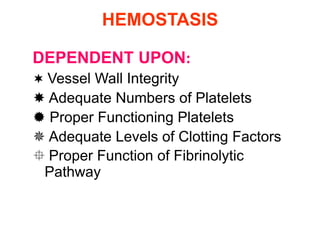
HEMOSTASIS

DEPENDENT UPON:
 Vessel Wall Integrity
 Adequate Numbers of Platelets
 Proper Functioning Platelets
 Adequate Levels of Clotting Factors
 Proper Function of Fibrinolytic
 Pathway
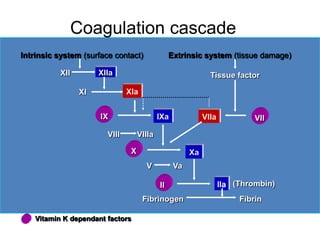
Coagulation cascade
Intrinsic system (surface contact)                Extrinsic system (tissue damage)

           XII         XIIa                                    Tissue factor

                  XI            XIa


                       IX                    IXa             VIIa            VII

                         VIII        VIIIa

                                 X                      Xa
                                       V           Va

                                             II                     IIa (Thrombin)
                                      Fibrinogen                         Fibrin

    Vitamin K dependant factors
LABORATORY EVALUATION
•   Platelet Count
•   Bleeding Time (BT)
•   Prothrombin Time (PT)
•   Partial Thromboplastin Time (PTT)
•   Thrombin Time (TT)
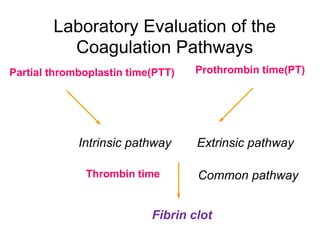
Laboratory Evaluation of the
          Coagulation Pathways
Partial thromboplastin time(PTT)   Prothrombin time(PT)


             Intrinsic pathway     Extrinsic pathway

              Thrombin time        Common pathway


                           Fibrin clot
Laboratory Evaluation of the
       Coagulation Pathways
• PT prolonged in extrinsic and common
  pathway
• APTT prolonged in intrinsic and common
  pathway
• PT &APTT – prolonged in common pathway
  ,liver dysfunction ,DIC
• DIC – thrombin time is also prolonged
• Factor XIII deficiency – platelet ,APTT,PT,BT-
  Normal
Diagnostic Approach
• Increased BT –
a) Platelet decreased – ITP
b) Platelet normal – anaphylactoid purpura
• Increased CT –
a) only PT prolonged – Factor VII deficiency
b) only APTT prolonged – factor – VIII,IX,XI,XII
   and von willebrand’s disease
Diagnostic Approach
c) Both PT & APTT prolonged –vit –k deficiency,
   severe liver ds, cong deficiency of factor V,
   X.fibrinogen deficiency ,DIC
PLATELET COUNT
 NORMAL            100,000 - 400,000 CELLS/MM3

 < 100,000            Thrombocytopenia

 50,000 - 100,000     Mild Thrombocytopenia

 < 50,000             Sev Thrombocytopenia
BLEEDING TIME

    PROVIDES ASSESSMENT OF
   PLATELET COUNT AND FUNCTION


NORMAL VALUE
 2-8 MINUTES
PROTHROMBIN TIME
Measures Effectiveness of the Extrinsic
 Pathway
Mnemonic - PET


NORMAL VALUE
 10-15 SECS
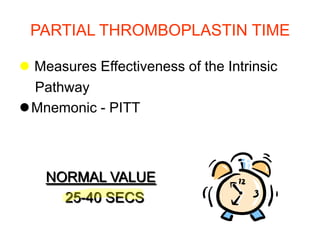
PARTIAL THROMBOPLASTIN TIME

 Measures Effectiveness of the Intrinsic
  Pathway
Mnemonic - PITT


    NORMAL VALUE
      25-40 SECS
THROMBIN TIME

 Time for Thrombin To Convert
 Fibrinogen           Fibrin
 A Measure of Fibrinolytic Pathway


NORMAL VALUE
  9-13 SECS
So What Causes Bleeding
       Disorders?

VESSEL DEFECTS            ?
PLATELET DISORDERS
FACTOR DEFICIENCIES
OTHER DISORDERS
                   ?
VESSEL DEFECTS

Vascular purpuras
• Infection – meningococcal meningitis, hge
  measles, typhoid
• Drugs – aspirin ,indomethacin, phenytoin ,
  quinine
• Anaphylactoid purpura – Henoch-schonlein P
• Metabolic – uremia, scurvy
PLATELET DISORDERS


Thrombocytopenia
FACTOR DEFICIENCIES
•   Hereditary
•   Hemophilia – factor VIII deficiency
•   Christmas ds – factor IX deficiency
•   Von-Willebrand’s ds
•   Acquired
•   Vit – k deficiency
•   Oral anticoagulant therapy
•   Liver ds
THRMBOCYTOPENIA


- CONGENITAL - TAR syndrome
               - Fanconi’s anemia
               - Wiskott Aldrich syndrome
- Acquired -Aplastic anemia
        - BM replacement
DECREASED PRODUCTION:-
 A) IMMUNE THROMBOCYTOPENIC PURPURA(ITP)
 B) INFECTIONS - EBV
              - HIV
              - HBV
             - RUBELLA
             - PARVO-B19
             - CMV
             - TB,TYPHOID
C .Drug induced - NSAID, ATT, AED, QUININE,
  SULFA,PENICILLIN, FRUSEMIDE, HEPARIN,
D . Autoimmune Disorders -SLE, hyperthyroidism
E . Malignancy - ALL, AML, Lymphoma,
   Neuroblastoma
Others
- DIC

- Microangiopathic Hemolytic Anemia- HUS
-Liver disease
- Neonatal thrombocytopenia – toxoplasmosis, CMV, herpes
simplex, ITP
IDIOPATHIC / IMMUNE
THROMBOCYTOPENIC PURPURA
   DEFINITION : is characterised by
      -Thrmbocytopenia < 100.000/cm
      - Shortened PLT. survival
   -Presence of antiplatelet AB in the plasma.
    -Increased Megakaryocytes in BM
BACKGROUND

 Most common causes of symptomatic
  thrombocytopenia in children.

 Incidence - 3 and 8 cases per 100,000
  children/yr

 Before a diagnosis of ITP – R/O other
  common causes of thrombocytopenia
(concurrent infection , autoimmune disorders ,
  malignancy , bone marrow failure .. )
CLASSIFICATION
1.Acute ITP (children)- PLT returns to normal
 value before 6mth.

2.Chronic ITP (adults) - PLT remains low
 after 6mth also
3.Secondary ITP (follow other diseases
4.RECCURRENT:-PLT count decreases after
  becoming normal
ETIOLOGY
Usually benign transient immune-mediated
 thrombocytolytic condition

Autoantibodies (usually IgG) directed against platelet
 membrane antigens (especially glycoprotein complex
 IIb/IIIa) are present

Thrombocytopenia results from phagocytosis of
 antibody-coated platelets by the reticuloendothelial
 system
ROLE OF SPLEEN


1.Auto-antibody production

2.Platelet destruction

3.Platelet storage
CLINICAL PRESENTATION
2- 10 years (peak 2 to 5 years )
Patients < 2 years or > 10 years at
 presentation are atypical
No seasonal variation
History of a preceding infection (1-4 wks
 back), in 50 to 85 % of pediatric cases
Post-vaccination cases also have been
 reported ( MMR )
CLINICAL PRESENTATION
•   Previously healthy child - sudden Skin and mucous
    membrane bleeds - Petechiae, purpura
    ecchymosed, Gingival bleeding and epistaxis ,
    gastrointestinal , genitourinary
 Conjunctival and retinal hemorrhages may
  occur

 Life-threatening bleeding, (ICH), - is very rare,
  occurring with an incidence of 0.1 to 1.0 %
Petechiae


Do not blanch with
    pressure
CLINICAL PRESENTATION

No other systemic symptoms - fever, anorexia,
 weight loss, or bone or joint pain

No significant enlargement of lymph nodes,
 liver, or spleen is present
LABORATORY STUDIES

   For the typical case of ITP :
          CBC
          platelet count
          peripheral blood smear (often large
           platelet forms are seen )
          Mean Platelet Volume increased
          Bleeding time prolonged
          PT/ APTT normal
          Platelet antibodies in 70-90 %
Fewer Platelets than normal.
LABORATORY STUDIES
   For the atypical case of ITP :
        viral antibody titers (including HIV)
        Coombs' test
        Reticulocyte count
        Studies for collagen vascular :
         ANA , Anti dsDNA, ANCA etc
        Studies for rheumatoid disorders:
         RF
Platelet Auto-antibodies


    Platelet Antigens
LABORATORY STUDIES
 BONE MARROW EXAMINATION (BME)
 In the past, BME was performed routinely in
  children with suspected ITP

 BME are unnecessary in the "typical" case of
  childhood ITP

 Bone marrow aspiration and biopsy is reserved
  for - atypical presentation

 BME - who initially was diagnosed as ITP but
  subsequent clinical course is inconsistent with
  the natural history of acute ITP
DIFFERENTIAL DIAGNOSIS


1.   Aplastic anemia
2.   Leukemia ( ALL )
3.   Autoimmune disease (SLE)
4.   HSP
5.   Infection - hepatitis, HIV
6.   Drug exposure - heparin, quinidine,
     sulfonamides
MANAGEMENT
 80 to 90 % of cases recover spontaneously within a few
 months (3-6 months) even without treatment

 Restriction of activity and avoidance of medications with
   antiplatelet activity (aspirin , ibuprofen ,NSAID)
 Guidelines suggest :
     Platelet counts >30,000 no symptoms – no
       treatment
      Platelet counts <30,000 with symptoms –
       treatment
THERAPY


Corticosteroids

Intravenous immunoglobulin (IVIG)

Anti-Rho(D) immune globulin
CORTICOSTEROIDS

 Steroids reduce the risk of symptoms by -
 1. Improving vascular integrity
 2. Diminishing antibody affinity for the
    platelet membrane
 3. Reducing antibody production
 4. Reducing reticuloendothelial system
    phagocytosis of antibody-coated
    platelets
Dosage regimens
Prednisone 1-4 mg/kg per day for 2 to 4
 weeks
   Pulse IV methylprednisolone as high as 50
   mg/kg per day for 3 to 7 days

Occasionally, a second course of
 treatment may be necessary if significant
 hemorrhagic symptoms again develop
CORTICOSTEROIDS

 Chronic administration of steroids -
  Avoided

 Alternative therapies - IVIG or Anti-D
  should be considered who need
  prolonged or repeated corticosteroid
  therapy
IVIG
 MoA: interferes with macrophage Fc receptor
  clearance

 Rapid improvement in platelet numbers - 95%
  patients within 48 hrs

 Dose - 400 mg/kg per day for five days
        - 1 gm/kg for one to two days

 The higher, shorter dosage schedules appear to
  be preferable
IVIG
 The side effects include :
 1. Nausea and vomiting (63 %)
 2. Headache (56 %)
 3. Fever (19 %)
 4. Neutropenia (absolute neutrophil count
    <1500/microL) 30 %

 Cost must be considered in the selection of
  therapy for ITP
ANTI-D IMMUNE GLOBULIN (Anti-Rho(D)

MoA: anti-D results in blockade of Fc receptors by
 antibody coated RBCs in place of antibody coated
 platelets

Dose - single dose of 50 µg/kg

80-85 % patients show rise in platelets within 48 hrs
Given to children with a Hb > 10 g/dl

One to two weeks after administration, a fall in the Hb
 level of 1 to 1.5 grams - as a result of mild hemolysis of
 the patient's Rho(D)-positive red cells
OUTCOME
80 % -90% - recovers spontaneously within three
 months of presentation, with or without therapy

10 % recovers in the next few months

15 to 20 % - have moderate or major hemorrhage

 0.1 to 1 % - Life-threatening bleeding(ICH) is rare

 <5 % with acute ITP have recurrent acute
  thrombocytopenia
CHRONIC ITP
 Definition - persistence of thrombocytopenia
  beyond six months from the time of diagnosis

 10 % of patients with typical ITP will have
  chronic ITP

 Patients who have atypical features at
  presentation are more likely to have chronic
  disease
CHRONIC ITP ( Management )
Aim of treatment - should focus on minimizing
 the risk for bleeding

Many patients will require no treatment

 Even after years, a significant proportion of
 such patients will improve
CHRONIC ITP ( Management )
Corticosteroids :

   Periodic short courses or pulses of corticosteroids

   For steroid dependent patients - alternate day dosing
    may be effective in preventing bleeding while
    reducing side effects
CHRONIC ITP ( Management )
Immunoglobulin therapy :
 IVIG or anti-Rho(D)- effective in chronic ITP who
  are resistant to steroids
 All of these strategies offer temporary relief of
  symptoms and improvement in platelet numbers
 Very costly
CHRONIC ITP ( Management )
Splenectomy :

 Effective in 60 to 90 % of children with chronic ITP

 Overwhelming post-splenectomy infection

 Presplenectomy immunizations and subsequent
  penicillin prophylaxis are necessary for all age groups
CHRONIC ITP ( Management )
Splenectomy :
 No universally accepted standards for the timing
  of splenectomy in chronic ITP

 Guidelines recommend waiting until at least 12
  months after diagnosis

 8)Immunosupressive agents - Cyclophoshamide
Acute ITP          Chronic ITP
Mostly children       Mostly adults
Male/Female =         Male/Female =      -
Acute onset           Usually gradual onset
Plt. Count mostly     Plt. Count 20 – 50000/mm
 < ,       /mm
Spontaneous           Spontaneous remission rare
 remission frequent
                      Chronic recurrent course
Mortality :    -
                      Duration - mo -yrs
Duration – 2-6 wks
Neonatal thrombocytopenia
Systemic illness
1.Cong infections – rubella, CMV, toxoplasmosis,
  syphillis
2.Gram –ve sepsis
Neonatal thrombocytopenia
Due to transfer of maternal antibodies directed
   against fetal platelets
1. Neonatal alloimmune TP-(NATP) –
    development of maternal antibody against
    antigens present on fetal platelets
 - develops symptoms in first few days of life
- No maternal thrombocytopenia
Neonatal thrombocytopenia
2. Baby of ITP mother-
• Symptoms in perinatal period
• Resolves within 2-4 months
• IVIG & steroids
TTP
• Thrombotic Thrombocytopenic purpura
• Pentad – fever, microangiopathic hemolytic
  anemia, thrombocytopenia,impaired renal
  function ,CNS changes
• Usually adolescents & adults
• Treatment – plasmapheresis – 80-95%
  effective
• Steroids & splenectomy
Platelet transfusions
• Source
   – Platelet concentrate (Random donor)
     Each donor unit should increase platelet count
     ~10,000 /µl
   – Pheresis platelets (Single donor)

• Storage
   – Up to 5 days at room temperature

• “Platelet trigger”
   – Bone marrow suppressed patient (>10-20,000/µl)
   – Bleeding/surgical patient (>50,000/µl)
Danzol 400 mg/m2/d for 3 mth.
9)PLASMAPHERESIS
10) T/T Of life threatening ITP:-
PLT. TRANSFUSION
SOLUMEDROL 500 Mg/m2/day IV TID.
IVIG 2g/kg
emergency Splenectomy.
Vincristine 2 mg/kg IV.
PROGNOSIS;-
EXCELENT 70-80 % recover ithin 6mth.
spontaneous remission in 1 yr- 5yrs.
Approach to the thrombocytopenic
              patient
• History
   – Is the patient bleeding?
   – Are there symptoms of a secondary illness? (neoplasm,
     infection, autoimmune disease)
   – Is there a history of medications, alcohol use, or recent
     transfusion?
   – Are there risk factors for HIV infection?
   – Is there a family history of thrombocytopenia?
   – Do the sites of bleeding suggest a platelet defect?

• Assess the number and function of platelets
   – CBC with peripheral smear
   – Platelet function study
Platelet transfusions
• Source
  – Platelet concentrate (Random donor)
  – Pheresis platelets (Single donor)

• Target level
  – Bone marrow suppressed patient (>10-20,000/µl)
  – Bleeding/surgical patient (>50,000/µl)
Platelet transfusions - complications
• Transfusion reactions
   – Higher incidence than in RBC transfusions
   – Related to length of storage/leukocytes/RBC mismatch
   – Bacterial contamination

• Platelet transfusion refractoriness
   – Alloimmune destruction of platelets (HLA antigens)
   – Non-immune refractoriness
      •   Microangiopathic hemolytic anemia
      •   Coagulopathy
      •   Splenic sequestration
      •   Fever and infection
      •   Medications (Amphotericin, vancomycin, ATG, Interferons)
Approach to the WERLHOF’S DISEASE
• History
  – Is the patient bleeding?
  – Are there symptoms of a secondary illness? (neoplasm,
    infection, autoimmune disease)
  – Is there a history of medications, alcohol use, or recent
    transfusion?
  – Are there risk factors for HIV infection?
  – Is there a family history of thrombocytopenia?
  – Do the sites of bleeding suggest a platelet defect?

• Assess the number and function of platelets
  – CBC with peripheral smear
  – Bleeding time or platelet aggregation study
  – TORNIQUET / RUMPEL-LEEDE TEST:-
THROMBOTIC THROMBOCYTOPENIC PURPURA(TTP)
                          MOSCHOWITZ’S SYNDROME
DEF:- It is rare acquired multisystem disease.
CLASSIFICATION :-
1) PRIMARY = ACUTE ,CHRONIC, RELAPSING & CONGENITAL.
2)SECONDARY = CTD, SBE, MALIGNANCY, INFECTION & DRUGS.
CLINICAL FEATURES :- Consumptive thrombocytopenia
Microangiopathic H. anaemia.
Fever, Jaundice,
Neurologic & Renal manifestations
DIAGNOSIS :-
TPC ,Hb %      , Haptoglobin    , hemoglobinuria
Decreased plasma factor - VIII & vWF.


GINGIVAL BIOPSY = Presense of segmantal hyaline microthrombi in
the microvasculature.
TREATMENT : -
PLASMAPHERESIS
FFP
STEROIDS
ANTIPLATELETS AGENTS.
SPLENECTOMY.
NONTHROMBOCYTOPENIC PURPURA

1)ANAPHYLACTOID PURPURA


2)INFECTIONS (Meningococcus, measles, rubella, SBE)


3)DRUGS(SULFA)


4)PURPURA FACTITIA:-It is a self inflictted lesions in a linear fashion commonly over accessible
parts of body due to Psychopathic disorder.
THROMBOCYTOPATHY
PLT. function disorders :-
1)BERNARD SOULIER SYNDROME
2)GLANZMAN’S THROMBASTHENIA
3)ALPORT SYNDROME(PF-3 deficiency)
4)CTD =
EHLERS DANLOS SYNDROME
PSEUDOXANTHOMA ELASTICUM
MARFAN’S SYNDROME
OSTEOGENESIS IMPERFECTA.
ESSENTIAL THROMBOCYTHEMIA
Diagnosed by :-TPC > 6000.000/cmm,        Hb% <13gm%
RCM < 36ML/KG.
NORMAL IRON IN BM.
ABNORMAL PLT FUNCTION TEST.
NO KNOWN CAUSE OF THROMBOCTYTOSIS
- ve philadelphia chromosome.
-ve BM fibrosis.
Thrombotic & haemorrhagic features common.
TREATMENT:- Anti-platelet agents = ASA, Dipyridamole(3-6 mg/kg/d
PLT lowering drugs = Hydroxyurea - 20-30mg/kg od
                   Alpha 2- interferon.
Thank you
Download more documents and slide shows on The
    Medical Post [ www.themedicalpost.net ]

Bleeding disorder

  • 1.
    Approach to ableeding disorder, Approach to thrombocytopenia, Idiopathic thrombocytopenia (ITP) Dr. Kalpana Malla MD Pediatrics Manipal Teaching Hospital Download more documents and slide shows on The Medical Post [ www.themedicalpost.net ]
  • 3.
    HEMOSTASIS 1. VASCULAR PHASE 2.PLATELET PHASE 3. COAGULATION PHASE 4. FIBRINOLYTIC PHASE
  • 4.
    VASCULAR PHASE WHENA BLOOD VESSEL IS DAMAGED - VASOCONSTRICTION
  • 5.
    PLATELET PHASE PLATELETSADHERE TO THE DAMAGED SURFACE AND FORM A TEMPORARY PLUG
  • 6.
    COAGULATION PHASE THROUGH TWO SEPARATE PATHWAYS THERE IS CONVERSION OF FIBRINOGEN TO FIBRIN
  • 7.
    FIBRINOLYTIC PHASE ANTICLOTTING MECHANISMS ARE ACTIVATED TO ALLOW CLOT DISINTEGRATION AND REPAIR OF THE DAMAGED VESSEL
  • 8.
    HEMOSTASIS DEPENDENT UPON:  VesselWall Integrity  Adequate Numbers of Platelets  Proper Functioning Platelets  Adequate Levels of Clotting Factors  Proper Function of Fibrinolytic Pathway
  • 9.
    Coagulation cascade Intrinsic system(surface contact) Extrinsic system (tissue damage) XII XIIa Tissue factor XI XIa IX IXa VIIa VII VIII VIIIa X Xa V Va II IIa (Thrombin) Fibrinogen Fibrin Vitamin K dependant factors
  • 10.
    LABORATORY EVALUATION • Platelet Count • Bleeding Time (BT) • Prothrombin Time (PT) • Partial Thromboplastin Time (PTT) • Thrombin Time (TT)
  • 11.
    Laboratory Evaluation ofthe Coagulation Pathways Partial thromboplastin time(PTT) Prothrombin time(PT) Intrinsic pathway Extrinsic pathway Thrombin time Common pathway Fibrin clot
  • 12.
    Laboratory Evaluation ofthe Coagulation Pathways • PT prolonged in extrinsic and common pathway • APTT prolonged in intrinsic and common pathway • PT &APTT – prolonged in common pathway ,liver dysfunction ,DIC • DIC – thrombin time is also prolonged • Factor XIII deficiency – platelet ,APTT,PT,BT- Normal
  • 13.
    Diagnostic Approach • IncreasedBT – a) Platelet decreased – ITP b) Platelet normal – anaphylactoid purpura • Increased CT – a) only PT prolonged – Factor VII deficiency b) only APTT prolonged – factor – VIII,IX,XI,XII and von willebrand’s disease
  • 14.
    Diagnostic Approach c) BothPT & APTT prolonged –vit –k deficiency, severe liver ds, cong deficiency of factor V, X.fibrinogen deficiency ,DIC
  • 15.
    PLATELET COUNT  NORMAL 100,000 - 400,000 CELLS/MM3 < 100,000 Thrombocytopenia 50,000 - 100,000 Mild Thrombocytopenia < 50,000 Sev Thrombocytopenia
  • 16.
    BLEEDING TIME PROVIDES ASSESSMENT OF PLATELET COUNT AND FUNCTION NORMAL VALUE 2-8 MINUTES
  • 17.
    PROTHROMBIN TIME Measures Effectivenessof the Extrinsic Pathway Mnemonic - PET NORMAL VALUE 10-15 SECS
  • 18.
    PARTIAL THROMBOPLASTIN TIME Measures Effectiveness of the Intrinsic Pathway Mnemonic - PITT NORMAL VALUE 25-40 SECS
  • 19.
    THROMBIN TIME  Timefor Thrombin To Convert Fibrinogen Fibrin  A Measure of Fibrinolytic Pathway NORMAL VALUE 9-13 SECS
  • 20.
    So What CausesBleeding Disorders? VESSEL DEFECTS ? PLATELET DISORDERS FACTOR DEFICIENCIES OTHER DISORDERS ?
  • 21.
    VESSEL DEFECTS Vascular purpuras •Infection – meningococcal meningitis, hge measles, typhoid • Drugs – aspirin ,indomethacin, phenytoin , quinine • Anaphylactoid purpura – Henoch-schonlein P • Metabolic – uremia, scurvy
  • 22.
  • 23.
    FACTOR DEFICIENCIES • Hereditary • Hemophilia – factor VIII deficiency • Christmas ds – factor IX deficiency • Von-Willebrand’s ds • Acquired • Vit – k deficiency • Oral anticoagulant therapy • Liver ds
  • 24.
    THRMBOCYTOPENIA - CONGENITAL -TAR syndrome - Fanconi’s anemia - Wiskott Aldrich syndrome - Acquired -Aplastic anemia - BM replacement
  • 25.
    DECREASED PRODUCTION:- A)IMMUNE THROMBOCYTOPENIC PURPURA(ITP) B) INFECTIONS - EBV - HIV - HBV - RUBELLA - PARVO-B19 - CMV - TB,TYPHOID
  • 26.
    C .Drug induced- NSAID, ATT, AED, QUININE, SULFA,PENICILLIN, FRUSEMIDE, HEPARIN, D . Autoimmune Disorders -SLE, hyperthyroidism E . Malignancy - ALL, AML, Lymphoma, Neuroblastoma
  • 27.
    Others - DIC - MicroangiopathicHemolytic Anemia- HUS -Liver disease - Neonatal thrombocytopenia – toxoplasmosis, CMV, herpes simplex, ITP
  • 28.
    IDIOPATHIC / IMMUNE THROMBOCYTOPENICPURPURA DEFINITION : is characterised by -Thrmbocytopenia < 100.000/cm - Shortened PLT. survival -Presence of antiplatelet AB in the plasma. -Increased Megakaryocytes in BM
  • 29.
    BACKGROUND  Most commoncauses of symptomatic thrombocytopenia in children.  Incidence - 3 and 8 cases per 100,000 children/yr  Before a diagnosis of ITP – R/O other common causes of thrombocytopenia (concurrent infection , autoimmune disorders , malignancy , bone marrow failure .. )
  • 30.
    CLASSIFICATION 1.Acute ITP (children)-PLT returns to normal value before 6mth. 2.Chronic ITP (adults) - PLT remains low after 6mth also 3.Secondary ITP (follow other diseases 4.RECCURRENT:-PLT count decreases after becoming normal
  • 31.
    ETIOLOGY Usually benign transientimmune-mediated thrombocytolytic condition Autoantibodies (usually IgG) directed against platelet membrane antigens (especially glycoprotein complex IIb/IIIa) are present Thrombocytopenia results from phagocytosis of antibody-coated platelets by the reticuloendothelial system
  • 32.
    ROLE OF SPLEEN 1.Auto-antibodyproduction 2.Platelet destruction 3.Platelet storage
  • 34.
    CLINICAL PRESENTATION 2- 10years (peak 2 to 5 years ) Patients < 2 years or > 10 years at presentation are atypical No seasonal variation History of a preceding infection (1-4 wks back), in 50 to 85 % of pediatric cases Post-vaccination cases also have been reported ( MMR )
  • 35.
    CLINICAL PRESENTATION • Previously healthy child - sudden Skin and mucous membrane bleeds - Petechiae, purpura ecchymosed, Gingival bleeding and epistaxis , gastrointestinal , genitourinary  Conjunctival and retinal hemorrhages may occur  Life-threatening bleeding, (ICH), - is very rare, occurring with an incidence of 0.1 to 1.0 %
  • 36.
  • 37.
    CLINICAL PRESENTATION No othersystemic symptoms - fever, anorexia, weight loss, or bone or joint pain No significant enlargement of lymph nodes, liver, or spleen is present
  • 38.
    LABORATORY STUDIES  For the typical case of ITP : CBC platelet count peripheral blood smear (often large platelet forms are seen ) Mean Platelet Volume increased Bleeding time prolonged PT/ APTT normal Platelet antibodies in 70-90 %
  • 39.
  • 40.
    LABORATORY STUDIES  For the atypical case of ITP : viral antibody titers (including HIV) Coombs' test Reticulocyte count Studies for collagen vascular : ANA , Anti dsDNA, ANCA etc Studies for rheumatoid disorders: RF
  • 41.
    Platelet Auto-antibodies Platelet Antigens
  • 42.
    LABORATORY STUDIES  BONEMARROW EXAMINATION (BME)  In the past, BME was performed routinely in children with suspected ITP  BME are unnecessary in the "typical" case of childhood ITP  Bone marrow aspiration and biopsy is reserved for - atypical presentation  BME - who initially was diagnosed as ITP but subsequent clinical course is inconsistent with the natural history of acute ITP
  • 43.
    DIFFERENTIAL DIAGNOSIS 1. Aplastic anemia 2. Leukemia ( ALL ) 3. Autoimmune disease (SLE) 4. HSP 5. Infection - hepatitis, HIV 6. Drug exposure - heparin, quinidine, sulfonamides
  • 44.
    MANAGEMENT  80 to90 % of cases recover spontaneously within a few  months (3-6 months) even without treatment  Restriction of activity and avoidance of medications with antiplatelet activity (aspirin , ibuprofen ,NSAID)  Guidelines suggest : Platelet counts >30,000 no symptoms – no treatment Platelet counts <30,000 with symptoms – treatment
  • 45.
  • 46.
    CORTICOSTEROIDS  Steroids reducethe risk of symptoms by - 1. Improving vascular integrity 2. Diminishing antibody affinity for the platelet membrane 3. Reducing antibody production 4. Reducing reticuloendothelial system phagocytosis of antibody-coated platelets
  • 47.
    Dosage regimens Prednisone 1-4mg/kg per day for 2 to 4 weeks  Pulse IV methylprednisolone as high as 50 mg/kg per day for 3 to 7 days Occasionally, a second course of treatment may be necessary if significant hemorrhagic symptoms again develop
  • 48.
    CORTICOSTEROIDS  Chronic administrationof steroids - Avoided  Alternative therapies - IVIG or Anti-D should be considered who need prolonged or repeated corticosteroid therapy
  • 49.
    IVIG  MoA: interfereswith macrophage Fc receptor clearance  Rapid improvement in platelet numbers - 95% patients within 48 hrs  Dose - 400 mg/kg per day for five days - 1 gm/kg for one to two days  The higher, shorter dosage schedules appear to be preferable
  • 50.
    IVIG  The sideeffects include : 1. Nausea and vomiting (63 %) 2. Headache (56 %) 3. Fever (19 %) 4. Neutropenia (absolute neutrophil count <1500/microL) 30 %  Cost must be considered in the selection of therapy for ITP
  • 51.
    ANTI-D IMMUNE GLOBULIN(Anti-Rho(D) MoA: anti-D results in blockade of Fc receptors by antibody coated RBCs in place of antibody coated platelets Dose - single dose of 50 µg/kg 80-85 % patients show rise in platelets within 48 hrs Given to children with a Hb > 10 g/dl One to two weeks after administration, a fall in the Hb level of 1 to 1.5 grams - as a result of mild hemolysis of the patient's Rho(D)-positive red cells
  • 52.
    OUTCOME 80 % -90%- recovers spontaneously within three months of presentation, with or without therapy 10 % recovers in the next few months 15 to 20 % - have moderate or major hemorrhage  0.1 to 1 % - Life-threatening bleeding(ICH) is rare  <5 % with acute ITP have recurrent acute thrombocytopenia
  • 53.
    CHRONIC ITP  Definition- persistence of thrombocytopenia beyond six months from the time of diagnosis  10 % of patients with typical ITP will have chronic ITP  Patients who have atypical features at presentation are more likely to have chronic disease
  • 54.
    CHRONIC ITP (Management ) Aim of treatment - should focus on minimizing the risk for bleeding Many patients will require no treatment  Even after years, a significant proportion of such patients will improve
  • 55.
    CHRONIC ITP (Management ) Corticosteroids :  Periodic short courses or pulses of corticosteroids  For steroid dependent patients - alternate day dosing may be effective in preventing bleeding while reducing side effects
  • 56.
    CHRONIC ITP (Management ) Immunoglobulin therapy :  IVIG or anti-Rho(D)- effective in chronic ITP who are resistant to steroids  All of these strategies offer temporary relief of symptoms and improvement in platelet numbers  Very costly
  • 57.
    CHRONIC ITP (Management ) Splenectomy :  Effective in 60 to 90 % of children with chronic ITP  Overwhelming post-splenectomy infection  Presplenectomy immunizations and subsequent penicillin prophylaxis are necessary for all age groups
  • 58.
    CHRONIC ITP (Management ) Splenectomy :  No universally accepted standards for the timing of splenectomy in chronic ITP  Guidelines recommend waiting until at least 12 months after diagnosis  8)Immunosupressive agents - Cyclophoshamide
  • 59.
    Acute ITP Chronic ITP Mostly children Mostly adults Male/Female = Male/Female = - Acute onset Usually gradual onset Plt. Count mostly Plt. Count 20 – 50000/mm < , /mm Spontaneous Spontaneous remission rare remission frequent Chronic recurrent course Mortality : - Duration - mo -yrs Duration – 2-6 wks
  • 60.
    Neonatal thrombocytopenia Systemic illness 1.Conginfections – rubella, CMV, toxoplasmosis, syphillis 2.Gram –ve sepsis
  • 61.
    Neonatal thrombocytopenia Due totransfer of maternal antibodies directed against fetal platelets 1. Neonatal alloimmune TP-(NATP) – development of maternal antibody against antigens present on fetal platelets - develops symptoms in first few days of life - No maternal thrombocytopenia
  • 62.
    Neonatal thrombocytopenia 2. Babyof ITP mother- • Symptoms in perinatal period • Resolves within 2-4 months • IVIG & steroids
  • 63.
    TTP • Thrombotic Thrombocytopenicpurpura • Pentad – fever, microangiopathic hemolytic anemia, thrombocytopenia,impaired renal function ,CNS changes • Usually adolescents & adults • Treatment – plasmapheresis – 80-95% effective • Steroids & splenectomy
  • 64.
    Platelet transfusions • Source – Platelet concentrate (Random donor) Each donor unit should increase platelet count ~10,000 /µl – Pheresis platelets (Single donor) • Storage – Up to 5 days at room temperature • “Platelet trigger” – Bone marrow suppressed patient (>10-20,000/µl) – Bleeding/surgical patient (>50,000/µl)
  • 65.
    Danzol 400 mg/m2/dfor 3 mth. 9)PLASMAPHERESIS 10) T/T Of life threatening ITP:- PLT. TRANSFUSION SOLUMEDROL 500 Mg/m2/day IV TID. IVIG 2g/kg emergency Splenectomy. Vincristine 2 mg/kg IV. PROGNOSIS;- EXCELENT 70-80 % recover ithin 6mth. spontaneous remission in 1 yr- 5yrs.
  • 66.
    Approach to thethrombocytopenic patient • History – Is the patient bleeding? – Are there symptoms of a secondary illness? (neoplasm, infection, autoimmune disease) – Is there a history of medications, alcohol use, or recent transfusion? – Are there risk factors for HIV infection? – Is there a family history of thrombocytopenia? – Do the sites of bleeding suggest a platelet defect? • Assess the number and function of platelets – CBC with peripheral smear – Platelet function study
  • 67.
    Platelet transfusions • Source – Platelet concentrate (Random donor) – Pheresis platelets (Single donor) • Target level – Bone marrow suppressed patient (>10-20,000/µl) – Bleeding/surgical patient (>50,000/µl)
  • 68.
    Platelet transfusions -complications • Transfusion reactions – Higher incidence than in RBC transfusions – Related to length of storage/leukocytes/RBC mismatch – Bacterial contamination • Platelet transfusion refractoriness – Alloimmune destruction of platelets (HLA antigens) – Non-immune refractoriness • Microangiopathic hemolytic anemia • Coagulopathy • Splenic sequestration • Fever and infection • Medications (Amphotericin, vancomycin, ATG, Interferons)
  • 69.
    Approach to theWERLHOF’S DISEASE • History – Is the patient bleeding? – Are there symptoms of a secondary illness? (neoplasm, infection, autoimmune disease) – Is there a history of medications, alcohol use, or recent transfusion? – Are there risk factors for HIV infection? – Is there a family history of thrombocytopenia? – Do the sites of bleeding suggest a platelet defect? • Assess the number and function of platelets – CBC with peripheral smear – Bleeding time or platelet aggregation study – TORNIQUET / RUMPEL-LEEDE TEST:-
  • 70.
    THROMBOTIC THROMBOCYTOPENIC PURPURA(TTP) MOSCHOWITZ’S SYNDROME DEF:- It is rare acquired multisystem disease. CLASSIFICATION :- 1) PRIMARY = ACUTE ,CHRONIC, RELAPSING & CONGENITAL. 2)SECONDARY = CTD, SBE, MALIGNANCY, INFECTION & DRUGS. CLINICAL FEATURES :- Consumptive thrombocytopenia Microangiopathic H. anaemia. Fever, Jaundice, Neurologic & Renal manifestations
  • 71.
    DIAGNOSIS :- TPC ,Hb% , Haptoglobin , hemoglobinuria Decreased plasma factor - VIII & vWF. GINGIVAL BIOPSY = Presense of segmantal hyaline microthrombi in the microvasculature. TREATMENT : - PLASMAPHERESIS FFP STEROIDS ANTIPLATELETS AGENTS. SPLENECTOMY.
  • 72.
    NONTHROMBOCYTOPENIC PURPURA 1)ANAPHYLACTOID PURPURA 2)INFECTIONS(Meningococcus, measles, rubella, SBE) 3)DRUGS(SULFA) 4)PURPURA FACTITIA:-It is a self inflictted lesions in a linear fashion commonly over accessible parts of body due to Psychopathic disorder.
  • 73.
    THROMBOCYTOPATHY PLT. function disorders:- 1)BERNARD SOULIER SYNDROME 2)GLANZMAN’S THROMBASTHENIA 3)ALPORT SYNDROME(PF-3 deficiency) 4)CTD = EHLERS DANLOS SYNDROME PSEUDOXANTHOMA ELASTICUM MARFAN’S SYNDROME OSTEOGENESIS IMPERFECTA.
  • 74.
    ESSENTIAL THROMBOCYTHEMIA Diagnosed by:-TPC > 6000.000/cmm, Hb% <13gm% RCM < 36ML/KG. NORMAL IRON IN BM. ABNORMAL PLT FUNCTION TEST. NO KNOWN CAUSE OF THROMBOCTYTOSIS - ve philadelphia chromosome. -ve BM fibrosis. Thrombotic & haemorrhagic features common. TREATMENT:- Anti-platelet agents = ASA, Dipyridamole(3-6 mg/kg/d PLT lowering drugs = Hydroxyurea - 20-30mg/kg od Alpha 2- interferon.
  • 75.
    Thank you Download moredocuments and slide shows on The Medical Post [ www.themedicalpost.net ]