MYOPATHY
DR BIPUL BORTHAKUR
PROF & HEAD
DEPT. OF ORTHOPAEDICS
SILCHAR MEDICAL COLLEGE
LEARNING OBJECTIVES
 INTRODUCTION
 SYMPTOMS
 CLASSIFICATION
 LABORATORY INVESTIGATIONS.
 INDIVIDUAL MYOPATHY.
 TREATMENT
MYOPATHY
 These are disorders with structural changes or
functional impairment of muscle.
INTRODUCTION
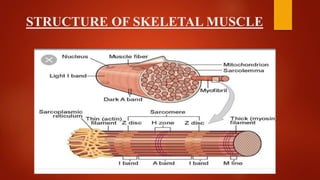
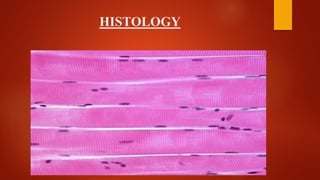
 Skeletal muscle is made up of large number of multinucleated
muscle fibres with outer membrane and cytoplasm
(sarcoplasm).
 The fibres are separated by connective
tissue(endomysium) and arranged in bundles(fasciculi).
 Each fasciculus has a connective tissue sheath(perimysium).
STRUCTURE OF SKELETAL MUSCLE
HISTOLOGY
GROUP OF SYMPTOMS
 Motor manifestations-
1)weakness- bilateral ,symmetrical affecting certain
group of muscles (proximal).
2) Hypotonia .
3) Change in muscle bulk(pseudohypertrophy).
 Pain- It is rare complaint in primary muscle disease.
 No sensory manifestations.
 No sphincter dysfunction.
CLASSIFICATION
 Primary - Progressive muscle dystrophy.
 Secondary –
1)Inflammatory.
2)Metabolic, periodic familial paralysis.
3)Endocrinal, thyrotoxic, cushing.
4)Drug induced- corticosteroid, statin.
5) Miscellaneous, carcinomatous.
CLASSIFICATION OF PROGRESSIVE
MUSCLE DYSTROPHY
1) X-LINKED DISORDERS
A) Duchenne’s muscular dystrophy.
B) Becker’s muscular dystrophy.
2) AUTOSOMAL RECESSIVE DISORDERS
A) Limb- Girdle muscular dystrophy.
AUTOSOMAL DOMINANT DISORDERS
 Fascio-scapulo- humeral muscular dystrophy.
 Distal myopathy.
 Ocular myopathy.
 Oculo-pharyngeal myopathy.
MYOPATHY BASED ON
WEAKNESS/MUSCLE INVOLVEMENT
PROXIMAL WEAKNESS(LIMB GIRDLE)
 Limb girdle , myotonic dystrophy type 2,rare FSHD.
 Congenital myopathies.
 Metabolic myopathies(glycogen and lipid storage)
 Mitochondrial myopathies.
 Inflammatory myopathies.
 Toxic myopathy.
 Neuromuscular junction disorders(myasthenia gravis, LEMS
etc).
BASED ON DISTAL WEAKNESS
 Distal muscular dystrophies/Myofibrillar dystrophy.
 Late onset centronuclear and nemaline rod
myopathy.
 Metabolic like Glycogen storage (McArdle disease)
Lipid storage disease(neutral lipid storage myopathy)
 NMJ disorders (myasthenia gravis etc).
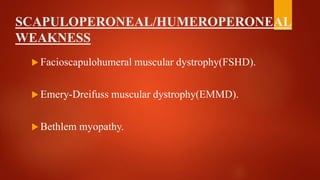
SCAPULOPERONEAL/HUMEROPERONEAL
WEAKNESS
 Facioscapulohumeral muscular dystrophy(FSHD).
 Emery-Dreifuss muscular dystrophy(EMMD).
 Bethlem myopathy.
DISTALARM/PROXIMAL LEG WEAKNESS
 Inclusion body myositis.
 Myotonic dystrophy.
AXIAL MUSCLE WEAKNESS
 Inflammatory(cervico-brachial).
 Isolated neck extensor myopathy/Bent spine syndrome.
 FSHD
 Late onset central core(RYR 1 MUTATION).
 Late onset pompe disease.
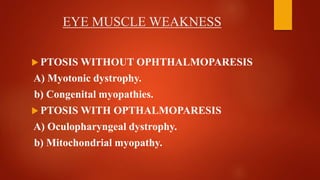
EYE MUSCLE WEAKNESS
 PTOSIS WITHOUT OPHTHALMOPARESIS
A) Myotonic dystrophy.
b) Congenital myopathies.
 PTOSIS WITH OPTHALMOPARESIS
A) Oculopharyngeal dystrophy.
b) Mitochondrial myopathy.
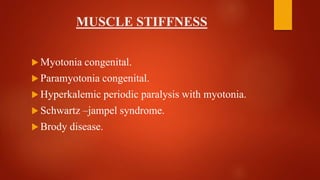
MUSCLE STIFFNESS
 Myotonia congenital.
 Paramyotonia congenital.
 Hyperkalemic periodic paralysis with myotonia.
 Schwartz –jampel syndrome.
 Brody disease.
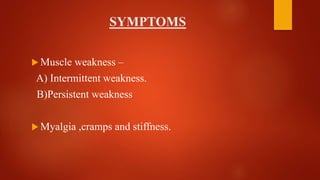
SYMPTOMS
 Muscle weakness –
A) Intermittent weakness.
B)Persistent weakness
 Myalgia ,cramps and stiffness.
LABORATORY EVALUATION
 Serum enzymes
1)CREATINE KINASE- most sensitive.
2) CK-MB
3)AST,ALT and LDH
4)ALDOLASE
5)GAMMA GLUTAMYL TRANSFERASE
ELECTRODIAGNOSTIC STUDIES
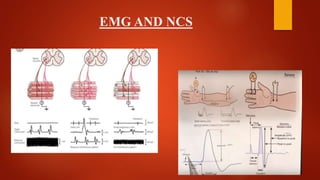
 EMG(ELECTROMYOGRAPHY)
 NCS(NERVE CONDUCTION STUDIES)
 REPETITIVE NERVE STIMULATION .
EMG AND NCS
 GENETIC TESTING IS THE GOLD STANDARD.
 FOREARM EXERCISE TEST.
 MUSCLE BIOPSY- mainly from most affected
muscle is taken.
DUCHENNE MUSCULAR DYSTROPHY
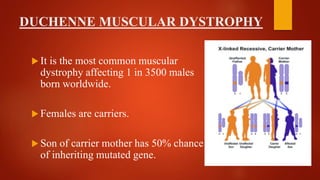
 It is the most common muscular
dystrophy affecting 1 in 3500 males
born worldwide.
 Females are carriers.
 Son of carrier mother has 50% chance
of inheriting mutated gene.
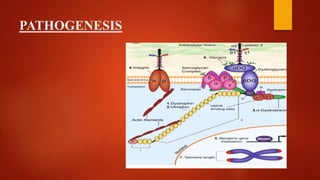
PATHOGENESIS
 Disorder is caused by mutation in DYSTROPHIN
gene,the largest gene on human x chromosome.
 Muscles undergo repeated cycles of necrosis and
regeneration.
 Mitochondrial dysfunction occurs due to excess
calcium penetration in sarcolemma.
PATHOGENESIS
CLINICAL FEATURES
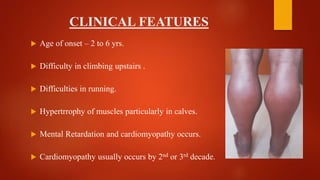
 Age of onset – 2 to 6 yrs.
 Difficulty in climbing upstairs .
 Difficulties in running.
 Hypertrrophy of muscles particularly in calves.
 Mental Retardation and cardiomyopathy occurs.
 Cardiomyopathy usually occurs by 2nd or 3rd decade.
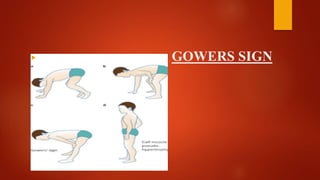
GOWERS SIGN
 S
LABORATORY EVALUATION
 Serum ck levels are elevated(50 to 100 times).
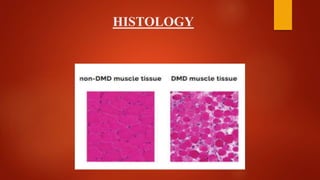
 Western blot analysis of muscle biopsy samples .
demonstrate absent dystrophin.
 Deletions within or duplications of the dystrophin .
HISTOLOGY
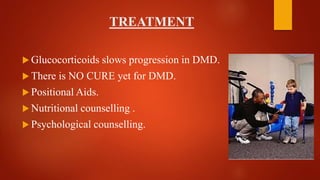
TREATMENT
 Glucocorticoids slows progression in DMD.
 There is NO CURE yet for DMD.
 Positional Aids.
 Nutritional counselling .
 Psychological counselling.
BECKER MUSCULAR DYSTROPHY
 X LINKED recessive muscular dystrophy.
 Muscle weakness due to DYSTROPHIN.
 Age of onset(10 to 13) yrs.
 Subtle form of DMD.
 Cardiopathy starts around 4th or 5th decade.
 Physical and occupational therapy are helpful.
LIMB GIRDLE MUSCULAR DYSTROPHY
 Males =Females
 Pelvic and Shoulder girdle musculature are affected.
 Immunohistochemistry differentes diff.
types(sarcoglycans,dysferlin,alpha dystroglycans).
 LGMD2L,the most common cause of LGMD is associated
with marked scapular winging,lack of calf muscle
hypertrophy.
EMERY-DREIFUSS MUSCULAR DYSTROPHY
 EMERIN and FHL1 mutations are due to X LINKED
inheritance.
 AUTOSOMAL dominant type associated with LAMIN A/C
gene.
 Muscle weakness affects humeral and peroneal
muscles>limb girdle .
 Atrial fibrillation and atrioventricular heart block can occur.
 Serum ck increased.
 Muscle biopsy- Myofibrillar myopathy.
 Supportive care and stretching of contractures.
 Use of defibrillators or cardiac pacemakers for
cardiomyopathy and arrhythmias .
MYOTONIC DYSTROPHY
 Two types myotonic dystrophy type 1 and 2 (known as
proximal myotonic myopathy).
 Type 1 have hatched faced appearance.
 Complete heart block and sudden cardiac death can occur.
 DM2 affects proximal muscle.
 CK inc,muscle biopsy shows internalised nuclei combined
with many atrophic fibres with pyknotic nuclear clamps.
 Cardiac pacemaker or implantable cardioverter
defibrillator should be considered.
 Molded ankle foot orthoses used in foot drop.
 BiPAP and modafinil may be beneficial.
FACIOSCAPULOHUMERAL MUSCULAR
DYSTROPHY
 Type 1 and type 2(95 and 5%) respectively.
 Presents in childhood,facial weakness is initial
manifestation.
 Loss of scapular stabilizers .
 COATS disease with telangiectasia,exudation and
retinal detachment occurs.
 NO specific treatment ,ankle foot orthosis are
helpful.
OCULOPHARYNGEAL DYSTROPHY
 Includes progressive external ophthalmoplegia.
 Pupil is spared,has late onset.
 Presents with ptosis or dysphagia.
 On electron microscope,feature of OPMD is presence
of 8.5nm tubular filament in muscle cell nuclei.
 Autosomal dominant,affects (French-Canadian and
Ashkenazi jews)
 Cricopharyngeal myotomy improves swallowing.
DISTAL MYOPATHIES
 Welander,Udd and Merkesbery-Griggs type distal
myopathies are late onset usually begins after 40
yrs.
 Laig distal myopathy and myofibrillar myopathies
presents with diatal weakness.
 In Miyoshi myopathy Gastrocnemius Muscles are
affected.
 Laing and Miyoshi myopathy,rimmed vacuoles can
be seen .
 Occupational therapy for loss of hand function,ankle
foot orthoses for lower limb support.
DISORDERS OF MUSCLE ENERGY
METABOLISM
 GLYCOGEN STORAGE AND GLYCOLYTIC DEFECTS
1)Pompe disease-alpha glucosidase or acid maltase
deficiency(type 2 glycogenosis)
- usually infants are affected,childhood form resembles
DMD.
-DEATH by 1.5 yrs.
2) Debranching enzyme deficiency(type 3 glycogenesis)
 Branching Enzyme deficiency(type 4 glycogenosis).
DISORDERS OF GLYCOLYSIS CAUSING
EXERCISE INTOLERANCE
 McArdle disease caused by myophosphorylase
deficiency.
 Carnitine Palmitoyltransferase 2 deficiency is the
most common cause of recurrent myoglobinuria.
MITOCHONDRIAL MYOPATHY
 Kearn-Sayre syndrome.
 Progressive external ophthalmoplegia.
 Myoclonic Epilepsy with Ragged Red
fibres(MERRF).
 Mitochondrial Myopathy,Encephalopathy,Lactic
acidosis and stroke like episodes.(MELAS)
 Mitochondrial DNA depletion Syndromes.
THANK YOU

Myopathy

  • 1.
    MYOPATHY DR BIPUL BORTHAKUR PROF& HEAD DEPT. OF ORTHOPAEDICS SILCHAR MEDICAL COLLEGE
  • 2.
    LEARNING OBJECTIVES  INTRODUCTION SYMPTOMS  CLASSIFICATION  LABORATORY INVESTIGATIONS.  INDIVIDUAL MYOPATHY.  TREATMENT
  • 3.
    MYOPATHY  These aredisorders with structural changes or functional impairment of muscle.
  • 4.
    INTRODUCTION  Skeletal muscleis made up of large number of multinucleated muscle fibres with outer membrane and cytoplasm (sarcoplasm).  The fibres are separated by connective tissue(endomysium) and arranged in bundles(fasciculi).  Each fasciculus has a connective tissue sheath(perimysium).
  • 5.
  • 6.
  • 7.
    GROUP OF SYMPTOMS Motor manifestations- 1)weakness- bilateral ,symmetrical affecting certain group of muscles (proximal). 2) Hypotonia . 3) Change in muscle bulk(pseudohypertrophy).
  • 8.
     Pain- Itis rare complaint in primary muscle disease.  No sensory manifestations.  No sphincter dysfunction.
  • 9.
    CLASSIFICATION  Primary -Progressive muscle dystrophy.  Secondary – 1)Inflammatory. 2)Metabolic, periodic familial paralysis. 3)Endocrinal, thyrotoxic, cushing. 4)Drug induced- corticosteroid, statin. 5) Miscellaneous, carcinomatous.
  • 10.
    CLASSIFICATION OF PROGRESSIVE MUSCLEDYSTROPHY 1) X-LINKED DISORDERS A) Duchenne’s muscular dystrophy. B) Becker’s muscular dystrophy. 2) AUTOSOMAL RECESSIVE DISORDERS A) Limb- Girdle muscular dystrophy.
  • 11.
    AUTOSOMAL DOMINANT DISORDERS Fascio-scapulo- humeral muscular dystrophy.  Distal myopathy.  Ocular myopathy.  Oculo-pharyngeal myopathy.
  • 12.
    MYOPATHY BASED ON WEAKNESS/MUSCLEINVOLVEMENT PROXIMAL WEAKNESS(LIMB GIRDLE)  Limb girdle , myotonic dystrophy type 2,rare FSHD.  Congenital myopathies.  Metabolic myopathies(glycogen and lipid storage)  Mitochondrial myopathies.  Inflammatory myopathies.  Toxic myopathy.  Neuromuscular junction disorders(myasthenia gravis, LEMS etc).
  • 13.
    BASED ON DISTALWEAKNESS  Distal muscular dystrophies/Myofibrillar dystrophy.  Late onset centronuclear and nemaline rod myopathy.  Metabolic like Glycogen storage (McArdle disease) Lipid storage disease(neutral lipid storage myopathy)  NMJ disorders (myasthenia gravis etc).
  • 14.
    SCAPULOPERONEAL/HUMEROPERONEAL WEAKNESS  Facioscapulohumeral musculardystrophy(FSHD).  Emery-Dreifuss muscular dystrophy(EMMD).  Bethlem myopathy.
  • 15.
    DISTALARM/PROXIMAL LEG WEAKNESS Inclusion body myositis.  Myotonic dystrophy.
  • 16.
    AXIAL MUSCLE WEAKNESS Inflammatory(cervico-brachial).  Isolated neck extensor myopathy/Bent spine syndrome.  FSHD  Late onset central core(RYR 1 MUTATION).  Late onset pompe disease.
  • 17.
    EYE MUSCLE WEAKNESS PTOSIS WITHOUT OPHTHALMOPARESIS A) Myotonic dystrophy. b) Congenital myopathies.  PTOSIS WITH OPTHALMOPARESIS A) Oculopharyngeal dystrophy. b) Mitochondrial myopathy.
  • 18.
    MUSCLE STIFFNESS  Myotoniacongenital.  Paramyotonia congenital.  Hyperkalemic periodic paralysis with myotonia.  Schwartz –jampel syndrome.  Brody disease.
  • 19.
    SYMPTOMS  Muscle weakness– A) Intermittent weakness. B)Persistent weakness  Myalgia ,cramps and stiffness.
  • 20.
    LABORATORY EVALUATION  Serumenzymes 1)CREATINE KINASE- most sensitive. 2) CK-MB 3)AST,ALT and LDH 4)ALDOLASE 5)GAMMA GLUTAMYL TRANSFERASE
  • 21.
    ELECTRODIAGNOSTIC STUDIES  EMG(ELECTROMYOGRAPHY) NCS(NERVE CONDUCTION STUDIES)  REPETITIVE NERVE STIMULATION .
  • 22.
  • 23.
     GENETIC TESTINGIS THE GOLD STANDARD.  FOREARM EXERCISE TEST.  MUSCLE BIOPSY- mainly from most affected muscle is taken.
  • 24.
    DUCHENNE MUSCULAR DYSTROPHY It is the most common muscular dystrophy affecting 1 in 3500 males born worldwide.  Females are carriers.  Son of carrier mother has 50% chance of inheriting mutated gene.
  • 25.
    PATHOGENESIS  Disorder iscaused by mutation in DYSTROPHIN gene,the largest gene on human x chromosome.  Muscles undergo repeated cycles of necrosis and regeneration.  Mitochondrial dysfunction occurs due to excess calcium penetration in sarcolemma.
  • 26.
  • 27.
    CLINICAL FEATURES  Ageof onset – 2 to 6 yrs.  Difficulty in climbing upstairs .  Difficulties in running.  Hypertrrophy of muscles particularly in calves.  Mental Retardation and cardiomyopathy occurs.  Cardiomyopathy usually occurs by 2nd or 3rd decade.
  • 28.
  • 29.
    LABORATORY EVALUATION  Serumck levels are elevated(50 to 100 times).  Western blot analysis of muscle biopsy samples . demonstrate absent dystrophin.  Deletions within or duplications of the dystrophin .
  • 30.
  • 31.
    TREATMENT  Glucocorticoids slowsprogression in DMD.  There is NO CURE yet for DMD.  Positional Aids.  Nutritional counselling .  Psychological counselling.
  • 32.
    BECKER MUSCULAR DYSTROPHY X LINKED recessive muscular dystrophy.  Muscle weakness due to DYSTROPHIN.  Age of onset(10 to 13) yrs.  Subtle form of DMD.  Cardiopathy starts around 4th or 5th decade.  Physical and occupational therapy are helpful.
  • 33.
    LIMB GIRDLE MUSCULARDYSTROPHY  Males =Females  Pelvic and Shoulder girdle musculature are affected.  Immunohistochemistry differentes diff. types(sarcoglycans,dysferlin,alpha dystroglycans).  LGMD2L,the most common cause of LGMD is associated with marked scapular winging,lack of calf muscle hypertrophy.
  • 34.
    EMERY-DREIFUSS MUSCULAR DYSTROPHY EMERIN and FHL1 mutations are due to X LINKED inheritance.  AUTOSOMAL dominant type associated with LAMIN A/C gene.  Muscle weakness affects humeral and peroneal muscles>limb girdle .  Atrial fibrillation and atrioventricular heart block can occur.
  • 35.
     Serum ckincreased.  Muscle biopsy- Myofibrillar myopathy.  Supportive care and stretching of contractures.  Use of defibrillators or cardiac pacemakers for cardiomyopathy and arrhythmias .
  • 36.
    MYOTONIC DYSTROPHY  Twotypes myotonic dystrophy type 1 and 2 (known as proximal myotonic myopathy).  Type 1 have hatched faced appearance.  Complete heart block and sudden cardiac death can occur.  DM2 affects proximal muscle.  CK inc,muscle biopsy shows internalised nuclei combined with many atrophic fibres with pyknotic nuclear clamps.
  • 37.
     Cardiac pacemakeror implantable cardioverter defibrillator should be considered.  Molded ankle foot orthoses used in foot drop.  BiPAP and modafinil may be beneficial.
  • 38.
    FACIOSCAPULOHUMERAL MUSCULAR DYSTROPHY  Type1 and type 2(95 and 5%) respectively.  Presents in childhood,facial weakness is initial manifestation.  Loss of scapular stabilizers .  COATS disease with telangiectasia,exudation and retinal detachment occurs.  NO specific treatment ,ankle foot orthosis are helpful.
  • 39.
    OCULOPHARYNGEAL DYSTROPHY  Includesprogressive external ophthalmoplegia.  Pupil is spared,has late onset.  Presents with ptosis or dysphagia.  On electron microscope,feature of OPMD is presence of 8.5nm tubular filament in muscle cell nuclei.  Autosomal dominant,affects (French-Canadian and Ashkenazi jews)  Cricopharyngeal myotomy improves swallowing.
  • 40.
    DISTAL MYOPATHIES  Welander,Uddand Merkesbery-Griggs type distal myopathies are late onset usually begins after 40 yrs.  Laig distal myopathy and myofibrillar myopathies presents with diatal weakness.  In Miyoshi myopathy Gastrocnemius Muscles are affected.
  • 41.
     Laing andMiyoshi myopathy,rimmed vacuoles can be seen .  Occupational therapy for loss of hand function,ankle foot orthoses for lower limb support.
  • 42.
    DISORDERS OF MUSCLEENERGY METABOLISM  GLYCOGEN STORAGE AND GLYCOLYTIC DEFECTS 1)Pompe disease-alpha glucosidase or acid maltase deficiency(type 2 glycogenosis) - usually infants are affected,childhood form resembles DMD. -DEATH by 1.5 yrs. 2) Debranching enzyme deficiency(type 3 glycogenesis)
  • 43.
     Branching Enzymedeficiency(type 4 glycogenosis).
  • 44.
    DISORDERS OF GLYCOLYSISCAUSING EXERCISE INTOLERANCE  McArdle disease caused by myophosphorylase deficiency.  Carnitine Palmitoyltransferase 2 deficiency is the most common cause of recurrent myoglobinuria.
  • 45.
    MITOCHONDRIAL MYOPATHY  Kearn-Sayresyndrome.  Progressive external ophthalmoplegia.  Myoclonic Epilepsy with Ragged Red fibres(MERRF).  Mitochondrial Myopathy,Encephalopathy,Lactic acidosis and stroke like episodes.(MELAS)  Mitochondrial DNA depletion Syndromes.
  • 46.