Neonatal Seizures


                                   Dr. Kalpana Malla
                                       MD Pediatrics
                           Manipal Teaching Hospital

Download more documents and slide shows on The Medical Post [ www.themedicalpost.net ]
INTRODUCTION


• Not uncommon
•Always due to some underlying cause
•25% cases cause – unknown
•Often first sign of neurological disorders
•Powerful predictors of long term
cognitive and developmental impairement
Pathophysiology
1.Large group of neurons undergo
    excessive, synchronized depolarization which
    results from –
a) Increase in excitatory
    neurotransmitters (glutamate)
b) Decrease in inhibitory
    neurotransmitters (gamma amino
    butyric acid- GABA
PROBABLE MECHANISMS

c. Disruption of ATP – dependent resting
  membrane potentials - Failure of Na - K
  pump – flow of sodium into the neuron
  & potassium out of neuron
d. Membrane alteration - Increased Na
   permeability
Incidence
• 1 in 200 healthy newborns
• 0.5 -0.8% Term babies
• 6-12% <1.5 kg (1 in 4 premature and
  LBW
• Many seizures are very subtle – go
  undetected
SEIZURE PATTERN
1. Subtle seizure: 50%of seizures
- Tonic horizontal deviation of eyes,
    staring look,Repetitive blinking /
    fluttering of eyelids
 - Oro- buccal movements-chewing,
    lip smacking, sucking, yawning
 - Tonic posturing of a limb
 - Apnea
- Swimming/ bycycling movements
SEIZURE PATTERN

2.Clonic - Focal / Multifocal –
 twitching migrate haphazardly
 from one limb to another,
 occur due to HIE & birth
 trauma
3.Generalised seizure - rare
SEIZURE PATTERN
4. Focal clonic –
   Localized & often assoc with loss of
  consciousness
  They are signs of bilateral c’bral disorder
 Common in metabolic disorder, birth
  trauma and c’bral infarction
SEIZURE PATTERN
5. Tonic seizure –
  - Stiffening similar to decerebrate
    posture but with eye signs and
    heavy breathing
 - Often associated with apnea
 - Seen in IVH, preterm and
   Kernicterus
SEIZURE PATTERN
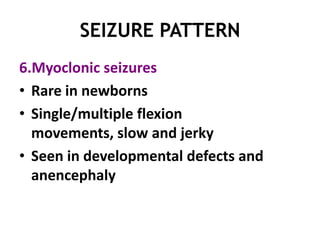
6.Myoclonic seizures
• Rare in newborns
• Single/multiple flexion
  movements, slow and jerky
• Seen in developmental defects and
  anencephaly
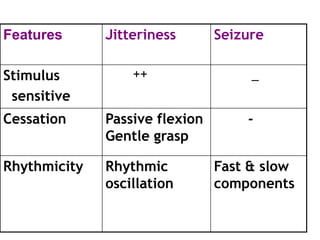
Features      Jitteriness       Seizure

Stimulus          ++                 _
 sensitive
Cessation     Passive flexion       -
              Gentle grasp

Rhythmicity   Rhythmic          Fast & slow
              oscillation       components
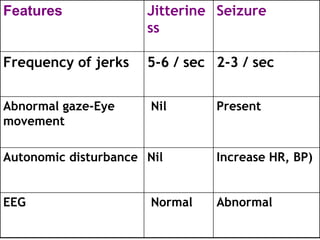
Features              Jitterine Seizure
                      ss

Frequency of jerks    5-6 / sec 2-3 / sec


Abnormal gaze-Eye      Nil      Present
movement

Autonomic disturbance Nil       Increase HR, BP)


EEG                    Normal   Abnormal
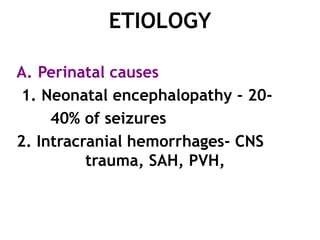
ETIOLOGY

A. Perinatal causes
 1. Neonatal encephalopathy - 20-
     40% of seizures
2. Intracranial hemorrhages- CNS
          trauma, SAH, PVH,
B. METABOLIC CAUSES


• Hypoglycemia
• Hypocalcemia – most common metabolic
  cause for NNS
• Hypomagnesemia
• Hypo / Hypernatremia
• Pyridoxine dependency
• IEM - Disorders of amino acid
  metabolism
C. Infections
• Intracranial
  - Meningitis
  - encephalitis – herpes, coxachie, echo, CMV,
   - Toxoplasmosis
Extracranial
     – septicemia
     - Tetanus
     - Severe rep distress
D. Developmental defects


– Cerebral Dysgenesis
– Hydrocephalus
– Microcephaly
– Neuronal migration defects-
  Lissencephaly,pachygyria,schizenceph
  aly
Others
E. Drugs- prolonged maternal
  administration
     - Vit B6-pyridoxin dependancy
     - Narcotic withdrawal
     - Theophylline
F. Polycythemia
G. Focal infarcts
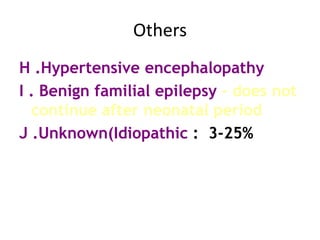
Others
H .Hypertensive encephalopathy
I . Benign familial epilepsy – does not
  continue after neonatal period
J .Unknown(Idiopathic : 3-25%
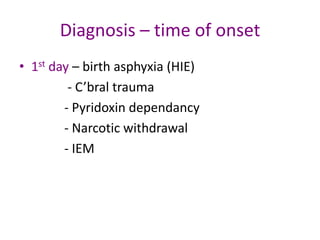
Diagnosis – time of onset
• 1st day – birth asphyxia (HIE)
         - C’bral trauma
        - Pyridoxin dependancy
        - Narcotic withdrawal
        - IEM
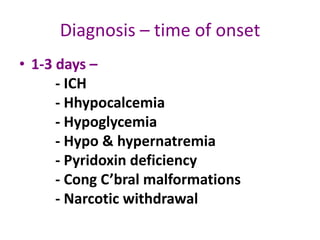
Diagnosis – time of onset
• 1-3 days –
      - ICH
      - Hhypocalcemia
      - Hypoglycemia
      - Hypo & hypernatremia
      - Pyridoxin deficiency
      - Cong C’bral malformations
      - Narcotic withdrawal
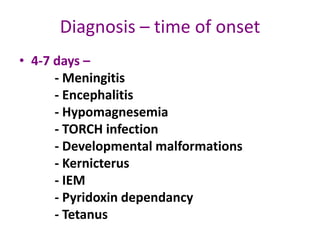
Diagnosis – time of onset
• 4-7 days –
      - Meningitis
      - Encephalitis
      - Hypomagnesemia
      - TORCH infection
      - Developmental malformations
      - Kernicterus
      - IEM
      - Pyridoxin dependancy
      - Tetanus
Refractory seizures

•   IEM –
•   Developmental defects of CNS
•   Narcotic withdrawal
•   Pyridoxin dependancy
•   Kernicterus
•   Benign familial seizures
Investigations
• CBC
• Blood – glucose, calcium, electrolytes, Mg,
  bilirubin, ABG
• CSF analysis
• Blood C/S , urine C/S
• Cranial USG
Second line investigations
• TORCH screening
• IEM screening – urine organic acids
•              - S. amino acid assay
• Imaging – CT scan
           - MRI
          - EEG brain
Management
• Collect all samples
• IV line
• Thermoneutral environment
• Glucose 10% - 2-4ml/kg as bolus followed by
  10% glucose as drip @ 8mg/kg/min
• IV calcium – gluconate 2ml/kg
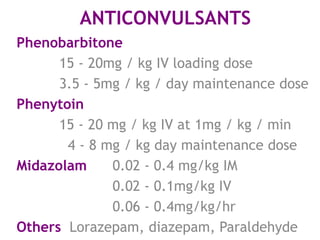
ANTICONVULSANTS
Phenobarbitone
      15 - 20mg / kg IV loading dose
      3.5 - 5mg / kg / day maintenance dose
Phenytoin
      15 - 20 mg / kg IV at 1mg / kg / min
       4 - 8 mg / kg day maintenance dose
Midazolam     0.02 - 0.4 mg/kg IM
              0.02 - 0.1mg/kg IV
              0.06 - 0.4mg/kg/hr
Others Lorazepam, diazepam, Paraldehyde
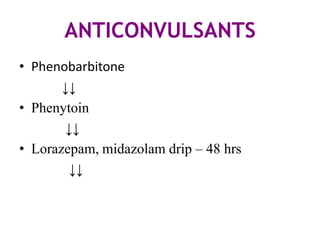
ANTICONVULSANTS
• Phenobarbitone
       ↓↓
• Phenytoin
       ↓↓
• Lorazepam, midazolam drip – 48 hrs
        ↓↓
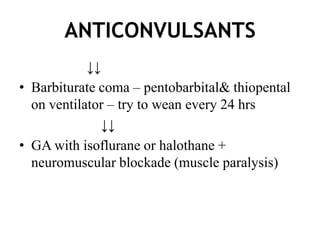
ANTICONVULSANTS
            ↓↓
• Barbiturate coma – pentobarbital& thiopental
  on ventilator – try to wean every 24 hrs
              ↓↓
• GA with isoflurane or halothane +
  neuromuscular blockade (muscle paralysis)
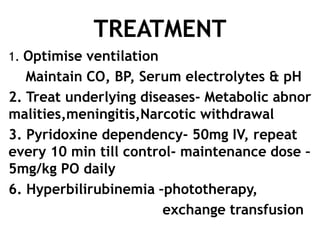
TREATMENT
1. Optimise ventilation
   Maintain CO, BP, Serum electrolytes & pH
2. Treat underlying diseases- Metabolic abnor
malities,meningitis,Narcotic withdrawal
3. Pyridoxine dependency- 50mg IV, repeat
every 10 min till control- maintenance dose –
5mg/kg PO daily
6. Hyperbilirubinemia –phototherapy,
                        exchange transfusion
Benign familial neonatal seizure
•   Typically occur in first 48- 72 hrs of life
•   Disappear by age 2-6 months
•   A family history seizures is usual
•   Development - normal
Benign idiopathic NNS
•   Typically Presents at day 5 of life
•   Also called 5th day fits
•   Multifocal in type
•   No cause detected
FOLLOW UP -
            ANTICONVULSANTS

1. Stop all others except maintenance PB
2. Maintenance PB : 2wks - 2months
3. Risk of recurrence
       Little: transient metabolic abnormalities
       30-50% : HIE
       High : Cortex malformations
PROGNOSIS
Normal Outcome: 56%
Neurological sequelae: 30 - 40%
Death : 15-25%
Chronic seizure disorder: 15-20%
Outcome depends on
    1. Level of maturity
    2. Etiology
    3. Neurological examination
    4. EEG / Imaging studies
GOOD PROGNOSIS

• Uncomplicated hypoglycemia
• Narcotic withdrawal
• SAH
POOR PROGNOSIS

•   Low APGAR score ≤ 6 at 5min
•   Onset o seizures within 24 hrs of life
•   Presence of myoclonic attacks
•   Abnormal EEG
•   3 or more days of uncontrolled seizures
Thank you
Download more documents and slide shows on The
    Medical Post [ www.themedicalpost.net ]

Neonatal seizures

  • 1.
    Neonatal Seizures Dr. Kalpana Malla MD Pediatrics Manipal Teaching Hospital Download more documents and slide shows on The Medical Post [ www.themedicalpost.net ]
  • 2.
    INTRODUCTION • Not uncommon •Alwaysdue to some underlying cause •25% cases cause – unknown •Often first sign of neurological disorders •Powerful predictors of long term cognitive and developmental impairement
  • 3.
    Pathophysiology 1.Large group ofneurons undergo excessive, synchronized depolarization which results from – a) Increase in excitatory neurotransmitters (glutamate) b) Decrease in inhibitory neurotransmitters (gamma amino butyric acid- GABA
  • 4.
    PROBABLE MECHANISMS c. Disruptionof ATP – dependent resting membrane potentials - Failure of Na - K pump – flow of sodium into the neuron & potassium out of neuron d. Membrane alteration - Increased Na permeability
  • 5.
    Incidence • 1 in200 healthy newborns • 0.5 -0.8% Term babies • 6-12% <1.5 kg (1 in 4 premature and LBW • Many seizures are very subtle – go undetected
  • 6.
    SEIZURE PATTERN 1. Subtleseizure: 50%of seizures - Tonic horizontal deviation of eyes, staring look,Repetitive blinking / fluttering of eyelids - Oro- buccal movements-chewing, lip smacking, sucking, yawning - Tonic posturing of a limb - Apnea - Swimming/ bycycling movements
  • 7.
    SEIZURE PATTERN 2.Clonic -Focal / Multifocal – twitching migrate haphazardly from one limb to another, occur due to HIE & birth trauma 3.Generalised seizure - rare
  • 8.
    SEIZURE PATTERN 4. Focalclonic – Localized & often assoc with loss of consciousness They are signs of bilateral c’bral disorder Common in metabolic disorder, birth trauma and c’bral infarction
  • 9.
    SEIZURE PATTERN 5. Tonicseizure – - Stiffening similar to decerebrate posture but with eye signs and heavy breathing - Often associated with apnea - Seen in IVH, preterm and Kernicterus
  • 10.
    SEIZURE PATTERN 6.Myoclonic seizures •Rare in newborns • Single/multiple flexion movements, slow and jerky • Seen in developmental defects and anencephaly
  • 11.
    Features Jitteriness Seizure Stimulus ++ _ sensitive Cessation Passive flexion - Gentle grasp Rhythmicity Rhythmic Fast & slow oscillation components
  • 12.
    Features Jitterine Seizure ss Frequency of jerks 5-6 / sec 2-3 / sec Abnormal gaze-Eye Nil Present movement Autonomic disturbance Nil Increase HR, BP) EEG Normal Abnormal
  • 13.
    ETIOLOGY A. Perinatal causes 1. Neonatal encephalopathy - 20- 40% of seizures 2. Intracranial hemorrhages- CNS trauma, SAH, PVH,
  • 14.
    B. METABOLIC CAUSES •Hypoglycemia • Hypocalcemia – most common metabolic cause for NNS • Hypomagnesemia • Hypo / Hypernatremia • Pyridoxine dependency • IEM - Disorders of amino acid metabolism
  • 15.
    C. Infections • Intracranial - Meningitis - encephalitis – herpes, coxachie, echo, CMV, - Toxoplasmosis Extracranial – septicemia - Tetanus - Severe rep distress
  • 16.
    D. Developmental defects –Cerebral Dysgenesis – Hydrocephalus – Microcephaly – Neuronal migration defects- Lissencephaly,pachygyria,schizenceph aly
  • 17.
    Others E. Drugs- prolongedmaternal administration - Vit B6-pyridoxin dependancy - Narcotic withdrawal - Theophylline F. Polycythemia G. Focal infarcts
  • 18.
    Others H .Hypertensive encephalopathy I. Benign familial epilepsy – does not continue after neonatal period J .Unknown(Idiopathic : 3-25%
  • 19.
    Diagnosis – timeof onset • 1st day – birth asphyxia (HIE) - C’bral trauma - Pyridoxin dependancy - Narcotic withdrawal - IEM
  • 20.
    Diagnosis – timeof onset • 1-3 days – - ICH - Hhypocalcemia - Hypoglycemia - Hypo & hypernatremia - Pyridoxin deficiency - Cong C’bral malformations - Narcotic withdrawal
  • 21.
    Diagnosis – timeof onset • 4-7 days – - Meningitis - Encephalitis - Hypomagnesemia - TORCH infection - Developmental malformations - Kernicterus - IEM - Pyridoxin dependancy - Tetanus
  • 22.
    Refractory seizures • IEM – • Developmental defects of CNS • Narcotic withdrawal • Pyridoxin dependancy • Kernicterus • Benign familial seizures
  • 23.
    Investigations • CBC • Blood– glucose, calcium, electrolytes, Mg, bilirubin, ABG • CSF analysis • Blood C/S , urine C/S • Cranial USG
  • 24.
    Second line investigations •TORCH screening • IEM screening – urine organic acids • - S. amino acid assay • Imaging – CT scan - MRI - EEG brain
  • 25.
    Management • Collect allsamples • IV line • Thermoneutral environment • Glucose 10% - 2-4ml/kg as bolus followed by 10% glucose as drip @ 8mg/kg/min • IV calcium – gluconate 2ml/kg
  • 26.
    ANTICONVULSANTS Phenobarbitone 15 - 20mg / kg IV loading dose 3.5 - 5mg / kg / day maintenance dose Phenytoin 15 - 20 mg / kg IV at 1mg / kg / min 4 - 8 mg / kg day maintenance dose Midazolam 0.02 - 0.4 mg/kg IM 0.02 - 0.1mg/kg IV 0.06 - 0.4mg/kg/hr Others Lorazepam, diazepam, Paraldehyde
  • 27.
    ANTICONVULSANTS • Phenobarbitone ↓↓ • Phenytoin ↓↓ • Lorazepam, midazolam drip – 48 hrs ↓↓
  • 28.
    ANTICONVULSANTS ↓↓ • Barbiturate coma – pentobarbital& thiopental on ventilator – try to wean every 24 hrs ↓↓ • GA with isoflurane or halothane + neuromuscular blockade (muscle paralysis)
  • 29.
    TREATMENT 1. Optimise ventilation Maintain CO, BP, Serum electrolytes & pH 2. Treat underlying diseases- Metabolic abnor malities,meningitis,Narcotic withdrawal 3. Pyridoxine dependency- 50mg IV, repeat every 10 min till control- maintenance dose – 5mg/kg PO daily 6. Hyperbilirubinemia –phototherapy, exchange transfusion
  • 30.
    Benign familial neonatalseizure • Typically occur in first 48- 72 hrs of life • Disappear by age 2-6 months • A family history seizures is usual • Development - normal
  • 31.
    Benign idiopathic NNS • Typically Presents at day 5 of life • Also called 5th day fits • Multifocal in type • No cause detected
  • 32.
    FOLLOW UP - ANTICONVULSANTS 1. Stop all others except maintenance PB 2. Maintenance PB : 2wks - 2months 3. Risk of recurrence Little: transient metabolic abnormalities 30-50% : HIE High : Cortex malformations
  • 33.
    PROGNOSIS Normal Outcome: 56% Neurologicalsequelae: 30 - 40% Death : 15-25% Chronic seizure disorder: 15-20% Outcome depends on 1. Level of maturity 2. Etiology 3. Neurological examination 4. EEG / Imaging studies
  • 34.
    GOOD PROGNOSIS • Uncomplicatedhypoglycemia • Narcotic withdrawal • SAH
  • 35.
    POOR PROGNOSIS • Low APGAR score ≤ 6 at 5min • Onset o seizures within 24 hrs of life • Presence of myoclonic attacks • Abnormal EEG • 3 or more days of uncontrolled seizures
  • 36.
    Thank you Download moredocuments and slide shows on The Medical Post [ www.themedicalpost.net ]