HEREDITARY SPASTIC PARAPLEGIADr.Y.Sasikumar
Hereditary spastic paraplegia (HSP) is a large group of inherited neurologic disorders, in which the prominent feature is a progressive spastic paraparesis.
Dr. Str ü mpell first described hereditary forms of spastic paraplegia in 1883.HSP is group of genetic disorders ,                    the modes of inheritance: autosomal dominant, autosomal recessive, Mitochondrial inheritance and x-linked recessive.Hereditary spastic paraplegia (HSP) is also called familial spastic paraparesis .

In Europe, the frequency of HSP is estimated to be 1-9 cases per 100,000 population.. HSP may occur at any age, from infancy through late adulthood (eg, 85 y). Most patients experience the onset of symptoms between the second and fourth decades of life.
Degeneration of the ends of the corticospinal tracts within the spinal cord.The ends of the longest fibers, which supply the lower extremities, are affected to a much greater extent than are the fibers to the upper body. Most people with HSP do not have symptoms in the hands or arms. PATHOPHYSIOLOGY
Impaired cellular membrane trafficking
More particularly axonal transport of macromolecules and organelles.
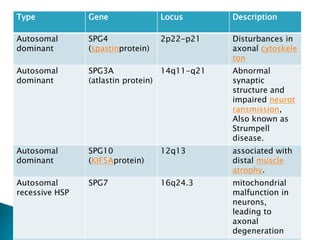
  Mutation of proteins, spastin and atlastin-1 causes impaired cellular membrane trafficking.Mitochondrial dysfunction
Paraplegin , an ATP-dependent proteolytic complex located at the mitochondrial inner membrane, which controls protein quality and regulates ribosome assembly.
Mutation causes  mitochondrial dysfunction.Mutation of myelin protein gene Patients with this form of HSP generally show evidence of myelin abnormalities, which are known to affect axon function.
CLASSIFICATIONHereditary Spastic Paraplegias are classifiedBased on the symptoms (pure form versus complicated form); Based on their mode of inheritance (autosomal dominant, autosomal recessive or x-linked)Based on the patient’s age at onset.
Based on symptoms
Spasticity in the lower limbs alone is described as pure HSP.
Complicated HSP, additional symptoms may include peripheral neuropathy, epilepsy, ataxia, optic neuropathy, retinopathy, dementia, ichthyosis, mental retardation, deafness, and problems with speech, swallowing.
Complicated HSP is rare.Based on patient's age at onset
Type I is characterized by age onset below 35 years. Spasticity of the lower limbs is more marked than weakness.Type II is characterized by onset over 35 years.Muscle weakness, urinary symptoms and sensory loss are more marked
Based on mode of inheritanceThere are four different modes of inheritance: autosomal dominant 
autosomal recessive
Mitochondrial inheritance 
 x-linked recessive.Autosomal dominant represents the most common mode of inheritance
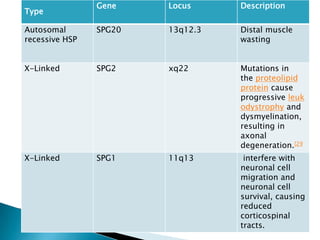
To date, the locations of several genes have been identified by Genetic mapping .
18 types of dominantly inherited pure or complicated HSP are known.
17 types of recessively inherited HSP.
  3 types of X-linked HSP.
SymptomsThe classic symptom of HSP is progressive difficulty in walking.
Patients usually have difficulty lifting their toes; as a result, they drag their toes when walking.
In later stages, patients experience difficulty flexing the thigh muscle when walking.
Experience increased muscle tone. Some patients complain of reduced sensation in the distal regions of the legs.
Some people also experience urinary problems (eg, incontinence)
Some patients eventually may require the use of a wheelchair.Abnormal gaitIncreasing stiffness in the legs is associated with frequent tripping.
Uncontrollable shaking of the legs may be noted when the patient ambulates.
 Dragging of the feet, scissoring of the legs during ambulation. Decreased sense of balanceA common symptom of HSP is a decreased sense of balance.
 For many people, this is the first symptom. Epilepsy, ataxia, optic neuropathy, retinopathy, dementia, ichthyosis, mental retardation, deafness, and problems with speech, swallowing. Physical SignsUpper extremity muscle tone and strength are normal.
In the lower extremities, muscle tone is increased at the hamstrings, quadriceps, and ankles.
Weakness is most notable at the iliopsoas muscles, the tibialis anterior muscles, and, to a lesser extent, the hamstring muscles. Muscle wasting may occur in patients with pure HSP.
It is mild and is limited to atrophy of the shins in elderly & wheelchair-dependent patients.Peripheral nerves are normal in patients with pure HSP.
Vibratory sensation is often mildly diminished in the distal lower extremities.
Deep tendon reflexes are pathologically increased (3+ to 4+) in the lower extremities. The patient's gait demonstrates circumductionowing to a difficulty with hip flexion and ankle dorsiflexion.
Ankle clonus, and extensor plantar responses are uniformly present.
Hoffman sign may be observed.
High-arched feet (pescavus) are generally present and are usually prominent in older patients.workupGenetic Testing

Hereditary spastic paraplegia

  • 1.
  • 2.
    Hereditary spastic paraplegia(HSP) is a large group of inherited neurologic disorders, in which the prominent feature is a progressive spastic paraparesis.
  • 3.
    Dr. Str ümpell first described hereditary forms of spastic paraplegia in 1883.HSP is group of genetic disorders , the modes of inheritance: autosomal dominant, autosomal recessive, Mitochondrial inheritance and x-linked recessive.Hereditary spastic paraplegia (HSP) is also called familial spastic paraparesis .
  • 4.
    In Europe, thefrequency of HSP is estimated to be 1-9 cases per 100,000 population.. HSP may occur at any age, from infancy through late adulthood (eg, 85 y). Most patients experience the onset of symptoms between the second and fourth decades of life.
  • 5.
    Degeneration of theends of the corticospinal tracts within the spinal cord.The ends of the longest fibers, which supply the lower extremities, are affected to a much greater extent than are the fibers to the upper body. Most people with HSP do not have symptoms in the hands or arms. PATHOPHYSIOLOGY
  • 6.
  • 7.
    More particularly axonaltransport of macromolecules and organelles.
  • 8.
    Mutationof proteins, spastin and atlastin-1 causes impaired cellular membrane trafficking.Mitochondrial dysfunction
  • 9.
    Paraplegin , anATP-dependent proteolytic complex located at the mitochondrial inner membrane, which controls protein quality and regulates ribosome assembly.
  • 10.
    Mutation causes mitochondrial dysfunction.Mutation of myelin protein gene Patients with this form of HSP generally show evidence of myelin abnormalities, which are known to affect axon function.
  • 11.
    CLASSIFICATIONHereditary Spastic Paraplegiasare classifiedBased on the symptoms (pure form versus complicated form); Based on their mode of inheritance (autosomal dominant, autosomal recessive or x-linked)Based on the patient’s age at onset.
  • 12.
  • 13.
    Spasticity in the lowerlimbs alone is described as pure HSP.
  • 14.
    Complicated HSP, additionalsymptoms may include peripheral neuropathy, epilepsy, ataxia, optic neuropathy, retinopathy, dementia, ichthyosis, mental retardation, deafness, and problems with speech, swallowing.
  • 15.
    Complicated HSP israre.Based on patient's age at onset
  • 16.
    Type I ischaracterized by age onset below 35 years. Spasticity of the lower limbs is more marked than weakness.Type II is characterized by onset over 35 years.Muscle weakness, urinary symptoms and sensory loss are more marked
  • 17.
    Based on modeof inheritanceThere are four different modes of inheritance: autosomal dominant 
  • 18.
  • 19.
  • 20.
     x-linked recessive.Autosomal dominant representsthe most common mode of inheritance
  • 21.
    To date, thelocations of several genes have been identified by Genetic mapping .
  • 22.
    18 types ofdominantly inherited pure or complicated HSP are known.
  • 23.
    17 types ofrecessively inherited HSP.
  • 24.
    3types of X-linked HSP.
  • 26.
    SymptomsThe classic symptomof HSP is progressive difficulty in walking.
  • 27.
    Patients usually havedifficulty lifting their toes; as a result, they drag their toes when walking.
  • 28.
    In later stages,patients experience difficulty flexing the thigh muscle when walking.
  • 29.
    Experience increased muscletone. Some patients complain of reduced sensation in the distal regions of the legs.
  • 30.
    Some people alsoexperience urinary problems (eg, incontinence)
  • 31.
    Some patients eventuallymay require the use of a wheelchair.Abnormal gaitIncreasing stiffness in the legs is associated with frequent tripping.
  • 32.
    Uncontrollable shaking ofthe legs may be noted when the patient ambulates.
  • 33.
    Dragging ofthe feet, scissoring of the legs during ambulation. Decreased sense of balanceA common symptom of HSP is a decreased sense of balance.
  • 34.
    For manypeople, this is the first symptom. Epilepsy, ataxia, optic neuropathy, retinopathy, dementia, ichthyosis, mental retardation, deafness, and problems with speech, swallowing. Physical SignsUpper extremity muscle tone and strength are normal.
  • 35.
    In the lowerextremities, muscle tone is increased at the hamstrings, quadriceps, and ankles.
  • 36.
    Weakness is mostnotable at the iliopsoas muscles, the tibialis anterior muscles, and, to a lesser extent, the hamstring muscles. Muscle wasting may occur in patients with pure HSP.
  • 37.
    It is mildand is limited to atrophy of the shins in elderly & wheelchair-dependent patients.Peripheral nerves are normal in patients with pure HSP.
  • 38.
    Vibratory sensation isoften mildly diminished in the distal lower extremities.
  • 39.
    Deep tendon reflexesare pathologically increased (3+ to 4+) in the lower extremities. The patient's gait demonstrates circumductionowing to a difficulty with hip flexion and ankle dorsiflexion.
  • 40.
    Ankle clonus, andextensor plantar responses are uniformly present.
  • 41.
    Hoffman sign maybe observed.
  • 42.
    High-arched feet (pescavus)are generally present and are usually prominent in older patients.workupGenetic Testing