SYRINGOMYELIA
DR. VAIBHAVI PARMAR (PT)
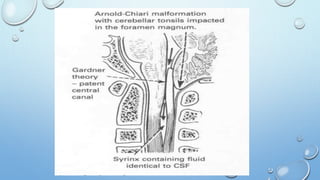
• Syringomyelia is acquired developmental of cavity ( syrinx)
within the central spinal cord.
• The lower cervical segments usually affected, but the
extension occurs upward into brain stem or downwards as far
as filum terminale.
• The cavitation appears to develop in association with
obstruction
• Frequently associated developmental abnormalities
– Vertebral column (thoracic scoliosis, fusion of vertebrae, or
klippel-feil anomaly),
– Base of the skull (platybasia, basilar invagination),
– Cerebellum and brain (type I chiari malformation)
• 90 percent of cases of syringomyelia have type I chiari
malformation.
TYPES
• Congenital- associated with chiari malformations
• Acquired – spinal cord tumors (usually intramedullary,
Especially hemangioblastoma)
– Traumatic myelopathy
– Spinal arachnoiditis and pachymeningitis
– Secondary myelomalacia from cord compression (Tumor,
spondylosis), infarction, hematomyelia
• Idiopathic
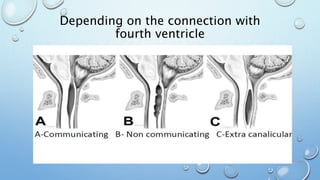
Depending on the connection with
fourth ventricle
PATHOGENESIS
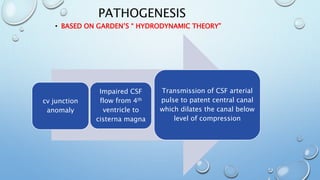
• BASED ON GARDEN’S “ HYDRODYNAMIC THEORY”
cv junction
anomaly
Impaired CSF
flow from 4th
ventricle to
cisterna magna
Transmission of CSF arterial
pulse to patent central canal
which dilates the canal below
level of compression
CLINICAL FEATURES
• Sensory
• Dissociated sensory loss
• In either or both arms, or in a shawl like distribution ,
• dysesthetic pain, a common complaint in syringomyelia,
usually involves the neck and shoulders, but may follow a
radicular distribution in the arms or trunk.
• When the cavity enlarges to involve the posterior columns,
position and vibration senses in the feet are lost;
astereognosis may be noted in the hands.
• Motor
• Syrinx extension into the anterior horns of the spinal cord
damages motor neurons (lower motor neuron) and causes
diffuse muscle atrophy that begins in the hands and
progresses proximally to include the forearms and shoulder
girdles. Clawhand may develop.
• Respiratory insufficiency, which usually is related to changes
in position, may occur.
Autonomic
• Impaired bowel and bladder functions usually occur as a late
manifestation.
• Sexual dysfunction may develop in long-standing cases.
• Horner syndrome may appear, reflecting damage to the
sympathetic neurons in the intermediolateral cell column.
• Reflex diminshed or absent
• Painless ulcers of the hands are frequent. Edema and
hyperhidrosis can be due to interruption of central autonomic
pathways.
• Neurogenic arthropathies (charcot joint)
DIAGNOSIS
• X RAY CERVICAL SPINE
• • 3D CT
• • MRI
TREATMENT
• ANALGESICS - FOR HEAD ACHE &
NECK PAIN
• SURGERY – DECOMPRESSIVE SX
• SUBOCCIPITAL AND CERVICAL
DECOMPRESSION.
– LAMINECTOMY AND SYRINGOTOMY
(DORSOLATERAL MYELOTOMY)
• Shunts
– Ventriculoperitoneal shunt - indicated if ventriculomegaly
and increased intracranial pressure are present.
– Syringosubarachnoid dorsal root entry zone shunt
– Syringoperitoneal shunt
Fourth ventriculostomy
Neuroendoscopic surgery
– A fibroscope inserted through a small myelotomy allows
inspection of the intramedullary cavity.
– This technique is particularly useful in evaluating and
treating multiple septate syrinxes.
– Septa are fenestrated, either mechanically or by laser. Fluid
from the cavity is then shunted into the subarachnoid space.

Syringomyelia

  • 1.
  • 2.
    • Syringomyelia isacquired developmental of cavity ( syrinx) within the central spinal cord. • The lower cervical segments usually affected, but the extension occurs upward into brain stem or downwards as far as filum terminale. • The cavitation appears to develop in association with obstruction
  • 3.
    • Frequently associateddevelopmental abnormalities – Vertebral column (thoracic scoliosis, fusion of vertebrae, or klippel-feil anomaly), – Base of the skull (platybasia, basilar invagination), – Cerebellum and brain (type I chiari malformation) • 90 percent of cases of syringomyelia have type I chiari malformation.
  • 4.
    TYPES • Congenital- associatedwith chiari malformations • Acquired – spinal cord tumors (usually intramedullary, Especially hemangioblastoma) – Traumatic myelopathy – Spinal arachnoiditis and pachymeningitis – Secondary myelomalacia from cord compression (Tumor, spondylosis), infarction, hematomyelia • Idiopathic
  • 5.
    Depending on theconnection with fourth ventricle
  • 6.
    PATHOGENESIS • BASED ONGARDEN’S “ HYDRODYNAMIC THEORY” cv junction anomaly Impaired CSF flow from 4th ventricle to cisterna magna Transmission of CSF arterial pulse to patent central canal which dilates the canal below level of compression
  • 8.
    CLINICAL FEATURES • Sensory •Dissociated sensory loss • In either or both arms, or in a shawl like distribution , • dysesthetic pain, a common complaint in syringomyelia, usually involves the neck and shoulders, but may follow a radicular distribution in the arms or trunk. • When the cavity enlarges to involve the posterior columns, position and vibration senses in the feet are lost; astereognosis may be noted in the hands.
  • 9.
    • Motor • Syrinxextension into the anterior horns of the spinal cord damages motor neurons (lower motor neuron) and causes diffuse muscle atrophy that begins in the hands and progresses proximally to include the forearms and shoulder girdles. Clawhand may develop. • Respiratory insufficiency, which usually is related to changes in position, may occur.
  • 10.
    Autonomic • Impaired boweland bladder functions usually occur as a late manifestation. • Sexual dysfunction may develop in long-standing cases. • Horner syndrome may appear, reflecting damage to the sympathetic neurons in the intermediolateral cell column. • Reflex diminshed or absent • Painless ulcers of the hands are frequent. Edema and hyperhidrosis can be due to interruption of central autonomic pathways. • Neurogenic arthropathies (charcot joint)
  • 11.
    DIAGNOSIS • X RAYCERVICAL SPINE • • 3D CT • • MRI
  • 12.
    TREATMENT • ANALGESICS -FOR HEAD ACHE & NECK PAIN • SURGERY – DECOMPRESSIVE SX • SUBOCCIPITAL AND CERVICAL DECOMPRESSION. – LAMINECTOMY AND SYRINGOTOMY (DORSOLATERAL MYELOTOMY)
  • 13.
    • Shunts – Ventriculoperitonealshunt - indicated if ventriculomegaly and increased intracranial pressure are present. – Syringosubarachnoid dorsal root entry zone shunt – Syringoperitoneal shunt Fourth ventriculostomy
  • 14.
    Neuroendoscopic surgery – Afibroscope inserted through a small myelotomy allows inspection of the intramedullary cavity. – This technique is particularly useful in evaluating and treating multiple septate syrinxes. – Septa are fenestrated, either mechanically or by laser. Fluid from the cavity is then shunted into the subarachnoid space.