

The disease was first described by the Neapolitan physician
Giovanni Semmola in 1834 and Gaetano Conte in 1836



DMD is named after the French neurologist Guillaume
Benjamin Amand Duchenne



In an 1868 publication, Duchenne established the
diagnostic criteria that are still used



Gowers was the first to deduce the genetic basis for the
disease



In 1986, Kunkel provided molecular genetic confirmation of
the X-linked inheritance pattern
The muscular dystrophies are a group of genetically
determined, progressive diseases of skeletal muscle

They are non-inflammatory and have no neurological
cause
Duchenne muscular dystrophy (DMD) is the most
common muscular dystrophy affecting 1 in 3500 boys
born worldwide.
Seen in males only
(expect in females with TURNER’S SYNDROME)
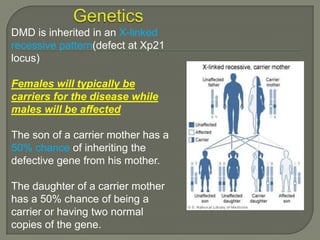
DMD is inherited in an X-linked
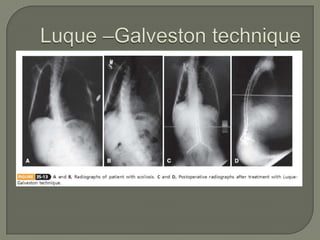
recessive pattern(defect at Xp21
locus)

Females will typically be
carriers for the disease while
males will be affected
The son of a carrier mother has a
50% chance of inheriting the
defective gene from his mother.
The daughter of a carrier mother
has a 50% chance of being a
carrier or having two normal
copies of the gene.
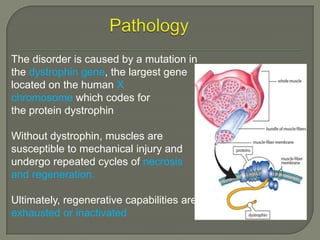
The disorder is caused by a mutation in
the dystrophin gene, the largest gene
located on the human X
chromosome which codes for
the protein dystrophin

Without dystrophin, muscles are
susceptible to mechanical injury and
undergo repeated cycles of necrosis
and regeneration.
Ultimately, regenerative capabilities are
exhausted or inactivated
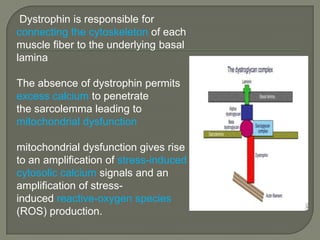
Dystrophin is responsible for
connecting the cytoskeleton of each
muscle fiber to the underlying basal
lamina

The absence of dystrophin permits
excess calcium to penetrate
the sarcolemma leading to
mitochondrial dysfunction
mitochondrial dysfunction gives rise
to an amplification of stress-induced
cytosolic calcium signals and an
amplification of stressinduced reactive-oxygen species
(ROS) production.
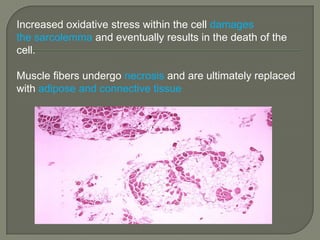
Increased oxidative stress within the cell damages
the sarcolemma and eventually results in the death of the
cell.
Muscle fibers undergo necrosis and are ultimately replaced
with adipose and connective tissue
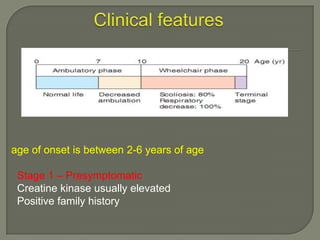
age of onset is between 2-6 years of age
Stage 1 – Presymptomatic
Creatine kinase usually elevated
Positive family history
Stage 2- Early ambulatory
clumsy & Waddling gait, manifesting in children aged 2-6 years;
secondary to hip girdle muscle weakness

Inexorable progressive weakness in the proximal
musculature, initially in the lower extremities, but later involving
the neck flexors, shoulders, and arms
Meryon’s sign
child slips through examiner’s grasp when lifted under arms
Possible toe-walking
Can climb stairs
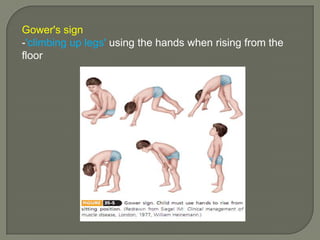
Gower's sign
-'climbing up legs' using the hands when rising from the
floor
Stage 3- Late ambulatory
More difficulty walking
Around age 8 years, most patients notice difficulty with
ascending stairs and respiratory muscle strength begins a
slow but steady decline
Cannot arise from the floor
The forced vital capacity begins to gradually wane, leading to
symptoms of nocturnal hypoxemia such as lethargy and early
morning headaches
Stage 4 – Early nonambulatory
Can self-propel for some time
Able to maintain posture
Possible development of scoliosis

Stage 5 – Late nonambulatory
Scoliosis may progress, especially when more wheelchair
dependent
If wheelchair bound and profoundly weak, patients develop
terminal respiratory or cardiac failure, usually by the early 30s

poor nutritional intake can also be a serious complication in
individuals with severe end-stage DMD
Contractures may develop
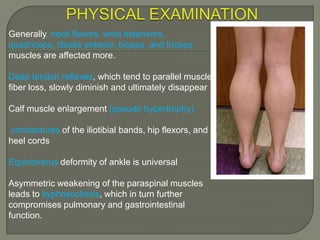
Generally, neck flexors, wrist extensors,
quadriceps, tibialis anterior, biceps, and triceps
muscles are affected more.
Deep tendon reflexes, which tend to parallel muscle
fiber loss, slowly diminish and ultimately disappear
Calf muscle enlargement (pseudo hypertrophy)
contractures of the iliotibial bands, hip flexors, and
heel cords
Equinovarus deformity of ankle is universal
Asymmetric weakening of the paraspinal muscles
leads to kyphoscoliosis, which in turn further
compromises pulmonary and gastrointestinal
function.





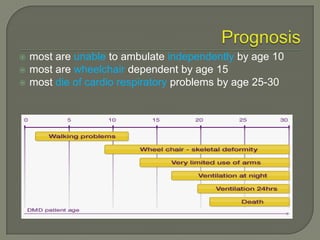
most are unable to ambulate independently by age 10
most are wheelchair dependent by age 15
most die of cardio respiratory problems by age 25-30
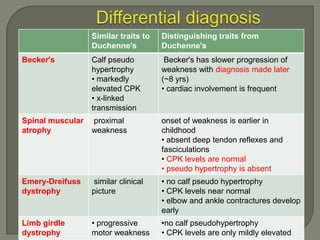
Similar traits to
Duchenne's

Distinguishing traits from
Duchenne's

Becker's

Calf pseudo
hypertrophy
• markedly
elevated CPK
• x-linked
transmission

Becker's has slower progression of
weakness with diagnosis made later
(~8 yrs)
• cardiac involvement is frequent

Spinal muscular
atrophy

proximal
weakness

onset of weakness is earlier in
childhood
• absent deep tendon reflexes and
fasciculations
• CPK levels are normal
• pseudo hypertrophy is absent

Emery-Dreifuss
dystrophy

similar clinical
picture

• no calf pseudo hypertrophy
• CPK levels near normal
• elbow and ankle contractures develop
early

Limb girdle
dystrophy

• progressive
motor weakness

•no calf pseudohypertrophy
• CPK levels are only mildly elevated
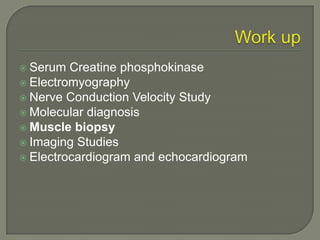
 Serum

Creatine phosphokinase
 Electromyography
 Nerve Conduction Velocity Study
 Molecular diagnosis
 Muscle biopsy
 Imaging Studies
 Electrocardiogram and echocardiogram


It is elevated in patients with muscle disease and is not specific
to the muscular dystrophies



As the muscle cell degenerates, CK is released and levels can
be elevated 20 to 200 times above normal




It is elevated in the Presymptomatic phase,
falls as the disease worsens,
and approaches near-normal levels in end-stage disease
useful for carrier screening
Muscle provocation test- After strenuous exercise,cpk
levels rise more in carrier females than non carriers.
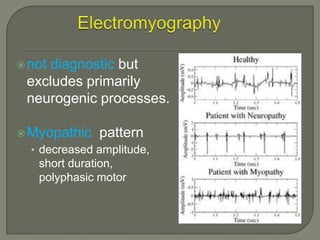
 not

diagnostic but
excludes primarily
neurogenic processes.

 Myopathic

pattern

• decreased amplitude,

short duration,
polyphasic motor
 In

a neuropathy, nerve conduction
velocities usually are slowed



In a myopathy, nerve conduction velocities
usually are normal
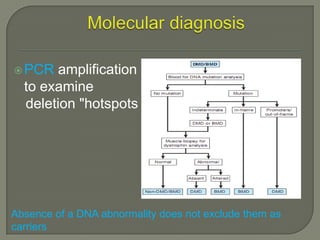
 PCR

amplification
to examine
deletion "hotspots

Absence of a DNA abnormality does not exclude them as
carriers


used for quantifying the amount of muscle dystrophin as well as
for detecting asymptomatic female carriers



the ideal muscle to biopsy is one that is easily accessible and
exhibits moderate weakness (i.e., has 80% strength)



Gastrocnemius are involved early and are a poor site to obtain
material for a biopsy



Quadriceps (esp. vastus lateralis at midthigh) & rectus
abdominis usually are the most reliable.



General anesthesia carries the known risk of anesthetic
complications, such as malignant hyperthermia. Regional
anesthesia may be used


The typical muscle biopsy sample consists of 2
specimens: fresh and fixed.



A second sample of muscle tissue should be taken at the
time of biopsy and sent for dystrophin analysis



Electrocautery should not be used while obtaining a
specimen for muscle biopsy



A fresh specimen is used for histochemical studies in all
patients and for immunofluorescence in selected patients
It should measure approximately 0.5 X 0.5 cm in crosssection, or 0.5 cm in diameter, and 1 cm in length along the
longitudinal axis of the muscle fibers.
The sample can be sent to the laboratory on salinemoistened gauze in a sealed container on ice. This technique
keeps the specimen cold but does not cause it to freeze
A fixed specimen is used for routine microscopy and possible
electron microscopy
The preferred fixative is liquid nitrogen for light microscopy
and for electron microscopy 3% glutaraldehyde be used.





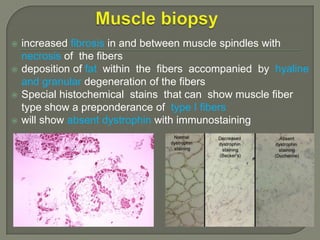
increased fibrosis in and between muscle spindles with
necrosis of the fibers
deposition of fat within the fibers accompanied by hyaline
and granular degeneration of the fibers
Special histochemical stains that can show muscle fiber
type show a preponderance of type I fibers
will show absent dystrophin with immunostaining


Radiographs of the spine are important for screening and
evaluating the degree of scoliotic deformity



As the disease progresses and dyspnea becomes a
complaint, chest radiography is also likely to become a
part of the evaluation



Dual energy x-ray absorptiometry
- Individuals with dystrophinopathies can have
accelerated osteopenia/osteoporosis/fracture risk


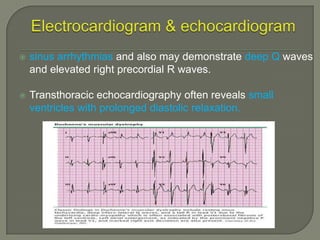
sinus arrhythmias and also may demonstrate deep Q waves
and elevated right precordial R waves.



Transthoracic echocardiography often reveals small
ventricles with prolonged diastolic relaxation.


Carrier detection is an important aspect of the care and
evaluation of patients with DMD and their family members



For many years, CPK testing was the best method for carrier
detection; however, it is elevated in only two thirds of female
carriers



If affected male in family has a known deletion or
duplication of the dystrophin gene, testing for carrier status
is performed accurately by testing possible carriers for the
same deletion or duplication


Absence of a DNA abnormality does not exclude them as
carriers



In families in which the affected male has no detectable
deletion or duplication, muscle immunofluorescence for
dystrophin used
- Carrier females should exhibit a mosaic
pattern, with some myofibers being normal and some being
abnormal


corticosteroid therapy (prednisone 0.75 mg/kg/day)



acutely improves strength, slows progressive
weakening, prevents scoliosis formation, and prolongs
ambulation
 delays deterioration of pulmonary function
• side effects
 osteonecrosis
 weight gain
 cushingoid appearance
 GI symptoms
 short stature
pulmonary care with nightly ventilation






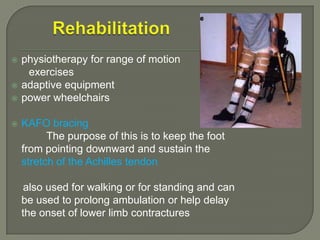
physiotherapy for range of motion
exercises
adaptive equipment
power wheelchairs
KAFO bracing
The purpose of this is to keep the foot
from pointing downward and sustain the
stretch of the Achilles tendon

also used for walking or for standing and can
be used to prolong ambulation or help delay
the onset of lower limb contractures
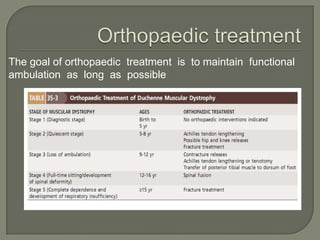
The goal of orthopaedic treatment is to maintain functional
ambulation as long as possible
For surgical correction of lower extremity contractures,
three approaches have been used, as follows

Ambulatory approach:
goal - to correct any contractures in the
lower extremity while the patient is still ambulatory.
Rideau indications:
• first appearance of contractures in lower extremities
• a plateau in muscle strength
•difficulty in maintaining upright posture with the feet
together.
• surgery be performed before deterioration of the Gower
maneuver time
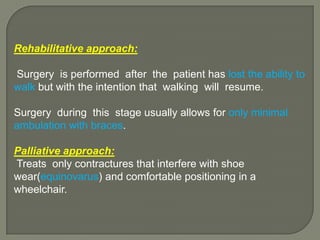
Rehabilitative approach:
Surgery is performed after the patient has lost the ability to
walk but with the intention that walking will resume.
Surgery during this stage usually allows for only minimal
ambulation with braces.
Palliative approach:
Treats only contractures that interfere with shoe
wear(equinovarus) and comfortable positioning in a
wheelchair.
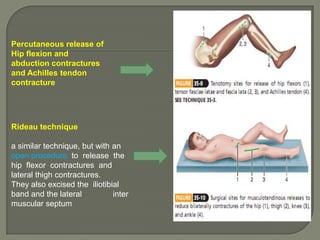
Percutaneous release of
Hip flexion and
abduction contractures
and Achilles tendon
contracture

Rideau technique
a similar technique, but with an
open procedure to release the
hip flexor contractures and
lateral thigh contractures.
They also excised the iliotibial
band and the lateral
inter
muscular septum
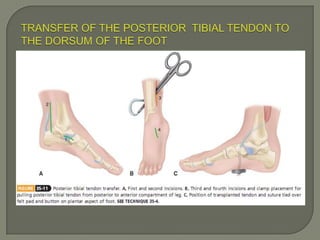
Duchenne muscular dystrophy

Duchenne muscular dystrophy

  • 2.
     The disease wasfirst described by the Neapolitan physician Giovanni Semmola in 1834 and Gaetano Conte in 1836  DMD is named after the French neurologist Guillaume Benjamin Amand Duchenne  In an 1868 publication, Duchenne established the diagnostic criteria that are still used  Gowers was the first to deduce the genetic basis for the disease  In 1986, Kunkel provided molecular genetic confirmation of the X-linked inheritance pattern
  • 3.
    The muscular dystrophiesare a group of genetically determined, progressive diseases of skeletal muscle They are non-inflammatory and have no neurological cause Duchenne muscular dystrophy (DMD) is the most common muscular dystrophy affecting 1 in 3500 boys born worldwide. Seen in males only (expect in females with TURNER’S SYNDROME)
  • 4.
    DMD is inheritedin an X-linked recessive pattern(defect at Xp21 locus) Females will typically be carriers for the disease while males will be affected The son of a carrier mother has a 50% chance of inheriting the defective gene from his mother. The daughter of a carrier mother has a 50% chance of being a carrier or having two normal copies of the gene.
  • 5.
    The disorder iscaused by a mutation in the dystrophin gene, the largest gene located on the human X chromosome which codes for the protein dystrophin Without dystrophin, muscles are susceptible to mechanical injury and undergo repeated cycles of necrosis and regeneration. Ultimately, regenerative capabilities are exhausted or inactivated
  • 6.
    Dystrophin is responsiblefor connecting the cytoskeleton of each muscle fiber to the underlying basal lamina The absence of dystrophin permits excess calcium to penetrate the sarcolemma leading to mitochondrial dysfunction mitochondrial dysfunction gives rise to an amplification of stress-induced cytosolic calcium signals and an amplification of stressinduced reactive-oxygen species (ROS) production.
  • 7.
    Increased oxidative stresswithin the cell damages the sarcolemma and eventually results in the death of the cell. Muscle fibers undergo necrosis and are ultimately replaced with adipose and connective tissue
  • 8.
    age of onsetis between 2-6 years of age Stage 1 – Presymptomatic Creatine kinase usually elevated Positive family history
  • 9.
    Stage 2- Earlyambulatory clumsy & Waddling gait, manifesting in children aged 2-6 years; secondary to hip girdle muscle weakness Inexorable progressive weakness in the proximal musculature, initially in the lower extremities, but later involving the neck flexors, shoulders, and arms Meryon’s sign child slips through examiner’s grasp when lifted under arms Possible toe-walking Can climb stairs
  • 10.
    Gower's sign -'climbing uplegs' using the hands when rising from the floor
  • 11.
    Stage 3- Lateambulatory More difficulty walking Around age 8 years, most patients notice difficulty with ascending stairs and respiratory muscle strength begins a slow but steady decline Cannot arise from the floor The forced vital capacity begins to gradually wane, leading to symptoms of nocturnal hypoxemia such as lethargy and early morning headaches
  • 12.
    Stage 4 –Early nonambulatory Can self-propel for some time Able to maintain posture Possible development of scoliosis Stage 5 – Late nonambulatory Scoliosis may progress, especially when more wheelchair dependent If wheelchair bound and profoundly weak, patients develop terminal respiratory or cardiac failure, usually by the early 30s poor nutritional intake can also be a serious complication in individuals with severe end-stage DMD Contractures may develop
  • 13.
    Generally, neck flexors,wrist extensors, quadriceps, tibialis anterior, biceps, and triceps muscles are affected more. Deep tendon reflexes, which tend to parallel muscle fiber loss, slowly diminish and ultimately disappear Calf muscle enlargement (pseudo hypertrophy) contractures of the iliotibial bands, hip flexors, and heel cords Equinovarus deformity of ankle is universal Asymmetric weakening of the paraspinal muscles leads to kyphoscoliosis, which in turn further compromises pulmonary and gastrointestinal function.
  • 14.
       most are unableto ambulate independently by age 10 most are wheelchair dependent by age 15 most die of cardio respiratory problems by age 25-30
  • 15.
    Similar traits to Duchenne's Distinguishingtraits from Duchenne's Becker's Calf pseudo hypertrophy • markedly elevated CPK • x-linked transmission Becker's has slower progression of weakness with diagnosis made later (~8 yrs) • cardiac involvement is frequent Spinal muscular atrophy proximal weakness onset of weakness is earlier in childhood • absent deep tendon reflexes and fasciculations • CPK levels are normal • pseudo hypertrophy is absent Emery-Dreifuss dystrophy similar clinical picture • no calf pseudo hypertrophy • CPK levels near normal • elbow and ankle contractures develop early Limb girdle dystrophy • progressive motor weakness •no calf pseudohypertrophy • CPK levels are only mildly elevated
  • 16.
     Serum Creatine phosphokinase Electromyography  Nerve Conduction Velocity Study  Molecular diagnosis  Muscle biopsy  Imaging Studies  Electrocardiogram and echocardiogram
  • 17.
     It is elevatedin patients with muscle disease and is not specific to the muscular dystrophies  As the muscle cell degenerates, CK is released and levels can be elevated 20 to 200 times above normal   It is elevated in the Presymptomatic phase, falls as the disease worsens, and approaches near-normal levels in end-stage disease useful for carrier screening Muscle provocation test- After strenuous exercise,cpk levels rise more in carrier females than non carriers.
  • 18.
     not diagnostic but excludesprimarily neurogenic processes.  Myopathic pattern • decreased amplitude, short duration, polyphasic motor
  • 19.
     In a neuropathy,nerve conduction velocities usually are slowed  In a myopathy, nerve conduction velocities usually are normal
  • 20.
     PCR amplification to examine deletion"hotspots Absence of a DNA abnormality does not exclude them as carriers
  • 21.
     used for quantifyingthe amount of muscle dystrophin as well as for detecting asymptomatic female carriers  the ideal muscle to biopsy is one that is easily accessible and exhibits moderate weakness (i.e., has 80% strength)  Gastrocnemius are involved early and are a poor site to obtain material for a biopsy  Quadriceps (esp. vastus lateralis at midthigh) & rectus abdominis usually are the most reliable.  General anesthesia carries the known risk of anesthetic complications, such as malignant hyperthermia. Regional anesthesia may be used
  • 22.
     The typical musclebiopsy sample consists of 2 specimens: fresh and fixed.  A second sample of muscle tissue should be taken at the time of biopsy and sent for dystrophin analysis  Electrocautery should not be used while obtaining a specimen for muscle biopsy  A fresh specimen is used for histochemical studies in all patients and for immunofluorescence in selected patients
  • 23.
    It should measureapproximately 0.5 X 0.5 cm in crosssection, or 0.5 cm in diameter, and 1 cm in length along the longitudinal axis of the muscle fibers. The sample can be sent to the laboratory on salinemoistened gauze in a sealed container on ice. This technique keeps the specimen cold but does not cause it to freeze A fixed specimen is used for routine microscopy and possible electron microscopy The preferred fixative is liquid nitrogen for light microscopy and for electron microscopy 3% glutaraldehyde be used.
  • 24.
        increased fibrosis inand between muscle spindles with necrosis of the fibers deposition of fat within the fibers accompanied by hyaline and granular degeneration of the fibers Special histochemical stains that can show muscle fiber type show a preponderance of type I fibers will show absent dystrophin with immunostaining
  • 25.
     Radiographs of thespine are important for screening and evaluating the degree of scoliotic deformity  As the disease progresses and dyspnea becomes a complaint, chest radiography is also likely to become a part of the evaluation  Dual energy x-ray absorptiometry - Individuals with dystrophinopathies can have accelerated osteopenia/osteoporosis/fracture risk
  • 26.
     sinus arrhythmias andalso may demonstrate deep Q waves and elevated right precordial R waves.  Transthoracic echocardiography often reveals small ventricles with prolonged diastolic relaxation.
  • 27.
     Carrier detection isan important aspect of the care and evaluation of patients with DMD and their family members  For many years, CPK testing was the best method for carrier detection; however, it is elevated in only two thirds of female carriers  If affected male in family has a known deletion or duplication of the dystrophin gene, testing for carrier status is performed accurately by testing possible carriers for the same deletion or duplication
  • 28.
     Absence of aDNA abnormality does not exclude them as carriers  In families in which the affected male has no detectable deletion or duplication, muscle immunofluorescence for dystrophin used - Carrier females should exhibit a mosaic pattern, with some myofibers being normal and some being abnormal
  • 29.
     corticosteroid therapy (prednisone0.75 mg/kg/day)  acutely improves strength, slows progressive weakening, prevents scoliosis formation, and prolongs ambulation  delays deterioration of pulmonary function • side effects  osteonecrosis  weight gain  cushingoid appearance  GI symptoms  short stature pulmonary care with nightly ventilation
  • 30.
        physiotherapy for rangeof motion exercises adaptive equipment power wheelchairs KAFO bracing The purpose of this is to keep the foot from pointing downward and sustain the stretch of the Achilles tendon also used for walking or for standing and can be used to prolong ambulation or help delay the onset of lower limb contractures
  • 31.
    The goal oforthopaedic treatment is to maintain functional ambulation as long as possible
  • 32.
    For surgical correctionof lower extremity contractures, three approaches have been used, as follows Ambulatory approach: goal - to correct any contractures in the lower extremity while the patient is still ambulatory. Rideau indications: • first appearance of contractures in lower extremities • a plateau in muscle strength •difficulty in maintaining upright posture with the feet together. • surgery be performed before deterioration of the Gower maneuver time
  • 33.
    Rehabilitative approach: Surgery isperformed after the patient has lost the ability to walk but with the intention that walking will resume. Surgery during this stage usually allows for only minimal ambulation with braces. Palliative approach: Treats only contractures that interfere with shoe wear(equinovarus) and comfortable positioning in a wheelchair.
  • 34.
    Percutaneous release of Hipflexion and abduction contractures and Achilles tendon contracture Rideau technique a similar technique, but with an open procedure to release the hip flexor contractures and lateral thigh contractures. They also excised the iliotibial band and the lateral inter muscular septum