Pain management

To be pain free is the right of every patient and should be the first step of management regardless of the
diagnosis. In this post we discuss various pharmacological agents that are commonly used as analgesics.

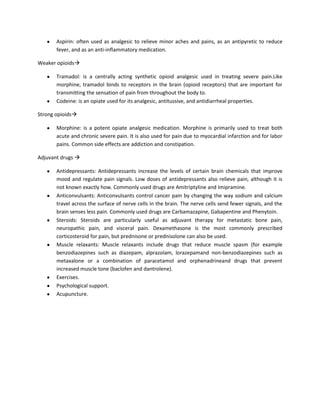
WHO has coined the term pain ladder which classifies pain according to the severity and helps a clinician
to manage pain in a better way. It was originally described for the management of cancer pain, but is
now widely used by medical professionals for the management of all types of pain.

The principle is to start from the bottom of the ladder, and to climb the ladder if pain is still present.


                   Figure showing WHO pain ladder principle for management of pain.

Let us discuss commonly used analgesics –

Non opiods

        Paracetamol: It has a well-known analgesic property and a week anti-inflammatory effect. It is
        better toleratedin patients in whom excessive gastric acid secretion or prolongation of bleeding
        time may be a concern.Paracetamol hepatotoxicity the most common cause of acute liver
        failure in both the United States and the United Kingdom.The common adult dose is 500 mg to
        1000 mg. The recommended maximum daily dose, for adults, is 4000 mg.

NSAIDs 

        Ibuprofen: Ibuprofen blocks the enzyme that makes prostaglandins (cyclooxygenase), resulting
        in lower levels of prostaglandins. As a consequence, inflammation, pain and fever are reduced.
        The usual adult dose is 200 or 400 mg every 4 to 6 hours.Ibuprofen should be taken with meals
        to prevent stomach upset.
        Diclofenac: Very commonly given analgesic. It is mostly given in acute conditions in an
        intramuscular form at a dose of 75 mg. Also available as sustained released tablets.
Aspirin: often used as analgesic to relieve minor aches and pains, as an antipyretic to reduce
       fever, and as an anti-inflammatory medication.

Weaker opioids

       Tramadol: is a centrally acting synthetic opioid analgesic used in treating severe pain.Like
       morphine, tramadol binds to receptors in the brain (opioid receptors) that are important for
       transmitting the sensation of pain from throughout the body to.
       Codeine: is an opiate used for its analgesic, antitussive, and antidiarrheal properties.

Strong opioids

       Morphine: is a potent opiate analgesic medication. Morphine is primarily used to treat both
       acute and chronic severe pain. It is also used for pain due to myocardial infarction and for labor
       pains. Common side effects are addiction and constipation.

Adjuvant drugs 

       Antidepressants: Antidepressants increase the levels of certain brain chemicals that improve
       mood and regulate pain signals. Low doses of antidepressants also relieve pain, although it is
       not known exactly how. Commonly used drugs are Amitriptyline and Imipramine.
       Anticonvulsants: Anticonvulsants control cancer pain by changing the way sodium and calcium
       travel across the surface of nerve cells in the brain. The nerve cells send fewer signals, and the
       brain senses less pain. Commonly used drugs are Carbamazapine, Gabapentine and Phenytoin.
       Steroids: Steroids are particularly useful as adjuvant therapy for metastatic bone pain,
       neuropathic pain, and visceral pain. Dexamethasone is the most commonly prescribed
       corticosteroid for pain, but prednisone or prednisolone can also be used.
       Muscle relaxants: Muscle relaxants include drugs that reduce muscle spasm (for example
       benzodiazepines such as diazepam, alprazolam, lorazepamand non-benzodiazepines such as
       metaxalone or a combination of paracetamol and orphenadrineand drugs that prevent
       increased muscle tone (baclofen and dantrolene).
       Exercises.
       Psychological support.
       Acupuncture.

Pain Management

  • 1.
    Pain management To bepain free is the right of every patient and should be the first step of management regardless of the diagnosis. In this post we discuss various pharmacological agents that are commonly used as analgesics. WHO has coined the term pain ladder which classifies pain according to the severity and helps a clinician to manage pain in a better way. It was originally described for the management of cancer pain, but is now widely used by medical professionals for the management of all types of pain. The principle is to start from the bottom of the ladder, and to climb the ladder if pain is still present. Figure showing WHO pain ladder principle for management of pain. Let us discuss commonly used analgesics – Non opiods Paracetamol: It has a well-known analgesic property and a week anti-inflammatory effect. It is better toleratedin patients in whom excessive gastric acid secretion or prolongation of bleeding time may be a concern.Paracetamol hepatotoxicity the most common cause of acute liver failure in both the United States and the United Kingdom.The common adult dose is 500 mg to 1000 mg. The recommended maximum daily dose, for adults, is 4000 mg. NSAIDs  Ibuprofen: Ibuprofen blocks the enzyme that makes prostaglandins (cyclooxygenase), resulting in lower levels of prostaglandins. As a consequence, inflammation, pain and fever are reduced. The usual adult dose is 200 or 400 mg every 4 to 6 hours.Ibuprofen should be taken with meals to prevent stomach upset. Diclofenac: Very commonly given analgesic. It is mostly given in acute conditions in an intramuscular form at a dose of 75 mg. Also available as sustained released tablets.
  • 2.
    Aspirin: often usedas analgesic to relieve minor aches and pains, as an antipyretic to reduce fever, and as an anti-inflammatory medication. Weaker opioids Tramadol: is a centrally acting synthetic opioid analgesic used in treating severe pain.Like morphine, tramadol binds to receptors in the brain (opioid receptors) that are important for transmitting the sensation of pain from throughout the body to. Codeine: is an opiate used for its analgesic, antitussive, and antidiarrheal properties. Strong opioids Morphine: is a potent opiate analgesic medication. Morphine is primarily used to treat both acute and chronic severe pain. It is also used for pain due to myocardial infarction and for labor pains. Common side effects are addiction and constipation. Adjuvant drugs  Antidepressants: Antidepressants increase the levels of certain brain chemicals that improve mood and regulate pain signals. Low doses of antidepressants also relieve pain, although it is not known exactly how. Commonly used drugs are Amitriptyline and Imipramine. Anticonvulsants: Anticonvulsants control cancer pain by changing the way sodium and calcium travel across the surface of nerve cells in the brain. The nerve cells send fewer signals, and the brain senses less pain. Commonly used drugs are Carbamazapine, Gabapentine and Phenytoin. Steroids: Steroids are particularly useful as adjuvant therapy for metastatic bone pain, neuropathic pain, and visceral pain. Dexamethasone is the most commonly prescribed corticosteroid for pain, but prednisone or prednisolone can also be used. Muscle relaxants: Muscle relaxants include drugs that reduce muscle spasm (for example benzodiazepines such as diazepam, alprazolam, lorazepamand non-benzodiazepines such as metaxalone or a combination of paracetamol and orphenadrineand drugs that prevent increased muscle tone (baclofen and dantrolene). Exercises. Psychological support. Acupuncture.