Anemia, Iron deficiency anemia


                                    Dr. Kalpana Malla
                                        MD Pediatrics
                            Manipal Teaching Hospital

 Download more documents and slide shows on The Medical Post [ www.themedicalpost.net ]
ANEMIA
What is Anemia?
• Reduction of the red blood cell (RBC) volume or
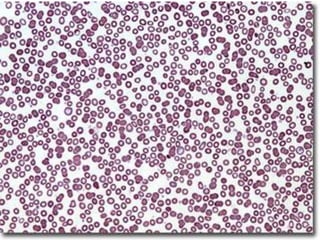
  hemoglobin concentration below reference
  level for the age and sex of the individual

• Hb < - 2SD or 95th centile for age and sex
Anemia Basics
All anemias are either due to….

1. Ineffective RBC production
                       or
2. Accelerated destruction of the RBC
Classification


• By RBC morphology and By Etiological
  factors responsible for anemia
Microcytic hypochromic anemia

1. Iron deficiency anemia – nutritional,
                         - posthemohragic
2. Ineffective Erythropoiesis
  - hemoglobinopathies, Thalassemia
     - Lead poisoning, Sideroblastic anemia
       - Cu deficiency, Pyridoxine deficiency
  -Chronic ds - infection, inflammations ,
                 renal ds
Macrocytic anemia

• Megaloblastic Erythropoiesis
a) Nutritional - Folate deficiency, B12 deficiency
b) Toxic – Treatment with antifolate compound –
        methotrexate,, and drugs that inhibit DNA
           replication – zidovudine, phenytoin
c) Congenital disorders of DNA synthesis like
     Orotic aciduria etc.
d) Malabsorption - liver ds
Macrocytic anemia
 Non - Megaloblastic Erythropoiesis
a) Chronic hemolytic anemia
b) Liver ds
c) Hypothyroidism
d) Diamond blackfan syndrome
Normocytic, Normochromic anemia
1. Impaired cell production (low reticulocyte count)
      - aplastic anemia
      - pure red cell aplasia
      - physiological anemia of infancy
      - infections
      - Systemic diseases like endocrinal, renal
         and hepatic diseases
     - bone marrow replacement – leukemia,
               tumors, storage ds, myelofibrosis,
                 osteopetrosis
2 Hemolytic anemia ( reticulocyte count high)
DIMORPHIC ANEMIA


• When two causes of anemia act
  simultaneously, e.g : macrocytic
  hypochromic due to hookworm infestation
  leading to deficiency of both iron and
  vitamin B12 or folic acid
• following a blood transfusion
ETIOLOGICAL CLASSIFICATION OF ANEMIA

• Blood loss
  Acute
   Chronic

• Decreased iron assimilation
  - Nutritional deficiency
   - Hypoplastic or aplastic anemia
   - Bone marrow infiltration like leukemia & other
      malignancies,
   - Myelodysplastic syndrome
    - Dyserythropoietic anemia
ETIOLOGICAL CLASSIFICATION OF ANEMIA

• Increased physiologic requirement
- Extracorpscular -
     - Alloimmune & isoimmune hemolytic anemia
     - Microangiopathic anemias
     - Infections
     - Hypersplenism
ETIOLOGICAL CLASSIFICATION OF ANEMIA

- Intracorpsular defect

   – Red cell membranopathy i.e. congenital
     spherocytosis,elliptocytosis

   – Hemoglobinopathy like HbS, C,D,E etc.
     Thalassemia syndrome

   – RBC enzymopathies like G6PD deficiency, PK
     deficiency etc.
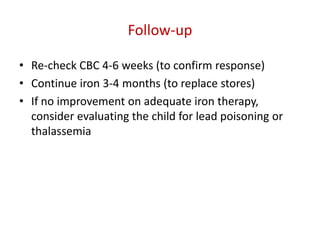
Follow-up

• Re-check CBC 4-6 weeks (to confirm response)
• Continue iron 3-4 months (to replace stores)
• If no improvement on adequate iron therapy,
  consider evaluating the child for lead poisoning or
  thalassemia
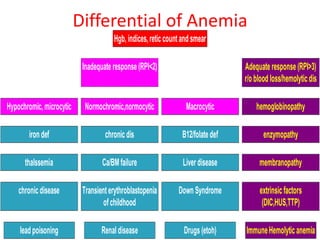
Differential of Anemia
                                      Hgb, indices, retic count and smear

                           Inadequate response (RPI<2)                           Adequate response (RPI>3)
                                                                                 r/o blood loss/hemolytic dis

Hypochromic, microcytic     Normochromic,normocytic              Macrocytic          hemoglobinopathy

       iron def                    chronic dis                  B12/folate def          enzymopathy

      thalssemia                  Ca/BM failure                 Liver disease         membranopathy

    chronic disease        Transient erythroblastopenia       Down Syndrome           extrinsic factors
                                   of childhood                                        (DIC,HUS,TTP)

    lead poisoning                Renal disease                 Drugs (etoh)     Immune Hemolytic anemia
IRON DEFICIENCY
    ANEMIA
IDA
• Most common cause of anemia worldwide

• Most important cause of iron deficiency anemia is
  parasitic infection - hookworms, whipworms and
  roundworms
GENERAL FEATURES
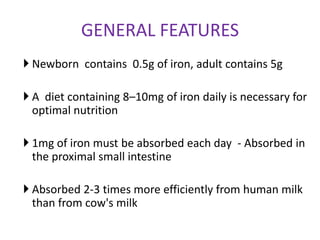
 Newborn contains 0.5g of iron, adult contains 5g

 A diet containing 8–10mg of iron daily is necessary for
  optimal nutrition

 1mg of iron must be absorbed each day - Absorbed in
  the proximal small intestine

 Absorbed 2-3 times more efficiently from human milk
  than from cow's milk
Iron sources:
• Meat
• Liver
• Kidney
• Egg-yolk
• Green vegetables
• Fruits
**** Cow’s milk- poor source of iron
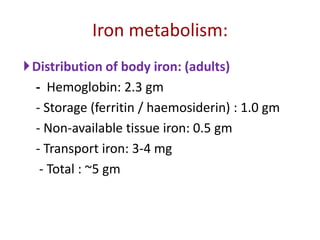
Iron metabolism:
Distribution of body iron: (adults)
 - Hemoglobin: 2.3 gm
 - Storage (ferritin / haemosiderin) : 1.0 gm
 - Non-available tissue iron: 0.5 gm
 - Transport iron: 3-4 mg
  - Total : ~5 gm
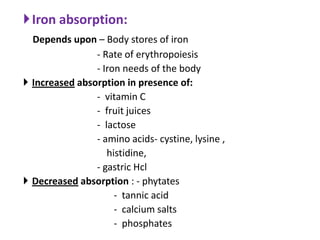
Iron absorption:
  Depends upon – Body stores of iron
                - Rate of erythropoiesis
                - Iron needs of the body
 Increased absorption in presence of:
                - vitamin C
                - fruit juices
                - lactose
                - amino acids- cystine, lysine ,
                   histidine,
                - gastric Hcl
 Decreased absorption : - phytates
                     - tannic acid
                     - calcium salts
                     - phosphates
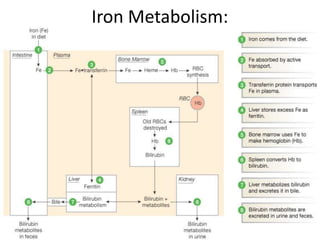
Iron Metabolism:


    Figure 16-8: Iron metabolism
Pathogenesis of IDA:
Increased physiological demand:
   - growing children (6-24 months)
   - adolescence
    - women during reproductive ages
Pathological blood loss:
     -chronic loss
Inadequate intake of diets rich in iron:
     -nutritional deficiency
     -decreased absorption- gastroenterostomy/
 tropical sprue/ coeliac disease
• High Hb conc of the newborn falls during the first 2–
  3 mo - considerable iron is stored - usually sufficient
  for blood formation in the first 6–9 mo of life in term
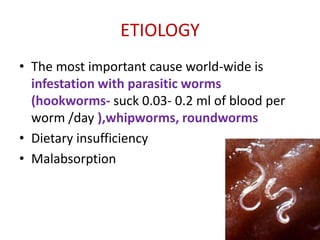
ETIOLOGY
• The most important cause world-wide is
  infestation with parasitic worms
  (hookworms- suck 0.03- 0.2 ml of blood per
  worm /day ),whipworms, roundworms
• Dietary insufficiency
• Malabsorption
ETIOLOGY
• Chronic blood loss - occult bleeding : peptic
  ulcer, Meckel diverticulum, polyp, hemangioma,
  inflammatory bowel disease, Intravascular
  hemolysis and hemoglobinuria
• Chronic diarrhea
• Milk allergy
Risk factors for IDA
• Demograpghic – Eldery, Teenager, Female

• Dieatary – low Iron, low Vit C, excess
  phytate,tea coffee,

• Social and physical – poverty,alcohol
  abuse,GIT ds
CLINICAL FEATURES
Pallor is the most important sign
Look for pallor : FACE, nails, palms, conj, mucus
 membranes
Pagophagia (pica for ice) / pica
Anxiety , Poor appetite
Below 5g/dL: irritability and anorexia are prominent
Tachycardia and systolic murmurs- dyspnea ,
 Palpitations
CLINICAL FEATURES
•   Hair loss and lightheadedness
•   Fainting
•   Sleepiness, Tinnitus
•    Mouth ulcers, Glossitis ,Angular cheilitis
•   Constipation
•   Depression, Twitching
    muscles, Tingling, numbness or burning
    sensations
CLINICAL FEATURES
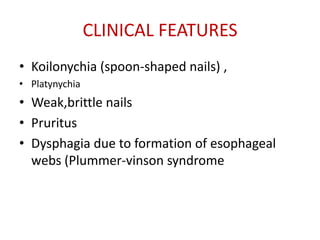
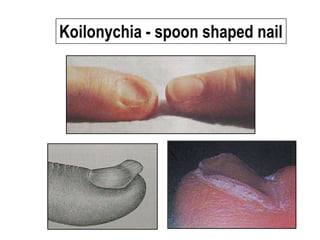
• Koilonychia (spoon-shaped nails) ,
• Platynychia
• Weak,brittle nails
• Pruritus
• Dysphagia due to formation of esophageal
  webs (Plummer-vinson syndrome
Koilonychia - spoon shaped nail
CLINICAL FEATURES
Neurologic and intellectual function
Affects attention span, alertness,
Verbal learning and memory
Monoamine oxidase (MAO), an iron dependent
 enzyme, has a crucial role in neurochemical
 reactions in the CNS
breath-holding spells
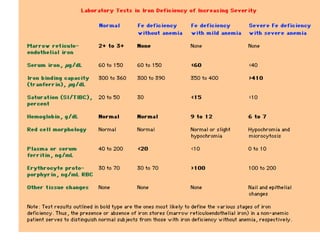
Response to low Hb:
First:
 Tissue iron stores represented by bone marrow hemosiderin
  disappear
 Serum ferritin decreases

Next:
   Serum iron level decreases
   Serum transferrin,S. iron-binding capacity of the - increases
   Percent saturation (transferrin saturation) falls below normal
   Free erythrocyte protoporphyrins (FEP) accumulates
Response to low Hb:


Later:
Microcytosis, hypochromia, poikilocytosis,
and increased RBC distribution width (RDW)
Diagnosis - LABORATORY INVESTIGATIONS

 1.complete blood count (CBC)
    - High RBC distribution width (RDW) -
  reflecting an increased variability in the size of
  red blood cells (RBCs).
   - A low MCV,MCH and MCHC
2. Hemoglobin (Hb)&hematocrit (Hct) value –
    low
3. Reticulocyte - normal or moderately elevated
Diagnosis - LABORATORY INVESTIGATIONS

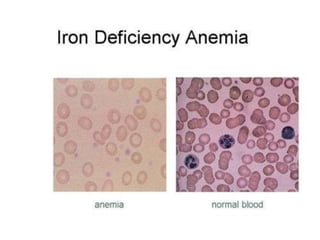
3.Peripheral blood smear – microcytic
  hypochromic anemia, target cells,
  hypochromic pencil-shaped cells, and
  occasionally small numbers of nucleated RBC
• Thrombocytosis -activate thrombopoietin
  receptors in precursor cells which make
  platelets
LABORATORY INVESTIGATIONS

4. Diagnostic tests –
- Serum ferritin- low
- Serum iron - low
- Serum transferrin -elevated
- Total iron binding capacity (TIBC) - high
5.Stool for occult blood
6.Stool R/M/E - hookworm and whipworm
LABORATORY INVESTIGATIONS

• Ratio of serum iron to TIBC (called iron
  saturation or transferrin saturation index - is
  the most specific indicator of iron deficiency -
  < 5% - indicates iron deficiency
DiagnosisLABORATORY INVESTIGATIONS

 Gold standard
• Bone marrow aspiration, with the marrow
  stained for iron -Bone marrow is hypercellular,
  with erythroid hyperplasia
• Leukocytes and megakaryocytes are normal
• No stainable iron in marrow reticulum cells
TREATMENT
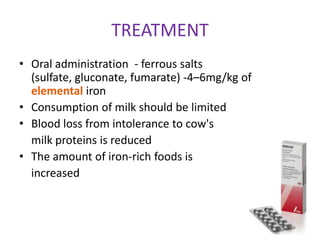
• Oral administration - ferrous salts
  (sulfate, gluconate, fumarate) -4–6mg/kg of
  elemental iron
• Consumption of milk should be limited
• Blood loss from intolerance to cow's
  milk proteins is reduced
• The amount of iron-rich foods is
  increased
Oral iron failure?
• Incorrect diagnosis (eg, thalassemia)
• Patient is not taking the medication
• Not absorbed (enteric coated?)
               malabsorption syndromes
               gastrectomy/celiac disease
• Rapid iron loss?
• Anemia of chronic disease-impairs bone
  marrow response
TREATMENT
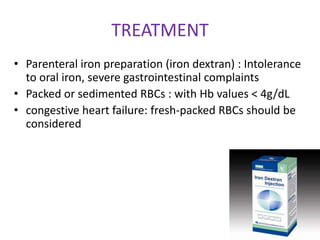
• Parenteral iron preparation (iron dextran) : Intolerance
  to oral iron, severe gastrointestinal complaints
• Packed or sedimented RBCs : with Hb values < 4g/dL
• congestive heart failure: fresh-packed RBCs should be
  considered
RESPONSES TO IRON THERAPY
12–24 hr
• Replacement of intracellular iron enzymes; subjective
  improvement; decreased irritability; increased Appetite
36–48 hr
• Initial bone marrow response; erythroid hyperplasia
48–72 hr
• Reticulocytosis, peaking at 5–7 days
4–30 days
• Increase in hemoglobin level
1–3 mo
• Repletion of stores
Thank you
Download more documents and slide shows on The
    Medical Post [ www.themedicalpost.net ]

Iron deficiency anemia

  • 1.
    Anemia, Iron deficiencyanemia Dr. Kalpana Malla MD Pediatrics Manipal Teaching Hospital Download more documents and slide shows on The Medical Post [ www.themedicalpost.net ]
  • 2.
  • 3.
    What is Anemia? •Reduction of the red blood cell (RBC) volume or hemoglobin concentration below reference level for the age and sex of the individual • Hb < - 2SD or 95th centile for age and sex
  • 4.
    Anemia Basics All anemiasare either due to…. 1. Ineffective RBC production or 2. Accelerated destruction of the RBC
  • 5.
    Classification • By RBCmorphology and By Etiological factors responsible for anemia
  • 6.
    Microcytic hypochromic anemia 1.Iron deficiency anemia – nutritional, - posthemohragic 2. Ineffective Erythropoiesis - hemoglobinopathies, Thalassemia - Lead poisoning, Sideroblastic anemia - Cu deficiency, Pyridoxine deficiency -Chronic ds - infection, inflammations , renal ds
  • 7.
    Macrocytic anemia • MegaloblasticErythropoiesis a) Nutritional - Folate deficiency, B12 deficiency b) Toxic – Treatment with antifolate compound – methotrexate,, and drugs that inhibit DNA replication – zidovudine, phenytoin c) Congenital disorders of DNA synthesis like Orotic aciduria etc. d) Malabsorption - liver ds
  • 8.
    Macrocytic anemia Non- Megaloblastic Erythropoiesis a) Chronic hemolytic anemia b) Liver ds c) Hypothyroidism d) Diamond blackfan syndrome
  • 9.
    Normocytic, Normochromic anemia 1.Impaired cell production (low reticulocyte count) - aplastic anemia - pure red cell aplasia - physiological anemia of infancy - infections - Systemic diseases like endocrinal, renal and hepatic diseases - bone marrow replacement – leukemia, tumors, storage ds, myelofibrosis, osteopetrosis 2 Hemolytic anemia ( reticulocyte count high)
  • 10.
    DIMORPHIC ANEMIA • Whentwo causes of anemia act simultaneously, e.g : macrocytic hypochromic due to hookworm infestation leading to deficiency of both iron and vitamin B12 or folic acid • following a blood transfusion
  • 11.
    ETIOLOGICAL CLASSIFICATION OFANEMIA • Blood loss Acute Chronic • Decreased iron assimilation - Nutritional deficiency - Hypoplastic or aplastic anemia - Bone marrow infiltration like leukemia & other malignancies, - Myelodysplastic syndrome - Dyserythropoietic anemia
  • 12.
    ETIOLOGICAL CLASSIFICATION OFANEMIA • Increased physiologic requirement - Extracorpscular - - Alloimmune & isoimmune hemolytic anemia - Microangiopathic anemias - Infections - Hypersplenism
  • 13.
    ETIOLOGICAL CLASSIFICATION OFANEMIA - Intracorpsular defect – Red cell membranopathy i.e. congenital spherocytosis,elliptocytosis – Hemoglobinopathy like HbS, C,D,E etc. Thalassemia syndrome – RBC enzymopathies like G6PD deficiency, PK deficiency etc.
  • 14.
    Follow-up • Re-check CBC4-6 weeks (to confirm response) • Continue iron 3-4 months (to replace stores) • If no improvement on adequate iron therapy, consider evaluating the child for lead poisoning or thalassemia
  • 15.
    Differential of Anemia Hgb, indices, retic count and smear Inadequate response (RPI<2) Adequate response (RPI>3) r/o blood loss/hemolytic dis Hypochromic, microcytic Normochromic,normocytic Macrocytic hemoglobinopathy iron def chronic dis B12/folate def enzymopathy thalssemia Ca/BM failure Liver disease membranopathy chronic disease Transient erythroblastopenia Down Syndrome extrinsic factors of childhood (DIC,HUS,TTP) lead poisoning Renal disease Drugs (etoh) Immune Hemolytic anemia
  • 16.
  • 17.
    IDA • Most commoncause of anemia worldwide • Most important cause of iron deficiency anemia is parasitic infection - hookworms, whipworms and roundworms
  • 18.
    GENERAL FEATURES  Newborncontains 0.5g of iron, adult contains 5g  A diet containing 8–10mg of iron daily is necessary for optimal nutrition  1mg of iron must be absorbed each day - Absorbed in the proximal small intestine  Absorbed 2-3 times more efficiently from human milk than from cow's milk
  • 19.
    Iron sources: • Meat •Liver • Kidney • Egg-yolk • Green vegetables • Fruits **** Cow’s milk- poor source of iron
  • 20.
    Iron metabolism: Distribution ofbody iron: (adults) - Hemoglobin: 2.3 gm - Storage (ferritin / haemosiderin) : 1.0 gm - Non-available tissue iron: 0.5 gm - Transport iron: 3-4 mg - Total : ~5 gm
  • 21.
    Iron absorption: Depends upon – Body stores of iron - Rate of erythropoiesis - Iron needs of the body  Increased absorption in presence of: - vitamin C - fruit juices - lactose - amino acids- cystine, lysine , histidine, - gastric Hcl  Decreased absorption : - phytates - tannic acid - calcium salts - phosphates
  • 22.
    Iron Metabolism: Figure 16-8: Iron metabolism
  • 23.
    Pathogenesis of IDA: Increasedphysiological demand: - growing children (6-24 months) - adolescence - women during reproductive ages Pathological blood loss: -chronic loss Inadequate intake of diets rich in iron: -nutritional deficiency -decreased absorption- gastroenterostomy/ tropical sprue/ coeliac disease
  • 24.
    • High Hbconc of the newborn falls during the first 2– 3 mo - considerable iron is stored - usually sufficient for blood formation in the first 6–9 mo of life in term
  • 25.
    ETIOLOGY • The mostimportant cause world-wide is infestation with parasitic worms (hookworms- suck 0.03- 0.2 ml of blood per worm /day ),whipworms, roundworms • Dietary insufficiency • Malabsorption
  • 26.
    ETIOLOGY • Chronic bloodloss - occult bleeding : peptic ulcer, Meckel diverticulum, polyp, hemangioma, inflammatory bowel disease, Intravascular hemolysis and hemoglobinuria • Chronic diarrhea • Milk allergy
  • 27.
    Risk factors forIDA • Demograpghic – Eldery, Teenager, Female • Dieatary – low Iron, low Vit C, excess phytate,tea coffee, • Social and physical – poverty,alcohol abuse,GIT ds
  • 28.
    CLINICAL FEATURES Pallor isthe most important sign Look for pallor : FACE, nails, palms, conj, mucus membranes Pagophagia (pica for ice) / pica Anxiety , Poor appetite Below 5g/dL: irritability and anorexia are prominent Tachycardia and systolic murmurs- dyspnea , Palpitations
  • 29.
    CLINICAL FEATURES • Hair loss and lightheadedness • Fainting • Sleepiness, Tinnitus • Mouth ulcers, Glossitis ,Angular cheilitis • Constipation • Depression, Twitching muscles, Tingling, numbness or burning sensations
  • 30.
    CLINICAL FEATURES • Koilonychia(spoon-shaped nails) , • Platynychia • Weak,brittle nails • Pruritus • Dysphagia due to formation of esophageal webs (Plummer-vinson syndrome
  • 31.
  • 32.
    CLINICAL FEATURES Neurologic andintellectual function Affects attention span, alertness, Verbal learning and memory Monoamine oxidase (MAO), an iron dependent enzyme, has a crucial role in neurochemical reactions in the CNS breath-holding spells
  • 33.
    Response to lowHb: First:  Tissue iron stores represented by bone marrow hemosiderin disappear  Serum ferritin decreases Next:  Serum iron level decreases  Serum transferrin,S. iron-binding capacity of the - increases  Percent saturation (transferrin saturation) falls below normal  Free erythrocyte protoporphyrins (FEP) accumulates
  • 34.
    Response to lowHb: Later: Microcytosis, hypochromia, poikilocytosis, and increased RBC distribution width (RDW)
  • 35.
    Diagnosis - LABORATORYINVESTIGATIONS 1.complete blood count (CBC) - High RBC distribution width (RDW) - reflecting an increased variability in the size of red blood cells (RBCs). - A low MCV,MCH and MCHC 2. Hemoglobin (Hb)&hematocrit (Hct) value – low 3. Reticulocyte - normal or moderately elevated
  • 36.
    Diagnosis - LABORATORYINVESTIGATIONS 3.Peripheral blood smear – microcytic hypochromic anemia, target cells, hypochromic pencil-shaped cells, and occasionally small numbers of nucleated RBC • Thrombocytosis -activate thrombopoietin receptors in precursor cells which make platelets
  • 37.
    LABORATORY INVESTIGATIONS 4. Diagnostictests – - Serum ferritin- low - Serum iron - low - Serum transferrin -elevated - Total iron binding capacity (TIBC) - high 5.Stool for occult blood 6.Stool R/M/E - hookworm and whipworm
  • 38.
    LABORATORY INVESTIGATIONS • Ratioof serum iron to TIBC (called iron saturation or transferrin saturation index - is the most specific indicator of iron deficiency - < 5% - indicates iron deficiency
  • 39.
    DiagnosisLABORATORY INVESTIGATIONS Goldstandard • Bone marrow aspiration, with the marrow stained for iron -Bone marrow is hypercellular, with erythroid hyperplasia • Leukocytes and megakaryocytes are normal • No stainable iron in marrow reticulum cells
  • 43.
    TREATMENT • Oral administration- ferrous salts (sulfate, gluconate, fumarate) -4–6mg/kg of elemental iron • Consumption of milk should be limited • Blood loss from intolerance to cow's milk proteins is reduced • The amount of iron-rich foods is increased
  • 44.
    Oral iron failure? •Incorrect diagnosis (eg, thalassemia) • Patient is not taking the medication • Not absorbed (enteric coated?) malabsorption syndromes gastrectomy/celiac disease • Rapid iron loss? • Anemia of chronic disease-impairs bone marrow response
  • 45.
    TREATMENT • Parenteral ironpreparation (iron dextran) : Intolerance to oral iron, severe gastrointestinal complaints • Packed or sedimented RBCs : with Hb values < 4g/dL • congestive heart failure: fresh-packed RBCs should be considered
  • 46.
    RESPONSES TO IRONTHERAPY 12–24 hr • Replacement of intracellular iron enzymes; subjective improvement; decreased irritability; increased Appetite 36–48 hr • Initial bone marrow response; erythroid hyperplasia 48–72 hr • Reticulocytosis, peaking at 5–7 days 4–30 days • Increase in hemoglobin level 1–3 mo • Repletion of stores
  • 47.
    Thank you Download moredocuments and slide shows on The Medical Post [ www.themedicalpost.net ]