K. Bhuvaneshwari
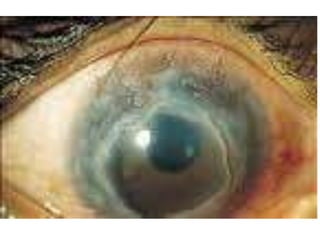
 It is a rare, degenerative, superficial ulcer,
starting at the corneal margin and
spreading circumferentially and axially
over the whole of this tissue.
 It is a rapidly progressive, painful,
ulcerative keratitis
 It can be only be diagnosed in the
absence of systemic cause and must be
differentiated from other corneal
abnormlities such as,Terriens
degeneration.
BENIGN /TYPICAL
 Unilateral
 Reponds well to treatment
 Elderly people
MALIGNANT
 Bilateral
 Very poorly responds to
treatment
 Younger people
 progressive
 It is an auto immune disorder.
 Associated with infections- helminthiasis,
hepatitisC, herpes simplex and zoster.
Various theories
 The antigen antibody reaction to infectious
toxin deposited in the peripheral cornea
causes inflammation and ulceration.
 Molecular mimicry may be involved,
stimulating an auto immune response.
 Deposition of immune complex over
peripheral cornea
Other causes:
 Physical trauma, foreign bodies, chemical
burns, surgeries such as cataract extraction
and keratoplasty.
 Auto immune lysis of the epithelium with
release of collagenolytic enzymes.
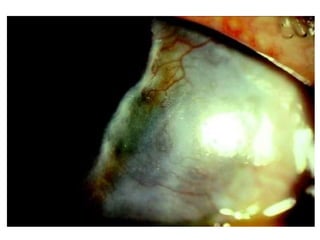
 Grey infiltrates , which break down, forming
small ulcers that spread and coalesce.
 It destroys the epithelium and superficial
stromal lamellae, forming a whitish
overhanging edge, while the base quickly
becomes vascularised.
 severe and persistent neuralgic pain.
 Redness
 Photophobia
 Lacrimation
 Decrease in visual acuity due to associated
iritis, central corneal involvement and
irregular astigmatism.
 CBC with differentials
 ESR
 RF
 Complement fixation
 ANA,ANCA & circulating immune complexes
 VDRL, FTA-ABS
 Urine analysis
 Topical steroids and antibiotics
 Excision of a 4-7 mm strip of adjacent
conjunctiva may prove successful by
eliminating conjunctival sources of
collagenase , proteoglycanase and other
inflammatory mediators.
 Perforation:
ulcer debridement
cyanoacrylate adhesive
soft contact lenses.
 Lamellar keratoplasty with i.v methotrexate
– halt the process
Mooren’s ulcer

Mooren’s ulcer

  • 1.
  • 2.
     It isa rare, degenerative, superficial ulcer, starting at the corneal margin and spreading circumferentially and axially over the whole of this tissue.  It is a rapidly progressive, painful, ulcerative keratitis  It can be only be diagnosed in the absence of systemic cause and must be differentiated from other corneal abnormlities such as,Terriens degeneration.
  • 4.
    BENIGN /TYPICAL  Unilateral Reponds well to treatment  Elderly people MALIGNANT  Bilateral  Very poorly responds to treatment  Younger people  progressive
  • 6.
     It isan auto immune disorder.  Associated with infections- helminthiasis, hepatitisC, herpes simplex and zoster. Various theories  The antigen antibody reaction to infectious toxin deposited in the peripheral cornea causes inflammation and ulceration.
  • 7.
     Molecular mimicrymay be involved, stimulating an auto immune response.  Deposition of immune complex over peripheral cornea Other causes:  Physical trauma, foreign bodies, chemical burns, surgeries such as cataract extraction and keratoplasty.
  • 8.
     Auto immunelysis of the epithelium with release of collagenolytic enzymes.  Grey infiltrates , which break down, forming small ulcers that spread and coalesce.  It destroys the epithelium and superficial stromal lamellae, forming a whitish overhanging edge, while the base quickly becomes vascularised.
  • 9.
     severe andpersistent neuralgic pain.  Redness  Photophobia  Lacrimation  Decrease in visual acuity due to associated iritis, central corneal involvement and irregular astigmatism.
  • 11.
     CBC withdifferentials  ESR  RF  Complement fixation  ANA,ANCA & circulating immune complexes  VDRL, FTA-ABS  Urine analysis
  • 12.
     Topical steroidsand antibiotics  Excision of a 4-7 mm strip of adjacent conjunctiva may prove successful by eliminating conjunctival sources of collagenase , proteoglycanase and other inflammatory mediators.  Perforation: ulcer debridement cyanoacrylate adhesive soft contact lenses.  Lamellar keratoplasty with i.v methotrexate – halt the process