Herpes simplex keratitis
To Vichhey
Outline
• Introduction
• Epithelial keratitis
• Disciform keratitis
• Necrotizing stromal keratitis
• Neurotrophic ulceration
• Prophylaxis
• Complication
I-Introduction
• Herpetic eye disease is the most common infectious cause of corneal
blindness in developed countries
• 60% of corneal ulcers in developing countries
• 10 million people worldwide may have herpetic eye disease
I-Introduction
• Herpes simplex virus (HSV)
• Two subtypes are HSV-1 and HSV-2 => neuronal ganglia
• HSV-1 causes infection above the waist (principally the face, lips and eyes)
• HSV-2 causes acquired infection (genital herpes). Rarely HSV-2 transmitted to the eye
• HSV transmission is facilitated in conditions of crowding and poor hygiene
I-Introduction
• Primary infection
• Usually occurs in childhood
• Spread by droplet transmission, or less frequently by direct inoculation
• It is uncommon during the first 6 months of life (maternal antibodies)
• Symptom
• Mild fever, malaise and upper respiratory tract symptoms
• Blepharitis and follicular conjunctivitis (usually mild and self-limited)
• Treatment
• If necessary, involves topical acyclovir ointment
I-Introduction
• Recurrent infection
• After primary infection: the virus is carried to the sensory for dermatome
• Subclinical reactivation
• Can periodically occur
• Are contagious
• Clinical reactivation
• A variety of stressors such as fever, hormonal change, ultraviolet radiation, trauma, or
trigeminal injury
• The pattern of disease
• Depend on the site of reactivation
I-Introduction
• Recurrent infection
• The rate for ocular recurrence
• After one episode is about 10% at 1 year and 50% at 10 year
• The higher the number of previous attacks the greater the risk of recurrence
• Risk factors for severe disease
• Which may be frequently recurrent, include atopic eye disease, childhood,
immunodeficiency or suppression, malnutrition, measles and malaria
II-Epithelial keratitis
1. Clinical features
Epithelial (dendritic or geographic) keratitis is associated with active virus
replication
• Presentation
• May be at any age with
• Mild discomfort
• Redness
• Photophobia
• Watering
• Blurred vision
II-Epithelial keratitis
1. Clinical features
• Signs in chronological order
• Swollen opaque epithelial cells arranged in a coarse punctate or stellate
pattern
• Central desquamation results in a linear-branching (dendritic) ulcer
• The ends of the ulcer have characteristic terminal buds and the bed of the
ulcer stains well with fluorescein
• Margin of the ulcer stain with rose Bengal
• Corneal sensation is reduced
• Mild associated subepithelial haze is typical
• Elevated IOP may occur
• Following healing
• Mild subepithelial scarring may develop after healing
II-Epithelial keratitis
2. Treatment
• Topical
• Aciclovir 3% ointment or ganciclovir 0.15% gel (5 times daily)
• Trifluridine (up to nine times a day)
• Debridement
• Protect adjacent healthy epithelium from infection
• Eliminated the antigenic stimulus to stromal inflammation
• Oral antiviral
• Probably indicated in most immunodeficient patients, poorly tolerated, or in resistant cases
• Interferon
• Combination => speed healing
• Skin lesions
• Treated with acyclovir cream five times daily
II-Epithelial keratitis
2. Treatment
• IOP control
• If glaucoma treatment is necessary, prostaglandin derivatives should probably be avoided
• Tropical steroids
• Are not used unless significant disciform keratitis is also present
• Slow healing or frequent recurrence
• Combination of two topical agents with oral valaciclovir or famiciclovir
III-Disciform keratitis
• The exact aetiology: controversial
• It may be active HSV infection of keratocytes or endothelium, or a
hypersensitivity reaction to viral antigen in the cornea
III-Disciform keratitis
1. Clinical features
• Presentation
• Gradual onset of blurred vision which may be associated with haloes around lights
• Discomfort and redness are common but tend to be milder than in purely epithelial disease
III-Disciform keratitis
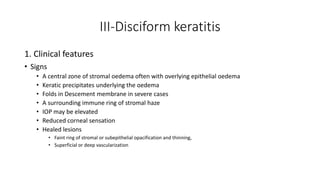
1. Clinical features
• Signs
• A central zone of stromal oedema often with overlying epithelial oedema
• Keratic precipitates underlying the oedema
• Folds in Descement membrane in severe cases
• A surrounding immune ring of stromal haze
• IOP may be elevated
• Reduced corneal sensation
• Healed lesions
• Faint ring of stromal or subepithelial opacification and thinning,
• Superficial or deep vascularization
III-Disciform keratitis
2. Treatment
• Initial treatment
• Topical steroids (prednisolone 1% or dexamethasone 0.1%) with antiviral cover, both
q.i.d
• Subsequently prednisolone 0.5% once daily is usually a safe dose at which to
stop topical antiviral cover
• With active epithelial ulceration
• Try to keep the steroid intensity as low as possible for adequate effect (b.d or t.i.d)
• With a more intensive antiviral (5 times daily)
• Topical cyclosporine 0.05%
• Particularly in presence of epithelial ulceration
• To facilitate tapering of topical steroids
IV-Necrotizing stroma keratitis
• This rare condition is
• Result from active viral replication within the stromal, though immune-
mediated inflammation
1. Signs
• Stromal necrosis and melting, often with profound interstitial opacification
• Anterior uveitis with keratic precipitates underlying the area of active stromal infiltration
• An epithelial defect may be present
• Progression to scarring, vascularization and lipid deposition is common
2. Treatment
• Similar to that of aggressive disciform keratitis
• But oral antiviral supplementation
V-Neurotrophic ulceration
• Neurotrophic ulceration
• Caused by failure of re-epithelialization resulting from corneal anaesthesia
• Often exacerbated by other factors such as drug toxicity
1. Signs
• A non-healing epithelial defect, sometimes after prolonged topical treatment
• The stromal beneath the defect is grey and opaque and may become thin
• Secondary bacterial or fungal infection may occur
2. Treatment
• Topical steroid to control any inflammatory component should be kept to a minimum
VI-Prophylaxis
• Long-term daily aciclovir reduces the rate of recurrence of epithelial
and stromal keratitis by about 50% and is usually well tolerated
• Considered in patients with frequent debilitating recurrence,
particularly if bilateral or involving an only eye
• The standard dose of aciclovir is 400 mg b.d
• Oral valaciclovir 500 mg once daily or famiciclovir are alternatives
• The prophylactic effect decrease or disappear when the drug is
stopped
VII-Complication
• Secondary infection
• Glaucoma
• Cataract
• Iris atrophy
Thank you

Herpes simplex keratitis

  • 1.
  • 2.
    Outline • Introduction • Epithelialkeratitis • Disciform keratitis • Necrotizing stromal keratitis • Neurotrophic ulceration • Prophylaxis • Complication
  • 3.
    I-Introduction • Herpetic eyedisease is the most common infectious cause of corneal blindness in developed countries • 60% of corneal ulcers in developing countries • 10 million people worldwide may have herpetic eye disease
  • 4.
    I-Introduction • Herpes simplexvirus (HSV) • Two subtypes are HSV-1 and HSV-2 => neuronal ganglia • HSV-1 causes infection above the waist (principally the face, lips and eyes) • HSV-2 causes acquired infection (genital herpes). Rarely HSV-2 transmitted to the eye • HSV transmission is facilitated in conditions of crowding and poor hygiene
  • 5.
    I-Introduction • Primary infection •Usually occurs in childhood • Spread by droplet transmission, or less frequently by direct inoculation • It is uncommon during the first 6 months of life (maternal antibodies) • Symptom • Mild fever, malaise and upper respiratory tract symptoms • Blepharitis and follicular conjunctivitis (usually mild and self-limited) • Treatment • If necessary, involves topical acyclovir ointment
  • 6.
    I-Introduction • Recurrent infection •After primary infection: the virus is carried to the sensory for dermatome • Subclinical reactivation • Can periodically occur • Are contagious • Clinical reactivation • A variety of stressors such as fever, hormonal change, ultraviolet radiation, trauma, or trigeminal injury • The pattern of disease • Depend on the site of reactivation
  • 7.
    I-Introduction • Recurrent infection •The rate for ocular recurrence • After one episode is about 10% at 1 year and 50% at 10 year • The higher the number of previous attacks the greater the risk of recurrence • Risk factors for severe disease • Which may be frequently recurrent, include atopic eye disease, childhood, immunodeficiency or suppression, malnutrition, measles and malaria
  • 8.
    II-Epithelial keratitis 1. Clinicalfeatures Epithelial (dendritic or geographic) keratitis is associated with active virus replication • Presentation • May be at any age with • Mild discomfort • Redness • Photophobia • Watering • Blurred vision
  • 9.
    II-Epithelial keratitis 1. Clinicalfeatures • Signs in chronological order • Swollen opaque epithelial cells arranged in a coarse punctate or stellate pattern • Central desquamation results in a linear-branching (dendritic) ulcer • The ends of the ulcer have characteristic terminal buds and the bed of the ulcer stains well with fluorescein • Margin of the ulcer stain with rose Bengal • Corneal sensation is reduced • Mild associated subepithelial haze is typical • Elevated IOP may occur • Following healing • Mild subepithelial scarring may develop after healing
  • 11.
    II-Epithelial keratitis 2. Treatment •Topical • Aciclovir 3% ointment or ganciclovir 0.15% gel (5 times daily) • Trifluridine (up to nine times a day) • Debridement • Protect adjacent healthy epithelium from infection • Eliminated the antigenic stimulus to stromal inflammation • Oral antiviral • Probably indicated in most immunodeficient patients, poorly tolerated, or in resistant cases • Interferon • Combination => speed healing • Skin lesions • Treated with acyclovir cream five times daily
  • 12.
    II-Epithelial keratitis 2. Treatment •IOP control • If glaucoma treatment is necessary, prostaglandin derivatives should probably be avoided • Tropical steroids • Are not used unless significant disciform keratitis is also present • Slow healing or frequent recurrence • Combination of two topical agents with oral valaciclovir or famiciclovir
  • 13.
    III-Disciform keratitis • Theexact aetiology: controversial • It may be active HSV infection of keratocytes or endothelium, or a hypersensitivity reaction to viral antigen in the cornea
  • 14.
    III-Disciform keratitis 1. Clinicalfeatures • Presentation • Gradual onset of blurred vision which may be associated with haloes around lights • Discomfort and redness are common but tend to be milder than in purely epithelial disease
  • 15.
    III-Disciform keratitis 1. Clinicalfeatures • Signs • A central zone of stromal oedema often with overlying epithelial oedema • Keratic precipitates underlying the oedema • Folds in Descement membrane in severe cases • A surrounding immune ring of stromal haze • IOP may be elevated • Reduced corneal sensation • Healed lesions • Faint ring of stromal or subepithelial opacification and thinning, • Superficial or deep vascularization
  • 17.
    III-Disciform keratitis 2. Treatment •Initial treatment • Topical steroids (prednisolone 1% or dexamethasone 0.1%) with antiviral cover, both q.i.d • Subsequently prednisolone 0.5% once daily is usually a safe dose at which to stop topical antiviral cover • With active epithelial ulceration • Try to keep the steroid intensity as low as possible for adequate effect (b.d or t.i.d) • With a more intensive antiviral (5 times daily) • Topical cyclosporine 0.05% • Particularly in presence of epithelial ulceration • To facilitate tapering of topical steroids
  • 18.
    IV-Necrotizing stroma keratitis •This rare condition is • Result from active viral replication within the stromal, though immune- mediated inflammation 1. Signs • Stromal necrosis and melting, often with profound interstitial opacification • Anterior uveitis with keratic precipitates underlying the area of active stromal infiltration • An epithelial defect may be present • Progression to scarring, vascularization and lipid deposition is common 2. Treatment • Similar to that of aggressive disciform keratitis • But oral antiviral supplementation
  • 20.
    V-Neurotrophic ulceration • Neurotrophiculceration • Caused by failure of re-epithelialization resulting from corneal anaesthesia • Often exacerbated by other factors such as drug toxicity 1. Signs • A non-healing epithelial defect, sometimes after prolonged topical treatment • The stromal beneath the defect is grey and opaque and may become thin • Secondary bacterial or fungal infection may occur 2. Treatment • Topical steroid to control any inflammatory component should be kept to a minimum
  • 22.
    VI-Prophylaxis • Long-term dailyaciclovir reduces the rate of recurrence of epithelial and stromal keratitis by about 50% and is usually well tolerated • Considered in patients with frequent debilitating recurrence, particularly if bilateral or involving an only eye • The standard dose of aciclovir is 400 mg b.d • Oral valaciclovir 500 mg once daily or famiciclovir are alternatives • The prophylactic effect decrease or disappear when the drug is stopped
  • 23.
    VII-Complication • Secondary infection •Glaucoma • Cataract • Iris atrophy
  • 24.