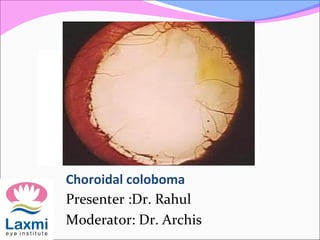
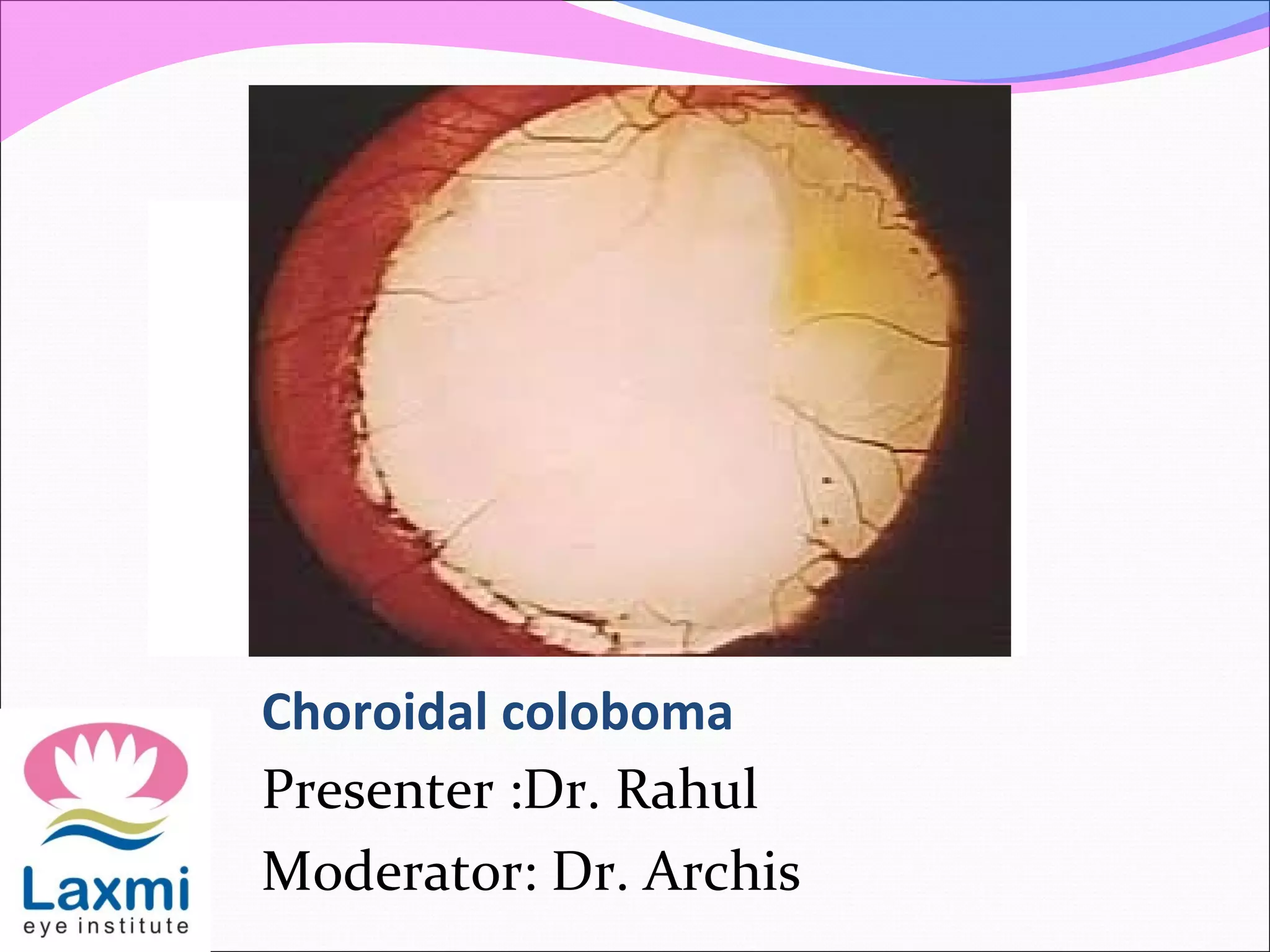
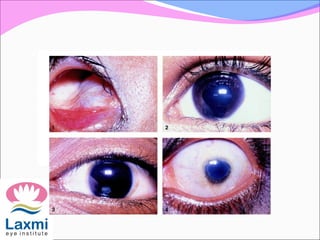
Choroidal coloboma
Presenter :Dr. Rahul
Moderator: Dr. Archis
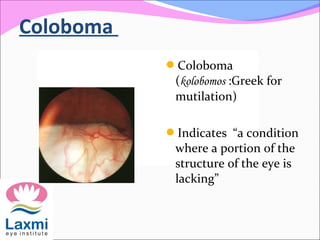
Coloboma
Coloboma
(kolobomos :Greek for
mutilation)
Indicates “a condition
where a portion of the
structure of the eye is
lacking”
Epidemiology
Incidence is 5 per 1,00,000 newborns
Prevalence is 1 in 10,000
60% are bilateral
Molecular genetics
 deletion in gene which maps to chromosome 7q26.
 a mutation in the PAX6 g
 # Warburg M
J Med Genet. 1993 Aug;30(8):664-9
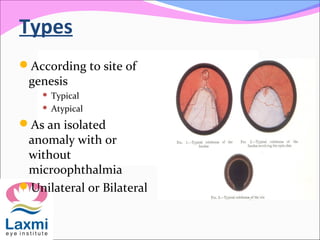
Types
According to site of
genesis
 Typical
 Atypical
As an isolated
anomaly with or
without
microophthalmia
Unilateral or Bilateral
Phenotypic classification
It may help the clinician to give a systematic
description of the anomalies
Two major classes
Total
Partial
Aetiological classification
• The aetiological classification consists of
three classes:
• Genetic
• Prenatally acquired
• Associations
• The aetiological classification can be
applied to other congenital birth defects
and improves counselling of families #
# Warburg M
J Med Genet. 1993 Aug;30(8):664-9
Classification of microphthalmos and coloboma
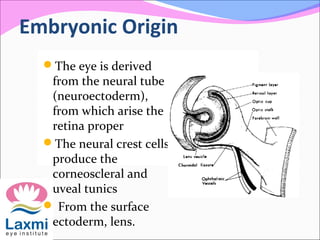
Embryonic Origin
The eye is derived
from the neural tube
(neuroectoderm),
from which arise the
retina proper
The neural crest cells
produce the
corneoscleral and
uveal tunics
 From the surface
ectoderm, lens.
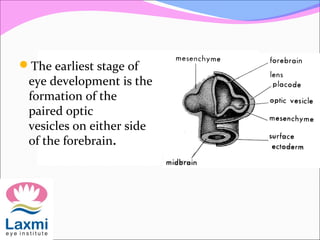
The earliest stage of
eye development is the
formation of the
paired optic
vesicles on either side
of the forebrain.
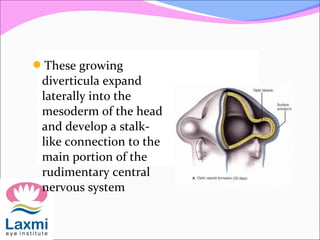
These growing
diverticula expand
laterally into the
mesoderm of the head
and develop a stalk-
like connection to the
main portion of the
rudimentary central
nervous system
In humans, this process begins at about 22 days of
development
 The vesicles continue to grow, their connection to
the brain becomes progressively narrower and more
stalk-like.
This stalks will eventually become the rudiments of
the optic nerves.
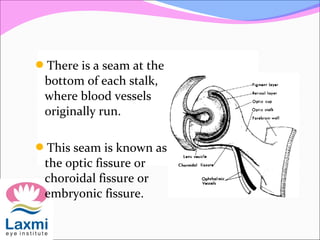
There is a seam at the
bottom of each stalk,
where blood vessels
originally run.
This seam is known as
the optic fissure or
choroidal fissure or
embryonic fissure.
The closure starts roughly in the middle of the
developing eye, and runs in both directions.
This process is start at five week & finished by the
seventh week of gestation.
If, for some reason, the closure does not happen, a
uveal coloboma is formed
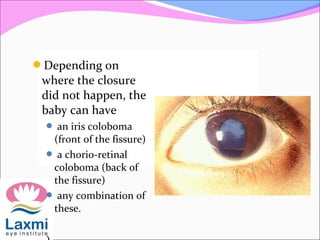
Depending on
where the closure
did not happen, the
baby can have
 an iris coloboma
(front of the fissure)
 a chorio-retinal
coloboma (back of
the fissure)
 any combination of
these.
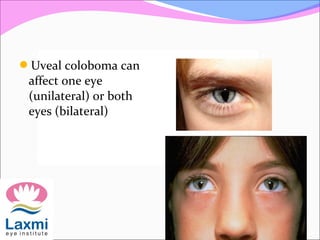
Uveal coloboma can
affect one eye
(unilateral) or both
eyes (bilateral)
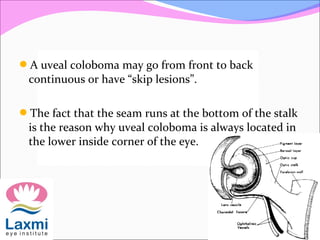
A uveal coloboma may go from front to back
continuous or have “skip lesions”.
The fact that the seam runs at the bottom of the stalk
is the reason why uveal coloboma is always located in
the lower inside corner of the eye.
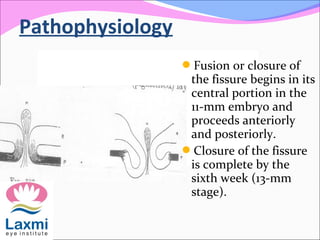
Pathophysiology
Fusion or closure of
the fissure begins in its
central portion in the
11-mm embryo and
proceeds anteriorly
and posteriorly.
Closure of the fissure
is complete by the
sixth week (13-mm
stage).
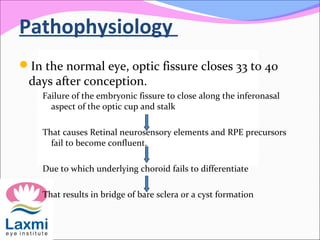
Pathophysiology
In the normal eye, optic fissure closes 33 to 40
days after conception.
Failure of the embryonic fissure to close along the inferonasal
aspect of the optic cup and stalk
That causes Retinal neurosensory elements and RPE precursors
fail to become confluent.
Due to which underlying choroid fails to differentiate
That results in bridge of bare sclera or a cyst formation
Pathophysiology
Anteriorly
defects in the neuroectodermally derived iris pigment
epithelium produce iris coloboma
Posteriorly
The entire optic nerve head may be involved in a
colobomatous malformation
Typical/atypical
Colobomas are called typical if they are located
inferonasally in the region of the fissure
Typical colobomas can involve the iris, ciliary body,
choroid, or any of the three, and also may involve the
optic nerve
Atypical colobomas are not related to closure of the fissure
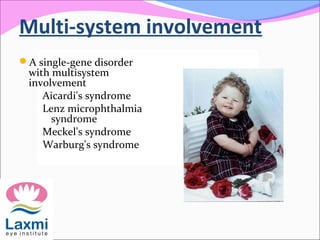
Multi-system involvement
A single-gene disorder
with multisystem
involvement
Aicardi's syndrome
Lenz microphthalmia
syndrome
Meckel's syndrome
Warburg's syndrome
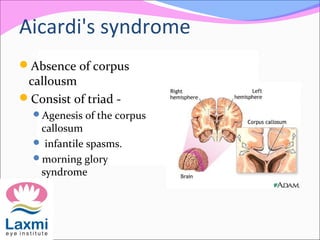
Aicardi's syndrome
Absence of corpus
callousm
Consist of triad -
Agenesis of the corpus
callosum
 infantile spasms.
morning glory
syndrome
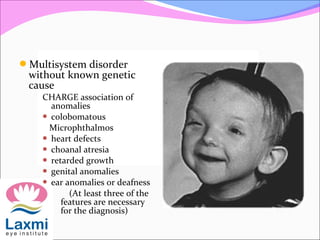
Multisystem disorder
without known genetic
cause
CHARGE association of
anomalies
 colobomatous
Microphthalmos
 heart defects
 choanal atresia
 retarded growth
 genital anomalies
 ear anomalies or deafness
(At least three of the
features are necessary
for the diagnosis)
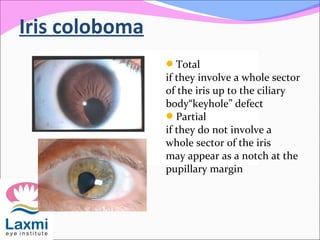
Iris coloboma
Total
if they involve a whole sector
of the iris up to the ciliary
body“keyhole” defect
Partial
if they do not involve a
whole sector of the iris
may appear as a notch at the
pupillary margin
Histological
Complete coloboma
involves the whole thickness of the iris
Incomplete coloboma
involves either the pigment epithelium or the stroma
Bridge coloboma
mesectodermal tissue forms a pupillary membrane that
stretches across the defect
Lens coloboma
Coloboma of the lens is not a true coloboma.
No lens tissue is missing
An absence of zonular fibers from an underlying
colobomatous ciliary body
Results in a lack of tension on the lens capsule in
that region
Notched equator/ Flattening of the inferior lens
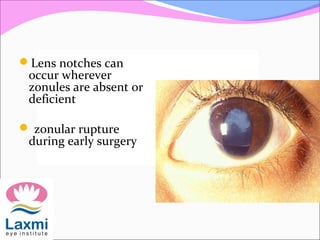
Lens notches can
occur wherever
zonules are absent or
deficient
 zonular rupture
during early surgery
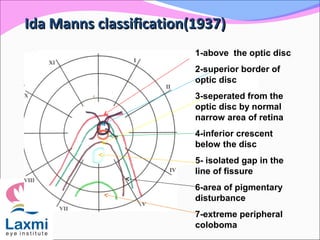
Ida Manns classification(1937)Ida Manns classification(1937)
1-above the optic disc
2-superior border of
optic disc
3-seperated from the
optic disc by normal
narrow area of retina
4-inferior crescent
below the disc
5- isolated gap in the
line of fissure
6-area of pigmentary
disturbance
7-extreme peripheral
coloboma
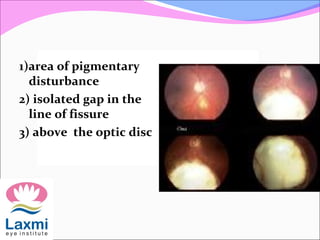
1)area of pigmentary
disturbance
2) isolated gap in the
line of fissure
3) above the optic disc
Retinal detachment in colobomaRetinal detachment in coloboma
40% develop RD , accounts for 0.5% of RD in young.
May or may not be due to coloboma
Vitreous traction cause breaks outside coloboma
RD due to coloboma is break along edge of coloboma
It is difficult to visualise breaks because they are under
edge or close to haemorrhage
Treatment modalitiesTreatment modalities
 Cryo to anterior margin and photocoagulation to
posterior margin
 Radial buckles (Patnaik et al,1961)-may extend to disc if
large.35-57% success rate
Management of RD with ColobomaManagement of RD with Coloboma
Prophylactic laser delimitation of the coloboma margins
If RD is due to peripheral coloboma-conventional scleral
buckling surgery &Vitrectomy with
endophotocoagualation with silicon oil injection
Management of RD with ColobomaManagement of RD with Coloboma
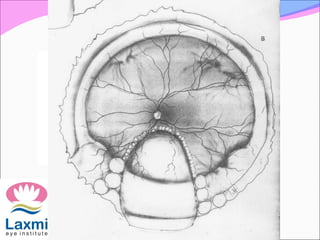
Lensectomy may be required in cases of difficulty in
visualizing inferior retina
Breaks usually identified
AFE easily done as sclera is concave
Prolonged inferior tamponade needed-silicon oil  gas.
SRNVM in retinochoroidal coloboma
Pathology-absence of choroid with breach in bruch’s
membrane leading to vessels entering sub-retinal space.
Also RPE abnormalities stimulate budding of
choriocapillaris endothelial cells.
Laser photocoagulation is advised modality of treatment.
Cataract in colobomatous eyes
Clinically significant cataract develops at a
younger age compaired with age-related nuclear
sclerotic cataract.
Cataract more likely to be denser.
Cuniform opacities are more likely to occur
earlier.
Increased no. of subluxated lens due to
associated zonuler deficiency
Michael L. Nordlund, Alan Sugar, Sayoko E.
Moroi,
J Cataract Refract Surg 2000; 26:1035-1040
Microophthalmos in colobomatous
eyes
Prevalence 21 per 100,000
82% at least >+7.00D of hypermetropia
Coloboma is the second MC association after cataract
(22% v/s 44%)
Microophthalmos with coloboma may or may not be
associated with microcornea
Mark J etal
Aetiology of severe visual impairment and
blindness in Microophthalmia
BJO 1994(78);332-334
Microophthalmos in colobomatous
eyes
A person with coloboma with microophthalmos
with microcornea has a poorer visual prognosis
than a person with coloboma with
microophthalmos without microcornea
Further a newborn with a corneal diameter<5mm
has a very poor prognosis
Mark J etal
 Aetiology of severe visual impairment
 and blindness in Microophthalmia
 BJO 1994(78);332-334
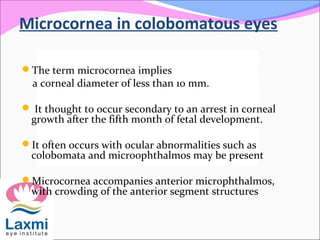
Microcornea in colobomatous eyes
The term microcornea implies
a corneal diameter of less than 10 mm.
 It thought to occur secondary to an arrest in corneal
growth after the fifth month of fetal development.
It often occurs with ocular abnormalities such as
colobomata and microophthalmos may be present
Microcornea accompanies anterior microphthalmos,
with crowding of the anterior segment structures
Management
Systemic evaluation
Ocular examination.
Investigations
Axial length
Keratometry
IOL Master
USG
UBM
Management
Clinically significant cataract develops at a younger age
If a coloboma involves the macula Axial length will be
varied so earlier refraction will be important or Axial
length may be obtained by locating the preferred fixation
point
Coloboma with microophthalmos with microcornea –
ECCE not a viable option
 The crystalline lens has been reported to be of normal or
slightly larger than normal size
#
Management
The lens:eye volume ratio is greater (10 to 32 percent) in
these eyes compared with emmetropic eyes (3 to 4
percent)
So Phaco-emulsification / manual phaco (SICS) is a
viable option
Phaco-emulsification—e.g. Slit Nucleotomy, Wooden
boot, Petalloid etc.
Manual phaco (SICS) —e.g. Sandwich technique,
Quarters technique, Phacotrisection etc.
 Michael L. Nordlund, Alan Sugar, Sayoko E. Moroi,
 J Cataract Refract Surg 2000; 26:1035-
#
Management
Minimal mydriasis or reactive miosis should be
anticipated
Iris retractors / multiple sphicterotomies
CCC run-off or tear can occur
Recommendations for CCC
Eccentric capsulorhexis
Increased magnification with dye assistance
Oblique illumination
Two stage CCC
Good chamber maintainence with viscoelastic
Nucleus sculpting / Nucleus cracking at opposite meridian + PCIOL@90°
to tear
Endothelial losses
Shell technique can be used
Michael L. Nordlund, Alan Sugar, Sayoko E. Moroi,
 J Cataract Refract Surg 2000; 26:1035-
#
Management
 Anterior vitrectomy
Vitreous loss –
Prolapse through PC rent
Prolapse through colobomatous area without PC rent
 Optimal centeration of the optic with the ectopic pupil to avoid
post-op mono-ocular diplopia
Puppiloplasty may be required
 Avoid silicon material IOLs
As future VR surgery may entail the use of silicon oil
# Michael L. Nordlund etal
Phacoemulsification and intraocular lens placement in
eyes with cataract and congenital coloboma: visual
acuity and complications
J Cataract Refract Surg 2000; 26:1035-1040
Prognosis
The prognosis for vision depended on the phenotype of
the better eye
 Microphthalmos with cyst has the worst prognosis
 Coloboma with microcornea and microphthalmos a poor
prognosis
 Coloboma with only microcornea has an intermediate prognosis
 Simple coloboma has the best prognosis
A corneal diameter <6 mm had a poor visual prognosis
whereas a corneal diameter >10 mm had a good prognosis
Time of surgery
Type of surgery
Hornby SJ, etal
Ophthalmology. 2000 Mar;107(3):511-20
Visual acuity in children with coloboma
Michael L. Nordlund, Alan Sugar,
Sayoko E. Moroi,
J Cataract Refract Surg 2000; 26:1035-
1040
Choroidal coloboma

Choroidal coloboma

  • 1.
    Choroidal coloboma Presenter :Dr.Rahul Moderator: Dr. Archis
  • 2.
    Coloboma Coloboma (kolobomos :Greek for mutilation) Indicates“a condition where a portion of the structure of the eye is lacking”
  • 3.
    Epidemiology Incidence is 5per 1,00,000 newborns Prevalence is 1 in 10,000 60% are bilateral Molecular genetics  deletion in gene which maps to chromosome 7q26.  a mutation in the PAX6 g  # Warburg M J Med Genet. 1993 Aug;30(8):664-9
  • 4.
    Types According to siteof genesis  Typical  Atypical As an isolated anomaly with or without microophthalmia Unilateral or Bilateral
  • 5.
    Phenotypic classification It mayhelp the clinician to give a systematic description of the anomalies Two major classes Total Partial
  • 6.
    Aetiological classification • Theaetiological classification consists of three classes: • Genetic • Prenatally acquired • Associations • The aetiological classification can be applied to other congenital birth defects and improves counselling of families # # Warburg M J Med Genet. 1993 Aug;30(8):664-9 Classification of microphthalmos and coloboma
  • 7.
    Embryonic Origin The eyeis derived from the neural tube (neuroectoderm), from which arise the retina proper The neural crest cells produce the corneoscleral and uveal tunics  From the surface ectoderm, lens.
  • 8.
    The earliest stageof eye development is the formation of the paired optic vesicles on either side of the forebrain.
  • 9.
    These growing diverticula expand laterallyinto the mesoderm of the head and develop a stalk- like connection to the main portion of the rudimentary central nervous system
  • 10.
    In humans, thisprocess begins at about 22 days of development  The vesicles continue to grow, their connection to the brain becomes progressively narrower and more stalk-like. This stalks will eventually become the rudiments of the optic nerves.
  • 11.
    There is aseam at the bottom of each stalk, where blood vessels originally run. This seam is known as the optic fissure or choroidal fissure or embryonic fissure.
  • 12.
    The closure startsroughly in the middle of the developing eye, and runs in both directions. This process is start at five week & finished by the seventh week of gestation. If, for some reason, the closure does not happen, a uveal coloboma is formed
  • 13.
    Depending on where theclosure did not happen, the baby can have  an iris coloboma (front of the fissure)  a chorio-retinal coloboma (back of the fissure)  any combination of these.
  • 14.
    Uveal coloboma can affectone eye (unilateral) or both eyes (bilateral)
  • 15.
    A uveal colobomamay go from front to back continuous or have “skip lesions”. The fact that the seam runs at the bottom of the stalk is the reason why uveal coloboma is always located in the lower inside corner of the eye.
  • 16.
    Pathophysiology Fusion or closureof the fissure begins in its central portion in the 11-mm embryo and proceeds anteriorly and posteriorly. Closure of the fissure is complete by the sixth week (13-mm stage).
  • 17.
    Pathophysiology In the normaleye, optic fissure closes 33 to 40 days after conception. Failure of the embryonic fissure to close along the inferonasal aspect of the optic cup and stalk That causes Retinal neurosensory elements and RPE precursors fail to become confluent. Due to which underlying choroid fails to differentiate That results in bridge of bare sclera or a cyst formation
  • 18.
    Pathophysiology Anteriorly defects in theneuroectodermally derived iris pigment epithelium produce iris coloboma Posteriorly The entire optic nerve head may be involved in a colobomatous malformation
  • 19.
    Typical/atypical Colobomas are calledtypical if they are located inferonasally in the region of the fissure Typical colobomas can involve the iris, ciliary body, choroid, or any of the three, and also may involve the optic nerve Atypical colobomas are not related to closure of the fissure
  • 20.
    Multi-system involvement A single-genedisorder with multisystem involvement Aicardi's syndrome Lenz microphthalmia syndrome Meckel's syndrome Warburg's syndrome
  • 21.
    Aicardi's syndrome Absence ofcorpus callousm Consist of triad - Agenesis of the corpus callosum  infantile spasms. morning glory syndrome
  • 22.
    Multisystem disorder without knowngenetic cause CHARGE association of anomalies  colobomatous Microphthalmos  heart defects  choanal atresia  retarded growth  genital anomalies  ear anomalies or deafness (At least three of the features are necessary for the diagnosis)
  • 23.
    Iris coloboma Total if theyinvolve a whole sector of the iris up to the ciliary body“keyhole” defect Partial if they do not involve a whole sector of the iris may appear as a notch at the pupillary margin
  • 24.
    Histological Complete coloboma involves thewhole thickness of the iris Incomplete coloboma involves either the pigment epithelium or the stroma Bridge coloboma mesectodermal tissue forms a pupillary membrane that stretches across the defect
  • 25.
    Lens coloboma Coloboma ofthe lens is not a true coloboma. No lens tissue is missing An absence of zonular fibers from an underlying colobomatous ciliary body Results in a lack of tension on the lens capsule in that region Notched equator/ Flattening of the inferior lens
  • 26.
    Lens notches can occurwherever zonules are absent or deficient  zonular rupture during early surgery
  • 27.
    Ida Manns classification(1937)IdaManns classification(1937) 1-above the optic disc 2-superior border of optic disc 3-seperated from the optic disc by normal narrow area of retina 4-inferior crescent below the disc 5- isolated gap in the line of fissure 6-area of pigmentary disturbance 7-extreme peripheral coloboma
  • 28.
    1)area of pigmentary disturbance 2)isolated gap in the line of fissure 3) above the optic disc
  • 29.
    Retinal detachment incolobomaRetinal detachment in coloboma 40% develop RD , accounts for 0.5% of RD in young. May or may not be due to coloboma Vitreous traction cause breaks outside coloboma
  • 30.
    RD due tocoloboma is break along edge of coloboma It is difficult to visualise breaks because they are under edge or close to haemorrhage
  • 31.
    Treatment modalitiesTreatment modalities Cryo to anterior margin and photocoagulation to posterior margin  Radial buckles (Patnaik et al,1961)-may extend to disc if large.35-57% success rate
  • 32.
    Management of RDwith ColobomaManagement of RD with Coloboma Prophylactic laser delimitation of the coloboma margins If RD is due to peripheral coloboma-conventional scleral buckling surgery &Vitrectomy with endophotocoagualation with silicon oil injection
  • 33.
    Management of RDwith ColobomaManagement of RD with Coloboma Lensectomy may be required in cases of difficulty in visualizing inferior retina Breaks usually identified AFE easily done as sclera is concave Prolonged inferior tamponade needed-silicon oil gas.
  • 35.
    SRNVM in retinochoroidalcoloboma Pathology-absence of choroid with breach in bruch’s membrane leading to vessels entering sub-retinal space. Also RPE abnormalities stimulate budding of choriocapillaris endothelial cells. Laser photocoagulation is advised modality of treatment.
  • 36.
    Cataract in colobomatouseyes Clinically significant cataract develops at a younger age compaired with age-related nuclear sclerotic cataract. Cataract more likely to be denser. Cuniform opacities are more likely to occur earlier. Increased no. of subluxated lens due to associated zonuler deficiency Michael L. Nordlund, Alan Sugar, Sayoko E. Moroi, J Cataract Refract Surg 2000; 26:1035-1040
  • 37.
    Microophthalmos in colobomatous eyes Prevalence21 per 100,000 82% at least >+7.00D of hypermetropia Coloboma is the second MC association after cataract (22% v/s 44%) Microophthalmos with coloboma may or may not be associated with microcornea Mark J etal Aetiology of severe visual impairment and blindness in Microophthalmia BJO 1994(78);332-334
  • 38.
    Microophthalmos in colobomatous eyes Aperson with coloboma with microophthalmos with microcornea has a poorer visual prognosis than a person with coloboma with microophthalmos without microcornea Further a newborn with a corneal diameter<5mm has a very poor prognosis Mark J etal  Aetiology of severe visual impairment  and blindness in Microophthalmia  BJO 1994(78);332-334
  • 40.
    Microcornea in colobomatouseyes The term microcornea implies a corneal diameter of less than 10 mm.  It thought to occur secondary to an arrest in corneal growth after the fifth month of fetal development. It often occurs with ocular abnormalities such as colobomata and microophthalmos may be present Microcornea accompanies anterior microphthalmos, with crowding of the anterior segment structures
  • 41.
  • 42.
    Management Clinically significant cataractdevelops at a younger age If a coloboma involves the macula Axial length will be varied so earlier refraction will be important or Axial length may be obtained by locating the preferred fixation point Coloboma with microophthalmos with microcornea – ECCE not a viable option  The crystalline lens has been reported to be of normal or slightly larger than normal size #
  • 43.
    Management The lens:eye volumeratio is greater (10 to 32 percent) in these eyes compared with emmetropic eyes (3 to 4 percent) So Phaco-emulsification / manual phaco (SICS) is a viable option Phaco-emulsification—e.g. Slit Nucleotomy, Wooden boot, Petalloid etc. Manual phaco (SICS) —e.g. Sandwich technique, Quarters technique, Phacotrisection etc.  Michael L. Nordlund, Alan Sugar, Sayoko E. Moroi,  J Cataract Refract Surg 2000; 26:1035- #
  • 44.
    Management Minimal mydriasis orreactive miosis should be anticipated Iris retractors / multiple sphicterotomies CCC run-off or tear can occur Recommendations for CCC Eccentric capsulorhexis Increased magnification with dye assistance Oblique illumination Two stage CCC Good chamber maintainence with viscoelastic Nucleus sculpting / Nucleus cracking at opposite meridian + PCIOL@90° to tear Endothelial losses Shell technique can be used Michael L. Nordlund, Alan Sugar, Sayoko E. Moroi,  J Cataract Refract Surg 2000; 26:1035- #
  • 46.
    Management  Anterior vitrectomy Vitreousloss – Prolapse through PC rent Prolapse through colobomatous area without PC rent  Optimal centeration of the optic with the ectopic pupil to avoid post-op mono-ocular diplopia Puppiloplasty may be required  Avoid silicon material IOLs As future VR surgery may entail the use of silicon oil # Michael L. Nordlund etal Phacoemulsification and intraocular lens placement in eyes with cataract and congenital coloboma: visual acuity and complications J Cataract Refract Surg 2000; 26:1035-1040
  • 47.
    Prognosis The prognosis forvision depended on the phenotype of the better eye  Microphthalmos with cyst has the worst prognosis  Coloboma with microcornea and microphthalmos a poor prognosis  Coloboma with only microcornea has an intermediate prognosis  Simple coloboma has the best prognosis A corneal diameter <6 mm had a poor visual prognosis whereas a corneal diameter >10 mm had a good prognosis Time of surgery Type of surgery Hornby SJ, etal Ophthalmology. 2000 Mar;107(3):511-20 Visual acuity in children with coloboma Michael L. Nordlund, Alan Sugar, Sayoko E. Moroi, J Cataract Refract Surg 2000; 26:1035- 1040