EyeAnteriorStructuresPathlogiesandDisordersFielmannOptometristIrinaJagiloviche-mail: irina.jagilovica@gmail.com
DISORDERS OF LASHES1.  Trichiasis2.  Metaplastic lashes3.  Distichiasis4. Phthiriasispalpebrarum5.  Madarosis6.  Poliosis
MadarosisDecrease in number or complete loss of lashesLocal causes Chronic anterior   lid margin diseaseInfiltrating tumours
Burns, radiotherapy   or cryotherapy
PoliosisPremature localized whitening of hairOcular associations Chronic anterior blepharitis Sympathetic ophthalmitisSystemic associationsVogt-Koyanagi-Harada    syndromeWaardenburg syndrome
DistichiasisSecond row of lashes arising from meibomian gland orifices
CongenitalTrichiasisMost frequently affects lower lidof normal lashes Most frequently affects lower lidInferior punctateepitheliopathy
Phthiriasispalpebrarum Infestation of lashes by pubic crab louse and its ova (nits) Typically affects children in poor hygenic conditions
Staphylococcal blepharitisChronic irritation worse in morningsHyperaemia and telangiectasia of anterior   lid marginScarring and hypertrophy if longstandingScales around base of lashes    (collarettes)
Complications of staphylococcal blepharitispoliosismadarosistrichiasisRecurrent styesMarginal keratitisTear film instability
SeborrhoeicblepharitisShiny anterior lid margin Greasy scales Hyperaemia of lid marginLashes stuck together
Meibomianitis Inflamed and blockedmeibomiangland orificesMeibomian cyst formation
MeibomianseborrhoeaOil globules over meibomian gland orificesOily and foamy tear film
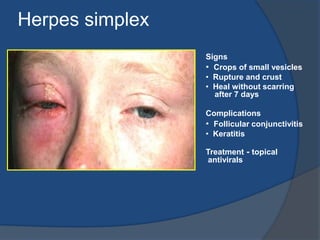
Herpes simplexSignsCrops of small vesicles
  Rupture and crust
  Heal without scarring    after 7 daysComplicationsFollicular conjunctivitis
KeratitisTreatment - topicalantivirals
BENIGN EYELID LESIONS1.  NodulesChalazion
  Acute hordeolaMolluscumcontagiosumXanthelasma2.  Cysts Cyst of Moll
 Cyst of Zeiss
Sebaceous cyst
Hidrocystoma3.  TumoursViral wart
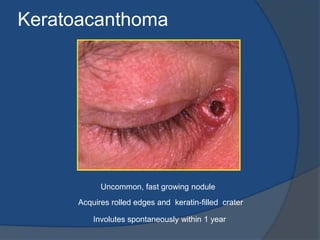
Keratoacanthoma
Naevi
 Capillary haemangioma
 Port-wine stain
Pyogenicgranuloma
Cutaneous hornSigns of chalazion (meibomian cyst)Painless, roundish, firm lesion within tarsal plateMay rupture through conjunctiva and cause granuloma
MolluscumcontagiosumPainless, waxy, umbilicated noduleMay be multiple in AIDS patientsChronic follicular conjunctivitisOccasionally superficial keratitis
XanthelasmaCommon in elderly or those withhypercholesterolaemiaYellowish, subcutaneous plaques containing cholesterol and lipidUsually bilateral and located medially
Eyelid cystsCyst of MollTranslucentOn anterior lid  marginCyst of ZeisOpaqueOn anterior lid margin
Viral wart (squamous cell papilloma)Most common benign lid tumourRaspberry-like surface
KeratosesSeborrhoeicActinicCommon in elderlyAffects elderly, fair-skinned individualsDiscrete, greasy, brown lesionMost common pre-malignant skin lesionFlat ‘stuck-on’ appearanceRare on eyelidsFlat, scaly, hyperkeratotic lesion
KeratoacanthomaUncommon, fast growing noduleAcquires rolled edges and  keratin-filled  craterInvolutes spontaneously within 1 year
Naevi ElevatedFlat, well-circumscribedHas both intradermal   and junctional   components May be non-pigmented Pigmented No malignant potential Low malignant potential
MALIGNANT EYELID TUMOURS1.  Basal cell carcinoma2.  Squamous cell carcinoma3.  Meibomian gland carcinoma4.  Melanoma5.  Kaposi sarcoma
Basal Cell Carcinoma - Important Facts1.  Most common human malignancy2.  Usually affects the elderly3.  Slow-growing, locally invasive4.  Does not metastasize5.  90% occur on head and neck6.  Of these 10% involve eyelids7.  Accounts for 90% of eyelid malignancies
Nodular basal cell carcinoma Shiny, indurated nodule Slow progression Surface vascularization May destroy large portion of eyelid
Ulcerative basal cell carcinoma(rodent ulcer)Chronic ulceration
Sclerosing basal cell carcinomaIndurated plaque with loss of lashesSpreads radially beneath normal   epidermisMay mimic chronic blepharitis
Squamous cell carcinomaNodularUlcerativeLess common but more aggressive than BCCNo surface vascularization
Meibomian gland carcinomaHard nodule; maymimic chalazionVery large tumourDiffuse thickening of lid margin and loss of lashesConjunctival invasion; maymimic chronic conjunctivitis
MelanomaPlaque with irregular  outlineBlue-black nodule withnormal surrounding skinMay be non-pigmentedVariable pigmentation
Kaposi sarcomaVascular tumour occurring in patients with AIDSUsually associated with advanced diseaseVery sensitive to radiotherapy
Entropion & ectropion
Horner syndromeCaused by oculosympatheticpalsyUsually unilateral mildptosis and miosis, anisocoriaNormal pupillary reactions
Important causes of Horner syndromeCentral(first order neurone)Posterior hypothalamusBrainstem disease  (vascular, demyelination) Spinal cord disease  (syringomyelia, tumours)Pre-ganglionic(second order neurone)Superior cervicalganglionIntrathoracic lesions (Pancoasttumour, aneurysm) Neck lesions  (glands, trauma)Post-ganglionic (third order neurone) Internal carotid artery diseaseCiliospinal centre of Budge( C8 - T2 ) Cavernous sinus massSimple bacterial conjunctivitisSubacute onset of mucopurulentdischargeCrusted eyelids and conjunctivalinjection
Signs of conjunctivitisUsually bilateral, acute waterydischarge and folliclesSubconjunctivalhaemorrhages andpseudomembranes if severe
Signs of keratitisFocal, subepithelialkeratitisFocal, epithelial keratitisMay persist for monthsTransient
Progression of vernal conjunctivitis Diffuse papillary hypertrophy, most marked on superior tarsus  Formation of cobblestone papillae
Limbal vernalTrantas dotsMucoid nodule
CONJUNCTIVAL TUMOURS1. BenignNaevus
Papilloma
Epibulbardermoid
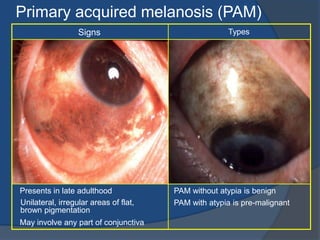
Lipodermoid2. Pre-malignant  Primary acquired melanosis ( PAM )
  Intraepithelial neoplasia (carcinoma in situ)3. Malignant  Melanoma
Squamous cell carcinoma
  Kaposi sarcoma
  LymphomaNaevusMost frequently juxtalimbalPresents in first two decadesSharply demarcated and slightly elevated30% are almost non-pigmented
Melanoma
PapillomaPedunculatedSessile  Presents in middle age
Presents in childhood or early adulthood
  Not caused by infection
  Infection with papilloma virus
Single and unilateral
  May be multiple and  bilateralEpibulbardermoidSignsAssociation  Presents in childhood
Occasionally Goldenhar   syndrome  Smooth, soft mass
  Usually juxtalimbalLipodermoidPresents in adulthood
Soft, movable, subconjunctival mass
  Most frequently at outer canthusIntraepithelial neoplasia(carcinoma in situ)SignsProgression  May become vascular and extend onto   corneaPresents in late adulthood
Juxtalimbal fleshy avascular mass
  Malignant transformation is uncommonPrimary acquired melanosis (PAM)SignsTypesPAM without atypia is benignPresents in late adulthoodUnilateral, irregular areas of flat, brown pigmentationPAM with atypia is pre-malignant May involve any part of conjunctiva
Conjunctival melanomaFrom naevusPrimaryFrom PAM with atypiaVery rareMost common typeSolitary noduleSudden appearance of nodules in PAMFrequently juxtalimbal but may be anywhereSudden increase in size or pigmentation
Squamous cell carcinomaProgressionSignsArises from intraepithelialneoplasia or de novo  Slow-growing
  May spread extensively
  Presents in late adulthood
  Rarely metastasizes
  Frequently juxtalimbalKaposi sarcoma  Affects patients with AIDS
  Vascular, slow-growing tumour of low malignancy
  Very sensitive to radiotherapy
  Most frequently in inferior fornixLymphoma  Usually presents in adulthood
Benign or malignant
  Salmon-coloured, subconjunctival infiltratePERIPHERAL CORNEAL INFLAMMATION1.  Marginal keratitis2.  Rosaceakeratitis3.  Phlyctenulosis4.  Acute stromalkeratitis
Marginal keratitisProgressionSubepithelial infiltrate separated by clear zoneVascularizationfollowed by resolutionCircumferential spread
RosaceakeratitisAffects 5% of patients with acne rosaeca
  Bilateral and chronicProgressionPeripheral inferiorvascularizationSubepithelial infiltrationThinning and perforationif severe
Phlyctenulosis  Uncommon, unilateral - typically affects children
  Severe photophobia, lacrimation and blepharospasmConjunctivalphlyctenCorneal phlycten  Small pinkish-white nodule    near limbus  Usually transient and resolves    spontaneously  Starts astride limbus
  Resolves spontaneously or extends   onto cornea
Acute stromalkeratitis  Uncommon, usually unilateral
  Associated with non-necrotizing scleritisProgressionSuperficial or mid-stromal infiltrationOpacification and vascularization
CORNEAL INFECTIONS1.  Bacterial keratitis2.  Fungal keratitis3.  Acanthamoebakeratitis4.  Infectious crystalline keratitisHerpes simplex keratitis-Epithelial	-Disciform6.  Herpes zoster keratitis
Bacterial keratitis  Contact lens wear
  Chronic ocular surface disease
  Corneal hypoaesthesiaExpanding oval, yellow-white, dense stromal infiltrateStromal suppuration and hypopyon
Fungal keratitisFrequently preceded by ocular trauma with organic matterGreyish-white ulcer which may be surrounded by feathery infiltrates  Slow progression and occasionally hypopyon
Acanthamoebakeratitis  Contact lens wearers at particular risk
  Symptoms worse than signsPerineuralinfiltrates (radial keratoneuritis) Small, patchy Anteriorstromalinfiltrates Ulceration, ring abscess& small, satellite lesionsStromalopacificationTreatment
Infectious crystalline keratitis  Very rare, indolent infection (Strep. viridans)
  Usually associated with long-term topical steroid use
  Particularly following penetrating keratoplasty  White, branching, anterior stromal crystalline deposits
Herpes simplex epithelial keratitisDendritic ulcer with terminal bulbs  May enlarge to become geographic  Stains with fluoresceinHerpes simplex disciformkeratitisSignsAssociationsCentral epithelial and stromaloedemaOccasionally surrounded by WesselyringFolds in Descemet membraneSmall keratic precipitates
Herpes zoster keratitisNummular keratitisAcute epithelial keratitisDevelops in about 50% within 2 days of rashDevelops in about 30% within 10 days of rashSmall, dendritic or stellateepithelial lesionsMultiple, fine, granular deposits just beneath Bowman membraneTapered ends without bulbsHalo of stromal hazeMay become chronicResolves within a few days
CORNEAL DEGENERATIONS1.  Age-relatedArcussenilis
Vogt white limbal girdle
Crocodile shagreen
 Cornea guttata2.  Lipid keratopathy Primary
 Secondary3.  Band keratopathy4.  Spheroidal degeneration5.  Salzmann nodular degeneration
Arcussenilis Innocuous and extremely common in elderly
 Occasionally associated with hyperlipoproteinaemia
Peripheral border separated    from limbus by clear zone  Bilateral, circumferential bands    of lipid depositsDiffuse central and sharp    peripheral border  Clear zone may be thinned    ( senile furrow)
Vogt white limbal girdleInnocuous and very common in elderlyBilateralWhite, crescentic line along nasal and temporal limbusType 1 - separated from limbus by clear zoneType 2 - not separated by clear zone
Crocodile shagreen Uncommon and innocuous
  Usually bilateralPolygonal stromal opacities separated by   clear space Most frequently involve anterior stroma  (anterior crocodile shagreen)Occasionally involve posterior stroma  (posterior crocodile shagreen)
Cornea guttata Common, bilateral and usually innocuous
 Rarely progression to Fuchs dystrophyTiny dark spots on central endothelium
Lipid keratopathyPrimarySecondaryCommon, secondary to previous disciformkeratitisRare, occurs spontaneously in avascular corneaUnilateral stromal deposits with vascularizationUsually unilateral stromal deposits  without vascularization
Band keratopathy Common, unilateral or bilateral depending on cause
Subepithelial calcificationProgressionCentral spread of calcificationInterpalpebrallimbalopacificationSmall holes within calcified area Separated by clear zone
CORNEAL DYSTROPHIES1. Anterior  Cogan microcystic..  Reis-Bucklers
  Meesmann

Anterior eye structures disorders