Sympathetic Ophthalmitis
Dr. Abhishek Onkar
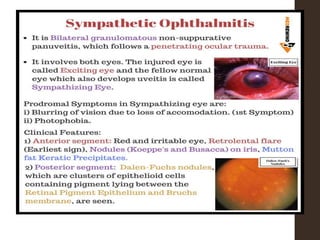
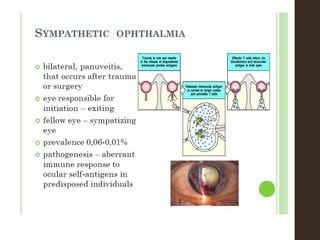
โ€ข Sympathetic ophthalmia is defined as a BILATERAL
DIFFUSE, GRANULOMATOUS PANUVEITIS
โ€ข That occurs after the uvea of one eye is subjected to a
penetrating injury due to either accidental trauma or
surgery.
โ€ข The injured eye is known as the exciting eye and the
fellow eye, developing inflammation days to years later,
is the sympathizing eye.
Epidemiology
โ€ข Prevalence: relatively rare disease (0.2%- trauma,
0.01%- ocular Sx)
โ€ข Inheritance: No proven role. Postulated correlation of
HLA DRB1, DQA1 . HLAA11, HLA-B40, HLA-
DR4/DRw53.
โ€ข Gender: M = F postsurgical; M > F traumatic
โ€ข No racial predisposition
โ€ข All ages, possible risk in the elderly or children
<10years.
โ€ข Surgical and Laser procedures like glaucoma filtration
Sx, PI, scleral buckling, cataract Sx, evisceration,
cyclocryotherapy and Nd:Yag laser cyclotherapy.
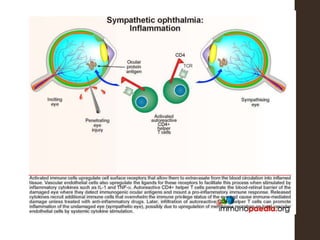
Theories of pathogenesis
โ€ข Neurogenic (extension from one eye to the other through
the optic nerves and the optic chiasma)
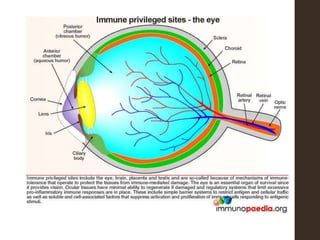
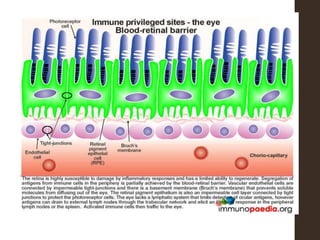
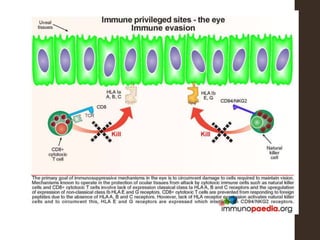
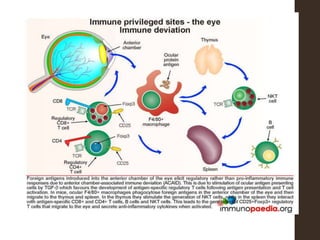
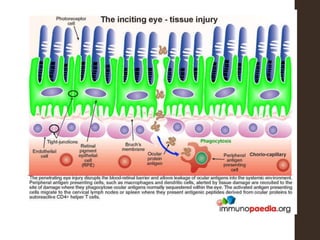
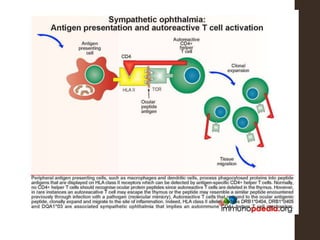
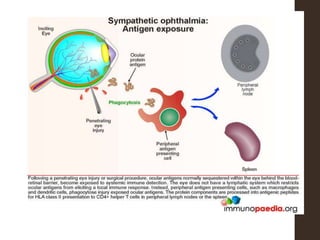
โ€ข Role of Ocular Immune Privilege: Not all cases of ocular
injury progress to SO
โ€ข The immune privileged ocular antigens in the exciting
eye to the host immune system leading to the activation
against these self antigens (such as choroidal
melanocytes, melanin pigment or uveo retinal extracts
including Retinal S antigen and interphotoreceptor
retinoid binding protein) in both eyes.
โ€ข T-cell proliferative response on exposure to uveal and
uveoretinal extracts.
Pathology
โ€ข The inflammatory changes in the exciting and
sympathizing eyes are the same, except for features of
trauma in the exciting eye.
โ€ข Granulomatous Uveitis โ€“
โ€ข The minimal and classic changes for the histopathologic
diagnosis of sympathetic ophthalmia are:
๏ƒ˜ diffuse lymphocytic infiltration of the uveal tract with
epithelioid cell nests,
๏ƒ˜ pigment phagocytosis by the epithelioid cells,
๏ƒ˜ absence of necrosis, and
๏ƒ˜ sparing of the retina and choriocapillaris ( protective effect
of RPE cells which release certain Anti inflamatory
mediators like RPE protective protein, which supresses
neutrophil superoxide generation) by the granulomatous
process.
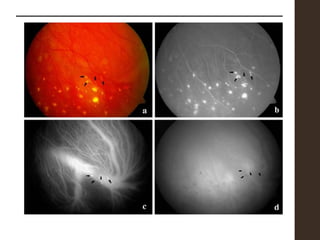
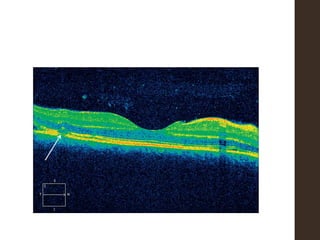
Dalen-Fuch's nodules
โ€ข Small, deep-yellow white nodules in the choroid.
โ€ข occur mostly in the periphery and consist of epithelioid cells located just
internal to Bruch's membrane.
โ€ข Histopathologically they are nodular aggregations of lymphocytes and
epitheloid cells with proliferation of retinal pigment epithelium.
โ€ข THE CHORIOCAPILLARIS IS TYPICALLY SPARED
โ€ข The interval between ocular injury and the onset of
sympathetic ophthalmia has been reported to be as
short as 5 days or as long as 66 years.
โ€ข In general, 65% of sympathetic ophthalmia cases occur 2
weeks to 3 months after injury
โ€ข 90% occur before 1 year.
โ€ข The traumatized eye in SO, characteristically exhibits a
persistent granulomatous inflammatory reaction.
Signs and symptoms
โ€ข THE EARLIEST SYMPTOM MAY BE DECREASED ACCOMMODATION
โ€ข THE EARLIEST SIGN: RETROLENTICULAR FLARE AND CELLS IN THE
FELLOW EYE.
โ€ข Sympathetic ophthalmia presents as a bilateral diffuse uveitis.
โ€ข Patients report insidious onset of blurry vision, pain, epiphora, and
photophobia in the sympathizing, non-injured eye.
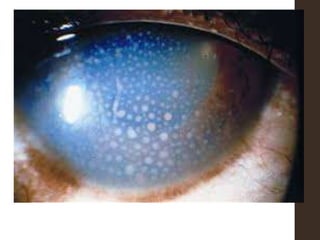
โ€ข Its accompanied by conjunctival injection and a granulomatous AC reaction
with mutton-fat KPs on the corneal endothelium.
โ€ข Poorly responsive pupil.
โ€ข The iris may thicken from lymphocytic infiltration; the severe inflammation
may lead to formation of posterior synechiae.
โ€ข Intraocular pressure may be elevated secondary to inflammatory cell blockage
of the trabecular meshwork, or it may lower as a result of ciliary body
shutdown.
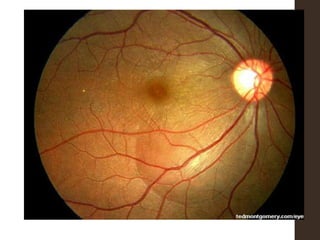
โ€ข Fundus- vitritis, papillitis, mid equatorial yellowish white choroidal lesions,
exudative RD.
DIFFERENTIAL DIAGNOSIS
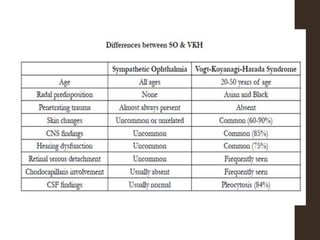
โ€ข Vogt-Koyanagi-Harada syndrome
โ€ข Lens induced uveitis
โ€ข Sarcoidosis
โ€ข Chronic idiopathic uveitis
โ€ข Tuberculosis
โ€ข Infective endophthalmitis
โ€ข Intraocular lymphoma
Management
โ€ข Oral corticosteroids (1.5-2mg/kg/BW)
โ€ข pulse therapy with intravenous methylprednisolone(up to 1 g daily
for 3 days)
โ€ข supplementation with sub-Tenonโ€™s injection of triamcinolone
acetonide (20โ€“40 mg)
โ€ข Intravitreal steroids- rapid therapy
โ€ข Topical steroids
โ€ข mydriatic/cycloplegic agents are used adjunctively as needed.
โ€ข Immunosuppresants- Cyclosporine A, cyclophosphamide,
Azathioprine, chlorambucil.
โ€ข anti-TNF agents (infliximab/Adalimumab) unresponsive to t/t
โ€ข Enucleation of the exciting eye (practiced earlier if done within 2
weeks of inflammation)
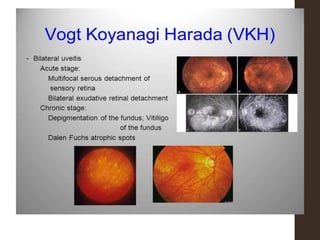
Vogtโ€“Koyanagiโ€“Harada
(VKH)
โ€ข Vogtโ€“Koyanagiโ€“Harada (VKH)-{ uveomeningio
encephalitic} disease is a BILATERAL
GRANULOMATOUS UVEITIS
โ€ข Often associated with exudative retinal detachment and
โ€ข extraocular manifestations:
๏ƒผ pleocytosis in the cerebrospinal
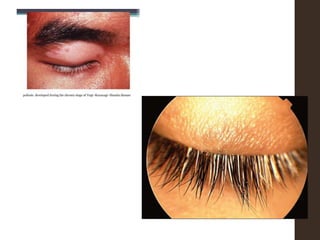
๏ƒผ Vitiligo
๏ƒผ Poliosis
๏ƒผ Alopecia
๏ƒผ dysacusis.
Epidemiology
โ€ข Individuals with a predisposing genetic background.
โ€ข Ethnic groups with more heavily pigmented skin.
โ€ข Asians, Native Americans, Hispanics, Asian Indians,
Middle Easterners.
โ€ข More common in Japan.
โ€ข Women more than men.
โ€ข 2nd โ€“ 5th decade.
โ€ข Pediatric age group may also be affected.
Aetiopathogenesis
โ€ข Remains unknown.
โ€ข T-LYMPHOCYTE MEDIATED AUTOIMMUNITY
DIRECTED AGAINST ONE OR MORE ANTIGENS
FOUND ON OR ASSOCIATED WITH MELANOCYTES
FOUND IN EYE, SKIN AND HAIR, INNER EAR, CNS.
โ€ข Tyrosinase family proteins are enzymes for melanin
formation and are expressed in melanocytes.
โ€ข There is a strong association with the human leukocyte
antigen (HLA) DR4 in Japanese patients with VKH
disease.
Pathology
โ€ข non-necrotizing diffuse granulomatous inflammation
involving the uvea
โ€ข Uvea is thickened by diffuse infiltration of lymphocytes
and macrophages, admixed with epithelioid cells and
multinucleated giant cells containing melanin granules.
โ€ข The neural retina is detached from the RPE, and the
subretinal space contains proteinaceous fluid exudates.
โ€ข Dalen-Fuchsโ€™ nodules: represent focal aggregates of
epithelioid histiocytes admixed with RPE, are located
between Bruchโ€™s membrane and the RPE.
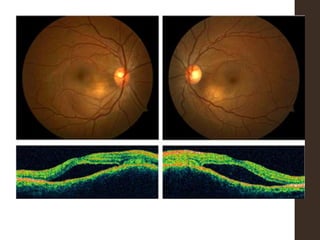
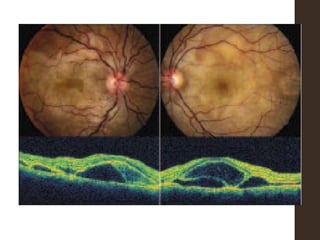
ACUTE Stage
โ€ข serous detachment of the retina,
โ€ข preservation of choriocapillaris from inflammatory cell
infiltration, and
โ€ข thickening of choroid from granulomatous inflammatory
cell infiltration-
Convalescent stage
โ€ข choroidal melanocytes decrease in number and
disappear,
โ€ข infiltration of lymphocytes and plasma cells in the
choroid
โ€ข resulting in the sunset glow appearance of the fundus.
chronic stage-
โ€ข formation of chorioretinal adhesions.
โ€ข the RPE and neural retina show degenerative changes .
โ€ข The RPE may reveal hyperplasia and fibrous metaplasia
with or without associated subretinal
neovascularization.
Clinical Features
โ€ข Integumentary Manifestations:
o Sensitivity of hair and skin to touch (early in prodromal
phase).
o Poliosis, vitiligo, alopecia (during convalescent stage).
โ€ข Neurologic Manifestations
o Most common during prodromal stage.
o Neck stiffness, headache, confusion.
o Occasionally focal neurologic signs.
o CSF pleocytosis.
โ€ข Auditory Manifestations
o May be presenting problem
o Sensorineural hearing loss usually involves higher
frequencies
o Tinnitus
o Vertigo
o May cause permanent hearing loss
Prodromal Phase:
โ€ข Mimics viral illness
โ€ข Neurologic and auditory manifestations
โ€ข Few days - duration
โ€ข Headache, orbital pain, stiff neck, malaise, abdominal
pain, nausea, fever, vertigo, tinnitus
โ€ข Cranial nerve palsies, optic neuritis (rare)
โ€ข CSF analysis- pleocytosis
Acute Uveitic Phase:
โ€ข Bilateral in 70% of patients, delay of 1-3 days before 2nd
eye becomes involved in 30%. In a few cases this interval
may last up to 10 days.
โ€ข Hallmark is bilateral multifocal exudative retinal
detachments, hyperemia and edema of the optic disc.
โ€ข Yellow-white lesions at level of RPE beneath serous RD.
โ€ข Thickening of posterior choroid manifested by elevation
of peripapillary retino-choroid layer.
โ€ข Retinal edema in posterior pole.
โ€ข Peripheral well-circumscribed yellow-white lesions
(clinical equivalent of Dalen-Fuchsโ€™ nodules).
โ€ข No inflammation of the anterior segment or mild to
moderate nongranulomatous anterior uveitis
โ€ข Acute angle closure glaucoma(inflammatory infiltrate in the
ciliary body and choroid may cause forward displacement of
the lens iris diaphragm)-shallow AC, elevated IOP
โ€ข Thickened choroid- B scan
โ€ข FFA- Alteration in RPE associated with multifocal choroidal
inflammation is easily observed by the hypofluorescence
dots at the early phase followed by multiple focal areas of
leakage and subretinal fluid accumulation at the late
phase.
โ€ข ICGA is useful to evaluate choroidal inflammatory changes
such as early choroidal stromal vessel hyperfluorescence
and leakage, and hypofluorescent dark dots at the level of
the choroid.
Convalescent Phase:
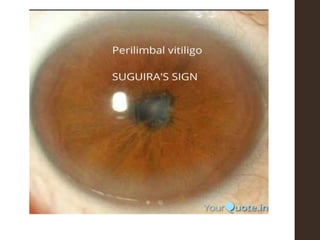
โ€ข Integumentary and uvea depigmentation.
โ€ข Perilimbal vitiligo-melanosis at the palisade of Vogt
(Sugiuraโ€™s sign).
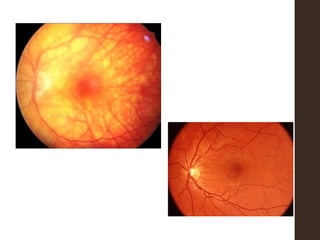
โ€ข Fundus exhibits an orange-red discoloration (โ€œsunset-
glowโ€ fundus).
โ€ข Multiple small yellow well-circumscribed areas of
chorioretinal atrophy representing regressed Dalen-
Fuchsโ€™ nodules.
โ€ข RPE clumping or migration.
โ€ข Pigmented demarcation lines.
Investigations
Diagnosis is made by clinical examination and ancillary
test findings
โ€ข Fluorescein angiography
โ€ข Indocyanine green angiography
โ€ข Ultrasonography
โ€ข Optical coherence tomography
โ€ข Multifocal electroretinograms
โ€ข Lumbar puncture
โ€ข Audiometry
Therapy
โ€ข Should be prompt and aggressive.
โ€ข Systemic corticosteroids are mainstay of therapy.
โ€ข 1-1.5 mg/kg/day of oral Prednisone (single morning-after-breakfast
dose).
โ€ข For 6-12 months with slow gradual tapering during this time.
โ€ข Intravenous high-dose pulse steroid therapy (1g/day of
Methylprednisolone given for 3 days) followed by oral Prednisone (1
mg/kg/day).
โ€ข Topical Prednisone 1% solution and cycloplegics for anterior uveitis.
โ€ข Patients adequately treated with corticosteroids have a fair visual
prognosis.
โ€ข Recurrences are associated with rapid or early decrease in steroid
doses.
โ€ข Patients treated initially with immunomodulatory drugs
(mycophenolate mofetil, cyclosporine A, azathioprine, and
methotrexate) combined with corticosteroids had a better visual
outcome than those who received corticosteroids as monotherapy.
โ€ข Immunomodulatory therapy combined with corticosteroids should
be considered as first-line therapy for patients with VKH.
โ€ข Use of mycophenolate mofetil as first-line therapy combined with
systemic corticosteroids is safe and effective in the treatment of
acute uveitis associated with VKH disease.
โ€ข It has marked corticosteroid-sparing effect and significantly
reduced development of chronic recurrent inflammation and late
complications and significantly improved visual outcome.
โ€ข response to subtenon injections of triamcinolone acetonide
โ€ข Anti-TNF-ฮฑ monoclonal antibody
Prognosis
โ€ข Visual prognosis is generally favorable.
โ€ข 87.5% achieved V.A. of โ‰ฅ20/40.
โ€ข High-dose systemic corticosteroids for >9 months with
slow tapering significantly improves the prognosis and
decreases risk of recurrence.
โ€ข Age older than 18 years is significantly associated with
the development of complications.
โ€ข Visual prognosis is generally favorable in children.
โ€ข Poor visual acuity and severe anterior segment
inflammation at presentation are significantly
associated with a worse outcome.
โ€ข Chronic recurrent disease is significantly associated
with more severe anterior segment inflammation and
less exudative retinal detachment at presentation, more
ocular complications and a worse visual outcome
compared with initial-onset disease.
โ€ข Use of immunomodulatory therapy as first-line therapy
combined with systemic corticosteroids significantly
improved clinical outcomes
Sympathetic ophthalmitis

Sympathetic ophthalmitis

  • 1.
  • 2.
    โ€ข Sympathetic ophthalmiais defined as a BILATERAL DIFFUSE, GRANULOMATOUS PANUVEITIS โ€ข That occurs after the uvea of one eye is subjected to a penetrating injury due to either accidental trauma or surgery. โ€ข The injured eye is known as the exciting eye and the fellow eye, developing inflammation days to years later, is the sympathizing eye.
  • 3.
    Epidemiology โ€ข Prevalence: relativelyrare disease (0.2%- trauma, 0.01%- ocular Sx) โ€ข Inheritance: No proven role. Postulated correlation of HLA DRB1, DQA1 . HLAA11, HLA-B40, HLA- DR4/DRw53. โ€ข Gender: M = F postsurgical; M > F traumatic โ€ข No racial predisposition โ€ข All ages, possible risk in the elderly or children <10years. โ€ข Surgical and Laser procedures like glaucoma filtration Sx, PI, scleral buckling, cataract Sx, evisceration, cyclocryotherapy and Nd:Yag laser cyclotherapy.
  • 4.
    Theories of pathogenesis โ€ขNeurogenic (extension from one eye to the other through the optic nerves and the optic chiasma) โ€ข Role of Ocular Immune Privilege: Not all cases of ocular injury progress to SO โ€ข The immune privileged ocular antigens in the exciting eye to the host immune system leading to the activation against these self antigens (such as choroidal melanocytes, melanin pigment or uveo retinal extracts including Retinal S antigen and interphotoreceptor retinoid binding protein) in both eyes. โ€ข T-cell proliferative response on exposure to uveal and uveoretinal extracts.
  • 13.
    Pathology โ€ข The inflammatorychanges in the exciting and sympathizing eyes are the same, except for features of trauma in the exciting eye. โ€ข Granulomatous Uveitis โ€“ โ€ข The minimal and classic changes for the histopathologic diagnosis of sympathetic ophthalmia are: ๏ƒ˜ diffuse lymphocytic infiltration of the uveal tract with epithelioid cell nests, ๏ƒ˜ pigment phagocytosis by the epithelioid cells, ๏ƒ˜ absence of necrosis, and ๏ƒ˜ sparing of the retina and choriocapillaris ( protective effect of RPE cells which release certain Anti inflamatory mediators like RPE protective protein, which supresses neutrophil superoxide generation) by the granulomatous process.
  • 14.
    Dalen-Fuch's nodules โ€ข Small,deep-yellow white nodules in the choroid. โ€ข occur mostly in the periphery and consist of epithelioid cells located just internal to Bruch's membrane. โ€ข Histopathologically they are nodular aggregations of lymphocytes and epitheloid cells with proliferation of retinal pigment epithelium. โ€ข THE CHORIOCAPILLARIS IS TYPICALLY SPARED
  • 18.
    โ€ข The intervalbetween ocular injury and the onset of sympathetic ophthalmia has been reported to be as short as 5 days or as long as 66 years. โ€ข In general, 65% of sympathetic ophthalmia cases occur 2 weeks to 3 months after injury โ€ข 90% occur before 1 year. โ€ข The traumatized eye in SO, characteristically exhibits a persistent granulomatous inflammatory reaction.
  • 19.
    Signs and symptoms โ€ขTHE EARLIEST SYMPTOM MAY BE DECREASED ACCOMMODATION โ€ข THE EARLIEST SIGN: RETROLENTICULAR FLARE AND CELLS IN THE FELLOW EYE. โ€ข Sympathetic ophthalmia presents as a bilateral diffuse uveitis. โ€ข Patients report insidious onset of blurry vision, pain, epiphora, and photophobia in the sympathizing, non-injured eye. โ€ข Its accompanied by conjunctival injection and a granulomatous AC reaction with mutton-fat KPs on the corneal endothelium. โ€ข Poorly responsive pupil. โ€ข The iris may thicken from lymphocytic infiltration; the severe inflammation may lead to formation of posterior synechiae. โ€ข Intraocular pressure may be elevated secondary to inflammatory cell blockage of the trabecular meshwork, or it may lower as a result of ciliary body shutdown. โ€ข Fundus- vitritis, papillitis, mid equatorial yellowish white choroidal lesions, exudative RD.
  • 20.
    DIFFERENTIAL DIAGNOSIS โ€ข Vogt-Koyanagi-Haradasyndrome โ€ข Lens induced uveitis โ€ข Sarcoidosis โ€ข Chronic idiopathic uveitis โ€ข Tuberculosis โ€ข Infective endophthalmitis โ€ข Intraocular lymphoma
  • 23.
    Management โ€ข Oral corticosteroids(1.5-2mg/kg/BW) โ€ข pulse therapy with intravenous methylprednisolone(up to 1 g daily for 3 days) โ€ข supplementation with sub-Tenonโ€™s injection of triamcinolone acetonide (20โ€“40 mg) โ€ข Intravitreal steroids- rapid therapy โ€ข Topical steroids โ€ข mydriatic/cycloplegic agents are used adjunctively as needed. โ€ข Immunosuppresants- Cyclosporine A, cyclophosphamide, Azathioprine, chlorambucil. โ€ข anti-TNF agents (infliximab/Adalimumab) unresponsive to t/t โ€ข Enucleation of the exciting eye (practiced earlier if done within 2 weeks of inflammation)
  • 24.
    Vogtโ€“Koyanagiโ€“Harada (VKH) โ€ข Vogtโ€“Koyanagiโ€“Harada (VKH)-{uveomeningio encephalitic} disease is a BILATERAL GRANULOMATOUS UVEITIS โ€ข Often associated with exudative retinal detachment and โ€ข extraocular manifestations: ๏ƒผ pleocytosis in the cerebrospinal ๏ƒผ Vitiligo ๏ƒผ Poliosis ๏ƒผ Alopecia ๏ƒผ dysacusis.
  • 25.
    Epidemiology โ€ข Individuals witha predisposing genetic background. โ€ข Ethnic groups with more heavily pigmented skin. โ€ข Asians, Native Americans, Hispanics, Asian Indians, Middle Easterners. โ€ข More common in Japan. โ€ข Women more than men. โ€ข 2nd โ€“ 5th decade. โ€ข Pediatric age group may also be affected.
  • 26.
    Aetiopathogenesis โ€ข Remains unknown. โ€ขT-LYMPHOCYTE MEDIATED AUTOIMMUNITY DIRECTED AGAINST ONE OR MORE ANTIGENS FOUND ON OR ASSOCIATED WITH MELANOCYTES FOUND IN EYE, SKIN AND HAIR, INNER EAR, CNS. โ€ข Tyrosinase family proteins are enzymes for melanin formation and are expressed in melanocytes. โ€ข There is a strong association with the human leukocyte antigen (HLA) DR4 in Japanese patients with VKH disease.
  • 27.
    Pathology โ€ข non-necrotizing diffusegranulomatous inflammation involving the uvea โ€ข Uvea is thickened by diffuse infiltration of lymphocytes and macrophages, admixed with epithelioid cells and multinucleated giant cells containing melanin granules. โ€ข The neural retina is detached from the RPE, and the subretinal space contains proteinaceous fluid exudates. โ€ข Dalen-Fuchsโ€™ nodules: represent focal aggregates of epithelioid histiocytes admixed with RPE, are located between Bruchโ€™s membrane and the RPE.
  • 32.
    ACUTE Stage โ€ข serousdetachment of the retina, โ€ข preservation of choriocapillaris from inflammatory cell infiltration, and โ€ข thickening of choroid from granulomatous inflammatory cell infiltration-
  • 33.
    Convalescent stage โ€ข choroidalmelanocytes decrease in number and disappear, โ€ข infiltration of lymphocytes and plasma cells in the choroid โ€ข resulting in the sunset glow appearance of the fundus.
  • 34.
    chronic stage- โ€ข formationof chorioretinal adhesions. โ€ข the RPE and neural retina show degenerative changes . โ€ข The RPE may reveal hyperplasia and fibrous metaplasia with or without associated subretinal neovascularization.
  • 35.
    Clinical Features โ€ข IntegumentaryManifestations: o Sensitivity of hair and skin to touch (early in prodromal phase). o Poliosis, vitiligo, alopecia (during convalescent stage). โ€ข Neurologic Manifestations o Most common during prodromal stage. o Neck stiffness, headache, confusion. o Occasionally focal neurologic signs. o CSF pleocytosis.
  • 37.
    โ€ข Auditory Manifestations oMay be presenting problem o Sensorineural hearing loss usually involves higher frequencies o Tinnitus o Vertigo o May cause permanent hearing loss
  • 38.
    Prodromal Phase: โ€ข Mimicsviral illness โ€ข Neurologic and auditory manifestations โ€ข Few days - duration โ€ข Headache, orbital pain, stiff neck, malaise, abdominal pain, nausea, fever, vertigo, tinnitus โ€ข Cranial nerve palsies, optic neuritis (rare) โ€ข CSF analysis- pleocytosis
  • 39.
    Acute Uveitic Phase: โ€ขBilateral in 70% of patients, delay of 1-3 days before 2nd eye becomes involved in 30%. In a few cases this interval may last up to 10 days. โ€ข Hallmark is bilateral multifocal exudative retinal detachments, hyperemia and edema of the optic disc. โ€ข Yellow-white lesions at level of RPE beneath serous RD. โ€ข Thickening of posterior choroid manifested by elevation of peripapillary retino-choroid layer. โ€ข Retinal edema in posterior pole. โ€ข Peripheral well-circumscribed yellow-white lesions (clinical equivalent of Dalen-Fuchsโ€™ nodules).
  • 40.
    โ€ข No inflammationof the anterior segment or mild to moderate nongranulomatous anterior uveitis โ€ข Acute angle closure glaucoma(inflammatory infiltrate in the ciliary body and choroid may cause forward displacement of the lens iris diaphragm)-shallow AC, elevated IOP โ€ข Thickened choroid- B scan โ€ข FFA- Alteration in RPE associated with multifocal choroidal inflammation is easily observed by the hypofluorescence dots at the early phase followed by multiple focal areas of leakage and subretinal fluid accumulation at the late phase. โ€ข ICGA is useful to evaluate choroidal inflammatory changes such as early choroidal stromal vessel hyperfluorescence and leakage, and hypofluorescent dark dots at the level of the choroid.
  • 41.
    Convalescent Phase: โ€ข Integumentaryand uvea depigmentation. โ€ข Perilimbal vitiligo-melanosis at the palisade of Vogt (Sugiuraโ€™s sign). โ€ข Fundus exhibits an orange-red discoloration (โ€œsunset- glowโ€ fundus). โ€ข Multiple small yellow well-circumscribed areas of chorioretinal atrophy representing regressed Dalen- Fuchsโ€™ nodules. โ€ข RPE clumping or migration. โ€ข Pigmented demarcation lines.
  • 44.
    Investigations Diagnosis is madeby clinical examination and ancillary test findings โ€ข Fluorescein angiography โ€ข Indocyanine green angiography โ€ข Ultrasonography โ€ข Optical coherence tomography โ€ข Multifocal electroretinograms โ€ข Lumbar puncture โ€ข Audiometry
  • 45.
    Therapy โ€ข Should beprompt and aggressive. โ€ข Systemic corticosteroids are mainstay of therapy. โ€ข 1-1.5 mg/kg/day of oral Prednisone (single morning-after-breakfast dose). โ€ข For 6-12 months with slow gradual tapering during this time. โ€ข Intravenous high-dose pulse steroid therapy (1g/day of Methylprednisolone given for 3 days) followed by oral Prednisone (1 mg/kg/day). โ€ข Topical Prednisone 1% solution and cycloplegics for anterior uveitis. โ€ข Patients adequately treated with corticosteroids have a fair visual prognosis. โ€ข Recurrences are associated with rapid or early decrease in steroid doses.
  • 46.
    โ€ข Patients treatedinitially with immunomodulatory drugs (mycophenolate mofetil, cyclosporine A, azathioprine, and methotrexate) combined with corticosteroids had a better visual outcome than those who received corticosteroids as monotherapy. โ€ข Immunomodulatory therapy combined with corticosteroids should be considered as first-line therapy for patients with VKH. โ€ข Use of mycophenolate mofetil as first-line therapy combined with systemic corticosteroids is safe and effective in the treatment of acute uveitis associated with VKH disease. โ€ข It has marked corticosteroid-sparing effect and significantly reduced development of chronic recurrent inflammation and late complications and significantly improved visual outcome. โ€ข response to subtenon injections of triamcinolone acetonide โ€ข Anti-TNF-ฮฑ monoclonal antibody
  • 47.
    Prognosis โ€ข Visual prognosisis generally favorable. โ€ข 87.5% achieved V.A. of โ‰ฅ20/40. โ€ข High-dose systemic corticosteroids for >9 months with slow tapering significantly improves the prognosis and decreases risk of recurrence. โ€ข Age older than 18 years is significantly associated with the development of complications. โ€ข Visual prognosis is generally favorable in children.
  • 48.
    โ€ข Poor visualacuity and severe anterior segment inflammation at presentation are significantly associated with a worse outcome. โ€ข Chronic recurrent disease is significantly associated with more severe anterior segment inflammation and less exudative retinal detachment at presentation, more ocular complications and a worse visual outcome compared with initial-onset disease. โ€ข Use of immunomodulatory therapy as first-line therapy combined with systemic corticosteroids significantly improved clinical outcomes