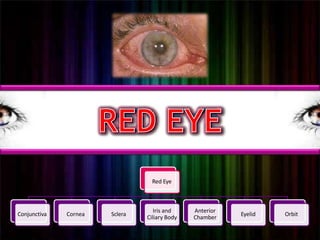
Red Eye
Conjunctiva Cornea Sclera
Iris and
Ciliary Body
Anterior
Chamber
Eyelid Orbit
• Red eye-non-specific term to describe an
eye that appears red due to
illness, injury, or some other condition
• Caused by enlarged, dilated blood
vessels, leading to the appearance of
redness on surface of eye
 Conjunctiva
– Conjunctivitis
– Dry eye
– Pterygium
– Subconjunctiva
l haemorrhage
– Trauma
 Cornea
– Abrasion
– Foreign body
– Laceration
– Corneal ulcer
– Keratitis
– Contact lens
wear
 Sclera
– Episcleritis
– Scleritis
 Iris and ciliary body
– Iritis
– Iridocyclitis
 Anterior chamber
– Hyphaema
– Acute angle
closure glaucoma
 Eyelid
– Triachiasis
– Entropion
– Ectropion
 Orbit
– Orbital cellulitis
– Acute
dacryocystitis
SYMPTOMS
⚫Pain –corneal ulcer, iritis, acute glaucoma
⚫Visual loss
⚫Eye discharge
 Purulent – bacterial conjunctivitis
Clear – viral or allergic cause
⚫Gritty sensation – common in conjunctivitis
⚫Itching – common in allergic eye
disease, blepharitis and topical drop
hypersensitivity
⚫Photophobia -panuveitis
1. Vesicles
2. Follicles
3. Ciliary flush
4. Irregular pupil
5. Papillae
6. Foreign body
7. Dilated conjunctival vessels
8. Discharge
9. Corneal ulcer
10. Hypopyon
11. Dendritic ulcer
12. Dilated episcleral vessels
1 2
3
4
5
6
7
8 10
9 11
12
Viral conjuctivitis
Conjuctivitis with follicular
blepharitis
• Characterize the symptoms:
• Duration – hours, days, weeks
Acute , Subacute and Chronic
• Types of discharge – clear, purulent, etc.
• Unilateral or bilateral
• Precipitating event – trauma, contact lens
usage
• Previous episodes of a similar problem
• Past medical history – DM, hypertension
• Allergic history
Red Eye
Conjunctiva Cornea Sclera
Iris and
Ciliary Body
Anterior
Chamber
Eyelid Orbit
• Thin, vascular mucous membrane/
epithelium
• Conjuntival causes of red eyes:
– Bact, viral, chlamydial, allergic
conjunctivitis, opthalmia neonatorum.
– dry eye, pterygium, subconjunctival
haemorrhage, injury.
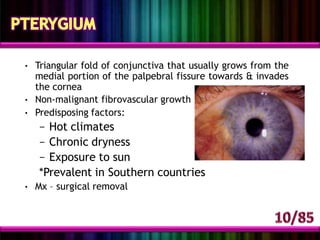
• Triangular fold of conjunctiva that usually grows from the
medial portion of the palpebral fissure towards & invades
the cornea
• Non-malignant fibrovascular growth
• Predisposing factors:
– Hot climates
– Chronic dryness
– Exposure to sun
*Prevalent in Southern countries
• Mx – surgical removal
• ‘Extensive bleeding under the
conjunctiva’
• Features: red eye, comfortable, no
visual disturbance,
• Hx of trauma, spontaneously in elderly
patient (compromised vascular struc in
arteriosclerosis), may occur after
coughing, sneezing, heavy lifting
objects.
• Mx: check BP , usually resolve
spontaneously within 2 weeks.
Red Eye
Conjunctiva Cornea Sclera
Iris and
Ciliary Body
Anterior
Chamber
Eyelid Orbit
Function:
•Transmission of light
•Refraction of light
•Barrier against infection, foreign bodies
5 layers
1.Epithelium
2.Bowman’s membrane
3.Stromal
4.Desscemet’s membrane
5.Endothelium
-extensive sensory fibre network(V1 distribution)
• Corneal abrasion
– epithelium defect due to
trauma, contact lens
– use fluorescein and blue light,
defect shine in green.
• Corneal foreign body
– foreign body in or on cornea.
– cause intense irritation and
profuse watering.
Mx
– Topical antibiotic (drop/ointment)
– Tropical NSAIDS, cyclopegic
– Tight patch
• Def : Inflammation of the cornea
• Type :
• Infective
– Bacterial
– Viral
– Protozoal
•Non Infective
– Autoimmune (eg: RA, SLE)
– Non Autoimmune (eg: Marginal keratitis)
 CAUSES - Staphylococcus epidermidis
- Staphylococcus aureus
- Streptococcus pneumoniae
- Coliforms
- Pseudomonas
- Haemophilis
 PREDISPOSING FACTOR
Keratoconjunctivitis sicca (dry eye)
 A breach in corneal epithelium
(eg following trauma)
Prolonged contact lens wear
Prolonged use of topical steroids
 SYMPTOMS & SIGNS
o severe pain
o purulent discharge
o ciliary injection
o visual loss
o hypopyon
o white corneal opacity, can be seen with naked eye
 MANAGEMENT
 Scrapes taken from base of ulcer for Gram-staining & culture
 Rx: Dual therapy of intensive topical antibiotics (eg: cefuroxime
for Gram +ve bacteria and gentamicin for Gram –ve bacteria)
 Monotherapy: fluoroquinolones (eg: ciprofloxacin, ofloxacin)
 Initially by tissue adhessive (cyanoacrylate glue) and subsequent
corneal graft– for severe or unresponsive disease where cornea
may perforate.
• Herpes simplex keratitis
– Causes: Type 1 or Type 2 Herpes Simplex Virus
– Most are asymptomatic
– Accompanied by:
• Fever
• Vesicular lid lesion
• Follicular conjunctivitis
• Pre-auricular lymphadenopathy
• Pathognomonic: dendritic ulcer on cornea
• Dendritic ulcer may heal without scar, but may progress to
stromal keratitis, a/w inflammatory infiltration, oedema and
ultimately loss of corneal transparency and permanent
scarring  if severe – corneal graft
• Rx: topical antivirus (trifluridine)– heal within 2 weeks.
 Herpes zoster ophthalmicus (ophthalmic shingles)
 Cause : Varicella zoster virus
 Area affected: ophthalmic division of CN V
 Accompanied by: prodromal period with systemically
unwell, vesicles, lid swelling, iritis, 2° glaucoma.
 Rx: - oral antiviral (eg: aciclovir, famciclovir) to
reduce post-infective neuralgia
- topical antiviral and steroids and
antibacterials to cover secondary infection for
the ocular disease.
White fibrous outer protective coat of eye
Continous with cornea ant and the dura of optic nerve posteriorly
Red Eye
Conjunctiva Cornea Sclera
Iris and
Ciliary Body
Anterior
Chamber
Eyelid Orbit
• Episcleritis
• Etiology
– Mostly idiopathic, rest collagen
vascular dz, infections(herpes
zoster,herpes
simplex,syphillis),IBD
• Rx
– Self-limited
– Tropical steroid if painful
• Scleritis
• Etiology
– 50% systemic
• collagen vascular dz
• Granulomatous
• Metabolic
• Infectious
• chemical/physical agents
– 50% idiopathic
• Rx
– Systemic NSAID/steroid
– Treat underlying etiology
Red Eye
Conjunctiva Cornea Sclera
Iris and
Ciliary Body
Anterior
Chamber
Eyelid Orbit
• Anterior chamber’s causes of red eyes:-
– Hyphaema
•is blood in the front (anterior) chamber of the
eye. It may appear as a reddish tinge, or it may
appear as a small pool of blood at the bottom of
the iris or in the cornea.
– Acute Congestive Glaucoma
Red Eye
Conjunctiva Cornea Sclera
Iris and
Ciliary Body
Anterior
Chamber
Eyelid Orbit
• Irritation of cornea due to aberrant eyelashes grow inward
with a normal eyelid position.
• May result from chronic inflammatory lid
diseases(blepharitis), Steven-johnson syn, trauma,burn etc
• Rx: - topical lubricant
-epilation with forceps
- electrolysis for
isolated lashes
- cryotherapy
- laser ablation
-surgery in cases resistant
to other treatment.
• Eversion of the lid leads to disruption of tears flow.
• Types:-
– Congenital
– Involutionary (senile) ectropion
• Affects lower lid of elderly(weak orbicularis oculi)
• Results in epiphora
– Cicatrical ectropion
• Caused by scarring or contracture of skin and underlying tissue, pulling eyelid
away from the globe
• Defect may be local (trauma) or general (burns or dermatitis)
– Paralytic ectropion
• Caused by facial nerve palsy
– Mechanical ectropion
• Caused by lid edema, herniated fat or tumour on or near the lid margin which
mechanically evert the lid.
• Irritation of eye and cornea due to inturning, usually of the lower
lid.
• Types:-
– Orbicularis oculi muscle spasm
– Involutionary (senile) entropion
• Affects mainly lower lid
• Constant rubbing of lashes in longstanding cases results in ulceration and
pannus formation.
– Cicatrical entropion
• Both eyelids can be affected
• Caused by severe scarring of palpebral conjunctiva, which pulls the lid margin
towards the globe
– Congenital entropion
• Caused by improper development of retractor aponeurosis insertion into
inferior border of tarsal plate.
• Sign: inturning of entire lower eyelid and lashes with absence of lower lid
crease.
Red Eye
Conjunctiva Cornea Sclera
Iris and
Ciliary Body
Anterior
Chamber
Eyelid Orbit
• Inflammation of orbital contents posterior to orbital
septum
• Can cause blindness & may spread to cause brain abscess.
• Often arises from adjacent ethmoid
sinus.(facial,toothinfection/trauma)
• Cause: Haemophilus infuenzae
• Symptoms & signs:
 painfull eye
 periorbital inflammation and swelling
 reduced eye movement
 conjunctival injection
 possible visual loss
 systemic illness and fever
• Rx: intravenous broad spectrum
antibiotics
Panophthalmitis
Purulent inflammation of all layers of the eye
Acute dacryoadenitis
Inflammation of the lacrimal
gland
Red Eye
Corneal Ulcer
Acute
Conjunctivitis
Acute
Iridocyclitis
Acute
Congestive
Glaucoma
• Discontinuation in normal epithelial surface of cornea a/w necrosis of
surrounding corneal tissue.
• Etiology:
– primary event due to bacterial, rarely viral ,fungal or protozoan
infections(acanthamoeba).
– secondary event that has compromised the eye – eg: corneal
exposure, abrasion, foreign body, contact lens
– associated with conjuctivitis, blepharitis, keratitis, vit A deficency.
• Symptoms : - red eye
- pain (main feature)  worsened by movement of eyelids
persists until healing occur. (not if herpes zoster opthalmicus)
- photophobia
- watery or mucopurulent discharge
• Signs: - normal or reduced V
A (central ulcer)
- generalized or localized conjunctival injection
- hazziness of the cornea
- hypopyon.
• Fluorescein MUST be used to see the ulcer
Red Eye
CornealUlcer
Acute
Conjunctivitis
Acute
Iridocyclitis
Acute
Congestive
Glaucoma
• Investigation:
– usually diagnosed through clinical appearance).
– swabs and culture to identify causative organism.
• Management: (urgent referral)
Drops & ointment of broad spectrum antibiotics.
Topical antiviral – for herpetic corneal infection
Cycloplegic drops – relieve pain resulting from
spasm of ciliary muscle and prevent adhesion of the
iris to the lens.
Topical steroids – reduce local inflammatory damage
 Complications
- Decreased vision
- Corneal perforation
- Iritis
- Endophtalmitis
- Inflammation of the
conjunctiva
- ACUTE vs CHRONIC
- Aetiology:
INFECTIOUS NON-INFECTIOUS
-Bacteria
- Viral
- Chlamydia
- Neonatal
-Allergic (acute vs
chronic)
- Toxic (due to irritants e.g
smoke,dust)
- due to other disease
(Steven-Johnson
syndrome)
Red Eye
CornealUlcer
Acute
Conjunctivitis
Acute
Iridocyclitis
Acute
Congestive
Glaucoma
•Aetiology:
– Staphylococcus, Streptococcus, Pneumococcus, Haemophil
us
• Patient presents with:
– red eye, purulent discharge yellow crusts, ocular
irritation (gritty, burning & pain sensation).
– History of contact with infected person. Usually unilateral
 bilateral.
• Findings:
– Chemosis, papillae, round & reactive pupil, normal vision.
Fluorescein drops  no staining of the cornea
• Investigations:
– not routinely done(diagnosed from the typical S&S).
• Management:
– usually self-limiting. Fails to resolve  conjunctival
swabs for C&S.
• General measures:
– wipe off all discharge & not sharing towel (prevent
spread of infection)
• Specific:
– 1)Antibiotic drops  hasten resolution (used day time,
broad spectrum e.g chloramphenicol, gentamicin)
– 2)Antibiotic ointment (used at night, during sleep).
Purulent discharge
•Aetiology:
– Adenovirus (commonest, highly contagious 
epidemic), Coxsackie, Herpes Simplex.
– Systemic infection – influenza virus, Epstein-Barr
virus, paramycovirus (measles, mumps) &
rubella.
•Patient presents with:
– Acute onset of diffuse red eye, discharge
(watery), excessive
lacrimation/epiphora, photophobia & feel
discomfort, cough & cold (AdenovirusURTI)
• Findings:
– last longer than bacterial type, diffuse conjunctival
injection, preauricular lymphadenopathy, follicles &
chemosis, lid oedema.
• Management:
– Self limiting condition. Antibiotic eye drops (for
example, chloramphenicol)  symptomatic relief,
prevent secondary bacterial infection.
– Chronic, protracted course  persistent corneal
lesions and symptoms  steroid eye drops may be
indicated
• Use cold compresses &
lubricants e.g. artificial
tears for comfort.
• Topical vasoconstrictors &
anti-histamines – for severe
itchiness.
• Strict hygiene (highly
contagious).
Viral conjunctivitis
Adenovirus conjunctivitis of the right eye and
enlarged preauricular nodes
• Different serotypes are responsible for 2 forms of ocular
infections:
– Inclusion keratoconjunctivis
– Trachoma
• Investigations:
– Often difficult and special bacteriological tests may be
necessary to confirm the clinical suspicions
– Culture of scrapes.
– Giemsa stain to screen for intracellular inclusion body of
Chlamydia.
– Presents of Chlamydial antigens using immunofluorescence.
• STD, serotypes D-K. Not treated adequately  chronic course (up to
18 months).
• S+S: palpebral conjunctival follicles, preauricular
lymphadenopathy, watery/stringy mucopurulent
discharge, micropannus associated with subepithelial
scarring, chemosis, lid oedema
• a/w GU symptoms (vaginitis, cervicitis, urethritis) and unresponsive
to antibiotics
• Management:
– topical and systemic erythromycin, tetracycline (C/I neonates and
pregnant women).
– Associated venereal disease should also be treated
– check the partner for symptoms or signs of venereal disease
• Commonest infective cause of blindness
• Serotypes A-C, chronic, endemic in unhygienic places.
• Vector: housefly. Encouraged by poor hygiene,
overcrowded, dry, and hot climate.
• Signs: subconjunctival fibrosis (hallmark), diffuse
inflammation papillary enlargement, follicles, trichiasis
(eyelashes directed backwards), corneal scarring
(recurrent keratitis and trichiasis) blindness.
• Management:
– Oral/ topical tetracycline or erythromycin.
– Azythromycin (alternative) single oral dose.
– Entropion and trichiasis  surgery.
Trachoma: scarred tarsal plate
Chlamydial conjunctivitis
• ACUTE VS CHRONIC (important to differentiate)
• Feat: usually both eyes. Itchiness (main feature),
lid swell, conjunctival injection, chemosis
• Mostly after allergen exposure and settles after
few hours
• Family history of atopy, recent contact with
chemicals or eye drops usually present.
• Similar symptoms may have occurred in the same
season in previous years.
Types of allergic conjunctivitis:
• Seasonal allergic conjunctivitis (SAC)
• Perennial allergic conjunctivitis (PAC)
• Vernal keratoconjunctivitis (VKC)
• Atopic keratoconjunctivitis (AKC)
• Giant papillary conjunctivitis (GPC)
 Rapid onset (IgE-mediated)
 Features: itchy, lid swelling, conjunctival injection and
oedema (chemosis), lacrimation.
 2 type:
 seasonal allergic conjunctivitis - hay fever at time of high
environmental pollen, seasonal in pattern.
 perennial allergic conjunctivitis- caused by allergens other than
pollen (eg: house dust mite), no seasonal pattern.
 Management:
 topical antihistamine (levocabastine)
 systemic antihistamine (terfenadine)
 Mast cell stabilizers (e.g. sodium
cromoglycate, nodocromyl, iodoxamide)
 VKC and AKC. GPC( not a true ouclar allergic reaction).
 Often affect male children with history of atopy
 Signs and Symptoms:
 Itchiness
 lacrimation
 redness both eye
 Photophobia
 Limbal follicles and white spots
 giant cobblestone ~ papillary conjunctivitis coalesce
 Ulcer and infiltration ~ vernal keratoconjunctivitis
 Mucoid discharge ~ giant papillary conjunctivitis (allergy to
foreign body)
• Management:
– Inital therapy: mast cells stabilizers or
antihistamines, or agents with both
properties (eg. Olopatidine)
– Topical steroids (severe cases)
– GPC topical mast cell stabilizers. Stop for a
period of time or permanently lens wear.
Chemosis
Large papillae (giant cobblestone )
• Neonatal conjunctivitis.
• Any conjunctivitis occurs in the 1st 28 days of life.
Notifiable disease
• Important: immature eye defences → severe
conjunctivitis, with membrane formation and bleeding
→ serious corneal disease and blindness.
• 2 important causative agents:
– Neisseria gonorrhoea (corneal perforation)
– Chlamydia trachomatis (chronic corneal scarring)
*Exclude venereal disease in parents
• Other causes: Bact conjunctivitis (usually gram
+ve), HSV (corneal scarring).
• DDx:
Congenital blocked nasolacrimal gland
Congenital glaucoma
• Corneal examination is important  exclude any ulceration.
• Management:
– refer to ophthalmologist
– Swab and send for culture test (mandatory)
– N.gonorrhoeae penicillin topically (local disease) and systemically
(systemic disease)
– Chlamydia  topical tetracycline ointment (local disease) and systemic
erythromycin (systemic disease)
– HSV  topical antivirals
Red Eye
Conjunctiva Cornea Sclera
Iris and
Ciliary Body
Anterior
Chamber
Eyelid Orbit
Inflammation of the uveal tract ( iris, ciliary
body, choroid)
Uveitis
Anterior
Uveitis
Iritis Iridocyclitis Cyclitis
Posterior
Uveitis
Choroiditis
Red Eye
Corneal Ulcer
Acute
Conjunctivitis
Acute
Iridocyclitis
Acute
Congestive
Glaucoma
• Inflammatory - due to autoimmune disease
• Infectious - caused by known ocular and systemic
pathogens
• Infiltrative - secondary to invasive neoplastic
processes
• Injurious - due to trauma
• Iatrogenic - caused by surgery, inadvertent
trauma, or medication
• Inherited - secondary to metabolic or dystrophic
disease
• Ischaemic - caused by impaired circulation
• Idiopathic - a category used when thorough
evaluation has failed to find an underlying cause
• Ocular pain
• Photophobia
• Blurring of vision
• Red eye
1) sarcoidosis, TB - SOB, cough
2) Behcet’s, psoriasis - skin problems
3)ankylosing spondylitis, juvenile chronic
arthritis, Reiter’s - back pain, arthritis
4) IBD - alteration of bowel habit
5) In AIDS
– Cytomegalovirus
– Human syncytial virus
– Cryptococcus
– Toxoplasma
– Candida
• Reduced visual acuity
• Ciliary injection : diffuse superficial conjunctival
hyperemia that would indicate conjunctivitis, as
opposed to the circumlimbal redness of anterior
uveitis. Blurred vision and photophobia are usually
absent with conjunctivitis.
• Keratitic precipitates ( on corneal endothelium) : in
acute cases KPs may be fine and white; in chronic
cases, large and yellowish. Colored or pigmented KPs
suggest prior episodes of anterior uveitis.
• Hypopyon
• Vessels on iris dilated
• Pigment and fibrin deposits on the anterior
surface of the lens are suggestive of synechiae.
The presence or absence of posterior subcapsular
cataract should be well documented because PSC
is a frequent complication of both the disease
and the therapy.
• Posterior synechiae - irregular pupil
• Anterior synechiae - may occlude drainage angle
Marked circumcorneal
congestion with contracting
fibrin in the anterior chamber
and a pupil in mid-mydriasis.
Posterior synechiae
between iris and lens
after iridocyclitis give the
pupil the shape of
cloverleaves
• Sympathetic ophthalmia (sometimes
referred to as sympathetic ophthalmitis
or sympathetic uveitis) is a rare form of
bilateral panuveitis. It is a specific type
of uveitis in response to trauma to one of
the eyes.
• A first episode of unilateral nongranulomatous acute uveitis
can be diagnosed by history and clinical examination alone
and does not need laboratory investigation.
If history and examination are normal but the uveitis is
granulomatous, recurrent or bilateral, the following
screening investigations should be carried out:
• Full blood count and ESR
• HLA-B27
• Antinuclear antibody
• Screening tests for syphilis and tuberculosis
• Chest x-ray
• General measures
Drops to dilate the pupil (cyclopegics) such as cyclopentolate 1% or
atropine 1% should be prescribed, but this is best done by a specialist
as this treatment is contraindicated in narrow angle glaucoma.
- To prevent adhesion of the iris to the anterior lens capsule(posterior
synechia), which can lead to iris bombe and elevated IOP
- To stabilize the blood-aqueous barrier and help prevent further
protein leakage (flare).
- To relieve pain by immobilizing the iris
When using cyclopegics, the patient should be warned that the pupil
will appear large and they will have a temporary problem with vision
in the eye in which the drops have been administered.
• Steroids
Steroid eye drops such as prednisolone 1% are the
first line treatment for the management of the
inflammation.
In more severe cases, steroid injection or even
systemic therapy may be required.
They should normally be prescribed by a specialist, as
they can cause corneal ulceration when the diagnosis
is herpes simplex infection, steroid glaucoma and on
prolonged use, steroid cataract.
...for not sleeping

2 red eye.pptx

  • 1.
    Red Eye Conjunctiva CorneaSclera Iris and Ciliary Body Anterior Chamber Eyelid Orbit
  • 2.
    • Red eye-non-specificterm to describe an eye that appears red due to illness, injury, or some other condition • Caused by enlarged, dilated blood vessels, leading to the appearance of redness on surface of eye
  • 3.
     Conjunctiva – Conjunctivitis –Dry eye – Pterygium – Subconjunctiva l haemorrhage – Trauma  Cornea – Abrasion – Foreign body – Laceration – Corneal ulcer – Keratitis – Contact lens wear  Sclera – Episcleritis – Scleritis  Iris and ciliary body – Iritis – Iridocyclitis  Anterior chamber – Hyphaema – Acute angle closure glaucoma  Eyelid – Triachiasis – Entropion – Ectropion  Orbit – Orbital cellulitis – Acute dacryocystitis
  • 4.
    SYMPTOMS ⚫Pain –corneal ulcer,iritis, acute glaucoma ⚫Visual loss ⚫Eye discharge  Purulent – bacterial conjunctivitis Clear – viral or allergic cause ⚫Gritty sensation – common in conjunctivitis ⚫Itching – common in allergic eye disease, blepharitis and topical drop hypersensitivity ⚫Photophobia -panuveitis
  • 5.
    1. Vesicles 2. Follicles 3.Ciliary flush 4. Irregular pupil 5. Papillae 6. Foreign body 7. Dilated conjunctival vessels 8. Discharge 9. Corneal ulcer 10. Hypopyon 11. Dendritic ulcer 12. Dilated episcleral vessels 1 2 3 4 5 6 7 8 10 9 11 12
  • 6.
  • 7.
    • Characterize thesymptoms: • Duration – hours, days, weeks Acute , Subacute and Chronic • Types of discharge – clear, purulent, etc. • Unilateral or bilateral • Precipitating event – trauma, contact lens usage • Previous episodes of a similar problem • Past medical history – DM, hypertension • Allergic history
  • 8.
    Red Eye Conjunctiva CorneaSclera Iris and Ciliary Body Anterior Chamber Eyelid Orbit
  • 9.
    • Thin, vascularmucous membrane/ epithelium • Conjuntival causes of red eyes: – Bact, viral, chlamydial, allergic conjunctivitis, opthalmia neonatorum. – dry eye, pterygium, subconjunctival haemorrhage, injury.
  • 10.
    • Triangular foldof conjunctiva that usually grows from the medial portion of the palpebral fissure towards & invades the cornea • Non-malignant fibrovascular growth • Predisposing factors: – Hot climates – Chronic dryness – Exposure to sun *Prevalent in Southern countries • Mx – surgical removal
  • 11.
    • ‘Extensive bleedingunder the conjunctiva’ • Features: red eye, comfortable, no visual disturbance, • Hx of trauma, spontaneously in elderly patient (compromised vascular struc in arteriosclerosis), may occur after coughing, sneezing, heavy lifting objects. • Mx: check BP , usually resolve spontaneously within 2 weeks.
  • 12.
    Red Eye Conjunctiva CorneaSclera Iris and Ciliary Body Anterior Chamber Eyelid Orbit
  • 13.
    Function: •Transmission of light •Refractionof light •Barrier against infection, foreign bodies 5 layers 1.Epithelium 2.Bowman’s membrane 3.Stromal 4.Desscemet’s membrane 5.Endothelium -extensive sensory fibre network(V1 distribution)
  • 14.
    • Corneal abrasion –epithelium defect due to trauma, contact lens – use fluorescein and blue light, defect shine in green. • Corneal foreign body – foreign body in or on cornea. – cause intense irritation and profuse watering. Mx – Topical antibiotic (drop/ointment) – Tropical NSAIDS, cyclopegic – Tight patch
  • 15.
    • Def :Inflammation of the cornea • Type : • Infective – Bacterial – Viral – Protozoal •Non Infective – Autoimmune (eg: RA, SLE) – Non Autoimmune (eg: Marginal keratitis)
  • 16.
     CAUSES -Staphylococcus epidermidis - Staphylococcus aureus - Streptococcus pneumoniae - Coliforms - Pseudomonas - Haemophilis  PREDISPOSING FACTOR Keratoconjunctivitis sicca (dry eye)  A breach in corneal epithelium (eg following trauma) Prolonged contact lens wear Prolonged use of topical steroids
  • 17.
     SYMPTOMS &SIGNS o severe pain o purulent discharge o ciliary injection o visual loss o hypopyon o white corneal opacity, can be seen with naked eye  MANAGEMENT  Scrapes taken from base of ulcer for Gram-staining & culture  Rx: Dual therapy of intensive topical antibiotics (eg: cefuroxime for Gram +ve bacteria and gentamicin for Gram –ve bacteria)  Monotherapy: fluoroquinolones (eg: ciprofloxacin, ofloxacin)  Initially by tissue adhessive (cyanoacrylate glue) and subsequent corneal graft– for severe or unresponsive disease where cornea may perforate.
  • 18.
    • Herpes simplexkeratitis – Causes: Type 1 or Type 2 Herpes Simplex Virus – Most are asymptomatic – Accompanied by: • Fever • Vesicular lid lesion • Follicular conjunctivitis • Pre-auricular lymphadenopathy • Pathognomonic: dendritic ulcer on cornea • Dendritic ulcer may heal without scar, but may progress to stromal keratitis, a/w inflammatory infiltration, oedema and ultimately loss of corneal transparency and permanent scarring  if severe – corneal graft • Rx: topical antivirus (trifluridine)– heal within 2 weeks.
  • 20.
     Herpes zosterophthalmicus (ophthalmic shingles)  Cause : Varicella zoster virus  Area affected: ophthalmic division of CN V  Accompanied by: prodromal period with systemically unwell, vesicles, lid swelling, iritis, 2° glaucoma.  Rx: - oral antiviral (eg: aciclovir, famciclovir) to reduce post-infective neuralgia - topical antiviral and steroids and antibacterials to cover secondary infection for the ocular disease.
  • 21.
    White fibrous outerprotective coat of eye Continous with cornea ant and the dura of optic nerve posteriorly Red Eye Conjunctiva Cornea Sclera Iris and Ciliary Body Anterior Chamber Eyelid Orbit
  • 22.
    • Episcleritis • Etiology –Mostly idiopathic, rest collagen vascular dz, infections(herpes zoster,herpes simplex,syphillis),IBD • Rx – Self-limited – Tropical steroid if painful • Scleritis • Etiology – 50% systemic • collagen vascular dz • Granulomatous • Metabolic • Infectious • chemical/physical agents – 50% idiopathic • Rx – Systemic NSAID/steroid – Treat underlying etiology
  • 23.
    Red Eye Conjunctiva CorneaSclera Iris and Ciliary Body Anterior Chamber Eyelid Orbit
  • 24.
    • Anterior chamber’scauses of red eyes:- – Hyphaema •is blood in the front (anterior) chamber of the eye. It may appear as a reddish tinge, or it may appear as a small pool of blood at the bottom of the iris or in the cornea. – Acute Congestive Glaucoma
  • 25.
    Red Eye Conjunctiva CorneaSclera Iris and Ciliary Body Anterior Chamber Eyelid Orbit
  • 26.
    • Irritation ofcornea due to aberrant eyelashes grow inward with a normal eyelid position. • May result from chronic inflammatory lid diseases(blepharitis), Steven-johnson syn, trauma,burn etc • Rx: - topical lubricant -epilation with forceps - electrolysis for isolated lashes - cryotherapy - laser ablation -surgery in cases resistant to other treatment.
  • 27.
    • Eversion ofthe lid leads to disruption of tears flow. • Types:- – Congenital – Involutionary (senile) ectropion • Affects lower lid of elderly(weak orbicularis oculi) • Results in epiphora – Cicatrical ectropion • Caused by scarring or contracture of skin and underlying tissue, pulling eyelid away from the globe • Defect may be local (trauma) or general (burns or dermatitis) – Paralytic ectropion • Caused by facial nerve palsy – Mechanical ectropion • Caused by lid edema, herniated fat or tumour on or near the lid margin which mechanically evert the lid.
  • 29.
    • Irritation ofeye and cornea due to inturning, usually of the lower lid. • Types:- – Orbicularis oculi muscle spasm – Involutionary (senile) entropion • Affects mainly lower lid • Constant rubbing of lashes in longstanding cases results in ulceration and pannus formation. – Cicatrical entropion • Both eyelids can be affected • Caused by severe scarring of palpebral conjunctiva, which pulls the lid margin towards the globe – Congenital entropion • Caused by improper development of retractor aponeurosis insertion into inferior border of tarsal plate. • Sign: inturning of entire lower eyelid and lashes with absence of lower lid crease.
  • 31.
    Red Eye Conjunctiva CorneaSclera Iris and Ciliary Body Anterior Chamber Eyelid Orbit
  • 32.
    • Inflammation oforbital contents posterior to orbital septum • Can cause blindness & may spread to cause brain abscess. • Often arises from adjacent ethmoid sinus.(facial,toothinfection/trauma) • Cause: Haemophilus infuenzae • Symptoms & signs:  painfull eye  periorbital inflammation and swelling  reduced eye movement  conjunctival injection  possible visual loss  systemic illness and fever • Rx: intravenous broad spectrum antibiotics
  • 33.
    Panophthalmitis Purulent inflammation ofall layers of the eye Acute dacryoadenitis Inflammation of the lacrimal gland
  • 34.
  • 35.
    • Discontinuation innormal epithelial surface of cornea a/w necrosis of surrounding corneal tissue. • Etiology: – primary event due to bacterial, rarely viral ,fungal or protozoan infections(acanthamoeba). – secondary event that has compromised the eye – eg: corneal exposure, abrasion, foreign body, contact lens – associated with conjuctivitis, blepharitis, keratitis, vit A deficency. • Symptoms : - red eye - pain (main feature)  worsened by movement of eyelids persists until healing occur. (not if herpes zoster opthalmicus) - photophobia - watery or mucopurulent discharge • Signs: - normal or reduced V A (central ulcer) - generalized or localized conjunctival injection - hazziness of the cornea - hypopyon. • Fluorescein MUST be used to see the ulcer Red Eye CornealUlcer Acute Conjunctivitis Acute Iridocyclitis Acute Congestive Glaucoma
  • 36.
    • Investigation: – usuallydiagnosed through clinical appearance). – swabs and culture to identify causative organism. • Management: (urgent referral) Drops & ointment of broad spectrum antibiotics. Topical antiviral – for herpetic corneal infection Cycloplegic drops – relieve pain resulting from spasm of ciliary muscle and prevent adhesion of the iris to the lens. Topical steroids – reduce local inflammatory damage  Complications - Decreased vision - Corneal perforation - Iritis - Endophtalmitis
  • 37.
    - Inflammation ofthe conjunctiva - ACUTE vs CHRONIC - Aetiology: INFECTIOUS NON-INFECTIOUS -Bacteria - Viral - Chlamydia - Neonatal -Allergic (acute vs chronic) - Toxic (due to irritants e.g smoke,dust) - due to other disease (Steven-Johnson syndrome) Red Eye CornealUlcer Acute Conjunctivitis Acute Iridocyclitis Acute Congestive Glaucoma
  • 38.
    •Aetiology: – Staphylococcus, Streptococcus,Pneumococcus, Haemophil us • Patient presents with: – red eye, purulent discharge yellow crusts, ocular irritation (gritty, burning & pain sensation). – History of contact with infected person. Usually unilateral  bilateral. • Findings: – Chemosis, papillae, round & reactive pupil, normal vision. Fluorescein drops  no staining of the cornea
  • 39.
    • Investigations: – notroutinely done(diagnosed from the typical S&S). • Management: – usually self-limiting. Fails to resolve  conjunctival swabs for C&S. • General measures: – wipe off all discharge & not sharing towel (prevent spread of infection) • Specific: – 1)Antibiotic drops  hasten resolution (used day time, broad spectrum e.g chloramphenicol, gentamicin) – 2)Antibiotic ointment (used at night, during sleep).
  • 40.
  • 41.
    •Aetiology: – Adenovirus (commonest,highly contagious  epidemic), Coxsackie, Herpes Simplex. – Systemic infection – influenza virus, Epstein-Barr virus, paramycovirus (measles, mumps) & rubella. •Patient presents with: – Acute onset of diffuse red eye, discharge (watery), excessive lacrimation/epiphora, photophobia & feel discomfort, cough & cold (AdenovirusURTI)
  • 42.
    • Findings: – lastlonger than bacterial type, diffuse conjunctival injection, preauricular lymphadenopathy, follicles & chemosis, lid oedema. • Management: – Self limiting condition. Antibiotic eye drops (for example, chloramphenicol)  symptomatic relief, prevent secondary bacterial infection. – Chronic, protracted course  persistent corneal lesions and symptoms  steroid eye drops may be indicated
  • 43.
    • Use coldcompresses & lubricants e.g. artificial tears for comfort. • Topical vasoconstrictors & anti-histamines – for severe itchiness. • Strict hygiene (highly contagious). Viral conjunctivitis Adenovirus conjunctivitis of the right eye and enlarged preauricular nodes
  • 44.
    • Different serotypesare responsible for 2 forms of ocular infections: – Inclusion keratoconjunctivis – Trachoma • Investigations: – Often difficult and special bacteriological tests may be necessary to confirm the clinical suspicions – Culture of scrapes. – Giemsa stain to screen for intracellular inclusion body of Chlamydia. – Presents of Chlamydial antigens using immunofluorescence.
  • 45.
    • STD, serotypesD-K. Not treated adequately  chronic course (up to 18 months). • S+S: palpebral conjunctival follicles, preauricular lymphadenopathy, watery/stringy mucopurulent discharge, micropannus associated with subepithelial scarring, chemosis, lid oedema • a/w GU symptoms (vaginitis, cervicitis, urethritis) and unresponsive to antibiotics • Management: – topical and systemic erythromycin, tetracycline (C/I neonates and pregnant women). – Associated venereal disease should also be treated – check the partner for symptoms or signs of venereal disease
  • 46.
    • Commonest infectivecause of blindness • Serotypes A-C, chronic, endemic in unhygienic places. • Vector: housefly. Encouraged by poor hygiene, overcrowded, dry, and hot climate. • Signs: subconjunctival fibrosis (hallmark), diffuse inflammation papillary enlargement, follicles, trichiasis (eyelashes directed backwards), corneal scarring (recurrent keratitis and trichiasis) blindness. • Management: – Oral/ topical tetracycline or erythromycin. – Azythromycin (alternative) single oral dose. – Entropion and trichiasis  surgery.
  • 47.
    Trachoma: scarred tarsalplate Chlamydial conjunctivitis
  • 48.
    • ACUTE VSCHRONIC (important to differentiate) • Feat: usually both eyes. Itchiness (main feature), lid swell, conjunctival injection, chemosis • Mostly after allergen exposure and settles after few hours • Family history of atopy, recent contact with chemicals or eye drops usually present. • Similar symptoms may have occurred in the same season in previous years.
  • 49.
    Types of allergicconjunctivitis: • Seasonal allergic conjunctivitis (SAC) • Perennial allergic conjunctivitis (PAC) • Vernal keratoconjunctivitis (VKC) • Atopic keratoconjunctivitis (AKC) • Giant papillary conjunctivitis (GPC)
  • 50.
     Rapid onset(IgE-mediated)  Features: itchy, lid swelling, conjunctival injection and oedema (chemosis), lacrimation.  2 type:  seasonal allergic conjunctivitis - hay fever at time of high environmental pollen, seasonal in pattern.  perennial allergic conjunctivitis- caused by allergens other than pollen (eg: house dust mite), no seasonal pattern.  Management:  topical antihistamine (levocabastine)  systemic antihistamine (terfenadine)  Mast cell stabilizers (e.g. sodium cromoglycate, nodocromyl, iodoxamide)
  • 51.
     VKC andAKC. GPC( not a true ouclar allergic reaction).  Often affect male children with history of atopy  Signs and Symptoms:  Itchiness  lacrimation  redness both eye  Photophobia  Limbal follicles and white spots  giant cobblestone ~ papillary conjunctivitis coalesce  Ulcer and infiltration ~ vernal keratoconjunctivitis  Mucoid discharge ~ giant papillary conjunctivitis (allergy to foreign body)
  • 52.
    • Management: – Initaltherapy: mast cells stabilizers or antihistamines, or agents with both properties (eg. Olopatidine) – Topical steroids (severe cases) – GPC topical mast cell stabilizers. Stop for a period of time or permanently lens wear.
  • 53.
  • 54.
    • Neonatal conjunctivitis. •Any conjunctivitis occurs in the 1st 28 days of life. Notifiable disease • Important: immature eye defences → severe conjunctivitis, with membrane formation and bleeding → serious corneal disease and blindness. • 2 important causative agents: – Neisseria gonorrhoea (corneal perforation) – Chlamydia trachomatis (chronic corneal scarring) *Exclude venereal disease in parents • Other causes: Bact conjunctivitis (usually gram +ve), HSV (corneal scarring).
  • 55.
    • DDx: Congenital blockednasolacrimal gland Congenital glaucoma • Corneal examination is important  exclude any ulceration. • Management: – refer to ophthalmologist – Swab and send for culture test (mandatory) – N.gonorrhoeae penicillin topically (local disease) and systemically (systemic disease) – Chlamydia  topical tetracycline ointment (local disease) and systemic erythromycin (systemic disease) – HSV  topical antivirals
  • 56.
    Red Eye Conjunctiva CorneaSclera Iris and Ciliary Body Anterior Chamber Eyelid Orbit
  • 57.
    Inflammation of theuveal tract ( iris, ciliary body, choroid) Uveitis Anterior Uveitis Iritis Iridocyclitis Cyclitis Posterior Uveitis Choroiditis Red Eye Corneal Ulcer Acute Conjunctivitis Acute Iridocyclitis Acute Congestive Glaucoma
  • 58.
    • Inflammatory -due to autoimmune disease • Infectious - caused by known ocular and systemic pathogens • Infiltrative - secondary to invasive neoplastic processes • Injurious - due to trauma • Iatrogenic - caused by surgery, inadvertent trauma, or medication • Inherited - secondary to metabolic or dystrophic disease • Ischaemic - caused by impaired circulation • Idiopathic - a category used when thorough evaluation has failed to find an underlying cause
  • 59.
    • Ocular pain •Photophobia • Blurring of vision • Red eye
  • 60.
    1) sarcoidosis, TB- SOB, cough 2) Behcet’s, psoriasis - skin problems 3)ankylosing spondylitis, juvenile chronic arthritis, Reiter’s - back pain, arthritis 4) IBD - alteration of bowel habit 5) In AIDS – Cytomegalovirus – Human syncytial virus – Cryptococcus – Toxoplasma – Candida
  • 61.
    • Reduced visualacuity • Ciliary injection : diffuse superficial conjunctival hyperemia that would indicate conjunctivitis, as opposed to the circumlimbal redness of anterior uveitis. Blurred vision and photophobia are usually absent with conjunctivitis. • Keratitic precipitates ( on corneal endothelium) : in acute cases KPs may be fine and white; in chronic cases, large and yellowish. Colored or pigmented KPs suggest prior episodes of anterior uveitis.
  • 62.
    • Hypopyon • Vesselson iris dilated • Pigment and fibrin deposits on the anterior surface of the lens are suggestive of synechiae. The presence or absence of posterior subcapsular cataract should be well documented because PSC is a frequent complication of both the disease and the therapy. • Posterior synechiae - irregular pupil • Anterior synechiae - may occlude drainage angle
  • 64.
    Marked circumcorneal congestion withcontracting fibrin in the anterior chamber and a pupil in mid-mydriasis. Posterior synechiae between iris and lens after iridocyclitis give the pupil the shape of cloverleaves
  • 65.
    • Sympathetic ophthalmia(sometimes referred to as sympathetic ophthalmitis or sympathetic uveitis) is a rare form of bilateral panuveitis. It is a specific type of uveitis in response to trauma to one of the eyes.
  • 66.
    • A firstepisode of unilateral nongranulomatous acute uveitis can be diagnosed by history and clinical examination alone and does not need laboratory investigation. If history and examination are normal but the uveitis is granulomatous, recurrent or bilateral, the following screening investigations should be carried out: • Full blood count and ESR • HLA-B27 • Antinuclear antibody • Screening tests for syphilis and tuberculosis • Chest x-ray
  • 67.
    • General measures Dropsto dilate the pupil (cyclopegics) such as cyclopentolate 1% or atropine 1% should be prescribed, but this is best done by a specialist as this treatment is contraindicated in narrow angle glaucoma. - To prevent adhesion of the iris to the anterior lens capsule(posterior synechia), which can lead to iris bombe and elevated IOP - To stabilize the blood-aqueous barrier and help prevent further protein leakage (flare). - To relieve pain by immobilizing the iris When using cyclopegics, the patient should be warned that the pupil will appear large and they will have a temporary problem with vision in the eye in which the drops have been administered.
  • 68.
    • Steroids Steroid eyedrops such as prednisolone 1% are the first line treatment for the management of the inflammation. In more severe cases, steroid injection or even systemic therapy may be required. They should normally be prescribed by a specialist, as they can cause corneal ulceration when the diagnosis is herpes simplex infection, steroid glaucoma and on prolonged use, steroid cataract.
  • 69.