ORGANELLE DNA
Dr. Aurelian Jovita Alexander
MDS
Dept. of Oral and Maxillofacial Pathology
INTRODUCTION
๏‚ข CELL
๏‚ข MITOCHONDRIA
๏‚ข OXIDATIVE PHOSPHORYLATION
๏‚ข mtDNA
๏‚ข ENDOSYMBIOTIC THEORY
๏‚ข STRUCTURE
๏‚ข MATERNAL INHERITANCE
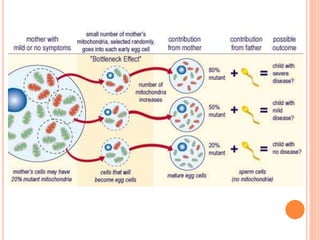
๏‚ข BOTTLENECK EFFECT
๏‚ข LACK OF RECOMBINATION
๏‚ข MUTATIONS
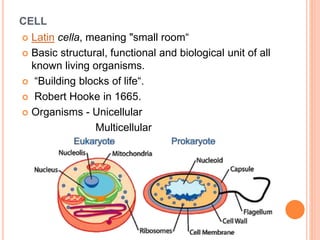
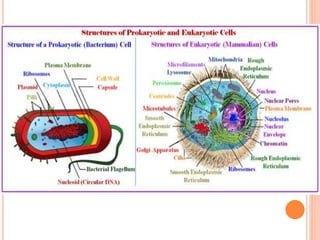
CELL
๏‚ข Latin cella, meaning "small roomโ€œ
๏‚ข Basic structural, functional and biological unit of all
known living organisms.
๏‚ข โ€œBuilding blocks of lifeโ€œ.
๏‚ข Robert Hooke in 1665.
๏‚ข Organisms - Unicellular
Multicellular
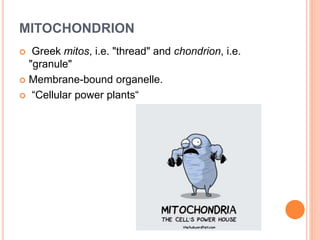
MITOCHONDRION
๏‚ข Greek mitos, i.e. "thread" and chondrion, i.e.
"granule"
๏‚ข Membrane-bound organelle.
๏‚ข โ€œCellular power plantsโ€œ
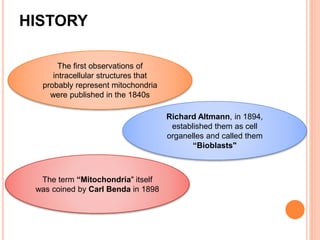
HISTORY
The first observations of
intracellular structures that
probably represent mitochondria
were published in the 1840s
Richard Altmann, in 1894,
established them as cell
organelles and called them
โ€œBioblasts"
The term โ€œMitochondria" itself
was coined by Carl Benda in 1898
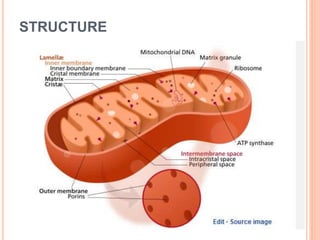
STRUCTURE
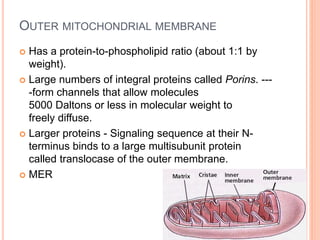
OUTER MITOCHONDRIAL MEMBRANE
๏‚ข Has a protein-to-phospholipid ratio (about 1:1 by
weight).
๏‚ข Large numbers of integral proteins called Porins. ---
-form channels that allow molecules
5000 Daltons or less in molecular weight to
freely diffuse.
๏‚ข Larger proteins - Signaling sequence at their N-
terminus binds to a large multisubunit protein
called translocase of the outer membrane.
๏‚ข MER
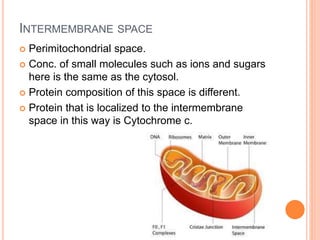
INTERMEMBRANE SPACE
๏‚ข Perimitochondrial space.
๏‚ข Conc. of small molecules such as ions and sugars
here is the same as the cytosol.
๏‚ข Protein composition of this space is different.
๏‚ข Protein that is localized to the intermembrane
space in this way is Cytochrome c.
INNER MEMBRANE
๏‚ข The inner mitochondrial membrane contains
proteins with five types of functions:[7]
Those that perform
the redox reactions
of oxidative
phosphorylation.
Specific transport
proteins that
regulate metabolite p
assage into and out
of the matrix
ATP synthase, which
generates ATP in the
matrix
Protein import
machinery.
Mitochondria
fusion and
fission protein.
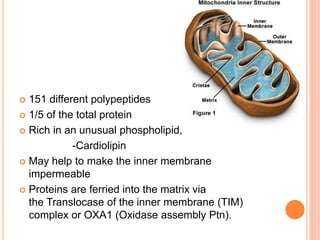
๏‚ข 151 different polypeptides
๏‚ข 1/5 of the total protein
๏‚ข Rich in an unusual phospholipid,
-Cardiolipin
๏‚ข May help to make the inner membrane
impermeable
๏‚ข Proteins are ferried into the matrix via
the Translocase of the inner membrane (TIM)
complex or OXA1 (Oxidase assembly Ptn).
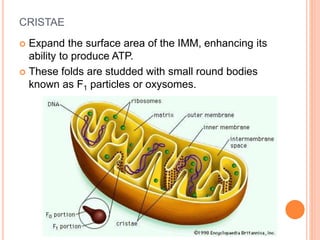
CRISTAE
๏‚ข Expand the surface area of the IMM, enhancing its
ability to produce ATP.
๏‚ข These folds are studded with small round bodies
known as F1 particles or oxysomes.
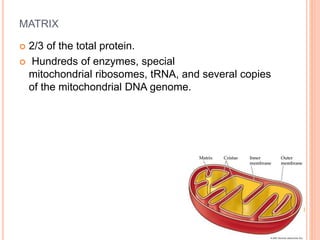
MATRIX
๏‚ข 2/3 of the total protein.
๏‚ข Hundreds of enzymes, special
mitochondrial ribosomes, tRNA, and several copies
of the mitochondrial DNA genome.
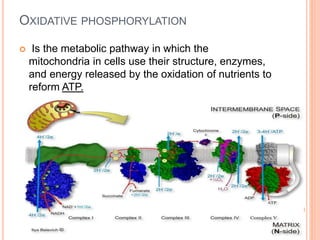
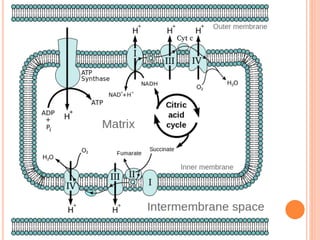
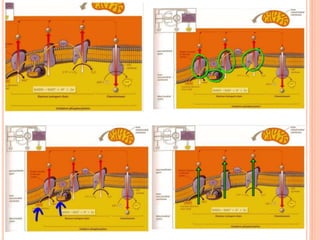
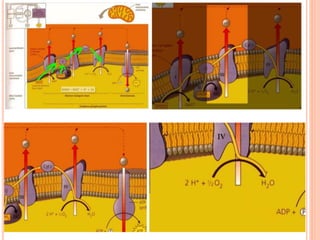
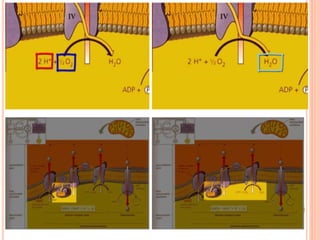
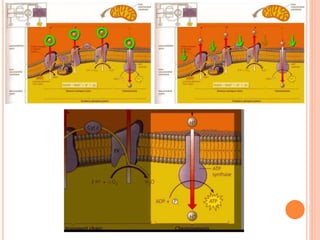
OXIDATIVE PHOSPHORYLATION
๏‚ข Is the metabolic pathway in which the
mitochondria in cells use their structure, enzymes,
and energy released by the oxidation of nutrients to
reform ATP.
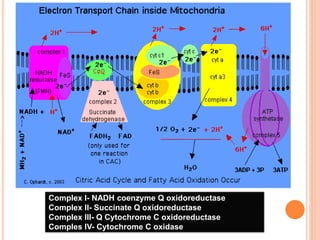
Complex I- NADH coenzyme Q oxidoreductase
Complex II- Succinate Q oxidoreductase
Complex III- Q Cytochrome C oxidoreductase
Comples IV- Cytochrome C oxidase
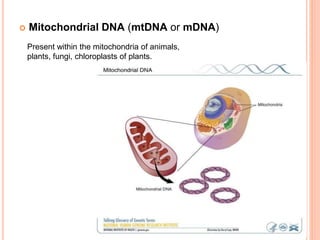
๏‚ข Mitochondrial DNA (mtDNA or mDNA)
Present within the mitochondria of animals,
plants, fungi, chloroplasts of plants.
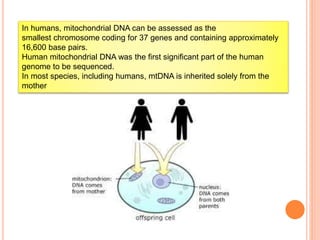
In humans, mitochondrial DNA can be assessed as the
smallest chromosome coding for 37 genes and containing approximately
16,600 base pairs.
Human mitochondrial DNA was the first significant part of the human
genome to be sequenced.
In most species, including humans, mtDNA is inherited solely from the
mother
ORIGIN
๏‚ข Nuclear and mitochondrial DNA are thought to be of
separate evolutionary origin
๏‚ข mtDNA being derived from the circular genomes of
the bacteria that were engulfed by the early
ancestors of today's eukaryotic cells. This theory is
called the endosymbiotic theory.
ENDOSYMBIOTIC THEORY
๏‚ข Greek: endon "within", syn "together" and biosis
"living"
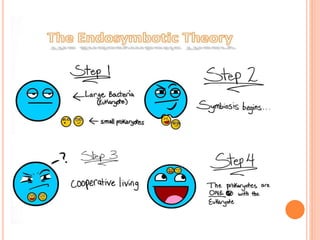
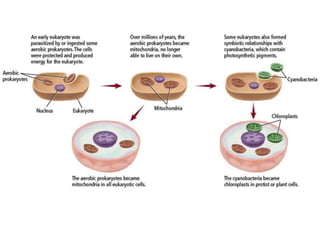
๏‚ข The endosymbiotic theory states that several
key organelles of eukaryotes originated
as symbioses between separate single-celled
organisms.
๏‚ข According to this
theory, mitochondria and plastids (e.g. chloroplasts)
, and possibly other organelles, represent formerly
free-living bacteria that were taken inside another
cell as an endosymbiont.
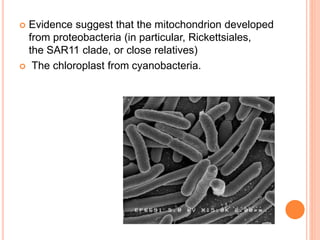
๏‚ข Evidence suggest that the mitochondrion developed
from proteobacteria (in particular, Rickettsiales,
the SAR11 clade, or close relatives)
๏‚ข The chloroplast from cyanobacteria.
ENDOSYMBIONT
๏‚ข An endosymbiont is any organism that lives within
the body or cells of another organism, i.e. forming
an endosymbiosis.
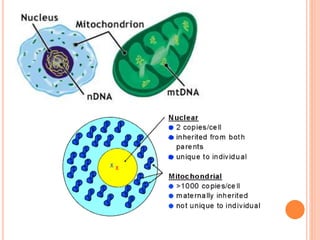
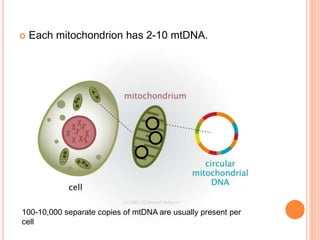
๏‚ข Each mitochondrion has 2-10 mtDNA.
100-10,000 separate copies of mtDNA are usually present per
cell
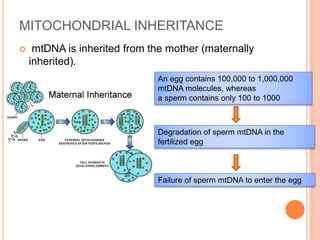
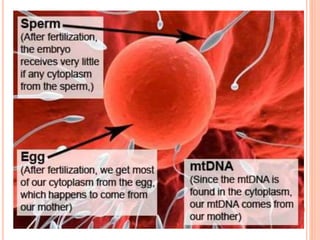
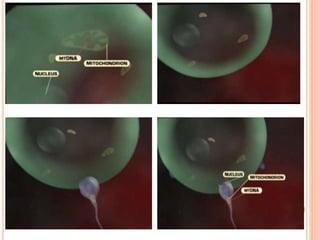
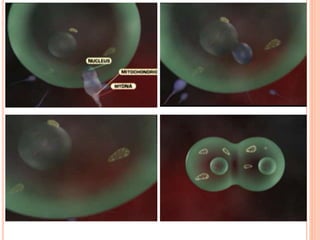
MITOCHONDRIAL INHERITANCE
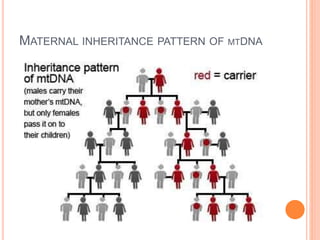
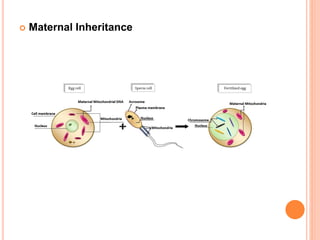
๏‚ข mtDNA is inherited from the mother (maternally
inherited).
An egg contains 100,000 to 1,000,000
mtDNA molecules, whereas
a sperm contains only 100 to 1000
Degradation of sperm mtDNA in the
fertilized egg
Failure of sperm mtDNA to enter the egg
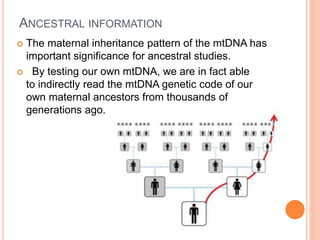
ANCESTRAL INFORMATION
๏‚ข The maternal inheritance pattern of the mtDNA has
important significance for ancestral studies.
๏‚ข By testing our own mtDNA, we are in fact able
to indirectly read the mtDNA genetic code of our
own maternal ancestors from thousands of
generations ago.
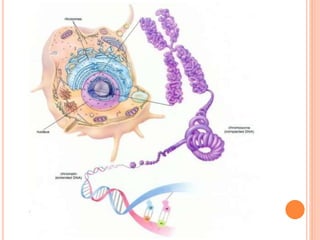
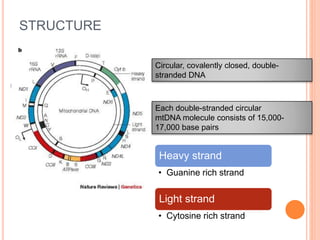
STRUCTURE
Circular, covalently closed, double-
stranded DNA
Each double-stranded circular
mtDNA molecule consists of 15,000-
17,000 base pairs
Heavy strand
โ€ข Guanine rich strand
Light strand
โ€ข Cytosine rich strand
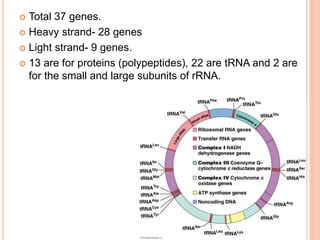
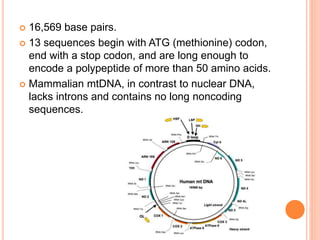
๏‚ข Total 37 genes.
๏‚ข Heavy strand- 28 genes
๏‚ข Light strand- 9 genes.
๏‚ข 13 are for proteins (polypeptides), 22 are tRNA and 2 are
for the small and large subunits of rRNA.
๏‚ข 16,569 base pairs.
๏‚ข 13 sequences begin with ATG (methionine) codon,
end with a stop codon, and are long enough to
encode a polypeptide of more than 50 amino acids.
๏‚ข Mammalian mtDNA, in contrast to nuclear DNA,
lacks introns and contains no long noncoding
sequences.
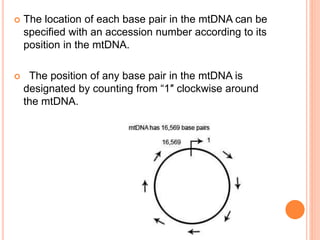
๏‚ข The location of each base pair in the mtDNA can be
specified with an accession number according to its
position in the mtDNA.
๏‚ข The position of any base pair in the mtDNA is
designated by counting from โ€œ1โ€ณ clockwise around
the mtDNA.
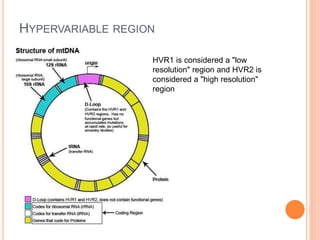
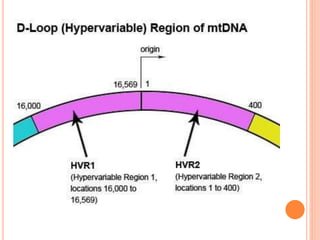
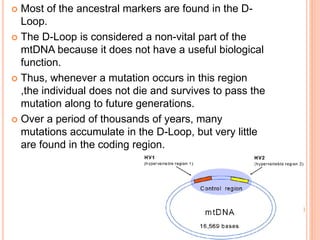
HYPERVARIABLE REGION
HVR1 is considered a "low
resolution" region and HVR2 is
considered a "high resolution"
region
๏‚ข Most of the ancestral markers are found in the D-
Loop.
๏‚ข The D-Loop is considered a non-vital part of the
mtDNA because it does not have a useful biological
function.
๏‚ข Thus, whenever a mutation occurs in this region
,the individual does not die and survives to pass the
mutation along to future generations.
๏‚ข Over a period of thousands of years, many
mutations accumulate in the D-Loop, but very little
are found in the coding region.
HIGH COPY NUMBER
๏‚ข Present in high copy number in human cells.
๏‚ข Extranuclear, cytoplasmic location of mtDNA.
๏‚ข Easier to obtain mtDNA for analysis,
๏‚ข Makes mtDNA the molecule of choice for analyzing
ancient DNA and for certain forensic DNA
applications.
๏‚ข Same property also complicates.
๏‚ข Several levels at which the populations of mtDNA
can be defined.
๏‚ข Need not be identical โ€“ Heteroplasmy.
๏‚ข 14% of the population.
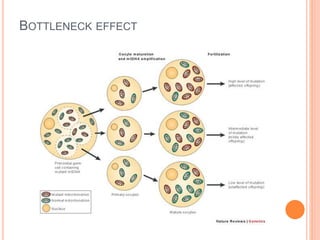
๏‚ข The overall homogeneity of mtDNA within
individuals indicates that a substantial bottleneck in
the number of mitochondria occurs early in
oogenesis.
BOTTLENECK EFFECT
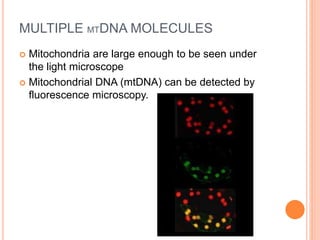
MULTIPLE MTDNA MOLECULES
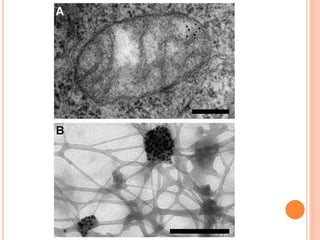
๏‚ข Mitochondria are large enough to be seen under
the light microscope
๏‚ข Mitochondrial DNA (mtDNA) can be detected by
fluorescence microscopy.
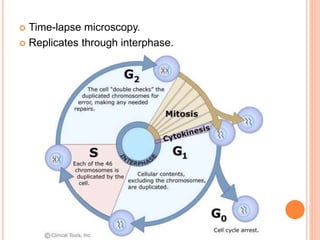
๏‚ข Time-lapse microscopy.
๏‚ข Replicates through interphase.
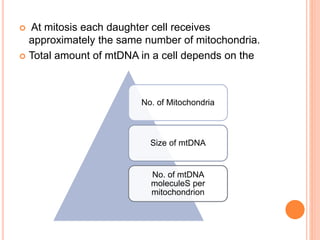
๏‚ข At mitosis each daughter cell receives
approximately the same number of mitochondria.
๏‚ข Total amount of mtDNA in a cell depends on the
No. of Mitochondria
Size of mtDNA
No. of mtDNA
moleculeS per
mitochondrion
GENES IN MTDNA EXHIBIT CYTOPLASMIC
INHERITANCE AND ENCODE RRNAS, TRNAS, AND
SOME MITOCHONDRIAL PROTEINS
๏‚ข Studies of mutants in yeasts and other single-celled
organisms first indicated
that mitochondria exhibit cytoplasmic inheritance
and thus must contain their own genetic system.
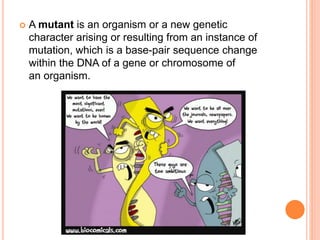
๏‚ข A mutant is an organism or a new genetic
character arising or resulting from an instance of
mutation, which is a base-pair sequence change
within the DNA of a gene or chromosome of
an organism.
Petite yeast mutants exhibit
structurally abnormal mitochondria
and are incapable of oxidative
phosphorylation.
Petite cells grow more slowly than
wild-type yeasts and form smaller
colonies
Genetic crosses showed that the petite
mutation does not segregate with any
known nuclear gene or chromosome.
Deletions of mtDNA.
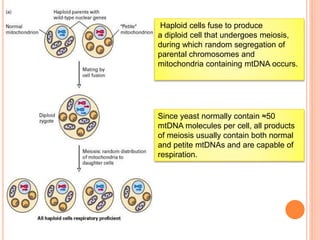
Haploid cells fuse to produce
a diploid cell that undergoes meiosis,
during which random segregation of
parental chromosomes and
mitochondria containing mtDNA occurs.
Since yeast normally contain โ‰ˆ50
mtDNA molecules per cell, all products
of meiosis usually contain both normal
and petite mtDNAs and are capable of
respiration.
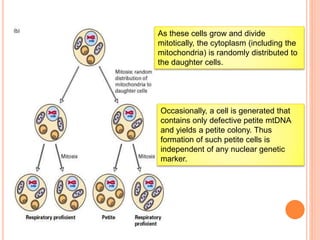
As these cells grow and divide
mitotically, the cytoplasm (including the
mitochondria) is randomly distributed to
the daughter cells.
Occasionally, a cell is generated that
contains only defective petite mtDNA
and yields a petite colony. Thus
formation of such petite cells is
independent of any nuclear genetic
marker.
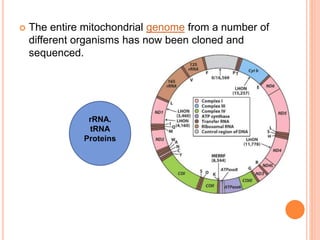
๏‚ข The entire mitochondrial genome from a number of
different organisms has now been cloned and
sequenced.
rRNA.
tRNA
Proteins
๏‚ข All mitochondrially synthesized polypeptides identified
thus far (with one possible exception) are not complete
enzymes but subunits of multimeric complexes used
in electron transport or ATP synthesis.
๏‚ข Most proteins localized in mitochondria, such as the
mitochondrial RNA and DNA polymerases, are
synthesized on cytoplasmic ribosomes and are
imported into the organelle.
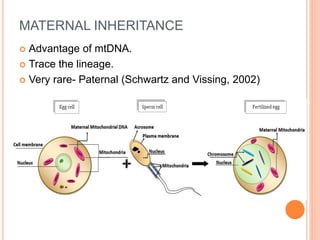
MATERNAL INHERITANCE
๏‚ข Advantage of mtDNA.
๏‚ข Trace the lineage.
๏‚ข Very rare- Paternal (Schwartz and Vissing, 2002)
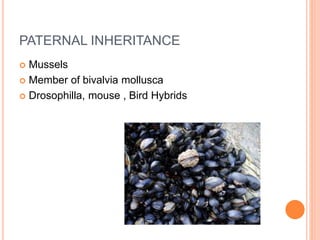
PATERNAL INHERITANCE
๏‚ข Mussels
๏‚ข Member of bivalvia mollusca
๏‚ข Drosophilla, mouse , Bird Hybrids
MATERNAL INHERITANCE PATTERN OF MTDNA
PRODUCTS OF MITOCHONDRIAL GENES ARE NOT
EXPORTED
๏‚ข All RNA transcripts of mtDNA and their translation
products remain in the mitochondrion.
๏‚ข All mtDNA-encoded proteins are synthesized on
mitochondrial ribosomes.
๏‚ข Mitochondria encode the rRNAs that form
mitochondrial ribosomes, although all but one or
two of the ribosomal proteins (depending on the
species) are imported from the cytosol.
TRNAS
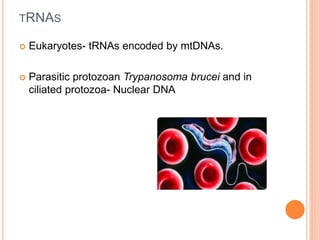
๏‚ข Eukaryotes- tRNAs encoded by mtDNAs.
๏‚ข Parasitic protozoan Trypanosoma brucei and in
ciliated protozoa- Nuclear DNA
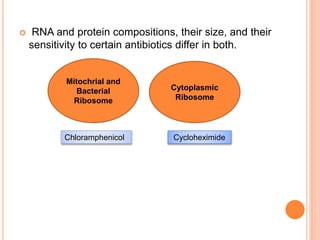
๏‚ข RNA and protein compositions, their size, and their
sensitivity to certain antibiotics differ in both.
Mitochrial and
Bacterial
Ribosome
Cytoplasmic
Ribosome
Chloramphenicol Cycloheximide
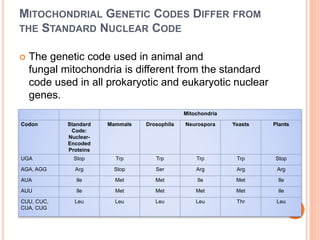
MITOCHONDRIAL GENETIC CODES DIFFER FROM
THE STANDARD NUCLEAR CODE
๏‚ข The genetic code used in animal and
fungal mitochondria is different from the standard
code used in all prokaryotic and eukaryotic nuclear
genes.
Mitochondria
Codon Standard
Code:
Nuclear-
Encoded
Proteins
Mammals Drosophila Neurospora Yeasts Plants
UGA Stop Trp Trp Trp Trp Stop
AGA, AGG Arg Stop Ser Arg Arg Arg
AUA Ile Met Met Ile Met Ile
AUU Ile Met Met Met Met Ile
CUU, CUC,
CUA, CUG
Leu Leu Leu Leu Thr Leu
LACK OF RECOMBINATION
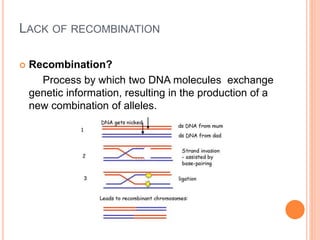
๏‚ข Recombination?
Process by which two DNA molecules exchange
genetic information, resulting in the production of a
new combination of alleles.
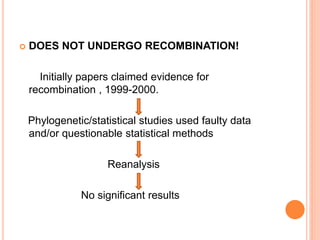
๏‚ข DOES NOT UNDERGO RECOMBINATION!
Initially papers claimed evidence for
recombination , 1999-2000.
Phylogenetic/statistical studies used faulty data
and/or questionable statistical methods
Reanalysis
No significant results
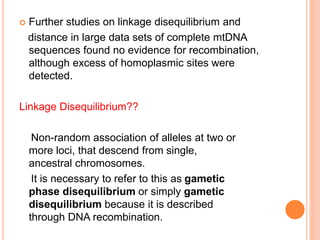
๏‚ข Further studies on linkage disequilibrium and
distance in large data sets of complete mtDNA
sequences found no evidence for recombination,
although excess of homoplasmic sites were
detected.
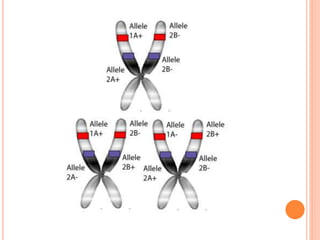
Linkage Disequilibrium??
Non-random association of alleles at two or
more loci, that descend from single,
ancestral chromosomes.
It is necessary to refer to this as gametic
phase disequilibrium or simply gametic
disequilibrium because it is described
through DNA recombination.
HOMOPLASMIC SITES?
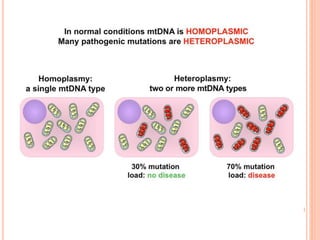
๏‚ข Homoplasmy is a term used in genetics to
describe a mammalian cell whose copies of mtDNA
are all identical.
๏‚ข Homoplasmic mtDNA copies may be normal or
mutated.
๏‚ข Most mutations are heteroplasmic - only occurring
in some copies of mtDNA
๏‚ข But it has been discovered that homoplastic
mtDNA mutations may be found in human tumours.
๏‚ข However, a case of observed recombination in
human mtDNA was reported in the only known
human with both maternal and paternal mtDNA.
๏‚ข Recombination between the maternal and the
paternal mtDNA occurred in approximately 0.7% of
the total mtDNA in the patientโ€™s muscle tissue.
MUTATION RATE
๏‚ข The mutation rate of mtDNA is several orders of
magnitude higher than that of nuclear genes.
๏‚ข An estimated rate of 0.017 ร— 10โˆ’6 substitutions per
site per year for the whole genome excluding the
control region.
๏‚ข However, in the two hypervariable regions (HVR I
and HVRII ) of the non coding control region, the
rate is even higher.
Phylogenetics
The study
of evolutionary relationships among
groups of organisms , which are
discovered through molecular
sequencing data and morphological
data matrices.
Phylogenetic comparisons, based on
either interspecific or intraspecific
comparisons were done.
Pedigree chart
A diagram that shows the
occurrence and appearance
or phenotypes of a particular gene
or organism and
its ancestors from one generation
to the next.
Direct observations of mtDNA
mutations in families or deep-
rooting Pedigrees were done.
๏‚ข Within the control region the mutation rate is very
heterogeneous, with some โ€œmutational hot spotsโ€
mutating four to five times as fast as the average
site.
๏‚ข Some claim, Recombination.
MUTATIONS IN MITOCHONDRIAL DNA
๏‚ข All cells have mitochondria, yet mutations in mtDNA
only affect some tissues.
๏‚ข Those most usually affected are,
Tissues that have a
high requirement for
ATP produced
by oxidative
phosphorylation.
Tissues that require most
or all of the mtDNA in the
cell to synthesize
functional mitochondrial
proteins.
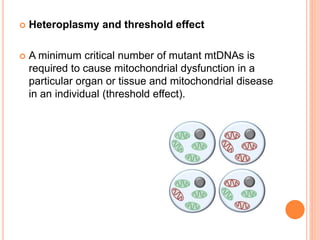
๏‚ข Heteroplasmy and threshold effect
๏‚ข A minimum critical number of mutant mtDNAs is
required to cause mitochondrial dysfunction in a
particular organ or tissue and mitochondrial disease
in an individual (threshold effect).
๏‚ข Mitotic segregation
๏‚ข At cell division, the proportion of mutant mtDNAs in
daughter cells may shift and the phenotype may
change accordingly.
๏‚ข Maternal Inheritance
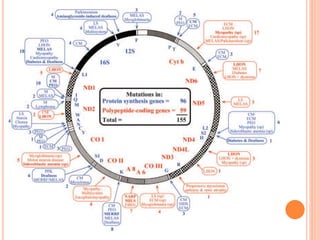
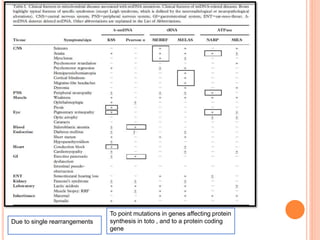
๏‚ข Over 150 point mutations and innumerable large
scale rearrangements have been associated with a
bewildering variety of diseases.
๏‚ข KSS involves a triad of the already described
Chronic Progressive External Opthalmoplegia, as
well as bilateral pigmentary retinopathy, and cardiac
conduction abnormalities.
๏‚ข Dominant and recessive forms of PEO can be
caused by genetic mutations in
the ANT1, POLG, POLG2 and PEO1 genes.
KSS Kearns-Sayre syndrome
๏‚ข Progressive myoclonic epilepsy
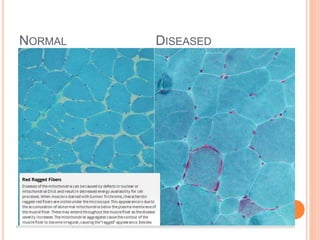
๏‚ข "Ragged Red Fibers" - clumps of
diseased mitochondria accumulate in the
subsarcolemmal region of the muscle fiber and
appear as "Ragged Red Fibers" when muscle is
stained with modified Gรถmรถri trichrome stain
๏‚ข short stature
๏‚ข hearing loss
๏‚ข lactic acidosis
๏‚ข exercise intolerance
๏‚ข poor night vision
MERRF
Myoclonus epilepsy and ragged
red fibers
NORMAL DISEASED
๏‚ข Caused by a maternally-inherited mutation at position
8344 in the mitochondrial genome in over 80% of cases.
๏‚ข This point mutation disrupts the mitochondrial gene
for tRNA-Lys and so disrupts synthesis of proteins
essential for oxidative phosphorylation.
๏‚ข Many genes are involved. These include:
๏‚ข MT-TK
๏‚ข MT-TL1
๏‚ข MT-TH
๏‚ข MT-TS1
๏‚ข MT-TS2
๏‚ข MT-TF
๏‚ข Increased acidity in the blood can lead to vomiting,
abdominal pain, extreme tiredness (fatigue), muscle
weakness, loss of bowel control, and difficulty
breathing.
๏‚ข Some of the genes (MT-ND1, MT-ND5) affected in
MELAS encode proteins that are part of NADH
dehydrogenase (also called complex I).
๏‚ข Other genes (MT-TH, MT-TL1, and MT-TV) encode
mitochondrial specific transfer RNAs (tRNAs).
MELAS
mitochondrial
encephalomyopathy,lactic acidosis, stroke -like episodes
๏‚ข Mutations in the MT-ATP6 gene cause neuropathy,
ataxia, and retinitis pigmentosa.
๏‚ข The MT-ATP6 gene provides instructions for
making a protein that is essential for normal
mitochondrial function.
NARP
Neuropathy, ataxia, retinitis
pigmentosa
๏‚ข The most common of these mutations is found in 10
to 20 percent of Leigh syndrome and occurs in MT-
ATP6, a gene that codes for a protein in the last
complex of the oxidative phosphorylation
chain, ATP synthase, an enzyme that directly
generates ATP.
MILS
Maternally inherited Leigh
syndrome
๏‚ข LHON is usually due to one of three pathogenic
mitochondrial DNA point mutations.
๏‚ข These mutations are at nucleotide positions
11778 G to A,
3460 G to A and
14484 T to C, respectively in the ND4, ND1 and
ND6 subunit genes of complex I of the oxidative
phosphorylation chain in mitochondria.
LHON
Leber hereditary optic neuropathy
Due to single rearrangements
To point mutations in genes affecting protein
synthesis in toto , and to a protein coding
gene
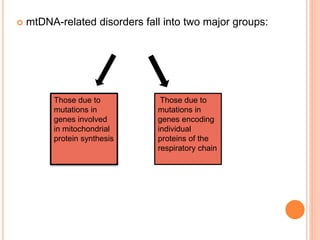
๏‚ข mtDNA-related disorders fall into two major groups:
Those due to
mutations in
genes involved
in mitochondrial
protein synthesis
Those due to
mutations in
genes encoding
individual
proteins of the
respiratory chain
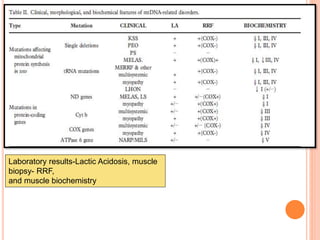
Laboratory results-Lactic Acidosis, muscle
biopsy- RRF,
and muscle biochemistry
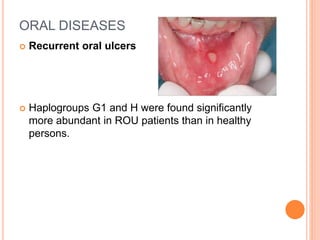
ORAL DISEASES
๏‚ข Recurrent oral ulcers
๏‚ข Haplogroups G1 and H were found significantly
more abundant in ROU patients than in healthy
persons.
๏‚ข Oral cancer and Precancerous Lesions
๏‚ข Real time Quantitavie PCR,
๏‚ข To detect and quantify mtDNA with the 4,977-bp
deletion in the histologically defined specified cell
groups.
๏‚ข The proportion of 4,977-bp deleted mtDNA in all
oral lesions is higher than normal and consistently
decreased during cancer progression from
precancer to primary cancer.
๏‚ข This suggests that accumulation and subsequent
cytoplasmic segregation of the mutant mtDNA
during cell division may play an important role in
oral carcinogenesis.
๏‚ข Squamous cell carcinoma
๏‚ข The mitochondrial D-Loop was also analysed.
๏‚ข Three mutation hotspots were observed in the D-
Loop at nt 146, 152 and 186,
Two of which (nt 146 and 152) have also been
implicated in oesophageal SCC, another smoking-
related cancer.
INHERITANCE OF SINGLE MTDNA MUTATIONS
๏‚ข Single mtDNA deletions are neither inherited from
the mother nor transmitted to the progeny and
disorders due to single mtDNA deletions, KSS,
PEO, and PS, are almost always sporadic.
๏‚ข Attributed to bottleneck phenomenon.
๏‚ข Few cases- maternal transmission.
FREQUENCY OF MTDNA RELATED DISEASES
๏‚ข Among the most common genetic disorders and a
major burden for society.
reviewed by Schaefer et al
๏‚ข Nuclear and mtDNA Mutations- The minimum
prevalence is at least 1 in 5,000
๏‚ข Study in England- Only mtDNA mutations-
6.57/100,000 , with a particularly high prevalence of
LHON
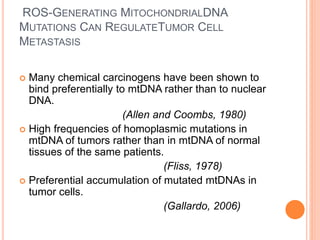
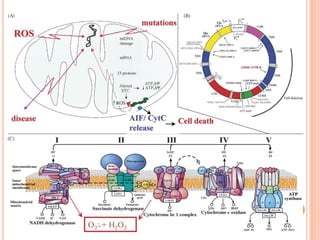
ROS-GENERATING MITOCHONDRIALDNA
MUTATIONS CAN REGULATETUMOR CELL
METASTASIS
๏‚ข Many chemical carcinogens have been shown to
bind preferentially to mtDNA rather than to nuclear
DNA.
(Allen and Coombs, 1980)
๏‚ข High frequencies of homoplasmic mutations in
mtDNA of tumors rather than in mtDNA of normal
tissues of the same patients.
(Fliss, 1978)
๏‚ข Preferential accumulation of mutated mtDNAs in
tumor cells.
(Gallardo, 2006)
ANCESTRAL MARKERS
๏‚ข What is an ancestral marker?
๏‚ข Ancestral markers are โ€œmutationsโ€, little changes or
โ€œhiccupsโ€ that occur in the genetic code of the
mtDNA.
๏‚ข Most commonly found mutations in mtDNA is called
a โ€œSNPโ€ (single nucleotide polymorphism).
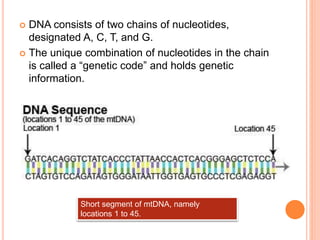
๏‚ข DNA consists of two chains of nucleotides,
designated A, C, T, and G.
๏‚ข The unique combination of nucleotides in the chain
is called a โ€œgenetic codeโ€ and holds genetic
information.
Short segment of mtDNA, namely
locations 1 to 45.
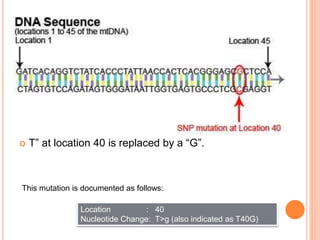
๏‚ข Tโ€ at location 40 is replaced by a โ€œGโ€.
This mutation is documented as follows:
Location : 40
Nucleotide Change: T>g (also indicated as T40G)
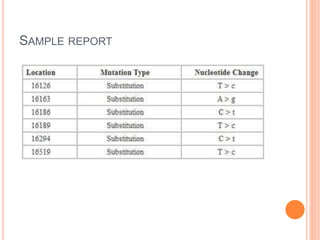
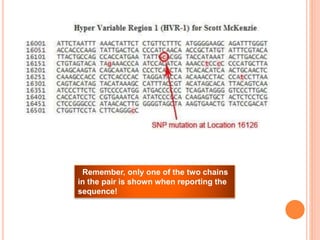
SAMPLE REPORT
Remember, only one of the two chains
in the pair is shown when reporting the
sequence!
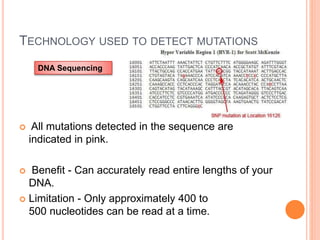
TECHNOLOGY USED TO DETECT MUTATIONS
๏‚ข All mutations detected in the sequence are
indicated in pink.
๏‚ข Benefit - Can accurately read entire lengths of your
DNA.
๏‚ข Limitation - Only approximately 400 to
500 nucleotides can be read at a time.
DNA Sequencing
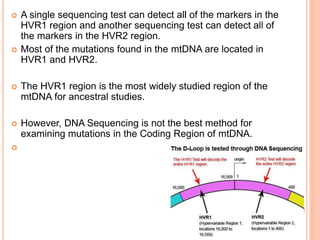
๏‚ข A single sequencing test can detect all of the markers in the
HVR1 region and another sequencing test can detect all of
the markers in the HVR2 region.
๏‚ข Most of the mutations found in the mtDNA are located in
HVR1 and HVR2.
๏‚ข The HVR1 region is the most widely studied region of the
mtDNA for ancestral studies.
๏‚ข However, DNA Sequencing is not the best method for
examining mutations in the Coding Region of mtDNA.
๏‚ข
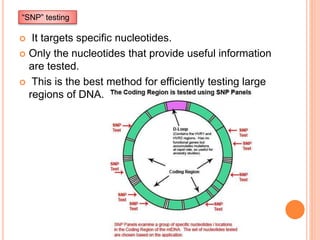
๏‚ข It targets specific nucleotides.
๏‚ข Only the nucleotides that provide useful information
are tested.
๏‚ข This is the best method for efficiently testing large
regions of DNA.
โ€œSNPโ€ testing
APPLICATIONS
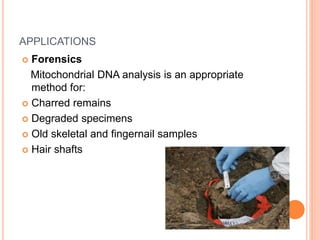
๏‚ข Forensics
Mitochondrial DNA analysis is an appropriate
method for:
๏‚ข Charred remains
๏‚ข Degraded specimens
๏‚ข Old skeletal and fingernail samples
๏‚ข Hair shafts
๏‚ข โ€œAncient DNAโ€ field has shown that highly degraded
samples contain populations of intact DNA molecules
that are severely restricted in size .
Additionally, mtDNA is quite useful in forensic investigations of
remains recovered of a missing person or mass disaster.
Biological material from known, maternal relatives, even quite
distant, can be used as a reference for direct comparison to
the recovered remains.
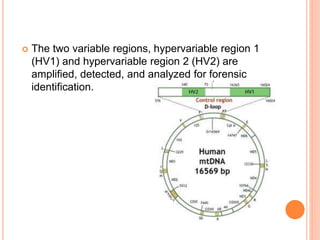
๏‚ข The two variable regions, hypervariable region 1
(HV1) and hypervariable region 2 (HV2) are
amplified, detected, and analyzed for forensic
identification.
WHY IS mtDNA IMPORTANT??
13 of its 37 genes are
involved in oxidative
phosphorylation.
The remaining 24 genes
are involved in the creation
of transfer RNA (tRNA) and
ribosomal RNA (rRNA)
which help to turn amino
acids into proteins.
SUMMARY
๏‚ข Mitochondrial DNA is the genetic material from
mitochondria, which is the cellular organic cell,
responsible for generating the necessary energy.
๏‚ข Maternally Inherited.
๏‚ข mtDNA is useful for the purpose of tracing ancestry.
๏‚ข mtDNA does not recombine.
๏‚ข Mutations, HV1, HV2
THANK
YOU!

Organelle DNA

  • 1.
    ORGANELLE DNA Dr. AurelianJovita Alexander MDS Dept. of Oral and Maxillofacial Pathology
  • 2.
    INTRODUCTION ๏‚ข CELL ๏‚ข MITOCHONDRIA ๏‚ขOXIDATIVE PHOSPHORYLATION ๏‚ข mtDNA ๏‚ข ENDOSYMBIOTIC THEORY ๏‚ข STRUCTURE ๏‚ข MATERNAL INHERITANCE ๏‚ข BOTTLENECK EFFECT ๏‚ข LACK OF RECOMBINATION ๏‚ข MUTATIONS
  • 3.
    CELL ๏‚ข Latin cella,meaning "small roomโ€œ ๏‚ข Basic structural, functional and biological unit of all known living organisms. ๏‚ข โ€œBuilding blocks of lifeโ€œ. ๏‚ข Robert Hooke in 1665. ๏‚ข Organisms - Unicellular Multicellular
  • 8.
    MITOCHONDRION ๏‚ข Greek mitos,i.e. "thread" and chondrion, i.e. "granule" ๏‚ข Membrane-bound organelle. ๏‚ข โ€œCellular power plantsโ€œ
  • 9.
    HISTORY The first observationsof intracellular structures that probably represent mitochondria were published in the 1840s Richard Altmann, in 1894, established them as cell organelles and called them โ€œBioblasts" The term โ€œMitochondria" itself was coined by Carl Benda in 1898
  • 10.
  • 11.
    OUTER MITOCHONDRIAL MEMBRANE ๏‚ขHas a protein-to-phospholipid ratio (about 1:1 by weight). ๏‚ข Large numbers of integral proteins called Porins. --- -form channels that allow molecules 5000 Daltons or less in molecular weight to freely diffuse. ๏‚ข Larger proteins - Signaling sequence at their N- terminus binds to a large multisubunit protein called translocase of the outer membrane. ๏‚ข MER
  • 12.
    INTERMEMBRANE SPACE ๏‚ข Perimitochondrialspace. ๏‚ข Conc. of small molecules such as ions and sugars here is the same as the cytosol. ๏‚ข Protein composition of this space is different. ๏‚ข Protein that is localized to the intermembrane space in this way is Cytochrome c.
  • 13.
    INNER MEMBRANE ๏‚ข Theinner mitochondrial membrane contains proteins with five types of functions:[7] Those that perform the redox reactions of oxidative phosphorylation. Specific transport proteins that regulate metabolite p assage into and out of the matrix ATP synthase, which generates ATP in the matrix Protein import machinery. Mitochondria fusion and fission protein.
  • 14.
    ๏‚ข 151 differentpolypeptides ๏‚ข 1/5 of the total protein ๏‚ข Rich in an unusual phospholipid, -Cardiolipin ๏‚ข May help to make the inner membrane impermeable ๏‚ข Proteins are ferried into the matrix via the Translocase of the inner membrane (TIM) complex or OXA1 (Oxidase assembly Ptn).
  • 15.
    CRISTAE ๏‚ข Expand thesurface area of the IMM, enhancing its ability to produce ATP. ๏‚ข These folds are studded with small round bodies known as F1 particles or oxysomes.
  • 16.
    MATRIX ๏‚ข 2/3 ofthe total protein. ๏‚ข Hundreds of enzymes, special mitochondrial ribosomes, tRNA, and several copies of the mitochondrial DNA genome.
  • 17.
    OXIDATIVE PHOSPHORYLATION ๏‚ข Isthe metabolic pathway in which the mitochondria in cells use their structure, enzymes, and energy released by the oxidation of nutrients to reform ATP.
  • 19.
    Complex I- NADHcoenzyme Q oxidoreductase Complex II- Succinate Q oxidoreductase Complex III- Q Cytochrome C oxidoreductase Comples IV- Cytochrome C oxidase
  • 24.
    ๏‚ข Mitochondrial DNA(mtDNA or mDNA) Present within the mitochondria of animals, plants, fungi, chloroplasts of plants.
  • 26.
    In humans, mitochondrialDNA can be assessed as the smallest chromosome coding for 37 genes and containing approximately 16,600 base pairs. Human mitochondrial DNA was the first significant part of the human genome to be sequenced. In most species, including humans, mtDNA is inherited solely from the mother
  • 27.
    ORIGIN ๏‚ข Nuclear andmitochondrial DNA are thought to be of separate evolutionary origin ๏‚ข mtDNA being derived from the circular genomes of the bacteria that were engulfed by the early ancestors of today's eukaryotic cells. This theory is called the endosymbiotic theory.
  • 28.
    ENDOSYMBIOTIC THEORY ๏‚ข Greek:endon "within", syn "together" and biosis "living" ๏‚ข The endosymbiotic theory states that several key organelles of eukaryotes originated as symbioses between separate single-celled organisms. ๏‚ข According to this theory, mitochondria and plastids (e.g. chloroplasts) , and possibly other organelles, represent formerly free-living bacteria that were taken inside another cell as an endosymbiont.
  • 30.
    ๏‚ข Evidence suggestthat the mitochondrion developed from proteobacteria (in particular, Rickettsiales, the SAR11 clade, or close relatives) ๏‚ข The chloroplast from cyanobacteria.
  • 31.
    ENDOSYMBIONT ๏‚ข An endosymbiontis any organism that lives within the body or cells of another organism, i.e. forming an endosymbiosis.
  • 33.
    ๏‚ข Each mitochondrionhas 2-10 mtDNA. 100-10,000 separate copies of mtDNA are usually present per cell
  • 34.
    MITOCHONDRIAL INHERITANCE ๏‚ข mtDNAis inherited from the mother (maternally inherited). An egg contains 100,000 to 1,000,000 mtDNA molecules, whereas a sperm contains only 100 to 1000 Degradation of sperm mtDNA in the fertilized egg Failure of sperm mtDNA to enter the egg
  • 35.
    ANCESTRAL INFORMATION ๏‚ข Thematernal inheritance pattern of the mtDNA has important significance for ancestral studies. ๏‚ข By testing our own mtDNA, we are in fact able to indirectly read the mtDNA genetic code of our own maternal ancestors from thousands of generations ago.
  • 36.
    STRUCTURE Circular, covalently closed,double- stranded DNA Each double-stranded circular mtDNA molecule consists of 15,000- 17,000 base pairs Heavy strand โ€ข Guanine rich strand Light strand โ€ข Cytosine rich strand
  • 37.
    ๏‚ข Total 37genes. ๏‚ข Heavy strand- 28 genes ๏‚ข Light strand- 9 genes. ๏‚ข 13 are for proteins (polypeptides), 22 are tRNA and 2 are for the small and large subunits of rRNA.
  • 38.
    ๏‚ข 16,569 basepairs. ๏‚ข 13 sequences begin with ATG (methionine) codon, end with a stop codon, and are long enough to encode a polypeptide of more than 50 amino acids. ๏‚ข Mammalian mtDNA, in contrast to nuclear DNA, lacks introns and contains no long noncoding sequences.
  • 39.
    ๏‚ข The locationof each base pair in the mtDNA can be specified with an accession number according to its position in the mtDNA. ๏‚ข The position of any base pair in the mtDNA is designated by counting from โ€œ1โ€ณ clockwise around the mtDNA.
  • 40.
    HYPERVARIABLE REGION HVR1 isconsidered a "low resolution" region and HVR2 is considered a "high resolution" region
  • 42.
    ๏‚ข Most ofthe ancestral markers are found in the D- Loop. ๏‚ข The D-Loop is considered a non-vital part of the mtDNA because it does not have a useful biological function. ๏‚ข Thus, whenever a mutation occurs in this region ,the individual does not die and survives to pass the mutation along to future generations. ๏‚ข Over a period of thousands of years, many mutations accumulate in the D-Loop, but very little are found in the coding region.
  • 43.
    HIGH COPY NUMBER ๏‚ขPresent in high copy number in human cells. ๏‚ข Extranuclear, cytoplasmic location of mtDNA. ๏‚ข Easier to obtain mtDNA for analysis, ๏‚ข Makes mtDNA the molecule of choice for analyzing ancient DNA and for certain forensic DNA applications.
  • 44.
    ๏‚ข Same propertyalso complicates. ๏‚ข Several levels at which the populations of mtDNA can be defined. ๏‚ข Need not be identical โ€“ Heteroplasmy. ๏‚ข 14% of the population. ๏‚ข The overall homogeneity of mtDNA within individuals indicates that a substantial bottleneck in the number of mitochondria occurs early in oogenesis.
  • 45.
  • 47.
    MULTIPLE MTDNA MOLECULES ๏‚ขMitochondria are large enough to be seen under the light microscope ๏‚ข Mitochondrial DNA (mtDNA) can be detected by fluorescence microscopy.
  • 48.
    ๏‚ข Time-lapse microscopy. ๏‚ขReplicates through interphase.
  • 49.
    ๏‚ข At mitosiseach daughter cell receives approximately the same number of mitochondria. ๏‚ข Total amount of mtDNA in a cell depends on the No. of Mitochondria Size of mtDNA No. of mtDNA moleculeS per mitochondrion
  • 50.
    GENES IN MTDNAEXHIBIT CYTOPLASMIC INHERITANCE AND ENCODE RRNAS, TRNAS, AND SOME MITOCHONDRIAL PROTEINS ๏‚ข Studies of mutants in yeasts and other single-celled organisms first indicated that mitochondria exhibit cytoplasmic inheritance and thus must contain their own genetic system.
  • 51.
    ๏‚ข A mutantis an organism or a new genetic character arising or resulting from an instance of mutation, which is a base-pair sequence change within the DNA of a gene or chromosome of an organism.
  • 52.
    Petite yeast mutantsexhibit structurally abnormal mitochondria and are incapable of oxidative phosphorylation. Petite cells grow more slowly than wild-type yeasts and form smaller colonies Genetic crosses showed that the petite mutation does not segregate with any known nuclear gene or chromosome. Deletions of mtDNA.
  • 53.
    Haploid cells fuseto produce a diploid cell that undergoes meiosis, during which random segregation of parental chromosomes and mitochondria containing mtDNA occurs. Since yeast normally contain โ‰ˆ50 mtDNA molecules per cell, all products of meiosis usually contain both normal and petite mtDNAs and are capable of respiration.
  • 54.
    As these cellsgrow and divide mitotically, the cytoplasm (including the mitochondria) is randomly distributed to the daughter cells. Occasionally, a cell is generated that contains only defective petite mtDNA and yields a petite colony. Thus formation of such petite cells is independent of any nuclear genetic marker.
  • 55.
    ๏‚ข The entiremitochondrial genome from a number of different organisms has now been cloned and sequenced. rRNA. tRNA Proteins
  • 56.
    ๏‚ข All mitochondriallysynthesized polypeptides identified thus far (with one possible exception) are not complete enzymes but subunits of multimeric complexes used in electron transport or ATP synthesis. ๏‚ข Most proteins localized in mitochondria, such as the mitochondrial RNA and DNA polymerases, are synthesized on cytoplasmic ribosomes and are imported into the organelle.
  • 57.
    MATERNAL INHERITANCE ๏‚ข Advantageof mtDNA. ๏‚ข Trace the lineage. ๏‚ข Very rare- Paternal (Schwartz and Vissing, 2002)
  • 61.
    PATERNAL INHERITANCE ๏‚ข Mussels ๏‚ขMember of bivalvia mollusca ๏‚ข Drosophilla, mouse , Bird Hybrids
  • 62.
  • 63.
    PRODUCTS OF MITOCHONDRIALGENES ARE NOT EXPORTED ๏‚ข All RNA transcripts of mtDNA and their translation products remain in the mitochondrion. ๏‚ข All mtDNA-encoded proteins are synthesized on mitochondrial ribosomes. ๏‚ข Mitochondria encode the rRNAs that form mitochondrial ribosomes, although all but one or two of the ribosomal proteins (depending on the species) are imported from the cytosol.
  • 64.
    TRNAS ๏‚ข Eukaryotes- tRNAsencoded by mtDNAs. ๏‚ข Parasitic protozoan Trypanosoma brucei and in ciliated protozoa- Nuclear DNA
  • 65.
    ๏‚ข RNA andprotein compositions, their size, and their sensitivity to certain antibiotics differ in both. Mitochrial and Bacterial Ribosome Cytoplasmic Ribosome Chloramphenicol Cycloheximide
  • 66.
    MITOCHONDRIAL GENETIC CODESDIFFER FROM THE STANDARD NUCLEAR CODE ๏‚ข The genetic code used in animal and fungal mitochondria is different from the standard code used in all prokaryotic and eukaryotic nuclear genes. Mitochondria Codon Standard Code: Nuclear- Encoded Proteins Mammals Drosophila Neurospora Yeasts Plants UGA Stop Trp Trp Trp Trp Stop AGA, AGG Arg Stop Ser Arg Arg Arg AUA Ile Met Met Ile Met Ile AUU Ile Met Met Met Met Ile CUU, CUC, CUA, CUG Leu Leu Leu Leu Thr Leu
  • 67.
    LACK OF RECOMBINATION ๏‚ขRecombination? Process by which two DNA molecules exchange genetic information, resulting in the production of a new combination of alleles.
  • 68.
    ๏‚ข DOES NOTUNDERGO RECOMBINATION! Initially papers claimed evidence for recombination , 1999-2000. Phylogenetic/statistical studies used faulty data and/or questionable statistical methods Reanalysis No significant results
  • 69.
    ๏‚ข Further studieson linkage disequilibrium and distance in large data sets of complete mtDNA sequences found no evidence for recombination, although excess of homoplasmic sites were detected. Linkage Disequilibrium?? Non-random association of alleles at two or more loci, that descend from single, ancestral chromosomes. It is necessary to refer to this as gametic phase disequilibrium or simply gametic disequilibrium because it is described through DNA recombination.
  • 71.
    HOMOPLASMIC SITES? ๏‚ข Homoplasmyis a term used in genetics to describe a mammalian cell whose copies of mtDNA are all identical. ๏‚ข Homoplasmic mtDNA copies may be normal or mutated. ๏‚ข Most mutations are heteroplasmic - only occurring in some copies of mtDNA ๏‚ข But it has been discovered that homoplastic mtDNA mutations may be found in human tumours.
  • 73.
    ๏‚ข However, acase of observed recombination in human mtDNA was reported in the only known human with both maternal and paternal mtDNA. ๏‚ข Recombination between the maternal and the paternal mtDNA occurred in approximately 0.7% of the total mtDNA in the patientโ€™s muscle tissue.
  • 74.
    MUTATION RATE ๏‚ข Themutation rate of mtDNA is several orders of magnitude higher than that of nuclear genes. ๏‚ข An estimated rate of 0.017 ร— 10โˆ’6 substitutions per site per year for the whole genome excluding the control region. ๏‚ข However, in the two hypervariable regions (HVR I and HVRII ) of the non coding control region, the rate is even higher.
  • 75.
    Phylogenetics The study of evolutionaryrelationships among groups of organisms , which are discovered through molecular sequencing data and morphological data matrices. Phylogenetic comparisons, based on either interspecific or intraspecific comparisons were done. Pedigree chart A diagram that shows the occurrence and appearance or phenotypes of a particular gene or organism and its ancestors from one generation to the next. Direct observations of mtDNA mutations in families or deep- rooting Pedigrees were done.
  • 76.
    ๏‚ข Within thecontrol region the mutation rate is very heterogeneous, with some โ€œmutational hot spotsโ€ mutating four to five times as fast as the average site. ๏‚ข Some claim, Recombination.
  • 77.
    MUTATIONS IN MITOCHONDRIALDNA ๏‚ข All cells have mitochondria, yet mutations in mtDNA only affect some tissues. ๏‚ข Those most usually affected are, Tissues that have a high requirement for ATP produced by oxidative phosphorylation. Tissues that require most or all of the mtDNA in the cell to synthesize functional mitochondrial proteins.
  • 78.
    ๏‚ข Heteroplasmy andthreshold effect ๏‚ข A minimum critical number of mutant mtDNAs is required to cause mitochondrial dysfunction in a particular organ or tissue and mitochondrial disease in an individual (threshold effect).
  • 79.
    ๏‚ข Mitotic segregation ๏‚ขAt cell division, the proportion of mutant mtDNAs in daughter cells may shift and the phenotype may change accordingly.
  • 80.
  • 81.
    ๏‚ข Over 150point mutations and innumerable large scale rearrangements have been associated with a bewildering variety of diseases.
  • 83.
    ๏‚ข KSS involvesa triad of the already described Chronic Progressive External Opthalmoplegia, as well as bilateral pigmentary retinopathy, and cardiac conduction abnormalities. ๏‚ข Dominant and recessive forms of PEO can be caused by genetic mutations in the ANT1, POLG, POLG2 and PEO1 genes. KSS Kearns-Sayre syndrome
  • 84.
    ๏‚ข Progressive myoclonicepilepsy ๏‚ข "Ragged Red Fibers" - clumps of diseased mitochondria accumulate in the subsarcolemmal region of the muscle fiber and appear as "Ragged Red Fibers" when muscle is stained with modified Gรถmรถri trichrome stain ๏‚ข short stature ๏‚ข hearing loss ๏‚ข lactic acidosis ๏‚ข exercise intolerance ๏‚ข poor night vision MERRF Myoclonus epilepsy and ragged red fibers
  • 85.
  • 86.
    ๏‚ข Caused bya maternally-inherited mutation at position 8344 in the mitochondrial genome in over 80% of cases. ๏‚ข This point mutation disrupts the mitochondrial gene for tRNA-Lys and so disrupts synthesis of proteins essential for oxidative phosphorylation. ๏‚ข Many genes are involved. These include: ๏‚ข MT-TK ๏‚ข MT-TL1 ๏‚ข MT-TH ๏‚ข MT-TS1 ๏‚ข MT-TS2 ๏‚ข MT-TF
  • 87.
    ๏‚ข Increased acidityin the blood can lead to vomiting, abdominal pain, extreme tiredness (fatigue), muscle weakness, loss of bowel control, and difficulty breathing. ๏‚ข Some of the genes (MT-ND1, MT-ND5) affected in MELAS encode proteins that are part of NADH dehydrogenase (also called complex I). ๏‚ข Other genes (MT-TH, MT-TL1, and MT-TV) encode mitochondrial specific transfer RNAs (tRNAs). MELAS mitochondrial encephalomyopathy,lactic acidosis, stroke -like episodes
  • 88.
    ๏‚ข Mutations inthe MT-ATP6 gene cause neuropathy, ataxia, and retinitis pigmentosa. ๏‚ข The MT-ATP6 gene provides instructions for making a protein that is essential for normal mitochondrial function. NARP Neuropathy, ataxia, retinitis pigmentosa
  • 89.
    ๏‚ข The mostcommon of these mutations is found in 10 to 20 percent of Leigh syndrome and occurs in MT- ATP6, a gene that codes for a protein in the last complex of the oxidative phosphorylation chain, ATP synthase, an enzyme that directly generates ATP. MILS Maternally inherited Leigh syndrome
  • 90.
    ๏‚ข LHON isusually due to one of three pathogenic mitochondrial DNA point mutations. ๏‚ข These mutations are at nucleotide positions 11778 G to A, 3460 G to A and 14484 T to C, respectively in the ND4, ND1 and ND6 subunit genes of complex I of the oxidative phosphorylation chain in mitochondria. LHON Leber hereditary optic neuropathy
  • 91.
    Due to singlerearrangements To point mutations in genes affecting protein synthesis in toto , and to a protein coding gene
  • 92.
    ๏‚ข mtDNA-related disordersfall into two major groups: Those due to mutations in genes involved in mitochondrial protein synthesis Those due to mutations in genes encoding individual proteins of the respiratory chain
  • 93.
    Laboratory results-Lactic Acidosis,muscle biopsy- RRF, and muscle biochemistry
  • 94.
    ORAL DISEASES ๏‚ข Recurrentoral ulcers ๏‚ข Haplogroups G1 and H were found significantly more abundant in ROU patients than in healthy persons.
  • 95.
    ๏‚ข Oral cancerand Precancerous Lesions ๏‚ข Real time Quantitavie PCR, ๏‚ข To detect and quantify mtDNA with the 4,977-bp deletion in the histologically defined specified cell groups. ๏‚ข The proportion of 4,977-bp deleted mtDNA in all oral lesions is higher than normal and consistently decreased during cancer progression from precancer to primary cancer. ๏‚ข This suggests that accumulation and subsequent cytoplasmic segregation of the mutant mtDNA during cell division may play an important role in oral carcinogenesis.
  • 96.
    ๏‚ข Squamous cellcarcinoma ๏‚ข The mitochondrial D-Loop was also analysed. ๏‚ข Three mutation hotspots were observed in the D- Loop at nt 146, 152 and 186, Two of which (nt 146 and 152) have also been implicated in oesophageal SCC, another smoking- related cancer.
  • 97.
    INHERITANCE OF SINGLEMTDNA MUTATIONS ๏‚ข Single mtDNA deletions are neither inherited from the mother nor transmitted to the progeny and disorders due to single mtDNA deletions, KSS, PEO, and PS, are almost always sporadic. ๏‚ข Attributed to bottleneck phenomenon. ๏‚ข Few cases- maternal transmission.
  • 98.
    FREQUENCY OF MTDNARELATED DISEASES ๏‚ข Among the most common genetic disorders and a major burden for society. reviewed by Schaefer et al ๏‚ข Nuclear and mtDNA Mutations- The minimum prevalence is at least 1 in 5,000 ๏‚ข Study in England- Only mtDNA mutations- 6.57/100,000 , with a particularly high prevalence of LHON
  • 99.
    ROS-GENERATING MITOCHONDRIALDNA MUTATIONS CANREGULATETUMOR CELL METASTASIS ๏‚ข Many chemical carcinogens have been shown to bind preferentially to mtDNA rather than to nuclear DNA. (Allen and Coombs, 1980) ๏‚ข High frequencies of homoplasmic mutations in mtDNA of tumors rather than in mtDNA of normal tissues of the same patients. (Fliss, 1978) ๏‚ข Preferential accumulation of mutated mtDNAs in tumor cells. (Gallardo, 2006)
  • 103.
    ANCESTRAL MARKERS ๏‚ข Whatis an ancestral marker? ๏‚ข Ancestral markers are โ€œmutationsโ€, little changes or โ€œhiccupsโ€ that occur in the genetic code of the mtDNA. ๏‚ข Most commonly found mutations in mtDNA is called a โ€œSNPโ€ (single nucleotide polymorphism).
  • 104.
    ๏‚ข DNA consistsof two chains of nucleotides, designated A, C, T, and G. ๏‚ข The unique combination of nucleotides in the chain is called a โ€œgenetic codeโ€ and holds genetic information. Short segment of mtDNA, namely locations 1 to 45.
  • 105.
    ๏‚ข Tโ€ atlocation 40 is replaced by a โ€œGโ€. This mutation is documented as follows: Location : 40 Nucleotide Change: T>g (also indicated as T40G)
  • 106.
  • 107.
    Remember, only oneof the two chains in the pair is shown when reporting the sequence!
  • 108.
    TECHNOLOGY USED TODETECT MUTATIONS ๏‚ข All mutations detected in the sequence are indicated in pink. ๏‚ข Benefit - Can accurately read entire lengths of your DNA. ๏‚ข Limitation - Only approximately 400 to 500 nucleotides can be read at a time. DNA Sequencing
  • 109.
    ๏‚ข A singlesequencing test can detect all of the markers in the HVR1 region and another sequencing test can detect all of the markers in the HVR2 region. ๏‚ข Most of the mutations found in the mtDNA are located in HVR1 and HVR2. ๏‚ข The HVR1 region is the most widely studied region of the mtDNA for ancestral studies. ๏‚ข However, DNA Sequencing is not the best method for examining mutations in the Coding Region of mtDNA. ๏‚ข
  • 110.
    ๏‚ข It targetsspecific nucleotides. ๏‚ข Only the nucleotides that provide useful information are tested. ๏‚ข This is the best method for efficiently testing large regions of DNA. โ€œSNPโ€ testing
  • 111.
    APPLICATIONS ๏‚ข Forensics Mitochondrial DNAanalysis is an appropriate method for: ๏‚ข Charred remains ๏‚ข Degraded specimens ๏‚ข Old skeletal and fingernail samples ๏‚ข Hair shafts
  • 112.
    ๏‚ข โ€œAncient DNAโ€field has shown that highly degraded samples contain populations of intact DNA molecules that are severely restricted in size . Additionally, mtDNA is quite useful in forensic investigations of remains recovered of a missing person or mass disaster. Biological material from known, maternal relatives, even quite distant, can be used as a reference for direct comparison to the recovered remains.
  • 113.
    ๏‚ข The twovariable regions, hypervariable region 1 (HV1) and hypervariable region 2 (HV2) are amplified, detected, and analyzed for forensic identification.
  • 114.
    WHY IS mtDNAIMPORTANT?? 13 of its 37 genes are involved in oxidative phosphorylation. The remaining 24 genes are involved in the creation of transfer RNA (tRNA) and ribosomal RNA (rRNA) which help to turn amino acids into proteins.
  • 115.
    SUMMARY ๏‚ข Mitochondrial DNAis the genetic material from mitochondria, which is the cellular organic cell, responsible for generating the necessary energy. ๏‚ข Maternally Inherited. ๏‚ข mtDNA is useful for the purpose of tracing ancestry. ๏‚ข mtDNA does not recombine. ๏‚ข Mutations, HV1, HV2
  • 116.