
Genomic DNA &
cDNA Libraries
By,
Abhinava J V
BIRAC Innovation Fellow
University of Agricultural Sciences, Dharwad
Introduction
 The use of genetic information is a powerful
tool that today is becoming more readily
available to scientists.
 In order to use this powerful tool it
necessary to know how to navigate
throughout the entire genome. The human
genome is about 3 x 10E9 bp.
 In humans this project is known as Human
Genome Project.
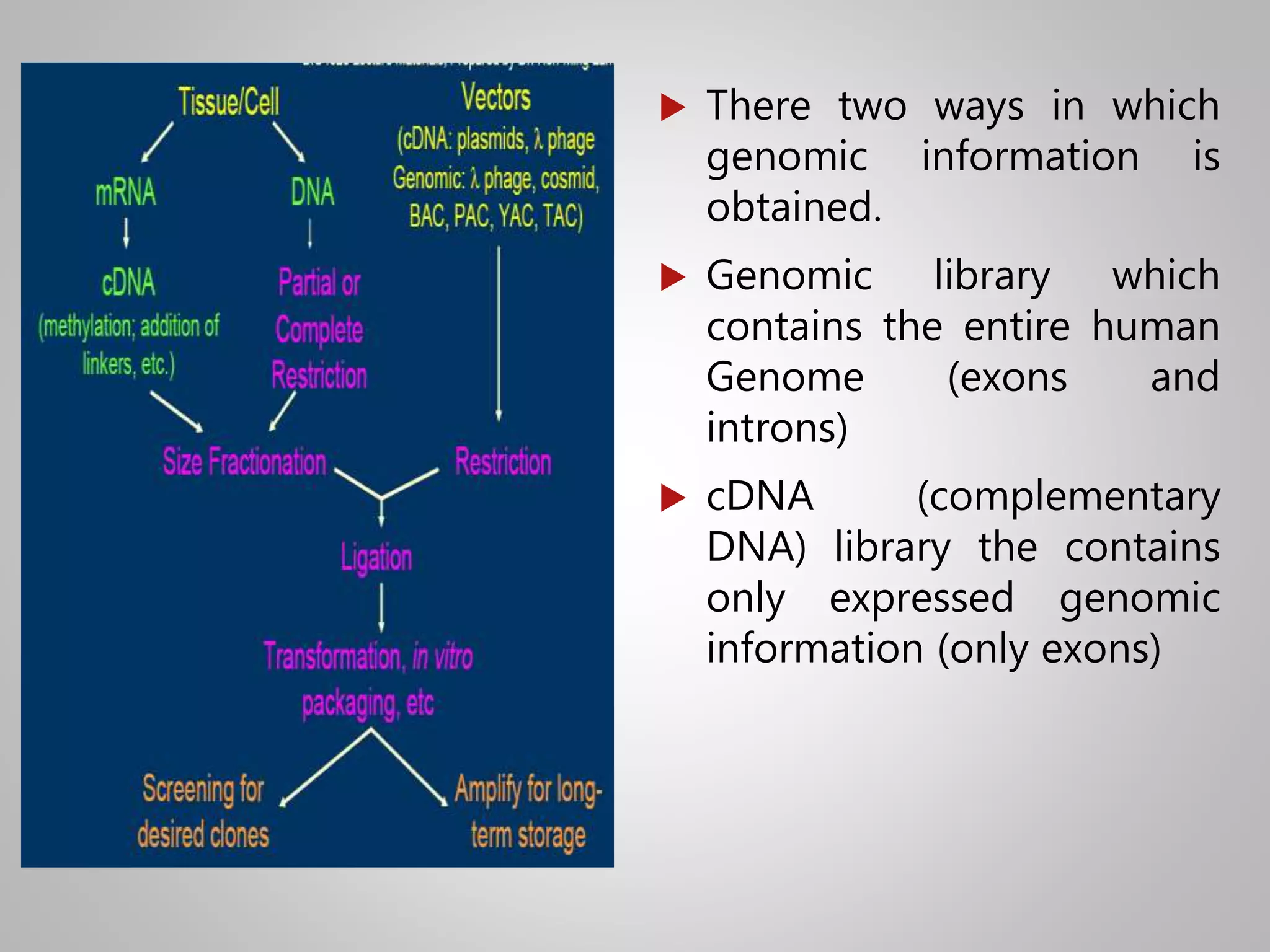
 There two ways in which
genomic information is
obtained.
 Genomic library which
contains the entire human
Genome (exons and
introns)
 cDNA (complementary
DNA) library the contains
only expressed genomic
information (only exons)
λ-phage as a Vector
 The genomic library is generated by using λ-phage for the following
reasons.
 A large number of λ phage can be screened simultaneously (5 x 10E4
phage plagues).
 λ phage as a higher transformation efficiency about 1000 times
higher compared to a plasmid.
 The vector as to maintain its lytic growth.
 Lysogenic pathway and other viral genes that are not important are
replaced with the DNA to be cloned.
Generating A Genomic Library
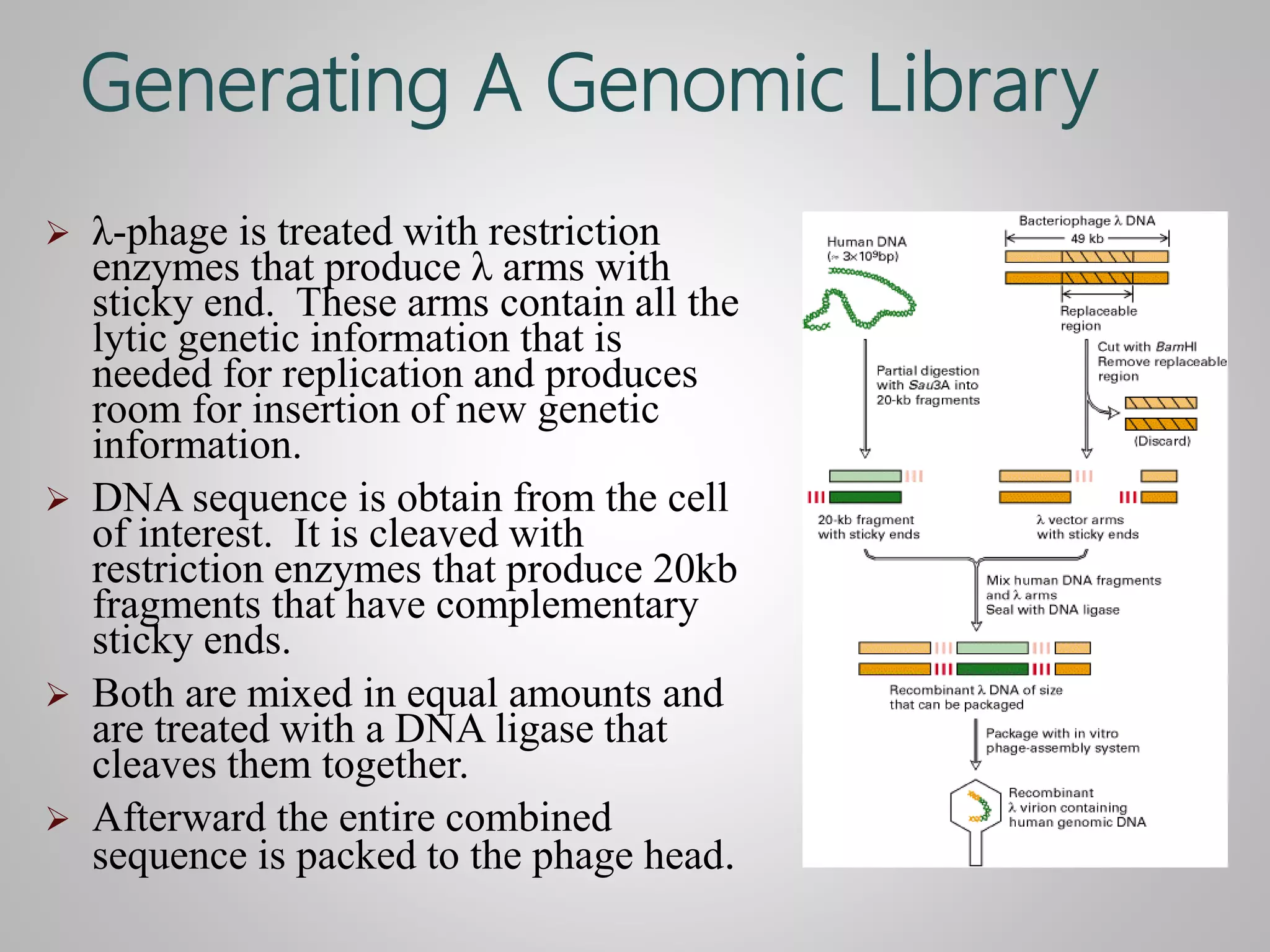
 λ-phage is treated with restriction
enzymes that produce λ arms with
sticky end. These arms contain all the
lytic genetic information that is
needed for replication and produces
room for insertion of new genetic
information.
 DNA sequence is obtain from the cell
of interest. It is cleaved with
restriction enzymes that produce 20kb
fragments that have complementary
sticky ends.
 Both are mixed in equal amounts and
are treated with a DNA ligase that
cleaves them together.
 Afterward the entire combined
sequence is packed to the phage head.
Packaging of the Recombinant DNA
 To prepare the phage an E.coli cell is infected with a mutant λ-phage
that as a defective “A-protein” (which is one of two genes that are
responsible for packaging genetic information).
 Therefore the E.Coli accumulates empty heads and also preassembled
tails.
 Once enough heads and tails are assembled we lysate the E.Coli cells.
 To the mixture of heads and tail we add isolated A protein (obtained
from E.Coli infected with λ-phage).
 In the next step we add the recombinant DNA that has the λ-phage
genetic information (which also includes COS sites).
 At this point we have a mixture containing mutant λ-phage heads and
tails. There is isolated A protein and recombinant DNA containing λ-
phage genetic information with COS sites.
 Therefore we have all the components necessary to package the
recombinant DNA into the λ-phage head. Once the information is
inserted the tail assembles and we have an infectious phage that
contains the recombinant DNA sequence.
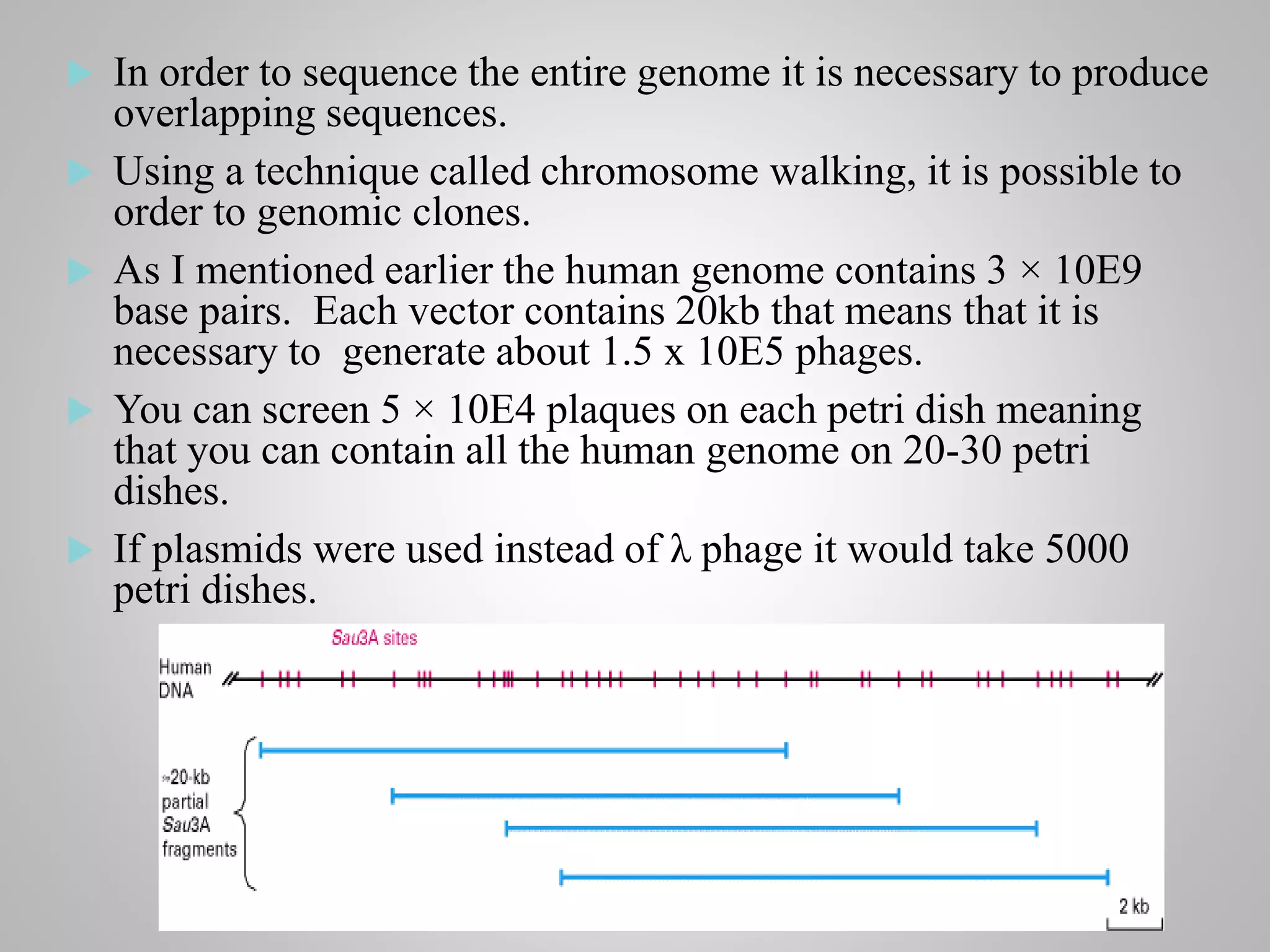
 In order to sequence the entire genome it is necessary to produce
overlapping sequences.
 Using a technique called chromosome walking, it is possible to
order to genomic clones.
 As I mentioned earlier the human genome contains 3 × 10E9
base pairs. Each vector contains 20kb that means that it is
necessary to generate about 1.5 x 10E5 phages.
 You can screen 5 × 10E4 plaques on each petri dish meaning
that you can contain all the human genome on 20-30 petri
dishes.
 If plasmids were used instead of λ phage it would take 5000
petri dishes.
Generating A cDNA Library
 All eukaryotes have an mRNA. Each specialized
cell have a specific mRNA that encodes information
for a specific protein.
 This information can be transformed back into DNA
or in other words a DNA copy of mRNA (using
reverse transcriptase). This cDNA can be stored in
plasmids or phages.
 cDNA contains only the expressed genetic
information which allows us to study the amino acid
sequence directly from the DNA.
 The first step in creating a cDNA
library is to isolate mRNA from the
cell.
 All mRNA have a poly A tail (unlike
tRNA and rRNA that don’t). By using
a column that contains a short poly T
sequence it is possible to isolate the
mRNA for both tRNA and rRNA.
 Once the mRNA is isolated it is treated
with an enzyme reverse transcriptase.
This enzyme will create a (ss)cDNA
intermediate from the mRNA.
 By hybridizing the poly A of the mRNA
with oligo T’d a primer is created.
Reverse transcriptase recognizes this
template and will add bases to 3’ end.
 At this point the (ss)cDNA needs to
be converted to the double strand
cDNA.
 The mRNA cDNA complex is
treated with an alkali which
hydrolyzes the mRNA, but not the
cDNA.
 Then by using terminal transferase
which is a DNA polymerase that
adds deoxynucleotides to free 3
ends without the need of template
(this will add poly G).
 To this a synthetic poly C is
hybridized which is used as primer
for the synthesis of the
complementary strand of the
cDNA.
Packing the cDNA
 The first step is to ligate to each end of the cDNA a short
restriction-site linkers (which are prepared by bactiophage T4).
This will produce blunt end at the end of the DNA.
 Now it is necessary to protect the cDNA from unwanted
digestion by restriction enzymes. Therefore the cDNA is treated
with a modification enzyme that methylates specific bases
within the restriction enzyme sequence.
 The next step is to treat the cDNA with restriction enzymes that
are specific to the blunt ends. This will result with sticky end.
 The final step is to ligate the sticky ends of the cDNA with the λ-
phage arms that have complementary sticky ends, thereby
inserting the Double strand cDNA into the vector.
Thank You

Genomic and c dna libraries

  • 1.
    Genomic DNA & cDNALibraries By, Abhinava J V BIRAC Innovation Fellow University of Agricultural Sciences, Dharwad
  • 2.
    Introduction  The useof genetic information is a powerful tool that today is becoming more readily available to scientists.  In order to use this powerful tool it necessary to know how to navigate throughout the entire genome. The human genome is about 3 x 10E9 bp.  In humans this project is known as Human Genome Project.
  • 3.
     There twoways in which genomic information is obtained.  Genomic library which contains the entire human Genome (exons and introns)  cDNA (complementary DNA) library the contains only expressed genomic information (only exons)
  • 4.
    λ-phage as aVector  The genomic library is generated by using λ-phage for the following reasons.  A large number of λ phage can be screened simultaneously (5 x 10E4 phage plagues).  λ phage as a higher transformation efficiency about 1000 times higher compared to a plasmid.  The vector as to maintain its lytic growth.  Lysogenic pathway and other viral genes that are not important are replaced with the DNA to be cloned.
  • 5.
    Generating A GenomicLibrary  λ-phage is treated with restriction enzymes that produce λ arms with sticky end. These arms contain all the lytic genetic information that is needed for replication and produces room for insertion of new genetic information.  DNA sequence is obtain from the cell of interest. It is cleaved with restriction enzymes that produce 20kb fragments that have complementary sticky ends.  Both are mixed in equal amounts and are treated with a DNA ligase that cleaves them together.  Afterward the entire combined sequence is packed to the phage head.
  • 6.
    Packaging of theRecombinant DNA  To prepare the phage an E.coli cell is infected with a mutant λ-phage that as a defective “A-protein” (which is one of two genes that are responsible for packaging genetic information).  Therefore the E.Coli accumulates empty heads and also preassembled tails.  Once enough heads and tails are assembled we lysate the E.Coli cells.  To the mixture of heads and tail we add isolated A protein (obtained from E.Coli infected with λ-phage).  In the next step we add the recombinant DNA that has the λ-phage genetic information (which also includes COS sites).  At this point we have a mixture containing mutant λ-phage heads and tails. There is isolated A protein and recombinant DNA containing λ- phage genetic information with COS sites.  Therefore we have all the components necessary to package the recombinant DNA into the λ-phage head. Once the information is inserted the tail assembles and we have an infectious phage that contains the recombinant DNA sequence.
  • 7.
     In orderto sequence the entire genome it is necessary to produce overlapping sequences.  Using a technique called chromosome walking, it is possible to order to genomic clones.  As I mentioned earlier the human genome contains 3 × 10E9 base pairs. Each vector contains 20kb that means that it is necessary to generate about 1.5 x 10E5 phages.  You can screen 5 × 10E4 plaques on each petri dish meaning that you can contain all the human genome on 20-30 petri dishes.  If plasmids were used instead of λ phage it would take 5000 petri dishes.
  • 8.
    Generating A cDNALibrary  All eukaryotes have an mRNA. Each specialized cell have a specific mRNA that encodes information for a specific protein.  This information can be transformed back into DNA or in other words a DNA copy of mRNA (using reverse transcriptase). This cDNA can be stored in plasmids or phages.  cDNA contains only the expressed genetic information which allows us to study the amino acid sequence directly from the DNA.
  • 9.
     The firststep in creating a cDNA library is to isolate mRNA from the cell.  All mRNA have a poly A tail (unlike tRNA and rRNA that don’t). By using a column that contains a short poly T sequence it is possible to isolate the mRNA for both tRNA and rRNA.  Once the mRNA is isolated it is treated with an enzyme reverse transcriptase. This enzyme will create a (ss)cDNA intermediate from the mRNA.  By hybridizing the poly A of the mRNA with oligo T’d a primer is created. Reverse transcriptase recognizes this template and will add bases to 3’ end.
  • 10.
     At thispoint the (ss)cDNA needs to be converted to the double strand cDNA.  The mRNA cDNA complex is treated with an alkali which hydrolyzes the mRNA, but not the cDNA.  Then by using terminal transferase which is a DNA polymerase that adds deoxynucleotides to free 3 ends without the need of template (this will add poly G).  To this a synthetic poly C is hybridized which is used as primer for the synthesis of the complementary strand of the cDNA.
  • 11.
    Packing the cDNA The first step is to ligate to each end of the cDNA a short restriction-site linkers (which are prepared by bactiophage T4). This will produce blunt end at the end of the DNA.  Now it is necessary to protect the cDNA from unwanted digestion by restriction enzymes. Therefore the cDNA is treated with a modification enzyme that methylates specific bases within the restriction enzyme sequence.  The next step is to treat the cDNA with restriction enzymes that are specific to the blunt ends. This will result with sticky end.  The final step is to ligate the sticky ends of the cDNA with the λ- phage arms that have complementary sticky ends, thereby inserting the Double strand cDNA into the vector.
  • 12.