UNIQUE AND
REPETITIVE DNA
HASNA P
No:09
Cytogenetics
INTRODUCTION
• Genetic material is the structure that carries the encoded
biological information about the structural, functional,
developmental and behavioural properties of organisms.
• It also serve as the agent that transfers or transmits the
coded biological information from parent to progeny.
• In most organisms, DNA is the genetic material. In some
viruses, RNA serve as the genetic material.
• The DNA sequnces comprising the eukaryotic genome can
be classified into three groups.
1. Non–repetitive sequence that are unique
2. Moderatively repetitive sequences that are dispersed
and repeated a small number of times, with some
copies not being identical.
3. Highly repetitive sequences that are short and
usually repeated more in number.
UNIQUE AND REPETITIVE DNA
• Chemically chromosomes are nucleoprotein in nature ;
composed of DNA, RNA and Protein.
• Generally chromosome contains 30–40℅ DNA, 50–65℅
protein and 0.5–10℅ RNA.
• In 1968, Roy Britten and David Kohne fragmented
genomes into pieces of few hundreds of nucleotides in
length, denatured and reannealed them, and so discovered
repetitive and unique DNAs.
• Re association kinetics identifies two general type of
genomic sequences.
1. Unique DNA (Non repetitive DNA)
• Nonrepetitive DNA consists of sequences that are unique.
• There is only one copy in a haploid genome.
• 2. Repetitive DNA
• Repetitive DNA consists of sequences that are present in
more than one copy in each genome.
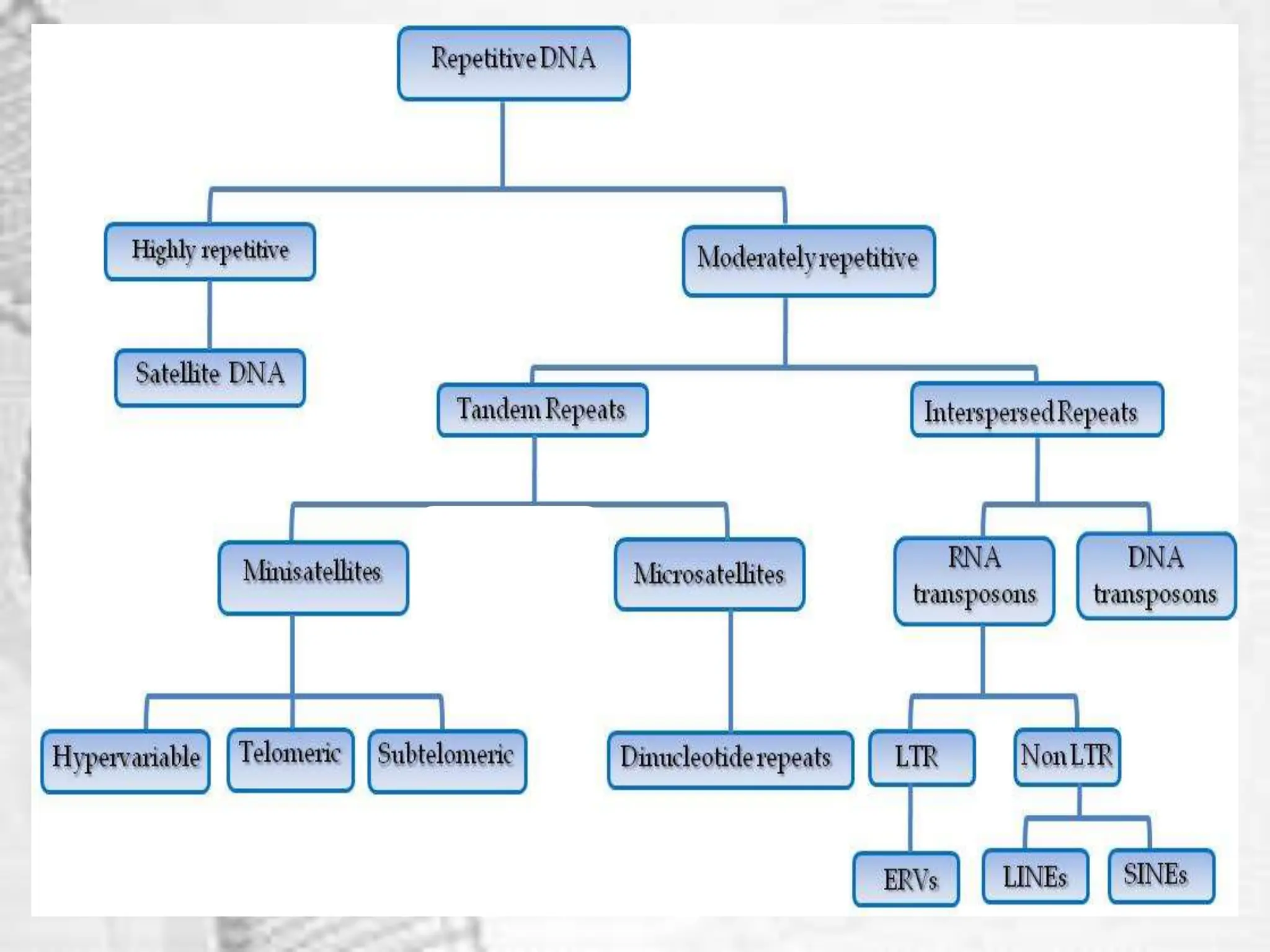
• Repetitive DNA is divided into two general types:
1. – Highly Repetitive DNA
• Very short sequences repeated many thousands times in a
genome.
• 2. – Moderately Repetitive DNA
• Relatively short sequences that are repeated 10– 1000
times in a genome.
Unique DNA
• Unique DNA consist of those DNA sequences which
are present in a single copy per genome (cell) and are
unique in nature.
• It is also known as Non–repetitive DNA.
• Greater than 50% of the eukaryotic genome consists
of DNA that is unique in sequence.
• It codes for protein which requires in large quantities
for cell.
• The average coding portions of a gene (the exons)
consist of about 2,000 base pairs of DNA that is unique
in sequence.
• The length of the non repetitive DNA component tends to
increase with overall genome size up to a total genome size
of about 3 × 10bp in mammals.
• However, further increases in genome size generally reflect
an increase in the amount and proportion of the repetitive
components.
• The nonrepetitive DNA content of genomes is a better
indication of the relative complexity of the organism.
• Prokaryotes contain non– repetitive DNA almost exclusively.
• For unicellular eukaryotes most DNA is non–repetitive.
• Re association kinetics shows that mRNA is transcribed
from non – repetitive DNA.
Repetitive DNA
• The genome of eukaryotes including human being
contains a large portion of non– coding sequences.
• Most of the non-coding DNA having multiple repeats of
the same nucleotides or base sequences is known as
repetitive DNA sequences.
• It consist of DNA nucleotides or base sequences, which
are few to several hundred base pairs (bp) long and are
present to a million copies per genome.
• Approximately 30% of the human genome consists of
repetitive DNA.
• The percentage of repetitive DNA varies from species to
species.
• Repetitive DNA is found almost in all eukaryotes (except
yeast) but almost negligible (0.3%) in prokaryotes.
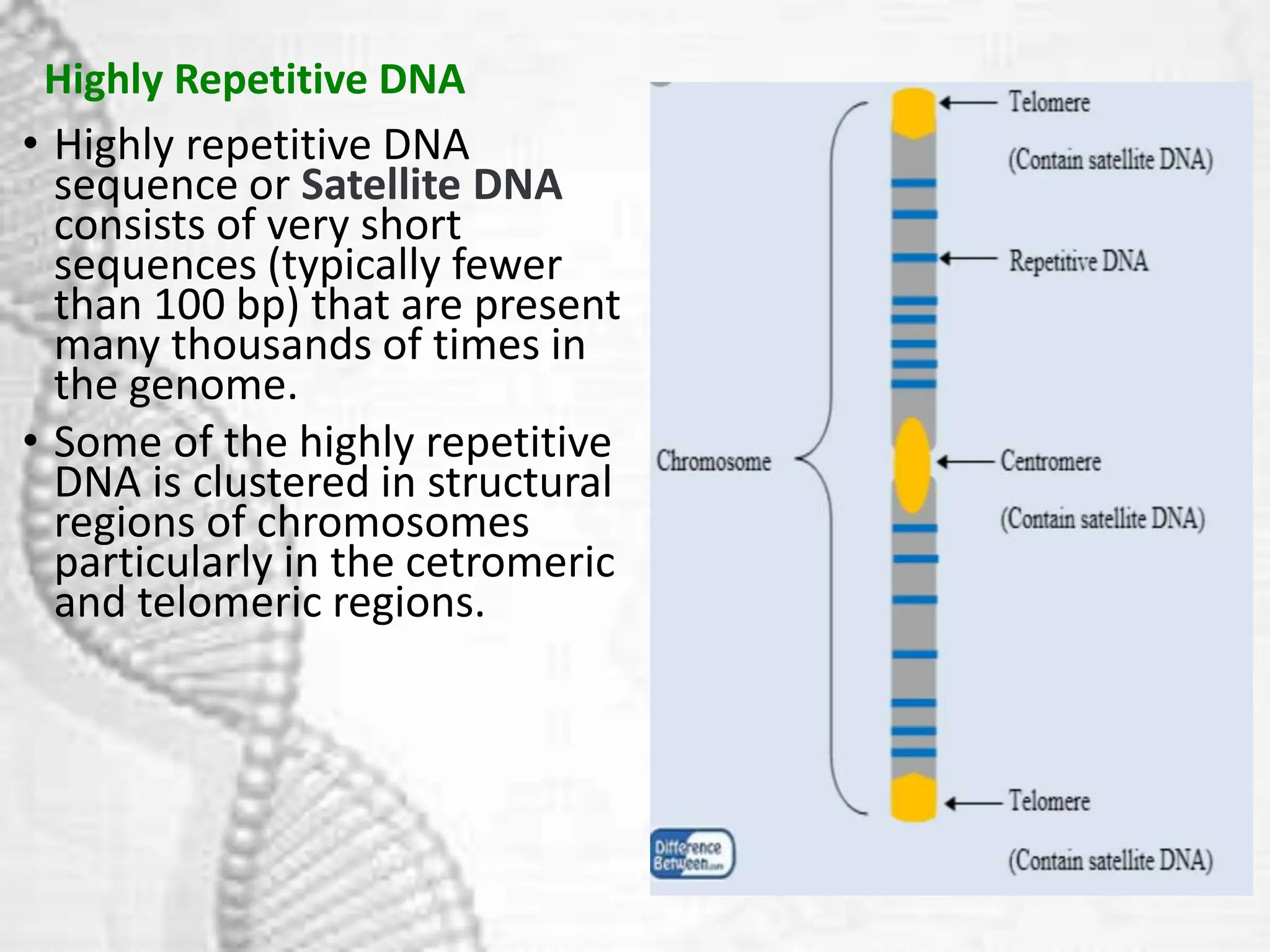
• Such DNA is found near the centromere in the
chromosome.
• There are multiple classes of repetitive DNA, two of these
classes include:
1. – Highly repetitive DNA
2. – Moderately repetitive DNA
• Repetitive, DNA is essential for genome function.
• Generic repeated signals in the DNA are necessary for
genome replication and accurate transmission to progeny
cells.
•
Highly Repetitive DNA
• Highly repetitive DNA
sequence or Satellite DNA
consists of very short
sequences (typically fewer
than 100 bp) that are present
many thousands of times in
the genome.
• Some of the highly repetitive
DNA is clustered in structural
regions of chromosomes
particularly in the cetromeric
and telomeric regions.
• Highly repetitive DNA comprises about 10-15% of the
total genomic DNA, is present in over a million copies
• It is transcriptionally inactive.
• Neither class is found in exons.
• Satellite DNA contributes to the essential processes of
formation of crucial chromosome structures, genome
stability and development.
• Moderately Repetitive DNA
• Moderately repetitive DNA consists of relatively short
sequences that are repeated typically 10 to 1,000 times in
the genome.
• Moderately repetitive DNA can be clustered at specific
chromosomal locations or distributed throughout the
genome.
• It is responsible for the high degree of secondary
structure formation in pre-mRNA.
• Most types of moderately repetitive DNA are short about
300 base pairs in length, are interspersed with unique
sequences, are often transcribed but do not code for
gene product
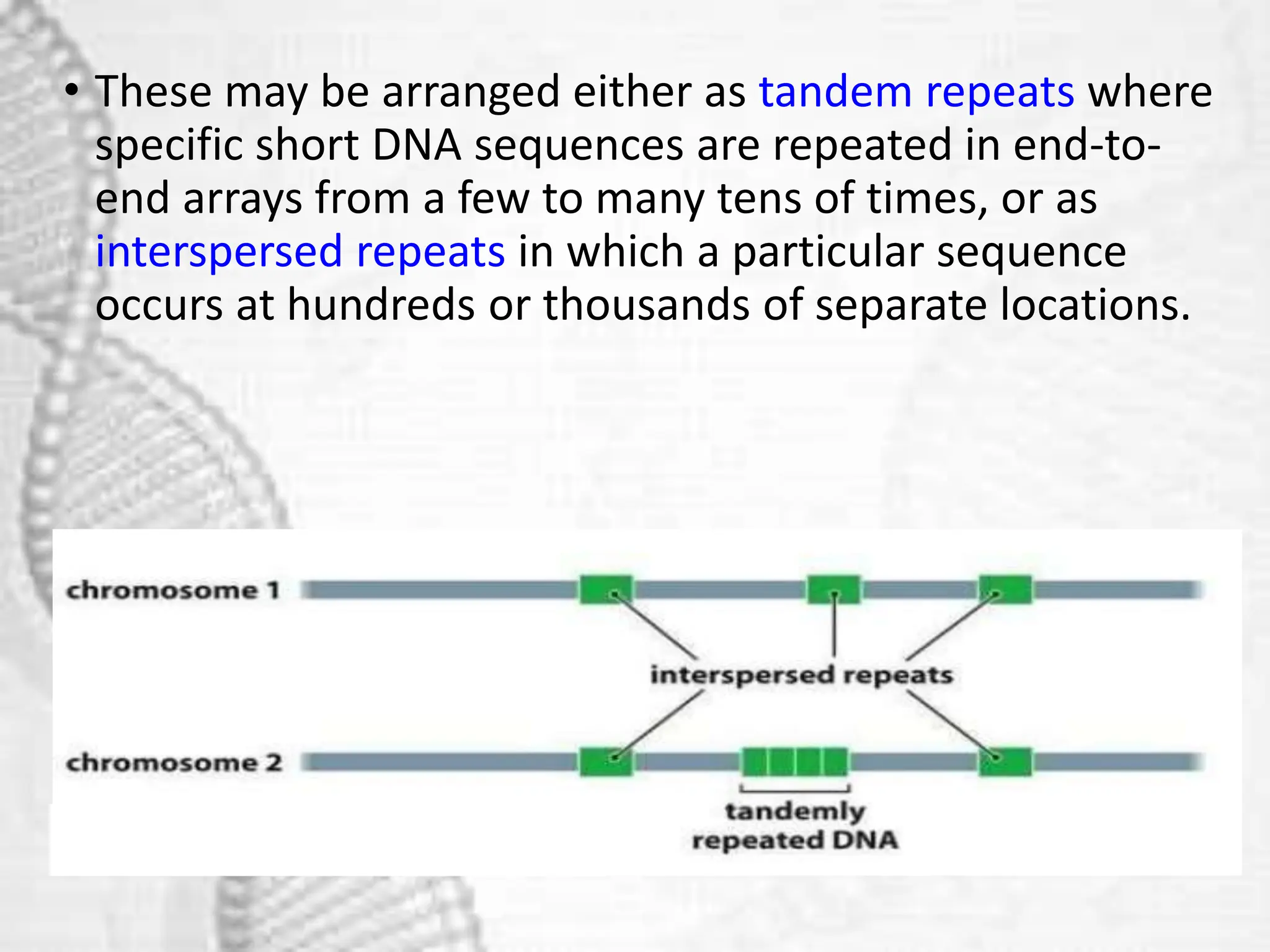
• These may be arranged either as tandem repeats where
specific short DNA sequences are repeated in end-to-
end arrays from a few to many tens of times, or as
interspersed repeats in which a particular sequence
occurs at hundreds or thousands of separate locations.
1. Tandem repeats
• Tandem repeats are highly repetitive sequence which
lies adjacent to each other.
• Short lengths of DNA repeated multiple times within a
gene.
• It occur in DNA when a pattern of one or more
nucleotides is repeated and the repetitions are directly
adjacent to each other.
• They serve as useful markers for identification because
they are found in great abundance throughout human
genome.
• Tandem repeat can be direct or inverted repeats.
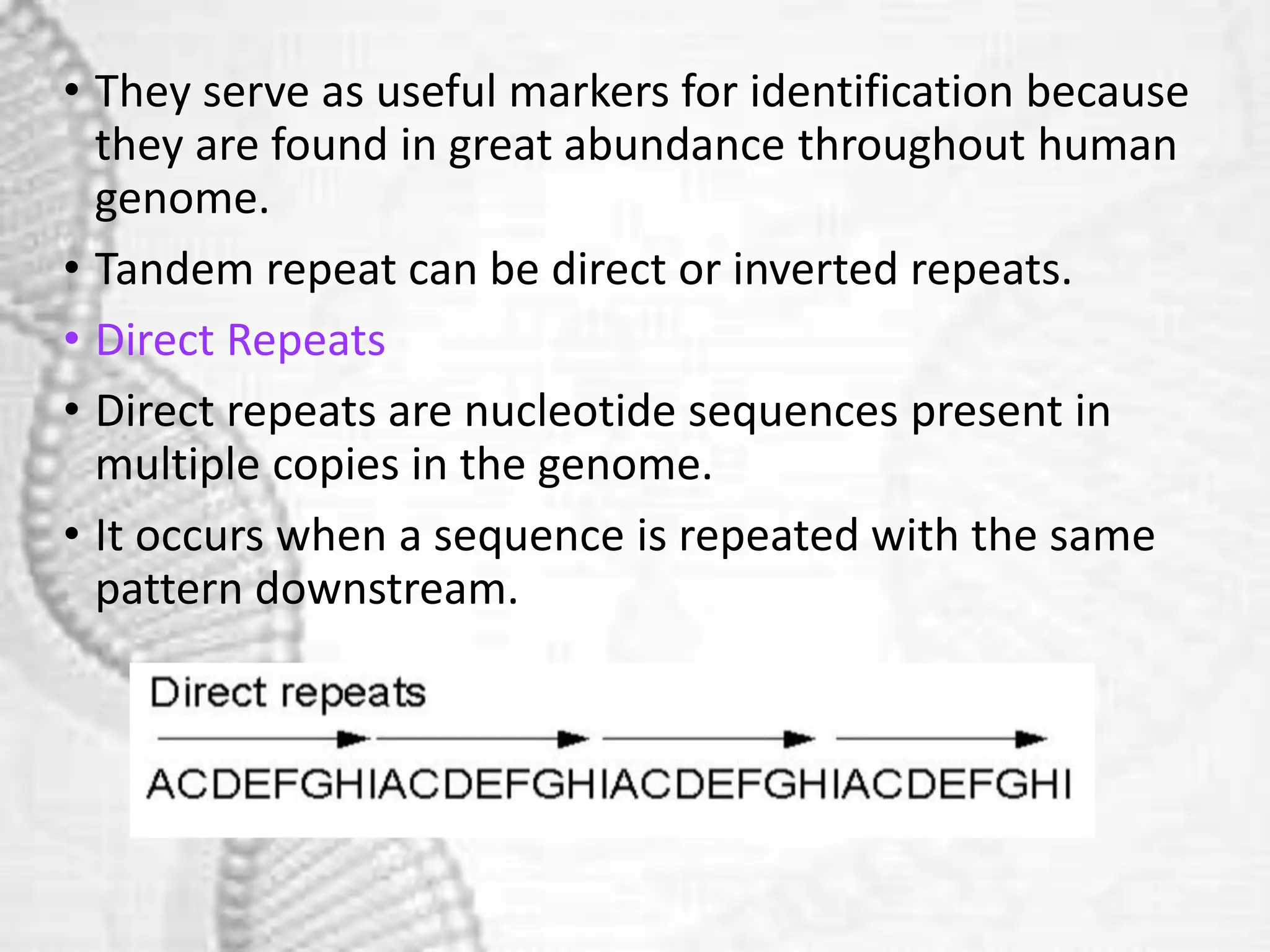
• Direct Repeats
• Direct repeats are nucleotide sequences present in
multiple copies in the genome.
• It occurs when a sequence is repeated with the same
pattern downstream.
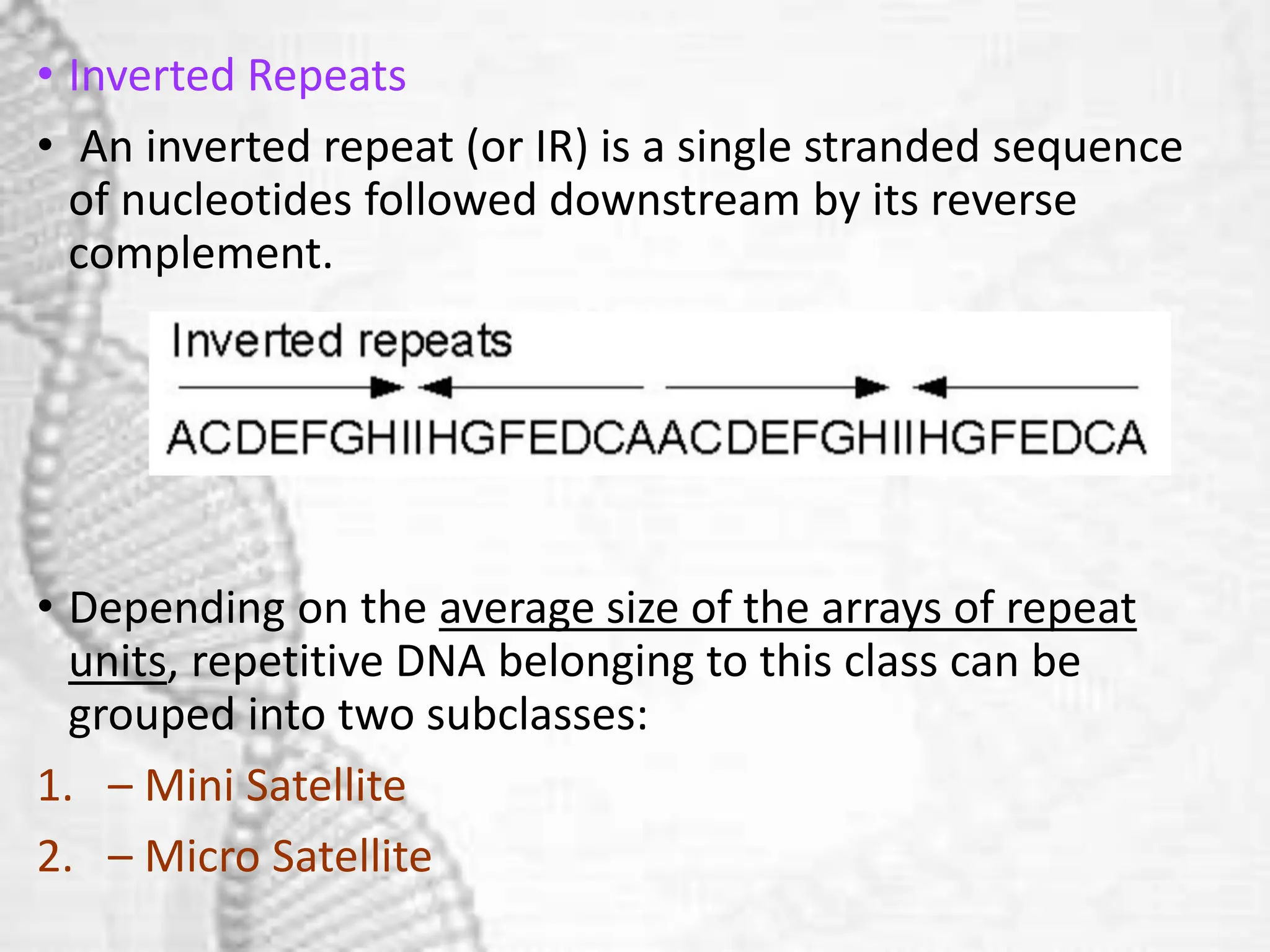
• Inverted Repeats
• An inverted repeat (or IR) is a single stranded sequence
of nucleotides followed downstream by its reverse
complement.
• Depending on the average size of the arrays of repeat
units, repetitive DNA belonging to this class can be
grouped into two subclasses:
1. – Mini Satellite
2. – Micro Satellite
• Minisatellite DNA
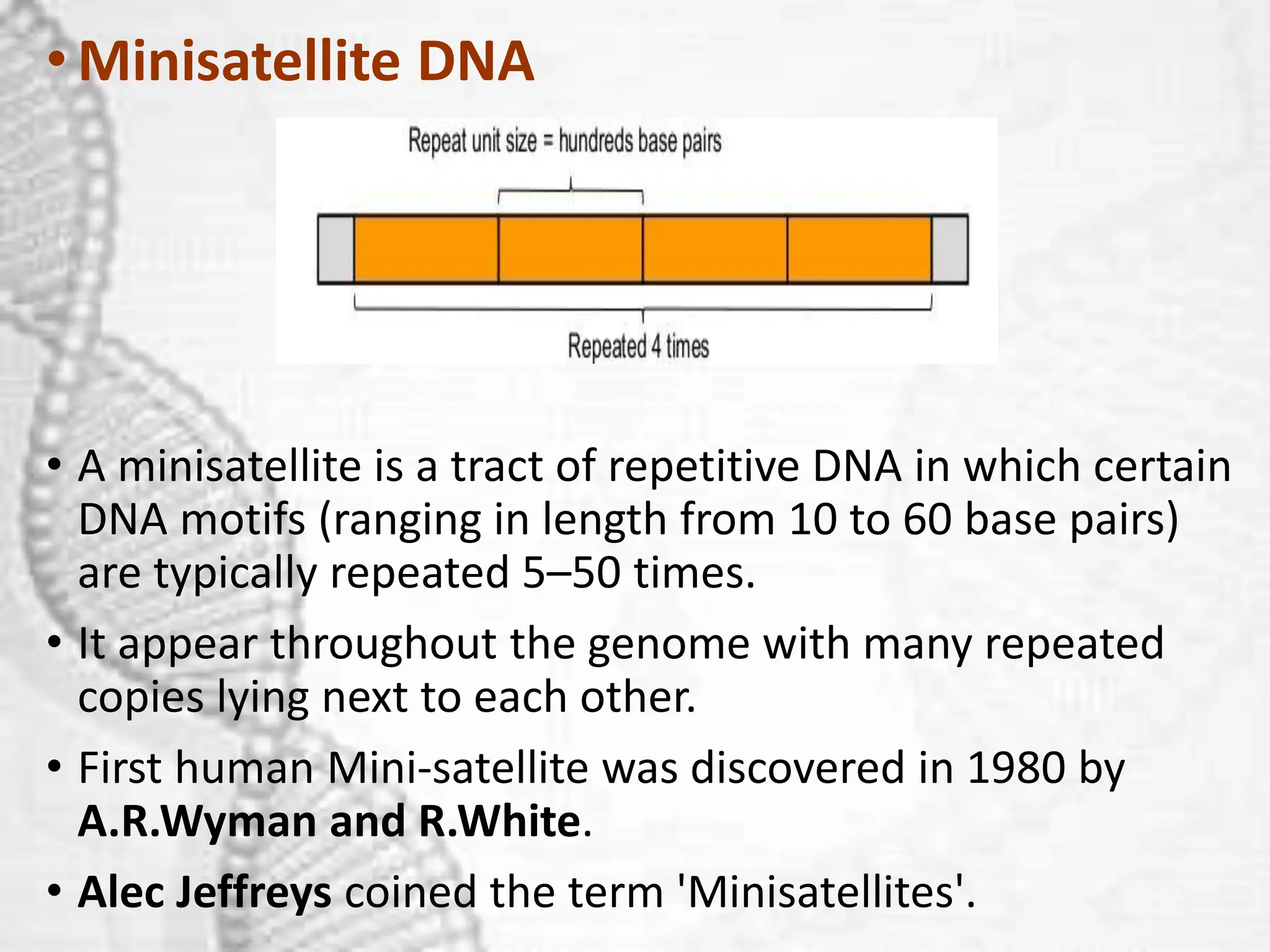
• A minisatellite is a tract of repetitive DNA in which certain
DNA motifs (ranging in length from 10 to 60 base pairs)
are typically repeated 5–50 times.
• It appear throughout the genome with many repeated
copies lying next to each other.
• First human Mini-satellite was discovered in 1980 by
A.R.Wyman and R.White.
• Alec Jeffreys coined the term 'Minisatellites'.
• Mini satellite is also known as Variable Number Tandem
Repeats (VNTR).
• Minisatellites are notable for their high mutation rate
and high diversity in the population, and they occur at
more than 1000 locations in the human genome.
• Minisatellites are prominent in the centromeres and
telomeres of chromosomes.
• Hypervariable minisatellite DNA sequences are short
tandemly repeated sequences that are present
throughout the human genome and are implicated to
enhance recombination.
• A Variable Number Tandem Repeat (VNTR) is a location
in a genome where a short nucleotide sequence is
organised as a tandem repeat.
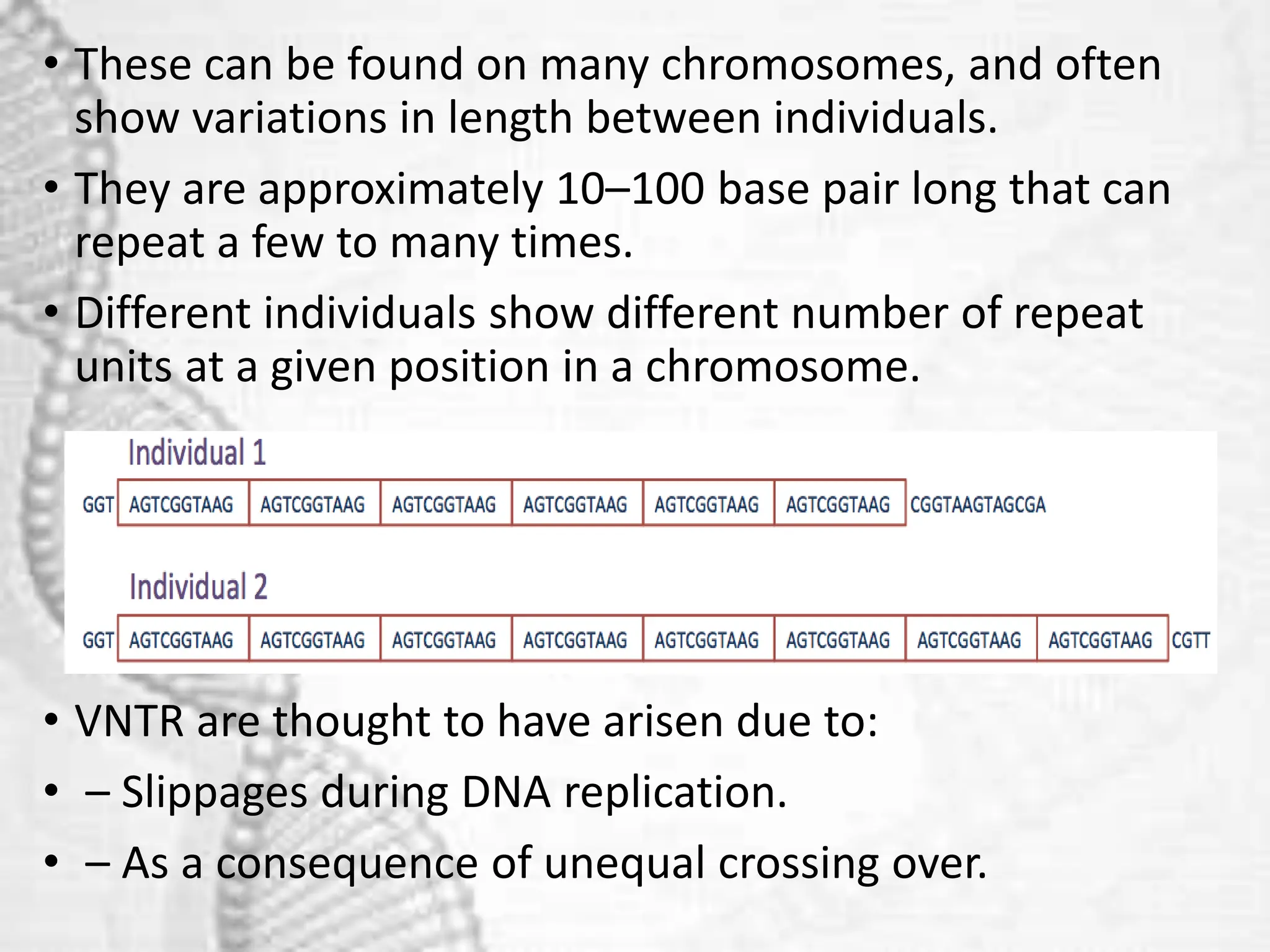
• These can be found on many chromosomes, and often
show variations in length between individuals.
• They are approximately 10–100 base pair long that can
repeat a few to many times.
• Different individuals show different number of repeat
units at a given position in a chromosome.
• VNTR are thought to have arisen due to:
• – Slippages during DNA replication.
• – As a consequence of unequal crossing over.
• The number of repeats varies widely in the populations,
allowing them to be used for personal or parental
identification.
• The variation in size (array length) of these regions
between individuals in humans was originally the basis
for DNA fingerprinting.
• Mini satellites are rich with G and C bases.
• Like Satellite DNA sequences are not normally
transcribed.
• They do not encode proteins.
• In humans, 90% of Mini-satellites are found at the sub-
telomeric region of chromosomes.
• Microsatellite DNA or SSR/STR
• An array of very short repeats.
• Microsatellite DNA comprises of repeating sequences of
2-6 base pairs of DNA and can be repeated 10 to 100
times and the repeating units are adjacent to each other.
• It is also known as Short Tandem Repeat (STR), Simple
Sequence Length Polymorphism (SSLP) and Simple
Sequence Repeat (SSR).
• Distributed throughout the genome including non coding
parts of the gene and within the coding gene.
• Rich with A and T bases.
• The lengths of particular microsatellite sequences tend
to be highly variable among individuals.
• They are highly polymorphic and are commonly used as a
genetic marker (DNA finger printing).
• Number and position of microsatellite vary even in
identical twins.
• When exactly two nucleotides are repeated, it is called a
"di nucleotide repeat".
• Eg: ACACACAC
• When three nucleotides are repeated, it is called a
"trinucleotide repeat".
• Eg: CAGCAGCAGCAG
• The Trinucleotide and Tetranucleotide tandem repeats
are comparatively rare.
• Applications of Minisatellites and Microsatellites
• Useful in studies involving:
• Genetic identity
• Genome mapping
• Pedigree analysis
• Parentage
• Population-level studies
• Personal or parental identification.
• Disease identification
• Evolutionary studies
• As they are highly polymorphic with regard to the number of
repeating units, they are commonly used as genetic marker.
• Their analysis is useful in genetics and biology research,
forensics, DNA fingerprinting and DNA profiling.
• 2. Interspersed Repetitive DNA
• When multiple copies of repetitive DNA found scattered
in the genome is called as interspersed repetitive DNA.
• A significant part of this consists of transposons.
• Transposons (jumping genes)
• They are short sequences of DNA (about 5 kb) that have
the ability to move to new locations in the genome and
make additional copies of themselves.
• Transposons are sometime viewed as 'selfish DNA' –
sequence that propagate themselves within a genome
without contributing to the development of organism.
• Transposons fall into two groups.
1. DNA Transposon
• Move directly from one position to another within the
genome using a transposase to "cut and paste" them
within the genome.
• 2. Retrotransposons
• It occurs by ''copy–paste'' mechanism (replicative).
• It is two types:
1. LTR (Long Terminal Repeats) Retrotransposon
2. Non - LTR Retrotransposon
• Non– LTR consist of two types of dispersed repeated
sequences known as SINEs and LINEs.
• SINEs and LINEs represent a significant proportion of the
entire moderately repeated DNA in the genome.
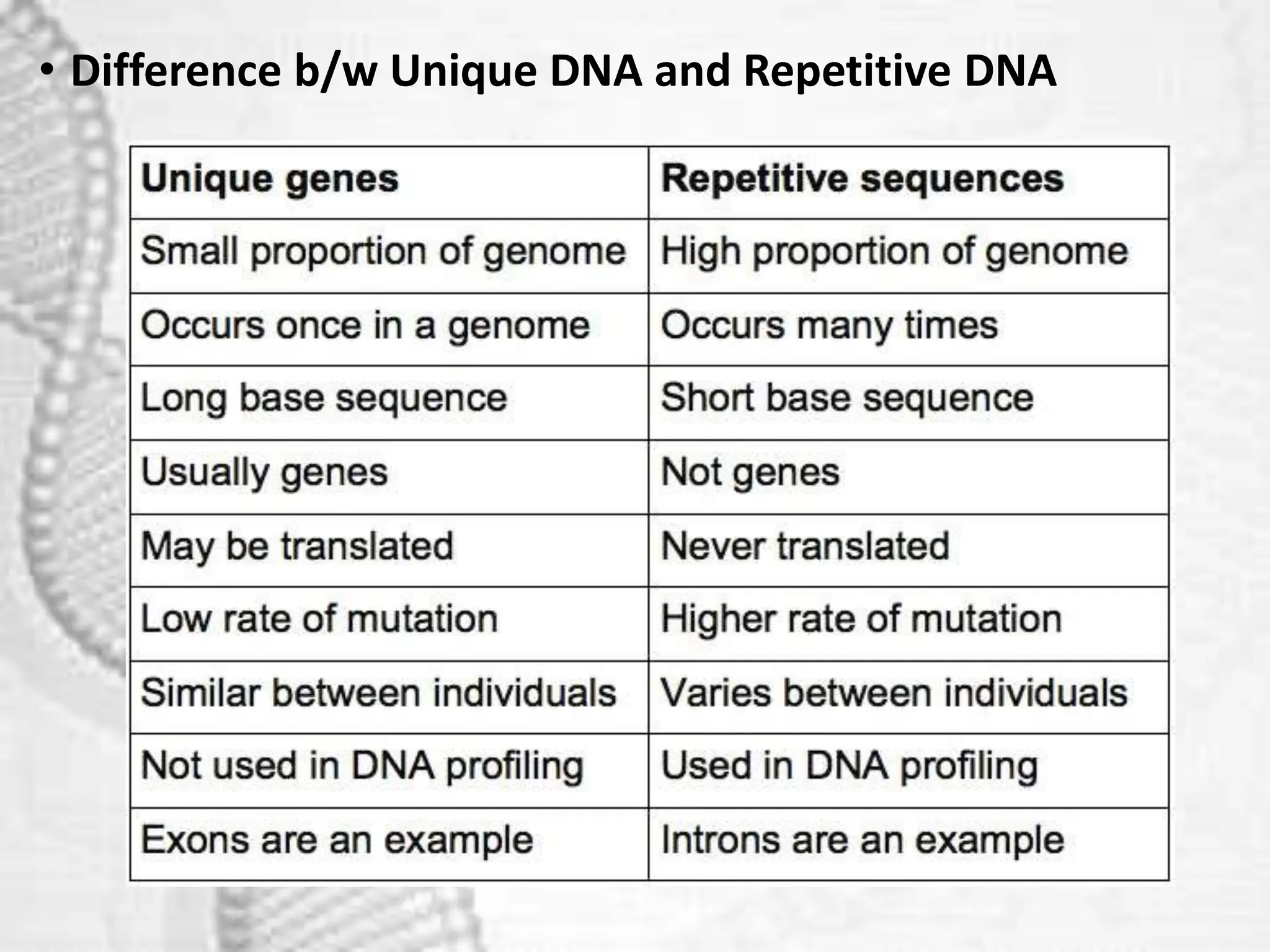
• Difference b/w Unique DNA and Repetitive DNA
CONCLUSION
• Eukaryotic genome contain large amount of repetitive DNA
sequence that are present in many copies by contrast, coding
regions of genes referred to as Unique DNA sequence are
present in single copy per genome.
• The development of gene cloning has enabled scientists to
dissect complex eukaryotic genomes and probe the functions
of eukaryotic genes.
• This provide scientists with a lot of information and enables
the investigation of eukaryotic genes, but also creates more
questions.
• The great thing about the determination of these sequence is
that it provides the foundation to understand the basis of
numerous human diseases.
....THANK YOU....

UNIQUE AND REPETITIVE DNA.a derailed presentation

  • 1.
    UNIQUE AND REPETITIVE DNA HASNAP No:09 Cytogenetics
  • 2.
    INTRODUCTION • Genetic materialis the structure that carries the encoded biological information about the structural, functional, developmental and behavioural properties of organisms. • It also serve as the agent that transfers or transmits the coded biological information from parent to progeny. • In most organisms, DNA is the genetic material. In some viruses, RNA serve as the genetic material. • The DNA sequnces comprising the eukaryotic genome can be classified into three groups.
  • 3.
    1. Non–repetitive sequencethat are unique 2. Moderatively repetitive sequences that are dispersed and repeated a small number of times, with some copies not being identical. 3. Highly repetitive sequences that are short and usually repeated more in number.
  • 4.
    UNIQUE AND REPETITIVEDNA • Chemically chromosomes are nucleoprotein in nature ; composed of DNA, RNA and Protein. • Generally chromosome contains 30–40℅ DNA, 50–65℅ protein and 0.5–10℅ RNA. • In 1968, Roy Britten and David Kohne fragmented genomes into pieces of few hundreds of nucleotides in length, denatured and reannealed them, and so discovered repetitive and unique DNAs. • Re association kinetics identifies two general type of genomic sequences.
  • 5.
    1. Unique DNA(Non repetitive DNA) • Nonrepetitive DNA consists of sequences that are unique. • There is only one copy in a haploid genome. • 2. Repetitive DNA • Repetitive DNA consists of sequences that are present in more than one copy in each genome. • Repetitive DNA is divided into two general types: 1. – Highly Repetitive DNA • Very short sequences repeated many thousands times in a genome. • 2. – Moderately Repetitive DNA • Relatively short sequences that are repeated 10– 1000 times in a genome.
  • 7.
    Unique DNA • UniqueDNA consist of those DNA sequences which are present in a single copy per genome (cell) and are unique in nature. • It is also known as Non–repetitive DNA. • Greater than 50% of the eukaryotic genome consists of DNA that is unique in sequence. • It codes for protein which requires in large quantities for cell. • The average coding portions of a gene (the exons) consist of about 2,000 base pairs of DNA that is unique in sequence.
  • 8.
    • The lengthof the non repetitive DNA component tends to increase with overall genome size up to a total genome size of about 3 × 10bp in mammals. • However, further increases in genome size generally reflect an increase in the amount and proportion of the repetitive components. • The nonrepetitive DNA content of genomes is a better indication of the relative complexity of the organism. • Prokaryotes contain non– repetitive DNA almost exclusively. • For unicellular eukaryotes most DNA is non–repetitive. • Re association kinetics shows that mRNA is transcribed from non – repetitive DNA.
  • 9.
    Repetitive DNA • Thegenome of eukaryotes including human being contains a large portion of non– coding sequences. • Most of the non-coding DNA having multiple repeats of the same nucleotides or base sequences is known as repetitive DNA sequences. • It consist of DNA nucleotides or base sequences, which are few to several hundred base pairs (bp) long and are present to a million copies per genome. • Approximately 30% of the human genome consists of repetitive DNA. • The percentage of repetitive DNA varies from species to species.
  • 10.
    • Repetitive DNAis found almost in all eukaryotes (except yeast) but almost negligible (0.3%) in prokaryotes. • Such DNA is found near the centromere in the chromosome. • There are multiple classes of repetitive DNA, two of these classes include: 1. – Highly repetitive DNA 2. – Moderately repetitive DNA • Repetitive, DNA is essential for genome function. • Generic repeated signals in the DNA are necessary for genome replication and accurate transmission to progeny cells.
  • 11.
  • 12.
    Highly Repetitive DNA •Highly repetitive DNA sequence or Satellite DNA consists of very short sequences (typically fewer than 100 bp) that are present many thousands of times in the genome. • Some of the highly repetitive DNA is clustered in structural regions of chromosomes particularly in the cetromeric and telomeric regions.
  • 13.
    • Highly repetitiveDNA comprises about 10-15% of the total genomic DNA, is present in over a million copies • It is transcriptionally inactive. • Neither class is found in exons. • Satellite DNA contributes to the essential processes of formation of crucial chromosome structures, genome stability and development.
  • 14.
    • Moderately RepetitiveDNA • Moderately repetitive DNA consists of relatively short sequences that are repeated typically 10 to 1,000 times in the genome. • Moderately repetitive DNA can be clustered at specific chromosomal locations or distributed throughout the genome. • It is responsible for the high degree of secondary structure formation in pre-mRNA. • Most types of moderately repetitive DNA are short about 300 base pairs in length, are interspersed with unique sequences, are often transcribed but do not code for gene product
  • 15.
    • These maybe arranged either as tandem repeats where specific short DNA sequences are repeated in end-to- end arrays from a few to many tens of times, or as interspersed repeats in which a particular sequence occurs at hundreds or thousands of separate locations.
  • 16.
    1. Tandem repeats •Tandem repeats are highly repetitive sequence which lies adjacent to each other. • Short lengths of DNA repeated multiple times within a gene. • It occur in DNA when a pattern of one or more nucleotides is repeated and the repetitions are directly adjacent to each other.
  • 17.
    • They serveas useful markers for identification because they are found in great abundance throughout human genome. • Tandem repeat can be direct or inverted repeats. • Direct Repeats • Direct repeats are nucleotide sequences present in multiple copies in the genome. • It occurs when a sequence is repeated with the same pattern downstream.
  • 18.
    • Inverted Repeats •An inverted repeat (or IR) is a single stranded sequence of nucleotides followed downstream by its reverse complement. • Depending on the average size of the arrays of repeat units, repetitive DNA belonging to this class can be grouped into two subclasses: 1. – Mini Satellite 2. – Micro Satellite
  • 19.
    • Minisatellite DNA •A minisatellite is a tract of repetitive DNA in which certain DNA motifs (ranging in length from 10 to 60 base pairs) are typically repeated 5–50 times. • It appear throughout the genome with many repeated copies lying next to each other. • First human Mini-satellite was discovered in 1980 by A.R.Wyman and R.White. • Alec Jeffreys coined the term 'Minisatellites'.
  • 20.
    • Mini satelliteis also known as Variable Number Tandem Repeats (VNTR). • Minisatellites are notable for their high mutation rate and high diversity in the population, and they occur at more than 1000 locations in the human genome. • Minisatellites are prominent in the centromeres and telomeres of chromosomes. • Hypervariable minisatellite DNA sequences are short tandemly repeated sequences that are present throughout the human genome and are implicated to enhance recombination. • A Variable Number Tandem Repeat (VNTR) is a location in a genome where a short nucleotide sequence is organised as a tandem repeat.
  • 21.
    • These canbe found on many chromosomes, and often show variations in length between individuals. • They are approximately 10–100 base pair long that can repeat a few to many times. • Different individuals show different number of repeat units at a given position in a chromosome. • VNTR are thought to have arisen due to: • – Slippages during DNA replication. • – As a consequence of unequal crossing over.
  • 22.
    • The numberof repeats varies widely in the populations, allowing them to be used for personal or parental identification. • The variation in size (array length) of these regions between individuals in humans was originally the basis for DNA fingerprinting. • Mini satellites are rich with G and C bases. • Like Satellite DNA sequences are not normally transcribed. • They do not encode proteins. • In humans, 90% of Mini-satellites are found at the sub- telomeric region of chromosomes.
  • 23.
    • Microsatellite DNAor SSR/STR • An array of very short repeats. • Microsatellite DNA comprises of repeating sequences of 2-6 base pairs of DNA and can be repeated 10 to 100 times and the repeating units are adjacent to each other. • It is also known as Short Tandem Repeat (STR), Simple Sequence Length Polymorphism (SSLP) and Simple Sequence Repeat (SSR).
  • 24.
    • Distributed throughoutthe genome including non coding parts of the gene and within the coding gene. • Rich with A and T bases. • The lengths of particular microsatellite sequences tend to be highly variable among individuals. • They are highly polymorphic and are commonly used as a genetic marker (DNA finger printing). • Number and position of microsatellite vary even in identical twins. • When exactly two nucleotides are repeated, it is called a "di nucleotide repeat". • Eg: ACACACAC
  • 25.
    • When threenucleotides are repeated, it is called a "trinucleotide repeat". • Eg: CAGCAGCAGCAG • The Trinucleotide and Tetranucleotide tandem repeats are comparatively rare.
  • 26.
    • Applications ofMinisatellites and Microsatellites • Useful in studies involving: • Genetic identity • Genome mapping • Pedigree analysis • Parentage • Population-level studies • Personal or parental identification. • Disease identification • Evolutionary studies • As they are highly polymorphic with regard to the number of repeating units, they are commonly used as genetic marker. • Their analysis is useful in genetics and biology research, forensics, DNA fingerprinting and DNA profiling.
  • 27.
    • 2. InterspersedRepetitive DNA • When multiple copies of repetitive DNA found scattered in the genome is called as interspersed repetitive DNA. • A significant part of this consists of transposons. • Transposons (jumping genes) • They are short sequences of DNA (about 5 kb) that have the ability to move to new locations in the genome and make additional copies of themselves. • Transposons are sometime viewed as 'selfish DNA' – sequence that propagate themselves within a genome without contributing to the development of organism. • Transposons fall into two groups.
  • 28.
    1. DNA Transposon •Move directly from one position to another within the genome using a transposase to "cut and paste" them within the genome. • 2. Retrotransposons • It occurs by ''copy–paste'' mechanism (replicative). • It is two types: 1. LTR (Long Terminal Repeats) Retrotransposon 2. Non - LTR Retrotransposon • Non– LTR consist of two types of dispersed repeated sequences known as SINEs and LINEs. • SINEs and LINEs represent a significant proportion of the entire moderately repeated DNA in the genome.
  • 29.
    • Difference b/wUnique DNA and Repetitive DNA
  • 30.
    CONCLUSION • Eukaryotic genomecontain large amount of repetitive DNA sequence that are present in many copies by contrast, coding regions of genes referred to as Unique DNA sequence are present in single copy per genome. • The development of gene cloning has enabled scientists to dissect complex eukaryotic genomes and probe the functions of eukaryotic genes. • This provide scientists with a lot of information and enables the investigation of eukaryotic genes, but also creates more questions. • The great thing about the determination of these sequence is that it provides the foundation to understand the basis of numerous human diseases.
  • 31.