GARRY D. LASAGA
DNA & MITOCHONDRIA
1
GARRY D. LASAGA
Mitochondrial DNA
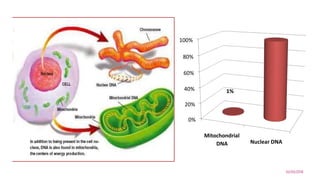
 Mitochondrial DNA is typically less than 1% of an animal
cell’s DNA population.
 Mitochondria contain their own genome in multiple
copies.
 Mitochondrial genome is distinct from that of the
nucleus.
 Mitochondria have their own DNA and express their
genes to produce proteins in the ETC.
2
0%
20%
40%
60%
80%
100%
Mitochondrial
DNA Nuclear DNA
1%
02/03/2018
3
Mitochondrial DNA
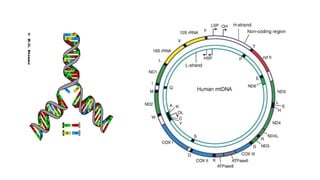
 mtDNA is double stranded circular DNA
molecule
 mt DNA contain 37 genes for normal
mitochondrial function
 13 genes make enzymes involved in oxidative
phosphorylation
4
5
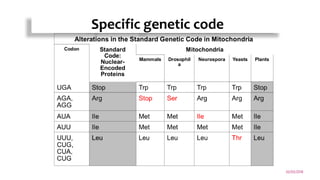
Specific genetic code
02/03/2018
6
Maternal Inheritance of mtDNA
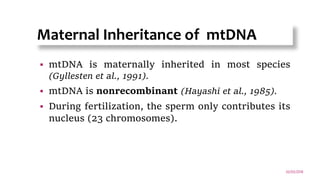
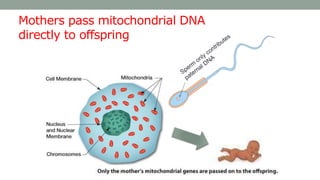
 mtDNA is maternally inherited in most species
(Gyllesten et al., 1991).
 mtDNA is nonrecombinant (Hayashi et al., 1985).
 During fertilization, the sperm only contributes its
nucleus (23 chromosomes).
02/03/2018
7
02/03/2018
8
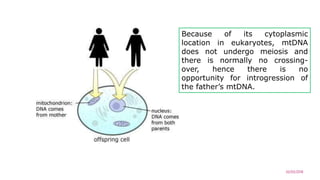
Because of its cytoplasmic
location in eukaryotes, mtDNA
does not undergo meiosis and
there is normally no crossing-
over, hence there is no
opportunity for introgression of
the father’s mtDNA.
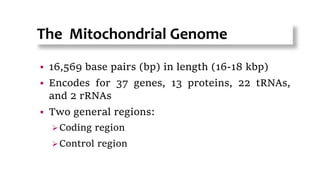
The Mitochondrial Genome
 16,569 base pairs (bp) in length (16-18 kbp)
 Encodes for 37 genes, 13 proteins, 22 tRNAs,
and 2 rRNAs
 Two general regions:
Coding region
Control region
9
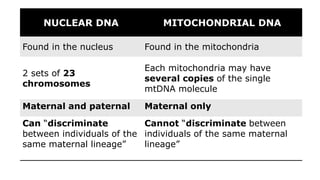
NUCLEAR DNA MITOCHONDRIAL DNA
Found in the nucleus Found in the mitochondria
2 sets of 23
chromosomes
Each mitochondria may have
several copies of the single
mtDNA molecule
Maternal and paternal Maternal only
Can “discriminate
between individuals of the
same maternal lineage”
Cannot “discriminate between
individuals of the same maternal
lineage”
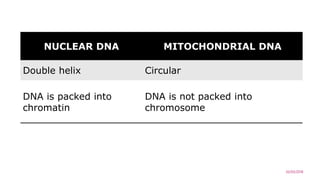
NUCLEAR DNA MITOCHONDRIAL DNA
Double helix Circular
DNA is packed into
chromatin
DNA is not packed into
chromosome
02/03/2018
11
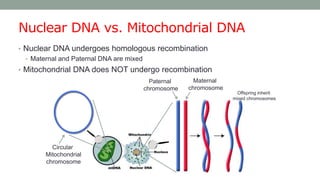
Nuclear DNA vs. Mitochondrial DNA
• Nuclear DNA undergoes homologous recombination
• Maternal and Paternal DNA are mixed
• Mitochondrial DNA does NOT undergo recombination
Paternal
chromosome
Maternal
chromosome
Offspring inherit
mixed chromosomes
Circular
Mitochondrial
chromosome
Mothers pass mitochondrial DNA
directly to offspring
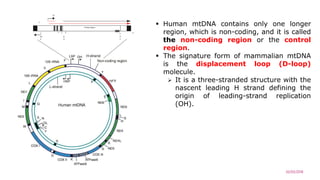
D-loop region
F
PT
A
S
1 2 3
LS
P
HS
P
O
H
02/03/2018
14 Human mtDNA contains only one longer
region, which is non-coding, and it is called
the non-coding region or the control
region.
 The signature form of mammalian mtDNA
is the displacement loop (D-loop)
molecule.
 It is a three-stranded structure with the
nascent leading H strand defining the
origin of leading-strand replication
(OH).

DNA and Mitochondria

  • 1.
    GARRY D. LASAGA DNA& MITOCHONDRIA 1 GARRY D. LASAGA
  • 2.
    Mitochondrial DNA  MitochondrialDNA is typically less than 1% of an animal cell’s DNA population.  Mitochondria contain their own genome in multiple copies.  Mitochondrial genome is distinct from that of the nucleus.  Mitochondria have their own DNA and express their genes to produce proteins in the ETC. 2
  • 3.
  • 4.
    Mitochondrial DNA  mtDNAis double stranded circular DNA molecule  mt DNA contain 37 genes for normal mitochondrial function  13 genes make enzymes involved in oxidative phosphorylation 4
  • 5.
  • 6.
  • 7.
    Maternal Inheritance ofmtDNA  mtDNA is maternally inherited in most species (Gyllesten et al., 1991).  mtDNA is nonrecombinant (Hayashi et al., 1985).  During fertilization, the sperm only contributes its nucleus (23 chromosomes). 02/03/2018 7
  • 8.
    02/03/2018 8 Because of itscytoplasmic location in eukaryotes, mtDNA does not undergo meiosis and there is normally no crossing- over, hence there is no opportunity for introgression of the father’s mtDNA.
  • 9.
    The Mitochondrial Genome 16,569 base pairs (bp) in length (16-18 kbp)  Encodes for 37 genes, 13 proteins, 22 tRNAs, and 2 rRNAs  Two general regions: Coding region Control region 9
  • 10.
    NUCLEAR DNA MITOCHONDRIALDNA Found in the nucleus Found in the mitochondria 2 sets of 23 chromosomes Each mitochondria may have several copies of the single mtDNA molecule Maternal and paternal Maternal only Can “discriminate between individuals of the same maternal lineage” Cannot “discriminate between individuals of the same maternal lineage”
  • 11.
    NUCLEAR DNA MITOCHONDRIALDNA Double helix Circular DNA is packed into chromatin DNA is not packed into chromosome 02/03/2018 11
  • 12.
    Nuclear DNA vs.Mitochondrial DNA • Nuclear DNA undergoes homologous recombination • Maternal and Paternal DNA are mixed • Mitochondrial DNA does NOT undergo recombination Paternal chromosome Maternal chromosome Offspring inherit mixed chromosomes Circular Mitochondrial chromosome
  • 13.
    Mothers pass mitochondrialDNA directly to offspring
  • 14.
    D-loop region F PT A S 1 23 LS P HS P O H 02/03/2018 14 Human mtDNA contains only one longer region, which is non-coding, and it is called the non-coding region or the control region.  The signature form of mammalian mtDNA is the displacement loop (D-loop) molecule.  It is a three-stranded structure with the nascent leading H strand defining the origin of leading-strand replication (OH).

Editor's Notes

  • #3 The mitochondrial DNA (mtDNA) is a small circular molecule that codes for some proteins in the respiratory chain and RNA molecules involved in translation of these proteins inside mitochondria. Mitochondria have their own DNA and express their genes to produce proteins active in the electron transport chain. However, most of the proteins they need are encoded in the nucleus of the cell. They need to import most of their proteins to function.
  • #4 The mitochondrial DNA is typically less than 1% of an animal cell’s DNA population. Mitochondria also contain their own genome present in multiple copies. Genome: genetic material in a cell or organism. The mitochondrial genome is separate and distinct from that of the nucleus. The mitochondrial DNA (mtDNA) is a small circular molecule that codes for some proteins in the respiratory chain and RNA molecules involved in translation of these proteins inside mitochondria. Mitochondria have their own DNA and express their genes to produce proteins active in the electron transport chain. However, most of the proteins they need are encoded in the nucleus of the cell. They need to import most of their proteins to function.
  • #5 Haploid refers to the reduced number of chromosomes in the ovum and sperm – half the (diploid) number in the somatic cells. In humans, there are about 20,000 to 25,000 protein coding genes and the mitochondrial DNA only contains 37 of those genes.
  • #6 A schematic presentation of a mitochondrial genome (human). It is a closes circular molecule. It has 2 strands. One of the strands is named heavy strand (H-strand), whereas the other strand is named light strand (L-strand). The H-strand is the template for transcription of the majority of genes, whereas the L-strand is the template for ND6 mRNA and eight tRNAs . SHAPE: double helix vs circular
  • #7  Mitochondria use a genetic code that differs from the “standard” genetic code. As an example UGA, which is a stop codon in most organisms, codes for tryphtophan in vertebrate mitochondria.
  • #8 It is said that we inherit mitochondrial DNA only from our mothers. In other words, the mtDNA can be passed down from mothers to both sons and daughters, but sons cannot pass along the mothers mtDNA to their children. NONRECOMBINANT – it does not combine with any other DNA so that it is passed down virtually unchanged through the direct maternal line over the generations. Mitochondria of the sperm cell are located at the mitochondrial sheath which is destroyed upon fertilization (there are some recent studies that oppose this claim).
  • #9 Introgression: entry or introduction of a gene from one gene complex into another (hybridization).
  • #10 CODING REGION: responsible for the production of various biological molecules involved in "cellular respiration“ CONTROL REGION: responsible for the regulation of the mtDNA molecule
  • #11 One’s mtDNA is nearly identical to the mtDNA of your straight line maternal ancestor who lived thousand of years ago, and it is also identical to thousands of people living today.
  • #13 Use this slide to emphasize the difference between mtDNA and nuclear DNA. Nuclear DNA is located inside the nucleus of the cell. Human nuclear DNA is organized into 23 pairs of chromosomes (one of each kind inherited from mother and father), and undergoes homologous recombination. mtDNA is located inside the mitochondria, each of which only has one bacteria-like circular chromosome. Because there is only 1 mitochondrial chromosome, it does not recombine. Because no recombination occurs, mtDNA is passed from parent to offspring virtually unchanged.
  • #14 The slide describes why it is that mitochondria is only inherited along the maternal line. The egg is much bigger than sperm, and contains all cellular material needed to start embryo growing. The sperm is small and contributes only genetic information (no mitochondria).
  • #15 Human mtDNA contains only one longer region, which is non-coding, and it is called the non-coding region or the control region. This region contains the regulatory elements the origin of H-strand replication (OH) and the transcriptional promoters. The signature form of mammalian mtDNA is the displacement loop (D-loop) molecule. The D-loop is defined as a three-stranded structure with the nascent leading H strand defining the origin of leading-strand replication (OH).