Mitochondria
Presented to: Mam Rafia
Presented by: rollno. 038833
BS Botany (6th Semester)
F.G. Postgraduate College for women, Wah Cantt.
Outline
• Introduction
• History
• Ultrastructure of mitochondria
• Dynamic nature of mitochondria
• Mitochondria DNA
• Mitochondrial Genetic code
• mtDNA replication
• mtDNA Transcription
• mtDNA Translation
• Mitochondrial inheritance
• Free radical theory of ageing
• Mitochondrial diseases
Introduction
• Double membrane bound organelle in cytoplasm of
eukaryotic cells
• Mito-thread; chondros-granule like
• Also called “powerhouses of cells”
• More abundant in actively growing and dividing cells
• Animal cells contain more mitochondria as compared to plant
cells
History of mitochondria
• First discovered in 1857 by Albert von Kolliker in flight
muscles of insects
• Named “Bioblasts” by Richard Altman in 1886
• Term “mitochondria” was coined by Carl Benda in 1898
• Discovered in plants by Frederick Meves in 1904
Origin of mitochondria
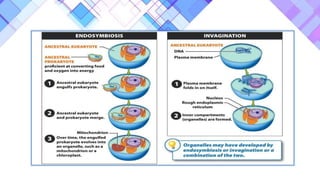
• Endosymbiotic hypothesis – mitochondria
formed by ingestion of aerobic bacteria
• Autogenous hypothesis/membrane
invagination hypothesis – formation of
mitochondria by folding of plasma membrane
inside the cell
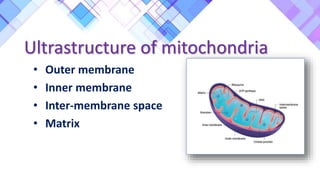
Ultrastructure of mitochondria
• Outer membrane
• Inner membrane
• Inter-membrane space
• Matrix
Outer membrane
• Encloses the mitochondria
• Fairly smooth membrane
• Simple phospholipid bilayer
• Contain protein structures called porins
• Separates the content of mitochondria from
the rest of the cell
Inner membrane
• Highly impermeable membrane
• Rich in proteins(76%), cardiolipin but lack
cholesterol
• Contain infoldings called cristae
• Main site of ATP production
• Contains protein that perform redox reactions
in oxidative phosphorylation
Intermembrane space
• Space between inner and outer mitochondrial
membranes
• Also called perimitochondrial space
• About 70Angstrom in length
• Plays a role in oxidative phosphorylation
Matrix
• Matrix is gel like
• Has high concentration of water soluble
proteins
• Contains ribosomes called mitoribosome and
circular double stranded DNA
• Contain enzymes for Krebs cycle and lipid
oxidation
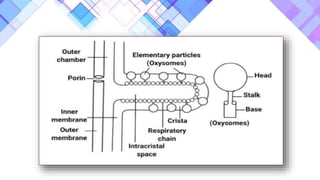
F1 Particles
• Knob like projections on inner surface of cristae
called F1 particles or oxysomes
• Consist of a base, a stalk and a head
• Base embedded in inner membrane
• Head projects into matrix
• Contains enzymes, coenzymes, electron
acceptors
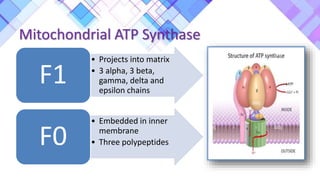
Mitochondrial ATP Synthase
• Projects into matrix
• 3 alpha, 3 beta,
gamma, delta and
epsilon chains
F1
• Embedded in inner
membrane
• Three polypeptides
F0
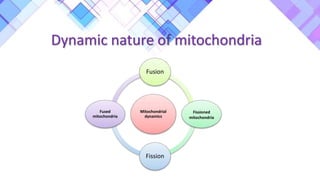
Dynamic nature of mitochondria
Mitochondrial
dynamics
Fusion
Fissioned
mitochondria
Fission
Fused
mitochondria
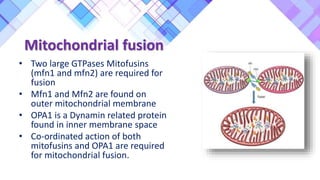
Mitochondrial fusion
• Two large GTPases Mitofusins
(mfn1 and mfn2) are required for
fusion
• Mfn1 and Mfn2 are found on
outer mitochondrial membrane
• OPA1 is a Dynamin related protein
found in inner membrane space
• Co-ordinated action of both
mitofusins and OPA1 are required
for mitochondrial fusion.
Mitochondrial fission
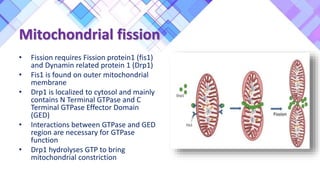
• Fission requires Fission protein1 (fis1)
and Dynamin related protein 1 (Drp1)
• Fis1 is found on outer mitochondrial
membrane
• Drp1 is localized to cytosol and mainly
contains N Terminal GTPase and C
Terminal GTPase Effector Domain
(GED)
• Interactions between GTPase and GED
region are necessary for GTPase
function
• Drp1 hydrolyses GTP to bring
mitochondrial constriction
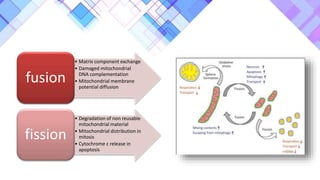
• Matrix component exchange
• Damaged mitochondrial
DNA complementation
• Mitochondrial membrane
potential diffusion
fusion
• Degradation of non reusable
mitochondrial material
• Mitochondrial distribution in
mitosis
• Cytochrome c release in
apoptosis
fission
Mitochondrial DNA
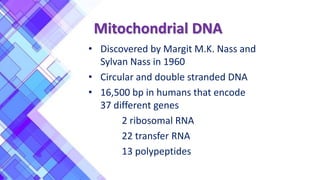
• Discovered by Margit M.K. Nass and
Sylvan Nass in 1960
• Circular and double stranded DNA
• 16,500 bp in humans that encode
37 different genes
2 ribosomal RNA
22 transfer RNA
13 polypeptides
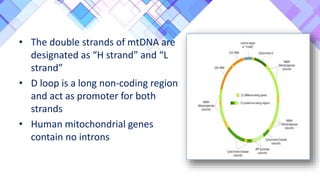
• The double strands of mtDNA are
designated as “H strand” and “L
strand”
• D loop is a long non-coding region
and act as promoter for both
strands
• Human mitochondrial genes
contain no introns
Heteroplasmy in mtDNA
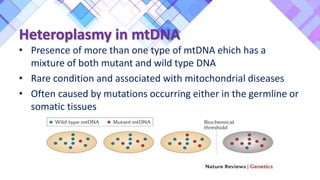
• Presence of more than one type of mtDNA ehich has a
mixture of both mutant and wild type DNA
• Rare condition and associated with mitochondrial diseases
• Often caused by mutations occurring either in the germline or
somatic tissues
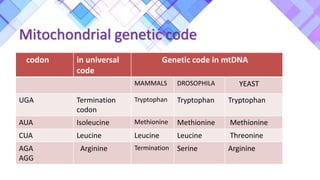
Mitochondrial genetic code
codon in universal
code
Genetic code in mtDNA
MAMMALS DROSOPHILA YEAST
UGA Termination
codon
Tryptophan Tryptophan Tryptophan
AUA Isoleucine Methionine Methionine Methionine
CUA Leucine Leucine Leucine Threonine
AGA
AGG
Arginine Termination Serine Arginine
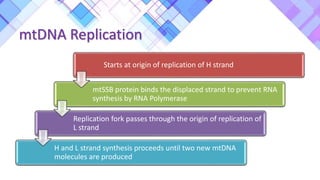
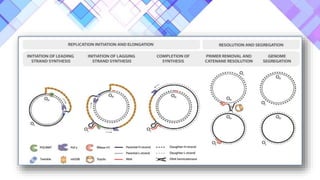
mtDNA Replication
Starts at origin of replication of H strand
mtSSB protein binds the displaced strand to prevent RNA
synthesis by RNA Polymerase
Replication fork passes through the origin of replication of
L strand
H and L strand synthesis proceeds until two new mtDNA
molecules are produced
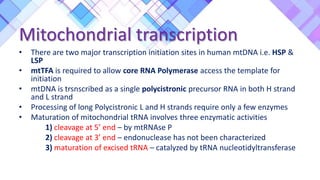
Mitochondrial transcription
• There are two major transcription initiation sites in human mtDNA i.e. HSP &
LSP
• mtTFA is required to allow core RNA Polymerase access the template for
initiation
• mtDNA is trsnscribed as a single polycistronic precursor RNA in both H strand
and L strand
• Processing of long Polycistronic L and H strands require only a few enzymes
• Maturation of mitochondrial tRNA involves three enzymatic activities
1) cleavage at 5’ end – by mtRNAse P
2) cleavage at 3’ end – endonuclease has not been characterized
3) maturation of excised tRNA – catalyzed by tRNA nucleotidyltransferase
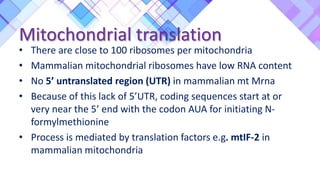
Mitochondrial translation
• There are close to 100 ribosomes per mitochondria
• Mammalian mitochondrial ribosomes have low RNA content
• No 5’ untranslated region (UTR) in mammalian mt Mrna
• Because of this lack of 5’UTR, coding sequences start at or
very near the 5’ end with the codon AUA for initiating N-
formylmethionine
• Process is mediated by translation factors e.g. mtIF-2 in
mammalian mitochondria
Mitochondrial inheritance
• Mitochondria have their own DNA and therefore
can pass the genetic information to the next
generation
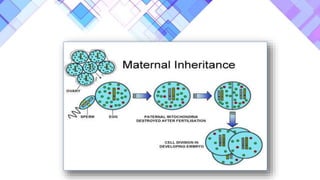
• Most of the zygote cytoplasm is derived from egg
• Sperm only contribute its nucleus
• So, mitochondrial genes show uniparental
inheritance or maternal inheritance
• Parental inheritance is also observed in
Polymouth chicken
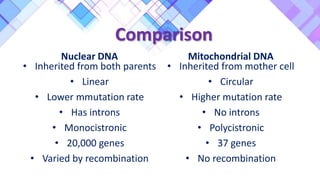
Comparison
Nuclear DNA
• Inherited from both parents
• Linear
• Lower mmutation rate
• Has introns
• Monocistronic
• 20,000 genes
• Varied by recombination
Mitochondrial DNA
• Inherited from mother cell
• Circular
• Higher mutation rate
• No introns
• Polycistronic
• 37 genes
• No recombination
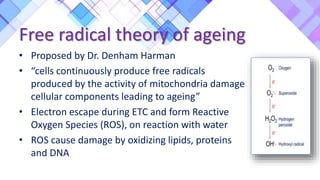
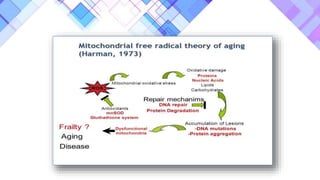
Free radical theory of ageing
• Proposed by Dr. Denham Harman
• “cells continuously produce free radicals
produced by the activity of mitochondria damage
cellular components leading to ageing”
• Electron escape during ETC and form Reactive
Oxygen Species (ROS), on reaction with water
• ROS cause damage by oxidizing lipids, proteins
and DNA
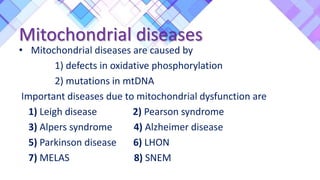
Mitochondrial diseases
• Mitochondrial diseases are caused by
1) defects in oxidative phosphorylation
2) mutations in mtDNA
Important diseases due to mitochondrial dysfunction are
1) Leigh disease 2) Pearson syndrome
3) Alpers syndrome 4) Alzheimer disease
5) Parkinson disease 6) LHON
7) MELAS 8) SNEM
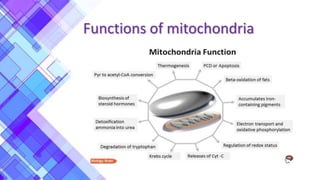
Functions of mitochondria
1). Apoptosis (PCD)
allows cells to self destruct when stimulated by appropriate trigger
cytochrome c released from mitochondria as a result of channels
formed in the membrane proteins, Bax and Bak
2). Thermogenesis
energy demanding process
endotherms produce heat to maintain body temp in response to
cold exposure
3). Pyruvate to Acetyl coA
pyruvate is produced in cytoplasm and transported to mitochondria
converted to Acetyl coA in mitochondrial matrix
Acetyl coA reacts with oxaloacetate and enters TCA cycle
4). Release of Cyt c
Helps to activate the Caspases, a family of killer proteases
facilitates the process of apoptosis
5). Ammonia to urea
Ammonia is toxic by product of nitrogen metabolism
Urea cycle converts ammonia into urea
Urea cycle intermediates tightly channeled in and out of
mitochondria
6). Degradation of Tryptophan
takes place partly in cytoplasm and partly in mitochondria
too much tryptophan causes trembling, shivering, fever, vomiting,
diarrhea, restlessness and agitation.
Mitochondria
Mitochondria

Mitochondria

  • 1.
    Mitochondria Presented to: MamRafia Presented by: rollno. 038833 BS Botany (6th Semester) F.G. Postgraduate College for women, Wah Cantt.
  • 2.
    Outline • Introduction • History •Ultrastructure of mitochondria • Dynamic nature of mitochondria • Mitochondria DNA • Mitochondrial Genetic code • mtDNA replication • mtDNA Transcription • mtDNA Translation • Mitochondrial inheritance • Free radical theory of ageing • Mitochondrial diseases
  • 3.
    Introduction • Double membranebound organelle in cytoplasm of eukaryotic cells • Mito-thread; chondros-granule like • Also called “powerhouses of cells” • More abundant in actively growing and dividing cells • Animal cells contain more mitochondria as compared to plant cells
  • 4.
    History of mitochondria •First discovered in 1857 by Albert von Kolliker in flight muscles of insects • Named “Bioblasts” by Richard Altman in 1886 • Term “mitochondria” was coined by Carl Benda in 1898 • Discovered in plants by Frederick Meves in 1904
  • 5.
    Origin of mitochondria •Endosymbiotic hypothesis – mitochondria formed by ingestion of aerobic bacteria • Autogenous hypothesis/membrane invagination hypothesis – formation of mitochondria by folding of plasma membrane inside the cell
  • 7.
    Ultrastructure of mitochondria •Outer membrane • Inner membrane • Inter-membrane space • Matrix
  • 8.
    Outer membrane • Enclosesthe mitochondria • Fairly smooth membrane • Simple phospholipid bilayer • Contain protein structures called porins • Separates the content of mitochondria from the rest of the cell
  • 9.
    Inner membrane • Highlyimpermeable membrane • Rich in proteins(76%), cardiolipin but lack cholesterol • Contain infoldings called cristae • Main site of ATP production • Contains protein that perform redox reactions in oxidative phosphorylation
  • 10.
    Intermembrane space • Spacebetween inner and outer mitochondrial membranes • Also called perimitochondrial space • About 70Angstrom in length • Plays a role in oxidative phosphorylation
  • 11.
    Matrix • Matrix isgel like • Has high concentration of water soluble proteins • Contains ribosomes called mitoribosome and circular double stranded DNA • Contain enzymes for Krebs cycle and lipid oxidation
  • 12.
    F1 Particles • Knoblike projections on inner surface of cristae called F1 particles or oxysomes • Consist of a base, a stalk and a head • Base embedded in inner membrane • Head projects into matrix • Contains enzymes, coenzymes, electron acceptors
  • 14.
    Mitochondrial ATP Synthase •Projects into matrix • 3 alpha, 3 beta, gamma, delta and epsilon chains F1 • Embedded in inner membrane • Three polypeptides F0
  • 15.
    Dynamic nature ofmitochondria Mitochondrial dynamics Fusion Fissioned mitochondria Fission Fused mitochondria
  • 16.
    Mitochondrial fusion • Twolarge GTPases Mitofusins (mfn1 and mfn2) are required for fusion • Mfn1 and Mfn2 are found on outer mitochondrial membrane • OPA1 is a Dynamin related protein found in inner membrane space • Co-ordinated action of both mitofusins and OPA1 are required for mitochondrial fusion.
  • 17.
    Mitochondrial fission • Fissionrequires Fission protein1 (fis1) and Dynamin related protein 1 (Drp1) • Fis1 is found on outer mitochondrial membrane • Drp1 is localized to cytosol and mainly contains N Terminal GTPase and C Terminal GTPase Effector Domain (GED) • Interactions between GTPase and GED region are necessary for GTPase function • Drp1 hydrolyses GTP to bring mitochondrial constriction
  • 18.
    • Matrix componentexchange • Damaged mitochondrial DNA complementation • Mitochondrial membrane potential diffusion fusion • Degradation of non reusable mitochondrial material • Mitochondrial distribution in mitosis • Cytochrome c release in apoptosis fission
  • 19.
    Mitochondrial DNA • Discoveredby Margit M.K. Nass and Sylvan Nass in 1960 • Circular and double stranded DNA • 16,500 bp in humans that encode 37 different genes 2 ribosomal RNA 22 transfer RNA 13 polypeptides
  • 20.
    • The doublestrands of mtDNA are designated as “H strand” and “L strand” • D loop is a long non-coding region and act as promoter for both strands • Human mitochondrial genes contain no introns
  • 21.
    Heteroplasmy in mtDNA •Presence of more than one type of mtDNA ehich has a mixture of both mutant and wild type DNA • Rare condition and associated with mitochondrial diseases • Often caused by mutations occurring either in the germline or somatic tissues
  • 22.
    Mitochondrial genetic code codonin universal code Genetic code in mtDNA MAMMALS DROSOPHILA YEAST UGA Termination codon Tryptophan Tryptophan Tryptophan AUA Isoleucine Methionine Methionine Methionine CUA Leucine Leucine Leucine Threonine AGA AGG Arginine Termination Serine Arginine
  • 23.
    mtDNA Replication Starts atorigin of replication of H strand mtSSB protein binds the displaced strand to prevent RNA synthesis by RNA Polymerase Replication fork passes through the origin of replication of L strand H and L strand synthesis proceeds until two new mtDNA molecules are produced
  • 25.
    Mitochondrial transcription • Thereare two major transcription initiation sites in human mtDNA i.e. HSP & LSP • mtTFA is required to allow core RNA Polymerase access the template for initiation • mtDNA is trsnscribed as a single polycistronic precursor RNA in both H strand and L strand • Processing of long Polycistronic L and H strands require only a few enzymes • Maturation of mitochondrial tRNA involves three enzymatic activities 1) cleavage at 5’ end – by mtRNAse P 2) cleavage at 3’ end – endonuclease has not been characterized 3) maturation of excised tRNA – catalyzed by tRNA nucleotidyltransferase
  • 26.
    Mitochondrial translation • Thereare close to 100 ribosomes per mitochondria • Mammalian mitochondrial ribosomes have low RNA content • No 5’ untranslated region (UTR) in mammalian mt Mrna • Because of this lack of 5’UTR, coding sequences start at or very near the 5’ end with the codon AUA for initiating N- formylmethionine • Process is mediated by translation factors e.g. mtIF-2 in mammalian mitochondria
  • 27.
    Mitochondrial inheritance • Mitochondriahave their own DNA and therefore can pass the genetic information to the next generation • Most of the zygote cytoplasm is derived from egg • Sperm only contribute its nucleus • So, mitochondrial genes show uniparental inheritance or maternal inheritance • Parental inheritance is also observed in Polymouth chicken
  • 29.
    Comparison Nuclear DNA • Inheritedfrom both parents • Linear • Lower mmutation rate • Has introns • Monocistronic • 20,000 genes • Varied by recombination Mitochondrial DNA • Inherited from mother cell • Circular • Higher mutation rate • No introns • Polycistronic • 37 genes • No recombination
  • 30.
    Free radical theoryof ageing • Proposed by Dr. Denham Harman • “cells continuously produce free radicals produced by the activity of mitochondria damage cellular components leading to ageing” • Electron escape during ETC and form Reactive Oxygen Species (ROS), on reaction with water • ROS cause damage by oxidizing lipids, proteins and DNA
  • 32.
    Mitochondrial diseases • Mitochondrialdiseases are caused by 1) defects in oxidative phosphorylation 2) mutations in mtDNA Important diseases due to mitochondrial dysfunction are 1) Leigh disease 2) Pearson syndrome 3) Alpers syndrome 4) Alzheimer disease 5) Parkinson disease 6) LHON 7) MELAS 8) SNEM
  • 33.
  • 34.
    1). Apoptosis (PCD) allowscells to self destruct when stimulated by appropriate trigger cytochrome c released from mitochondria as a result of channels formed in the membrane proteins, Bax and Bak 2). Thermogenesis energy demanding process endotherms produce heat to maintain body temp in response to cold exposure 3). Pyruvate to Acetyl coA pyruvate is produced in cytoplasm and transported to mitochondria converted to Acetyl coA in mitochondrial matrix Acetyl coA reacts with oxaloacetate and enters TCA cycle
  • 35.
    4). Release ofCyt c Helps to activate the Caspases, a family of killer proteases facilitates the process of apoptosis 5). Ammonia to urea Ammonia is toxic by product of nitrogen metabolism Urea cycle converts ammonia into urea Urea cycle intermediates tightly channeled in and out of mitochondria 6). Degradation of Tryptophan takes place partly in cytoplasm and partly in mitochondria too much tryptophan causes trembling, shivering, fever, vomiting, diarrhea, restlessness and agitation.