Mechanical Joints
Methods of joining materials
  Welding
  Mechanical joints

     – Screw fasteners
     – Rivets
  Adhesives
Uses of welding:
   Ship building, industrial and
    commercial buildings.
   Oil pipe -line construction.
   Automobile, railways and bridges.
   Machine tools.
   Farm equipment, home appliances, and
    air-conditioning units.
   Computer components.
   Mining equipment.
   Boilers, furnaces and vessels.
   Maintenance and repair of equipment
Welding and cutting processes:
 Oxy-fuel gas welding (OFW)
  oxygen and acetylene
 Shield metal arc welding (SMAW)
  it is the most popular method
  because:
     High quality weld
     Excellent uniformity
     High rate
     It can be used for variety of
      materials and thickness.
• Gas tungsten arc welding (GTAW):
   Clean
 High quality weld
 No post weld finishing is required
 Performed on variety of material
   • Gas metal arc welding
     (GMAW):
 Fast
 Economical
 Welding on thin as well as thick
  plates
 Reduced post-weld cleanup
• Pressure welding or resistance
welding
  Spot welding
  Seam welding
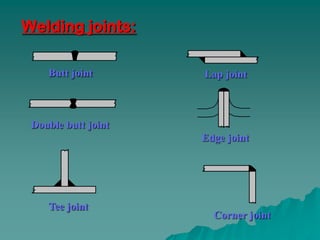
Welding joints:

    Butt joint       Lap joint


 Double butt joint
                     Edge joint


    Tee joint
                       Corner joint
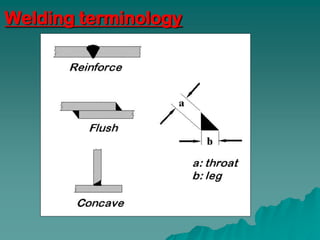
Welding terminology
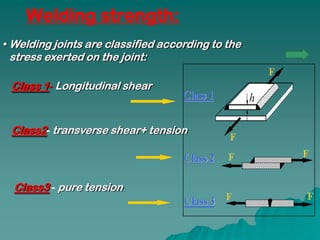
Welding strength:
• Welding joints are classified according to the
 stress exerted on the joint:

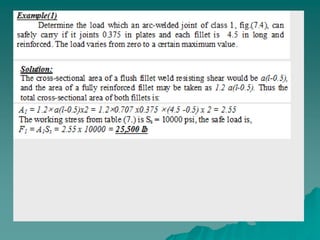
 Class 1- Longitudinal shear


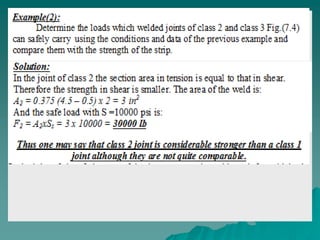
 Class2- transverse shear+ tension


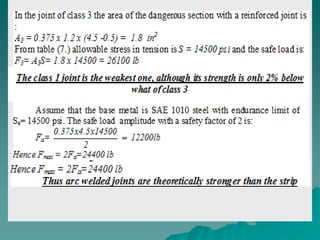
  Class3 - pure tension
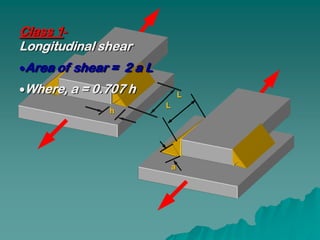
Class 1-
Longitudinal shear
Area of shear = 2 a L
Where, a = 0.707 h              L
                        L
              h


                            a
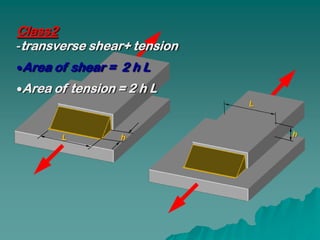
Class2
-transverse shear+ tension
Area of shear = 2 h L
Area of tension = 2 h L


       L        h            h
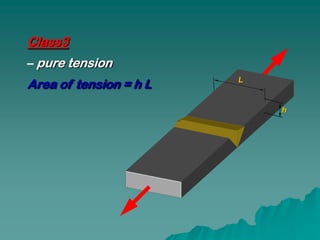
Class3
– pure tension
Area of tension = h L
                        h
Design of welding joint:
    Welding rods coated with flux table (7.1), (7.3)
    Uncoated welding rods 80% of table (7.1)
    ½ inch should be added to the length of weld
    compensate for the defects which may occur at
     the beginning and end of welding
    Stress concentration factors should be taken
     from table (7.2)
    For reinforced weld increase the weld area by
     20%
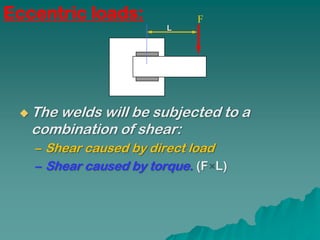
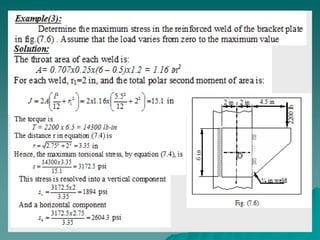
Eccentric loads:             F
                        L


  Thewelds will be subjected to a
   combination of shear:
   – Shear caused by direct load
   – Shear caused by torque. (F L)
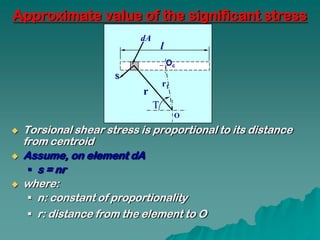
Approximate value of the significant stress
                           dA
                                    l
                                        Oc
                      S
                                    r1
                            r
                                T
                                         O

   Torsional shear stress is proportional to its distance
    from centroid
   Assume, on element dA
      s = nr
   where:
      n: constant of proportionality
      r: distance from the element to O
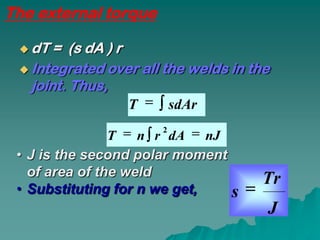
The external torque

  dT  = (s dA ) r
  Integrated over all the welds in the
   joint. Thus,
                   T    sdAr
                      2
                T   n r dA    nJ
 • J is the second polar moment
   of area of the weld
                                       Tr
 • Substituting for n we get,      s
                                       J
Thank You

MET 304 Mechanical joint-welding

  • 1.
  • 2.
    Methods of joiningmaterials  Welding  Mechanical joints – Screw fasteners – Rivets  Adhesives
  • 3.
    Uses of welding:  Ship building, industrial and commercial buildings.  Oil pipe -line construction.  Automobile, railways and bridges.  Machine tools.  Farm equipment, home appliances, and air-conditioning units.  Computer components.  Mining equipment.  Boilers, furnaces and vessels.  Maintenance and repair of equipment
  • 4.
    Welding and cuttingprocesses: Oxy-fuel gas welding (OFW) oxygen and acetylene Shield metal arc welding (SMAW) it is the most popular method because:  High quality weld  Excellent uniformity  High rate  It can be used for variety of materials and thickness.
  • 5.
    • Gas tungstenarc welding (GTAW): Clean  High quality weld  No post weld finishing is required  Performed on variety of material • Gas metal arc welding (GMAW):  Fast  Economical  Welding on thin as well as thick plates  Reduced post-weld cleanup
  • 6.
    • Pressure weldingor resistance welding Spot welding Seam welding
  • 7.
    Welding joints: Butt joint Lap joint Double butt joint Edge joint Tee joint Corner joint
  • 8.
  • 9.
    Welding strength: • Weldingjoints are classified according to the stress exerted on the joint: Class 1- Longitudinal shear Class2- transverse shear+ tension Class3 - pure tension
  • 10.
    Class 1- Longitudinal shear Areaof shear = 2 a L Where, a = 0.707 h L L h a
  • 11.
    Class2 -transverse shear+ tension Areaof shear = 2 h L Area of tension = 2 h L L h h
  • 12.
    Class3 – pure tension Areaof tension = h L h
  • 13.
    Design of weldingjoint:  Welding rods coated with flux table (7.1), (7.3)  Uncoated welding rods 80% of table (7.1)  ½ inch should be added to the length of weld  compensate for the defects which may occur at the beginning and end of welding  Stress concentration factors should be taken from table (7.2)  For reinforced weld increase the weld area by 20%
  • 14.
    Eccentric loads: F L  Thewelds will be subjected to a combination of shear: – Shear caused by direct load – Shear caused by torque. (F L)
  • 15.
    Approximate value ofthe significant stress dA l Oc S r1 r T O  Torsional shear stress is proportional to its distance from centroid  Assume, on element dA  s = nr  where:  n: constant of proportionality  r: distance from the element to O
  • 16.
    The external torque  dT = (s dA ) r  Integrated over all the welds in the joint. Thus, T sdAr 2 T n r dA nJ • J is the second polar moment of area of the weld Tr • Substituting for n we get, s J
  • 22.