
Bolted Connections
by: Dinesh Nath
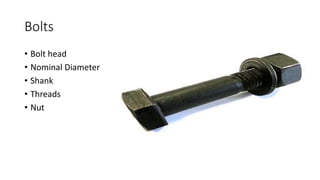
Bolts
• Bolt head
• Nominal Diameter
• Shank
• Threads
• Nut
Types of bolts
According to material and strength
a) Ordinary structure bolts
b) High strength steel bolts
According to type of shear
a) Unfinished or black bolt
b) turned bolt
According to fit and pitch
a) Standard pitch bolt
b) Fine pitch bolt
c) Coarse pitch bolt
According to shape of head
a) Square bolt
b) Hexagonal bolt
Advantages of bolted connection
1. Less man power required compared to rivet connection
2. High strength bolts are much stronger than the rivets. Hence
number of fasteners required for bolts are much lesser when
compared with rivets.
3. Bolted connections are faster
4. Tightening Bolts and nuts are much silent when compared with
rivets where lot of hammering has to be done.
5. Bolts is a cold process. Hence no risk of fire.
6. Bolts can be removed, replaced or retightened easily in the event of
faulty bolting or damaged bolts due t accidents/hazards.
Disadvantages:
• Bolted connection have lesser strength in axial tension as the net area
at the root of the thread is less.
• Under vibratory loads the strength is reduced if the connections get
loosened.
• Unfinished bolts have lesser strength because of non uniform
diameter.
• Architectural look.
Types of bolted joints
1 Lap Joint 2 Butt joint
1 Shop joint 2 Field joint
1 Friction type joint 2 Bearing type of joint
Analysis and design of bolted connections
• Analysis & Design are identical to rivet except the strength calculation
for bolts are based on their nominal diameter.
Allowable stress in bolts
Allowable stress in
kg/cm2
Turned and fitted Black ( common) High strength
Shear
Bearing
Tension
1025
2360
-
865
2045
1260
(for d > 38)
945 ( 20<d<38)
785 (d< 20)
1760
-
4680
Design of bolted shear connection
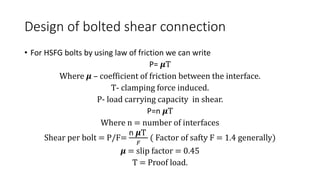
• For HSFG bolts by using law of friction we can write
P= 𝝁T
Where 𝝁 – coefficient of friction between the interface.
T- clamping force induced.
P- load carrying capacity in shear.
P=n 𝝁T
Where n = number of interfaces
Shear per bolt = P/F=
n 𝝁T
𝐹
( Factor of safty F = 1.4 generally)
𝝁 = slip factor = 0.45
T = Proof load.
Example of lap Joint
• Design the doubly bolted lap joint connecting two plates of thickness
12 mm to 10 mm to carry its full load. Assume permissible axial
tension in plate as 150 Mpa. ( F = 1.4, 18 mm bolt T = 131. 3 kN)

Bolts

  • 1.
  • 2.
    Bolts • Bolt head •Nominal Diameter • Shank • Threads • Nut
  • 3.
    Types of bolts Accordingto material and strength a) Ordinary structure bolts b) High strength steel bolts According to type of shear a) Unfinished or black bolt b) turned bolt According to fit and pitch a) Standard pitch bolt b) Fine pitch bolt c) Coarse pitch bolt According to shape of head a) Square bolt b) Hexagonal bolt
  • 4.
    Advantages of boltedconnection 1. Less man power required compared to rivet connection 2. High strength bolts are much stronger than the rivets. Hence number of fasteners required for bolts are much lesser when compared with rivets. 3. Bolted connections are faster 4. Tightening Bolts and nuts are much silent when compared with rivets where lot of hammering has to be done. 5. Bolts is a cold process. Hence no risk of fire. 6. Bolts can be removed, replaced or retightened easily in the event of faulty bolting or damaged bolts due t accidents/hazards.
  • 5.
    Disadvantages: • Bolted connectionhave lesser strength in axial tension as the net area at the root of the thread is less. • Under vibratory loads the strength is reduced if the connections get loosened. • Unfinished bolts have lesser strength because of non uniform diameter. • Architectural look.
  • 6.
    Types of boltedjoints 1 Lap Joint 2 Butt joint 1 Shop joint 2 Field joint 1 Friction type joint 2 Bearing type of joint
  • 7.
    Analysis and designof bolted connections • Analysis & Design are identical to rivet except the strength calculation for bolts are based on their nominal diameter. Allowable stress in bolts Allowable stress in kg/cm2 Turned and fitted Black ( common) High strength Shear Bearing Tension 1025 2360 - 865 2045 1260 (for d > 38) 945 ( 20<d<38) 785 (d< 20) 1760 - 4680
  • 8.
    Design of boltedshear connection • For HSFG bolts by using law of friction we can write P= 𝝁T Where 𝝁 – coefficient of friction between the interface. T- clamping force induced. P- load carrying capacity in shear. P=n 𝝁T Where n = number of interfaces Shear per bolt = P/F= n 𝝁T 𝐹 ( Factor of safty F = 1.4 generally) 𝝁 = slip factor = 0.45 T = Proof load.
  • 9.
    Example of lapJoint • Design the doubly bolted lap joint connecting two plates of thickness 12 mm to 10 mm to carry its full load. Assume permissible axial tension in plate as 150 Mpa. ( F = 1.4, 18 mm bolt T = 131. 3 kN)