Welded Connection Design – AISC Spec J
Welding Information
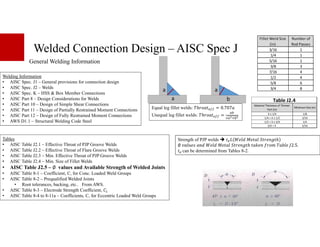
• AISC Spec. J1 – General provisions for connection design
• AISC Spec. J2 – Welds
• AISC Spec. K – HSS & Box Member Connections
• AISC Part 8 – Design Considerations for Welds
• AISC Part 10 – Design of Simple Shear Connections
• AISC Part 11 – Design of Partially Restrained Moment Connections
• AISC Part 12 – Design of Fully Restrained Moment Connections
• AWS D1.1 – Structural Welding Code Steel
General Welding Information
Tables
• AISC Table J2.1 – Effective Throat of PJP Groove Welds
• AISC Table J2.2 – Effective Throat of Flare Groove Welds
• AISC Table J2.3 – Min. Effective Throat of PJP Groove Welds
• AISC Table J2.4 – Min. Size of Fillet Welds
• AISC Table J2.5 – ∅ values and Available Strength of Welded Joints
• AISC Table 8-1 – Coefficient, C, for Conc. Loaded Weld Groups
• AISC Table 8-2 – Prequalified Welded Joints
• Root tolerances, backing, etc.. From AWS.
• AISC Table 8-3 – Electrode Strength Coefficient,
• AISC Table 8-4 to 8-11a – Coefficients, C, for Eccentric Loaded Weld Groups
Fillet Weld Size
(in)
Number of
Rod Passes
3/16 1
1/4 1
5/16 1
3/8 3
7/16 4
1/2 4
5/8 6
3/4 8
Material Thickness of Thinner
Part (in)
Minimum Size (in)
X ≤ 1/4 1/8
1/4 < X ≤ 1/2 3/16
1/2 < X ≤ 3/4 1/4
3/4 < X 5/16
Table J2.4
Equal leg fillet welds: = 0.707
Unequal leg fillet welds: =
a
a
a
b
Strength of PJP welds
∅ ! " # $ %2.5.
can be determined from Tables 8-2.
Welded Connection Design – AISC Spec J
General Welding Information
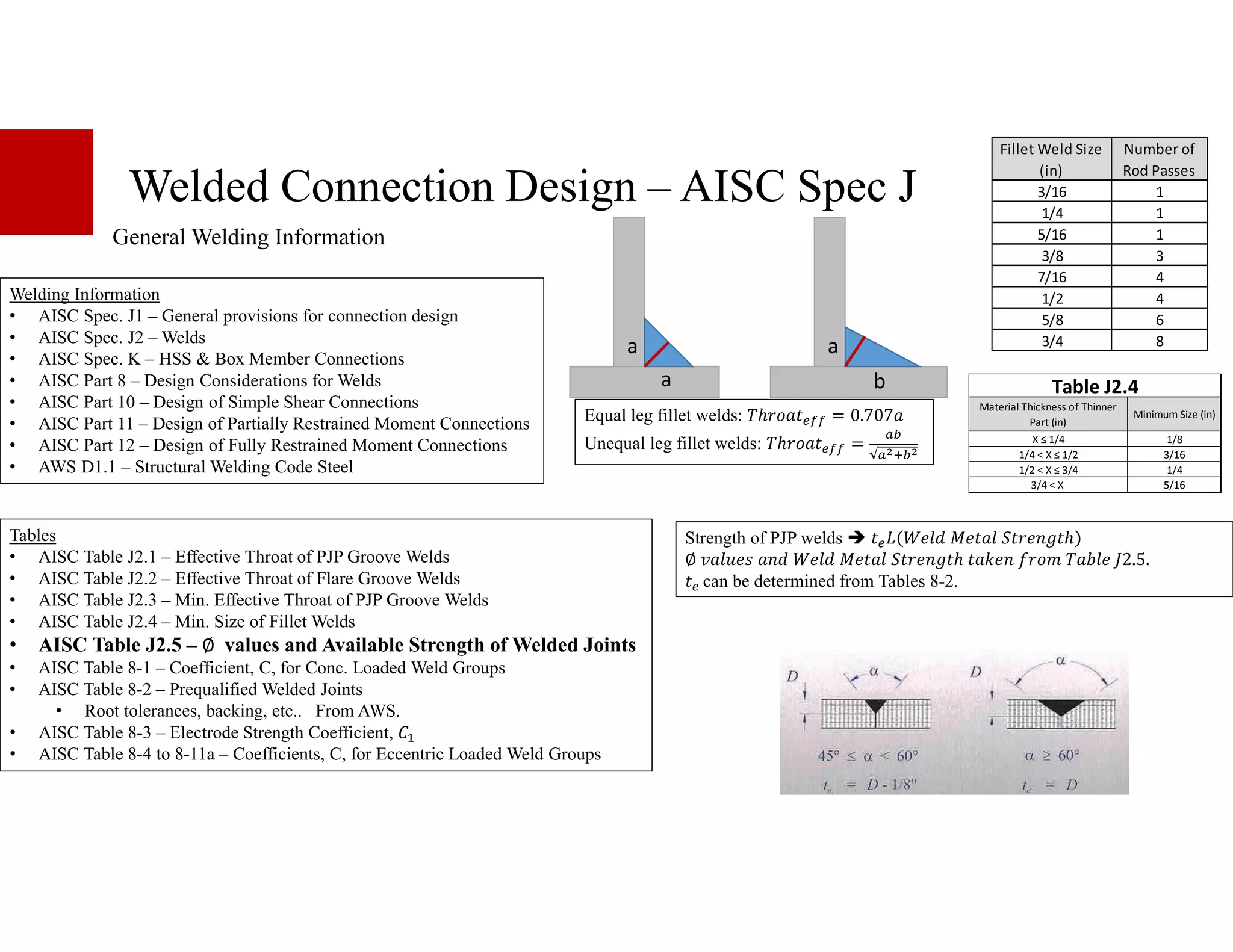
Size Requirements for Fillet Welds
• Effective Area = (effective length) x (effective throat)
• Minimum Size of Fillet Welds
• Table J2.4 – By material thickness of parts joined
• Maximum Size of Fillet Welds
• For mtrl. < ¼” thick Not greater than the mtrl. Thickness
• For mtrl ≥ ¼” thick Not greater than the mtrl thickness – 1/16”
• Effective Length of fillet weld must be at least 4x nominal size.
• (e.g. ¼” fillet weld must be 1” long) **or min of 1-1/2” for
intermittent welds, whichever is greater**
• Minimum Thickness of Connected Elements
• Base member in tension
)*+ =
,.-./00,.1,1(3)
.5(6789)
• Base member in shear
)*+ =
,.-./00,.1,1(3)
,.-.5(6789)
./00,.1,1(3)
.5(6789)
• Intermittent Fillet Welds
• Minimum length is larger of 4x nominal size or 1-1/2”
• Built-up tension members max spacing is 300x :
• Where : =radius of gyration of smaller member being
welded AISC D4
• Built-up compression members max spacing is
• To connect two rolled shapes = 24 in
• See AISC Spec E6.2
Weld Strength
• Function of a) base metal, b) weld metal, c) welding process, & d) weld penetration
• Nominal resistance of a weld ;+
• For Base Metal ;+ = <+,>?@>?
• For Weld Metal ;+ = <+3@A
• For Tensile Members ;+ = B<+3@3 Don’t forget shear lag.
• Fillet Weld Strength
• <3 = 0.60<DEE
• F
+ = <+3 = 0.707 G 0.60<DEE = 0.707
-
H 0.6 70
I
*+
1H
• Per inch of fillet weld 1.86 k/in/16th
• ∅F
+ = 0.75
.K-
L
MN
-OP
=
.QRS
L
MN
-OP
ASD
TN
U
=
.K-
S
=
,.RSK
L
MN
-OP
• When the length (L) is over 100 times the leg size (w), multiply (L) by β
• β= 1.2 − 0.002 X
3
⁄ ≤ 1.0
• If weld length is over 300w, use 180w.
• Necessary Tables
• Table J2.1 – Effective throat of PJP welds
• Table J2.2 – Effective Weld Sizes of Flare Groove Welds (common w/ HSS)
• Table J2.3 – Minimum Eff. Throat Thickness of PJP groove welds
• Table J2.5 – Available Strength of Welded Joints (Very Important!!)
• Limitations
• Longitudinal fillet weld lengths may not be less than the distance between
them because of Shear Lag (Case 4 Table D3.1).
• In Lap Joints, minimum amount of lap permitted is 5x thickness of thinner
part, but not less than 1 inch.
Welded Connection Design – AISC Spec J
Loaded Fillet Welds
Transverse/Angled Loading of Fillet Welds
• J2.4 allows transverse loading allows an increase of strength
• A) For a linear weld group w/ uniform leg size, loaded through
center of gravity,
;+ = <+3@3 w/ ∅ = 0.75
<+3 = 0.60<DEE 1.0 + 0.50 H .]
] measured off longitudinal axis.
• B) For weld elements analyzed w/ ICR, ;+^ , ;+_ , & + are
permitted to be determined as given on AISC pg 16.1-116
• C) Fillet weld groups concentrically loaded w/ longitudinal and
transverse elements. ;+= greater of: w/ ∅ = 0.75
1. ;+ = ;+3` + ;+3O
Or
2. ;+ = 0.85;+3` + 1.5;+3O
Note: Don’t use <+3 = 0.60<DEE 1.0 + 0.50 H .] for
these cases b/c transverse & longitudinal fillet welds have
different deformation properties and limits. Use
;+3`&;+3O = <3@3
<3 commonly 0.60<DEE & @3 0.707 G
&
∅
A) C)
Welded Connection Design – AISC Spec J
Loaded Angle/Truss Member
Angle to Plate Welded Connections
• Prescribing welds balanced about the neutral axis
• Weld group centroid coincides w/ centroid of tensile load.
S
c
d
Nominal Tensile Capacity of member with lower @e
;f = G " ∅g+ = ∅<_@e w/∅ = 0.9
∅g+ = ∅<f@ w/∅ = 0.75 & @ = B@+
Consider shear lag from Table 4.1 case 2 or 4. Some
apply U=0.87 up front (case 4)
+e`
A
Block Shear:
;+ = 0.6<
f@+i + B :<
f@+O ≤ 0.6<
_@ei + B :<
f@+O [AISC J4-5]
B : = 1 when tension stress is uniform, 0.85 otherwise
@+i = #H $j k = 3 :
@+O = #H $j k H = ( +e` ` e)( : )
∅lm = 0.75lm ≥ ln opqor
s tm uvwx y vz {tms |wqs qwm}v~
•` O
A
Plate-to-Plate
Method 1: Shear Lag Up Front Method 2: Shear Lag to Lengthen Welds
at the end (preferred b/c accurate U factor)
;f = G " ∅g+ = ∅<_@e w/∅ = 0.9
Select Fillet Weld Size & total length 3
assuming U=1.0
Take Moment about “Point A“
;f c
d − +e` gS = 0
S,€ `€ =
•
A `‚ ƒO„. • „ *+€P
,€ `€ = 3 − S,€ `€
Shear Lag Factor Higher of Case 2 or 4
(Case 2 & 4 evaluated w/ longer weld)
,„ … =
X†,‡7ˆ‡
‰ S,„ …=
X ,‡7ˆ‡
‰
Select Fillet Weld Size & total length 3
Take Moment about “Point A“
;f c
d − +e` gS = 0
S,€ `€ =
•
A `‚ ƒO„. • „ *+€P
,€ `€ = 3 − S,€ `€
U to Lengthen Welds @ end (preferred b/c accurate U factor)
;f = G " ∅g+ = ∅<_@e w/∅ = 0.9
Select Fillet Weld Size & total length 3
assuming U=1.0 3 = 2
Shear Lag Factor from Case 4
,„ … =
,€ `€
B
Welded Connection Design – AISC Spec J
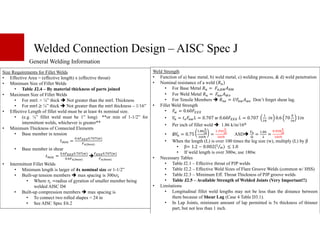
Eccentrically Loaded Weld Groups
• Two commonly used methods
• Elastic Method
• Instantaneous Center of Rotation Method
ICR Method Ultimate Strength Method
• More accurate
• AISC Table 8-3 to 8-11 can be used to aid the design
• Nominal strength of weld group ;+,I*•: = Š *+ w/ ∅ = 0.75
• = coefficient from AISC Table 8-#
• = electrode coefficient from AISC Table 8-3 ( = 1.0 " <DEE)
• D = number of 1/16ths of an inch of fillet weld size
• *+= characteristic length of weld group in inches
• Available strength must be greater than required strength
• gf ≤ ∅;+ gf ≤ ∅ Š *+
• Minimum required values for C, D, & L are given in the Tables 8-#
• )*+ =
•5
∅‹†ŒX
Š)*+=
•5
∅‹†‹X )*+=
•5
∅‹†‹Œ
Elastic Method
• Very Conservative
• More simplistic method when deign aids are unavailable
• Statics-based
• Pieces welded together are assumed to be completely rigid
• All deformation is in the weld
• Based on a summation of forces in 3-D space from g^_• & ^_•
• There are two ways to approach this method
• 1) Express/simplified methods - for weld group shapes where location of max stress is known.
• 2) General method – intensive hand calc, but applicable to all planar weld groups
Welded Connection Design – AISC Spec J
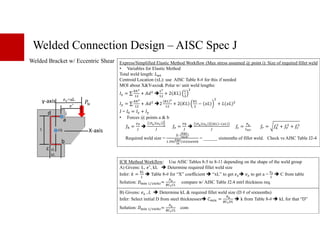
Welded Bracket w/ Eccentric Shear
CG
gf
xL
kL
L
r
^=aL
ICR Method Workflow: Use AISC Tables 8-5 to 8-11 depending on the shape of the weld group
A) Givens: L, r
, kL Determine required fillet weld size
Infer: ! =
IX
X
Table 8-# for “X” coefficient “xL” to get ^ ^ to get a = Ž
X
C from table
Solution: Š••‘ / -OP:=
•5
∅‹†‹X
compare w/ AISC Table J2.4 mtrl thickness req.
B) Givens: ^ , Determine kL & required fillet weld size (D # of sixteenths)
Infer: Select initial D from steel thicknesses )*+ =
•5
∅‹†ŒX
k from Table 8-# kL for that “D”
Solution: Š••‘ / -OP:=
•5
∅‹†‹X
com
Express/Simplified Elastic Method Workflow (Max stress assumed @ point i): Size of required fillet weld
• Variables for Elastic Method
Total weld length: 3O
Centroid Location (xL): use AISC Table 8-# for this if needed
MOI about X&Y-axis& Polar w/ unit weld lengths:
“^ = ∑
P•
S
+ @ S X•
S
+ 2 –
X
S
S
“_ = ∑
P•
S
+ @ S
2
—X •
S
+ 2 –
—X
S
− ˜
S
+ ˜ S
J = “, = “^ + “_
• Forces @ points a & b
"P =
™i
š
•5 Ž
›
š
"i =
™P
š
•5 Ž —X œ ^X
š
": =
•5
X•ž
"„ = "P
S
+ "i
S
+ ":
S
Required weld size =
Ÿ (
LM 8
MN‡¡
)
.QRS
LM 8
MN
/:*^O +OP
= ______ sixteenths of fillet weld. Check vs AISC Table J2-4
i
b
c
d
a
X-axis
y-axis
Welded Connection Design – AISC Spec J
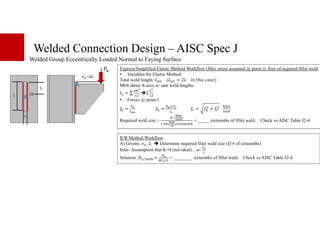
Welded Group Eccentrically Loaded Normal to Faying Surface
CG
gf
kL
L
^=aL
ICR Method Workflow:
A) Givens: ^ , Determine required fillet weld size (D # of sixteenths)
Infer: Assumption that K=0 (not ideal) , a= Ž
X
Solution: Š / -OP:=
•5
∅‹†‹X
= ________ sixteenths of fillet weld. Check vs AISC Table J2-4
i
Express/Simplified Elastic Method Workflow (Max stress assumed @ point i): Size of required fillet weld
• Variables for Elastic Method
Total weld length: 3O ( 3O = 2 H H k )
MOI about X-axis w/ unit weld lengths:
“^ = ∑
P•
S
2
X•
S
• Forces @ point I
"i =
•5
X•ž
"P =
•5 ¢M
£Ž
"„ = "P
S
+ "i
S I*•:
*+€P
Required weld size =
Ÿ (
LM 8
MN‡¡
)
.QRS
LM 8
MN
/:*^O +OP
= _____ sixteenths of fillet weld. Check vs AISC Table J2-4
¤*
Welded Connection Design – AISC Spec J
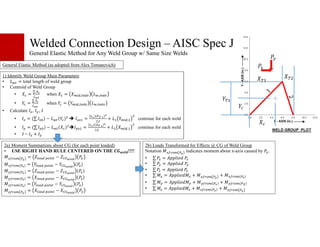
General Elastic Method for Any Weld Group w/ Same Size Welds
General Elastic Method (as adopted from Alex Tomanovich)
1) Identify Weld Group Main Parameters
• 3O = total length of weld group
• Centroid of Weld Group
• ¥€ =
∑ E‡
X•ž
when ¥€ = ¥)*‚,*+‚i 3,*+‚i
• ¤€ =
∑ ¢‡
X•ž
when ¤€ = ¤)*‚,*+‚i 3,*+‚i
• Calculate “^, “_, J
• “^ = (∑ “^,) − 3O ¤€
S “^¦ =
X† ¢§ †
S
+ ¤)*‚,
S
continue for each weld
• “_ = (∑ “_,) − 3O ¥€
S
“_¦ =
X† E§ †
S
+ ¥)*‚,
S
continue for each weld
• J = “^ + “_
2b) Loads Transformed for Effects @ CG of Weld Group
Notation ^ „¦) •¨
indicates moment about x-axis caused by g_.
• ∑ g^ = @©© H g^
• ∑ g_ = @©© H g_
• ∑ g• = @©© H g•
• ∑ ^ = @©© H ^ + ^ „¦) •¨
+ ^ „¦) •ª
• ∑ _ = @©© H _ + _ „¦) •Ž
+ _ „¦) •«
• ∑ • = @©© H • + • „¦) •Ž
+ • „¦) •¨
¤€
¥€
¤™
¥™
¥™S
2a) Moment Summations about CG (for each point loaded)
• USE RIGHT HAND RULE CENTERED ON THE ¬-|wqs!!!!
^ „¦) •¨
= ®`¦ ‚ •¦*+O − ®‹¯•9ˆ°
g_
^ „¦) •ª
= ¤`¦ ‚ •¦*+O − ¤‹¯•9ˆ°
g•
_ „¦) •Ž
= ®`¦ ‚ •¦*+O − ®‹¯•9ˆ°
g^
_ „¦) •ª
= ¥`¦ ‚ •¦*+O − ¥‹¯•9ˆ°
g•
• „¦) •Ž
= ¤`¦ ‚ •¦*+O − ¤‹¯•9ˆ°
g^
• „¦) •¨
= ¥`¦ ‚ •¦*+O − ¥‹¯•9ˆ°
g_
g_
g^
Welded Connection Design – AISC Spec J
Elastic Method General Algorithm
General Elastic Method (as adopted from Alex Tomanovich)
4) Weld Requirements and Base Metal Check
• Fillet weld size required (in 16ths of an inch) = Ÿ985ˆž7Nž
,.1∗3∗ ,.-./00 ∗(f+*O ` +eOP)
= Ÿ985ˆž7Nž
.QRS L
MN
†²ž¡
³
³
for LRFD.
• If using ASD, substitute 0.928I
MN
†²ž¡
³
³ for 1.392 I
MN
†²ž¡
³
³
• Base Metal Shear Allowable
• LRFD: ∅;+ = (1.00)(0.6)(<_ : ) µ Hk! ______ ¦„€
f+*O ` +eOP
³ usually
—*•:
*+€P
• Refer to AISC Spec. J4
• ;+ = 0.6<_@ei G/ ∅ = 1.00 Ω = 1.5 ( H H G 0.4<_ " @ Š k # " #)
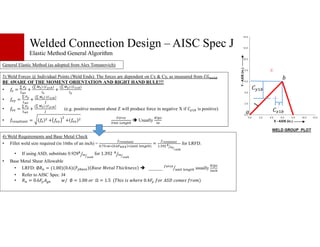
3) Weld Forces @ Individual Points (Weld Ends): The forces are dependent on Cx & Cy, as measured from ¸3 `‚
BE AWARE OF THE MOMENT ORIENTATION AND RIGHT HAND RULE!!!
• "• =
∑ •ª
X•ž
+
(∑ ?Ž) (‹¨†6)
£Ž
+
(∑ ?¨) (‹Ž†6)
£¨
• "i_ =
∑ •¨
X•ž
+
(∑ ?ª) (‹Ž†6)
š
• "i^ =
∑ •Ž
X•ž
+
(∑ ?ª) (‹¨†6)
š
(e.g. positive moment about Z will produce force in negative X if _ is positive)
• "„ :f`O +O = "•
S + "i_
S
+ "i^
S .¦„€
‰+*O X +eOP
Usually
—*•:
*+
_
$
^
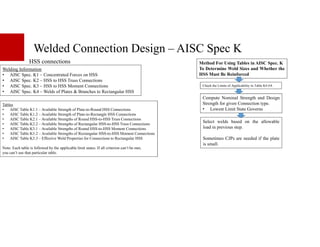
Welded Connection Design – AISC Spec K
HSS connections
Welding Information
• AISC Spec. K1 – Concentrated Forces on HSS
• AISC Spec. K2 – HSS to HSS Truss Connections
• AISC Spec. K3 – HSS to HSS Moment Connections
• AISC Spec. K4 – Welds of Plates & Branches to Rectangular HSS
Tables
• AISC Table K1.1 – Available Strength of Plate-to-Round HSS Connections
• AISC Table K1.2 – Available Strength of Plate-to-Rectangle HSS Connections
• AISC Table K2.1 – Available Strengths of Round HSS-to-HSS Truss Connections
• AISC Table K2.2 – Available Strengths of Rectangular HSS-to-HSS Truss Connections
• AISC Table K3.1 – Available Strengths of Round HSS-to-HSS Moment Connections
• AISC Table K3.2 – Available Strengths of Rectangular HSS-to-HSS Moment Connections
• AISC Table K3.3 – Effective Weld Properties for Connections to Rectangular HSS
Note: Each table is followed by the applicable limit states. If all criterion can’t be met,
you can’t use that particular table.
Check the Limits of Applicability in Table K#.#A
Method For Using Tables in AISC Spec. K
To Determine Weld Sizes and Whether the
HSS Must Be Reinforced
Compute Nominal Strength and Design
Strength for given Connection type.
• Lowest Limit State Governs
Select welds based on the allowable
load in previous step.
Sometimes CJPs are needed if the plate
is small.

Weld_Portion.pdf

  • 1.
    Welded Connection Design– AISC Spec J Welding Information • AISC Spec. J1 – General provisions for connection design • AISC Spec. J2 – Welds • AISC Spec. K – HSS & Box Member Connections • AISC Part 8 – Design Considerations for Welds • AISC Part 10 – Design of Simple Shear Connections • AISC Part 11 – Design of Partially Restrained Moment Connections • AISC Part 12 – Design of Fully Restrained Moment Connections • AWS D1.1 – Structural Welding Code Steel General Welding Information Tables • AISC Table J2.1 – Effective Throat of PJP Groove Welds • AISC Table J2.2 – Effective Throat of Flare Groove Welds • AISC Table J2.3 – Min. Effective Throat of PJP Groove Welds • AISC Table J2.4 – Min. Size of Fillet Welds • AISC Table J2.5 – ∅ values and Available Strength of Welded Joints • AISC Table 8-1 – Coefficient, C, for Conc. Loaded Weld Groups • AISC Table 8-2 – Prequalified Welded Joints • Root tolerances, backing, etc.. From AWS. • AISC Table 8-3 – Electrode Strength Coefficient, • AISC Table 8-4 to 8-11a – Coefficients, C, for Eccentric Loaded Weld Groups Fillet Weld Size (in) Number of Rod Passes 3/16 1 1/4 1 5/16 1 3/8 3 7/16 4 1/2 4 5/8 6 3/4 8 Material Thickness of Thinner Part (in) Minimum Size (in) X ≤ 1/4 1/8 1/4 < X ≤ 1/2 3/16 1/2 < X ≤ 3/4 1/4 3/4 < X 5/16 Table J2.4 Equal leg fillet welds: = 0.707 Unequal leg fillet welds: = a a a b Strength of PJP welds ∅ ! " # $ %2.5. can be determined from Tables 8-2.
  • 2.
    Welded Connection Design– AISC Spec J General Welding Information Size Requirements for Fillet Welds • Effective Area = (effective length) x (effective throat) • Minimum Size of Fillet Welds • Table J2.4 – By material thickness of parts joined • Maximum Size of Fillet Welds • For mtrl. < ¼” thick Not greater than the mtrl. Thickness • For mtrl ≥ ¼” thick Not greater than the mtrl thickness – 1/16” • Effective Length of fillet weld must be at least 4x nominal size. • (e.g. ¼” fillet weld must be 1” long) **or min of 1-1/2” for intermittent welds, whichever is greater** • Minimum Thickness of Connected Elements • Base member in tension )*+ = ,.-./00,.1,1(3) .5(6789) • Base member in shear )*+ = ,.-./00,.1,1(3) ,.-.5(6789) ./00,.1,1(3) .5(6789) • Intermittent Fillet Welds • Minimum length is larger of 4x nominal size or 1-1/2” • Built-up tension members max spacing is 300x : • Where : =radius of gyration of smaller member being welded AISC D4 • Built-up compression members max spacing is • To connect two rolled shapes = 24 in • See AISC Spec E6.2 Weld Strength • Function of a) base metal, b) weld metal, c) welding process, & d) weld penetration • Nominal resistance of a weld ;+ • For Base Metal ;+ = <+,>?@>? • For Weld Metal ;+ = <+3@A • For Tensile Members ;+ = B<+3@3 Don’t forget shear lag. • Fillet Weld Strength • <3 = 0.60<DEE • F + = <+3 = 0.707 G 0.60<DEE = 0.707 - H 0.6 70 I *+ 1H • Per inch of fillet weld 1.86 k/in/16th • ∅F + = 0.75 .K- L MN -OP = .QRS L MN -OP ASD TN U = .K- S = ,.RSK L MN -OP • When the length (L) is over 100 times the leg size (w), multiply (L) by β • β= 1.2 − 0.002 X 3 ⁄ ≤ 1.0 • If weld length is over 300w, use 180w. • Necessary Tables • Table J2.1 – Effective throat of PJP welds • Table J2.2 – Effective Weld Sizes of Flare Groove Welds (common w/ HSS) • Table J2.3 – Minimum Eff. Throat Thickness of PJP groove welds • Table J2.5 – Available Strength of Welded Joints (Very Important!!) • Limitations • Longitudinal fillet weld lengths may not be less than the distance between them because of Shear Lag (Case 4 Table D3.1). • In Lap Joints, minimum amount of lap permitted is 5x thickness of thinner part, but not less than 1 inch.
  • 3.
    Welded Connection Design– AISC Spec J Loaded Fillet Welds Transverse/Angled Loading of Fillet Welds • J2.4 allows transverse loading allows an increase of strength • A) For a linear weld group w/ uniform leg size, loaded through center of gravity, ;+ = <+3@3 w/ ∅ = 0.75 <+3 = 0.60<DEE 1.0 + 0.50 H .] ] measured off longitudinal axis. • B) For weld elements analyzed w/ ICR, ;+^ , ;+_ , & + are permitted to be determined as given on AISC pg 16.1-116 • C) Fillet weld groups concentrically loaded w/ longitudinal and transverse elements. ;+= greater of: w/ ∅ = 0.75 1. ;+ = ;+3` + ;+3O Or 2. ;+ = 0.85;+3` + 1.5;+3O Note: Don’t use <+3 = 0.60<DEE 1.0 + 0.50 H .] for these cases b/c transverse & longitudinal fillet welds have different deformation properties and limits. Use ;+3`&;+3O = <3@3 <3 commonly 0.60<DEE & @3 0.707 G & ∅ A) C)
  • 4.
    Welded Connection Design– AISC Spec J Loaded Angle/Truss Member Angle to Plate Welded Connections • Prescribing welds balanced about the neutral axis • Weld group centroid coincides w/ centroid of tensile load. S c d Nominal Tensile Capacity of member with lower @e ;f = G " ∅g+ = ∅<_@e w/∅ = 0.9 ∅g+ = ∅<f@ w/∅ = 0.75 & @ = B@+ Consider shear lag from Table 4.1 case 2 or 4. Some apply U=0.87 up front (case 4) +e` A Block Shear: ;+ = 0.6< f@+i + B :< f@+O ≤ 0.6< _@ei + B :< f@+O [AISC J4-5] B : = 1 when tension stress is uniform, 0.85 otherwise @+i = #H $j k = 3 : @+O = #H $j k H = ( +e` ` e)( : ) ∅lm = 0.75lm ≥ ln opqor s tm uvwx y vz {tms |wqs qwm}v~ •` O A Plate-to-Plate Method 1: Shear Lag Up Front Method 2: Shear Lag to Lengthen Welds at the end (preferred b/c accurate U factor) ;f = G " ∅g+ = ∅<_@e w/∅ = 0.9 Select Fillet Weld Size & total length 3 assuming U=1.0 Take Moment about “Point A“ ;f c d − +e` gS = 0 S,€ `€ = • A `‚ ƒO„. • „ *+€P ,€ `€ = 3 − S,€ `€ Shear Lag Factor Higher of Case 2 or 4 (Case 2 & 4 evaluated w/ longer weld) ,„ … = X†,‡7ˆ‡ ‰ S,„ …= X ,‡7ˆ‡ ‰ Select Fillet Weld Size & total length 3 Take Moment about “Point A“ ;f c d − +e` gS = 0 S,€ `€ = • A `‚ ƒO„. • „ *+€P ,€ `€ = 3 − S,€ `€ U to Lengthen Welds @ end (preferred b/c accurate U factor) ;f = G " ∅g+ = ∅<_@e w/∅ = 0.9 Select Fillet Weld Size & total length 3 assuming U=1.0 3 = 2 Shear Lag Factor from Case 4 ,„ … = ,€ `€ B
  • 5.
    Welded Connection Design– AISC Spec J Eccentrically Loaded Weld Groups Eccentrically Loaded Weld Groups • Two commonly used methods • Elastic Method • Instantaneous Center of Rotation Method ICR Method Ultimate Strength Method • More accurate • AISC Table 8-3 to 8-11 can be used to aid the design • Nominal strength of weld group ;+,I*•: = Š *+ w/ ∅ = 0.75 • = coefficient from AISC Table 8-# • = electrode coefficient from AISC Table 8-3 ( = 1.0 " <DEE) • D = number of 1/16ths of an inch of fillet weld size • *+= characteristic length of weld group in inches • Available strength must be greater than required strength • gf ≤ ∅;+ gf ≤ ∅ Š *+ • Minimum required values for C, D, & L are given in the Tables 8-# • )*+ = •5 ∅‹†ŒX Š)*+= •5 ∅‹†‹X )*+= •5 ∅‹†‹Œ Elastic Method • Very Conservative • More simplistic method when deign aids are unavailable • Statics-based • Pieces welded together are assumed to be completely rigid • All deformation is in the weld • Based on a summation of forces in 3-D space from g^_• & ^_• • There are two ways to approach this method • 1) Express/simplified methods - for weld group shapes where location of max stress is known. • 2) General method – intensive hand calc, but applicable to all planar weld groups
  • 6.
    Welded Connection Design– AISC Spec J Welded Bracket w/ Eccentric Shear CG gf xL kL L r ^=aL ICR Method Workflow: Use AISC Tables 8-5 to 8-11 depending on the shape of the weld group A) Givens: L, r , kL Determine required fillet weld size Infer: ! = IX X Table 8-# for “X” coefficient “xL” to get ^ ^ to get a = Ž X C from table Solution: Š••‘ / -OP:= •5 ∅‹†‹X compare w/ AISC Table J2.4 mtrl thickness req. B) Givens: ^ , Determine kL & required fillet weld size (D # of sixteenths) Infer: Select initial D from steel thicknesses )*+ = •5 ∅‹†ŒX k from Table 8-# kL for that “D” Solution: Š••‘ / -OP:= •5 ∅‹†‹X com Express/Simplified Elastic Method Workflow (Max stress assumed @ point i): Size of required fillet weld • Variables for Elastic Method Total weld length: 3O Centroid Location (xL): use AISC Table 8-# for this if needed MOI about X&Y-axis& Polar w/ unit weld lengths: “^ = ∑ P• S + @ S X• S + 2 – X S S “_ = ∑ P• S + @ S 2 —X • S + 2 – —X S − ˜ S + ˜ S J = “, = “^ + “_ • Forces @ points a & b "P = ™i š •5 Ž › š "i = ™P š •5 Ž —X œ ^X š ": = •5 X•ž "„ = "P S + "i S + ": S Required weld size = Ÿ ( LM 8 MN‡¡ ) .QRS LM 8 MN /:*^O +OP = ______ sixteenths of fillet weld. Check vs AISC Table J2-4 i b c d a X-axis y-axis
  • 7.
    Welded Connection Design– AISC Spec J Welded Group Eccentrically Loaded Normal to Faying Surface CG gf kL L ^=aL ICR Method Workflow: A) Givens: ^ , Determine required fillet weld size (D # of sixteenths) Infer: Assumption that K=0 (not ideal) , a= Ž X Solution: Š / -OP:= •5 ∅‹†‹X = ________ sixteenths of fillet weld. Check vs AISC Table J2-4 i Express/Simplified Elastic Method Workflow (Max stress assumed @ point i): Size of required fillet weld • Variables for Elastic Method Total weld length: 3O ( 3O = 2 H H k ) MOI about X-axis w/ unit weld lengths: “^ = ∑ P• S 2 X• S • Forces @ point I "i = •5 X•ž "P = •5 ¢M £Ž "„ = "P S + "i S I*•: *+€P Required weld size = Ÿ ( LM 8 MN‡¡ ) .QRS LM 8 MN /:*^O +OP = _____ sixteenths of fillet weld. Check vs AISC Table J2-4 ¤*
  • 8.
    Welded Connection Design– AISC Spec J General Elastic Method for Any Weld Group w/ Same Size Welds General Elastic Method (as adopted from Alex Tomanovich) 1) Identify Weld Group Main Parameters • 3O = total length of weld group • Centroid of Weld Group • ¥€ = ∑ E‡ X•ž when ¥€ = ¥)*‚,*+‚i 3,*+‚i • ¤€ = ∑ ¢‡ X•ž when ¤€ = ¤)*‚,*+‚i 3,*+‚i • Calculate “^, “_, J • “^ = (∑ “^,) − 3O ¤€ S “^¦ = X† ¢§ † S + ¤)*‚, S continue for each weld • “_ = (∑ “_,) − 3O ¥€ S “_¦ = X† E§ † S + ¥)*‚, S continue for each weld • J = “^ + “_ 2b) Loads Transformed for Effects @ CG of Weld Group Notation ^ „¦) •¨ indicates moment about x-axis caused by g_. • ∑ g^ = @©© H g^ • ∑ g_ = @©© H g_ • ∑ g• = @©© H g• • ∑ ^ = @©© H ^ + ^ „¦) •¨ + ^ „¦) •ª • ∑ _ = @©© H _ + _ „¦) •Ž + _ „¦) •« • ∑ • = @©© H • + • „¦) •Ž + • „¦) •¨ ¤€ ¥€ ¤™ ¥™ ¥™S 2a) Moment Summations about CG (for each point loaded) • USE RIGHT HAND RULE CENTERED ON THE ¬-|wqs!!!! ^ „¦) •¨ = ®`¦ ‚ •¦*+O − ®‹¯•9ˆ° g_ ^ „¦) •ª = ¤`¦ ‚ •¦*+O − ¤‹¯•9ˆ° g• _ „¦) •Ž = ®`¦ ‚ •¦*+O − ®‹¯•9ˆ° g^ _ „¦) •ª = ¥`¦ ‚ •¦*+O − ¥‹¯•9ˆ° g• • „¦) •Ž = ¤`¦ ‚ •¦*+O − ¤‹¯•9ˆ° g^ • „¦) •¨ = ¥`¦ ‚ •¦*+O − ¥‹¯•9ˆ° g_ g_ g^
  • 9.
    Welded Connection Design– AISC Spec J Elastic Method General Algorithm General Elastic Method (as adopted from Alex Tomanovich) 4) Weld Requirements and Base Metal Check • Fillet weld size required (in 16ths of an inch) = Ÿ985ˆž7Nž ,.1∗3∗ ,.-./00 ∗(f+*O ` +eOP) = Ÿ985ˆž7Nž .QRS L MN †²ž¡ ³ ³ for LRFD. • If using ASD, substitute 0.928I MN †²ž¡ ³ ³ for 1.392 I MN †²ž¡ ³ ³ • Base Metal Shear Allowable • LRFD: ∅;+ = (1.00)(0.6)(<_ : ) µ Hk! ______ ¦„€ f+*O ` +eOP ³ usually —*•: *+€P • Refer to AISC Spec. J4 • ;+ = 0.6<_@ei G/ ∅ = 1.00 Ω = 1.5 ( H H G 0.4<_ " @ Š k # " #) 3) Weld Forces @ Individual Points (Weld Ends): The forces are dependent on Cx & Cy, as measured from ¸3 `‚ BE AWARE OF THE MOMENT ORIENTATION AND RIGHT HAND RULE!!! • "• = ∑ •ª X•ž + (∑ ?Ž) (‹¨†6) £Ž + (∑ ?¨) (‹Ž†6) £¨ • "i_ = ∑ •¨ X•ž + (∑ ?ª) (‹Ž†6) š • "i^ = ∑ •Ž X•ž + (∑ ?ª) (‹¨†6) š (e.g. positive moment about Z will produce force in negative X if _ is positive) • "„ :f`O +O = "• S + "i_ S + "i^ S .¦„€ ‰+*O X +eOP Usually —*•: *+ _ $ ^
  • 10.
    Welded Connection Design– AISC Spec K HSS connections Welding Information • AISC Spec. K1 – Concentrated Forces on HSS • AISC Spec. K2 – HSS to HSS Truss Connections • AISC Spec. K3 – HSS to HSS Moment Connections • AISC Spec. K4 – Welds of Plates & Branches to Rectangular HSS Tables • AISC Table K1.1 – Available Strength of Plate-to-Round HSS Connections • AISC Table K1.2 – Available Strength of Plate-to-Rectangle HSS Connections • AISC Table K2.1 – Available Strengths of Round HSS-to-HSS Truss Connections • AISC Table K2.2 – Available Strengths of Rectangular HSS-to-HSS Truss Connections • AISC Table K3.1 – Available Strengths of Round HSS-to-HSS Moment Connections • AISC Table K3.2 – Available Strengths of Rectangular HSS-to-HSS Moment Connections • AISC Table K3.3 – Effective Weld Properties for Connections to Rectangular HSS Note: Each table is followed by the applicable limit states. If all criterion can’t be met, you can’t use that particular table. Check the Limits of Applicability in Table K#.#A Method For Using Tables in AISC Spec. K To Determine Weld Sizes and Whether the HSS Must Be Reinforced Compute Nominal Strength and Design Strength for given Connection type. • Lowest Limit State Governs Select welds based on the allowable load in previous step. Sometimes CJPs are needed if the plate is small.