Joining Processes of Plastics Ümit TAYFUN
Outline What is joining process Types of Plastic Joining Process Hot Plate La se r  Welding Ultrasonic Assembly Vibration  Welding Spin Welding  Mechanical Fastening Joint Design
What is Joining Process Materials joining is a group of technologies that includes welding, brazing, soldering, and adhesive bonding of metals, ceramics, plastics, and composites to themselves and to each other. A complete  “ understanding of materials joining requires a thorough knowledge of processes, materials, non-destructive evaluation, and design. ’’
Joining Methods Adhesives and mechanical fastening are very useful joining techniques, but fusion bonding or welding is particularly suitable since joining times are often very short, enabling high volume production, and the welded parts are readily recycled or incinerated, easing disposal problems.
Features of Joining Process J oining thermoplastics and thermoplastic composites involves heating the polymer to a viscous state and physically causing polymer chains to interdiffuse, usually by application of pressure. These processes have several attractive features:  Speed  Strong joints  Tolerance of contaminated surfaces.  Joins difficult substrates, such as polyolefins  Improved recyclability or incineration.
Classification of Joining Methods Welding by Direct Heating(heated tool,hotgas,resistance wire,infrared,laser) Induced heating(induction,fusion) Frictional heating(ultrasonic,vibration,spin) Solvent Welding Mechanical Fastening
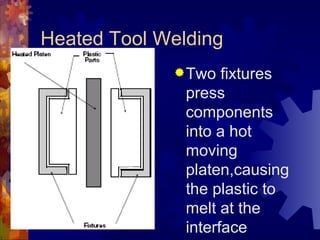
Heated Tool Welding Two fixtures press components into a hot moving platen,causing the plastic to melt at the interface
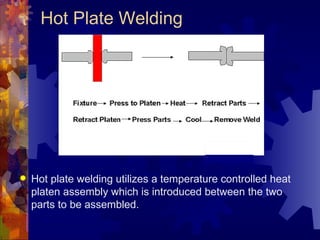
Hot Plate Welding  Hot plate welding utilizes a temperature controlled heat platen assembly which is introduced between the two parts to be assembled.
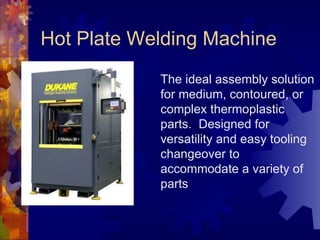
Hot Plate Welding Machine The ideal assembly solution for medium, contoured, or complex thermoplastic parts.  Designed for versatility and easy tooling changeover to accommodate a variety of parts
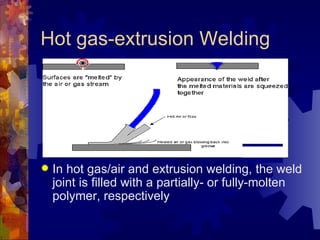
H ot gas - extrusion  W elding In hot gas/air and extrusion welding, the weld joint is filled with a partially- or fully-molten polymer, respectively
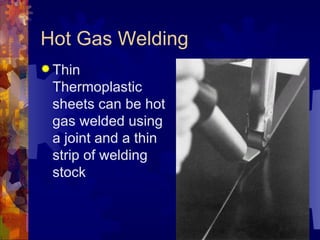
Hot Gas Welding Thin Thermoplastic sheets can be hot gas welded using a joint and a thin strip of welding stock
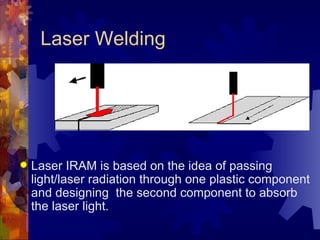
Laser  Welding Laser IRAM is based on the idea of passing light/laser radiation through one plastic component and designing  the second component to absorb the laser light.
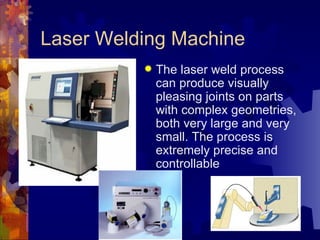
Laser Welding Machine The laser weld process can produce visually pleasing joints on parts with complex geometries, both very large and very small. The process is extremely precise and controllable
Friction Welding In Friction Welding the interface alone is heated due to mechanical friction caused by one substrare contacting and sliding over another surface. Ultrasonic Welding Spin Welding Vibration Welding
Ultrasonic  Welding   Ultrasonic  welding  utilizes an acoustic tool called a horn to transfer vibratory energy through the part to the joint area, where it is converted to heat through friction that melts the plastic
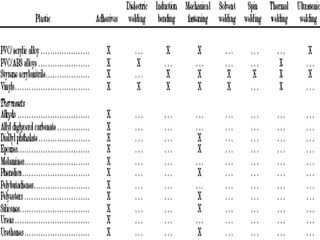
Ultrasonic Weldabilities for common Thermoplastics
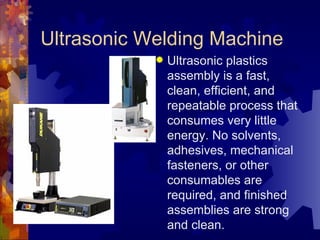
Ultrasonic Welding Machine Ultrasonic plastics assembly is a fast, clean, efficient, and repeatable process that consumes very little energy. No solvents, adhesives, mechanical fasteners, or other consumables are required, and finished assemblies are strong and clean.
Spin  W elding Spin welding is a  process  that joins circular thermoplastic parts by bringing the part interfaces together, under pressure, with a circular, spinning motion.
Joints in Spin Welding Common joints used in Spin Welding Process
Spin Welding Machine S pin welders use heat generated by rotational friction at the joint line to weld thermoplastic parts with rotationally symmetric joints. The machine applies pressure axially while rotating one part against its stationary mate, and the resulting friction generates heat that melts the parts together .
Vibration  Welding Vibration or linear friction welding involves the rubbing of two thermoplastic parts together, under pressure and at a suitable frequency and amplitude, until enough heat is generated to melt and mix the polymer.
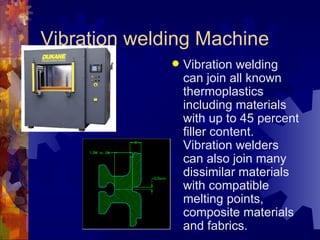
Vibration welding  Machine Vibration welding can join all known thermoplastics including materials with up to 45 percent filler content. Vibration welders can also join many dissimilar materials with compatible melting points, composite materials and fabrics.
Microwave  W elding Microwave welding is still a technology in a fairly early stage of development. Microwaves have higher frequencies than either induction or RF (dielectric) welding
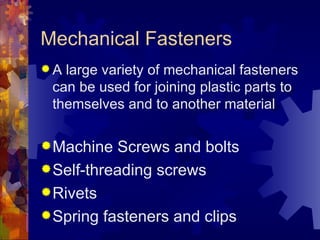
Mechanical Fasteners A large variety of mechanical fasteners can be used for joining plastic parts to themselves and to another material Machine Screws and bolts Self-threading screws Rivets Spring fasteners and clips
Advantages of using self-threading screws Off-the-shelf availability Low cost High Production rates Minimum tooling investment
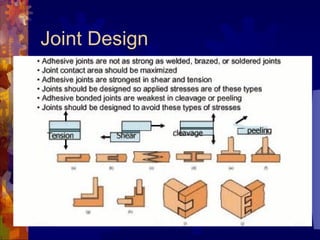
Joint Design
 
 
References: www.ewi.org www.knovel.com www.plasticwelders.com www.specializedassembly.com www.ultrasonicsforless.com  www.branson-plasticsjoin.com  www.modernplasticwelding.com.au

Joining processes of polymers

  • 1.
    Joining Processes ofPlastics Ümit TAYFUN
  • 2.
    Outline What isjoining process Types of Plastic Joining Process Hot Plate La se r Welding Ultrasonic Assembly Vibration Welding Spin Welding  Mechanical Fastening Joint Design
  • 3.
    What is JoiningProcess Materials joining is a group of technologies that includes welding, brazing, soldering, and adhesive bonding of metals, ceramics, plastics, and composites to themselves and to each other. A complete “ understanding of materials joining requires a thorough knowledge of processes, materials, non-destructive evaluation, and design. ’’
  • 4.
    Joining Methods Adhesivesand mechanical fastening are very useful joining techniques, but fusion bonding or welding is particularly suitable since joining times are often very short, enabling high volume production, and the welded parts are readily recycled or incinerated, easing disposal problems.
  • 5.
    Features of JoiningProcess J oining thermoplastics and thermoplastic composites involves heating the polymer to a viscous state and physically causing polymer chains to interdiffuse, usually by application of pressure. These processes have several attractive features: Speed Strong joints Tolerance of contaminated surfaces. Joins difficult substrates, such as polyolefins Improved recyclability or incineration.
  • 6.
    Classification of JoiningMethods Welding by Direct Heating(heated tool,hotgas,resistance wire,infrared,laser) Induced heating(induction,fusion) Frictional heating(ultrasonic,vibration,spin) Solvent Welding Mechanical Fastening
  • 7.
    Heated Tool WeldingTwo fixtures press components into a hot moving platen,causing the plastic to melt at the interface
  • 8.
    Hot Plate Welding Hot plate welding utilizes a temperature controlled heat platen assembly which is introduced between the two parts to be assembled.
  • 9.
    Hot Plate WeldingMachine The ideal assembly solution for medium, contoured, or complex thermoplastic parts.  Designed for versatility and easy tooling changeover to accommodate a variety of parts
  • 10.
    H ot gas- extrusion W elding In hot gas/air and extrusion welding, the weld joint is filled with a partially- or fully-molten polymer, respectively
  • 11.
    Hot Gas WeldingThin Thermoplastic sheets can be hot gas welded using a joint and a thin strip of welding stock
  • 12.
    Laser WeldingLaser IRAM is based on the idea of passing light/laser radiation through one plastic component and designing  the second component to absorb the laser light.
  • 13.
    Laser Welding MachineThe laser weld process can produce visually pleasing joints on parts with complex geometries, both very large and very small. The process is extremely precise and controllable
  • 14.
    Friction Welding InFriction Welding the interface alone is heated due to mechanical friction caused by one substrare contacting and sliding over another surface. Ultrasonic Welding Spin Welding Vibration Welding
  • 15.
    Ultrasonic Welding  Ultrasonic welding utilizes an acoustic tool called a horn to transfer vibratory energy through the part to the joint area, where it is converted to heat through friction that melts the plastic
  • 16.
    Ultrasonic Weldabilities forcommon Thermoplastics
  • 17.
    Ultrasonic Welding MachineUltrasonic plastics assembly is a fast, clean, efficient, and repeatable process that consumes very little energy. No solvents, adhesives, mechanical fasteners, or other consumables are required, and finished assemblies are strong and clean.
  • 18.
    Spin Welding Spin welding is a process that joins circular thermoplastic parts by bringing the part interfaces together, under pressure, with a circular, spinning motion.
  • 19.
    Joints in SpinWelding Common joints used in Spin Welding Process
  • 20.
    Spin Welding MachineS pin welders use heat generated by rotational friction at the joint line to weld thermoplastic parts with rotationally symmetric joints. The machine applies pressure axially while rotating one part against its stationary mate, and the resulting friction generates heat that melts the parts together .
  • 21.
    Vibration WeldingVibration or linear friction welding involves the rubbing of two thermoplastic parts together, under pressure and at a suitable frequency and amplitude, until enough heat is generated to melt and mix the polymer.
  • 22.
    Vibration welding Machine Vibration welding can join all known thermoplastics including materials with up to 45 percent filler content. Vibration welders can also join many dissimilar materials with compatible melting points, composite materials and fabrics.
  • 23.
    Microwave Welding Microwave welding is still a technology in a fairly early stage of development. Microwaves have higher frequencies than either induction or RF (dielectric) welding
  • 24.
    Mechanical Fasteners Alarge variety of mechanical fasteners can be used for joining plastic parts to themselves and to another material Machine Screws and bolts Self-threading screws Rivets Spring fasteners and clips
  • 25.
    Advantages of usingself-threading screws Off-the-shelf availability Low cost High Production rates Minimum tooling investment
  • 26.
  • 27.
  • 28.
  • 29.
    References: www.ewi.org www.knovel.comwww.plasticwelders.com www.specializedassembly.com www.ultrasonicsforless.com www.branson-plasticsjoin.com www.modernplasticwelding.com.au