UNIT-III
TEMPERARY JOINTS AND PERMANENT JOINTS
Dr. C.GOPINATH
Assistant Professor
St. Joseph college of Engineering
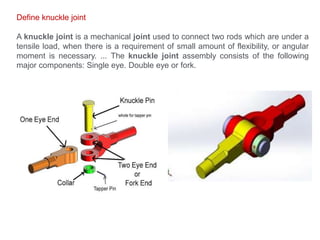
Define knuckle joint
A knuckle joint is a mechanical joint used to connect two rods which are under a
tensile load, when there is a requirement of small amount of flexibility, or angular
moment is necessary. ... The knuckle joint assembly consists of the following
major components: Single eye. Double eye or fork.
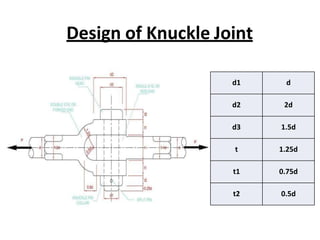
Design of Knuckle Joint
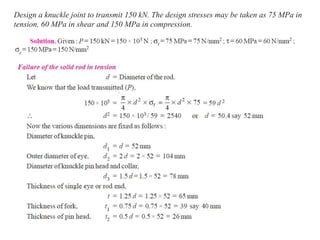
d1 d
d2 2d
d3 1.5d
t 1.25d
t1 0.75d
t2 0.5d
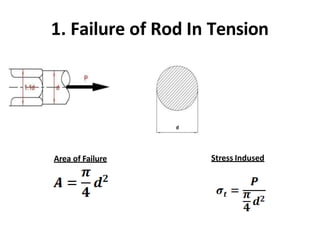
1. Failure of Rod In Tension
Area of Failure Stress Indused
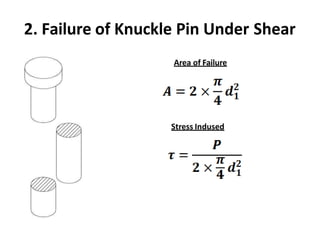
2. Failure of Knuckle Pin Under Shear
Area of Failure
Stress Indused
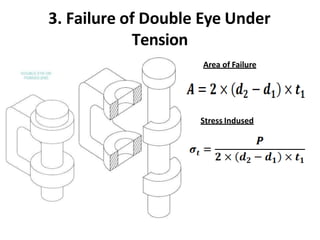
3. Failure of Double Eye Under
Tension
Area of Failure
Stress Indused
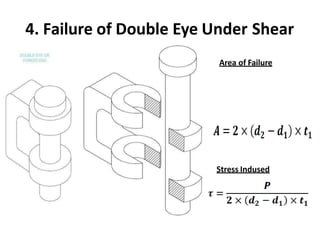
4. Failure of Double Eye Under Shear
Area of Failure
Stress Indused
5. Failure of Double Eye Under
Crushing
Area of Failure
Stress Indused
V.V.P.Polytechnic, Solapur,
Prof. V.R. Muttagi,
Mechanical Department,
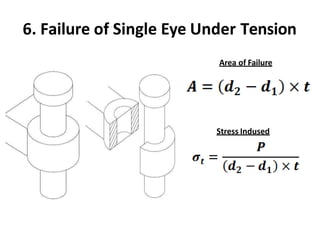
6. Failure of Single Eye Under Tension
Area of Failure
Stress Indused
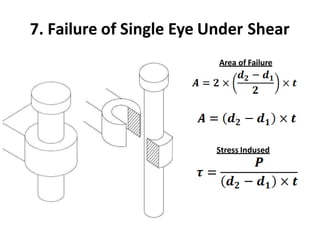
7. Failure of Single Eye Under Shear
Area of Failure
Stress Indused
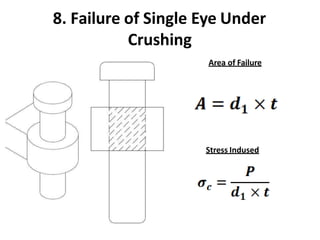
8. Failure of Single Eye Under
Crushing
Area of Failure
Stress Indused
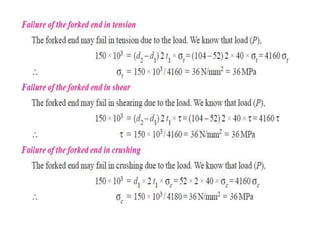
Design a knuckle joint to transmit 150 kN. The design stresses may be taken as 75 MPa in
tension, 60 MPa in shear and 150 MPa in compression.
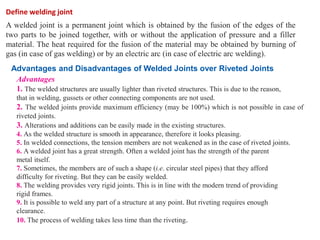
A welded joint is a permanent joint which is obtained by the fusion of the edges of the
two parts to be joined together, with or without the application of pressure and a filler
material. The heat required for the fusion of the material may be obtained by burning of
gas (in case of gas welding) or by an electric arc (in case of electric arc welding).
Define welding joint
Advantages and Disadvantages of Welded Joints over Riveted Joints
Advantages
1. The welded structures are usually lighter than riveted structures. This is due to the reason,
that in welding, gussets or other connecting components are not used.
2. The welded joints provide maximum efficiency (may be 100%) which is not possible in case of
riveted joints.
3. Alterations and additions can be easily made in the existing structures.
4. As the welded structure is smooth in appearance, therefore it looks pleasing.
5. In welded connections, the tension members are not weakened as in the case of riveted joints.
6. A welded joint has a great strength. Often a welded joint has the strength of the parent
metal itself.
7. Sometimes, the members are of such a shape (i.e. circular steel pipes) that they afford
difficulty for riveting. But they can be easily welded.
8. The welding provides very rigid joints. This is in line with the modern trend of providing
rigid frames.
9. It is possible to weld any part of a structure at any point. But riveting requires enough
clearance.
10. The process of welding takes less time than the riveting.
Disadvantages
1. Since there is an uneven heating and cooling during fabrication, therefore the members
may get distorted or additional stresses may develop.
2. It requires a highly skilled labour and supervision.
3. Since no provision is kept for expansion and contraction in the frame, therefore there is a
possibility of cracks developing in it.
4. The inspection of welding work is more difficult than riveting work.
Types of Welded Joints
1. Lap joint or fillet joint, and
2. Butt joint.
Lap Joint
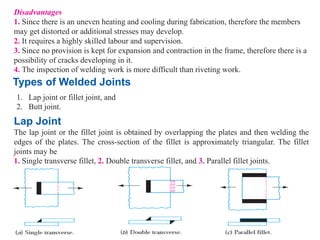
The lap joint or the fillet joint is obtained by overlapping the plates and then welding the
edges of the plates. The cross-section of the fillet is approximately triangular. The fillet
joints may be
1. Single transverse fillet, 2. Double transverse fillet, and 3. Parallel fillet joints.
Butt Joint
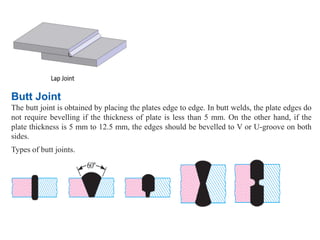
The butt joint is obtained by placing the plates edge to edge. In butt welds, the plate edges do
not require bevelling if the thickness of plate is less than 5 mm. On the other hand, if the
plate thickness is 5 mm to 12.5 mm, the edges should be bevelled to V or U-groove on both
sides.
Types of butt joints.
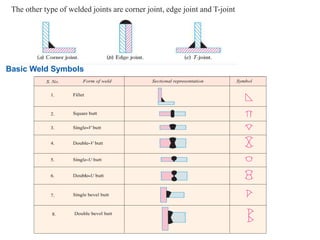
The other type of welded joints are corner joint, edge joint and T-joint
Basic Weld Symbols
Strength of Transverse Fillet Welded Joints
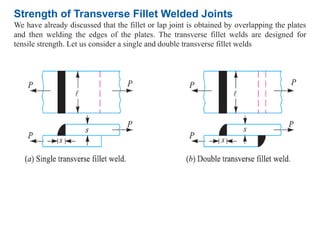
We have already discussed that the fillet or lap joint is obtained by overlapping the plates
and then welding the edges of the plates. The transverse fillet welds are designed for
tensile strength. Let us consider a single and double transverse fillet welds
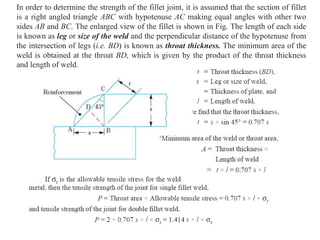
In order to determine the strength of the fillet joint, it is assumed that the section of fillet
is a right angled triangle ABC with hypotenuse AC making equal angles with other two
sides AB and BC. The enlarged view of the fillet is shown in Fig. The length of each side
is known as leg or size of the weld and the perpendicular distance of the hypotenuse from
the intersection of legs (i.e. BD) is known as throat thickness. The minimum area of the
weld is obtained at the throat BD, which is given by the product of the throat thickness
and length of weld.
Strength of Parallel Fillet Welded Joints
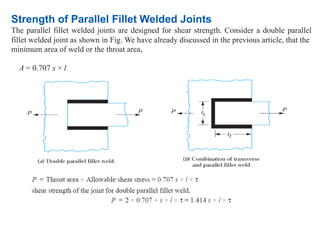
The parallel fillet welded joints are designed for shear strength. Consider a double parallel
fillet welded joint as shown in Fig. We have already discussed in the previous article, that the
minimum area of weld or the throat area,
A = 0.707 s × l
A plate 100 mm wide and 10 mm thick is to be welded to another plate by means of double
parallel fillets. The plates are subjected to a static load of 80 kN. Find the length of weld if
the permissible shear stress in the weld does not exceed 55 MPa.
l =Length of weld, and
s = Size of weld = Plate thickness = 10 mm
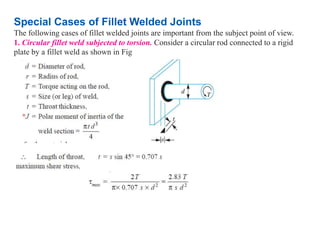
Special Cases of Fillet Welded Joints
The following cases of fillet welded joints are important from the subject point of view.
1. Circular fillet weld subjected to torsion. Consider a circular rod connected to a rigid
plate by a fillet weld as shown in Fig
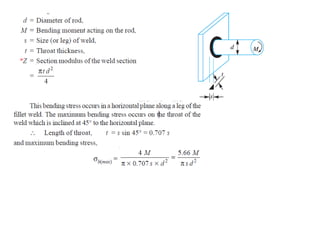
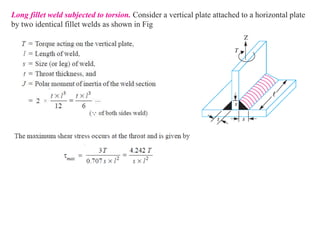
Long fillet weld subjected to torsion. Consider a vertical plate attached to a horizontal plate
by two identical fillet welds as shown in Fig
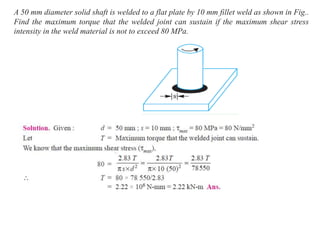
A 50 mm diameter solid shaft is welded to a flat plate by 10 mm fillet weld as shown in Fig..
Find the maximum torque that the welded joint can sustain if the maximum shear stress
intensity in the weld material is not to exceed 80 MPa.
A plate 100 mm wide and 12.5 mm thick is to be welded to another plate by means of parallel
fillet welds. The plates are subjected to a load of 50 kN. Find the length of the weld so that
the maximum stress does not exceed 56 MPa. Consider the joint first under static loading and
then under fatigue loading.
Length of weld for fatigue loading
maximum load which the plates can carry for
double parallel fillet welds (P),
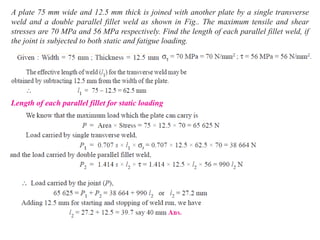
A plate 75 mm wide and 12.5 mm thick is joined with another plate by a single transverse
weld and a double parallel fillet weld as shown in Fig.. The maximum tensile and shear
stresses are 70 MPa and 56 MPa respectively. Find the length of each parallel fillet weld, if
the joint is subjected to both static and fatigue loading.
Length of each parallel fillet for static loading
Length of each parallel fillet for fatigue loading
we find that the stress concentration factor for transverse welds is 1.5 and for parallel fillet
welds is 2.7.
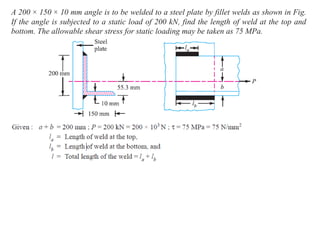
A 200 × 150 × 10 mm angle is to be welded to a steel plate by fillet welds as shown in Fig.
If the angle is subjected to a static load of 200 kN, find the length of weld at the top and
bottom. The allowable shear stress for static loading may be taken as 75 MPa.
Design of machine elements-UNIT 3.pptx

Design of machine elements-UNIT 3.pptx

  • 1.
    UNIT-III TEMPERARY JOINTS ANDPERMANENT JOINTS Dr. C.GOPINATH Assistant Professor St. Joseph college of Engineering
  • 2.
    Define knuckle joint Aknuckle joint is a mechanical joint used to connect two rods which are under a tensile load, when there is a requirement of small amount of flexibility, or angular moment is necessary. ... The knuckle joint assembly consists of the following major components: Single eye. Double eye or fork.
  • 3.
    Design of KnuckleJoint d1 d d2 2d d3 1.5d t 1.25d t1 0.75d t2 0.5d
  • 4.
    1. Failure ofRod In Tension Area of Failure Stress Indused
  • 5.
    2. Failure ofKnuckle Pin Under Shear Area of Failure Stress Indused
  • 6.
    3. Failure ofDouble Eye Under Tension Area of Failure Stress Indused
  • 7.
    4. Failure ofDouble Eye Under Shear Area of Failure Stress Indused
  • 8.
    5. Failure ofDouble Eye Under Crushing Area of Failure Stress Indused V.V.P.Polytechnic, Solapur, Prof. V.R. Muttagi, Mechanical Department,
  • 9.
    6. Failure ofSingle Eye Under Tension Area of Failure Stress Indused
  • 10.
    7. Failure ofSingle Eye Under Shear Area of Failure Stress Indused
  • 11.
    8. Failure ofSingle Eye Under Crushing Area of Failure Stress Indused
  • 12.
    Design a knucklejoint to transmit 150 kN. The design stresses may be taken as 75 MPa in tension, 60 MPa in shear and 150 MPa in compression.
  • 15.
    A welded jointis a permanent joint which is obtained by the fusion of the edges of the two parts to be joined together, with or without the application of pressure and a filler material. The heat required for the fusion of the material may be obtained by burning of gas (in case of gas welding) or by an electric arc (in case of electric arc welding). Define welding joint Advantages and Disadvantages of Welded Joints over Riveted Joints Advantages 1. The welded structures are usually lighter than riveted structures. This is due to the reason, that in welding, gussets or other connecting components are not used. 2. The welded joints provide maximum efficiency (may be 100%) which is not possible in case of riveted joints. 3. Alterations and additions can be easily made in the existing structures. 4. As the welded structure is smooth in appearance, therefore it looks pleasing. 5. In welded connections, the tension members are not weakened as in the case of riveted joints. 6. A welded joint has a great strength. Often a welded joint has the strength of the parent metal itself. 7. Sometimes, the members are of such a shape (i.e. circular steel pipes) that they afford difficulty for riveting. But they can be easily welded. 8. The welding provides very rigid joints. This is in line with the modern trend of providing rigid frames. 9. It is possible to weld any part of a structure at any point. But riveting requires enough clearance. 10. The process of welding takes less time than the riveting.
  • 16.
    Disadvantages 1. Since thereis an uneven heating and cooling during fabrication, therefore the members may get distorted or additional stresses may develop. 2. It requires a highly skilled labour and supervision. 3. Since no provision is kept for expansion and contraction in the frame, therefore there is a possibility of cracks developing in it. 4. The inspection of welding work is more difficult than riveting work. Types of Welded Joints 1. Lap joint or fillet joint, and 2. Butt joint. Lap Joint The lap joint or the fillet joint is obtained by overlapping the plates and then welding the edges of the plates. The cross-section of the fillet is approximately triangular. The fillet joints may be 1. Single transverse fillet, 2. Double transverse fillet, and 3. Parallel fillet joints.
  • 17.
    Butt Joint The buttjoint is obtained by placing the plates edge to edge. In butt welds, the plate edges do not require bevelling if the thickness of plate is less than 5 mm. On the other hand, if the plate thickness is 5 mm to 12.5 mm, the edges should be bevelled to V or U-groove on both sides. Types of butt joints.
  • 18.
    The other typeof welded joints are corner joint, edge joint and T-joint Basic Weld Symbols
  • 19.
    Strength of TransverseFillet Welded Joints We have already discussed that the fillet or lap joint is obtained by overlapping the plates and then welding the edges of the plates. The transverse fillet welds are designed for tensile strength. Let us consider a single and double transverse fillet welds
  • 20.
    In order todetermine the strength of the fillet joint, it is assumed that the section of fillet is a right angled triangle ABC with hypotenuse AC making equal angles with other two sides AB and BC. The enlarged view of the fillet is shown in Fig. The length of each side is known as leg or size of the weld and the perpendicular distance of the hypotenuse from the intersection of legs (i.e. BD) is known as throat thickness. The minimum area of the weld is obtained at the throat BD, which is given by the product of the throat thickness and length of weld.
  • 21.
    Strength of ParallelFillet Welded Joints The parallel fillet welded joints are designed for shear strength. Consider a double parallel fillet welded joint as shown in Fig. We have already discussed in the previous article, that the minimum area of weld or the throat area, A = 0.707 s × l
  • 22.
    A plate 100mm wide and 10 mm thick is to be welded to another plate by means of double parallel fillets. The plates are subjected to a static load of 80 kN. Find the length of weld if the permissible shear stress in the weld does not exceed 55 MPa. l =Length of weld, and s = Size of weld = Plate thickness = 10 mm
  • 23.
    Special Cases ofFillet Welded Joints The following cases of fillet welded joints are important from the subject point of view. 1. Circular fillet weld subjected to torsion. Consider a circular rod connected to a rigid plate by a fillet weld as shown in Fig
  • 25.
    Long fillet weldsubjected to torsion. Consider a vertical plate attached to a horizontal plate by two identical fillet welds as shown in Fig
  • 26.
    A 50 mmdiameter solid shaft is welded to a flat plate by 10 mm fillet weld as shown in Fig.. Find the maximum torque that the welded joint can sustain if the maximum shear stress intensity in the weld material is not to exceed 80 MPa.
  • 27.
    A plate 100mm wide and 12.5 mm thick is to be welded to another plate by means of parallel fillet welds. The plates are subjected to a load of 50 kN. Find the length of the weld so that the maximum stress does not exceed 56 MPa. Consider the joint first under static loading and then under fatigue loading. Length of weld for fatigue loading maximum load which the plates can carry for double parallel fillet welds (P),
  • 28.
    A plate 75mm wide and 12.5 mm thick is joined with another plate by a single transverse weld and a double parallel fillet weld as shown in Fig.. The maximum tensile and shear stresses are 70 MPa and 56 MPa respectively. Find the length of each parallel fillet weld, if the joint is subjected to both static and fatigue loading. Length of each parallel fillet for static loading
  • 29.
    Length of eachparallel fillet for fatigue loading we find that the stress concentration factor for transverse welds is 1.5 and for parallel fillet welds is 2.7.
  • 30.
    A 200 ×150 × 10 mm angle is to be welded to a steel plate by fillet welds as shown in Fig. If the angle is subjected to a static load of 200 kN, find the length of weld at the top and bottom. The allowable shear stress for static loading may be taken as 75 MPa.