MAGNETOM Flash 
The Magazine of MRI 
Issue Number 3/2013 | MR Angiography Edition 
53 
Non-Contrast MRA: 
FSD-Prepared 3D Balanced SSFP 
Page 2 
Non-Contrast ECG-Gated QISS 
MRA of the Lower Extremities 
at 3T 
Page 8 
Respiratory Self-Navigation 
for Free Breathing Whole-Heart 
Coronary MRI 
Page 12 
Combining Throughput and 
Highest Quality MRA in an 
Optimized Clinical Workflow 
Page 26 
Advancements in the 
ECG-Gated Contrast-Enhanced 
MR Angiography 
Page 32 
How-I-do-it 
3D Navigator-Gated, IR FLASH 
with Blood Pool Contrast Agent 
Page 18 
Contrast-Enhanced MRA in 
Practice: Tips and Caveats 
Page 40 
Not for distribution in the US
Technology MR Angiography MR Angiography Technology 
90°x 180°y 90°-x 
δ 
2 
τ 
G S 
Sequence diagrams of the unipolar- (2A) and 
bipolar-gradient (2B) FSD modules and their 
corresponding NC-MRA images (2C, 2D). Both 
modules consist of a 90°x-180°y-90°-x RF series 
and two symmetric FSD gradient pulses placed 
at either side of the center 180°-pulse. Notice 
the stripe artifacts shown on the unipolar-gradient 
FSD images interfere with the visual-ization 
of main arterial branches to some 
degree, which are removed by the bipolar-gradient 
FSD module. 
module can introduce a spatial signal 
modulation in static tissues, as shown 
below, if the center 180° RF pulse 
­frequency 
response is spatially 
inhomogeneous. 
Mz =(–cos Θ sin2 Ф + cos2 Ф) × M0 [1] 
Ф(r) = γ × r × A [2] 
Where Mz is the longitudinal magneti-zation 
right after FSD-preparation, 
M0 is the equilibrium magnetization, 
Θ is the actual flip angle of the 
­180°- 
pulse, Ф is the phase the static 
spins accumulate during the FSD gra-dient 
before the 180°-pulse, which is 
dependent of the gradient’s net area 
A, r is the spatial variable along the 
gradient direction, and γ is the gyro-magnetic 
ratio. The period, λ, of the 
spatial signal modulation is defined as: 
λ = [3] 
A simple solution to circumventing 
the issue is to have Ф, or A, equal 
to zero. A bipolar-gradient scheme 
(Fig. 2B) becomes a natural choice 
to achieve this goal. Example images 
using the two gradient waveforms 
are shown in figures 2C and D. 
Non-Contrast MR Angiography: 
Flow-Sensitive Dephasing (FSD)-Prepared 
3D Balanced SSFP 
Zhaoyang Fan1; Rola Saouaf2; Xin Liu3; Xiaoming Bi4; Debiao Li1 
1 Biomedical Imaging Research Institute, Cedars-Sinai Medical Center, Los Angeles, CA, USA 
2 Imaging Department, Cedars-Sinai Medical Center, Los Angeles, CA, USA 
3 Lauterbur Research Center for Biomedical Imaging, Shenzhen Institutes of Advanced Technology of Chinese Academy of Sciences, 
Shenzhen, China 
4 Siemens Healthcare, MR R&D, Los Angeles, CA, USA 
Bright-Artery 
Image 
Dark-Artery 
Image 
Subtraction 
Artery Vein Background tissues 
1A 
Signal 
Intensity 
GRO/PE 
90°x 
T2prep 
Fat Sat 
180°y 
bSSFP 
90°x 
S 
T2prep 
1C 
RF 
GRO/PE 
bSSFP 
S 
FSD 
Fat Sat 
180°y 
G G 
T2prep 
90°x 
90°x 
(1A) Schematic of the FSD-prepared balanced SSFP technique. In the bright-artery 
acquisition, both arterial blood, venous blood, and other tissues are of high signal 
intensity. In the dark-artery measurement, arterial blood signals are mostly suppressed 
by FSD-preparation because of substantially fast flow. Thus, arterial blood signals 
remain and the signals of venous blood and background tissues are essentially 
cancelled out upon image subtraction. 
(1B) The sequence diagram of the bright-artery acquisition (T2-prepared balanced SSFP). 
(1C) The sequence diagram of the dark-artery acquisition (FSD-prepared 
balanced SSFP). G = FSD gradients, S = spoiler gradients. 
RF 
1 
Introduction 
Contrast-enhanced MR angiography 
(CE-MRA) has become a non-invasive 
modality of choice for detecting arte-rial 
disease across various vascular 
regions. However, patients with renal 
insufficiency who receive gadolinium-based 
agents are at risk for develop-ing 
a debilitating and potentially fatal 
disease known as nephrogenic sys-temic 
fibrosis (NSF) [1, 2]. As a result, 
a substantial population in need for 
angiogram will not be able to benefit 
from this radiation-free, non-invasive 
diagnostic tool. Furthermore, with 
CE-MRA, short contrast first-pass win-dow 
in arteries often limits the imag-ing 
coverage and/or spatial resolution, 
and venous contamination may be 
present at distal run-off vessels. All 
limitations above, along with added 
cost of contrast agent, have triggered 
a renaissance of interest in non-con-trast 
MRA (NC-MRA). 
Time-of-flight and phase-contrast 
are two original NC-MRA techniques, 
but not widely accepted for imaging 
peripheral arteries, primarily due to 
the limited spatial coverage (or time 
inefficiency) as well as well-known 
flow artifacts associated with complex 
flow [3]. Recently, a group of NC-MRA 
techniques, such as fast spin-echo 
based fresh blood imaging (FBI) meth-ods 
(also known as NATIVE SPACE 
on Siemens systems) [4], quiescent 
90°x 180°y 90°-x 
RF 
GRO 
T 
δ 
G S 
2A 
2C 2D 
interval single-shot (QISS) [5] or Ghost 
[6], have been developed as an alter-native 
to CE-MRA for peripheral MRA. 
Among them, balanced steady-state 
free precession (SSFP) using flow-sen-sitive 
dephasing (FSD) magnetization 
preparation* is a non-contrast 
approach that provides several unique 
features including high arterial blood 
SNR and blood-tissue CNR, isotropic 
sub-millimeter spatial resolution, and 
flexible FSD module to suppress flow 
in different directions and with differ-ent 
speeds [7]. The clinical feasibili-ties 
of this method have been demon-strated 
in lower legs [8, 9], feet [10], 
and hands [11, 12]. Given its poten-tially 
broad applications and rising 
research and clinical interests, this work 
provides an overview of underlying 
principles and technical considerations 
followed by clinical research results. 
* Work in progress. The product is still under 
development and not commercially available 
yet. Its future availability cannot be ensured. 
Principles 
The FSD-prepared balanced SSFP 
method exploits the arterial pulsatility 
and introvoxel spin dephasing effect 
to selectively depict arterial flow. The 
similar idea dates back to 1980s by 
Wedeen et al. [13] and Meuli et al. [14]. 
RF 
GRO 
2B 
In brief, two consecutive ECG-triggered 
acquisitions are acquired in one scan 
(Fig. 1A). The bright-artery measure-ment 
is acquired with a zero-gradient-strength 
FSD preparation (i.e. T2 prep-aration) 
during diastole when arterial 
flow is substantially slow and thus 
retains high signal intensity on bal-anced 
SSFP images (Fig. 1B). The dark-artery 
measurement is collected dur-ing 
systole exploiting the marked 
velocity difference between arterial and 
venous flows. An optimal FSD prepa-ration 
is employed to intravoxelly 
dephase the arterial blood spins while 
having little effect on venous blood 
and static tissues (Fig. 1C). Magnitude 
subtraction of the two measurements 
allows the visualization of arteries 
with dramatically suppressed back-ground 
and venous signals. 
Technical considerations 
FSD gradient waveform 
The FSD pulse sequence is a 
90°x-180°y-90°-x driven equilibrium 
Fourier transform diffusion preparation 
module, and identical field ­gradients 
are applied symmetrically around the 
180° radio-frequency (RF) pulse [15]. 
Analysis based on the Bloch equation 
reveals that conventional unipolar-gradient 
pulses (Fig. 2A) in the FSD 
1B 
2 MAGNETOM Flash | 3/2013 | www.siemens.com/magnetom-world Not for distribution in the US. Not for distribution in the US. MAGNETOM Flash | 3/2013 | www.siemens.com/magnetom-world 3
Choice of the direction 
of FSD sensitivity 
Intravoxel spin dephasing requires 
that flowing spins have the flow com-ponents 
along the direction of applied 
FSD gradients. Compared to other 
­NC- 
MRA techniques, a unique feature 
with FSD preparation is the flexibility 
in direction in which the signal of 
flow is exclusively suppressed. FSD 
gradients have been applied in all three 
logic axes simultaneously in order to 
impart flow sensitization to all dimen-sions 
for vessel wall imaging in previ-ous 
work [18-20]. Such gradient pulse 
configuration essentially renders the 
flow-­sensitization 
unidirectional, 
90°x 180°y 90°-x 
RF 
GRO 
GPE 
3A 
m1 m1,RO 
Choice of the FSD strength 
Flow sensitization imparted by the 
FSD preparation is essential for the 
NC-MRA technique, and its strength 
can be measured by the first-order 
gradient moment denoted as m1 [7]. 
An unnecessarily large m1 value may 
entail signal contamination from 
venous blood and, potentially, other 
static background tissues due to the 
associated diffusion effect, whereas 
incomplete delineation of arterial 
segments may result from an inade-quate 
m1 value. Consequently, a sub-optimal 
m1 tends to cause poor image 
quality, overestimation of stenosis, 
or false diagnosis in FSD MRA. 
The optimal m1, however, is subject 
and artery specific since dephasing 
of flowing spins is not only dependent 
on the m1 of the FSD preparation 
but also on the local flow velocity 
profile [7, 16]. To obtain a satisfying 
MR angiogram, an empirical m1 value 
derived from a pilot study can be 
advantageous. A more effective and 
reliable way is to first conduct an 
m1-scout scan that can rapidly (within 
1 min) assess a range of first-order 
gradient moment values at their effec-tiveness 
in blood signal suppression, 
and an individually-tailored m1 is then 
selected for ­­­­FSD 
­NC- 
MRA scans [17]. 
S 
S 
4 MAGNETOM Flash | 3/2013 | www.siemens.com/magnetom-world Not for distribution in the US. 
as derived from the vector sum of all 
FSD gradients. In case of FSD-prepared 
MRA, the signal of a coherent flow 
that is perpendicular to this direction 
will not be effectively nulled. Thus, 
the conventional FSD module may 
result in a suboptimal vessel segment 
depiction on MR angiograms. 
To achieve signal suppression of 
multi-directional blood flow, we pro-posed 
a multi-directional FSD prepar-ative 
scheme. Specifically, two (or 
three for three-dimensional flow) 
conventional FSD preparative mod-ules 
are applied in series, with bal-anced 
FSD gradients applied along 
the RO direction in the first module 
and along the PE direction in the sec-ond 
one (Fig. 3) [21]. The spoiler 
­gradients 
applied at the end of the 
­preceding 
FSD module ensure that 
dephased flow spin components will 
not be rephased in the subsequent 
one. Thus, flow components along indi-vidual 
directions can be suppressed 
independently by their corresponding 
modules. Figure 3 shows an example 
whereby certain signal loss on MIP 
MRA was observed at several arterial 
segments when using the conven-tional 
single FSD module. Such signal 
defects mimicking vessel narrowing 
can be markedly ameliorated by the 
two-module FSD preparation. 
Clinical applications 
Clinical feasibility of using the FSD-based 
NC-MRA technique has been 
demonstrated in multiple arterial 
­stations, 
including lower legs [8, 9], 
feet [10], and hands [11, 12]. In all 
of past studies, CE-MRA was used as a 
comparison reference, reflecting the 
fact that invasive X-ray angiography 
is not commonly performed in clinical 
diagnostic imaging routines. 
At lower legs, Lim et al. [8] showed 
that FSD-based NC-MRA is more robust 
to arterial flow variations than fast 
spin-echo based techniques and “can 
be performed first line at 1.5T where 
exogenous contrast agents are unde-sirable 
or contraindicated”. In this 
MR Angiography Technology 
work, FSD-based MRA demonstrated 
satisfactory image quality, excellent 
negative predictive value (91.7%), 
and good sensitivity (80.3%), specific-ity 
(81.7%), and diagnostic accuracy 
(81.3%) for hemodynamically signifi-cant 
(≥ 50%) stenosis. Another study 
by Liu et al. [9] showed that the num-ber 
of diagnostic segments is not sig-nificantly 
between FSD-based NC-MRA 
and ­CE- 
MRA, although the image qual-ity 
of NC-MRA is slightly lower with 
­signifcance 
reached. Similarly, high 
diagnostic accuracy was obtained using 
the NC-MRA technique. An exmaple 
case from [9] is shown in figure 4. 
Pedal arteries present a few chal-lenges 
to NC-MRA techniques, includ-ing 
small caliber size, relatively slow 
flow, and more tortuous anatomy. 
FSD-based NC-MRA has recently been 
successfully applied to diabetic 
patients who have foot vascular com-plications 
[10]. This work demon-strated 
that the NC-MRA technique 
can yield a significantly higher num-ber 
of diagnostic arterial segments 
4A 4B 
CE-MRA (4A) and NC-MRA (4B) MIP images and X-ray angiography image (4C) of the right upper calf in a 65-year-old woman 
with diabetes. NC-MRA clearly depicts luminal narrowing at the proximal anterior tibia artery (ATA) and peroneal artery consistent 
with X-ray angiography (arrows). Also, NC-MRA clearly depicts collaterals (arrowheads) with less venous contamination compared 
to CE-MRA in the location of a complete occlusion of proximal posterior tibia artery (PTA). 
4 
Not for distribution in the US. MAGNETOM Flash | 3/2013 | www.siemens.com/magnetom-world 5 
Sequence diagrams and example images using the single-module FSD preparative scheme versus two-module FSD 
preparative scheme. Notice that signal defects are observed at several arterial segments (arrows, generally located 
at the 90° with respect to the vector sum of the readout and phase-encoding directions) on single module-based 
NC-MRA, which are dramatically improved on two module-based NC-MRA. 
3 
ATA 
PTA 
PTA 
ATA 
ATA 
4C 
PTA 
3C 3D 
90°x 180°y 90°-x 
RF 
GRO 
S 
90°x 180°y 90°-x 
GPE 
S 
12 ms 12 ms 
3B 
m1,PE 
m1,RO m1,PE 
Technology MR Angiography
5A 5B 
DA 
Right Right 
6A 6B 
6 
A 33-year-old female with SLE for 13 years 
and hand symptoms for 10 years. FSD 
demonstrates excellent visualization of 
the palmar vessels and excellent to good 
visualization of the digital vessels. There 
is mild venous contamination which does 
not affect the diagnostic quality of the 
images. TWIST images have good separation 
of arterial and venous phases but relatively 
poor opacification of digital vessels. 
CE-MRA has very good resolution but 
significant venous contamination limiting 
visualization of digital vessels. 
6C 
MR Angiography Technology 
Contact 
Debiao Li, Ph.D. 
Cedars-Sinai Medical Center 
116 N. Robertson Blvd, 
Suite 800 
Los Angeles, CA 90048 
USA 
Phone: +1 310-423-7743 
debiao.li@cshs.org 
References 
1 Thomsen HS. Nephrogenic systemic 
fibrosis: A serious late adverse reaction 
to gadodiamide. Eur Radiol 2006; 
16:2619-21. 
2 Marckmann P, Skov L, Rossen K, et al. 
Nephrogenic systemic fibrosis: suspected 
causative role of gadodiamide used for 
contrast-enhanced magnetic resonance 
imaging. J Am Soc Nephrol 
2006;17:2359-62. 
3 Miyazaki M, Lee VS. Nonenhanced MR 
angiography. Radiology 2008; 248:20-43. 
4 Miyazaki M, Sugiura S, Tateishi F, et al. 
Non-contrast-enhanced MR angiography 
using 3D ECG-synchronized half-Fourier 
fast spin echo. J Magn Reson Imaging 
2000;12:776-83. 
5 Edelman RR, Sheehan JJ, Dunkle E, et al 
Quiescent-interval single-shot 
unenhanced magnetic resonance angiog-raphy 
of peripheral vascular disease: 
Technical considerations and clinical feasi-bility 
.Magn Reson Med 2010; 63:951-8. 
6 Koktzoglou I, Edelman RR. Ghost Magnetic 
Resonance Angiography. Magnetic 
Resonance in Medicine, 2009, 
61:1515–1519. 
7 Fan Z, Sheehan J, Bi X, et al. 3D 
non­contrast 
MR angiography of the distal 
lower extremities using flow-sensitive 
dephasing (FSD)-prepared balanced SSFP. 
Magn Reson Med 2009; 62:1523-32. 
8 Lim RP, Fan Z, Chatterji M, et al. 
Comparison of nonenhanced MR angio-graphic 
subtraction techniques for infra-genual 
arteries at 1.5 T: A preliminary 
study. Radiology 2013; 267:293-304. 
9 Zhang N, Fan Z, Feng F, et al. Clinical 
evaluation of peripheral non-contrast 
enhanced MR angiography (NCE-MRA) 
using steady-state free precession (SSFP) 
and flow sensitive dephasing (FSD) in 
diabetes. In Proceedings of the 20th 
Annual Meeting of ISMRM, Melbourne, 
Victoria, Australia, 2012; p. 730. 
10 Fan Z, Liu X, Zhang N, et al. Non-contrast 
enhanced MR angiography (NCE-MRA) 
of the foot using flow sensitive 
dephasing (FSD) prepared steady-state 
free precession (SSFP) in patients with 
diabetes. In Proceedings of the 21st 
Annual Meeting of ISMRM, Salt Lake City, 
Utah, USA, 2013; p.5799. 
11 Sheehan JJ, Fan Z, Davarpanah AH, et al. 
Nonenhanced MR angiography of the 
hand with flow-sensitive dephasing-prepared 
balanced SSFP sequence: initial 
experience with systemic sclerosis. 
Radiology 2011; 259:248-56. 
12 Saouaf R, Fan Z, Ishimori ML, et al. 
Comparison of noncontrast FSD MRA to 
time resolved (TWIST) and high 
resolution contrast enhanced MRA of the 
hands in patients with systemic lupus 
erythematosus (SLE) and clinical vascu-lopathy. 
In Proceedings of the 21st 
Annual Meeting of ISMRM, Salt Lake City, 
Utah, USA, 2013; p.3963. 
13 Wedeen VJ, Meuli RA, Edelman RR, et al. 
Projective imaging of pulsatile flow with 
magnetic resonance. Science 1985; 
230:946 –948. 
14 Meuli RA, Wedeen VJ, Geller SC, et al. 
MR gated subtraction angiography: 
evaluation of lower extremities. Radiology 
1986; 159:411– 418. 
15 Becker ED, Farrar TC. Driven equilibrium 
Fourier transform spectroscopy. A new 
method for nuclear magnetic resonance 
signal enhancement. J Am Chem Soc 
1969; 91:7784-7785. 
16 Haacke EM, Brown RW, Thompson MR, 
Venkatesan R. Magnetic resonance 
imaging physical principles and sequence 
design. New York: Wiley-Liss; 1999, 
pp. 673. 
17 Fan Z, Zhou X, Bi X, et al. Determination 
of the optimal first-order gradient moment 
for flow-sensitive dephasing magneti-zation- 
prepared 3D noncontrast MR 
angiography. Magn Reson Med 2011; 
65:964-72. 
18 Sirol M, Itskovich VV, Mani V, et al. 
­Lipid- 
rich atherosclerotic plaques 
detected by gadofluorine-enhanced 
in vivo magnetic resonance imaging. 
­Circulation 
2004; 109:2890-2896. 
19 Koktzoglou I, Li D. Diffusion-prepared 
segmented steady-state free precession: 
Application to 3D black-blood cardiovas-cular 
magnetic resonance of the thoracic 
aorta and carotid artery walls. J 
Cardiovasc Magn Reson 2007; 9:33-42. 
20 Wang J, Yarnykh VL, Hatsukami T, et al. 
Improved suppression of plaque-mimicking 
artifacts in black-blood carotid 
atherosclerosis imaging using a multislice 
motion-sensitized driven-equilibrium 
(MSDE) turbo spin-echo (TSE) sequence. 
Magn Reson Med 2007; 58:973-981. 
21 Fan Z, Hodnett P, Davarpanah A, et al. 
Noncontrast magnetic resonance angiog-raphy 
of the hand: Improved arterial 
conspicuity by multidirectional flow-sensitive 
dephasing (FSD) magnetization 
preparation in 3D balanced steady-state 
free precession imaging. Investigative 
Radiology 2011; 46:515-523. 
22 Connell DA, Koulouris G, Thorn DA, 
Potter HG. Contrast-enhanced MR 
angiography of the hand. Radiographics 
2002; 22:583-599. 
compared to CE-MRA (93% vs. 65%). 
The average image quality score of 
­NC- 
MRA is also significantly higher. 
An example case from [10] is shown 
in figure 5. 
Additionally, FSD-based NC-MRA has 
also found a unique application in 
patients with autoimmune disorders 
characterized by vasculopathies in the 
hands. Lesions are primarily involved 
in proper digital arteries, and the 
diagnostic performance of CE-MRA 
can be compromised in imaging this 
station whereby small vessel caliber 
and short arteriovenous transit times 
present competing demands of high 
spatial resolution and short imaging 
time [22]. The pilot study of Reynaud 
phenomenon by Sheehan et al. [11] 
showed that FSD-based NC-MRA yield 
a lower degree of stenosis as com-pared 
with both high-resolution static 
CE-MRA and time-resolved CE-MRA, 
suggesting that “FSD findings may be 
more accurate determinants of vessel 
diameter”. When utilizing the multi-directional 
FSD scheme, our recent 
investigation of systemic lupus ery-thematosus 
disease demonstrated 
that FSD-based NC-MRA is superior 
to CE-MRA in visualizing arterial seg-ments 
in all hand vascular regions, 
and particularly the 3rd terminal digi-tal 
arteries are much better depicted 
[12]. A clincal case from this work is 
shown in figure 6. 
Conclusion 
FSD-based balanced SSFP is a promis-ing 
NC-MRA approach to the diagno-sis 
of peripheral arterial disease in 
various vascular regions. This method 
eliminates the intravenous injection 
of contrast medium and prevents 
adverse contrast reaction and compli-cations 
while reducing the medicla 
expense. Most importantly, the use 
of this approach in clinical practice will 
greatly benefit patients with impaired 
kidney function. Preliminary patient 
studies have demonstrated very prom-ising 
clinical value. However, this 
technique still awaits clinical valida-tions 
with large-size patient popula-tion 
to establish itself as a routine non-contrast 
MRA diagnostic tool. 
Acknowledgements 
The authors are grateful to the col-leagues 
from Siemens Healthcare, 
especially Renate Jerecic, Sven 
­Zuehlsdorff, 
and Gehard Laub. 
CE-MRA (5A) and NC-MRA (5B) MIP images of bilateral feet in a 64-year-old female with diabetes. Compared to CE-MRA images, 
NC-MRA shows excellent delineation of foot arteries without venous contamination. ATA = anterior tibia artery, 
PTA = posterior tibia artery, DA = dorsal pedal artery, LPA = lateral plantar artery, MPA = medial plantar artery, Arch = pedal arch 
5 
PTA 
LPA 
LPA LPA LPA 
DA 
PTA 
MPA 
Arch 
Arch 
FSD-MRA TWIST 
CE-MRA 
26.1s 
Technology MR Angiography 
6 MAGNETOM Flash | 3/2013 | www.siemens.com/magnetom-world Not for distribution in the US. Not for distribution in the US. MAGNETOM Flash | 3/2013 | www.siemens.com/magnetom-world 7
Technology MR Angiography MR Angiography Technology 
Non-Contrast-Enhanced ECG-Gated Quiescent 
Interval Single Shot MR Angiography of the 
Lower Extremities at 3 Tesla: a Case Report 
superficial femoral artery (SFA), with 
evidence of isolated collaterals and 
only low poststenotic flow in the 
popliteal artery. The iliac vessels could 
not be fully evaluated due to overly-ing 
intestinal gas. Based on the clini-cal 
symptoms and the Doppler ultra-sound 
findings, digital subtraction 
angiography (DSA) was indicated. 
Furthermore, a QISS MRA at 3T was 
performed as part of a prospective 
study prior to the DSA procedure. 
Methods 
QISS MRA is a 2D ECG-gated single-shot 
balanced steady-state free-­precession 
(bSSFP) acquisition. The 
sequence uses initial saturation pulses 
which suppress both background 
­tissue 
and venous blood flowing into 
the imaging slice. This preparatory 
phase is followed by the ‘quiescent 
interval’ (QI), during which unsatu-rated 
spins are carried into the imag-ing 
slice by arterial blood. Subsequent 
imaging is performed in diastole with 
a 2D bSSFP sequence. For the QISS 
MRA, the patient was positioned supine 
in a 3T MR system (MAGNETOM Skyra, 
Siemens Healthcare, Erlangen, Ger-many), 
with his heels at the scanner-side 
table end. The ECG signal for 
triggering the image acquisition was 
derived from the ECG system inte- 
Gesine Knobloch1; Peter Schmitt2; Alexander Huppertz3; Moritz Wagner1 
1 Department of Radiology, Charité Campus Mitte, Berlin, Germany 
2 Siemens AG, Healthcare Sector, Imaging & Therapy Division, Erlangen, Germany 
3 Imaging Science Institute Charité - Siemens, Berlin, Germany 
Background 
Non-contrast-enhanced magnetic 
­resonance 
angiography (non-CE-MRA) 
sequences have become of increasing 
interest. Non-CE-MRA is a promising 
alternative to contrast-enhanced MRA 
or computed tomography angiogra-phy 
(CTA), in particular for patients 
with renal insufficiency. Recent 
decades have seen the development 
of various techniques for non-CE-MRA 
sequences such as time-of-flight MRA 
[1-4] and ECG-gated 3D partial-Fourier 
fast spin echo techniques [5-10]. In 
2010, Edelman et al. introduced Qui-escent 
Interval Single Shot (QISS) 
MRA as a new non-contrast-enhanced 
technique for imaging the peripheral 
arterial vascular system [11]. This case 
report describes the use of QISS MRA 
at 3 Tesla (T) for the preinterventional 
imaging for a patient with peripheral 
artery occlusive disease (PAOD). 
Case description 
A 66-year-old patient with peripheral 
artery occlusive disease (PAOD), type 
2 diabetes mellitus, nicotine abuse 
(40 pack years) and arterial hyperten-sion 
presented due to increasing inter-mittent 
claudication and pain in the 
left leg, originating from the calf. Due 
to moderate symptoms in the past, 
the patient had previously received 
conventional treatment consisting of 
vasoactive infusion therapy and 
­walking 
exercises. Treadmill testing 
revealed a reduction in the pain-free 
walking distance from previously 
385 m to now 165 m and deteriora-tion 
of the left ankle-brachial index 
from previously 0.6 to 0.3. Doppler 
ultrasound findings were suggestive 
of a short occlusion of the left middle 
1 MIP of the QISS MRA. 
1 
30° rotated MIP of the QISS MRA 
with high-grade stenosis at the 
origin of the left SFA and occlusion 
in the left middle SFA. 
2A 
grated in the MR scanner. For signal 
readout, a combination of two 
18-channel body coils for abdomen 
and pelvis, the 36-channel peripheral 
angio coil, and the 32-element spine 
coil was used. 
The other image parameters were as 
follows: 400 x 260 mm² field-of-view 
(FOV); measured voxel size, 1.0 × 1.0 
× 3.0 mm³; reconstructed voxel size, 
0.5 × 0.5 × 3.0 mm³; repetition time 
(TR), 4.1 ms; echo time (TE), 1.74 ms; 
flip angle per slab of 50°–120°, 
depending on specific absorption rate 
(SAR) limitations; parallel acquisition 
(GRAPPA) with an acceleration factor 
of 2 with a patient’s heart rate of 
76-80 beats per minute (bpm); partial 
Fourier in the phase-encoding direc-tion, 
5/8. To span the entire arterial 
system from the pelvis, over the legs, 
to the feet, eight groups of 70 slices 
were acquired with 3 mm slice thick-ness 
and 0.6 mm overlap. Each slice 
group covered 16.86 cm. 
2B MPR shows the stenosis at the 
MIP shows the occlusion in the 
left middle SFA. 
origin of the left proximal SFA. 
2C 
2A 2B 
Result 3 
Evaluation of the QISS MRA revealed 
diffuse arteriosclerotic irregularities 
in the wall of the abdominal aorta 
and all peripheral arteries (Fig. 1). 
Confirming the Doppler ultrasound 
findings, an occlusion of 3 cm in 
length of the left middle SFA was 
detected (Fig. 2A, 2B). The mean 
intensity projection (MIP) of the QISS 
showed numerous collaterals via the 
profunda femoris artery (PFA) and 
side branches of the left SFA (Fig. 1). 
Furthermore, there was bilateral 
occlusion of the posterior tibial artery 
(PTA, Fig. 1) as well as a high-grade 
stenosis at the origin of the left SFA 
(left femoral bifurcation, Fig. 2A, 2C), 
which was missed in the Doppler 
ultrasound. 
Correlating well with the QISS MRA 
findings, the diagnostic DSA per-formed 
thereafter showed the diffuse 
changes of the vessel wall with the 
high-grade stenosis at the origin 
of the left SFA, the collateralized 
short occlusion of the left SFA, and 
the bilateral occlusion of the posterior 
tibial artery (Fig. 3, 4). Following 
3 Stenosis at origin of left SFA. 
2C 
8 MAGNETOM Flash | 3/2013 | www.siemens.com/magnetom-world Not for distribution in the US. Not for distribution in the US. MAGNETOM Flash | 3/2013 | www.siemens.com/magnetom-world 9
Technology MR Angiography MR Angiography Technology 
Contact 
Moritz Wagner, M.D. 
Department of Radiology 
Charité, Campus Mitte 
Charitéplatz 1 
10115 Berlin 
Germany 
moritz.wagner@charite.de 
References 
1 Collins R, Burch J, Cranny G, et al. Duplex 
ultrasonography, magnetic resonance 
angiography, and computed tomography 
angiography for diagnosis and assessment 
of symptomatic, lower limb peripheral 
arterial disease: systematic review. BMJ 
(Clinical research ed). 2007;334:1257. 
doi:10.1136/bmj.39217.473275.55. 
2 Kaufman JA, McCarter D, Geller SC, et al. 
Two-dimensional time-of-flight MR 
angiography of the lower extremities: 
artifacts and pitfalls. AJR Am J Roentgenol. 
1998;171:129-35. 
3 McCauley TR, Monib A, Dickey KW, et al. 
Peripheral vascular occlusive disease: 
accuracy and reliability of time-of-flight 
MR angiography. Radiology. 
1994;192:351-7. 
4 Owen RS, Carpenter JP, Baum RA, et al. 
Magnetic resonance imaging of angio-graphically 
occult runoff vessels in 
peripheral arterial occlusive disease. 
N Engl J Med. 1992;326:1577-81. 
5 Gutzeit A, Sutter R, Froehlich JM, et al. 
ECG-triggered non-contrast-enhanced 
MR angiography (TRANCE) versus digital 
subtraction angiography (DSA) in patients 
with peripheral arterial occlusive disease 
of the lower extremities. Eur Radiol. 
2011;21:1979-87. doi:10.1007/ 
s00330-011-2132-4. 
6 Miyazaki M, Sugiura S, Tateishi F, et al. 
Non-contrast-enhanced MR angiography 
using 3D ECG-synchronized half-Fourier 
fast spin echo. J Magn Reson Imaging. 
2000;12:776-83. doi:10.1002/1522- 
2586(200011)12:5<776::AID-JMRI17>3.0. 
CO;2-X [pii]. 
7 Miyazaki M, Takai H, Sugiura S, et al. 
Peripheral MR angiography: separation 
of arteries from veins with flow-spoiled 
gradient pulses in electrocardiography-triggered 
three-dimensional half-Fourier 
fast spin-echo imaging. Radiology. 
2003;227:890-6. doi:10.1148/ 
radiol.2273020227, 2273020227 [pii]. 
8 Haneder S, Attenberger U, Riffel P, et al. 
Magnetic resonance angiography (MRA) 
of the calf station at 3.0 T: intraindividual 
comparison of non-enhanced ECG-gated 
flow-dependent MRA, continuous table 
movement MRA and time-resolved MRA. 
Eur Radiol. 2011;21:1452-61. 
doi:10.1007/s00330-011-2063-0. 
9 Lim RP, Hecht EM, Xu J, et al. 3D nongado-linium- 
enhanced ECG-gated MRA of the 
distal lower extremities: Preliminary 
clinical experience. Journal of Magnetic 
Resonance Imaging. 2008;28:181-9. 
doi:10.1002/jmri.21416. 
10 Mohrs O, Petersen S, Heidt M, et al. High-resolution 
3D non-contrast-enhanced, 
ECG-gated, multi-step MR angiography of 
the lower extremities: Comparison with 
contrast-enhanced MR angiography. Eur 
Radiol. 2011;21:434-42. doi:10.1007/ 
s00330-010-1932-2. 
11 Edelman RR, Sheehan JJ, Dunkle E, et al. 
Quiescent-interval single-shot unenhanced 
magnetic resonance angiography of 
peripheral vascular disease: Technical 
considerations and clinical feasibility. 
4 Recanalization of the left SFA occlusion. 
interdisciplinary ­discussion 
of the 
case, a two-stage treatment strategy 
for the left leg was adopted. In the 
first step, the stenosis of the left fem-oral 
bifurcation was surgically cor-rected 
by means of thromboendarter-ectomy 
(TEA) and application of a 
patch graft. Then another catheter 
angiography was carried out and the 
SFA occlusion was successfully recan-alized 
and stented (Fig. 4). Shortly 
thereafter, the patient was discharged 
home with significantly improved 
symptoms. 
Discussion 
QISS MRA was successfully used in 
the diagnosis of a patient with PAOD. 
Compared to the Doppler ultrasound 
exam, QISS MRA provided additional 
information on the extent and local-ization 
of significant stenoses regard-less 
of the examiner, allowing early 
treatment decisions and planning. 
In a previous study at 1.5T, the 
diagnostic accuracy of QISS MRA was 
­evaluated 
in 53 patients with sus-pected 
or known PAOD [12]. QISS MRA 
showed high sensitivity (89.7% and 
87.0%, two readers) and specificity 
(96.5% and 94.6%, two readers) 
using CE-MRA as reference standard. 
In a sub-group of 15 patients (279 
segments), conventional DSA was 
performed during a therapeutic inter-ventional 
procedure or when MRA 
revealed pathologic conditions that 
warranted further investigation. In 
these vessel segments, QISS MRA had 
high sensitivity (91.0%, mean values) 
and specificity (96.6 %, mean values) 
using conventional DSA as reference 
standard. The high sensitivity and 
specificity of QISS MRA at 1.5T has 
been confirmed in two other studies, 
which also included patients with 
PAOD and mainly used CE-MRA as 
reference standard [13, 14]. Nowa-days, 
3T MR scanners are increasingly 
being used in clinical practice. A 
recent volunteer study indicated that 
QISS MRA benefits from higher field 
strengths [15]. However, clinical 
studies of QISS MRA at 3T have not 
yet been published. One advantage of 
QISS MRA over other MRA techniques 
4A 4B 
4C 4D 
is that it is easy to use and does not 
require preplanning of slice blocks or 
calibration of sequence parameters 
according to arterial flow patterns. In 
our experience so far, QISS MRA takes 
only slightly longer considering the 
preparation time for planning scans 
and testbolus of a conventional con-trast- 
enhanced MRA. A limitation in 
the present QISS examination was the 
suboptimal suppression of the venous 
signal. However, this had no substan-tial 
impact on the assessment of the 
peripheral arteries. 
In summary, QISS MRA is an easy-to-use, 
robust technique for unenhanced 
imaging of the peripheral arteries. 
QISS MRA could be a future alternative 
to CE-MRA for preoperative diagnosis 
and treatment planning for patients 
with PAOD. 
Magnetic resonance in medicine : 
official journal of the Society of Magnetic 
Resonance in Medicine / Society of 
Magnetic Resonance in Medicine. 2010; 
63:951-8. doi:10.1002/mrm.22287. 
12 Hodnett PA, Koktzoglou I, Davarpanah AH, 
et al. Evaluation of peripheral arterial 
disease with nonenhanced quiescent-interval 
single-shot MR angiography. 
Radiology. 2011;260:282-93. 
doi:10.1148/radiol.11101336. 
13 Hodnett PA, Ward EV, Davarpanah AH, 
et al. Peripheral arterial disease in 
a symptomatic diabetic population: 
prospective comparison of rapid 
unenhanced MR angiography (MRA) with 
contrast-enhanced MRA. AJR American 
journal of roentgenology. 2011;197: 
1466-73. doi:10.2214/AJR.10.6091. 
14 Klasen J, Blondin D, Schmitt P, et al. 
Nonenhanced ECG-gated quiescent-interval 
single-shot MRA (QISS MRA)) of 
the lower extremities: comparison with 
contrast-enhanced MRA. Clinical radiology. 
2012;67:441-6. doi:10.1016/j. 
crad.2011.10.014. 
15 Glielmi C, Carr M, Bi X, et al. High Acceler-ation 
Quiescent-Interval Single Shot 
Magnetic Resonance Angiography at 1.5 
and 3T. Proc Intl Soc Mag Reson Med. 
2012;20:3876. 
10 MAGNETOM Flash | 3/2013 | www.siemens.com/magnetom-world Not for distribution in the US. Not for distribution in the US. MAGNETOM Flash | 3/2013 | www.siemens.com/magnetom-world 11
Technology MR Angiography 
Respiratory Self-Navigation for Free Breathing 
Whole-Heart Coronary MR Imaging with 
High Isotropic Spatial Resolution in Patients 
Davide Piccini1, 3; Jürg Schwitter, M.D.2; Pierre Monney, M.D.2; Tobias Rutz, M.D.2; Gabriella Vincenti, M.D.2; 
Christophe Sierro, M.D.2; Matthias Stuber, Ph.D.3 
1 Advanced Clinical Imaging Technology, Siemens Healthcare IM BM PI, Lausanne, Switzerland 
2 Division of Cardiology and Cardiac MR Center (CRMC), University Hospital of Lausanne (CHUV), Lausanne, Switzerland 
3 Department of Radiology, University Hospital (CHUV) and University of Lausanne (UNIL) / Center for Biomedical Imaging (CIBM), 
Lausanne, Switzerland 
a - Navigator Gating 
b - Self-Navigation 
Illustration of a typical whole-heart navigator-gated acquisition sequence (1A) in 
comparison to respiratory self-navigation (1B). In the gated setup, the additional 
acquisition of a pencil beam navigator (in red) is needed to decide whether to reject and 
re-acquire data segments acquired outside a specific respiratory phase. Conversely, 
­self- 
navigation assesses motion directly in the readouts acquired for cardiac imaging and 
allows for inline respiratory motion correction of all acquired data. While in (1A) the 
final scan efficiency is generally low, uncertain and highly dependent on the respiratory 
pattern of the examined subject, 100% scan efficiency and a priori knowledge of the 
total scan time become possible with self-navigation. In particular, the technique applied 
in the WIP makes use of a 1D readout constantly oriented along the head-foot direction 
to track the position of the blood pool at each acquired heartbeat (as displayed in the 
bottom-right corner). 
1 
Introduction 
Cardiovascular disease is the leading 
cause of death in industrialized 
nations. In the US, 50% of these 
deaths can be attributed to coronary 
heart disease [1]. The gold standard 
for the assessment of luminal coro-nary 
artery disease remains X-ray 
coronary angiography, an invasive 
procedure that involves the insertion 
of a catheter, injection of an iodin-ated 
contrast agent and imaging 
using X-ray fluoroscopy. For many 
years, coronary MR angiography 
(MRA) has been a potentially very 
appealing alternative to routine inva-sive 
procedures such as X-ray angio-graphy 
or also, more recently, coro-nary 
computed tomography (CT). MR 
is non-invasive, safe, easily repeat-able, 
and avoids exposure to ionizing 
radiation for both patients and medi-cal 
professionals [2]. Considering 
that up to 40% of patients who 
undergo the invasive gold standard 
test X-ray angiography are found to 
have no significant coronary artery 
disease [3], a non-invasive test that 
reliably rules out significant luminal 
coronary artery disease would have 
a great impact on patient manage-ment. 
Furthermore, the integration 
of a coronary acquisition protocol 
into a routine clinical examination 
that includes tissue characterization, 
morphology characterization and the 
measurement of function would sig-nificantly 
enhance MR as the most 
comprehensive imaging tool in con-temporary 
cardiology. 
As MR acquisitions are relatively slow 
and high resolution is needed to 
Example of the measurement planning. The cubic field-of-view must simply be centered in the blood pool of the left ventricle, 
while the saturation slab needs to be placed over the chest wall. The self-navigated whole-heart sequence requires a minimal 
amount of user interaction during scan planning. Fold-over is not a concern, as the 3D radial trajectory includes oversampling in 
every spatial direction and no navigator placement is needed. Once the scan is started, the self-navigated motion detection can 
be assessed directly in real time with the inline monitor display (bottom-right corner). 
2 
2 
image the small dimensions of the 
­coronary 
arteries, the scan is usually 
segmented over several consecutive 
heartbeats. ECG triggering is applied 
to target the acquisition on the cardiac 
phase with minimal myocardial motion 
(usually mid-diastole or end-systole). 
To account for the respiratory motion, 
a pencil-beam navigator [4], most 
commonly placed on the dome of the 
right hemidiaphragm, provides a real-time 
feedback on the respiratory posi-tion 
along the major direction of dis-placement, 
i.e. the superior-inferior (SI) 
direction. A so-called gating (or accep-tance) 
window is defined at end-expi-ration 
to enforce the spatial consistency 
of the dataset, such that only the seg-ments 
acquired within such a window 
are used for the reconstruction of the 
final image. All other segments are 
discarded and re-acquired later during 
the scan. Prospective motion compen-sation, 
known also as tracking [4, 5], 
can additionally be performed on the 
accepted segments by means of a fixed 
correlation factor with the diaphrag-matic 
displacement [6]. An example of 
such navigator-gated acquisition is 
depicted in Figure 1A. 
Although major strides in respiratory 
motion suppression have led to highly 
promising results even in a multicenter 
setting [7], a number of issues still 
hinder a more widespread use and 
acceptance of this technique. Firstly, 
respiratory gating if associated with 
irregular breathing patterns (which 
often occur in coronary artery dis-ease 
patients), can lead to low scan 
efficiency, highly unpredictable scan-ning 
times or even complete failure 
of data acquisition. This makes coro-nary 
MRA unattractive for integration 
into a routine ­clinical 
exam with time 
and workflow constraints. Secondly, 
the experience, confidence and 
expertise of the operator with the 
planning of the coronary measure-ment 
is essential for a good out-come, 
as a suboptimal placement of 
the navigator can lead to even more 
extended examination times or even 
to the failure of the scan. Therefore, 
the most promising results to date 
have been obtained in academic cen-ters 
with significant experience, but 
even here the technique still suffers 
from a limited ease-of-use and opera-tor 
dependency. To remove those 
constraints, respiratory self-naviga-tion 
for coronary MRA has been intro-duced 
in 2005 [8] and has been sig-nificantly 
refined since [9, 10]. The 
idea behind this technique is that 
motion detection is performed using 
the image data themselves, while 
navigator placement can be avoided, 
thus leading to a much reduced 
­operator 
dependency. Motion correc-tion 
is no longer based on a relation-ship 
between diaphragm position 
and heart position (which can vary 
throughout the scan), but on the 
heart position itself. Furthermore, 
since the technique operates without 
a gating ­window 
and all data seg-ments 
are accepted and corrected for 
respiratory motion, scanning time 
is highly predictable and no longer 
dependent on the respiratory pat-tern. 
This leads to a substantially 
improved workflow. Finally, and since 
3D radial acquisition is used, isotro-pic 
spatial resolution is obtained and 
fold-over is always avoided, which 
further maximizes the ease-of-use. 
Especially thanks to the true isotropic 
resolution a detailed retrospective 
interrogation of the sometimes com-plex 
anatomy is enabled, which 
removes the burden of a meticulous 
scan plane planning during MR data 
acquisition. This has shown to be 
most valuable in cases with congeni-tal 
heart disease. While to date only 
1D motion correction has been 
implemented as part of this highly 
promising technique, the opportuni-ties 
for multi-dimensional and non-linear 
correction and reconstruction 
schemes are vast and remain to be 
explored, but will undoubtedly lead 
to a quantum leap in image quality, 
detail visibility, and ultimately more 
widespread acceptance of the method. 
1A 
1B 
12 MAGNETOM Flash | 3/2013 | www.siemens.com/magnetom-world Not for distribution in the US. Not for distribution in the US. MAGNETOM Flash | 3/2013 | www.siemens.com/magnetom-world 13
Example of self-navigated whole-heart coronary acquisition on a healthy volunteer without the use of contrast agent. 
The sagittal (3A), coronal (3B), and axial (3C) views demonstrate the true 3D high isotropic spatial resolution of the datasets. 
After the acquisition is completed, offline multiplanar reformatting can be used to visualize the coronary arteries (3D). 
3 
Patient studies 
As the total acquisition time is known 
a priori and only depends on the heart 
rate of the examined subject, it is now 
possible to optionally integrate the 
free breathing self-navigated whole-heart 
coronary acquisition into a com-plete 
clinical cardiac MR examination 
with minimal or no impact on the total 
examination time. Given that the per-formance 
of self-navigation in part 
depends on myocardium-blood con-trast, 
and provided that there is often 
a time gap between perfusion imaging 
and late gadolinium enhancement 
(LGE) imaging in routine clinical proto-cols, 
high-resolution self-navigated 
3D whole-heart imaging may easily be 
performed to obtain information on 
both the general cardiac anatomy and 
the coronary tree. A first patient study 
using this WIP sequence was conducted 
at the university hospital of Lausanne 
(CHUV), in Switzerland in collaboration 
Whole-heart coronary MRI 
with respiratory 
self-navigation WIP 
The self-navigated whole-heart coro-nary 
MRI sequence1 consists of a 
­segmented 
radial 3D acquisition 
incorporating a spiral phyllotaxis pat-tern, 
as described in [9]. Such 3D 
radial trajectory is intrinsically robust 
against motion, spatial undersam-pling, 
and foldover artifacts. More-over, 
it achieves reduced eddy currents 
effects, while ensuring a uniform 
coverage of k-space. At the start of 
each data segment, a readout is 
acquired with a consistent orienta-tion 
along the SI direction. The algo-rithm 
for automatic detection and 
segmentation of the blood pool 
described in [10] is then applied to 
the 1D Fourier transform of these SI 
readouts. After segmentation, the 
SI displacement of the heart due to 
respiratory motion is tracked in real 
time during the acquisition using a 
modified cross-correlation algorithm. 
The whole acquisition set-up is highly 
simplified and, once the scan is 
started, a feedback from the motion 
detection algorithm can be visualized 
in real time with the inline monitor 
display (Fig. 2). Motion compensation 
is automatically performed before 
image reconstruction at the scanner. 
An example dataset acquired without 
contrast agent in a healthy adult vol-unteer 
is displayed in figure 3. The 
described self-navigated technique 
was previously compared to the stan-dard 
navigator-gated acquisition in 
a number of volunteers in [10] and 
some of the results are reported in 
figure 4. 
1 Work in progress: The product is still under 
development and not commercially available 
yet. Its future availability cannot be ensured. 
14 MAGNETOM Flash | 3/2013 | www.siemens.com/magnetom-world Not for distribution in the US. 
with the CVMR team of Prof. Matthias 
Stuber and the Cardiac MR Center 
(CRMC) of Prof. Jürg Schwitter. 
More than 250 patient datasets were 
acquired in a period of about 8 months. 
The choice of acquiring the self-navi-gated 
coronary sequence was taken by 
the responsible clinician and technolo-gist 
on a case-by-case basis. All exami-nations 
were performed on a 1.5T 
MAGNETOM Aera (Siemens Healthcare, 
Erlangen, Germany) during the wait 
time between perfusion imaging and 
2D LGE. A total of 30 elements of the 
anterior and posterior phased-array 
coils were activated for signal reception. 
All measurements were performed 
using k-space segmentation and ECG-triggering. 
For the acquisition of each 
k-space segment, both T2-preparation 
(TE 40 ms) and fat saturation were 
added prior to balanced steady-state 
free precession (bSSFP) image data 
acquisition. The 3D self-navigated 
acquisition started approx. 
4 min after injection of a bolus of 
0.2 mmol/kg of Gadobutrol (Gadovist, 
Bayer Schering Pharma, Zurich, Swit-zerland). 
Imaging was performed with 
the following parameters: TR 3.1 ms, 
TE 1.56 ms, FOV (220 mm)3, matrix 
1923, acquired true isotropic voxel 
size (1.15 mm)3, RF excitation angle 
115°, and receiver bandwidth 
900 Hz/Px. A total of about 12,000 
radial readouts were acquired during 
377 to 610 consecutive heartbeats 
with different acquisition windows, 
depending on the individual heart 
rate of each patient. The trigger delay 
was set using visual inspection of the 
most quiescent mid-diastolic or end-systolic 
period on a mid-ventricular 
short axis cine image series acquired 
prior to the injection of contrast agent. 
Results and discussion 
The acquisition time of the 3D whole-heart 
dataset always fitted in the 
wait time after perfusion imaging and 
before 2D LGE. Some example refor-mats 
of the coronary arteries are 
­displayed 
in figure 5. The normal 
or anomalous origin and proximal 
course of the coronary arteries, with 
respect to the anatomy of the heart 
and the great vessels, could be 
assessed in all cases. An example of 
anomalous coronary artery, acquired 
in collaboration with Dr. Pierre 
MR Angiography Technology 
­Monney, 
is reported in figure 5D. 
Although further advances are 
needed for improved diagnostic per-formance 
for the detection of 
­significant 
coronary artery disease, 
anomalous coronary arteries can 
­reliably 
and routinely be already 
assessed. Complex anatomy in con-genital 
patients can retrospectively 
be studied with a high and isotropic 
spatial resolution and some of the 
datasets (Fig. 6) have already showed 
great promise for the identification 
of significant proximal coronary 
artery disease with X-ray coronary 
angiography as the gold standard. 
The proposed technique removes 
several of the roadblocks to success-ful 
high resolution whole-heart 
­cardiac 
imaging. Firstly, the scan 
duration is well-defined and no lon-ger 
respiration dependent. This makes 
the protocol a reliable module that 
can easily be integrated into a com-prehensive 
clinical cardiac protocol. 
Secondly, navigator scout scanning 
and volume targeting can be avoided 
while fold-over no longer occurs due 
to oversampling in all spatial direc-tions. 
This makes the technique less 
3A 3B 
3C 3D 
4A 4B 4C 
4A 4B 4C 
Localizers 2 
Scan time ~15 min 
Resp. efficiency < 50 % 
Navigator gating 
Localizers 1 
Scan time 377 hb 
Resp. efficiency 100 % 
Self-navigation 
The whole-heart coronary sequence with respiratory self-navigation was compared with the state of the art navigator gated 
technique in 10 healthy volunteers [10]. Example reformats of two right coronary arteries (RCA) and one left anterior descending 
artery (LAD) are displayed, respectively, in (4A), (4B) and (4C). No significant difference could be measured in the vessel 
sharpness of the coronary arteries. As depicted in these images, in cases of low acceptance rate of the navigated scan, a visual 
improvement can be noticed in the self-navigated acquisitions (arrows). 
4 
Not for distribution in the US. MAGNETOM Flash | 3/2013 | www.siemens.com/magnetom-world 15 
Technology MR Angiography
The cardiovascular magnetic resonance (CVMR) team and friends at the 2013 
retreat in Gex, France. 
Contact 
Davide Piccini c/o 
Center for BioMedical 
Imaging (CIBM) 
Centre Hospitalier 
Universitaire Vaudois (CHUV) 
Rue de Bugnon 46, BH 7.84 
1011 Lausanne 
Switzerland 
davide.piccini@siemens.com 
References 
1 Harold, J.C., et al., ACCF/AHA/SCAI 2013 
Update of the Clinical Competence 
Statement on Coronary Artery Interven-tional 
Procedures A Report of the American 
College of Cardiology Foundation/ 
American Heart Association/American 
College of Physicians Task Force on 
Clinical Competence and Training (Writing 
Committee to Revise the 2007 Clinical 
Competence Statement on Cardiac Inter-ventional 
Procedures). Circulation, 2013. 
2 Hauser, T.H. and W.J. Manning, The 
promise of whole-heart coronary MRI. 
Curr Cardiol Rep, 2008. 10(1): p. 46-50. 
3 Dissmann, W. and M. de Ridder, The soft 
science of German cardiology. Lancet, 
2002. 359(9322): p. 2027-9. 
4 Ehman, R.L. and J.P. Felmlee, Adaptive 
technique for high-definition MR imaging 
of moving structures. Radiology, 1989. 
173(1): p. 255-63. 
5 Danias, P.G., et al., Prospective navigator 
correction of image position for coronary 
MR angiography. Radiology, 1997. 
203(3): p. 733-6. 
6 Wang, Y., S.J. Riederer, and R.L. Ehman, 
Respiratory motion of the heart: 
kinematics and the implications for the 
spatial resolution in coronary imaging. 
Magn Reson Med, 1995. 33(5): p. 713-9. 
7 Kato, S., et al., Assessment of coronary 
artery disease using magnetic 
resonance coronary angiography: 
a national multicenter trial. J Am Coll 
Cardiol, 2010. 56(12): p. 983-91. 
8 Stehning, C., et al., Free-breathing 
whole-heart coronary MRA with 3D 
radial SSFP and self-navigated image 
reconstruction. Magn Reson Med, 2005. 
54(2): p. 476-80. 
9 Piccini, D., et al., Spiral phyllotaxis: 
the natural way to construct a 3D radial 
trajectory in MRI. Magn Reson Med, 
2011. 66(4): p. 1049-56. 
10 Piccini, D., et al., Respiratory self-navigation 
for whole-heart bright-blood 
coronary MRI: methods for robust 
isolation and automatic segmentation 
of the blood pool. Magn Reson Med, 
2012. 68(2): p. 571-9. 
operator dependent and improves the 
overall ease-of-use. Finally, and even 
given the already successful use of our 
technique in a clinical setting, the 
opportunities to further improve motion 
correction in multiple spatial directions 
and by incorporating modern multi 
transmit architecture and non-linear 
reconstruction are vast. Although 
some issues need further investiga-tion, 
such as the optimum data acqui-sition 
window (length and position 
during the RR-interval) or eliminiation 
and preservation of acquired k-lines 
according the breathing pattern 
(changes) during the scan, continuous 
and rapid progress is expected while 
a more widespread adoption of this 
technique is likely. 
The Cardiovascular MR team 
in Lausanne 
The cardiovascular magnetic reso-nance 
(CVMR) center, part of the Center 
for Biomedical Imaging (CIBM), was 
established in 2010 and is dedicated 
to the technical development and clini-cal 
evaluation of novel non-invasive 
cardiovascular magnetic resonance 
methodology. Located at the University 
Hospital of the Canton de Vaud (CHUV) 
in the department of radiology, a direct 
interdisciplinary collaboration between 
basic scientists and clinician research-ers 
critically enables scientific discovery 
and translation that is directed towards 
Example of some of the results obtained with the self-navigated WIP for free-breathing coronary MRA. From top to bottom 
and from left to right. Normal origin and course of the RCA (5A) and LAD (5B) in a 19-year-old male patient tested with MR for 
exertional dizziness without syncope. Case of a 26-year-old female patient operated for Ebstein malformation in which both RCA 
(5C) and LAD (5D) present normal origin and course. Abnormal origin of the left coronary artery, arising from the non-coronary 
sinus (arrow) and running between the aorta and the left atrium (5E) shown in the case of an 18-year-old male patient with 
Shone complex, after valve surgery. Case of a 19-year-old female patient with Kawasaki disease: large aneurysms (arrows) are 
clearly visible in this reformat of the RCA (5F). 
5 
improved prevention, diagnosis and 
therapy of cardiovascular disease. 
Therefore strong collaborative links 
with the CRMC directed by Prof. 
Schwitter, Prof. Hullin from Cardio-logy, 
and the service of nuclear 
­medicine 
directed by Prof. Prior have 
been established locally. The CVMR 
center is also committed to the 
­education 
and training of researchers 
and ­clinicians 
in the field. 
The members of the CVMR team are: 
Prof. Matthias Stuber (head of the 
group), Dr. Ruud van Heeswijk (post-doctoral 
fellow and project leader), 
Davide Piccini (industrial partner and 
project leader), Jérôme Yerly (post-doctoral 
fellow and project leader), 
Gabriele Bonanno (Ph.D. student), 
Simone Coppo (Ph.D. student), 
Andrew Coristine (Ph.D. student), 
Hélène Feliciano (Ph.D. student), 
Jérôme Chaptinel (Ph.D. student), 
and Giulia Ginami (Ph.D. student). 
Acknowledgements 
The authors would like to thank all 
the members of the CRMC team and 
the MR technologists at the CHUV for 
their valuable participation, helpful-ness 
and support during this study. 
A last but very important acknowledg-ment 
goes to Dr. Michael Zenge, 
Dr. Arne Littmann and the whole 
­Siemens 
MR Cardio team of Edgar 
Müller in Erlangen. 
5A 5B 5C 
5D 5E 5F 
6A 6B 
6 
Example of visual 
comparison between 
a multiplanar reformat of 
the whole-heart self-navigated 
coronary MRI 
dataset (6A) and the corre-sponding 
X-ray coronary 
angiogram (6B) for the 
detection of a coronary 
stenosis (arrows) in the 
mid section of the LAD. 
X-ray angiogram courtesy 
of Dr. C. Sierro. 
Technology MR Angiography 
16 MAGNETOM Flash | 3/2013 | www.siemens.com/magnetom-world Not for distribution in the US. Not for distribution in the US. MAGNETOM Flash | 3/2013 | www.siemens.com/magnetom-world 17
How I Do It How I Do It 
3D Navigator-Gated, Inversion Recovery 
FLASH (Nav_IR_Flash) with Blood Pool 
Contrast Agent 
Marci Messina, RT(R)(MR)1; Cynthia Rigsby, M.D.1; Jie Deng, Ph.D.1; Xiaoming Bi, Ph.D.2; Gary McNeal, MSBME2 
with extracellular contrast agent as 
there is only one chance to obtain 
images prior to the contrast moving 
out of the vasculature. 
TWIST images provide time-resolved, 
dynamic information of 3D vascular 
structures. Nav_IR_Flash can supple-ment 
it by providing 3D images at 
much higher spatial resolution 
acquired with navigator-gating and 
ECG-triggering. The utilization of a 
blood pool agent facilitates dynamic 
TWIST imaging during the first pass 
and Nav_IR_Flash imaging during the 
equilibrium state of contrast kinetics 
without compromising each other. 
Compared to TrueFISP readout, FLASH 
readout is not sensitive to signal drop 
out from off-resonance and/or fast 
flow, particularly in the setting of 
pediatric imaging. Overall, in combi-nation 
with high relaxativity contrast 
media and inversion preparation, 
Nav_IR_Flash provides reliable image 
quality with excellent imaging con-trast 
between blood signals and back-ground 
tissues. 
Coronary imaging is the most chal-lenging 
exam in small children and it 
is difficult to obtain reliable images 
using the standard T2-prepared 
­TrueFISP 
sequence. We therefore 
chose to pursue Nav_IR_Flash tech-nique 
by administering a blood pool 
contrast agent, gadofosveset triso-dium 
(Ablavar®, Lantheus Medical 
1 Medical Imaging, Ann & Robert H. Lurie Children’s Hospital of Chicago, Chicago, IL, USA 
2 Siemens Healthcare, Cardiovascular MR R&D 
Materials and methods 
Pediatric MRA requires high spatial 
resolution due to small patient size. 
Coronary imaging presents a signifi-cant 
challenge in young children due 
to small vessel size and high heart 
rate. Quick pediatric circulation times 
also present a challenge in perform-ing 
MRA examinations in children 
Objectives 
The purpose of this article is to 
explain how we have maximized 
image quality for our contrast-enhanced 
3D acquisitions for MR 
angiography (MRA) applications in 
pediatric* patients using a blood 
pool contrast agent. 
Imaging, Inc. MA, USA). This contrast 
agent remains within the blood pool 
for several hours after administration. 
The prolonged presence of the blood 
pool agent facilitates repeated imag-ing 
if there is patient motion, allows 
for higher resolution imaging in coro-nary 
imaging, and makes it possible 
to image multiple body parts after 
injection. These benefits are all ideal 
for scanning pediatric patients. We 
acquire the IR FLASH sequence with 
near isotropic voxels, allowing for 
reconstructions in any plane making 
this MR sequence much like CT, but 
without the radiation penalty. 
Methods and procedures 
Patient preparation 
Communication between the technol-ogist 
and patient are vital to achiev-ing 
a successful pediatric imaging 
study. When imaging a young patient 
without the use of sedation, it is best 
to keep the instructions simple, but 
direct. Assure the patient with positive 
encouragement, for example “I know 
you can do this. We will work through 
this together”. Make the patient com-fortable 
by adding swaddling materials 
and knee cushions when possible. 
Offer music or a movie for entertain-ment 
during the exam if available. 
2 
Steady respiratory and heart rates 
and limited body movement are key 
to high quality images, especially for 
coronary imaging. When imaging a 
patient under general anesthesia, the 
patient should fast for up to 8 hours. 
More specifically, two hours for 
water, four hours for breast milk, six 
hours for formula and eight hours for 
solid food per anesthesia protocol. 
Communication between the MRI 
and anesthesiology teams is vital. If 
apnea (breath-hold) is needed, the 
patient will need to be intubated and 
paralyzed. If apnea is not necessary, 
1 Coil selection and setup for different size of patient. 
*MR scanning has not been established as 
safe for imaging fetuses and infants under 
two years of age. The responsible physician 
must evaluate the benefit of the MRI exami-nation 
in comparison to other imaging 
procedures. 
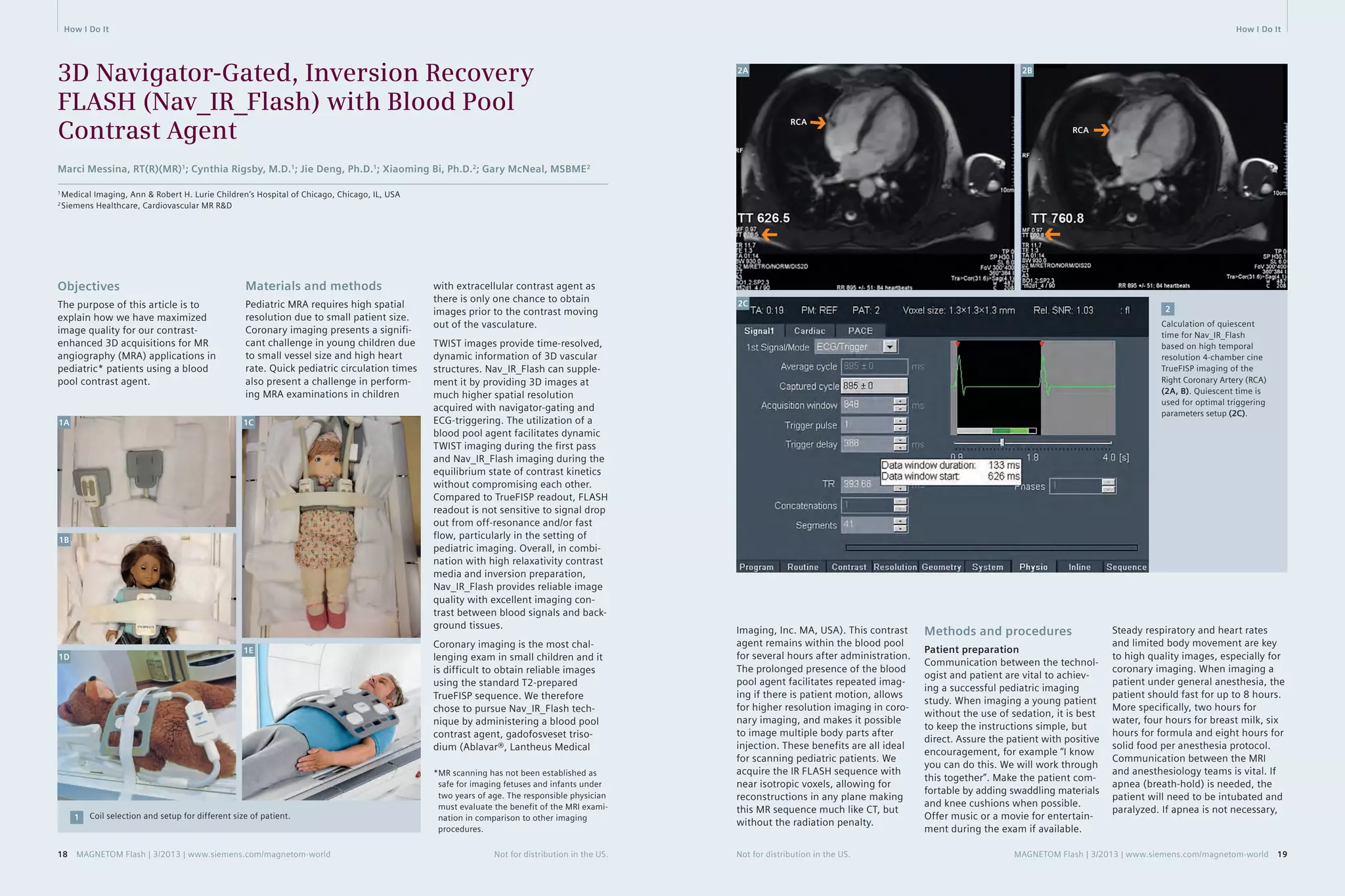
Calculation of quiescent 
time for Nav_IR_Flash 
based on high temporal 
resolution 4-chamber cine 
TrueFISP imaging of the 
Right Coronary Artery (RCA) 
(2A, B). Quiescent time is 
used for optimal triggering 
parameters setup (2C). 
2A 2B 
1A 
1B 
1C 
1D 
1E 
2C 
RCA 
RCA 
18 MAGNETOM Flash | 3/2013 | www.siemens.com/magnetom-world Not for distribution in the US. Not for distribution in the US. MAGNETOM Flash | 3/2013 | www.siemens.com/magnetom-world 19
How I Do It How I Do It 
other methods of ­sedation 
can be 
utilized. 
Coil selection 
Selection of the coil that closely 
matches the patient size and pre-dicted 
imaging field-of-view is impor-tant 
for maximizing MR signal. For 
imaging the pediatric cardiovascular 
system, we select from four available 
coils. We have dedicated protocols for 
each of these coils, with isotropic res-olution 
optimized to the patient size. 
Higher resolution protocols were also 
built for coronary origin imaging 
(Table 1). 
Special purpose (4-channel array) coil 
works best with neonates and infants 
under 10 kg weight (Fig. 1A), and two 
such coils may be applied in a clam-shell 
configuration (Fig. 1B). 
Small Flex (4-channel array) coil works 
best for infants over 10 kg weight. 
Large Flex (4-channel array) coils work 
best for toddlers and small children, 
and these may be combined with a 
posterior spine array coil (Fig. 1D). 
Another option for toddler size is to 
use two special purpose coils, both 
anterior in combination with the pos-terior 
spine array coil (Fig. 1C). 
Body Matrix (18-channel array) coils 
work best for large children through 
adult-sized patients and this may be 
combined with a posterior spine array 
coil (Fig. 1E). 
Contrast administration 
Using a power injector with right 
antecubital 22 gauge or larger IV, we 
administer a single dose of Ablavar 
(0.03 mmol/kg or 0.12 ml/kg) at a rate 
of 2.5–3.0 ml/s, followed by a sterile 
saline flush of 1 ml/kg (up to max 
10 ml). We perform TWIST dynamic 
imaging during the contrast injection, 
followed by the 3D Nav_IR_Flash 
imaging within 15 minutes (up to an 
hour) [1] for optimal vascular con-trast 
enhancement. 
Exam protocol 
All imaging is performed on 
a 1.5T MAGNETOM Aera scanner 
­( 
Siemens Healthcare, Erlangen, 
Germany). 
Workflow for cardiovascular 
MRA exam: 
1. 3 plane TrueFISP breath-hold 
localizers 
2. Interactive real-time TrueFISP to 
locate and save a clear 4-chamber 
view 
3. Single slice 4-chamber high tempo-ral 
resolution cine TrueFISP imag-ing 
for calculation of quiescent 
time. It is acquired during free 
breathing with 3–4 averages (60 
true cardiac phases per heart beat). 
Scroll through the cine images in 
the viewer card to find the optimal 
trigger time in the cardiac cycle 
when the coronaries are most sta-tionary 
(located in the atrioventric-ular 
grooves). Often the quiescent 
period is found in diastole for lower 
heart rates (50–80 bpm) and sys-tole 
for higher heart rates (80+ 
bpm). The trigger time (TT) of each 
frame is located on the lower left 
corner of the image text. Mark the 
two specific TT’s at the start and 
end times of the quiescent period 
in the cardiac cycle. These two spe-cific 
TT’s will be used to set up the 
timing para­meters 
for the Nav_IR_ 
Flash. Figures 2A and 2B show one 
example of setting up the quies-cent 
time for Nav_IR_Flash. 
4. Ablavar administration 
5. Coronal dynamic TWIST imaging 
(temporal resolution 2.5 s/frame) 
6. 3D Nav_IR_Flash_TI_260_Coronal/ 
Axial Oblique. This sequence is 
scanned after the single dose injec-tion 
on TWIST sequence. Figure 2C 
shows the optimal trigger para­meter 
adjustments to acquire data 
during the quiescent period. 
Imaging can be performed at 3T. 
Alteration in the protocol for 3T imag-ing 
includes changing the inversion-recovery 
time (TI) to 350 ms and flip 
angle to 15 degrees. 
Setting up the Nav_IR_Flash 
sequence: 
A. Plan from all 3 plane breath-hold 
localizers 
B. The Nav_IR_Flash sequence can be 
converted from the T2-prepared 
TrueFISP sequence by following the 
parameters in Table 1. 
C. In the Physio tab begin with click-ing 
on capture cycle, then adjust 
the number of segments to reach 
the desired data window duration 
time, and then adjust the trigger 
delay to reach the desired data 
window start time. Hover over the 
trigger delay with cursor to see the 
changes in the tooltips popup. For 
example, if the quiet period of the 
cardiac cycle (from the high resolu-tion 
free breathing 4-chamber cine 
image) is from TT 626 to TT 759, 
then the data window start time 
should be set to 626 and the data 
window duration should be set to 
133 (Fig. 2C). 
D. Place the intersection of the cross-pair 
navigators in the middle of the 
dome of the liver as viewed from 
the axial localizer (Fig. 3A). Then 
right-click, perpendicular from the 
axial image to find the navigator 
on the corresponding sagittal and 
coronal planes to verify its optimal 
location centered at the level of 
the diaphragm (Figs. 3B, C). Work-ing 
on the axial plane, one can 
slightly rotate the oblique navigator 
away from the heart if it crosses 
anatomy; however must not rotate 
the orthogonal navigator (aligned 
in anterior-posterior direction). 
‘Couple graphics’ should be ‘off’ for 
the dual navigator set up. 
E. Before starting the scan, first run 
the sequence in scout mode, check 
the ‘Scout mode’ box in Physio- 
PACE card (Fig. 3G). Open the Inline 
Display window during the scout 
mode to get the position histo-gram, 
‘mode number’ (Figs. 3D, E). 
Next, apply the mode number into 
the ‘search position (red)’ and 
uncheck the scout mode to run the 
full scan. When viewing the navi-gator 
signal within the Inline Dis-play 
window, the green bar (Accept 
3A 3B 3C 
3D 3E 3F 
Cross-pair navigator positioning (3A–C). Navigator scout (3D) gives position histogram for ‘Mode number’ (3E) calculation, 
to determine the ‘search postion (red)’ for optimal navigator waveform during Nav_IR_Flash acquistion (3F). 
3 
3G 
20 MAGNETOM Flash | 3/2013 | www.siemens.com/magnetom-world Not for distribution in the US. Not for distribution in the US. MAGNETOM Flash | 3/2013 | www.siemens.com/magnetom-world 21
How I Do It How I Do It 
7A 7D 
Window) should be centered at the 
end-expiratory peaks of the respi-ratory 
waveform (Fig. 3F). An 
acceptance window of ±2.5 mm 
is typically used with ‘Respiratory 
Motion Adaption’ selected to 
ensure that the scan completes 
even if the patient’s respirations 
are inconsistent. 
Results 
Figure 4 shows a coronal Nav_IR_ 
Flash image in a teen patient using 
body matrix and spine coils. This 
patient has relative mesocardia, apex 
leftward, related to right lung hypo-plasia. 
Hypoplastic right lung associ-ated 
with elevation of the right hemi-diaphragm 
and right shift of the 
mediastinum are consistent with 
scimitar syndrome. 
Figure 5 shows coronal MIP of Nav_ 
IR_Flash cardiovascular image in a 
neonatal patient using special purpose 
coil. This patient has moderately 
hypoplastic RPA with proximal RPA 
stenosis. 
Figure 6 shows oblique coronal MIP 
and 3D reformat images of the coro-nary 
vessels acquired by Nav_IR_Flash 
sequence in a 24-month-old toddler, 
using small flex phased array and 
spine coil. Post Senning atrial switch 
repair of D-looped TGA are seen. Mild 
dilatation and moderate hypertrophy 
of the systemic morphologic right 
ventricle. 
Figure 7 demonstrates the comparison 
of image quality of 3D Nav_IR_Flash 
post Ablavar (7A–C) and Nav_T2-pre-pared 
SSFP post Magnevist (7D–F) in 
the same patient on two exam dates. 
Nav_IR_Flash provided superior image 
quality with better SNR and reduced 
susceptibility artifacts compared to 
TrueFISP. 
Coronal Nav_IR_Flash image (4A) and 3D 
reformat (4B) of the scimitar vein (arrow) 
in a teen patient. 
4 
4A 
5 Oblique thin-MIP’s (6A, B) and curved thin-MIP’s (6C, D) of 
Coronal MIP of Nav_IR_Flash cardiovascular 
image in a neonatal patient with moderately 
hypoplastic RPA (arrow). 
the coronary vessels acquired by Nav_IR_Flash sequence 
in a 24-month-old toddler. 
6 
Comparison of 3D Nav_IR_Flash post Ablavar (7A–C) and Nav_T2-prepared SSFP post Magnevist (7D–F) in the same patient on 
two exam dates. 
7 
4B 
5 
6A 
6B 
7C 
7F 
7B 
6C 
6D 
7E 
22 MAGNETOM Flash | 3/2013 | www.siemens.com/magnetom-world Not for distribution in the US. Not for distribution in the US. MAGNETOM Flash | 3/2013 | www.siemens.com/magnetom-world 23
Table 1: Resolution parameters for Nav_IR_Flash for large vessels 
(upper section), for coronary vessels (middle section), and for coil/sequence 
parameters for all vessels (lower section). 
Acquisition parameters Patient size 
Large Vessel (Coronal plane) Neonate/Infant Toddler 
Summary 
The desire for high quality imaging 
and the goal to minimize radiation 
doses continues to bring cardiovascu-lar 
imaging referrals to MRI. The 3D 
Nav_IR_Flash sequence paired with 
blood pool contrast agent – gadofos-veset 
trisodium (Ablavar) are benefi-cial 
imaging options to evaluate com-plex 
cardiac indications in pediatric 
patients. 
Acknowledgments 
We would like to thank the cardio­vascular 
MRI team at Ann & Robert 
H. Lurie Children’s Hospital, for their 
advanced practice and knowledge in 
implementing this protocol. We would 
Pediatric/ 
Small Teen 
also like to thank Shivraman Giri, Ph.D., 
Senior Scientist, Cardiovascular MR 
R&D Siemens Healthcare, for his help 
with this article. 
Large Teen/Adult 
FOV 
(mm × mm × mm) 
220 × 165 × 70 280 × 151 × 93 300 × 177 × 123 340 × 204 × 132 
Acquired Resolution 
(mm × mm × mm) 
1.1 × 1.1 × 1.5 1.3 × 1.3 × 2.4 1.4 × 1.4 × 2.4 1.5 × 1.5 × 2.5 
Reconstructed Resolution 
(mm × mm × mm) 
1.1 × 1.1 × 1.1 1.3 × 1.3 × 1.3 1.4 × 1.4 × 1.4 1.5 × 1.5 × 1.5 
Matrix 192 × 192 224 × 224 208 × 208 224 × 208 
Coronary 
(Axial Oblique Plane) 
Neonate/Infant Toddler 
Pediatric/ 
Small Teen 
Large Teen/Adult 
FOV 
(mm × mm × mm) 
190 × 190 × 30 250 × 206 × 30 300 × 243 × 40 300 × 243 × 40 
Acquired Resolution 
(mm × mm × mm) 
0.9 × 0.9 × 1.32 0.9 × 0.9 × 1.32 0.9 × 0.9 × 1.41 0.9 × 0.9 × 1.67 
Reconstructed Resolution 
(mm × mm × mm) 
0.9 × 0.9 × 1.0 0.9 × 0.9 × 1.0 0.9 × 0.9 × 1.0 0.9 × 0.9 × 1.0 
Matrix 192 × 192 256 × 256 320 × 320 320 × 320 
Coil Special or Small Flex Small or Large Flex 
Large Flex or 
Body Matrix 
Body Matrix 
TI (Inversion Time) 260 260 260 260 
FA (Flip Angle) 18 18 18 18 
TE (ms) 1.45 1.39 1.41 1.28 
TR (ms) 405 405 405 405 
Echo Spacing (ms) 3.45 3.38 3.42 3.18 
Reference 
1 http://www.ablavar.com/mra-agent.html 
Contact 
Marci Messina, RT(R)(MR) 
Medical Imaging 
Ann & Robert H. Lurie 
Children’s Hospital of 
Chicago 
225 E. Chicago Avenue 
Chicago, Illinois 60611 
USA 
MMessina@luriechildrens.org 
24 MAGNETOM Flash | 3/2013 | www.siemens.com/magnetom-world Not for distribution in the US. 
www.siemens.com/vascular-analysis 
Complete Vascular Analysis 
in less than 15 minutes 
1. Imaging beyond MRI. Harmonization with syngo.CT Vascular Analysis 
2. Fast, semiautomatic lesion measurement. With syngo.MR Vascular Analysis 
3. Combine with Angio Dot Engine for optimal angiography workflow 
from scanning to evaluation 
Answers for life. 
How I Do It
Clinical MR Angiography MR Angiography Clinical 
MAGNETOM Aera – Combining 
Throughput and Highest Quality 
MR Angiography in an Optimized 
Clinical Workflow 
Johan Dehem, M.D. 
VZW Jan Yperman, Ieper, Belgium 
MR Angiography examinations in our 
institution are mainly performed in 
a time-resolved way using the TWIST 
sequence. The main rationale behind 
this is to obtain the dynamic informa-tion 
just like we could obtain using 
the conventional DSA technique. 
Indeed, having 4D data sets is of 
benefit to understanding the impact 
of stenosing lesions. To date, the only 
exception to this rule is the imaging 
of the smaller pudendal vessels in 
erectile dysfunction. Here we use the 
Angio Dot Engine to focus on high 
resolution. All you need to do is plan 
the sequence, give the resolution 
and coverage you want and the Dot 
engine adjusts the delay between 
injection and scanning to ensure pure 
arterial phase. You no longer need a 
pen and paper to calculate that delay. 
Figure 1 shows an asymptomatic, mid-dle- 
aged woman with systolic ‘souffle’ 
over the right carotid artery inciden-tally 
noted during physical examina-tion. 
She has 30 pack years of smok-ing. 
Inline MIP reconstruction of the 
3D data sets (every 6 seconds). Tar-geted 
reconstructions are performed 
in post-processing on the desired 
3D dataset. The total acquisition time 
including sequence planning was 
5 minutes. 
1F 1G 
We can scan even faster: in breath-hold 
imaging like thoracic aorta, renal 
arteries or mesenteric arteries, we 
like to scan as fast as possible to keep 
the breath-holds patient-friendly 
and still have 3D datasets in different 
Instant results with 
Inline MIP of 3D data 
sets every 6 seconds. 
Spatial resolution: 
0.9 x 0.9 x 0.9 mm 
isotropic. 
1A–E 
1A 
Targeted MIP reconstructions: (1F) Arterial phase and (1G) late arterial phase 6 seconds later. 
Both demonstrate the high grade internal carotid artery stenosis. 
1F–G 
time points providing the dynamic 
information we want. Figure 2 shows 
a case of Marfan syndrome. We were 
asked to exclude ascending aorta 
aneurysm. Time-resolved imaging in 
a single breath-hold at 1.2 mm isotro- 
pic resolution gives us a 3D dataset 
every 4 seconds! Targeted MIP and SSD 
reconstruction on the pure arterial 
dataset provide excellent detail of the 
aortic root exluding aneurysm. 
2A 2B 
2C 
1E 
1B 
1C 1D 
Targeted MIP of the 
aortic root. 
2B 
SSD reconstruction of the 
aortic root exluding aneurysm. 
2C 
Time-resolved imaging in a single breath-hold at 1.2 mm isotropic resolution 
having a 3D dataset every 4 seconds. 
2A 
26 MAGNETOM Flash | 3/2013 | www.siemens.com/magnetom-world Not for distribution in the US. Not for distribution in the US. MAGNETOM Flash | 3/2013 | www.siemens.com/magnetom-world 27
Clinical MR Angiography MR Angiography Clinical 
Figure 3 shows images of an 81-year-old 
female patient in poor condition 
presenting with angor abdominalis. 
We were asked to exclude mesenteric 
artery stenosis. Time-resolved imag-ing 
without breath-hold command 
(cooperation was non-existant) with 
a 3D dataset every 3 seconds already 
depicting a renal artery stenosis on 
the coronal overview images and nicely 
depicting high-grade stenosis on the 
sagittal overview series and on the 
targeted thin MIP of the pure arterial 
series. 
3A 
3B 3D dataset every 
3 seconds, depicting 
a renal artery stenosis 
in this case of angor 
abdominalis. 
3A 
4A 
4B 
4C 
We perform imaging of the aorta 
and lower and upper leg arteries in 
a time-resolved way to pick up the 
dynamic physiologic information 
regarding the peripheral run off. We 
start the examination on the lower 
legs having 3D series every 5 seconds 
in a 1.1 mm isotropic resolution 
using 5 cc or less of 1M gadolinium 
contrast followed by 30 cc saline flush 
(Fig. 4A), we repeat that sequence 
for the upper legs with 6 cc gd and 
saline flush (Fig. 4B); and complete 
this with a time-resolved series of 
the abdomen in 1.2 mm isotropic 
resolution. 
The pure arterial phases are com-posed 
and rendered in 3D (Fig. 4C) 
giving the vascular surgeons their 
roadmap to intervene and the dynamic 
series to have a full diagnostic skill 
set with physiologic information. 
As a bonus since you scan dyna-mically 
venous contamination is no 
longer an issue. 
High temporal resolution in dynamic 
imaging can be the ultimate trick to 
Arterial phase targeted 
thin MIP coronal and 
sagittal at 81 seconds, 
showing renal artery 
stenosis. 
3B 
4A Lower legs 3D series every 5 seconds. 
4B Upper legs 3D series in 5 seconds. 
Composed aorta, lower and upper leg arterial phases 
provide a 3D roadmap for vascular surgeons. 
4C 
28 MAGNETOM Flash | 3/2013 | www.siemens.com/magnetom-world Not for distribution in the US. Not for distribution in the US. MAGNETOM Flash | 3/2013 | www.siemens.com/magnetom-world 29
Clinical MR Angiography MR Angiography Clinical 
image organs with a fast venous retour 
like the kidneys, but also for the hand. 
Figure 5 show targeted reconstruction 
images in a case of Buerger’s disease 
in pure arterial phase (5A) and time-resolved 
overview images of a male 
patient with repetitive strain injury (RSI) 
due to drilling occupation, the small 
arteries of the hand and fingers are 
readily depicted and occlusions are 
readily depicted. The two 3D datasets 
in figure 5B have been obtained in less 
than 2 seconds! 
MR angiogram (MRA) of the pudendal 
artery: high resolution is really key 
in this examination since we are look-ing 
for small vessels. If the surgeon 
wants to perform a bypass, we want 
to know if distal outflow is present, so 
good arterial timing is the other key 
issue. However, to obtain this spatial 
resolution and coverage in a time-resolved 
fashion is not satisfying, which 
is why the testbolus technique is still 
preferred in this clinical setting. 
Whereas testbolus MRA could be 
tricky in the past (having a piece of 
paper at hand to calculate your delay), 
Targeted MIP reconstruction in a case of Buerger’s disease. 
Spatial resolution 0.7 mm isotropic, using the 16-channel 
hand-wrist coil. 
5A 
6 Screenshot showing the advantage of the Angio Dot Engine in calculating the delay. 
7 Overview thick MIP showing excellent image quality. 
the Angio Dot Engine effectively 
calculates and updates the delay 
depending on the planned ­coverage 
/ 
resolution (Fig. 6). The operator only 
has to place the region-of-interest 
(ROI) in the artery and vein of the 
testbolus image. This is easy, very 
robust, ultimately foolproof! Starting 
your contrast injection and starting 
your sequence at the same time gives 
you a pop-up-window with a count-down 
of the delay time until the arte-rial 
phase effectively starts. Subtrac-tion 
is performed inline. 
The resulting image quality of the 
3D subtracted data set provides the 
signal and detail you need to recon-struct 
the angiographic images as 
depicted in figure 7. 
Contact 
Johan Dehem, M.D. 
VZW Jan Yperman 
Ieper 
Belgium 
johan.dehem@gmail.com 
Targeted reconstruction of pudendal artery demonstrating severe narrowing and 
irregularities but patent distal outflow. 
8 
5A 5B 
6 
7A 
7B 
8A 8B 
A case of RSI due to drilling activity. MIP of the 3D dataset at 
timepoint 32.5 s and at timpoint 34 s: 1.5 seconds apart! 
5B 
Further Information 
Visit us at 
www.siemens.com/magentom-world 
to listen to Dr. Dehemʼs talk 
on Highest Quality Imaging in an 
Optimized Clinical Workflow 
given during the lunch symposium 
at the 15th International MRI 
Symposium 2013 in Garmisch- 
Partenkirchen, Germany 
Go to 
www.siemens.com/ 
magnetom-word 
> Clinical Corner 
> Clinical Talks 
Johan Dehem, M.D. 
VZW Jan Yperman 
(leper, Belgium) 
30 MAGNETOM Flash | 3/2013 | www.siemens.com/magnetom-world Not for distribution in the US. Not for distribution in the US. MAGNETOM Flash | 3/2013 | www.siemens.com/magnetom-world 31
Technology MR Angiography MR Angiography Technology 
Heart 
Beat # 
1 
2 
⋅ 
⋅ 
⋅ 
Outer Loop 
(Slice-Enc.,kz) 
Inner Loop 
(Phase-Enc., ky) 
Arterial window 
Time 
arterial 
phase 
venous 
phase 
Trigger 
Delay 
Inner Loop 1 
Wait Time 
Trigger 
Delay 
Inner Loop 2 
Wait Time 
Heart Beat #1 Heart Beat #2 
• • • 
The conventional approach to ECG-gated CE-MRA. In each heartbeat, all phase-encoding steps of a single slice-encoding line are 
acquired. The TTC can be matched with the contrast timing since each triggered shot is acquired in linear order in slice direction. 
2 
ECG 
2 
of the acquisition. Furthermore, the 
conventional gated CE-MRA technique 
cannot reduce scan time by taking 
advantage of parallel acquisition tech-nique 
(iPAT) and partial Fourier in 
phase encoding direction; if either of 
these parameters is modified, the 
total scan time remains the same since 
conventional CE-MRA only a single 
complete inner loop is played out per 
heartbeat, regardless of its duration. 
Moreover, the unpredictable nature 
of the ECG-triggering adds some 
uncertainty to the gated CE-MRA 
method. While the sequence assumes 
a steady R-R interval and uses a fixed 
acquisition window, due to physiolog-ical 
irregularities (the R-R interval can 
vary during a breath-hold [5]) and 
mechanical imperfections (ECG detec-tion 
device can fail), trigger events 
can be either detected too early or 
too late to substantially increase the 
scan time. The CE-MRA sequence has 
a strict timing requirement with the 
contrast arrival, and any deviation from 
this may result in a contrast washout 
with missed optimal timing. 
This paper highlights recent advance-ments 
in the ECG-gated CE-MRA 
approach* that address these short-comings. 
With these advancements, 
high-resolution, full coverage ECG-gated 
CE-MRA exams can be realized 
within a single breath-hold. 
* The sequence is currently under develop-ment 
and is available as a work-in-progress 
package (#691B for VB17A and #791 for 
VD11D/13A); it is not for the sale in the US 
and other countries. Its future availability 
cannot be guaranteed. 
Flexible trigger 
segmentation 
To improve the efficiency of the rigid 
trigger segmentation in conventional 
gated CE-MRA, we propose a flexible 
approach (Fig. 3). Here, the inner 
loop is not restricted to a single dimen-sion 
in k-space. The points that are 
sampled within the individual triggered 
segments are determined with a fuzzy 
pseudo-random algorithm. As a result, 
the size and shape of the triggered 
segments are no longer restricted. 
In addition, the flexible triggered 
segmentation can freely adjust the 
acquisition order, both within and 
in between triggered segments. 
Not for distribution in the US. MAGNETOM Flash | 3/2013 | www.siemens.com/magnetom-world 33 
Advancements in the ECG-Gated 
Contrast-Enhanced MR Angiography 
Yutaka Natsuaki, Ph.D.1; Randall Kroeker, Ph.D.1; Gerhard Laub, Ph.D.1; Peter Schmitt2; J. Paul Finn, M.D.3 
1 Siemens Healthcare, CA, USA 
2 Siemens AG, Healthcare Sector, Imaging & Therapy Division, Erlangen, Germany 
3 Diagnostic Cardiovascular Imaging, Department of Radiology, David Geffen School of Medicine at UCLA, CA, USA 
phase, where the cardiac motions 
are most prominent. With proper 
­contrast 
injection timing, the arterial 
window can still be matched with the 
center of the k-space in the outer 
loop (i.e. slice encoding) direction. 
With this scheme, the total scan time 
corresponds to the average R-R inter-val 
multiplied by the total number 
of slice encoding steps. 
Non-Gated 
CE-MRA 
Gated 
CE-MRA 
Time To Center (TTC) 
The major drawback of this conven-tional 
acquisition inefficiency. A typical high-resolution 
less than 200 phase encode steps in 
ky direction. Hence, the data acquisi-tion 
much shorter than the average R-R 
interval, which reduces the efficiency 
k=0 
k=0 
gated CE-MRA approach is its 
non-gated CE-MRA proto-col 
uses short TR times of 2.7 ms and 
window during each heartbeat is 
k 
k 
Non-gated CE-MRA vs. gated CE-MRA. Darker purple color bar represents the outer 
k-space in both phase (ky) and slice (kz) encoding steps, and the lighter purple repre-sents 
the inner k-space. The center of both phase and slice encoding steps (ky=0, 
kz=0) is represented by k=0. Typically in CE-MRA, the contrast arrival timing is matched 
with the center acquisition of the phase and slice encoding steps (i.e. considering 
the time-to-center, TTC) for the optimal image contrast. For non-gated CE-MRA, the 
data is acquired in a single continuous delayed centric trajectory, where phase and 
slice encoding steps start from the outer k-space, then acquire inner k-space & k=0, 
and finally the rest of the outerk-space to complete the scan. For the gated CE-MRA, 
the acquisition is segmented (e.g. Fig. 2) and acquired in sync with the 
ECG-triggering. 
ECG 
1 
Introduction 
For most of the current contrast-enhanced 
MR angiography (CE-MRA) 
examinations, the acquisition is 
­optimized 
for the image contrast 
enhancement by matching the con-trast 
arrival timing with the acquisi-tion 
of the central phase encoding 
steps (i.e. time-to-center, TTC) [1]. 
The total scan time is kept short within 
a breath-hold length (less than 25 s) 
to suppress bulk breathing motion. 
Typically, the CE-MRA data are acquired 
without ECG-gating in a ­single 
contin-uous 
delayed centric trajectory (Fig. 1, 
non-gated CE-MRA). While, for most 
purposes, this approach is entirely 
satisfactory, in CE-MRA of the thorax 
the cardiac chambers and ventricular 
outflow vessels can be delineated 
with a certain degree of blurring with 
non-gated acquisition. To address this 
limitation, CE-MRA can be acquired 
with ECG gating, whereby the seg-mented 
data acquisition is synchro-nized 
with the cardiac cycle [2, 3, 4] 
(Fig. 1, gated CE-MRA). 
The current product version of the 
­CE- 
MRA sequence (fl3d_ce) supports 
ECG gating with a rigid trigger seg-mentation 
(Fig. 2, conventional gated 
CE-MRA). For every trigger pulse, the 
conventional gated CE-MRA acquires 
all phase encoding steps for a single 
value of the slice encoding gradient. 
The acquisition is then repeated in 
linear order for all slice encoding val-ues. 
With a suitable trigger delay (TD), 
the center of k-space in the inner loop 
(i.e. phase-encoding) direction (ky = 0) 
can be acquired outside of the sys-tolic 
1 
32 MAGNETOM Flash | 3/2013 | www.siemens.com/magnetom-world Not for distribution in the US.
Fixed 
ky = 0 
kz (Slice-Enc., Outer Loop) kz (Slice-Enc., Inner Loop) 
The conventional gated CE-MRA with rigid triggered segmentation vs. the proposed gated CE-MRA with flexible triggered segmen-tation. 
The flexible triggered segmentation can fill in any unnecessary wait time after the data acquisition window (seq. acq.), 
and thus more efficient. Note that even with the proposed flexible triggered segmentation, the total efficiency is around 70% due 
to the trigger delay needed for avoiding cardiac motion during systolic phase. Furthermore the center of the triggered segments 
can be specified with the flexible triggered segments, while the rigid triggered segments case will be fixed somewhere in the 
middle of the acquisition window. 
3 
are positioned in diastole (i.e. the 
­quiescent 
phase with the minimal 
cardiac motion). With the proposed 
sequence, the time used for each 
individual triggered segment acquisi-tion 
has been increased in order to 
use the RR interval more efficiently. 
In order to achieve this, we need a 
flexible reordering that (1) assigns 
more k-space points to each triggered 
segments, and (2) makes sure that 
the most important data points within 
each shot (lines close to k-space cen-ter, 
kz=0 in Fig.3) are still acquired in 
diastole. In the proposed sequence, 
the linear-centric reordering (e.g. 
combination of linear and centric reor-dering, 
with simple example shown 
in Fig.4) enables this regardless of 
the size and the shape of the triggered 
segments. The user interface para-meter 
‘Time-To-Center (TTC) per Heart 
3 
Scan efficiency improvements with 
flexible triggered segmentations 
With a flexible size of the triggered 
shots, the sequence can utilize essen-tially 
all of the available time in the 
acquisition window, which helps 
reduce unnecessary wait time. In 
practice, this alone can improve the 
scan efficiency of a gated CE-MRA 
acquisition to values close to 70%, 
which is more than twice the conven-tional 
gated CE-MRA of approx. 30%. 
Furthermore, the flexible segmenta-tion 
is compatible with conventional 
scan time reduction methods such as 
iPAT, partial Fourier, and elliptical 
scanning. 
The rigid trigger segmentation can 
potentially improve the scan effi-ciency 
by acquiring multiple complete 
phase encoding lines since each trig-ger 
segment acquisition is typically 
far shorter than the RR interval (as 
shown in Fig.3). This, however, is still 
restricted since the in-vivo RR interval 
can never match to the exact integer 
multiples of the complete phase 
encoding lines. Also the scan effi-ciency 
varies according to the actual 
heart rates, and on shorter extreme 
of the RR interval the gated CE-MRA 
cannot be performed. 
Cardiac motion suppression with 
flexible center of the triggered 
­segmentations 
In the conventional gated CE-MRA, 
only the PE steps for a single partition 
encoding step are acquired. This 
corresponds to the comparatively 
short acquisition duration. In order to 
reduce the pulsatile cardiac motion, 
these triggered segment acquisitions 
34 MAGNETOM Flash | 3/2013 | www.siemens.com/magnetom-world Not for distribution in the US. 
MR Angiography Technology 
Schematic diagram of the flexible inter-triggered shot ordering. Each triggered shot is represented by the different color on the 
ky-kz map (right), and has assigned ShotPos# in linear ascending order. The figure on the left represents the overall triggered shot 
acquisition timing relative to the contrast injection. The overall TTC is defined as the time from the beginning of the scan to the 
acquisition of the center positioned segment (in above example, SegPos#3). 
4 
can remain the same as for a standard 
non-gated CE-MRA protocol. Unlike 
the conventional gated CE-MRA 
where other scan parameters such as 
matrix size, resolution, FOV and PAT 
factor determine the segmentation, 
and particularly the duration of a sin-gle 
shot. In the proposed CE-MRA, 
however, shot duration is automati-cally 
Not for distribution in the US. MAGNETOM Flash | 3/2013 | www.siemens.com/magnetom-world 35 
Conventional gated CE-MRA Proposed gated CE-MRA 
ECG 
Trigger 
Delay 
Wait 
Time 
Acquisition Window 
ECG 
Trigger 
Delay 
No Wait 
Time 
Flexible 
kz = 0 
Acquisition Window 
Seg. Acq. 
Triggered 
Segmentation 
Center of 
the Segment 
ky 
(Phase-Enc., 
Outer Loop) 
ky 
(Phase-Enc., 
Inner Loop) 
Flexible Triggered 
Segmentation 
kz 
ky 
Seg Pos. # 1 2 3 4 5 
Arterial window 
arterial phase 
venous phase 
SegPos #3 SegPos #2 SegPos #4 SegPos #1 SegPos #5 
SegPos #2 SegPos #3 SegPos #4 SegPos #1 SegPos #5 
SegPos #1 SegPos #2 SegPos #3 SegPos #4 SegPos #5 
SegPos #1 SegPos #4 SegPos #2 SegPos #3 SegPos #5 
HB# with TTC 
1 (centric out) 
2 (linear-centric) 
3 (linear ascend) 
4 (centric in) 
Time 
Scan Window (fixed) 
Trigger Delay (TD) 
Wait for the next 
Trigger Event 
Acquisition Window 
ECG 
Dummy Data Acquisition Dummy 
4 
5 
Beat (HB)’ (located on the Sequence 
Special Card) is utilized to specify 
the center of the triggered segment 
acquisition timing, and this can be 
set to anywhere within the acquisition 
window. 
Contrast timing optimization 
with flexible triggered segments 
reordering 
The order of the inter trigger shots is 
also flexible in the proposed approach. 
With the linear-centric algorithm, the 
user can specify when to acquire the 
triggered shot that encompasses the 
k-space center (ky = 0, kz = 0, Shot- 
Pos#3 in the example in Fig.4). In 
analogy to the ‘TTC’ parameter in the 
non-gated CE-MRA, the user interface 
parameter ‘overall TTC’ calculates and 
adjusts the triggered shot ordering 
to the closest match. 
User interface (UI) improvements 
From user perspective, the flexible 
triggered segmentation in the pro-posed 
gated CE-MRA translates into 
an intuitive UI experience: For TTC 
per HB, for the specific cardiac phase 
timing only one additional UI parame-ter 
was required. Other than captur-ing 
the cardiac cycle and setting few 
parameters (trigger delay and TTC per 
HB), all the other protocol parameters 
Steady state triggering. In order to maintain the magnetization in FLASH readout 
(represented as green dots), the steady state triggering continues to play out 
RF pulses without data acquisition during the wait time and trigger delay 
(i.e. Dummy pulses, represented as black dots). 
5 
adjusted according to the sub-ject’s 
heartbeat. 
Adaptive steady state 
triggering 
The proposed gated CE-MRA has 
implemented the steady state trigger-ing 
mechanism (i.e. RF pulses are 
played out without acquisition during 
the wait time and the trigger delay) in 
order to avoid signal variations in the 
segmented FLASH readout (Fig.5). In 
addition, the proposed gated CE-MRA 
Seg. Acq. 
Technology MR Angiography
automatically adapts the steady state 
triggering to compensate some of 
the commonly occurring trigger issues 
(i.e. early and late trigger detections). 
This adaptive steady state triggering 
ensures that the gated CE-MRA is 
completed in an efficient manner. 
Early trigger cases 
In the conventional approach, any 
trigger event that occurs within the 
acquisition window of the preceding 
shot is not detected. There are many 
cases where the R-R interval has been 
shortened just enough to miss the 
trigger event (i. e. the early trigger 
event). The goal of the adaptive 
approach is to salvage the early trig- 
Resume 
Here 
Delay S. 
Skip Acquisition 
Resume Acquisition 
as usual 
(= 130% of R-R interval) has elapsed, 
the trigger event is enforced with 
TD = 0. If we observe the 2 consecu-tive 
maximum wait times (i.e. 4 total 
heart beats without an event), shorten 
the maximum wait time to 30% of 
R-R interval in order to complete the 
scan within the reasonable time. 
Results and feedback 
The proposed gated CE-MRA sequence 
has been tested on both 1.5T and 
3T scanners at multiple research 
collaboration sites. The feedback is 
overwhelmingly positive thus far. 
Delay Segment Acquisition 
Missed 
Trigger 
Missed 
Trigger 
Adjust 
Delay 
Delay Segment Acquisition Adj. Segment Acquisition Delay S. 
Conventional 
Triggering 
Adaptive 
Triggering 
6 
Schematic diagram of the early trigger case (missed trigger event). In the conventional case, any missed trigger will result in an 
unused RR interval. The adaptive triggering, on the other hand, will adjust the delay time to compensate the missed trigger time 
if it is less than the trigger delay. 
6 
Triggered 
Segment Acq. #1 
Max Wait Time 
(Ave RR x 130%) 
Forced Segment 
Acq. #3 
Max Wait Time 
(Ave RR x 130%) 
Forced Segment 
Acq. #3 
Red. Max 
Wait Time 
Forced Segment 
Acq. #4 
Heart Beats #1 
(RR interval) 
Heart Beats #2 
(RR interval) 
Heart Beats #3 
(RR interval) 
Heart Beats #4 
(RR interval) 
Reduced Max Wait Time 
(Ave RR x 30%) 
7 
Schematic diagram of the late trigger case. When the maximal wait time occurs consecutively, which corresponds to the equiv-alent 
time of 4 RR intervals, and it is assumed that the ECG has failed. In anticipation of further delays, the maximum duration 
will be reduced for the remaining scan time to ensure the completion of the scan. If the ECG recovers, the sequence can revert 
to the regular trigger detection mode, but with reduced maximal wait time. 
7 
ger event as much as possible and 
retain the original TD from the trigger 
event. Once the scan window is com-pleted, 
the algorithm checks when 
the trigger event has occurred during 
the segment acquisition and then 
­calculates 
the Missed Trigger Time 
(= the delay time since the latest trig-ger 
event). If a trigger event is detected 
during the acquisition, the TD of the 
next shot will be reduced accordingly. 
Late trigger cases 
In order to complete the gated ­CE- 
MRA 
in the case of an ECG trigger failure, 
it is important to enforce a trigger 
event after a pre-determined maximum 
wait time. After a maximum wait time 
8 Non-Gated CE-MRA (21 s, 100% efficiency) New Gated CE-MRA (21 s, 75% efficiency) 
Direct comparison of the non-gated vs. gated CE-MRA on the same healthy volunteer. Reformatted thinMIPs of coronal (native 
acquisition orientation), sagittal and axial orientations are shown. The acquisition parameters are identical, except the gated 
CE-MRA has few additional parameters in TTC per HB, Acquisition window, and trigger delay. Also the gated CE-MRA has acquired 
with the elliptical scan to help compensate the efficiency loss. 
Imaging details: 1.5T MAGNETOM Avanto (software version syngo MR B17A), 6-channel body matrix coil + spine coil, 3D FLASH 
(fl3d_ce) readout, coronal orientation, GRAPPA with integrated reference scans, iPAT acceleration factor 3, FOV 375 × 500 mm2, 
matrix 288 × 512, voxel size 1.3 × 1.0 ×1.3 mm3, 120 slices (67 slice encoding steps with partial Fourier 6/8 and slice res. 66%), 
TTC 6 s, total scan time 21 s. 
For the gated CE-MRA only: TD 150 ms, TTC per HB set at quiescent mid diastole. 
8 
9A 9B 9C 
9D 
Various clinical results with the proposed gated CE-MRA as obtained on a 1.5T MAGNETOM Avanto. All images are reformatted 
thin MIPs based on the original coronal acquisition data. (9A) Left arterial descending coronary artery. (9B) Stent lumen 
narrowing, post repair of aortic coarctation. (9C) Dilation of ascending aorta due to aneurism. (9D) Aortic dissection. 
Imaging parameters are identical to those provided with figure 8. 
9 
Data Acquisition 
Technology MR Angiography 
36 MAGNETOM Flash | 3/2013 | www.siemens.com/magnetom-world Not for distribution in the US. Not for distribution in the US. MAGNETOM Flash | 3/2013 | www.siemens.com/magnetom-world 37
Technology MR Angiography MR Angiography Technology 
References 
1 Prince MR, Grist TM, and Debatin JF. 
3D Contrast MR Angiography. Berlin: 
Springer, 2003. 
2 Simonetti OP, Finn JP, R.D.W, Bis KG, 
Shetty AN, Tkach J, Flamm SD, and 
Laub G. Proc.ISMRM 1996. 
3 Spincemaille P, Zhao XH, Cheng L, Prince 
M, and Wang Y. Proc.IEEE EMBS 2006. 
4 Ashman R, Hull E. Essentials of electrocar-diography 
for the student and practi-tioner 
of medicine, 2nd ed. New York: 
Macmillan; 1945. p162–163. 
5 Natsuaki Y, Kroeker R, Finn JP, Schmitt P, 
and Laub G. Proc ISMRM 2013. 
Contact 
Yutaka Natsuaki 
Siemens Medical Solutions 
USA, Inc. 
NAM RC-US H IM MR COL 
10945 Le Conte Avenue, 
Suite 3371 
90095 Los Angeles, CA 
USA 
yutaka.natsuaki@siemens.com 
10C matches the typical non-gated cardio-thoracic 
A clinical result with the proposed gated CE-MRA obtained on a 3T MAGNETOM Trio with Tim. 12-year-old patient with congenital 
heart disease (CHD) vascular ring case with 1st pass gated CE-MRA. The image was acquired in an anesthetized pediatric patient who 
could perform ‘perfect’ breath-holds. (10A) Coronal thin MIP of the original data. (10B) Volume-rendered reconstruction of the gated 
CE-MRA in coronal view. (10C) Volume-rendered reconstruction, zoomed in at the vascular region. (10D) Volume-rendered recon-struction, 
zoomed in and rotated for visualizing the vascular ring. 
Imaging parameters: 3T MAGNETOM Trio, a Tim system (software version syngo MR B17A), 6-channel body matrix coil + spine coil, 
3D FLASH (fl3d_ce) readout, coronal orientation, GRAPPA with integrated reference scans, iPAT acceleration factor 4, FOV 312 × 500 mm2, 
matrix 285 x 608, voxel size 1.1 x 0.8 x 1 mm3, 120 slices (67 slice encoding steps with partial Fourier 6/8 and slice res. 66%), 
TR 2.86 ms, TE 1.04 ms, TTC 6 s, TD 50 ms, TTC per HB at quiescent mid diastole, total scan time 20 s. 
In clinical practice, cardiothoracic 
­CE- 
MRA is typically acquired without 
ECG gating, with high resolution and 
within a single breath-hold (e.g. cor-onal 
orientation to cover the whole 
chest, image matrix 288 × 512 
(phase × read), slices 120, slice reso-lution 
66%, partial Fourier 6/8 (corre-sponding 
to 67 partition encoding 
steps), GRAPPA with iPAT factor 3, 
and voxel size 1.3 × 1.0 × 1.3 mm3, 
total scan time 21 s). With the con-ventional 
gated CE-MRA, the same 
resolution is impossible to achieve 
within a breath-hold; the correspond-ing 
protocol would either take too 
long (in the example above, 67 heart 
beats, or 50–60 seconds) or would 
10 
be limited with respect to its coverage 
in slice direction (with a maximum 
breath-hold duration of approx. 25 s, 
the conventional gated CE-MRA only 
allows about 25–30 slice encoding 
steps). 
The proposed gated CE-MRA with flexi-ble 
triggered segments, however, 
CE-MRA protocols in both 
resolution and coverage, all within a 
slight increase in breath-hold (typically 
1-2 seconds or less). Despite the scan 
efficiency improvements, the proposed 
sequence still has ~70% efficiency 
compared to the 100% efficiency of 
the non-gated counterpart. The ~30% 
efficiency loss in the gated CE-MRA 
has been mostly compensated by the 
elliptical scan and slightly less slice 
oversampling (and thus able to mini-mize 
an extra breath-hold to be in 
1-2 seconds or less). The pulsatile car-diac 
motion artifacts of the ECG-gating 
is evident when the sequences are 
directly compared on the same volun-teer 
with identical scan parameters 
and contrast injection profile (Fig. 8). 
Many clinical study cases have shown 
improved vascular image quality that 
would not be possible without ECG 
gating (Figs. 9, 10). 
The adaptive steady state feature 
increases confidence in the use if gated 
CE-MRA technique instead of a clinical 
standard non-gated CE-MRA. Among 
the feedback cases, early trigger events 
were detected occasionally (about 10% 
of the feedback study cases have shown 
slight shortening of the R-R interval). 
All of these early trigger cases were 
completed within a single breath-hold 
(slightly shorter than predicted total 
scan time), and none of them had 
shown adverse effects such as washed 
out contrast or excessive motion arti-facts. 
No feedback cases had shown 
late triggering, i.e. the ECG-triggering 
did not fail in any of these cases, and 
the R-R interval change (extension) was 
never significant enough to enforce 
a trigger event. 
Conclusion 
The conventional ECG-gated CE-MRA 
has been available for more than a 
decade. While the benefits of 
­ECG- 
gated CE-MRA in the cardiac 
­pulsatile 
motion reduction are well 
documented, the technique has 
remained a niche application, mainly 
due to its low scan efficiency (only 
about 30%) and its limited slice 
coverage (only 25-30 slice partitions 
within a breath-hold). In addition, 
physiological and mechanical imper-fections 
of the ECG-triggering might 
have led to reduced user confidence. 
The overall robustness of non-gated 
CE-MRA might have out weighted the 
benefit of the gated CE-MRA, so that 
the mainstream cardiothoracic ­CE- 
MRA 
had been acquired without ECG. 
The proposed gated CE-MRA addresses 
these major drawbacks of the con-ventional 
gated CE-MRA. With the flex-ible 
trigger segmentation, the pro-posed 
gated CE-MRA now provides 
vastly improved scan efficiency 
(about 70% or above) and is no longer 
restricted in terms of slice coverage. 
The adaptive steady state triggering 
ensures a CE-MRA scan completion in 
a very efficient manner, and further 
improves the robustness of the 
sequence. The proposed gated CE-MRA 
has high potential as a viable option 
for high-resolution cardiothoracic 
­CE- 
MRA. Further clinical research col-laborations 
and tests are warranted. 
Acknowledgments 
The authors thank Siemens Health-care 
colleagues for their continuous 
support and contributions, especially 
to Xiaoming Bi, Vibhas Deshpande, 
­Marcel 
Dominik Nickel, Shivraman 
Giri, Kevin Johnson, and Gary 
McNeal. 
10A 10B 
10D 
38 MAGNETOM Flash | 3/2013 | www.siemens.com/magnetom-world Not for distribution in the US. Not for distribution in the US. MAGNETOM Flash | 3/2013 | www.siemens.com/magnetom-world 39
How I Do It How I Do It 
Contrast-Enhanced MRA 
in Practice: Tips and Caveats 
Sarah N Khan, M.D.1; Yutaka Natsuaki, Ph.D.2; Wenchao Tao1, M.S.; Gerhard Laub, Ph.D.2; J. Paul Finn, M.D.1 
1 Diagnostic Cardiovascular Imaging, Department of Radiology, David Geffen School of Medicine at UCLA, CA, USA 
2 Siemens Healthcare, CA, USA 
Introduction 
At UCLA, we perform contrast-enhanced 
MR angiography (CE-MRA) 
in adults and children* of all ages, 
covering most vascular territories. 
In this short article, we will consider 
thoracic and abdominal applications, 
although similar principles apply 
also to carotid and extremity MRA. 
In some patients, CE-MRA is performed 
as a stand-alone procedure and in 
other cases it is combined with cardiac 
MRI, brain MRI or abdominal MRI. 
In all cases, some common rules and 
guidelines apply in the setup and 
­execution 
of the studies. 
Although several non-contrast MRA 
techniques exist and continue to 
undergo development, CE-MRA is 
generally faster, less flow-dependent 
and more reliable than its non-con-trast 
enhanced counterparts. 
First, it is important to realize that 
­CE- 
MRA is a procedure, not just a 
pulse sequence, and each step should 
be planned. A high performance 3D 
pulse sequence is a prerequisite, but 
on its own it is insufficient. For first 
pass imaging, accurate timing of the 
contrast bolus is crucial and in all 
cases it is essential to avoid patient 
motion artifact [1-15]. If we mistime 
the bolus or the patient moves during 
the acquisition, the study will be 
degraded or non-diagnostic, no matter 
how good the contrast agent or sys-tem 
hardware. 
At the time of writing, the U.S. 
Food and Drug Administration (FDA) 
has approved the usage of two gado-linium 
based contrast agents for 
­vascular 
imaging applications with 
MR. These are gadofosveset (‘Ablavar’, 
Lantheus Medical) and Gd BOPTA 
(‘Multihance’, Bracco Diagnostics) 
frequently than the peripheral por-tion 
and data from neighboring 
peripheral k-space sets are shared. 
A detailed consideration of TWIST 
parameters is beyond the scope of 
this work, but we will simply state 
that in all of our CE-MRA studies, we 
use TWIST with very low dose Gd as 
a timing run for the high-resolution 
CE-MRA acquisition and sometimes 
we acquire an additional breath-held, 
low dose TWIST between the timing 
run and the main Gd injection for the 
high resolution study. 
Based on the TWIST timing run, we 
can read off the time it takes for the 
test bolus to reach an early peak in 
the vessel of interest (e.g. aorta). We 
will then use this time as the starting 
time for the high-resolution acquisi-tion 
with infusion of the main con-trast 
bolus. As mentioned above, the 
center of k-space within the high-res-olution 
(20 second) acquisition can 
be positioned freely by the user, using 
the TTC parameter in the exam card. 
Some principles guide our choice of 
the TTC. 
1. The contrast bolus must be in the 
vessels of interest when we acquire 
the center of k-space. If the center 
of k-space is acquired before the 
bolus arrives, we will fail to show 
the major vessels and the study will 
be non-diagnostic. This is a worst-case 
scenario and is sometimes 
referred to as ‘high pass filtering’ 
because the low spatial frequencies 
are compromised and only the high 
spatial frequencies are ‘passed 
through’. Without low spatial fre-quency 
information, the study is 
useless. 
2. The contrast bolus should persist 
for long enough in the vessels of 
interest to encompass not just the 
center of k-space, but the periph-ery 
also. If the bolus is too short 
and covers only the center of 
k-space, large vessels may appear 
bright but the images will be 
blurred and fine edge detail will 
be compromised. This is sometimes 
referred to as ‘low pass filtering’ 
because the high spatial frequencies 
are compromised and only the 
low spatial frequencies are ‘passed 
through’. 
Contrast agent ‘preparation’ – 
we dilute! Why? 
In 2007, the association between 
nephrogenic systemic fibrosis (NSF) 
and gadolinium administration in 
patients with renal failure was discov-ered 
[18-21]. It became clear that the 
high doses of Gd used routinely for 
CE-MRA were particularly problem-atic, 
and as a community we imple-mented 
immediate and sometimes 
draconian restrictions and dose reduc-tions 
in the use of Gd. As a result, 
NSF has virtually disappeared and no 
new cases have been confirmed in 
the past several years. 
In the process of evaluating dose 
reduction regimens for CE-MRA, we 
were faced with some issues of imple-mentation. 
The good news is that it 
has proved feasible to reduce the dose 
of Gd by a factor of 3-4 at 3T and of 
2 at 1.5T, relative to what we used to 
use in the past. So instead of using 
double or triple dose (0.2–0.3 mmol/kg) 
extracellular contrast agents, we can 
still get very good results with single 
dose or half-dose (0.05–0.1 mmol/kg) 
[22]. The challenge is how to admin-ister 
the lower dose while maintaining 
the desired time course for the con-trast 
bolus. So, for example, if we used 
to use 30 ml of undiluted Gd over 
15 seconds (injected at 2 ml/s) for 
an average adult patient at 3T, we 
might now want to use a quarter of 
that dose (7.5 ml). If we inject at 
2 ml/s, the entire amount is infused 
in 3.5 seconds and we get a very 
short peak. This will very likely result 
in the ‘low pass filtering’ effect we 
described above. If we extend the 
infusion period to our 15 second target 
by injecting at 0.5 ml/s, timing 
may become unreliable for first pass 
imaging because in some patients 
the small volume of contrast may get 
held up in the veins of the thoracic 
inlet. An approach we have found 
very reliable is to dilute the Gd back 
up to the original volume (30 ml) and 
inject the dilute solution at the origi-nal 
rate (2 ml/s). The shape of the 
contrast bolus will be exactly as it was 
with the full strength Gd, but the 
peak concentration will be propor-tionately 
lower. Experience and theo-retical 
considerations confirm that 
the reduction in signal-to-noise ratio 
3. We have found that a default 
TTC of 6 seconds results in reliable 
CE-MRA in most cases. Six seconds 
is a typical value for contrast to 
move from the arterial inflow to 
the venous outflow of organs such 
as brain, lungs and kidneys, so the 
early peak of the arterial signal and 
the center of k-space occur prior 
to the venous peak. In children or in 
cases where rapid venous enhance-ment 
occurs on the timing run, 
it may be appropriate to shorten 
the TTC accordingly. 
For many years, we have known that 
for a 20 second acquisition, a contrast 
infusion duration of about 15 seconds 
will provide a wide enough bolus 
­plateau 
to encompass all of k-space 
adequately. For an adult, this has 
­typically 
meant that we inject about 
30 ml of contrast solution at 2 ml 
per second, for a 15 second infusion 
period. We would like the center of 
k-space to occur during the early por-tion 
of the plateau and we would like 
to be acquiring only the peripheral 
portions of k-space by the time the 
veins fill. This means that we have 
a high, fairly uniform concentration 
of contrast in the arteries throughout 
the acquisition (we ‘pass through’ 
both low and high spatial frequencies 
for the arteries), while we effectively 
have engineered high spatial fre-quency 
filtering of the veins. In this 
way, the arteries appear bright and 
well defined while the veins are dark 
in the center and only their edges are 
seen. What we have described is an 
ideal situation, but it can be made to 
happen pretty routinely with proper 
timing. If, however, there is substantial 
contrast in the veins by the time we 
acquire the center of k-space, we will 
see both arteries and veins with a 
similar intensity. Depending on the ter-ritory 
and clinical question, this may 
or may not be a big deal. In any case, 
if our timing is not ideal, better to err 
on the side of being a bit late than 
too early – better to see arteries and 
veins than neither arteries nor veins! 
* MR scanning has not been established as 
safe for imaging fetuses and infants under 
two years of age. The responsible physician 
must evaluate the benefit of the MRI exam-ination 
in comparison to other imaging 
procedures. 
[16, 17]. The indication for Ablavar 
is to evaluate aortoiliac occlusive 
­disease 
(AIOD) in adults with known 
or suspected peripheral vascular dis-ease, 
and Multihance is to evaluate 
adults with known or suspected renal 
or aorto-ilio-femoral occlusive vascu-lar 
disease. All other cardiovascular 
indications with these agents are off 
label (performed at the discretion 
of the physician) and all cardiovascu-lar 
indications with all other agents 
are off label. 
Although similar physical principles 
apply when imaging adults and 
­children, 
there are practicalities of 
scale and logistics which make it use-ful 
to consider them separately. 
Prior to scanning, adult patients are 
deemed suitable if they are alert and 
co-operative and have no contraindi-cation 
to gadolinium. Common indi-cations 
for imaging the thoracic arter-ies 
include evaluation of aortic 
aneurysm, coarctation, dissection, 
aortic valve disease and vasculitis, as 
well as assessment for thoracic outlet 
syndrome. Equipment setup requires 
ECG leads for monitoring, IV place-ment 
for contrast injection, and typi-cally 
two body array coils. 
In our experience, adult patients 
can typically manage a comfortable 
breath-hold of around 20 seconds. 
Some can do more and some less, but 
we will use this as our typical acquisi-tion 
period for a high resolution, 
­contrast- 
enhanced study. Both X-ray 
CT angiography (CTA) and CE-MRA 
depend on a timed contrast injection 
to highlight the enhancing lumen. 
However, whereas the signal with CTA 
depends in a fairly straightforward 
way on how well the vessels are opaci-fied 
at the instant the slices are being 
irradiated, CE-MRA uses spatial gradi-ents 
to encode the signal and in the 
process it traverses k-space. Over the 
course of the 20 second (or there-abouts) 
acquisition, k-space is tra-versed 
at a fairly uniform speed, but 
in a non-linear way. The center of 
k-space encodes the bulk of the 
image contrast and should be timed 
always to occur when the contrast 
bolus is in the vessels of interest. The 
time, in seconds from the start of the 
acquisition to the center of k-space 
can be chosen freely by the user, 
using the TTC parameter in the exam 
card. Ideally, all of the k-space data 
(not just the center) will be acquired 
when the vessels contain the bolus, 
but if the center is acquired before 
the bolus arrives, only edges or small 
vessels will be enhanced and the 
study will be non-diagnostic (see 
‘point 1’ below). If, on the other hand, 
the center of k-space is acquired after 
the veins enhance, these will appear 
comparably bright to the arteries. 
Ideal timing would position the cen-ter 
of k-space at the early peak of 
arterial enhancement, before the 
veins enhance. It should be noted, 
however, that in cases of abnormally 
rapid venous filling, it may not be 
possible to isolate the arterial phase 
with a single, long high resolution 
acquisition, and time resolved tech-niques 
may be appropriate for this 
purpose. 
As an aside, time-resolved tech-niques, 
such as TWIST, acquire mul-tiple 
3D data sets sequentially, but 
k-space is not sampled uniformly. 
In order to increase the temporal 
resolution, the central portion (e.g. 
10–20%) of k-space is acquired more 
40 MAGNETOM Flash | 3/2013 | www.siemens.com/magnetom-world Not for distribution in the US. Not for distribution in the US. MAGNETOM Flash | 3/2013 | www.siemens.com/magnetom-world 41
How I Do It How I Do It 
(SNR) due to the reduced peak con-centration 
is much less than reduction 
in contrast dose and the image qual-ity 
holds up well. 
In the examples that follow, we illus-trate 
parameters and contrast dosages 
and formulations in both adults and 
children, based on the principles out-lined 
above. More cases, together with 
movie files and detailed parameters, 
are available on the UCLA Cardiovas-cular 
Imaging Gallery [23]. 
Thoraco-abdominal 
CE-MRA in adults 
With appropriate dilution, the contrast 
volumes can be made identical at 
1.5T and 3T, such that the injection 
rates and volumes are the same at 
both field strengths, even though the 
concentration and dose of Gd is 
lower at 3T. 
With reference to the dilute solution, 
as a general rule, we perform a sagittal 
timing TWIST acquisition during free 
breathing with injection of 3 ml at 
a rate of 2 ml/s. Then we perform 
breath-held coronal time TWIST with 
injection of 7 ml at a rate of 3 ml/s. 
Finally, we perform coronal high 
resolution MRA with injection of 
30 ml at a rate of 2 ml/s. 
The cases below will illustrate these 
principles. The actual doses and 
dilution factors may differ slightly 
from the sample schemes outlined 
above, but in all cases they will be 
approximately the same. 
Note the immediate enhancement 
of the right renal AVM with direct 
shunting from the lower pole artery 
(arrows in figures 2A and 2B) to 
the grossly enlarged veins (arrows in 
­figures 
2C and 2D). 
2A 2B 
2C 2D 
2 Coronal breath-held TWIST; full thickness MIP reconstruction. 
1A 1B 58-year-old female in good general 
health; incidental finding of renal 
arteriovenous malformation. She 
denied symptoms of hematuria, flank 
pain, dyspnea and did not have any 
signs of pelvic congestion syndrome. 
CE-MRA was performed to character-ize 
the vascular malformation prior to 
possible embolization therapy. 
Scanner 3T MAGNETOM Trio, 
A Tim System 
Agent Multihance. 15 ml native 
formulation of Multihance 
was diluted to 45 ml with 
normal saline. 
Repetition time (TR) 2.0 ms 
Echo time (TE) 0.9 ms 
Flip angle 18 degrees 
Bandwidth 1015 Hz/pixel 
FOV 281 × 500 
Matrix 202 × 488 
Slice thickness 6 mm 
Grappa acceleration 
factor 2 
Temporal resolution 0.9 s 
4 ml one third 
strength Multihance 
at 2 ml/s 
Case A: Adult renal arteriovenous fistula 
1C 1D 
1 Oblique sagittal TWIST timing; full thickness MIP reconstruction. 
TR 2.0 ms 
TE 0.9 ms 
Flip angle 16 degrees 
Bandwidth 751 Hz/pixel 
FOV 312 x 500 
Matrix 211 x 512 
Slice thickness 4 mm 
Grappa acceleration 
factor 3 
Temporal resolution 1.0 s 
11 ml one third 
strength Multihance 
at 3 ml/s 
Peak aortic enhancement occurs at 
15 seconds and this is the time delay 
chosen to begin the high-resolution 
CE-MRA acquisition. 
42 MAGNETOM Flash | 3/2013 | www.siemens.com/magnetom-world Not for distribution in the US. Not for distribution in the US. MAGNETOM Flash | 3/2013 | www.siemens.com/magnetom-world 43
How I Do It How I Do It 
The high-resolution study shows that 
the malformation (orange arrows) is 
supplied by an enlarged upper pole 
renal artery (green arrow). An acces-sory 
right lower pole renal artery 
(red arrow) supplies the uninvolved 
portion of the kidney. Note that for 
the high-resolution study, the arteri- 
3A 3B 
3C 3D 
3 Coronal breath-held TWIST; as in figure 2 but with Volume Rendered Reconstruction of the 4D data. 
4B 
TR 2.64 ms 
TE 0.97 ms 
Flip angle 18 degrees 
Bandwidth 610 Hz/pixel 
FOV 375 × 500 
Matrix 576 x 389 
Slice thickness 1.1 
Voxel dimensions = 0.96 × 0.87 × 1.1 mm 
Grappa 
acceleration factor 3 
4A 
alized veins in the right kidney 
enhance simultaneously with the 
arteries, whereas they are separable 
on the time-resolved TWIST study. 
In this way, high spatial resolution 
imaging and high temporal resolu-tion 
imaging are complementary in 
highly vascular lesions. 
Case B: Coarctation of the aorta 
5A 5B 
5C 5D 
64-year-old male with an 18 month 
history of walking difficulties, pain and 
decreased sensation in his lower legs. 
Past history of hypertension and sur-gery 
for coarctation of the aorta at age 
18. An MRI /MRA was performed to 
evaluate cardiac function and vascular 
anatomy. 
Scanner 1.5T MAGNETOM Avanto 
Agent Multihance. 15 ml native 
formulation diluted to 45 ml 
with normal saline. 
TR 2.0 ms 
TE 0.9 ms 
Flip angle 18 degrees 
Bandwidth 1015 Hz/pixel 
FOV 250 × 500 
Matrix 180 × 488 
Slice thickness 6 mm 
Grappa acceleration 
factor 2 
Temporal resolution 0.9 s 
4 ml one third 
strength Multihance 
at 2 ml/s 
Peak aortic enhancement occurs at 
22 seconds and this is the time delay 
chosen to begin the high resolution 
CE-MRA acquisition. 
4B 
4 High-resolution CE-MRA. 5 Oblique sagittal TWIST timing; full thickness MIP reconstruction. 
44 MAGNETOM Flash | 3/2013 | www.siemens.com/magnetom-world Not for distribution in the US. Not for distribution in the US. MAGNETOM Flash | 3/2013 | www.siemens.com/magnetom-world 45
7A 
How I Do It How I Do It 
Note the persistence of signal in the 
descending aorta (arrow) due to filling 
via collaterals. 
6A 6B 
6C 6D 
6 Coronal breath-held TWIST; full thickness MIP reconstruction. 
TR 2.0 ms 
TE 0.9 ms 
Flip angle 16 degrees 
Bandwidth 751 Hz/pixel 
FOV 406 × 500 
Matrix 291 × 512 
Slice thickness 5 mm 
Grappa acceleration 
factor 3 
Temporal resolution 2.3 s 
9 ml one third 
strength Multihance 
at 3 ml/s 
High resolution CE-MRA with full FOV Volume Rendered Reconstruction. 
As in Figure 7A, but zoomed in to focus on the arch hypoplasia and collaterals (arrows). At its narrowest, 
the arch measures 7.5 mm in diameter. 
7A 
7B 
7B 
Parameters for high resolution CE-MRA 
TR 2.28 ms 
TE 0.95 ms 
Flip angle 29 degrees 
Pixel bandwidth 610 
FOV 375 × 500 
Matrix 288 × 512 
Slice thickness 1.3 
Grappa acceleration 
3 
factor 
34 ml one third 
strength Multihance 
at 2 ml/s 
Volume rendered full field-of-view 
(FOV) reconstruction shows persis-tent 
hypoplasia of the distal aortic 
arch (purple arrow) and enlarged 
intercostal collateral arteries. 
46 MAGNETOM Flash | 3/2013 | www.siemens.com/magnetom-world Not for distribution in the US. Not for distribution in the US. MAGNETOM Flash | 3/2013 | www.siemens.com/magnetom-world 47
How I Do It How I Do It 
Case C: Takayasu’s arteritis 
31-year-old female with history of 
Takayasu’s arteritis. Multiple arterial 
occlusions, including left internal 
carotid and right subclavian arteries. 
CE-MRA with 15 cc Multihance. TWIST 
and 3D high-resolution CE-MRA. 
­Figure 
8 shows a volume rendered 
reconstruction of the heart and great 
vessels in the anterior (left) and pos-terior 
(right) views. Figure 9 shows 
close up of renal arteries with 
narrowing. 
Note the immediate occlusion of 
the right lower lobe pulmonary artery 
(arrow in 9A) and of both subclavian 
arteries and stenosis of the left com-mon 
carotid artery (arrows in 9C). 
The later enhancement of the right 
inferior phrenic artery (arrow in 9D) 
highlights its role as a collateral 
(see figure 10). 
Scanner 3T MAGNETOM Trio. 
Agent Multihance. 15 ml native 
formulation of Multihance 
was diluted to 45 ml with 
normal saline. 
Peak aortic enhancement occurs at 
17 seconds and this is the time delay 
chosen to begin the high resolution 
CE-MRA acquisition. 
8A 8B 
8C 8D 
8 Oblique sagittal TWIST timing; full thickness MIP reconstruction. 
TR 2.0 ms 
TE 0.9 ms 
Flip angle 18 degrees 
Bandwidth 1015 Hz/pixel 
FOV 265 × 500 
Matrix 190 × 488 
Slice thickness 6 mm 
Grappa acceleration 
factor 2 
Temporal resolution 1.1 s 
3 ml one third 
strength Multihance 
at 2 ml/s 
9A 9B 
9C 9D 
9 Coronal breath-held TWIST; full thickness MIP reconstruction. 
TR 2.5 ms 
TE 0.9 ms 
Flip angle 20 degrees 
Bandwidth 751 Hz/pixel 
FOV 375 × 500 
Matrix 288 × 512 
Slice thickness 4 mm 
Grappa acceleration 
factor 3 
Temporal resolution 1.0 s 
6 ml one third 
strength Multihance 
at 3 ml/s 
48 MAGNETOM Flash | 3/2013 | www.siemens.com/magnetom-world Not for distribution in the US. Not for distribution in the US. MAGNETOM Flash | 3/2013 | www.siemens.com/magnetom-world 49
10A 10B 
How I Do It How I Do It 
10 High resolution CE-MRA with full FOV (10A) and zoomed (10B) Volume Rendered Reconstruction. 
Again shown in greater detail is 
occlusion of both subclavian arteries 
and stenosis of the left common 
carotid artery (arrows in 10A). Note 
the enlarged right inferior phrenic 
artery (upper arrow in 10B) and the 
critically stenosed right renal artery 
(arrows 10A, B). The left renal artery 
is occluded. 
Parameters for high resolution CE-MRA 
Field strength 3T 
TR 2.8 ms 
TE 1.06 ms 
Flip angle 18 degrees 
Pixel bandwidth 620 Hz/pixel 
FOV 375 × 500 mm 
Matrix 389 × 576 mm 
Slice thickness 1.1 mm 
Grappa acceleration 
factor 4 
36 ml one third 
strength Multihance 
at 2 ml/s 
Thoraco-Abdominal CE-MRA 
in Children 
Here, we will consider only very 
young children* who differ signifi-cantly 
from adults both in physical 
scale and their inability to cooperate 
with the study. Where detailed evalu-ation 
of thoracic and/or abdominal 
vascular anatomy is required, it is 
necessary to avoid motion artifact 
and to acquire images with sufficient 
spatial resolution. We use the head 
coil or extremity coil for neonates 
or very small infants. For larger chil-dren, 
coil options include small or 
large flex coils and the body array 
coil, depending on patient size. 
We routinely request that small chil-dren 
are anesthetized and intubated. 
In this way, the airway is protected 
and the anesthesiologist or neonatal 
intensivist can prevent respiratory 
motion artifact by controlled ventila-tion. 
A stable IV line is mandatory 
and children must be monitored 
closely throughout the procedure 
with pulse oximetry, non-invasive 
blood pressure measurement, ECG 
and end-expiratory CO2 monitoring. 
Whereas the size of the target vessels 
in small children is less than in adults, 
the time required to image them is 
not. In fact, the resolution require-ments 
are more stringent so we need 
to do what we can to maximize sig-nal- 
to-noise ratio (SNR). SNR can be 
increased in a variety of ways, for 
example by using small multi-element 
coil arrays, using high relaxivity 
­contrast 
agents and imaging at 3T 
(see case D). In children with complex 
congenital heart disease, the cardiac 
index may be very high (relative to 
normal adults) so we routinely aim to 
deliver ‘double dose’ contrast. 
In general, for high resolution imaging 
in children, we aim for similar acquisi-tion 
times as in adults i.e. about 20 sec-onds. 
Breathing can be safely sus-pended 
for 20 seconds or more in the 
majority of ventilated children, espe-cially 
if higher inspired oxygen concen-tration 
and mild hyperventilation are 
used in the run up to the apneic period. 
The same principles apply to the tim-ing 
of the image acquisition relative to 
the contrast injection as in adults. So, 
we want to infuse the timed contrast 
bolus over about 15 seconds to 
encompass most of the acquisition 
period. Because the requisite dose of 
contrast agent may be contained in 
less than one milliliter of the native 
formulation, infusing this over 15 sec-onds 
requires that we dilute the con-trast 
substantially. In children weigh-ing 
3 kg or less, we infuse at 0.3 ml/s. 
At this rate, in 15 seconds we will 
infuse 4.5 ml, so 4.5 ml must contain 
our required dose of (whatever) con-trast 
agent. For example, if we aim 
to use 0.2 mmol/kg Multihance in 
a 2.5 kg patient, we want to deliver 
1 ml of native contrast in 15 seconds, 
so our dilution is 1 part contrast and 
3.5 parts saline. Practically, we might 
draw up 10 ml of Multihance into 
the syringe, draw up 35 ml saline 
into the same syringe and agitate the 
mixture. We now have a 1 in 4.5 
strength solution of Multihance. 
Because the total volume we will 
inject is less than the dead space in 
the injector tubing, we prime the 
dead space with dilute contrast and 
we do not use a saline flush. For 
Ablavar (or other agents) the princi-ples 
are the same, but the appropri-ate 
dilution factor will vary, depend-ing 
on the total dose (‘double dose’ 
Ablavar is 0.06 mmol/kg) and the 
concentration of the native agent 
(Gadavist is formulated as a more 
concentrated solution at 1 mmol/ml). 
*MR scanning has not been established as 
safe for imaging fetuses and infants under 
two years of age. The responsible physician 
must evaluate the benefit of the MRI exam-ination 
in comparison to other imaging 
procedures. 
Case D: Shone’s Complex 
3-day-old female neonate with com-plex 
congenital heart disease (Shone’s 
complex) and multiple corrective sur-geries 
after birth. MRI / MRA ordered 
to evaluate anatomy prior to further 
planned corrective surgery. 
Scanner Images have been acquired 
on a 3T MAGNETOM Trio, 
A Tim System, using the 
15-channel knee coil 
Agent Ablavar. Native formulation 
diluted by a factor of 8 with 
normal saline. 
11A 
TR 2.8 ms 
TE 1.08 ms 
Flip angle 13 degrees 
Bandwidth 698 Hz/pixel 
FOV 131 × 300 mm 
Matrix 157 × 488 mm 
Slice thickness 3 mm 
Grappa acceleration 
factor 3 
Temporal resolution 1.43 s 
1 ml one eighth 
strength Ablavar at 0.3 ml/s 
Note the enlarged ductus arteriosus 
(arrow in 11A) and early shunting to 
the aortic arch (arrow in 11B). Inci-dentally 
noted is enhancement of 
brown fat in the shoulder regions 
bilaterally (arrows in 11D). The coro-nal 
TWIST acquisition in this case was 
used to optimize the timing for the 
high resolution study below. 
11B 
11C 11D 
11 Coronal breath-held TWIST; full thickness MIP reconstruction. 
50 MAGNETOM Flash | 3/2013 | www.siemens.com/magnetom-world Not for distribution in the US. Not for distribution in the US. MAGNETOM Flash | 3/2013 | www.siemens.com/magnetom-world 51
How I Do It How I Do It 
High resolution cardiac gated CE-MRA with full FOV Volume Rendered Reconstruction. 
12A 12B 
12C 12D 
12 High resolution cardiac gated CE-MRA with full FOV Volume Rendered Reconstruction. 
Four representative views of the full 
FOV, cardiac gated acquisition show 
clear definition of cardiac chamber 
anatomy and renal fetal lobation. More 
detailed vascular anatomy is depicted 
in the zoomed images in figure 12D. 
Parameters for high resolution CE-MRA 
Field strength 3T 
TR 3.09 ms 
TE 1.15 ms 
Flip angle 14 degree 
Pixel bandwidth 610 Hz/pixel 
FOV 131 × 300 mm 
Matrix 161 × 512 mm 
Slice thickness 0.80 
Voxel dimensions 0.8 × 0.6 × 0.8 
mm3 
iPAT 3 
Effective TTC 11 s 
Acquisition time 23 s 
5 ml one eighth 
strength Ablavar at 0.3 ml/s 
High resolution cardiac gated CE-MRA with zoomed Volume Rendered Reconstruction. 
From the same dataset as figure 12A–C, the zoomed images maintain detail because of the high resolution, 
cardiac gated acquisition. Annotated are the right and left pulmonary arteries (LPA and RPA), taking origin 
abnormally from the large ductus arteriosus (DUCTUS). The aortic arch is markedly hypoplastic, measuring 
1.5 mm in diameter. This patient went on to have surgical correction on the basis of the MRI findings. 
12D 
12D 
Further Information 
More cases, together with movie files and 
detailed parameters, are available on the 
UCLA Cardiovascular Imaging Gallery 
http://www.radnet.ucla.edu/safaridemos/showcase/gallery 
52 MAGNETOM Flash | 3/2013 | www.siemens.com/magnetom-world Not for distribution in the US. Not for distribution in the US. MAGNETOM Flash | 3/2013 | www.siemens.com/magnetom-world 53
How I Do It 
16 http://www.ablavar.com/home.html 
17 http://imaging.bracco.com/us-en/ 
products-and-solutions/contrast-media/ 
multihance 
18 Reiter T, Ritter O, Prince MR, Nordbeck P, 
Wanner C, Nagel E, Bauer WR. Minimizing 
risk of nephrogenic systemic fibrosis in 
cardiovascular magnetic resonance. J 
Cardiovasc Magn Reson. 2012 May 
20;14:31. doi: 10.1186/1532-429X- 
14-31. Review. PubMed PMID: 22607376; 
PubMed Central PMCID: PMC3409035. 
19 Zou Z, Zhang HL, Roditi GH, Leiner T, 
Kucharczyk W, Prince MR. Nephrogenic 
systemic fibrosis: review of 370 biopsy-confirmed 
cases. JACC Cardiovasc 
Imaging. 2011 Nov;4(11):1206-16. doi: 
10.1016/j.jcmg.2011.08.013. Review. 
PubMed PMID: 22093272. 
20 Prince MR, Zhang HL, Prowda JC, 
Grossman ME, Silvers DN. Nephrogenic 
systemic fibrosis and its impact on 
abdominal imaging. Radiographics. 2009 
Oct;29(6):1565-74. doi: 10.1148/ 
rg.296095517. Review. PubMed PMID: 
19959508. 
21 Prince MR, Zhang HL, Roditi GH, Leiner T, 
Kucharczyk W. Risk factors for NSF: a 
literature review. J Magn Reson Imaging. 
2009 Dec;30(6):1298-308. doi: 10.1002/ 
jmri.21973. Review. PubMed PMID: 
19937930. 
22 Nael K, Moriarty JM, Finn JP. Low dose 
CE-MRA. Eur J Radiol. 2011 Oct;80(1): 
2-8. doi: 10.1016/j.ejrad.2011.01.092. 
Epub 2011 Apr 1. Review. PubMed PMID: 
21458187. 
23 http://www.radnet.ucla.edu/safaridemos/ 
showcase/gallery 
Contact 
J. Paul Finn, M.D. 
Diagnostic Cardiovascular 
Imaging 
Department of Radiology 
David Geffen School of 
Medicine at UCLA 
10833 Le Conte Ave. 
Los Angeles, CA 90095 
USA 
pfinn@mednet.ucla.edu 
References 
1 Nael K, Krishnam M, Nael A, Ton A, 
Ruehm SG, Finn JP. Peripheral contrast-enhanced 
MR angiography at 3.0T, 
improved spatial resolution and low 
dose contrast: initial clinical experience. 
Eur Radiol. 2008 Dec;18(12):2893-900. 
doi: 10.1007/s00330-008-1074-y. Epub 
2008 Jul 11. PubMed PMID: 18618122. 
2 Kramer JH, Grist TM. Peripheral MR 
Angiography. Magn Reson Imaging Clin 
N Am. 2012 Nov;20(4):761-76. doi: 
10.1016/j.mric.2012.08.002. Epub 2012 
Sep 25. Review. PubMed PMID: 
23088949. 
3 Krishnam MS, Tomasian A, Lohan DG, 
Tran L, Finn JP, Ruehm SG. 
Low-dose, time-resolved, contrast-enhanced 
3D MR angiography in cardiac 
and vascular diseases: correlation to 
high spatial resolution 3D contrast-enhanced 
MRA. Clin Radiol. 2008 
Jul;63(7):744-55. doi: 10.1016/j. 
crad.2008.01.001. Epub 2008 Mar 28. 
PubMed PMID: 18555032. 
4 Pasqua AD, Barcudi S, Leonardi B, 
Clemente D, Colajacomo M, Sanders SP. 
Comparison of contrast and noncontrast 
magnetic resonance angiography for 
quantitative analysis of thoracic arteries 
in young patients with congenital heart 
defects. Ann Pediatr Cardiol. 2011 
Jan;4(1):36-40. doi: 10.4103/0974- 
2069.79621. PubMed PMID: 21677803; 
PubMed Central PMCID: PMC3104530. 
5 Nael K, Ruehm SG, Michaely HJ, Saleh R, 
Lee M, Laub G, Finn JP. Multistation 
whole-body high-spatial-resolution MR 
angiography using a 32-channel MR 
system. AJR Am J Roentgenol. 2007 
Feb;188(2):529-39. PubMed PMID: 
17242265. 
6 Fenchel M, Saleh R, Dinh H, Lee MH, 
Nael K, Krishnam M, Ruehm SG, Miller S, 
Child J, Finn JP. Time-resolved 3D 
contrast-enhanced MR Angiography in 
Adult Congenital Heart Disease. 
Radiology 2007 Aug;244(2):399-410. 
7 Kim CY, Merkle EM. Time-resolved MR 
angiography of the central veins of 
the chest. AJR Am J Roentgenol. 2008 
Nov;191(5):1581-8. doi: 10.2214/ 
AJR.08.1027. PubMed PMID: 18941105. 
8 Nael K, Saleh R, Nyborg GK, Fonseca CG, 
Weinmann HJ, Laub G, Finn JP. Pulmonary 
MR perfusion at 3.0 Tesla using a blood 
pool contrast agent: Initial results in 
a swine model. J Magn Reson Imaging. 
2007 Jan;25(1):66-72. PubMed PMID: 
17154181. 
9 Fenchel M, Nael K, Deshpande VS, Finn 
JP, Kramer U, Miller S, Ruehm S, Laub G. 
Renal magnetic resonance angiography 
at 3.0 Tesla using a 32-element phased-array 
coil system and parallel imaging in 
2 directions. Invest Radiol. 2006 
Sep;41(9):697-703. PubMed PMID: 
16896305. 
10 Lohan DG, Krishnam M, Tomasian A, 
Saleh R, Finn JP. Time-resolved MR 
angiography of the thorax. Magn Reson 
Imaging Clin N Am. 2008 
May;16(2):235-48, viii. doi: 10.1016/j. 
mric.2008.02.015. Review. PubMed 
PMID: 18474329. 
11 Nael K, Fenchel MC, Kramer U, Finn JP, 
Ruehm SG. Whole-body contrast-enhanced 
magnetic resonance angiog-raphy: 
new advances at 3.0 T. Top Magn 
Reson Imaging. 2007 Apr;18(2):127-34. 
Review. Erratum in: Top Magn Reson 
Imaging. 2007 Aug;18(4):316. Gruehm, 
Stefan [corrected to Ruehm, Stefan G]. 
PubMed PMID: 17621226. 
12 Young PM, McGee KP, Pieper MS, 
Binkovitz LA, Matsumoto JM, Kolbe AB, 
Foley TA, Julsrud PR. Tips and tricks for 
MR angiography of pediatric and adult 
congenital cardiovascular diseases. 
AJR Am J Roentgenol. 2013 May;200(5): 
980-8. doi: 10.2214/AJR.12.9632. 
PubMed PMID: 23617479. 
13 Nael K, Saleh R, Lee M, McNamara T, 
Godinez SR, Laub G, Finn JP, Ruehm SG. 
High-spatial-resolution contrast-enhanced 
MR angiography of abdominal arteries 
with parallel acquisition at 3.0 T: initial 
experience in 32 patients. AJR Am J 
Roentgenol. 2006 Jul;187(1):W77-85. 
PubMed PMID: 16794143. 
14 Nael K, Laub G, Finn JP. Three-dimensional 
contrast-enhanced MR angiography of 
the thoraco-abdominal vessels. Magn 
Reson Imaging Clin N Am. 2005 May; 
13(2):359-80. Review. PubMed PMID: 
15935317. 
15 Michaely HJ, Nael K, Schoenberg SO, Finn 
JP, Laub G, Reiser MF, Ruehm SG. The 
feasibility of spatial high-resolution 
magnetic resonance angiography (MRA) 
of the renal arteries at 3.0 T. Rofo. 
2005 Jun;177(6):800-4. PubMed PMID: 
15902628. 
54 MAGNETOM Flash | 3/2013 | www.siemens.com/magnetom-world Not for distribution in the US. 
Pediatric ImagHinogw C-lIi-ndioc-aitl 
Battlefield Imaging, 
Ringgold, USA; 
Benedictus Hospital, 
Tutzing, Germany; 
Hong Kong Sanatorium & 
Hospital, Happy Valley, 
Hong Kong; 
MR Bremen Mitte, 
Bremen, Germany; 
Siemens AG, 
Healthcare Sector, 
Erlangen, Germany; 
Tateyama Hospital, 
Tateyama, Japan; 
University Hospital, 
Essen, Germany; 
University Hospital 
Rechts der Isar, 
Munich, Germany; 
University Hospital UCLA, 
Los Angeles, USA; 
www.siemens.com/CMR 
MR Angiography 
2013 55 
MAGNETOM Flash · 2/2011 · www.siemens.com/magnetom-world Get your 
free copy 
of the MR 
Angiography 
poster 
Visit us at 
www.siemens.com/ 
magnetom-world 
Go to > Publications > 
Subscriptions > MRI Poster 
MR angiography is one of the most-performed 
exams in Magnetic Resonance Imaging (MRI). MRI 
offers not only visualization of vessel lumen like 
conventional angiography, but also the possibility 
to analyse the vessel walls. The Siemens application 
syngo TWIST even enables dynamic angiographical 
imaging, with very low dose of contrast. And, with 
syngo NATIVE no contrast agent is used at all. With the 
Siemens-unique continuous table move, syngo TimCT, 
even a complete whole-body scan can be performed in 
a matter of minutes. 
Answers for life. 
Order No. A91MR-1100-49X-7600 | Printed in Germany | CC 415 0412.5 | © 04.2012, Siemens AG
Subscriptions Imprint 
Siemens Healthcare Publications 
Our publications offer the latest information and background for every 
healthcare field. From the hospital director to the radiological assistant – 
here, you can quickly find information relevant to your needs. 
Heartbeat 
Everything from the world 
of sustainable cardiovascular 
care. 
MAGNETOM Flash 
Everything from the world 
of magnetic resonance 
imaging. 
SOMATOM Sessions 
Everything from the world 
of computed tomography. 
Medical Solutions Online 
The online version includes additional video features 
and greater depth to the articles in the printed 
healthcare leadership magazine. Read online at: 
www.siemens.com/medical-solutions 
AXIOM Innovations 
Everything from the world 
of interventional radiology, 
cardiology, and surgery. 
Imaging Life 
Everything from the 
world of molecular imaging 
innovations. 
For current and past issues and to order the 
magazines, please visit 
www.siemens.com/healthcare-magazine 
MAGNETOM Flash – Imprint 
© 2013 by Siemens AG, Berlin and Munich, 
All Rights Reserved 
Publisher: 
Siemens AG 
Medical Solutions 
Business Unit Magnetic Resonance, 
Karl-Schall-Straße 6, D-91052 Erlangen, 
Germany 
Editor-in-Chief: Lars Drüppel, Ph.D. 
(lars.drueppel@siemens.com) 
Associate Editor: Antje Hellwich 
(antje.hellwich@siemens.com) 
Editorial Board: Wellesley Were; 
Ralph Strecker; Sven Zühlsdorff, Ph.D.; 
Gary R. McNeal, MS (BME); 
Peter Kreisler, Ph.D.; Dr. Sunil Kumar 
Production: Norbert Moser, Siemens AG, 
Medical Solutions 
Layout: independent Medien-Design 
Widenmayerstrasse 16, D-80538 Munich 
Printer: G. Peschke Druckerei GmbH, 
Schatzbogen 35, D-81829 Munich, Germany 
Note in accordance with § 33 Para.1 of 
the German Federal Data Protection Law: 
Despatch is made using an address file 
which is maintained with the aid of an 
automated data processing system. 
MAGNETOM Flash with a total circulation 
of 35,000 copies is sent free of charge to 
Siemens MR customers, qualified physicians, 
technologists, physicists and radiology 
departments throughout the world. 
It includes reports in the English language 
on magnetic resonance: diagnostic and 
therapeutic methods and their application 
as well as results and experience gained 
with corresponding systems and solutions. 
It introduces from case to case new prin-ciples 
and procedures and discusses their 
clinical potential. The statements and views 
of the authors in the individual contribu-tions 
do not necessarily reflect the opinion 
of the publisher. 
The information presented in these articles 
and case reports is for illustration only 
and is not intended to be relied upon by the 
reader for instruction as to the practice 
of medicine. Any health care practitioner 
reading this information is reminded that 
they must use their own learning, training 
and expertise in dealing with their individual 
patients. This material does not substitute 
for that duty and is not intended by Siemens 
Medical Solutions to be used for any 
purpose in that regard. The drugs and doses 
mentioned herein are consistent with the 
approval labeling for uses and/or indications 
of the drug. The treating physician bears the 
sole responsibility for the diagnosis and 
treatment of patients, including drugs and 
doses prescribed in connection with such 
use. The Operating Instructions must always 
be strictly followed when operating the MR 
system. The sources for the technical data 
are the corresponding data sheets. Results 
may vary. 
Partial reproduction in printed form of indi-vidual 
contributions is permitted, provided 
the customary bibliographical data such as 
author’s name and title of the contribution 
as well as year, issue number and pages 
of MAGNETOM Flash are named, but the 
editors request that two copies be sent to 
them. The written consent of the authors 
and publisher is required for the complete 
reprinting of an article. 
We welcome your questions and 
comments about the editorial content of 
MAGNETOM Flash. Please contact us at 
magnetomworld.med@siemens.com. 
Manuscripts as well as suggestions, pro-posals 
and information are always welcome; 
they are carefully examined and submitted 
to the editorial board for attention. 
MAGNETOM Flash is not responsible for loss, 
damage, or any other injury to unsolicited 
manuscripts or other materials. We reserve 
the right to edit for clarity, accuracy, and 
space. Include your name, address, and 
phone number and send to the editors, 
address above. 
MAGNETOM Flash is also 
available on the internet: 
www.siemens.com/magnetom-world 
56 MAGNETOM Flash | 3/2013 | www.siemens.com/magnetom-world Not for distribution in the US. Not for distribution in the US. MAGNETOM Flash | 3/2013 | www.siemens.com/magnetom-world 57
On account of certain regional limitations of sales rights and service availability, we ­cannot 
guarantee that all products included in this brochure are available through the ­Siemens 
sales 
organization worldwide. Availability and packaging may vary by country and is subject to 
change without prior notice. Some/All of the features and products described herein may 
not be available in the United States. 
The information in this document contains general technical descriptions of specifications 
and options as well as standard and optional features which do not always have to be present 
in individual cases. 
Siemens reserves the right to modify the design, packaging, specifications, and options 
described herein without prior notice. 
Please contact your local Siemens sales representative for the most current information. 
Note: Any technical data contained in this document may vary within defined tolerances. 
Original images always lose a certain amount of detail when reproduced. 
Local Contact Information 
Asia/Pacific: 
Siemens Medical Solutions 
Asia Pacific Headquarters 
The Siemens Center 
60 MacPherson Road 
Singapore 348615 
Phone: +65 6490 6000 
Canada: 
Siemens Canada Limited 
Healthcare Sector 
1550 Appleby Lane 
Burlington, ON L7L 6X7, Canada 
Phone +1 905 315-6868 
Europe/Africa/Middle East: 
Siemens AG, Healthcare Sector 
Henkestr. 127 
91052 Erlangen, Germany 
Phone: +49 9131 84-0 
Latin America: 
Siemens S.A., Medical Solutions 
Avenida de Pte. Julio A. Roca No 516, Piso 
C1067 ABN Buenos Aires, Argentina 
Phone: +54 11 4340-8400 
USA: 
Siemens Medical Solutions USA, Inc. 
51 Valley Stream Parkway 
Malvern, PA 19355-1406, USA 
Phone: +1 888 826-9702 
Global Siemens 
Healthcare Headquarters 
Siemens AG 
Healthcare Sector 
Henkestrasse 127 
91052 Erlangen 
Germany 
Phone: +49 9131 84-0 
www.siemens.com/healthcare 
Not for distribution in the US 
Global Business Unit 
Siemens AG 
Medical Solutions 
Magnetic Resonance 
Henkestrasse 127 
DE-91052 Erlangen 
Germany 
Phone: +49 9131 84-0 
www.siemens.com/healthcare 
Global Siemens Headquarters 
Siemens AG 
Wittelsbacherplatz 2 
80333 Munich 
Germany 
Order No. A91MR-1000-100C-7600 | Printed in Germany | CC MR 1320 08130.2 | © 08.13, Siemens AG 
www.siemens.com/magnetom-world

MR Angiography Edition – Issue 53

  • 1.
    MAGNETOM Flash TheMagazine of MRI Issue Number 3/2013 | MR Angiography Edition 53 Non-Contrast MRA: FSD-Prepared 3D Balanced SSFP Page 2 Non-Contrast ECG-Gated QISS MRA of the Lower Extremities at 3T Page 8 Respiratory Self-Navigation for Free Breathing Whole-Heart Coronary MRI Page 12 Combining Throughput and Highest Quality MRA in an Optimized Clinical Workflow Page 26 Advancements in the ECG-Gated Contrast-Enhanced MR Angiography Page 32 How-I-do-it 3D Navigator-Gated, IR FLASH with Blood Pool Contrast Agent Page 18 Contrast-Enhanced MRA in Practice: Tips and Caveats Page 40 Not for distribution in the US
  • 2.
    Technology MR AngiographyMR Angiography Technology 90°x 180°y 90°-x δ 2 τ G S Sequence diagrams of the unipolar- (2A) and bipolar-gradient (2B) FSD modules and their corresponding NC-MRA images (2C, 2D). Both modules consist of a 90°x-180°y-90°-x RF series and two symmetric FSD gradient pulses placed at either side of the center 180°-pulse. Notice the stripe artifacts shown on the unipolar-gradient FSD images interfere with the visual-ization of main arterial branches to some degree, which are removed by the bipolar-gradient FSD module. module can introduce a spatial signal modulation in static tissues, as shown below, if the center 180° RF pulse ­frequency response is spatially inhomogeneous. Mz =(–cos Θ sin2 Ф + cos2 Ф) × M0 [1] Ф(r) = γ × r × A [2] Where Mz is the longitudinal magneti-zation right after FSD-preparation, M0 is the equilibrium magnetization, Θ is the actual flip angle of the ­180°- pulse, Ф is the phase the static spins accumulate during the FSD gra-dient before the 180°-pulse, which is dependent of the gradient’s net area A, r is the spatial variable along the gradient direction, and γ is the gyro-magnetic ratio. The period, λ, of the spatial signal modulation is defined as: λ = [3] A simple solution to circumventing the issue is to have Ф, or A, equal to zero. A bipolar-gradient scheme (Fig. 2B) becomes a natural choice to achieve this goal. Example images using the two gradient waveforms are shown in figures 2C and D. Non-Contrast MR Angiography: Flow-Sensitive Dephasing (FSD)-Prepared 3D Balanced SSFP Zhaoyang Fan1; Rola Saouaf2; Xin Liu3; Xiaoming Bi4; Debiao Li1 1 Biomedical Imaging Research Institute, Cedars-Sinai Medical Center, Los Angeles, CA, USA 2 Imaging Department, Cedars-Sinai Medical Center, Los Angeles, CA, USA 3 Lauterbur Research Center for Biomedical Imaging, Shenzhen Institutes of Advanced Technology of Chinese Academy of Sciences, Shenzhen, China 4 Siemens Healthcare, MR R&D, Los Angeles, CA, USA Bright-Artery Image Dark-Artery Image Subtraction Artery Vein Background tissues 1A Signal Intensity GRO/PE 90°x T2prep Fat Sat 180°y bSSFP 90°x S T2prep 1C RF GRO/PE bSSFP S FSD Fat Sat 180°y G G T2prep 90°x 90°x (1A) Schematic of the FSD-prepared balanced SSFP technique. In the bright-artery acquisition, both arterial blood, venous blood, and other tissues are of high signal intensity. In the dark-artery measurement, arterial blood signals are mostly suppressed by FSD-preparation because of substantially fast flow. Thus, arterial blood signals remain and the signals of venous blood and background tissues are essentially cancelled out upon image subtraction. (1B) The sequence diagram of the bright-artery acquisition (T2-prepared balanced SSFP). (1C) The sequence diagram of the dark-artery acquisition (FSD-prepared balanced SSFP). G = FSD gradients, S = spoiler gradients. RF 1 Introduction Contrast-enhanced MR angiography (CE-MRA) has become a non-invasive modality of choice for detecting arte-rial disease across various vascular regions. However, patients with renal insufficiency who receive gadolinium-based agents are at risk for develop-ing a debilitating and potentially fatal disease known as nephrogenic sys-temic fibrosis (NSF) [1, 2]. As a result, a substantial population in need for angiogram will not be able to benefit from this radiation-free, non-invasive diagnostic tool. Furthermore, with CE-MRA, short contrast first-pass win-dow in arteries often limits the imag-ing coverage and/or spatial resolution, and venous contamination may be present at distal run-off vessels. All limitations above, along with added cost of contrast agent, have triggered a renaissance of interest in non-con-trast MRA (NC-MRA). Time-of-flight and phase-contrast are two original NC-MRA techniques, but not widely accepted for imaging peripheral arteries, primarily due to the limited spatial coverage (or time inefficiency) as well as well-known flow artifacts associated with complex flow [3]. Recently, a group of NC-MRA techniques, such as fast spin-echo based fresh blood imaging (FBI) meth-ods (also known as NATIVE SPACE on Siemens systems) [4], quiescent 90°x 180°y 90°-x RF GRO T δ G S 2A 2C 2D interval single-shot (QISS) [5] or Ghost [6], have been developed as an alter-native to CE-MRA for peripheral MRA. Among them, balanced steady-state free precession (SSFP) using flow-sen-sitive dephasing (FSD) magnetization preparation* is a non-contrast approach that provides several unique features including high arterial blood SNR and blood-tissue CNR, isotropic sub-millimeter spatial resolution, and flexible FSD module to suppress flow in different directions and with differ-ent speeds [7]. The clinical feasibili-ties of this method have been demon-strated in lower legs [8, 9], feet [10], and hands [11, 12]. Given its poten-tially broad applications and rising research and clinical interests, this work provides an overview of underlying principles and technical considerations followed by clinical research results. * Work in progress. The product is still under development and not commercially available yet. Its future availability cannot be ensured. Principles The FSD-prepared balanced SSFP method exploits the arterial pulsatility and introvoxel spin dephasing effect to selectively depict arterial flow. The similar idea dates back to 1980s by Wedeen et al. [13] and Meuli et al. [14]. RF GRO 2B In brief, two consecutive ECG-triggered acquisitions are acquired in one scan (Fig. 1A). The bright-artery measure-ment is acquired with a zero-gradient-strength FSD preparation (i.e. T2 prep-aration) during diastole when arterial flow is substantially slow and thus retains high signal intensity on bal-anced SSFP images (Fig. 1B). The dark-artery measurement is collected dur-ing systole exploiting the marked velocity difference between arterial and venous flows. An optimal FSD prepa-ration is employed to intravoxelly dephase the arterial blood spins while having little effect on venous blood and static tissues (Fig. 1C). Magnitude subtraction of the two measurements allows the visualization of arteries with dramatically suppressed back-ground and venous signals. Technical considerations FSD gradient waveform The FSD pulse sequence is a 90°x-180°y-90°-x driven equilibrium Fourier transform diffusion preparation module, and identical field ­gradients are applied symmetrically around the 180° radio-frequency (RF) pulse [15]. Analysis based on the Bloch equation reveals that conventional unipolar-gradient pulses (Fig. 2A) in the FSD 1B 2 MAGNETOM Flash | 3/2013 | www.siemens.com/magnetom-world Not for distribution in the US. Not for distribution in the US. MAGNETOM Flash | 3/2013 | www.siemens.com/magnetom-world 3
  • 3.
    Choice of thedirection of FSD sensitivity Intravoxel spin dephasing requires that flowing spins have the flow com-ponents along the direction of applied FSD gradients. Compared to other ­NC- MRA techniques, a unique feature with FSD preparation is the flexibility in direction in which the signal of flow is exclusively suppressed. FSD gradients have been applied in all three logic axes simultaneously in order to impart flow sensitization to all dimen-sions for vessel wall imaging in previ-ous work [18-20]. Such gradient pulse configuration essentially renders the flow-­sensitization unidirectional, 90°x 180°y 90°-x RF GRO GPE 3A m1 m1,RO Choice of the FSD strength Flow sensitization imparted by the FSD preparation is essential for the NC-MRA technique, and its strength can be measured by the first-order gradient moment denoted as m1 [7]. An unnecessarily large m1 value may entail signal contamination from venous blood and, potentially, other static background tissues due to the associated diffusion effect, whereas incomplete delineation of arterial segments may result from an inade-quate m1 value. Consequently, a sub-optimal m1 tends to cause poor image quality, overestimation of stenosis, or false diagnosis in FSD MRA. The optimal m1, however, is subject and artery specific since dephasing of flowing spins is not only dependent on the m1 of the FSD preparation but also on the local flow velocity profile [7, 16]. To obtain a satisfying MR angiogram, an empirical m1 value derived from a pilot study can be advantageous. A more effective and reliable way is to first conduct an m1-scout scan that can rapidly (within 1 min) assess a range of first-order gradient moment values at their effec-tiveness in blood signal suppression, and an individually-tailored m1 is then selected for ­­­­FSD ­NC- MRA scans [17]. S S 4 MAGNETOM Flash | 3/2013 | www.siemens.com/magnetom-world Not for distribution in the US. as derived from the vector sum of all FSD gradients. In case of FSD-prepared MRA, the signal of a coherent flow that is perpendicular to this direction will not be effectively nulled. Thus, the conventional FSD module may result in a suboptimal vessel segment depiction on MR angiograms. To achieve signal suppression of multi-directional blood flow, we pro-posed a multi-directional FSD prepar-ative scheme. Specifically, two (or three for three-dimensional flow) conventional FSD preparative mod-ules are applied in series, with bal-anced FSD gradients applied along the RO direction in the first module and along the PE direction in the sec-ond one (Fig. 3) [21]. The spoiler ­gradients applied at the end of the ­preceding FSD module ensure that dephased flow spin components will not be rephased in the subsequent one. Thus, flow components along indi-vidual directions can be suppressed independently by their corresponding modules. Figure 3 shows an example whereby certain signal loss on MIP MRA was observed at several arterial segments when using the conven-tional single FSD module. Such signal defects mimicking vessel narrowing can be markedly ameliorated by the two-module FSD preparation. Clinical applications Clinical feasibility of using the FSD-based NC-MRA technique has been demonstrated in multiple arterial ­stations, including lower legs [8, 9], feet [10], and hands [11, 12]. In all of past studies, CE-MRA was used as a comparison reference, reflecting the fact that invasive X-ray angiography is not commonly performed in clinical diagnostic imaging routines. At lower legs, Lim et al. [8] showed that FSD-based NC-MRA is more robust to arterial flow variations than fast spin-echo based techniques and “can be performed first line at 1.5T where exogenous contrast agents are unde-sirable or contraindicated”. In this MR Angiography Technology work, FSD-based MRA demonstrated satisfactory image quality, excellent negative predictive value (91.7%), and good sensitivity (80.3%), specific-ity (81.7%), and diagnostic accuracy (81.3%) for hemodynamically signifi-cant (≥ 50%) stenosis. Another study by Liu et al. [9] showed that the num-ber of diagnostic segments is not sig-nificantly between FSD-based NC-MRA and ­CE- MRA, although the image qual-ity of NC-MRA is slightly lower with ­signifcance reached. Similarly, high diagnostic accuracy was obtained using the NC-MRA technique. An exmaple case from [9] is shown in figure 4. Pedal arteries present a few chal-lenges to NC-MRA techniques, includ-ing small caliber size, relatively slow flow, and more tortuous anatomy. FSD-based NC-MRA has recently been successfully applied to diabetic patients who have foot vascular com-plications [10]. This work demon-strated that the NC-MRA technique can yield a significantly higher num-ber of diagnostic arterial segments 4A 4B CE-MRA (4A) and NC-MRA (4B) MIP images and X-ray angiography image (4C) of the right upper calf in a 65-year-old woman with diabetes. NC-MRA clearly depicts luminal narrowing at the proximal anterior tibia artery (ATA) and peroneal artery consistent with X-ray angiography (arrows). Also, NC-MRA clearly depicts collaterals (arrowheads) with less venous contamination compared to CE-MRA in the location of a complete occlusion of proximal posterior tibia artery (PTA). 4 Not for distribution in the US. MAGNETOM Flash | 3/2013 | www.siemens.com/magnetom-world 5 Sequence diagrams and example images using the single-module FSD preparative scheme versus two-module FSD preparative scheme. Notice that signal defects are observed at several arterial segments (arrows, generally located at the 90° with respect to the vector sum of the readout and phase-encoding directions) on single module-based NC-MRA, which are dramatically improved on two module-based NC-MRA. 3 ATA PTA PTA ATA ATA 4C PTA 3C 3D 90°x 180°y 90°-x RF GRO S 90°x 180°y 90°-x GPE S 12 ms 12 ms 3B m1,PE m1,RO m1,PE Technology MR Angiography
  • 4.
    5A 5B DA Right Right 6A 6B 6 A 33-year-old female with SLE for 13 years and hand symptoms for 10 years. FSD demonstrates excellent visualization of the palmar vessels and excellent to good visualization of the digital vessels. There is mild venous contamination which does not affect the diagnostic quality of the images. TWIST images have good separation of arterial and venous phases but relatively poor opacification of digital vessels. CE-MRA has very good resolution but significant venous contamination limiting visualization of digital vessels. 6C MR Angiography Technology Contact Debiao Li, Ph.D. Cedars-Sinai Medical Center 116 N. Robertson Blvd, Suite 800 Los Angeles, CA 90048 USA Phone: +1 310-423-7743 debiao.li@cshs.org References 1 Thomsen HS. Nephrogenic systemic fibrosis: A serious late adverse reaction to gadodiamide. Eur Radiol 2006; 16:2619-21. 2 Marckmann P, Skov L, Rossen K, et al. Nephrogenic systemic fibrosis: suspected causative role of gadodiamide used for contrast-enhanced magnetic resonance imaging. J Am Soc Nephrol 2006;17:2359-62. 3 Miyazaki M, Lee VS. Nonenhanced MR angiography. Radiology 2008; 248:20-43. 4 Miyazaki M, Sugiura S, Tateishi F, et al. Non-contrast-enhanced MR angiography using 3D ECG-synchronized half-Fourier fast spin echo. J Magn Reson Imaging 2000;12:776-83. 5 Edelman RR, Sheehan JJ, Dunkle E, et al Quiescent-interval single-shot unenhanced magnetic resonance angiog-raphy of peripheral vascular disease: Technical considerations and clinical feasi-bility .Magn Reson Med 2010; 63:951-8. 6 Koktzoglou I, Edelman RR. Ghost Magnetic Resonance Angiography. Magnetic Resonance in Medicine, 2009, 61:1515–1519. 7 Fan Z, Sheehan J, Bi X, et al. 3D non­contrast MR angiography of the distal lower extremities using flow-sensitive dephasing (FSD)-prepared balanced SSFP. Magn Reson Med 2009; 62:1523-32. 8 Lim RP, Fan Z, Chatterji M, et al. Comparison of nonenhanced MR angio-graphic subtraction techniques for infra-genual arteries at 1.5 T: A preliminary study. Radiology 2013; 267:293-304. 9 Zhang N, Fan Z, Feng F, et al. Clinical evaluation of peripheral non-contrast enhanced MR angiography (NCE-MRA) using steady-state free precession (SSFP) and flow sensitive dephasing (FSD) in diabetes. In Proceedings of the 20th Annual Meeting of ISMRM, Melbourne, Victoria, Australia, 2012; p. 730. 10 Fan Z, Liu X, Zhang N, et al. Non-contrast enhanced MR angiography (NCE-MRA) of the foot using flow sensitive dephasing (FSD) prepared steady-state free precession (SSFP) in patients with diabetes. In Proceedings of the 21st Annual Meeting of ISMRM, Salt Lake City, Utah, USA, 2013; p.5799. 11 Sheehan JJ, Fan Z, Davarpanah AH, et al. Nonenhanced MR angiography of the hand with flow-sensitive dephasing-prepared balanced SSFP sequence: initial experience with systemic sclerosis. Radiology 2011; 259:248-56. 12 Saouaf R, Fan Z, Ishimori ML, et al. Comparison of noncontrast FSD MRA to time resolved (TWIST) and high resolution contrast enhanced MRA of the hands in patients with systemic lupus erythematosus (SLE) and clinical vascu-lopathy. In Proceedings of the 21st Annual Meeting of ISMRM, Salt Lake City, Utah, USA, 2013; p.3963. 13 Wedeen VJ, Meuli RA, Edelman RR, et al. Projective imaging of pulsatile flow with magnetic resonance. Science 1985; 230:946 –948. 14 Meuli RA, Wedeen VJ, Geller SC, et al. MR gated subtraction angiography: evaluation of lower extremities. Radiology 1986; 159:411– 418. 15 Becker ED, Farrar TC. Driven equilibrium Fourier transform spectroscopy. A new method for nuclear magnetic resonance signal enhancement. J Am Chem Soc 1969; 91:7784-7785. 16 Haacke EM, Brown RW, Thompson MR, Venkatesan R. Magnetic resonance imaging physical principles and sequence design. New York: Wiley-Liss; 1999, pp. 673. 17 Fan Z, Zhou X, Bi X, et al. Determination of the optimal first-order gradient moment for flow-sensitive dephasing magneti-zation- prepared 3D noncontrast MR angiography. Magn Reson Med 2011; 65:964-72. 18 Sirol M, Itskovich VV, Mani V, et al. ­Lipid- rich atherosclerotic plaques detected by gadofluorine-enhanced in vivo magnetic resonance imaging. ­Circulation 2004; 109:2890-2896. 19 Koktzoglou I, Li D. Diffusion-prepared segmented steady-state free precession: Application to 3D black-blood cardiovas-cular magnetic resonance of the thoracic aorta and carotid artery walls. J Cardiovasc Magn Reson 2007; 9:33-42. 20 Wang J, Yarnykh VL, Hatsukami T, et al. Improved suppression of plaque-mimicking artifacts in black-blood carotid atherosclerosis imaging using a multislice motion-sensitized driven-equilibrium (MSDE) turbo spin-echo (TSE) sequence. Magn Reson Med 2007; 58:973-981. 21 Fan Z, Hodnett P, Davarpanah A, et al. Noncontrast magnetic resonance angiog-raphy of the hand: Improved arterial conspicuity by multidirectional flow-sensitive dephasing (FSD) magnetization preparation in 3D balanced steady-state free precession imaging. Investigative Radiology 2011; 46:515-523. 22 Connell DA, Koulouris G, Thorn DA, Potter HG. Contrast-enhanced MR angiography of the hand. Radiographics 2002; 22:583-599. compared to CE-MRA (93% vs. 65%). The average image quality score of ­NC- MRA is also significantly higher. An example case from [10] is shown in figure 5. Additionally, FSD-based NC-MRA has also found a unique application in patients with autoimmune disorders characterized by vasculopathies in the hands. Lesions are primarily involved in proper digital arteries, and the diagnostic performance of CE-MRA can be compromised in imaging this station whereby small vessel caliber and short arteriovenous transit times present competing demands of high spatial resolution and short imaging time [22]. The pilot study of Reynaud phenomenon by Sheehan et al. [11] showed that FSD-based NC-MRA yield a lower degree of stenosis as com-pared with both high-resolution static CE-MRA and time-resolved CE-MRA, suggesting that “FSD findings may be more accurate determinants of vessel diameter”. When utilizing the multi-directional FSD scheme, our recent investigation of systemic lupus ery-thematosus disease demonstrated that FSD-based NC-MRA is superior to CE-MRA in visualizing arterial seg-ments in all hand vascular regions, and particularly the 3rd terminal digi-tal arteries are much better depicted [12]. A clincal case from this work is shown in figure 6. Conclusion FSD-based balanced SSFP is a promis-ing NC-MRA approach to the diagno-sis of peripheral arterial disease in various vascular regions. This method eliminates the intravenous injection of contrast medium and prevents adverse contrast reaction and compli-cations while reducing the medicla expense. Most importantly, the use of this approach in clinical practice will greatly benefit patients with impaired kidney function. Preliminary patient studies have demonstrated very prom-ising clinical value. However, this technique still awaits clinical valida-tions with large-size patient popula-tion to establish itself as a routine non-contrast MRA diagnostic tool. Acknowledgements The authors are grateful to the col-leagues from Siemens Healthcare, especially Renate Jerecic, Sven ­Zuehlsdorff, and Gehard Laub. CE-MRA (5A) and NC-MRA (5B) MIP images of bilateral feet in a 64-year-old female with diabetes. Compared to CE-MRA images, NC-MRA shows excellent delineation of foot arteries without venous contamination. ATA = anterior tibia artery, PTA = posterior tibia artery, DA = dorsal pedal artery, LPA = lateral plantar artery, MPA = medial plantar artery, Arch = pedal arch 5 PTA LPA LPA LPA LPA DA PTA MPA Arch Arch FSD-MRA TWIST CE-MRA 26.1s Technology MR Angiography 6 MAGNETOM Flash | 3/2013 | www.siemens.com/magnetom-world Not for distribution in the US. Not for distribution in the US. MAGNETOM Flash | 3/2013 | www.siemens.com/magnetom-world 7
  • 5.
    Technology MR AngiographyMR Angiography Technology Non-Contrast-Enhanced ECG-Gated Quiescent Interval Single Shot MR Angiography of the Lower Extremities at 3 Tesla: a Case Report superficial femoral artery (SFA), with evidence of isolated collaterals and only low poststenotic flow in the popliteal artery. The iliac vessels could not be fully evaluated due to overly-ing intestinal gas. Based on the clini-cal symptoms and the Doppler ultra-sound findings, digital subtraction angiography (DSA) was indicated. Furthermore, a QISS MRA at 3T was performed as part of a prospective study prior to the DSA procedure. Methods QISS MRA is a 2D ECG-gated single-shot balanced steady-state free-­precession (bSSFP) acquisition. The sequence uses initial saturation pulses which suppress both background ­tissue and venous blood flowing into the imaging slice. This preparatory phase is followed by the ‘quiescent interval’ (QI), during which unsatu-rated spins are carried into the imag-ing slice by arterial blood. Subsequent imaging is performed in diastole with a 2D bSSFP sequence. For the QISS MRA, the patient was positioned supine in a 3T MR system (MAGNETOM Skyra, Siemens Healthcare, Erlangen, Ger-many), with his heels at the scanner-side table end. The ECG signal for triggering the image acquisition was derived from the ECG system inte- Gesine Knobloch1; Peter Schmitt2; Alexander Huppertz3; Moritz Wagner1 1 Department of Radiology, Charité Campus Mitte, Berlin, Germany 2 Siemens AG, Healthcare Sector, Imaging & Therapy Division, Erlangen, Germany 3 Imaging Science Institute Charité - Siemens, Berlin, Germany Background Non-contrast-enhanced magnetic ­resonance angiography (non-CE-MRA) sequences have become of increasing interest. Non-CE-MRA is a promising alternative to contrast-enhanced MRA or computed tomography angiogra-phy (CTA), in particular for patients with renal insufficiency. Recent decades have seen the development of various techniques for non-CE-MRA sequences such as time-of-flight MRA [1-4] and ECG-gated 3D partial-Fourier fast spin echo techniques [5-10]. In 2010, Edelman et al. introduced Qui-escent Interval Single Shot (QISS) MRA as a new non-contrast-enhanced technique for imaging the peripheral arterial vascular system [11]. This case report describes the use of QISS MRA at 3 Tesla (T) for the preinterventional imaging for a patient with peripheral artery occlusive disease (PAOD). Case description A 66-year-old patient with peripheral artery occlusive disease (PAOD), type 2 diabetes mellitus, nicotine abuse (40 pack years) and arterial hyperten-sion presented due to increasing inter-mittent claudication and pain in the left leg, originating from the calf. Due to moderate symptoms in the past, the patient had previously received conventional treatment consisting of vasoactive infusion therapy and ­walking exercises. Treadmill testing revealed a reduction in the pain-free walking distance from previously 385 m to now 165 m and deteriora-tion of the left ankle-brachial index from previously 0.6 to 0.3. Doppler ultrasound findings were suggestive of a short occlusion of the left middle 1 MIP of the QISS MRA. 1 30° rotated MIP of the QISS MRA with high-grade stenosis at the origin of the left SFA and occlusion in the left middle SFA. 2A grated in the MR scanner. For signal readout, a combination of two 18-channel body coils for abdomen and pelvis, the 36-channel peripheral angio coil, and the 32-element spine coil was used. The other image parameters were as follows: 400 x 260 mm² field-of-view (FOV); measured voxel size, 1.0 × 1.0 × 3.0 mm³; reconstructed voxel size, 0.5 × 0.5 × 3.0 mm³; repetition time (TR), 4.1 ms; echo time (TE), 1.74 ms; flip angle per slab of 50°–120°, depending on specific absorption rate (SAR) limitations; parallel acquisition (GRAPPA) with an acceleration factor of 2 with a patient’s heart rate of 76-80 beats per minute (bpm); partial Fourier in the phase-encoding direc-tion, 5/8. To span the entire arterial system from the pelvis, over the legs, to the feet, eight groups of 70 slices were acquired with 3 mm slice thick-ness and 0.6 mm overlap. Each slice group covered 16.86 cm. 2B MPR shows the stenosis at the MIP shows the occlusion in the left middle SFA. origin of the left proximal SFA. 2C 2A 2B Result 3 Evaluation of the QISS MRA revealed diffuse arteriosclerotic irregularities in the wall of the abdominal aorta and all peripheral arteries (Fig. 1). Confirming the Doppler ultrasound findings, an occlusion of 3 cm in length of the left middle SFA was detected (Fig. 2A, 2B). The mean intensity projection (MIP) of the QISS showed numerous collaterals via the profunda femoris artery (PFA) and side branches of the left SFA (Fig. 1). Furthermore, there was bilateral occlusion of the posterior tibial artery (PTA, Fig. 1) as well as a high-grade stenosis at the origin of the left SFA (left femoral bifurcation, Fig. 2A, 2C), which was missed in the Doppler ultrasound. Correlating well with the QISS MRA findings, the diagnostic DSA per-formed thereafter showed the diffuse changes of the vessel wall with the high-grade stenosis at the origin of the left SFA, the collateralized short occlusion of the left SFA, and the bilateral occlusion of the posterior tibial artery (Fig. 3, 4). Following 3 Stenosis at origin of left SFA. 2C 8 MAGNETOM Flash | 3/2013 | www.siemens.com/magnetom-world Not for distribution in the US. Not for distribution in the US. MAGNETOM Flash | 3/2013 | www.siemens.com/magnetom-world 9
  • 6.
    Technology MR AngiographyMR Angiography Technology Contact Moritz Wagner, M.D. Department of Radiology Charité, Campus Mitte Charitéplatz 1 10115 Berlin Germany moritz.wagner@charite.de References 1 Collins R, Burch J, Cranny G, et al. Duplex ultrasonography, magnetic resonance angiography, and computed tomography angiography for diagnosis and assessment of symptomatic, lower limb peripheral arterial disease: systematic review. BMJ (Clinical research ed). 2007;334:1257. doi:10.1136/bmj.39217.473275.55. 2 Kaufman JA, McCarter D, Geller SC, et al. Two-dimensional time-of-flight MR angiography of the lower extremities: artifacts and pitfalls. AJR Am J Roentgenol. 1998;171:129-35. 3 McCauley TR, Monib A, Dickey KW, et al. Peripheral vascular occlusive disease: accuracy and reliability of time-of-flight MR angiography. Radiology. 1994;192:351-7. 4 Owen RS, Carpenter JP, Baum RA, et al. Magnetic resonance imaging of angio-graphically occult runoff vessels in peripheral arterial occlusive disease. N Engl J Med. 1992;326:1577-81. 5 Gutzeit A, Sutter R, Froehlich JM, et al. ECG-triggered non-contrast-enhanced MR angiography (TRANCE) versus digital subtraction angiography (DSA) in patients with peripheral arterial occlusive disease of the lower extremities. Eur Radiol. 2011;21:1979-87. doi:10.1007/ s00330-011-2132-4. 6 Miyazaki M, Sugiura S, Tateishi F, et al. Non-contrast-enhanced MR angiography using 3D ECG-synchronized half-Fourier fast spin echo. J Magn Reson Imaging. 2000;12:776-83. doi:10.1002/1522- 2586(200011)12:5<776::AID-JMRI17>3.0. CO;2-X [pii]. 7 Miyazaki M, Takai H, Sugiura S, et al. Peripheral MR angiography: separation of arteries from veins with flow-spoiled gradient pulses in electrocardiography-triggered three-dimensional half-Fourier fast spin-echo imaging. Radiology. 2003;227:890-6. doi:10.1148/ radiol.2273020227, 2273020227 [pii]. 8 Haneder S, Attenberger U, Riffel P, et al. Magnetic resonance angiography (MRA) of the calf station at 3.0 T: intraindividual comparison of non-enhanced ECG-gated flow-dependent MRA, continuous table movement MRA and time-resolved MRA. Eur Radiol. 2011;21:1452-61. doi:10.1007/s00330-011-2063-0. 9 Lim RP, Hecht EM, Xu J, et al. 3D nongado-linium- enhanced ECG-gated MRA of the distal lower extremities: Preliminary clinical experience. Journal of Magnetic Resonance Imaging. 2008;28:181-9. doi:10.1002/jmri.21416. 10 Mohrs O, Petersen S, Heidt M, et al. High-resolution 3D non-contrast-enhanced, ECG-gated, multi-step MR angiography of the lower extremities: Comparison with contrast-enhanced MR angiography. Eur Radiol. 2011;21:434-42. doi:10.1007/ s00330-010-1932-2. 11 Edelman RR, Sheehan JJ, Dunkle E, et al. Quiescent-interval single-shot unenhanced magnetic resonance angiography of peripheral vascular disease: Technical considerations and clinical feasibility. 4 Recanalization of the left SFA occlusion. interdisciplinary ­discussion of the case, a two-stage treatment strategy for the left leg was adopted. In the first step, the stenosis of the left fem-oral bifurcation was surgically cor-rected by means of thromboendarter-ectomy (TEA) and application of a patch graft. Then another catheter angiography was carried out and the SFA occlusion was successfully recan-alized and stented (Fig. 4). Shortly thereafter, the patient was discharged home with significantly improved symptoms. Discussion QISS MRA was successfully used in the diagnosis of a patient with PAOD. Compared to the Doppler ultrasound exam, QISS MRA provided additional information on the extent and local-ization of significant stenoses regard-less of the examiner, allowing early treatment decisions and planning. In a previous study at 1.5T, the diagnostic accuracy of QISS MRA was ­evaluated in 53 patients with sus-pected or known PAOD [12]. QISS MRA showed high sensitivity (89.7% and 87.0%, two readers) and specificity (96.5% and 94.6%, two readers) using CE-MRA as reference standard. In a sub-group of 15 patients (279 segments), conventional DSA was performed during a therapeutic inter-ventional procedure or when MRA revealed pathologic conditions that warranted further investigation. In these vessel segments, QISS MRA had high sensitivity (91.0%, mean values) and specificity (96.6 %, mean values) using conventional DSA as reference standard. The high sensitivity and specificity of QISS MRA at 1.5T has been confirmed in two other studies, which also included patients with PAOD and mainly used CE-MRA as reference standard [13, 14]. Nowa-days, 3T MR scanners are increasingly being used in clinical practice. A recent volunteer study indicated that QISS MRA benefits from higher field strengths [15]. However, clinical studies of QISS MRA at 3T have not yet been published. One advantage of QISS MRA over other MRA techniques 4A 4B 4C 4D is that it is easy to use and does not require preplanning of slice blocks or calibration of sequence parameters according to arterial flow patterns. In our experience so far, QISS MRA takes only slightly longer considering the preparation time for planning scans and testbolus of a conventional con-trast- enhanced MRA. A limitation in the present QISS examination was the suboptimal suppression of the venous signal. However, this had no substan-tial impact on the assessment of the peripheral arteries. In summary, QISS MRA is an easy-to-use, robust technique for unenhanced imaging of the peripheral arteries. QISS MRA could be a future alternative to CE-MRA for preoperative diagnosis and treatment planning for patients with PAOD. Magnetic resonance in medicine : official journal of the Society of Magnetic Resonance in Medicine / Society of Magnetic Resonance in Medicine. 2010; 63:951-8. doi:10.1002/mrm.22287. 12 Hodnett PA, Koktzoglou I, Davarpanah AH, et al. Evaluation of peripheral arterial disease with nonenhanced quiescent-interval single-shot MR angiography. Radiology. 2011;260:282-93. doi:10.1148/radiol.11101336. 13 Hodnett PA, Ward EV, Davarpanah AH, et al. Peripheral arterial disease in a symptomatic diabetic population: prospective comparison of rapid unenhanced MR angiography (MRA) with contrast-enhanced MRA. AJR American journal of roentgenology. 2011;197: 1466-73. doi:10.2214/AJR.10.6091. 14 Klasen J, Blondin D, Schmitt P, et al. Nonenhanced ECG-gated quiescent-interval single-shot MRA (QISS MRA)) of the lower extremities: comparison with contrast-enhanced MRA. Clinical radiology. 2012;67:441-6. doi:10.1016/j. crad.2011.10.014. 15 Glielmi C, Carr M, Bi X, et al. High Acceler-ation Quiescent-Interval Single Shot Magnetic Resonance Angiography at 1.5 and 3T. Proc Intl Soc Mag Reson Med. 2012;20:3876. 10 MAGNETOM Flash | 3/2013 | www.siemens.com/magnetom-world Not for distribution in the US. Not for distribution in the US. MAGNETOM Flash | 3/2013 | www.siemens.com/magnetom-world 11
  • 7.
    Technology MR Angiography Respiratory Self-Navigation for Free Breathing Whole-Heart Coronary MR Imaging with High Isotropic Spatial Resolution in Patients Davide Piccini1, 3; Jürg Schwitter, M.D.2; Pierre Monney, M.D.2; Tobias Rutz, M.D.2; Gabriella Vincenti, M.D.2; Christophe Sierro, M.D.2; Matthias Stuber, Ph.D.3 1 Advanced Clinical Imaging Technology, Siemens Healthcare IM BM PI, Lausanne, Switzerland 2 Division of Cardiology and Cardiac MR Center (CRMC), University Hospital of Lausanne (CHUV), Lausanne, Switzerland 3 Department of Radiology, University Hospital (CHUV) and University of Lausanne (UNIL) / Center for Biomedical Imaging (CIBM), Lausanne, Switzerland a - Navigator Gating b - Self-Navigation Illustration of a typical whole-heart navigator-gated acquisition sequence (1A) in comparison to respiratory self-navigation (1B). In the gated setup, the additional acquisition of a pencil beam navigator (in red) is needed to decide whether to reject and re-acquire data segments acquired outside a specific respiratory phase. Conversely, ­self- navigation assesses motion directly in the readouts acquired for cardiac imaging and allows for inline respiratory motion correction of all acquired data. While in (1A) the final scan efficiency is generally low, uncertain and highly dependent on the respiratory pattern of the examined subject, 100% scan efficiency and a priori knowledge of the total scan time become possible with self-navigation. In particular, the technique applied in the WIP makes use of a 1D readout constantly oriented along the head-foot direction to track the position of the blood pool at each acquired heartbeat (as displayed in the bottom-right corner). 1 Introduction Cardiovascular disease is the leading cause of death in industrialized nations. In the US, 50% of these deaths can be attributed to coronary heart disease [1]. The gold standard for the assessment of luminal coro-nary artery disease remains X-ray coronary angiography, an invasive procedure that involves the insertion of a catheter, injection of an iodin-ated contrast agent and imaging using X-ray fluoroscopy. For many years, coronary MR angiography (MRA) has been a potentially very appealing alternative to routine inva-sive procedures such as X-ray angio-graphy or also, more recently, coro-nary computed tomography (CT). MR is non-invasive, safe, easily repeat-able, and avoids exposure to ionizing radiation for both patients and medi-cal professionals [2]. Considering that up to 40% of patients who undergo the invasive gold standard test X-ray angiography are found to have no significant coronary artery disease [3], a non-invasive test that reliably rules out significant luminal coronary artery disease would have a great impact on patient manage-ment. Furthermore, the integration of a coronary acquisition protocol into a routine clinical examination that includes tissue characterization, morphology characterization and the measurement of function would sig-nificantly enhance MR as the most comprehensive imaging tool in con-temporary cardiology. As MR acquisitions are relatively slow and high resolution is needed to Example of the measurement planning. The cubic field-of-view must simply be centered in the blood pool of the left ventricle, while the saturation slab needs to be placed over the chest wall. The self-navigated whole-heart sequence requires a minimal amount of user interaction during scan planning. Fold-over is not a concern, as the 3D radial trajectory includes oversampling in every spatial direction and no navigator placement is needed. Once the scan is started, the self-navigated motion detection can be assessed directly in real time with the inline monitor display (bottom-right corner). 2 2 image the small dimensions of the ­coronary arteries, the scan is usually segmented over several consecutive heartbeats. ECG triggering is applied to target the acquisition on the cardiac phase with minimal myocardial motion (usually mid-diastole or end-systole). To account for the respiratory motion, a pencil-beam navigator [4], most commonly placed on the dome of the right hemidiaphragm, provides a real-time feedback on the respiratory posi-tion along the major direction of dis-placement, i.e. the superior-inferior (SI) direction. A so-called gating (or accep-tance) window is defined at end-expi-ration to enforce the spatial consistency of the dataset, such that only the seg-ments acquired within such a window are used for the reconstruction of the final image. All other segments are discarded and re-acquired later during the scan. Prospective motion compen-sation, known also as tracking [4, 5], can additionally be performed on the accepted segments by means of a fixed correlation factor with the diaphrag-matic displacement [6]. An example of such navigator-gated acquisition is depicted in Figure 1A. Although major strides in respiratory motion suppression have led to highly promising results even in a multicenter setting [7], a number of issues still hinder a more widespread use and acceptance of this technique. Firstly, respiratory gating if associated with irregular breathing patterns (which often occur in coronary artery dis-ease patients), can lead to low scan efficiency, highly unpredictable scan-ning times or even complete failure of data acquisition. This makes coro-nary MRA unattractive for integration into a routine ­clinical exam with time and workflow constraints. Secondly, the experience, confidence and expertise of the operator with the planning of the coronary measure-ment is essential for a good out-come, as a suboptimal placement of the navigator can lead to even more extended examination times or even to the failure of the scan. Therefore, the most promising results to date have been obtained in academic cen-ters with significant experience, but even here the technique still suffers from a limited ease-of-use and opera-tor dependency. To remove those constraints, respiratory self-naviga-tion for coronary MRA has been intro-duced in 2005 [8] and has been sig-nificantly refined since [9, 10]. The idea behind this technique is that motion detection is performed using the image data themselves, while navigator placement can be avoided, thus leading to a much reduced ­operator dependency. Motion correc-tion is no longer based on a relation-ship between diaphragm position and heart position (which can vary throughout the scan), but on the heart position itself. Furthermore, since the technique operates without a gating ­window and all data seg-ments are accepted and corrected for respiratory motion, scanning time is highly predictable and no longer dependent on the respiratory pat-tern. This leads to a substantially improved workflow. Finally, and since 3D radial acquisition is used, isotro-pic spatial resolution is obtained and fold-over is always avoided, which further maximizes the ease-of-use. Especially thanks to the true isotropic resolution a detailed retrospective interrogation of the sometimes com-plex anatomy is enabled, which removes the burden of a meticulous scan plane planning during MR data acquisition. This has shown to be most valuable in cases with congeni-tal heart disease. While to date only 1D motion correction has been implemented as part of this highly promising technique, the opportuni-ties for multi-dimensional and non-linear correction and reconstruction schemes are vast and remain to be explored, but will undoubtedly lead to a quantum leap in image quality, detail visibility, and ultimately more widespread acceptance of the method. 1A 1B 12 MAGNETOM Flash | 3/2013 | www.siemens.com/magnetom-world Not for distribution in the US. Not for distribution in the US. MAGNETOM Flash | 3/2013 | www.siemens.com/magnetom-world 13
  • 8.
    Example of self-navigatedwhole-heart coronary acquisition on a healthy volunteer without the use of contrast agent. The sagittal (3A), coronal (3B), and axial (3C) views demonstrate the true 3D high isotropic spatial resolution of the datasets. After the acquisition is completed, offline multiplanar reformatting can be used to visualize the coronary arteries (3D). 3 Patient studies As the total acquisition time is known a priori and only depends on the heart rate of the examined subject, it is now possible to optionally integrate the free breathing self-navigated whole-heart coronary acquisition into a com-plete clinical cardiac MR examination with minimal or no impact on the total examination time. Given that the per-formance of self-navigation in part depends on myocardium-blood con-trast, and provided that there is often a time gap between perfusion imaging and late gadolinium enhancement (LGE) imaging in routine clinical proto-cols, high-resolution self-navigated 3D whole-heart imaging may easily be performed to obtain information on both the general cardiac anatomy and the coronary tree. A first patient study using this WIP sequence was conducted at the university hospital of Lausanne (CHUV), in Switzerland in collaboration Whole-heart coronary MRI with respiratory self-navigation WIP The self-navigated whole-heart coro-nary MRI sequence1 consists of a ­segmented radial 3D acquisition incorporating a spiral phyllotaxis pat-tern, as described in [9]. Such 3D radial trajectory is intrinsically robust against motion, spatial undersam-pling, and foldover artifacts. More-over, it achieves reduced eddy currents effects, while ensuring a uniform coverage of k-space. At the start of each data segment, a readout is acquired with a consistent orienta-tion along the SI direction. The algo-rithm for automatic detection and segmentation of the blood pool described in [10] is then applied to the 1D Fourier transform of these SI readouts. After segmentation, the SI displacement of the heart due to respiratory motion is tracked in real time during the acquisition using a modified cross-correlation algorithm. The whole acquisition set-up is highly simplified and, once the scan is started, a feedback from the motion detection algorithm can be visualized in real time with the inline monitor display (Fig. 2). Motion compensation is automatically performed before image reconstruction at the scanner. An example dataset acquired without contrast agent in a healthy adult vol-unteer is displayed in figure 3. The described self-navigated technique was previously compared to the stan-dard navigator-gated acquisition in a number of volunteers in [10] and some of the results are reported in figure 4. 1 Work in progress: The product is still under development and not commercially available yet. Its future availability cannot be ensured. 14 MAGNETOM Flash | 3/2013 | www.siemens.com/magnetom-world Not for distribution in the US. with the CVMR team of Prof. Matthias Stuber and the Cardiac MR Center (CRMC) of Prof. Jürg Schwitter. More than 250 patient datasets were acquired in a period of about 8 months. The choice of acquiring the self-navi-gated coronary sequence was taken by the responsible clinician and technolo-gist on a case-by-case basis. All exami-nations were performed on a 1.5T MAGNETOM Aera (Siemens Healthcare, Erlangen, Germany) during the wait time between perfusion imaging and 2D LGE. A total of 30 elements of the anterior and posterior phased-array coils were activated for signal reception. All measurements were performed using k-space segmentation and ECG-triggering. For the acquisition of each k-space segment, both T2-preparation (TE 40 ms) and fat saturation were added prior to balanced steady-state free precession (bSSFP) image data acquisition. The 3D self-navigated acquisition started approx. 4 min after injection of a bolus of 0.2 mmol/kg of Gadobutrol (Gadovist, Bayer Schering Pharma, Zurich, Swit-zerland). Imaging was performed with the following parameters: TR 3.1 ms, TE 1.56 ms, FOV (220 mm)3, matrix 1923, acquired true isotropic voxel size (1.15 mm)3, RF excitation angle 115°, and receiver bandwidth 900 Hz/Px. A total of about 12,000 radial readouts were acquired during 377 to 610 consecutive heartbeats with different acquisition windows, depending on the individual heart rate of each patient. The trigger delay was set using visual inspection of the most quiescent mid-diastolic or end-systolic period on a mid-ventricular short axis cine image series acquired prior to the injection of contrast agent. Results and discussion The acquisition time of the 3D whole-heart dataset always fitted in the wait time after perfusion imaging and before 2D LGE. Some example refor-mats of the coronary arteries are ­displayed in figure 5. The normal or anomalous origin and proximal course of the coronary arteries, with respect to the anatomy of the heart and the great vessels, could be assessed in all cases. An example of anomalous coronary artery, acquired in collaboration with Dr. Pierre MR Angiography Technology ­Monney, is reported in figure 5D. Although further advances are needed for improved diagnostic per-formance for the detection of ­significant coronary artery disease, anomalous coronary arteries can ­reliably and routinely be already assessed. Complex anatomy in con-genital patients can retrospectively be studied with a high and isotropic spatial resolution and some of the datasets (Fig. 6) have already showed great promise for the identification of significant proximal coronary artery disease with X-ray coronary angiography as the gold standard. The proposed technique removes several of the roadblocks to success-ful high resolution whole-heart ­cardiac imaging. Firstly, the scan duration is well-defined and no lon-ger respiration dependent. This makes the protocol a reliable module that can easily be integrated into a com-prehensive clinical cardiac protocol. Secondly, navigator scout scanning and volume targeting can be avoided while fold-over no longer occurs due to oversampling in all spatial direc-tions. This makes the technique less 3A 3B 3C 3D 4A 4B 4C 4A 4B 4C Localizers 2 Scan time ~15 min Resp. efficiency < 50 % Navigator gating Localizers 1 Scan time 377 hb Resp. efficiency 100 % Self-navigation The whole-heart coronary sequence with respiratory self-navigation was compared with the state of the art navigator gated technique in 10 healthy volunteers [10]. Example reformats of two right coronary arteries (RCA) and one left anterior descending artery (LAD) are displayed, respectively, in (4A), (4B) and (4C). No significant difference could be measured in the vessel sharpness of the coronary arteries. As depicted in these images, in cases of low acceptance rate of the navigated scan, a visual improvement can be noticed in the self-navigated acquisitions (arrows). 4 Not for distribution in the US. MAGNETOM Flash | 3/2013 | www.siemens.com/magnetom-world 15 Technology MR Angiography
  • 9.
    The cardiovascular magneticresonance (CVMR) team and friends at the 2013 retreat in Gex, France. Contact Davide Piccini c/o Center for BioMedical Imaging (CIBM) Centre Hospitalier Universitaire Vaudois (CHUV) Rue de Bugnon 46, BH 7.84 1011 Lausanne Switzerland davide.piccini@siemens.com References 1 Harold, J.C., et al., ACCF/AHA/SCAI 2013 Update of the Clinical Competence Statement on Coronary Artery Interven-tional Procedures A Report of the American College of Cardiology Foundation/ American Heart Association/American College of Physicians Task Force on Clinical Competence and Training (Writing Committee to Revise the 2007 Clinical Competence Statement on Cardiac Inter-ventional Procedures). Circulation, 2013. 2 Hauser, T.H. and W.J. Manning, The promise of whole-heart coronary MRI. Curr Cardiol Rep, 2008. 10(1): p. 46-50. 3 Dissmann, W. and M. de Ridder, The soft science of German cardiology. Lancet, 2002. 359(9322): p. 2027-9. 4 Ehman, R.L. and J.P. Felmlee, Adaptive technique for high-definition MR imaging of moving structures. Radiology, 1989. 173(1): p. 255-63. 5 Danias, P.G., et al., Prospective navigator correction of image position for coronary MR angiography. Radiology, 1997. 203(3): p. 733-6. 6 Wang, Y., S.J. Riederer, and R.L. Ehman, Respiratory motion of the heart: kinematics and the implications for the spatial resolution in coronary imaging. Magn Reson Med, 1995. 33(5): p. 713-9. 7 Kato, S., et al., Assessment of coronary artery disease using magnetic resonance coronary angiography: a national multicenter trial. J Am Coll Cardiol, 2010. 56(12): p. 983-91. 8 Stehning, C., et al., Free-breathing whole-heart coronary MRA with 3D radial SSFP and self-navigated image reconstruction. Magn Reson Med, 2005. 54(2): p. 476-80. 9 Piccini, D., et al., Spiral phyllotaxis: the natural way to construct a 3D radial trajectory in MRI. Magn Reson Med, 2011. 66(4): p. 1049-56. 10 Piccini, D., et al., Respiratory self-navigation for whole-heart bright-blood coronary MRI: methods for robust isolation and automatic segmentation of the blood pool. Magn Reson Med, 2012. 68(2): p. 571-9. operator dependent and improves the overall ease-of-use. Finally, and even given the already successful use of our technique in a clinical setting, the opportunities to further improve motion correction in multiple spatial directions and by incorporating modern multi transmit architecture and non-linear reconstruction are vast. Although some issues need further investiga-tion, such as the optimum data acqui-sition window (length and position during the RR-interval) or eliminiation and preservation of acquired k-lines according the breathing pattern (changes) during the scan, continuous and rapid progress is expected while a more widespread adoption of this technique is likely. The Cardiovascular MR team in Lausanne The cardiovascular magnetic reso-nance (CVMR) center, part of the Center for Biomedical Imaging (CIBM), was established in 2010 and is dedicated to the technical development and clini-cal evaluation of novel non-invasive cardiovascular magnetic resonance methodology. Located at the University Hospital of the Canton de Vaud (CHUV) in the department of radiology, a direct interdisciplinary collaboration between basic scientists and clinician research-ers critically enables scientific discovery and translation that is directed towards Example of some of the results obtained with the self-navigated WIP for free-breathing coronary MRA. From top to bottom and from left to right. Normal origin and course of the RCA (5A) and LAD (5B) in a 19-year-old male patient tested with MR for exertional dizziness without syncope. Case of a 26-year-old female patient operated for Ebstein malformation in which both RCA (5C) and LAD (5D) present normal origin and course. Abnormal origin of the left coronary artery, arising from the non-coronary sinus (arrow) and running between the aorta and the left atrium (5E) shown in the case of an 18-year-old male patient with Shone complex, after valve surgery. Case of a 19-year-old female patient with Kawasaki disease: large aneurysms (arrows) are clearly visible in this reformat of the RCA (5F). 5 improved prevention, diagnosis and therapy of cardiovascular disease. Therefore strong collaborative links with the CRMC directed by Prof. Schwitter, Prof. Hullin from Cardio-logy, and the service of nuclear ­medicine directed by Prof. Prior have been established locally. The CVMR center is also committed to the ­education and training of researchers and ­clinicians in the field. The members of the CVMR team are: Prof. Matthias Stuber (head of the group), Dr. Ruud van Heeswijk (post-doctoral fellow and project leader), Davide Piccini (industrial partner and project leader), Jérôme Yerly (post-doctoral fellow and project leader), Gabriele Bonanno (Ph.D. student), Simone Coppo (Ph.D. student), Andrew Coristine (Ph.D. student), Hélène Feliciano (Ph.D. student), Jérôme Chaptinel (Ph.D. student), and Giulia Ginami (Ph.D. student). Acknowledgements The authors would like to thank all the members of the CRMC team and the MR technologists at the CHUV for their valuable participation, helpful-ness and support during this study. A last but very important acknowledg-ment goes to Dr. Michael Zenge, Dr. Arne Littmann and the whole ­Siemens MR Cardio team of Edgar Müller in Erlangen. 5A 5B 5C 5D 5E 5F 6A 6B 6 Example of visual comparison between a multiplanar reformat of the whole-heart self-navigated coronary MRI dataset (6A) and the corre-sponding X-ray coronary angiogram (6B) for the detection of a coronary stenosis (arrows) in the mid section of the LAD. X-ray angiogram courtesy of Dr. C. Sierro. Technology MR Angiography 16 MAGNETOM Flash | 3/2013 | www.siemens.com/magnetom-world Not for distribution in the US. Not for distribution in the US. MAGNETOM Flash | 3/2013 | www.siemens.com/magnetom-world 17
  • 10.
    How I DoIt How I Do It 3D Navigator-Gated, Inversion Recovery FLASH (Nav_IR_Flash) with Blood Pool Contrast Agent Marci Messina, RT(R)(MR)1; Cynthia Rigsby, M.D.1; Jie Deng, Ph.D.1; Xiaoming Bi, Ph.D.2; Gary McNeal, MSBME2 with extracellular contrast agent as there is only one chance to obtain images prior to the contrast moving out of the vasculature. TWIST images provide time-resolved, dynamic information of 3D vascular structures. Nav_IR_Flash can supple-ment it by providing 3D images at much higher spatial resolution acquired with navigator-gating and ECG-triggering. The utilization of a blood pool agent facilitates dynamic TWIST imaging during the first pass and Nav_IR_Flash imaging during the equilibrium state of contrast kinetics without compromising each other. Compared to TrueFISP readout, FLASH readout is not sensitive to signal drop out from off-resonance and/or fast flow, particularly in the setting of pediatric imaging. Overall, in combi-nation with high relaxativity contrast media and inversion preparation, Nav_IR_Flash provides reliable image quality with excellent imaging con-trast between blood signals and back-ground tissues. Coronary imaging is the most chal-lenging exam in small children and it is difficult to obtain reliable images using the standard T2-prepared ­TrueFISP sequence. We therefore chose to pursue Nav_IR_Flash tech-nique by administering a blood pool contrast agent, gadofosveset triso-dium (Ablavar®, Lantheus Medical 1 Medical Imaging, Ann & Robert H. Lurie Children’s Hospital of Chicago, Chicago, IL, USA 2 Siemens Healthcare, Cardiovascular MR R&D Materials and methods Pediatric MRA requires high spatial resolution due to small patient size. Coronary imaging presents a signifi-cant challenge in young children due to small vessel size and high heart rate. Quick pediatric circulation times also present a challenge in perform-ing MRA examinations in children Objectives The purpose of this article is to explain how we have maximized image quality for our contrast-enhanced 3D acquisitions for MR angiography (MRA) applications in pediatric* patients using a blood pool contrast agent. Imaging, Inc. MA, USA). This contrast agent remains within the blood pool for several hours after administration. The prolonged presence of the blood pool agent facilitates repeated imag-ing if there is patient motion, allows for higher resolution imaging in coro-nary imaging, and makes it possible to image multiple body parts after injection. These benefits are all ideal for scanning pediatric patients. We acquire the IR FLASH sequence with near isotropic voxels, allowing for reconstructions in any plane making this MR sequence much like CT, but without the radiation penalty. Methods and procedures Patient preparation Communication between the technol-ogist and patient are vital to achiev-ing a successful pediatric imaging study. When imaging a young patient without the use of sedation, it is best to keep the instructions simple, but direct. Assure the patient with positive encouragement, for example “I know you can do this. We will work through this together”. Make the patient com-fortable by adding swaddling materials and knee cushions when possible. Offer music or a movie for entertain-ment during the exam if available. 2 Steady respiratory and heart rates and limited body movement are key to high quality images, especially for coronary imaging. When imaging a patient under general anesthesia, the patient should fast for up to 8 hours. More specifically, two hours for water, four hours for breast milk, six hours for formula and eight hours for solid food per anesthesia protocol. Communication between the MRI and anesthesiology teams is vital. If apnea (breath-hold) is needed, the patient will need to be intubated and paralyzed. If apnea is not necessary, 1 Coil selection and setup for different size of patient. *MR scanning has not been established as safe for imaging fetuses and infants under two years of age. The responsible physician must evaluate the benefit of the MRI exami-nation in comparison to other imaging procedures. Calculation of quiescent time for Nav_IR_Flash based on high temporal resolution 4-chamber cine TrueFISP imaging of the Right Coronary Artery (RCA) (2A, B). Quiescent time is used for optimal triggering parameters setup (2C). 2A 2B 1A 1B 1C 1D 1E 2C RCA RCA 18 MAGNETOM Flash | 3/2013 | www.siemens.com/magnetom-world Not for distribution in the US. Not for distribution in the US. MAGNETOM Flash | 3/2013 | www.siemens.com/magnetom-world 19
  • 11.
    How I DoIt How I Do It other methods of ­sedation can be utilized. Coil selection Selection of the coil that closely matches the patient size and pre-dicted imaging field-of-view is impor-tant for maximizing MR signal. For imaging the pediatric cardiovascular system, we select from four available coils. We have dedicated protocols for each of these coils, with isotropic res-olution optimized to the patient size. Higher resolution protocols were also built for coronary origin imaging (Table 1). Special purpose (4-channel array) coil works best with neonates and infants under 10 kg weight (Fig. 1A), and two such coils may be applied in a clam-shell configuration (Fig. 1B). Small Flex (4-channel array) coil works best for infants over 10 kg weight. Large Flex (4-channel array) coils work best for toddlers and small children, and these may be combined with a posterior spine array coil (Fig. 1D). Another option for toddler size is to use two special purpose coils, both anterior in combination with the pos-terior spine array coil (Fig. 1C). Body Matrix (18-channel array) coils work best for large children through adult-sized patients and this may be combined with a posterior spine array coil (Fig. 1E). Contrast administration Using a power injector with right antecubital 22 gauge or larger IV, we administer a single dose of Ablavar (0.03 mmol/kg or 0.12 ml/kg) at a rate of 2.5–3.0 ml/s, followed by a sterile saline flush of 1 ml/kg (up to max 10 ml). We perform TWIST dynamic imaging during the contrast injection, followed by the 3D Nav_IR_Flash imaging within 15 minutes (up to an hour) [1] for optimal vascular con-trast enhancement. Exam protocol All imaging is performed on a 1.5T MAGNETOM Aera scanner ­( Siemens Healthcare, Erlangen, Germany). Workflow for cardiovascular MRA exam: 1. 3 plane TrueFISP breath-hold localizers 2. Interactive real-time TrueFISP to locate and save a clear 4-chamber view 3. Single slice 4-chamber high tempo-ral resolution cine TrueFISP imag-ing for calculation of quiescent time. It is acquired during free breathing with 3–4 averages (60 true cardiac phases per heart beat). Scroll through the cine images in the viewer card to find the optimal trigger time in the cardiac cycle when the coronaries are most sta-tionary (located in the atrioventric-ular grooves). Often the quiescent period is found in diastole for lower heart rates (50–80 bpm) and sys-tole for higher heart rates (80+ bpm). The trigger time (TT) of each frame is located on the lower left corner of the image text. Mark the two specific TT’s at the start and end times of the quiescent period in the cardiac cycle. These two spe-cific TT’s will be used to set up the timing para­meters for the Nav_IR_ Flash. Figures 2A and 2B show one example of setting up the quies-cent time for Nav_IR_Flash. 4. Ablavar administration 5. Coronal dynamic TWIST imaging (temporal resolution 2.5 s/frame) 6. 3D Nav_IR_Flash_TI_260_Coronal/ Axial Oblique. This sequence is scanned after the single dose injec-tion on TWIST sequence. Figure 2C shows the optimal trigger para­meter adjustments to acquire data during the quiescent period. Imaging can be performed at 3T. Alteration in the protocol for 3T imag-ing includes changing the inversion-recovery time (TI) to 350 ms and flip angle to 15 degrees. Setting up the Nav_IR_Flash sequence: A. Plan from all 3 plane breath-hold localizers B. The Nav_IR_Flash sequence can be converted from the T2-prepared TrueFISP sequence by following the parameters in Table 1. C. In the Physio tab begin with click-ing on capture cycle, then adjust the number of segments to reach the desired data window duration time, and then adjust the trigger delay to reach the desired data window start time. Hover over the trigger delay with cursor to see the changes in the tooltips popup. For example, if the quiet period of the cardiac cycle (from the high resolu-tion free breathing 4-chamber cine image) is from TT 626 to TT 759, then the data window start time should be set to 626 and the data window duration should be set to 133 (Fig. 2C). D. Place the intersection of the cross-pair navigators in the middle of the dome of the liver as viewed from the axial localizer (Fig. 3A). Then right-click, perpendicular from the axial image to find the navigator on the corresponding sagittal and coronal planes to verify its optimal location centered at the level of the diaphragm (Figs. 3B, C). Work-ing on the axial plane, one can slightly rotate the oblique navigator away from the heart if it crosses anatomy; however must not rotate the orthogonal navigator (aligned in anterior-posterior direction). ‘Couple graphics’ should be ‘off’ for the dual navigator set up. E. Before starting the scan, first run the sequence in scout mode, check the ‘Scout mode’ box in Physio- PACE card (Fig. 3G). Open the Inline Display window during the scout mode to get the position histo-gram, ‘mode number’ (Figs. 3D, E). Next, apply the mode number into the ‘search position (red)’ and uncheck the scout mode to run the full scan. When viewing the navi-gator signal within the Inline Dis-play window, the green bar (Accept 3A 3B 3C 3D 3E 3F Cross-pair navigator positioning (3A–C). Navigator scout (3D) gives position histogram for ‘Mode number’ (3E) calculation, to determine the ‘search postion (red)’ for optimal navigator waveform during Nav_IR_Flash acquistion (3F). 3 3G 20 MAGNETOM Flash | 3/2013 | www.siemens.com/magnetom-world Not for distribution in the US. Not for distribution in the US. MAGNETOM Flash | 3/2013 | www.siemens.com/magnetom-world 21
  • 12.
    How I DoIt How I Do It 7A 7D Window) should be centered at the end-expiratory peaks of the respi-ratory waveform (Fig. 3F). An acceptance window of ±2.5 mm is typically used with ‘Respiratory Motion Adaption’ selected to ensure that the scan completes even if the patient’s respirations are inconsistent. Results Figure 4 shows a coronal Nav_IR_ Flash image in a teen patient using body matrix and spine coils. This patient has relative mesocardia, apex leftward, related to right lung hypo-plasia. Hypoplastic right lung associ-ated with elevation of the right hemi-diaphragm and right shift of the mediastinum are consistent with scimitar syndrome. Figure 5 shows coronal MIP of Nav_ IR_Flash cardiovascular image in a neonatal patient using special purpose coil. This patient has moderately hypoplastic RPA with proximal RPA stenosis. Figure 6 shows oblique coronal MIP and 3D reformat images of the coro-nary vessels acquired by Nav_IR_Flash sequence in a 24-month-old toddler, using small flex phased array and spine coil. Post Senning atrial switch repair of D-looped TGA are seen. Mild dilatation and moderate hypertrophy of the systemic morphologic right ventricle. Figure 7 demonstrates the comparison of image quality of 3D Nav_IR_Flash post Ablavar (7A–C) and Nav_T2-pre-pared SSFP post Magnevist (7D–F) in the same patient on two exam dates. Nav_IR_Flash provided superior image quality with better SNR and reduced susceptibility artifacts compared to TrueFISP. Coronal Nav_IR_Flash image (4A) and 3D reformat (4B) of the scimitar vein (arrow) in a teen patient. 4 4A 5 Oblique thin-MIP’s (6A, B) and curved thin-MIP’s (6C, D) of Coronal MIP of Nav_IR_Flash cardiovascular image in a neonatal patient with moderately hypoplastic RPA (arrow). the coronary vessels acquired by Nav_IR_Flash sequence in a 24-month-old toddler. 6 Comparison of 3D Nav_IR_Flash post Ablavar (7A–C) and Nav_T2-prepared SSFP post Magnevist (7D–F) in the same patient on two exam dates. 7 4B 5 6A 6B 7C 7F 7B 6C 6D 7E 22 MAGNETOM Flash | 3/2013 | www.siemens.com/magnetom-world Not for distribution in the US. Not for distribution in the US. MAGNETOM Flash | 3/2013 | www.siemens.com/magnetom-world 23
  • 13.
    Table 1: Resolutionparameters for Nav_IR_Flash for large vessels (upper section), for coronary vessels (middle section), and for coil/sequence parameters for all vessels (lower section). Acquisition parameters Patient size Large Vessel (Coronal plane) Neonate/Infant Toddler Summary The desire for high quality imaging and the goal to minimize radiation doses continues to bring cardiovascu-lar imaging referrals to MRI. The 3D Nav_IR_Flash sequence paired with blood pool contrast agent – gadofos-veset trisodium (Ablavar) are benefi-cial imaging options to evaluate com-plex cardiac indications in pediatric patients. Acknowledgments We would like to thank the cardio­vascular MRI team at Ann & Robert H. Lurie Children’s Hospital, for their advanced practice and knowledge in implementing this protocol. We would Pediatric/ Small Teen also like to thank Shivraman Giri, Ph.D., Senior Scientist, Cardiovascular MR R&D Siemens Healthcare, for his help with this article. Large Teen/Adult FOV (mm × mm × mm) 220 × 165 × 70 280 × 151 × 93 300 × 177 × 123 340 × 204 × 132 Acquired Resolution (mm × mm × mm) 1.1 × 1.1 × 1.5 1.3 × 1.3 × 2.4 1.4 × 1.4 × 2.4 1.5 × 1.5 × 2.5 Reconstructed Resolution (mm × mm × mm) 1.1 × 1.1 × 1.1 1.3 × 1.3 × 1.3 1.4 × 1.4 × 1.4 1.5 × 1.5 × 1.5 Matrix 192 × 192 224 × 224 208 × 208 224 × 208 Coronary (Axial Oblique Plane) Neonate/Infant Toddler Pediatric/ Small Teen Large Teen/Adult FOV (mm × mm × mm) 190 × 190 × 30 250 × 206 × 30 300 × 243 × 40 300 × 243 × 40 Acquired Resolution (mm × mm × mm) 0.9 × 0.9 × 1.32 0.9 × 0.9 × 1.32 0.9 × 0.9 × 1.41 0.9 × 0.9 × 1.67 Reconstructed Resolution (mm × mm × mm) 0.9 × 0.9 × 1.0 0.9 × 0.9 × 1.0 0.9 × 0.9 × 1.0 0.9 × 0.9 × 1.0 Matrix 192 × 192 256 × 256 320 × 320 320 × 320 Coil Special or Small Flex Small or Large Flex Large Flex or Body Matrix Body Matrix TI (Inversion Time) 260 260 260 260 FA (Flip Angle) 18 18 18 18 TE (ms) 1.45 1.39 1.41 1.28 TR (ms) 405 405 405 405 Echo Spacing (ms) 3.45 3.38 3.42 3.18 Reference 1 http://www.ablavar.com/mra-agent.html Contact Marci Messina, RT(R)(MR) Medical Imaging Ann & Robert H. Lurie Children’s Hospital of Chicago 225 E. Chicago Avenue Chicago, Illinois 60611 USA MMessina@luriechildrens.org 24 MAGNETOM Flash | 3/2013 | www.siemens.com/magnetom-world Not for distribution in the US. www.siemens.com/vascular-analysis Complete Vascular Analysis in less than 15 minutes 1. Imaging beyond MRI. Harmonization with syngo.CT Vascular Analysis 2. Fast, semiautomatic lesion measurement. With syngo.MR Vascular Analysis 3. Combine with Angio Dot Engine for optimal angiography workflow from scanning to evaluation Answers for life. How I Do It
  • 14.
    Clinical MR AngiographyMR Angiography Clinical MAGNETOM Aera – Combining Throughput and Highest Quality MR Angiography in an Optimized Clinical Workflow Johan Dehem, M.D. VZW Jan Yperman, Ieper, Belgium MR Angiography examinations in our institution are mainly performed in a time-resolved way using the TWIST sequence. The main rationale behind this is to obtain the dynamic informa-tion just like we could obtain using the conventional DSA technique. Indeed, having 4D data sets is of benefit to understanding the impact of stenosing lesions. To date, the only exception to this rule is the imaging of the smaller pudendal vessels in erectile dysfunction. Here we use the Angio Dot Engine to focus on high resolution. All you need to do is plan the sequence, give the resolution and coverage you want and the Dot engine adjusts the delay between injection and scanning to ensure pure arterial phase. You no longer need a pen and paper to calculate that delay. Figure 1 shows an asymptomatic, mid-dle- aged woman with systolic ‘souffle’ over the right carotid artery inciden-tally noted during physical examina-tion. She has 30 pack years of smok-ing. Inline MIP reconstruction of the 3D data sets (every 6 seconds). Tar-geted reconstructions are performed in post-processing on the desired 3D dataset. The total acquisition time including sequence planning was 5 minutes. 1F 1G We can scan even faster: in breath-hold imaging like thoracic aorta, renal arteries or mesenteric arteries, we like to scan as fast as possible to keep the breath-holds patient-friendly and still have 3D datasets in different Instant results with Inline MIP of 3D data sets every 6 seconds. Spatial resolution: 0.9 x 0.9 x 0.9 mm isotropic. 1A–E 1A Targeted MIP reconstructions: (1F) Arterial phase and (1G) late arterial phase 6 seconds later. Both demonstrate the high grade internal carotid artery stenosis. 1F–G time points providing the dynamic information we want. Figure 2 shows a case of Marfan syndrome. We were asked to exclude ascending aorta aneurysm. Time-resolved imaging in a single breath-hold at 1.2 mm isotro- pic resolution gives us a 3D dataset every 4 seconds! Targeted MIP and SSD reconstruction on the pure arterial dataset provide excellent detail of the aortic root exluding aneurysm. 2A 2B 2C 1E 1B 1C 1D Targeted MIP of the aortic root. 2B SSD reconstruction of the aortic root exluding aneurysm. 2C Time-resolved imaging in a single breath-hold at 1.2 mm isotropic resolution having a 3D dataset every 4 seconds. 2A 26 MAGNETOM Flash | 3/2013 | www.siemens.com/magnetom-world Not for distribution in the US. Not for distribution in the US. MAGNETOM Flash | 3/2013 | www.siemens.com/magnetom-world 27
  • 15.
    Clinical MR AngiographyMR Angiography Clinical Figure 3 shows images of an 81-year-old female patient in poor condition presenting with angor abdominalis. We were asked to exclude mesenteric artery stenosis. Time-resolved imag-ing without breath-hold command (cooperation was non-existant) with a 3D dataset every 3 seconds already depicting a renal artery stenosis on the coronal overview images and nicely depicting high-grade stenosis on the sagittal overview series and on the targeted thin MIP of the pure arterial series. 3A 3B 3D dataset every 3 seconds, depicting a renal artery stenosis in this case of angor abdominalis. 3A 4A 4B 4C We perform imaging of the aorta and lower and upper leg arteries in a time-resolved way to pick up the dynamic physiologic information regarding the peripheral run off. We start the examination on the lower legs having 3D series every 5 seconds in a 1.1 mm isotropic resolution using 5 cc or less of 1M gadolinium contrast followed by 30 cc saline flush (Fig. 4A), we repeat that sequence for the upper legs with 6 cc gd and saline flush (Fig. 4B); and complete this with a time-resolved series of the abdomen in 1.2 mm isotropic resolution. The pure arterial phases are com-posed and rendered in 3D (Fig. 4C) giving the vascular surgeons their roadmap to intervene and the dynamic series to have a full diagnostic skill set with physiologic information. As a bonus since you scan dyna-mically venous contamination is no longer an issue. High temporal resolution in dynamic imaging can be the ultimate trick to Arterial phase targeted thin MIP coronal and sagittal at 81 seconds, showing renal artery stenosis. 3B 4A Lower legs 3D series every 5 seconds. 4B Upper legs 3D series in 5 seconds. Composed aorta, lower and upper leg arterial phases provide a 3D roadmap for vascular surgeons. 4C 28 MAGNETOM Flash | 3/2013 | www.siemens.com/magnetom-world Not for distribution in the US. Not for distribution in the US. MAGNETOM Flash | 3/2013 | www.siemens.com/magnetom-world 29
  • 16.
    Clinical MR AngiographyMR Angiography Clinical image organs with a fast venous retour like the kidneys, but also for the hand. Figure 5 show targeted reconstruction images in a case of Buerger’s disease in pure arterial phase (5A) and time-resolved overview images of a male patient with repetitive strain injury (RSI) due to drilling occupation, the small arteries of the hand and fingers are readily depicted and occlusions are readily depicted. The two 3D datasets in figure 5B have been obtained in less than 2 seconds! MR angiogram (MRA) of the pudendal artery: high resolution is really key in this examination since we are look-ing for small vessels. If the surgeon wants to perform a bypass, we want to know if distal outflow is present, so good arterial timing is the other key issue. However, to obtain this spatial resolution and coverage in a time-resolved fashion is not satisfying, which is why the testbolus technique is still preferred in this clinical setting. Whereas testbolus MRA could be tricky in the past (having a piece of paper at hand to calculate your delay), Targeted MIP reconstruction in a case of Buerger’s disease. Spatial resolution 0.7 mm isotropic, using the 16-channel hand-wrist coil. 5A 6 Screenshot showing the advantage of the Angio Dot Engine in calculating the delay. 7 Overview thick MIP showing excellent image quality. the Angio Dot Engine effectively calculates and updates the delay depending on the planned ­coverage / resolution (Fig. 6). The operator only has to place the region-of-interest (ROI) in the artery and vein of the testbolus image. This is easy, very robust, ultimately foolproof! Starting your contrast injection and starting your sequence at the same time gives you a pop-up-window with a count-down of the delay time until the arte-rial phase effectively starts. Subtrac-tion is performed inline. The resulting image quality of the 3D subtracted data set provides the signal and detail you need to recon-struct the angiographic images as depicted in figure 7. Contact Johan Dehem, M.D. VZW Jan Yperman Ieper Belgium johan.dehem@gmail.com Targeted reconstruction of pudendal artery demonstrating severe narrowing and irregularities but patent distal outflow. 8 5A 5B 6 7A 7B 8A 8B A case of RSI due to drilling activity. MIP of the 3D dataset at timepoint 32.5 s and at timpoint 34 s: 1.5 seconds apart! 5B Further Information Visit us at www.siemens.com/magentom-world to listen to Dr. Dehemʼs talk on Highest Quality Imaging in an Optimized Clinical Workflow given during the lunch symposium at the 15th International MRI Symposium 2013 in Garmisch- Partenkirchen, Germany Go to www.siemens.com/ magnetom-word > Clinical Corner > Clinical Talks Johan Dehem, M.D. VZW Jan Yperman (leper, Belgium) 30 MAGNETOM Flash | 3/2013 | www.siemens.com/magnetom-world Not for distribution in the US. Not for distribution in the US. MAGNETOM Flash | 3/2013 | www.siemens.com/magnetom-world 31
  • 17.
    Technology MR AngiographyMR Angiography Technology Heart Beat # 1 2 ⋅ ⋅ ⋅ Outer Loop (Slice-Enc.,kz) Inner Loop (Phase-Enc., ky) Arterial window Time arterial phase venous phase Trigger Delay Inner Loop 1 Wait Time Trigger Delay Inner Loop 2 Wait Time Heart Beat #1 Heart Beat #2 • • • The conventional approach to ECG-gated CE-MRA. In each heartbeat, all phase-encoding steps of a single slice-encoding line are acquired. The TTC can be matched with the contrast timing since each triggered shot is acquired in linear order in slice direction. 2 ECG 2 of the acquisition. Furthermore, the conventional gated CE-MRA technique cannot reduce scan time by taking advantage of parallel acquisition tech-nique (iPAT) and partial Fourier in phase encoding direction; if either of these parameters is modified, the total scan time remains the same since conventional CE-MRA only a single complete inner loop is played out per heartbeat, regardless of its duration. Moreover, the unpredictable nature of the ECG-triggering adds some uncertainty to the gated CE-MRA method. While the sequence assumes a steady R-R interval and uses a fixed acquisition window, due to physiolog-ical irregularities (the R-R interval can vary during a breath-hold [5]) and mechanical imperfections (ECG detec-tion device can fail), trigger events can be either detected too early or too late to substantially increase the scan time. The CE-MRA sequence has a strict timing requirement with the contrast arrival, and any deviation from this may result in a contrast washout with missed optimal timing. This paper highlights recent advance-ments in the ECG-gated CE-MRA approach* that address these short-comings. With these advancements, high-resolution, full coverage ECG-gated CE-MRA exams can be realized within a single breath-hold. * The sequence is currently under develop-ment and is available as a work-in-progress package (#691B for VB17A and #791 for VD11D/13A); it is not for the sale in the US and other countries. Its future availability cannot be guaranteed. Flexible trigger segmentation To improve the efficiency of the rigid trigger segmentation in conventional gated CE-MRA, we propose a flexible approach (Fig. 3). Here, the inner loop is not restricted to a single dimen-sion in k-space. The points that are sampled within the individual triggered segments are determined with a fuzzy pseudo-random algorithm. As a result, the size and shape of the triggered segments are no longer restricted. In addition, the flexible triggered segmentation can freely adjust the acquisition order, both within and in between triggered segments. Not for distribution in the US. MAGNETOM Flash | 3/2013 | www.siemens.com/magnetom-world 33 Advancements in the ECG-Gated Contrast-Enhanced MR Angiography Yutaka Natsuaki, Ph.D.1; Randall Kroeker, Ph.D.1; Gerhard Laub, Ph.D.1; Peter Schmitt2; J. Paul Finn, M.D.3 1 Siemens Healthcare, CA, USA 2 Siemens AG, Healthcare Sector, Imaging & Therapy Division, Erlangen, Germany 3 Diagnostic Cardiovascular Imaging, Department of Radiology, David Geffen School of Medicine at UCLA, CA, USA phase, where the cardiac motions are most prominent. With proper ­contrast injection timing, the arterial window can still be matched with the center of the k-space in the outer loop (i.e. slice encoding) direction. With this scheme, the total scan time corresponds to the average R-R inter-val multiplied by the total number of slice encoding steps. Non-Gated CE-MRA Gated CE-MRA Time To Center (TTC) Time To Center (TTC) The major drawback of this conven-tional acquisition inefficiency. A typical high-resolution less than 200 phase encode steps in ky direction. Hence, the data acquisi-tion much shorter than the average R-R interval, which reduces the efficiency k=0 k=0 gated CE-MRA approach is its non-gated CE-MRA proto-col uses short TR times of 2.7 ms and window during each heartbeat is k k Non-gated CE-MRA vs. gated CE-MRA. Darker purple color bar represents the outer k-space in both phase (ky) and slice (kz) encoding steps, and the lighter purple repre-sents the inner k-space. The center of both phase and slice encoding steps (ky=0, kz=0) is represented by k=0. Typically in CE-MRA, the contrast arrival timing is matched with the center acquisition of the phase and slice encoding steps (i.e. considering the time-to-center, TTC) for the optimal image contrast. For non-gated CE-MRA, the data is acquired in a single continuous delayed centric trajectory, where phase and slice encoding steps start from the outer k-space, then acquire inner k-space & k=0, and finally the rest of the outerk-space to complete the scan. For the gated CE-MRA, the acquisition is segmented (e.g. Fig. 2) and acquired in sync with the ECG-triggering. ECG 1 Introduction For most of the current contrast-enhanced MR angiography (CE-MRA) examinations, the acquisition is ­optimized for the image contrast enhancement by matching the con-trast arrival timing with the acquisi-tion of the central phase encoding steps (i.e. time-to-center, TTC) [1]. The total scan time is kept short within a breath-hold length (less than 25 s) to suppress bulk breathing motion. Typically, the CE-MRA data are acquired without ECG-gating in a ­single contin-uous delayed centric trajectory (Fig. 1, non-gated CE-MRA). While, for most purposes, this approach is entirely satisfactory, in CE-MRA of the thorax the cardiac chambers and ventricular outflow vessels can be delineated with a certain degree of blurring with non-gated acquisition. To address this limitation, CE-MRA can be acquired with ECG gating, whereby the seg-mented data acquisition is synchro-nized with the cardiac cycle [2, 3, 4] (Fig. 1, gated CE-MRA). The current product version of the ­CE- MRA sequence (fl3d_ce) supports ECG gating with a rigid trigger seg-mentation (Fig. 2, conventional gated CE-MRA). For every trigger pulse, the conventional gated CE-MRA acquires all phase encoding steps for a single value of the slice encoding gradient. The acquisition is then repeated in linear order for all slice encoding val-ues. With a suitable trigger delay (TD), the center of k-space in the inner loop (i.e. phase-encoding) direction (ky = 0) can be acquired outside of the sys-tolic 1 32 MAGNETOM Flash | 3/2013 | www.siemens.com/magnetom-world Not for distribution in the US.
  • 18.
    Fixed ky =0 kz (Slice-Enc., Outer Loop) kz (Slice-Enc., Inner Loop) The conventional gated CE-MRA with rigid triggered segmentation vs. the proposed gated CE-MRA with flexible triggered segmen-tation. The flexible triggered segmentation can fill in any unnecessary wait time after the data acquisition window (seq. acq.), and thus more efficient. Note that even with the proposed flexible triggered segmentation, the total efficiency is around 70% due to the trigger delay needed for avoiding cardiac motion during systolic phase. Furthermore the center of the triggered segments can be specified with the flexible triggered segments, while the rigid triggered segments case will be fixed somewhere in the middle of the acquisition window. 3 are positioned in diastole (i.e. the ­quiescent phase with the minimal cardiac motion). With the proposed sequence, the time used for each individual triggered segment acquisi-tion has been increased in order to use the RR interval more efficiently. In order to achieve this, we need a flexible reordering that (1) assigns more k-space points to each triggered segments, and (2) makes sure that the most important data points within each shot (lines close to k-space cen-ter, kz=0 in Fig.3) are still acquired in diastole. In the proposed sequence, the linear-centric reordering (e.g. combination of linear and centric reor-dering, with simple example shown in Fig.4) enables this regardless of the size and the shape of the triggered segments. The user interface para-meter ‘Time-To-Center (TTC) per Heart 3 Scan efficiency improvements with flexible triggered segmentations With a flexible size of the triggered shots, the sequence can utilize essen-tially all of the available time in the acquisition window, which helps reduce unnecessary wait time. In practice, this alone can improve the scan efficiency of a gated CE-MRA acquisition to values close to 70%, which is more than twice the conven-tional gated CE-MRA of approx. 30%. Furthermore, the flexible segmenta-tion is compatible with conventional scan time reduction methods such as iPAT, partial Fourier, and elliptical scanning. The rigid trigger segmentation can potentially improve the scan effi-ciency by acquiring multiple complete phase encoding lines since each trig-ger segment acquisition is typically far shorter than the RR interval (as shown in Fig.3). This, however, is still restricted since the in-vivo RR interval can never match to the exact integer multiples of the complete phase encoding lines. Also the scan effi-ciency varies according to the actual heart rates, and on shorter extreme of the RR interval the gated CE-MRA cannot be performed. Cardiac motion suppression with flexible center of the triggered ­segmentations In the conventional gated CE-MRA, only the PE steps for a single partition encoding step are acquired. This corresponds to the comparatively short acquisition duration. In order to reduce the pulsatile cardiac motion, these triggered segment acquisitions 34 MAGNETOM Flash | 3/2013 | www.siemens.com/magnetom-world Not for distribution in the US. MR Angiography Technology Schematic diagram of the flexible inter-triggered shot ordering. Each triggered shot is represented by the different color on the ky-kz map (right), and has assigned ShotPos# in linear ascending order. The figure on the left represents the overall triggered shot acquisition timing relative to the contrast injection. The overall TTC is defined as the time from the beginning of the scan to the acquisition of the center positioned segment (in above example, SegPos#3). 4 can remain the same as for a standard non-gated CE-MRA protocol. Unlike the conventional gated CE-MRA where other scan parameters such as matrix size, resolution, FOV and PAT factor determine the segmentation, and particularly the duration of a sin-gle shot. In the proposed CE-MRA, however, shot duration is automati-cally Not for distribution in the US. MAGNETOM Flash | 3/2013 | www.siemens.com/magnetom-world 35 Conventional gated CE-MRA Proposed gated CE-MRA ECG Trigger Delay Wait Time Acquisition Window ECG Trigger Delay No Wait Time Flexible kz = 0 Acquisition Window Seg. Acq. Triggered Segmentation Center of the Segment ky (Phase-Enc., Outer Loop) ky (Phase-Enc., Inner Loop) Flexible Triggered Segmentation kz ky Seg Pos. # 1 2 3 4 5 Arterial window arterial phase venous phase SegPos #3 SegPos #2 SegPos #4 SegPos #1 SegPos #5 SegPos #2 SegPos #3 SegPos #4 SegPos #1 SegPos #5 SegPos #1 SegPos #2 SegPos #3 SegPos #4 SegPos #5 SegPos #1 SegPos #4 SegPos #2 SegPos #3 SegPos #5 HB# with TTC 1 (centric out) 2 (linear-centric) 3 (linear ascend) 4 (centric in) Time Scan Window (fixed) Trigger Delay (TD) Wait for the next Trigger Event Acquisition Window ECG Dummy Data Acquisition Dummy 4 5 Beat (HB)’ (located on the Sequence Special Card) is utilized to specify the center of the triggered segment acquisition timing, and this can be set to anywhere within the acquisition window. Contrast timing optimization with flexible triggered segments reordering The order of the inter trigger shots is also flexible in the proposed approach. With the linear-centric algorithm, the user can specify when to acquire the triggered shot that encompasses the k-space center (ky = 0, kz = 0, Shot- Pos#3 in the example in Fig.4). In analogy to the ‘TTC’ parameter in the non-gated CE-MRA, the user interface parameter ‘overall TTC’ calculates and adjusts the triggered shot ordering to the closest match. User interface (UI) improvements From user perspective, the flexible triggered segmentation in the pro-posed gated CE-MRA translates into an intuitive UI experience: For TTC per HB, for the specific cardiac phase timing only one additional UI parame-ter was required. Other than captur-ing the cardiac cycle and setting few parameters (trigger delay and TTC per HB), all the other protocol parameters Steady state triggering. In order to maintain the magnetization in FLASH readout (represented as green dots), the steady state triggering continues to play out RF pulses without data acquisition during the wait time and trigger delay (i.e. Dummy pulses, represented as black dots). 5 adjusted according to the sub-ject’s heartbeat. Adaptive steady state triggering The proposed gated CE-MRA has implemented the steady state trigger-ing mechanism (i.e. RF pulses are played out without acquisition during the wait time and the trigger delay) in order to avoid signal variations in the segmented FLASH readout (Fig.5). In addition, the proposed gated CE-MRA Seg. Acq. Technology MR Angiography
  • 19.
    automatically adapts thesteady state triggering to compensate some of the commonly occurring trigger issues (i.e. early and late trigger detections). This adaptive steady state triggering ensures that the gated CE-MRA is completed in an efficient manner. Early trigger cases In the conventional approach, any trigger event that occurs within the acquisition window of the preceding shot is not detected. There are many cases where the R-R interval has been shortened just enough to miss the trigger event (i. e. the early trigger event). The goal of the adaptive approach is to salvage the early trig- Resume Here Delay S. Skip Acquisition Resume Acquisition as usual (= 130% of R-R interval) has elapsed, the trigger event is enforced with TD = 0. If we observe the 2 consecu-tive maximum wait times (i.e. 4 total heart beats without an event), shorten the maximum wait time to 30% of R-R interval in order to complete the scan within the reasonable time. Results and feedback The proposed gated CE-MRA sequence has been tested on both 1.5T and 3T scanners at multiple research collaboration sites. The feedback is overwhelmingly positive thus far. Delay Segment Acquisition Missed Trigger Missed Trigger Adjust Delay Delay Segment Acquisition Adj. Segment Acquisition Delay S. Conventional Triggering Adaptive Triggering 6 Schematic diagram of the early trigger case (missed trigger event). In the conventional case, any missed trigger will result in an unused RR interval. The adaptive triggering, on the other hand, will adjust the delay time to compensate the missed trigger time if it is less than the trigger delay. 6 Triggered Segment Acq. #1 Max Wait Time (Ave RR x 130%) Forced Segment Acq. #3 Max Wait Time (Ave RR x 130%) Forced Segment Acq. #3 Red. Max Wait Time Forced Segment Acq. #4 Heart Beats #1 (RR interval) Heart Beats #2 (RR interval) Heart Beats #3 (RR interval) Heart Beats #4 (RR interval) Reduced Max Wait Time (Ave RR x 30%) 7 Schematic diagram of the late trigger case. When the maximal wait time occurs consecutively, which corresponds to the equiv-alent time of 4 RR intervals, and it is assumed that the ECG has failed. In anticipation of further delays, the maximum duration will be reduced for the remaining scan time to ensure the completion of the scan. If the ECG recovers, the sequence can revert to the regular trigger detection mode, but with reduced maximal wait time. 7 ger event as much as possible and retain the original TD from the trigger event. Once the scan window is com-pleted, the algorithm checks when the trigger event has occurred during the segment acquisition and then ­calculates the Missed Trigger Time (= the delay time since the latest trig-ger event). If a trigger event is detected during the acquisition, the TD of the next shot will be reduced accordingly. Late trigger cases In order to complete the gated ­CE- MRA in the case of an ECG trigger failure, it is important to enforce a trigger event after a pre-determined maximum wait time. After a maximum wait time 8 Non-Gated CE-MRA (21 s, 100% efficiency) New Gated CE-MRA (21 s, 75% efficiency) Direct comparison of the non-gated vs. gated CE-MRA on the same healthy volunteer. Reformatted thinMIPs of coronal (native acquisition orientation), sagittal and axial orientations are shown. The acquisition parameters are identical, except the gated CE-MRA has few additional parameters in TTC per HB, Acquisition window, and trigger delay. Also the gated CE-MRA has acquired with the elliptical scan to help compensate the efficiency loss. Imaging details: 1.5T MAGNETOM Avanto (software version syngo MR B17A), 6-channel body matrix coil + spine coil, 3D FLASH (fl3d_ce) readout, coronal orientation, GRAPPA with integrated reference scans, iPAT acceleration factor 3, FOV 375 × 500 mm2, matrix 288 × 512, voxel size 1.3 × 1.0 ×1.3 mm3, 120 slices (67 slice encoding steps with partial Fourier 6/8 and slice res. 66%), TTC 6 s, total scan time 21 s. For the gated CE-MRA only: TD 150 ms, TTC per HB set at quiescent mid diastole. 8 9A 9B 9C 9D Various clinical results with the proposed gated CE-MRA as obtained on a 1.5T MAGNETOM Avanto. All images are reformatted thin MIPs based on the original coronal acquisition data. (9A) Left arterial descending coronary artery. (9B) Stent lumen narrowing, post repair of aortic coarctation. (9C) Dilation of ascending aorta due to aneurism. (9D) Aortic dissection. Imaging parameters are identical to those provided with figure 8. 9 Data Acquisition Technology MR Angiography 36 MAGNETOM Flash | 3/2013 | www.siemens.com/magnetom-world Not for distribution in the US. Not for distribution in the US. MAGNETOM Flash | 3/2013 | www.siemens.com/magnetom-world 37
  • 20.
    Technology MR AngiographyMR Angiography Technology References 1 Prince MR, Grist TM, and Debatin JF. 3D Contrast MR Angiography. Berlin: Springer, 2003. 2 Simonetti OP, Finn JP, R.D.W, Bis KG, Shetty AN, Tkach J, Flamm SD, and Laub G. Proc.ISMRM 1996. 3 Spincemaille P, Zhao XH, Cheng L, Prince M, and Wang Y. Proc.IEEE EMBS 2006. 4 Ashman R, Hull E. Essentials of electrocar-diography for the student and practi-tioner of medicine, 2nd ed. New York: Macmillan; 1945. p162–163. 5 Natsuaki Y, Kroeker R, Finn JP, Schmitt P, and Laub G. Proc ISMRM 2013. Contact Yutaka Natsuaki Siemens Medical Solutions USA, Inc. NAM RC-US H IM MR COL 10945 Le Conte Avenue, Suite 3371 90095 Los Angeles, CA USA yutaka.natsuaki@siemens.com 10C matches the typical non-gated cardio-thoracic A clinical result with the proposed gated CE-MRA obtained on a 3T MAGNETOM Trio with Tim. 12-year-old patient with congenital heart disease (CHD) vascular ring case with 1st pass gated CE-MRA. The image was acquired in an anesthetized pediatric patient who could perform ‘perfect’ breath-holds. (10A) Coronal thin MIP of the original data. (10B) Volume-rendered reconstruction of the gated CE-MRA in coronal view. (10C) Volume-rendered reconstruction, zoomed in at the vascular region. (10D) Volume-rendered recon-struction, zoomed in and rotated for visualizing the vascular ring. Imaging parameters: 3T MAGNETOM Trio, a Tim system (software version syngo MR B17A), 6-channel body matrix coil + spine coil, 3D FLASH (fl3d_ce) readout, coronal orientation, GRAPPA with integrated reference scans, iPAT acceleration factor 4, FOV 312 × 500 mm2, matrix 285 x 608, voxel size 1.1 x 0.8 x 1 mm3, 120 slices (67 slice encoding steps with partial Fourier 6/8 and slice res. 66%), TR 2.86 ms, TE 1.04 ms, TTC 6 s, TD 50 ms, TTC per HB at quiescent mid diastole, total scan time 20 s. In clinical practice, cardiothoracic ­CE- MRA is typically acquired without ECG gating, with high resolution and within a single breath-hold (e.g. cor-onal orientation to cover the whole chest, image matrix 288 × 512 (phase × read), slices 120, slice reso-lution 66%, partial Fourier 6/8 (corre-sponding to 67 partition encoding steps), GRAPPA with iPAT factor 3, and voxel size 1.3 × 1.0 × 1.3 mm3, total scan time 21 s). With the con-ventional gated CE-MRA, the same resolution is impossible to achieve within a breath-hold; the correspond-ing protocol would either take too long (in the example above, 67 heart beats, or 50–60 seconds) or would 10 be limited with respect to its coverage in slice direction (with a maximum breath-hold duration of approx. 25 s, the conventional gated CE-MRA only allows about 25–30 slice encoding steps). The proposed gated CE-MRA with flexi-ble triggered segments, however, CE-MRA protocols in both resolution and coverage, all within a slight increase in breath-hold (typically 1-2 seconds or less). Despite the scan efficiency improvements, the proposed sequence still has ~70% efficiency compared to the 100% efficiency of the non-gated counterpart. The ~30% efficiency loss in the gated CE-MRA has been mostly compensated by the elliptical scan and slightly less slice oversampling (and thus able to mini-mize an extra breath-hold to be in 1-2 seconds or less). The pulsatile car-diac motion artifacts of the ECG-gating is evident when the sequences are directly compared on the same volun-teer with identical scan parameters and contrast injection profile (Fig. 8). Many clinical study cases have shown improved vascular image quality that would not be possible without ECG gating (Figs. 9, 10). The adaptive steady state feature increases confidence in the use if gated CE-MRA technique instead of a clinical standard non-gated CE-MRA. Among the feedback cases, early trigger events were detected occasionally (about 10% of the feedback study cases have shown slight shortening of the R-R interval). All of these early trigger cases were completed within a single breath-hold (slightly shorter than predicted total scan time), and none of them had shown adverse effects such as washed out contrast or excessive motion arti-facts. No feedback cases had shown late triggering, i.e. the ECG-triggering did not fail in any of these cases, and the R-R interval change (extension) was never significant enough to enforce a trigger event. Conclusion The conventional ECG-gated CE-MRA has been available for more than a decade. While the benefits of ­ECG- gated CE-MRA in the cardiac ­pulsatile motion reduction are well documented, the technique has remained a niche application, mainly due to its low scan efficiency (only about 30%) and its limited slice coverage (only 25-30 slice partitions within a breath-hold). In addition, physiological and mechanical imper-fections of the ECG-triggering might have led to reduced user confidence. The overall robustness of non-gated CE-MRA might have out weighted the benefit of the gated CE-MRA, so that the mainstream cardiothoracic ­CE- MRA had been acquired without ECG. The proposed gated CE-MRA addresses these major drawbacks of the con-ventional gated CE-MRA. With the flex-ible trigger segmentation, the pro-posed gated CE-MRA now provides vastly improved scan efficiency (about 70% or above) and is no longer restricted in terms of slice coverage. The adaptive steady state triggering ensures a CE-MRA scan completion in a very efficient manner, and further improves the robustness of the sequence. The proposed gated CE-MRA has high potential as a viable option for high-resolution cardiothoracic ­CE- MRA. Further clinical research col-laborations and tests are warranted. Acknowledgments The authors thank Siemens Health-care colleagues for their continuous support and contributions, especially to Xiaoming Bi, Vibhas Deshpande, ­Marcel Dominik Nickel, Shivraman Giri, Kevin Johnson, and Gary McNeal. 10A 10B 10D 38 MAGNETOM Flash | 3/2013 | www.siemens.com/magnetom-world Not for distribution in the US. Not for distribution in the US. MAGNETOM Flash | 3/2013 | www.siemens.com/magnetom-world 39
  • 21.
    How I DoIt How I Do It Contrast-Enhanced MRA in Practice: Tips and Caveats Sarah N Khan, M.D.1; Yutaka Natsuaki, Ph.D.2; Wenchao Tao1, M.S.; Gerhard Laub, Ph.D.2; J. Paul Finn, M.D.1 1 Diagnostic Cardiovascular Imaging, Department of Radiology, David Geffen School of Medicine at UCLA, CA, USA 2 Siemens Healthcare, CA, USA Introduction At UCLA, we perform contrast-enhanced MR angiography (CE-MRA) in adults and children* of all ages, covering most vascular territories. In this short article, we will consider thoracic and abdominal applications, although similar principles apply also to carotid and extremity MRA. In some patients, CE-MRA is performed as a stand-alone procedure and in other cases it is combined with cardiac MRI, brain MRI or abdominal MRI. In all cases, some common rules and guidelines apply in the setup and ­execution of the studies. Although several non-contrast MRA techniques exist and continue to undergo development, CE-MRA is generally faster, less flow-dependent and more reliable than its non-con-trast enhanced counterparts. First, it is important to realize that ­CE- MRA is a procedure, not just a pulse sequence, and each step should be planned. A high performance 3D pulse sequence is a prerequisite, but on its own it is insufficient. For first pass imaging, accurate timing of the contrast bolus is crucial and in all cases it is essential to avoid patient motion artifact [1-15]. If we mistime the bolus or the patient moves during the acquisition, the study will be degraded or non-diagnostic, no matter how good the contrast agent or sys-tem hardware. At the time of writing, the U.S. Food and Drug Administration (FDA) has approved the usage of two gado-linium based contrast agents for ­vascular imaging applications with MR. These are gadofosveset (‘Ablavar’, Lantheus Medical) and Gd BOPTA (‘Multihance’, Bracco Diagnostics) frequently than the peripheral por-tion and data from neighboring peripheral k-space sets are shared. A detailed consideration of TWIST parameters is beyond the scope of this work, but we will simply state that in all of our CE-MRA studies, we use TWIST with very low dose Gd as a timing run for the high-resolution CE-MRA acquisition and sometimes we acquire an additional breath-held, low dose TWIST between the timing run and the main Gd injection for the high resolution study. Based on the TWIST timing run, we can read off the time it takes for the test bolus to reach an early peak in the vessel of interest (e.g. aorta). We will then use this time as the starting time for the high-resolution acquisi-tion with infusion of the main con-trast bolus. As mentioned above, the center of k-space within the high-res-olution (20 second) acquisition can be positioned freely by the user, using the TTC parameter in the exam card. Some principles guide our choice of the TTC. 1. The contrast bolus must be in the vessels of interest when we acquire the center of k-space. If the center of k-space is acquired before the bolus arrives, we will fail to show the major vessels and the study will be non-diagnostic. This is a worst-case scenario and is sometimes referred to as ‘high pass filtering’ because the low spatial frequencies are compromised and only the high spatial frequencies are ‘passed through’. Without low spatial fre-quency information, the study is useless. 2. The contrast bolus should persist for long enough in the vessels of interest to encompass not just the center of k-space, but the periph-ery also. If the bolus is too short and covers only the center of k-space, large vessels may appear bright but the images will be blurred and fine edge detail will be compromised. This is sometimes referred to as ‘low pass filtering’ because the high spatial frequencies are compromised and only the low spatial frequencies are ‘passed through’. Contrast agent ‘preparation’ – we dilute! Why? In 2007, the association between nephrogenic systemic fibrosis (NSF) and gadolinium administration in patients with renal failure was discov-ered [18-21]. It became clear that the high doses of Gd used routinely for CE-MRA were particularly problem-atic, and as a community we imple-mented immediate and sometimes draconian restrictions and dose reduc-tions in the use of Gd. As a result, NSF has virtually disappeared and no new cases have been confirmed in the past several years. In the process of evaluating dose reduction regimens for CE-MRA, we were faced with some issues of imple-mentation. The good news is that it has proved feasible to reduce the dose of Gd by a factor of 3-4 at 3T and of 2 at 1.5T, relative to what we used to use in the past. So instead of using double or triple dose (0.2–0.3 mmol/kg) extracellular contrast agents, we can still get very good results with single dose or half-dose (0.05–0.1 mmol/kg) [22]. The challenge is how to admin-ister the lower dose while maintaining the desired time course for the con-trast bolus. So, for example, if we used to use 30 ml of undiluted Gd over 15 seconds (injected at 2 ml/s) for an average adult patient at 3T, we might now want to use a quarter of that dose (7.5 ml). If we inject at 2 ml/s, the entire amount is infused in 3.5 seconds and we get a very short peak. This will very likely result in the ‘low pass filtering’ effect we described above. If we extend the infusion period to our 15 second target by injecting at 0.5 ml/s, timing may become unreliable for first pass imaging because in some patients the small volume of contrast may get held up in the veins of the thoracic inlet. An approach we have found very reliable is to dilute the Gd back up to the original volume (30 ml) and inject the dilute solution at the origi-nal rate (2 ml/s). The shape of the contrast bolus will be exactly as it was with the full strength Gd, but the peak concentration will be propor-tionately lower. Experience and theo-retical considerations confirm that the reduction in signal-to-noise ratio 3. We have found that a default TTC of 6 seconds results in reliable CE-MRA in most cases. Six seconds is a typical value for contrast to move from the arterial inflow to the venous outflow of organs such as brain, lungs and kidneys, so the early peak of the arterial signal and the center of k-space occur prior to the venous peak. In children or in cases where rapid venous enhance-ment occurs on the timing run, it may be appropriate to shorten the TTC accordingly. For many years, we have known that for a 20 second acquisition, a contrast infusion duration of about 15 seconds will provide a wide enough bolus ­plateau to encompass all of k-space adequately. For an adult, this has ­typically meant that we inject about 30 ml of contrast solution at 2 ml per second, for a 15 second infusion period. We would like the center of k-space to occur during the early por-tion of the plateau and we would like to be acquiring only the peripheral portions of k-space by the time the veins fill. This means that we have a high, fairly uniform concentration of contrast in the arteries throughout the acquisition (we ‘pass through’ both low and high spatial frequencies for the arteries), while we effectively have engineered high spatial fre-quency filtering of the veins. In this way, the arteries appear bright and well defined while the veins are dark in the center and only their edges are seen. What we have described is an ideal situation, but it can be made to happen pretty routinely with proper timing. If, however, there is substantial contrast in the veins by the time we acquire the center of k-space, we will see both arteries and veins with a similar intensity. Depending on the ter-ritory and clinical question, this may or may not be a big deal. In any case, if our timing is not ideal, better to err on the side of being a bit late than too early – better to see arteries and veins than neither arteries nor veins! * MR scanning has not been established as safe for imaging fetuses and infants under two years of age. The responsible physician must evaluate the benefit of the MRI exam-ination in comparison to other imaging procedures. [16, 17]. The indication for Ablavar is to evaluate aortoiliac occlusive ­disease (AIOD) in adults with known or suspected peripheral vascular dis-ease, and Multihance is to evaluate adults with known or suspected renal or aorto-ilio-femoral occlusive vascu-lar disease. All other cardiovascular indications with these agents are off label (performed at the discretion of the physician) and all cardiovascu-lar indications with all other agents are off label. Although similar physical principles apply when imaging adults and ­children, there are practicalities of scale and logistics which make it use-ful to consider them separately. Prior to scanning, adult patients are deemed suitable if they are alert and co-operative and have no contraindi-cation to gadolinium. Common indi-cations for imaging the thoracic arter-ies include evaluation of aortic aneurysm, coarctation, dissection, aortic valve disease and vasculitis, as well as assessment for thoracic outlet syndrome. Equipment setup requires ECG leads for monitoring, IV place-ment for contrast injection, and typi-cally two body array coils. In our experience, adult patients can typically manage a comfortable breath-hold of around 20 seconds. Some can do more and some less, but we will use this as our typical acquisi-tion period for a high resolution, ­contrast- enhanced study. Both X-ray CT angiography (CTA) and CE-MRA depend on a timed contrast injection to highlight the enhancing lumen. However, whereas the signal with CTA depends in a fairly straightforward way on how well the vessels are opaci-fied at the instant the slices are being irradiated, CE-MRA uses spatial gradi-ents to encode the signal and in the process it traverses k-space. Over the course of the 20 second (or there-abouts) acquisition, k-space is tra-versed at a fairly uniform speed, but in a non-linear way. The center of k-space encodes the bulk of the image contrast and should be timed always to occur when the contrast bolus is in the vessels of interest. The time, in seconds from the start of the acquisition to the center of k-space can be chosen freely by the user, using the TTC parameter in the exam card. Ideally, all of the k-space data (not just the center) will be acquired when the vessels contain the bolus, but if the center is acquired before the bolus arrives, only edges or small vessels will be enhanced and the study will be non-diagnostic (see ‘point 1’ below). If, on the other hand, the center of k-space is acquired after the veins enhance, these will appear comparably bright to the arteries. Ideal timing would position the cen-ter of k-space at the early peak of arterial enhancement, before the veins enhance. It should be noted, however, that in cases of abnormally rapid venous filling, it may not be possible to isolate the arterial phase with a single, long high resolution acquisition, and time resolved tech-niques may be appropriate for this purpose. As an aside, time-resolved tech-niques, such as TWIST, acquire mul-tiple 3D data sets sequentially, but k-space is not sampled uniformly. In order to increase the temporal resolution, the central portion (e.g. 10–20%) of k-space is acquired more 40 MAGNETOM Flash | 3/2013 | www.siemens.com/magnetom-world Not for distribution in the US. Not for distribution in the US. MAGNETOM Flash | 3/2013 | www.siemens.com/magnetom-world 41
  • 22.
    How I DoIt How I Do It (SNR) due to the reduced peak con-centration is much less than reduction in contrast dose and the image qual-ity holds up well. In the examples that follow, we illus-trate parameters and contrast dosages and formulations in both adults and children, based on the principles out-lined above. More cases, together with movie files and detailed parameters, are available on the UCLA Cardiovas-cular Imaging Gallery [23]. Thoraco-abdominal CE-MRA in adults With appropriate dilution, the contrast volumes can be made identical at 1.5T and 3T, such that the injection rates and volumes are the same at both field strengths, even though the concentration and dose of Gd is lower at 3T. With reference to the dilute solution, as a general rule, we perform a sagittal timing TWIST acquisition during free breathing with injection of 3 ml at a rate of 2 ml/s. Then we perform breath-held coronal time TWIST with injection of 7 ml at a rate of 3 ml/s. Finally, we perform coronal high resolution MRA with injection of 30 ml at a rate of 2 ml/s. The cases below will illustrate these principles. The actual doses and dilution factors may differ slightly from the sample schemes outlined above, but in all cases they will be approximately the same. Note the immediate enhancement of the right renal AVM with direct shunting from the lower pole artery (arrows in figures 2A and 2B) to the grossly enlarged veins (arrows in ­figures 2C and 2D). 2A 2B 2C 2D 2 Coronal breath-held TWIST; full thickness MIP reconstruction. 1A 1B 58-year-old female in good general health; incidental finding of renal arteriovenous malformation. She denied symptoms of hematuria, flank pain, dyspnea and did not have any signs of pelvic congestion syndrome. CE-MRA was performed to character-ize the vascular malformation prior to possible embolization therapy. Scanner 3T MAGNETOM Trio, A Tim System Agent Multihance. 15 ml native formulation of Multihance was diluted to 45 ml with normal saline. Repetition time (TR) 2.0 ms Echo time (TE) 0.9 ms Flip angle 18 degrees Bandwidth 1015 Hz/pixel FOV 281 × 500 Matrix 202 × 488 Slice thickness 6 mm Grappa acceleration factor 2 Temporal resolution 0.9 s 4 ml one third strength Multihance at 2 ml/s Case A: Adult renal arteriovenous fistula 1C 1D 1 Oblique sagittal TWIST timing; full thickness MIP reconstruction. TR 2.0 ms TE 0.9 ms Flip angle 16 degrees Bandwidth 751 Hz/pixel FOV 312 x 500 Matrix 211 x 512 Slice thickness 4 mm Grappa acceleration factor 3 Temporal resolution 1.0 s 11 ml one third strength Multihance at 3 ml/s Peak aortic enhancement occurs at 15 seconds and this is the time delay chosen to begin the high-resolution CE-MRA acquisition. 42 MAGNETOM Flash | 3/2013 | www.siemens.com/magnetom-world Not for distribution in the US. Not for distribution in the US. MAGNETOM Flash | 3/2013 | www.siemens.com/magnetom-world 43
  • 23.
    How I DoIt How I Do It The high-resolution study shows that the malformation (orange arrows) is supplied by an enlarged upper pole renal artery (green arrow). An acces-sory right lower pole renal artery (red arrow) supplies the uninvolved portion of the kidney. Note that for the high-resolution study, the arteri- 3A 3B 3C 3D 3 Coronal breath-held TWIST; as in figure 2 but with Volume Rendered Reconstruction of the 4D data. 4B TR 2.64 ms TE 0.97 ms Flip angle 18 degrees Bandwidth 610 Hz/pixel FOV 375 × 500 Matrix 576 x 389 Slice thickness 1.1 Voxel dimensions = 0.96 × 0.87 × 1.1 mm Grappa acceleration factor 3 4A alized veins in the right kidney enhance simultaneously with the arteries, whereas they are separable on the time-resolved TWIST study. In this way, high spatial resolution imaging and high temporal resolu-tion imaging are complementary in highly vascular lesions. Case B: Coarctation of the aorta 5A 5B 5C 5D 64-year-old male with an 18 month history of walking difficulties, pain and decreased sensation in his lower legs. Past history of hypertension and sur-gery for coarctation of the aorta at age 18. An MRI /MRA was performed to evaluate cardiac function and vascular anatomy. Scanner 1.5T MAGNETOM Avanto Agent Multihance. 15 ml native formulation diluted to 45 ml with normal saline. TR 2.0 ms TE 0.9 ms Flip angle 18 degrees Bandwidth 1015 Hz/pixel FOV 250 × 500 Matrix 180 × 488 Slice thickness 6 mm Grappa acceleration factor 2 Temporal resolution 0.9 s 4 ml one third strength Multihance at 2 ml/s Peak aortic enhancement occurs at 22 seconds and this is the time delay chosen to begin the high resolution CE-MRA acquisition. 4B 4 High-resolution CE-MRA. 5 Oblique sagittal TWIST timing; full thickness MIP reconstruction. 44 MAGNETOM Flash | 3/2013 | www.siemens.com/magnetom-world Not for distribution in the US. Not for distribution in the US. MAGNETOM Flash | 3/2013 | www.siemens.com/magnetom-world 45
  • 24.
    7A How IDo It How I Do It Note the persistence of signal in the descending aorta (arrow) due to filling via collaterals. 6A 6B 6C 6D 6 Coronal breath-held TWIST; full thickness MIP reconstruction. TR 2.0 ms TE 0.9 ms Flip angle 16 degrees Bandwidth 751 Hz/pixel FOV 406 × 500 Matrix 291 × 512 Slice thickness 5 mm Grappa acceleration factor 3 Temporal resolution 2.3 s 9 ml one third strength Multihance at 3 ml/s High resolution CE-MRA with full FOV Volume Rendered Reconstruction. As in Figure 7A, but zoomed in to focus on the arch hypoplasia and collaterals (arrows). At its narrowest, the arch measures 7.5 mm in diameter. 7A 7B 7B Parameters for high resolution CE-MRA TR 2.28 ms TE 0.95 ms Flip angle 29 degrees Pixel bandwidth 610 FOV 375 × 500 Matrix 288 × 512 Slice thickness 1.3 Grappa acceleration 3 factor 34 ml one third strength Multihance at 2 ml/s Volume rendered full field-of-view (FOV) reconstruction shows persis-tent hypoplasia of the distal aortic arch (purple arrow) and enlarged intercostal collateral arteries. 46 MAGNETOM Flash | 3/2013 | www.siemens.com/magnetom-world Not for distribution in the US. Not for distribution in the US. MAGNETOM Flash | 3/2013 | www.siemens.com/magnetom-world 47
  • 25.
    How I DoIt How I Do It Case C: Takayasu’s arteritis 31-year-old female with history of Takayasu’s arteritis. Multiple arterial occlusions, including left internal carotid and right subclavian arteries. CE-MRA with 15 cc Multihance. TWIST and 3D high-resolution CE-MRA. ­Figure 8 shows a volume rendered reconstruction of the heart and great vessels in the anterior (left) and pos-terior (right) views. Figure 9 shows close up of renal arteries with narrowing. Note the immediate occlusion of the right lower lobe pulmonary artery (arrow in 9A) and of both subclavian arteries and stenosis of the left com-mon carotid artery (arrows in 9C). The later enhancement of the right inferior phrenic artery (arrow in 9D) highlights its role as a collateral (see figure 10). Scanner 3T MAGNETOM Trio. Agent Multihance. 15 ml native formulation of Multihance was diluted to 45 ml with normal saline. Peak aortic enhancement occurs at 17 seconds and this is the time delay chosen to begin the high resolution CE-MRA acquisition. 8A 8B 8C 8D 8 Oblique sagittal TWIST timing; full thickness MIP reconstruction. TR 2.0 ms TE 0.9 ms Flip angle 18 degrees Bandwidth 1015 Hz/pixel FOV 265 × 500 Matrix 190 × 488 Slice thickness 6 mm Grappa acceleration factor 2 Temporal resolution 1.1 s 3 ml one third strength Multihance at 2 ml/s 9A 9B 9C 9D 9 Coronal breath-held TWIST; full thickness MIP reconstruction. TR 2.5 ms TE 0.9 ms Flip angle 20 degrees Bandwidth 751 Hz/pixel FOV 375 × 500 Matrix 288 × 512 Slice thickness 4 mm Grappa acceleration factor 3 Temporal resolution 1.0 s 6 ml one third strength Multihance at 3 ml/s 48 MAGNETOM Flash | 3/2013 | www.siemens.com/magnetom-world Not for distribution in the US. Not for distribution in the US. MAGNETOM Flash | 3/2013 | www.siemens.com/magnetom-world 49
  • 26.
    10A 10B HowI Do It How I Do It 10 High resolution CE-MRA with full FOV (10A) and zoomed (10B) Volume Rendered Reconstruction. Again shown in greater detail is occlusion of both subclavian arteries and stenosis of the left common carotid artery (arrows in 10A). Note the enlarged right inferior phrenic artery (upper arrow in 10B) and the critically stenosed right renal artery (arrows 10A, B). The left renal artery is occluded. Parameters for high resolution CE-MRA Field strength 3T TR 2.8 ms TE 1.06 ms Flip angle 18 degrees Pixel bandwidth 620 Hz/pixel FOV 375 × 500 mm Matrix 389 × 576 mm Slice thickness 1.1 mm Grappa acceleration factor 4 36 ml one third strength Multihance at 2 ml/s Thoraco-Abdominal CE-MRA in Children Here, we will consider only very young children* who differ signifi-cantly from adults both in physical scale and their inability to cooperate with the study. Where detailed evalu-ation of thoracic and/or abdominal vascular anatomy is required, it is necessary to avoid motion artifact and to acquire images with sufficient spatial resolution. We use the head coil or extremity coil for neonates or very small infants. For larger chil-dren, coil options include small or large flex coils and the body array coil, depending on patient size. We routinely request that small chil-dren are anesthetized and intubated. In this way, the airway is protected and the anesthesiologist or neonatal intensivist can prevent respiratory motion artifact by controlled ventila-tion. A stable IV line is mandatory and children must be monitored closely throughout the procedure with pulse oximetry, non-invasive blood pressure measurement, ECG and end-expiratory CO2 monitoring. Whereas the size of the target vessels in small children is less than in adults, the time required to image them is not. In fact, the resolution require-ments are more stringent so we need to do what we can to maximize sig-nal- to-noise ratio (SNR). SNR can be increased in a variety of ways, for example by using small multi-element coil arrays, using high relaxivity ­contrast agents and imaging at 3T (see case D). In children with complex congenital heart disease, the cardiac index may be very high (relative to normal adults) so we routinely aim to deliver ‘double dose’ contrast. In general, for high resolution imaging in children, we aim for similar acquisi-tion times as in adults i.e. about 20 sec-onds. Breathing can be safely sus-pended for 20 seconds or more in the majority of ventilated children, espe-cially if higher inspired oxygen concen-tration and mild hyperventilation are used in the run up to the apneic period. The same principles apply to the tim-ing of the image acquisition relative to the contrast injection as in adults. So, we want to infuse the timed contrast bolus over about 15 seconds to encompass most of the acquisition period. Because the requisite dose of contrast agent may be contained in less than one milliliter of the native formulation, infusing this over 15 sec-onds requires that we dilute the con-trast substantially. In children weigh-ing 3 kg or less, we infuse at 0.3 ml/s. At this rate, in 15 seconds we will infuse 4.5 ml, so 4.5 ml must contain our required dose of (whatever) con-trast agent. For example, if we aim to use 0.2 mmol/kg Multihance in a 2.5 kg patient, we want to deliver 1 ml of native contrast in 15 seconds, so our dilution is 1 part contrast and 3.5 parts saline. Practically, we might draw up 10 ml of Multihance into the syringe, draw up 35 ml saline into the same syringe and agitate the mixture. We now have a 1 in 4.5 strength solution of Multihance. Because the total volume we will inject is less than the dead space in the injector tubing, we prime the dead space with dilute contrast and we do not use a saline flush. For Ablavar (or other agents) the princi-ples are the same, but the appropri-ate dilution factor will vary, depend-ing on the total dose (‘double dose’ Ablavar is 0.06 mmol/kg) and the concentration of the native agent (Gadavist is formulated as a more concentrated solution at 1 mmol/ml). *MR scanning has not been established as safe for imaging fetuses and infants under two years of age. The responsible physician must evaluate the benefit of the MRI exam-ination in comparison to other imaging procedures. Case D: Shone’s Complex 3-day-old female neonate with com-plex congenital heart disease (Shone’s complex) and multiple corrective sur-geries after birth. MRI / MRA ordered to evaluate anatomy prior to further planned corrective surgery. Scanner Images have been acquired on a 3T MAGNETOM Trio, A Tim System, using the 15-channel knee coil Agent Ablavar. Native formulation diluted by a factor of 8 with normal saline. 11A TR 2.8 ms TE 1.08 ms Flip angle 13 degrees Bandwidth 698 Hz/pixel FOV 131 × 300 mm Matrix 157 × 488 mm Slice thickness 3 mm Grappa acceleration factor 3 Temporal resolution 1.43 s 1 ml one eighth strength Ablavar at 0.3 ml/s Note the enlarged ductus arteriosus (arrow in 11A) and early shunting to the aortic arch (arrow in 11B). Inci-dentally noted is enhancement of brown fat in the shoulder regions bilaterally (arrows in 11D). The coro-nal TWIST acquisition in this case was used to optimize the timing for the high resolution study below. 11B 11C 11D 11 Coronal breath-held TWIST; full thickness MIP reconstruction. 50 MAGNETOM Flash | 3/2013 | www.siemens.com/magnetom-world Not for distribution in the US. Not for distribution in the US. MAGNETOM Flash | 3/2013 | www.siemens.com/magnetom-world 51
  • 27.
    How I DoIt How I Do It High resolution cardiac gated CE-MRA with full FOV Volume Rendered Reconstruction. 12A 12B 12C 12D 12 High resolution cardiac gated CE-MRA with full FOV Volume Rendered Reconstruction. Four representative views of the full FOV, cardiac gated acquisition show clear definition of cardiac chamber anatomy and renal fetal lobation. More detailed vascular anatomy is depicted in the zoomed images in figure 12D. Parameters for high resolution CE-MRA Field strength 3T TR 3.09 ms TE 1.15 ms Flip angle 14 degree Pixel bandwidth 610 Hz/pixel FOV 131 × 300 mm Matrix 161 × 512 mm Slice thickness 0.80 Voxel dimensions 0.8 × 0.6 × 0.8 mm3 iPAT 3 Effective TTC 11 s Acquisition time 23 s 5 ml one eighth strength Ablavar at 0.3 ml/s High resolution cardiac gated CE-MRA with zoomed Volume Rendered Reconstruction. From the same dataset as figure 12A–C, the zoomed images maintain detail because of the high resolution, cardiac gated acquisition. Annotated are the right and left pulmonary arteries (LPA and RPA), taking origin abnormally from the large ductus arteriosus (DUCTUS). The aortic arch is markedly hypoplastic, measuring 1.5 mm in diameter. This patient went on to have surgical correction on the basis of the MRI findings. 12D 12D Further Information More cases, together with movie files and detailed parameters, are available on the UCLA Cardiovascular Imaging Gallery http://www.radnet.ucla.edu/safaridemos/showcase/gallery 52 MAGNETOM Flash | 3/2013 | www.siemens.com/magnetom-world Not for distribution in the US. Not for distribution in the US. MAGNETOM Flash | 3/2013 | www.siemens.com/magnetom-world 53
  • 28.
    How I DoIt 16 http://www.ablavar.com/home.html 17 http://imaging.bracco.com/us-en/ products-and-solutions/contrast-media/ multihance 18 Reiter T, Ritter O, Prince MR, Nordbeck P, Wanner C, Nagel E, Bauer WR. Minimizing risk of nephrogenic systemic fibrosis in cardiovascular magnetic resonance. J Cardiovasc Magn Reson. 2012 May 20;14:31. doi: 10.1186/1532-429X- 14-31. Review. PubMed PMID: 22607376; PubMed Central PMCID: PMC3409035. 19 Zou Z, Zhang HL, Roditi GH, Leiner T, Kucharczyk W, Prince MR. Nephrogenic systemic fibrosis: review of 370 biopsy-confirmed cases. JACC Cardiovasc Imaging. 2011 Nov;4(11):1206-16. doi: 10.1016/j.jcmg.2011.08.013. Review. PubMed PMID: 22093272. 20 Prince MR, Zhang HL, Prowda JC, Grossman ME, Silvers DN. Nephrogenic systemic fibrosis and its impact on abdominal imaging. Radiographics. 2009 Oct;29(6):1565-74. doi: 10.1148/ rg.296095517. Review. PubMed PMID: 19959508. 21 Prince MR, Zhang HL, Roditi GH, Leiner T, Kucharczyk W. Risk factors for NSF: a literature review. J Magn Reson Imaging. 2009 Dec;30(6):1298-308. doi: 10.1002/ jmri.21973. Review. PubMed PMID: 19937930. 22 Nael K, Moriarty JM, Finn JP. Low dose CE-MRA. Eur J Radiol. 2011 Oct;80(1): 2-8. doi: 10.1016/j.ejrad.2011.01.092. Epub 2011 Apr 1. Review. PubMed PMID: 21458187. 23 http://www.radnet.ucla.edu/safaridemos/ showcase/gallery Contact J. Paul Finn, M.D. Diagnostic Cardiovascular Imaging Department of Radiology David Geffen School of Medicine at UCLA 10833 Le Conte Ave. Los Angeles, CA 90095 USA pfinn@mednet.ucla.edu References 1 Nael K, Krishnam M, Nael A, Ton A, Ruehm SG, Finn JP. Peripheral contrast-enhanced MR angiography at 3.0T, improved spatial resolution and low dose contrast: initial clinical experience. Eur Radiol. 2008 Dec;18(12):2893-900. doi: 10.1007/s00330-008-1074-y. Epub 2008 Jul 11. PubMed PMID: 18618122. 2 Kramer JH, Grist TM. Peripheral MR Angiography. Magn Reson Imaging Clin N Am. 2012 Nov;20(4):761-76. doi: 10.1016/j.mric.2012.08.002. Epub 2012 Sep 25. Review. PubMed PMID: 23088949. 3 Krishnam MS, Tomasian A, Lohan DG, Tran L, Finn JP, Ruehm SG. Low-dose, time-resolved, contrast-enhanced 3D MR angiography in cardiac and vascular diseases: correlation to high spatial resolution 3D contrast-enhanced MRA. Clin Radiol. 2008 Jul;63(7):744-55. doi: 10.1016/j. crad.2008.01.001. Epub 2008 Mar 28. PubMed PMID: 18555032. 4 Pasqua AD, Barcudi S, Leonardi B, Clemente D, Colajacomo M, Sanders SP. Comparison of contrast and noncontrast magnetic resonance angiography for quantitative analysis of thoracic arteries in young patients with congenital heart defects. Ann Pediatr Cardiol. 2011 Jan;4(1):36-40. doi: 10.4103/0974- 2069.79621. PubMed PMID: 21677803; PubMed Central PMCID: PMC3104530. 5 Nael K, Ruehm SG, Michaely HJ, Saleh R, Lee M, Laub G, Finn JP. Multistation whole-body high-spatial-resolution MR angiography using a 32-channel MR system. AJR Am J Roentgenol. 2007 Feb;188(2):529-39. PubMed PMID: 17242265. 6 Fenchel M, Saleh R, Dinh H, Lee MH, Nael K, Krishnam M, Ruehm SG, Miller S, Child J, Finn JP. Time-resolved 3D contrast-enhanced MR Angiography in Adult Congenital Heart Disease. Radiology 2007 Aug;244(2):399-410. 7 Kim CY, Merkle EM. Time-resolved MR angiography of the central veins of the chest. AJR Am J Roentgenol. 2008 Nov;191(5):1581-8. doi: 10.2214/ AJR.08.1027. PubMed PMID: 18941105. 8 Nael K, Saleh R, Nyborg GK, Fonseca CG, Weinmann HJ, Laub G, Finn JP. Pulmonary MR perfusion at 3.0 Tesla using a blood pool contrast agent: Initial results in a swine model. J Magn Reson Imaging. 2007 Jan;25(1):66-72. PubMed PMID: 17154181. 9 Fenchel M, Nael K, Deshpande VS, Finn JP, Kramer U, Miller S, Ruehm S, Laub G. Renal magnetic resonance angiography at 3.0 Tesla using a 32-element phased-array coil system and parallel imaging in 2 directions. Invest Radiol. 2006 Sep;41(9):697-703. PubMed PMID: 16896305. 10 Lohan DG, Krishnam M, Tomasian A, Saleh R, Finn JP. Time-resolved MR angiography of the thorax. Magn Reson Imaging Clin N Am. 2008 May;16(2):235-48, viii. doi: 10.1016/j. mric.2008.02.015. Review. PubMed PMID: 18474329. 11 Nael K, Fenchel MC, Kramer U, Finn JP, Ruehm SG. Whole-body contrast-enhanced magnetic resonance angiog-raphy: new advances at 3.0 T. Top Magn Reson Imaging. 2007 Apr;18(2):127-34. Review. Erratum in: Top Magn Reson Imaging. 2007 Aug;18(4):316. Gruehm, Stefan [corrected to Ruehm, Stefan G]. PubMed PMID: 17621226. 12 Young PM, McGee KP, Pieper MS, Binkovitz LA, Matsumoto JM, Kolbe AB, Foley TA, Julsrud PR. Tips and tricks for MR angiography of pediatric and adult congenital cardiovascular diseases. AJR Am J Roentgenol. 2013 May;200(5): 980-8. doi: 10.2214/AJR.12.9632. PubMed PMID: 23617479. 13 Nael K, Saleh R, Lee M, McNamara T, Godinez SR, Laub G, Finn JP, Ruehm SG. High-spatial-resolution contrast-enhanced MR angiography of abdominal arteries with parallel acquisition at 3.0 T: initial experience in 32 patients. AJR Am J Roentgenol. 2006 Jul;187(1):W77-85. PubMed PMID: 16794143. 14 Nael K, Laub G, Finn JP. Three-dimensional contrast-enhanced MR angiography of the thoraco-abdominal vessels. Magn Reson Imaging Clin N Am. 2005 May; 13(2):359-80. Review. PubMed PMID: 15935317. 15 Michaely HJ, Nael K, Schoenberg SO, Finn JP, Laub G, Reiser MF, Ruehm SG. The feasibility of spatial high-resolution magnetic resonance angiography (MRA) of the renal arteries at 3.0 T. Rofo. 2005 Jun;177(6):800-4. PubMed PMID: 15902628. 54 MAGNETOM Flash | 3/2013 | www.siemens.com/magnetom-world Not for distribution in the US. Pediatric ImagHinogw C-lIi-ndioc-aitl Battlefield Imaging, Ringgold, USA; Benedictus Hospital, Tutzing, Germany; Hong Kong Sanatorium & Hospital, Happy Valley, Hong Kong; MR Bremen Mitte, Bremen, Germany; Siemens AG, Healthcare Sector, Erlangen, Germany; Tateyama Hospital, Tateyama, Japan; University Hospital, Essen, Germany; University Hospital Rechts der Isar, Munich, Germany; University Hospital UCLA, Los Angeles, USA; www.siemens.com/CMR MR Angiography 2013 55 MAGNETOM Flash · 2/2011 · www.siemens.com/magnetom-world Get your free copy of the MR Angiography poster Visit us at www.siemens.com/ magnetom-world Go to > Publications > Subscriptions > MRI Poster MR angiography is one of the most-performed exams in Magnetic Resonance Imaging (MRI). MRI offers not only visualization of vessel lumen like conventional angiography, but also the possibility to analyse the vessel walls. The Siemens application syngo TWIST even enables dynamic angiographical imaging, with very low dose of contrast. And, with syngo NATIVE no contrast agent is used at all. With the Siemens-unique continuous table move, syngo TimCT, even a complete whole-body scan can be performed in a matter of minutes. Answers for life. Order No. A91MR-1100-49X-7600 | Printed in Germany | CC 415 0412.5 | © 04.2012, Siemens AG
  • 29.
    Subscriptions Imprint SiemensHealthcare Publications Our publications offer the latest information and background for every healthcare field. From the hospital director to the radiological assistant – here, you can quickly find information relevant to your needs. Heartbeat Everything from the world of sustainable cardiovascular care. MAGNETOM Flash Everything from the world of magnetic resonance imaging. SOMATOM Sessions Everything from the world of computed tomography. Medical Solutions Online The online version includes additional video features and greater depth to the articles in the printed healthcare leadership magazine. Read online at: www.siemens.com/medical-solutions AXIOM Innovations Everything from the world of interventional radiology, cardiology, and surgery. Imaging Life Everything from the world of molecular imaging innovations. For current and past issues and to order the magazines, please visit www.siemens.com/healthcare-magazine MAGNETOM Flash – Imprint © 2013 by Siemens AG, Berlin and Munich, All Rights Reserved Publisher: Siemens AG Medical Solutions Business Unit Magnetic Resonance, Karl-Schall-Straße 6, D-91052 Erlangen, Germany Editor-in-Chief: Lars Drüppel, Ph.D. (lars.drueppel@siemens.com) Associate Editor: Antje Hellwich (antje.hellwich@siemens.com) Editorial Board: Wellesley Were; Ralph Strecker; Sven Zühlsdorff, Ph.D.; Gary R. McNeal, MS (BME); Peter Kreisler, Ph.D.; Dr. Sunil Kumar Production: Norbert Moser, Siemens AG, Medical Solutions Layout: independent Medien-Design Widenmayerstrasse 16, D-80538 Munich Printer: G. Peschke Druckerei GmbH, Schatzbogen 35, D-81829 Munich, Germany Note in accordance with § 33 Para.1 of the German Federal Data Protection Law: Despatch is made using an address file which is maintained with the aid of an automated data processing system. MAGNETOM Flash with a total circulation of 35,000 copies is sent free of charge to Siemens MR customers, qualified physicians, technologists, physicists and radiology departments throughout the world. It includes reports in the English language on magnetic resonance: diagnostic and therapeutic methods and their application as well as results and experience gained with corresponding systems and solutions. It introduces from case to case new prin-ciples and procedures and discusses their clinical potential. The statements and views of the authors in the individual contribu-tions do not necessarily reflect the opinion of the publisher. The information presented in these articles and case reports is for illustration only and is not intended to be relied upon by the reader for instruction as to the practice of medicine. Any health care practitioner reading this information is reminded that they must use their own learning, training and expertise in dealing with their individual patients. This material does not substitute for that duty and is not intended by Siemens Medical Solutions to be used for any purpose in that regard. The drugs and doses mentioned herein are consistent with the approval labeling for uses and/or indications of the drug. The treating physician bears the sole responsibility for the diagnosis and treatment of patients, including drugs and doses prescribed in connection with such use. The Operating Instructions must always be strictly followed when operating the MR system. The sources for the technical data are the corresponding data sheets. Results may vary. Partial reproduction in printed form of indi-vidual contributions is permitted, provided the customary bibliographical data such as author’s name and title of the contribution as well as year, issue number and pages of MAGNETOM Flash are named, but the editors request that two copies be sent to them. The written consent of the authors and publisher is required for the complete reprinting of an article. We welcome your questions and comments about the editorial content of MAGNETOM Flash. Please contact us at magnetomworld.med@siemens.com. Manuscripts as well as suggestions, pro-posals and information are always welcome; they are carefully examined and submitted to the editorial board for attention. MAGNETOM Flash is not responsible for loss, damage, or any other injury to unsolicited manuscripts or other materials. We reserve the right to edit for clarity, accuracy, and space. Include your name, address, and phone number and send to the editors, address above. MAGNETOM Flash is also available on the internet: www.siemens.com/magnetom-world 56 MAGNETOM Flash | 3/2013 | www.siemens.com/magnetom-world Not for distribution in the US. Not for distribution in the US. MAGNETOM Flash | 3/2013 | www.siemens.com/magnetom-world 57
  • 30.
    On account ofcertain regional limitations of sales rights and service availability, we ­cannot guarantee that all products included in this brochure are available through the ­Siemens sales organization worldwide. Availability and packaging may vary by country and is subject to change without prior notice. Some/All of the features and products described herein may not be available in the United States. The information in this document contains general technical descriptions of specifications and options as well as standard and optional features which do not always have to be present in individual cases. Siemens reserves the right to modify the design, packaging, specifications, and options described herein without prior notice. Please contact your local Siemens sales representative for the most current information. Note: Any technical data contained in this document may vary within defined tolerances. Original images always lose a certain amount of detail when reproduced. Local Contact Information Asia/Pacific: Siemens Medical Solutions Asia Pacific Headquarters The Siemens Center 60 MacPherson Road Singapore 348615 Phone: +65 6490 6000 Canada: Siemens Canada Limited Healthcare Sector 1550 Appleby Lane Burlington, ON L7L 6X7, Canada Phone +1 905 315-6868 Europe/Africa/Middle East: Siemens AG, Healthcare Sector Henkestr. 127 91052 Erlangen, Germany Phone: +49 9131 84-0 Latin America: Siemens S.A., Medical Solutions Avenida de Pte. Julio A. Roca No 516, Piso C1067 ABN Buenos Aires, Argentina Phone: +54 11 4340-8400 USA: Siemens Medical Solutions USA, Inc. 51 Valley Stream Parkway Malvern, PA 19355-1406, USA Phone: +1 888 826-9702 Global Siemens Healthcare Headquarters Siemens AG Healthcare Sector Henkestrasse 127 91052 Erlangen Germany Phone: +49 9131 84-0 www.siemens.com/healthcare Not for distribution in the US Global Business Unit Siemens AG Medical Solutions Magnetic Resonance Henkestrasse 127 DE-91052 Erlangen Germany Phone: +49 9131 84-0 www.siemens.com/healthcare Global Siemens Headquarters Siemens AG Wittelsbacherplatz 2 80333 Munich Germany Order No. A91MR-1000-100C-7600 | Printed in Germany | CC MR 1320 08130.2 | © 08.13, Siemens AG www.siemens.com/magnetom-world