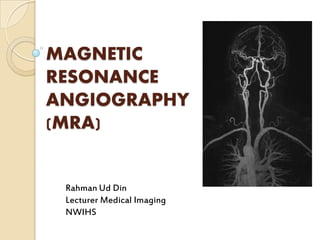
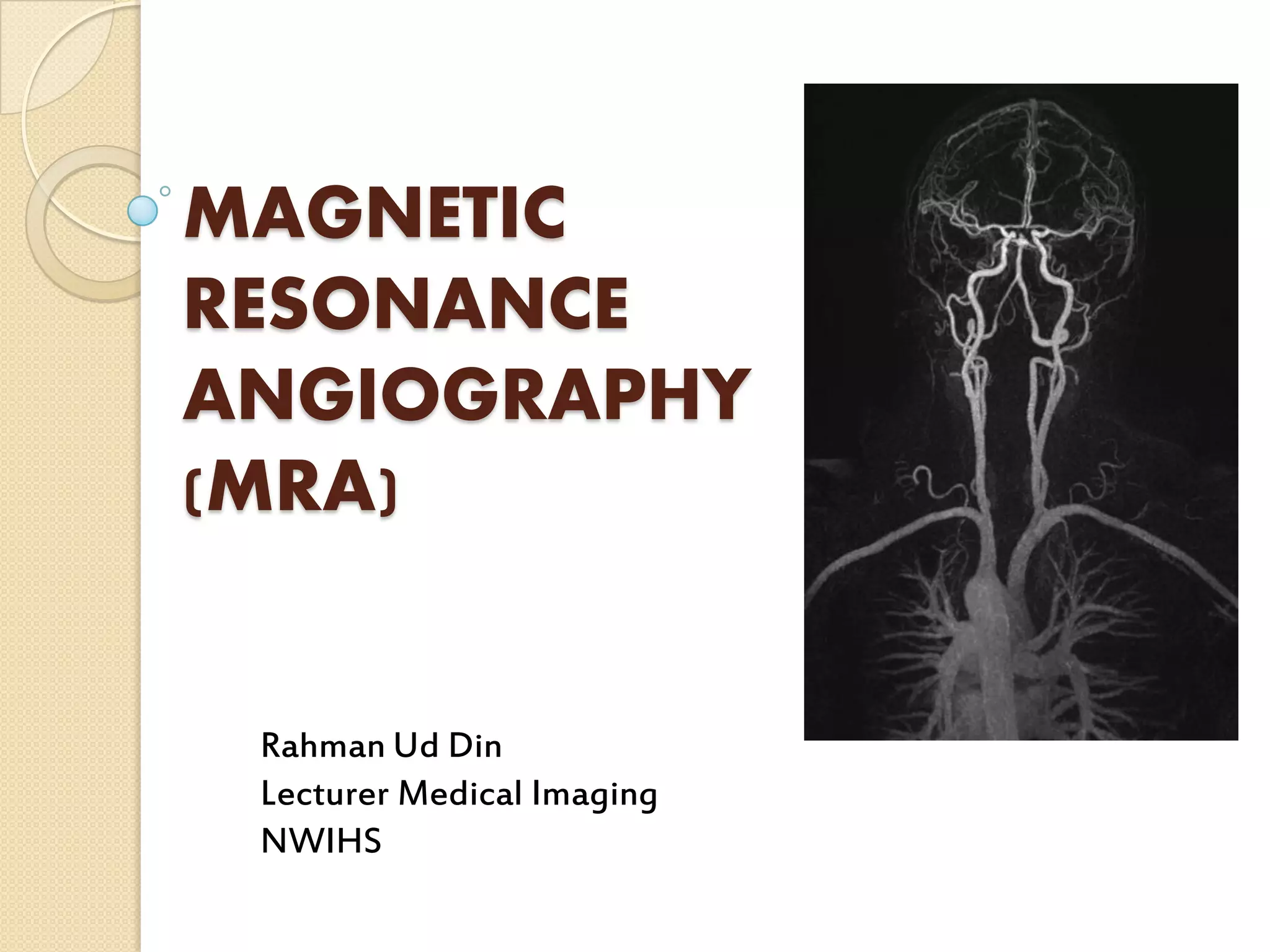
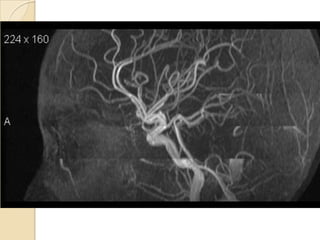
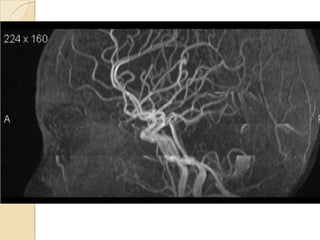
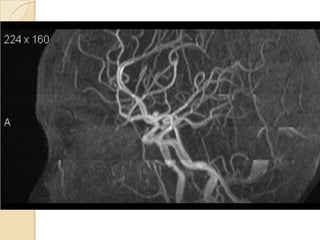
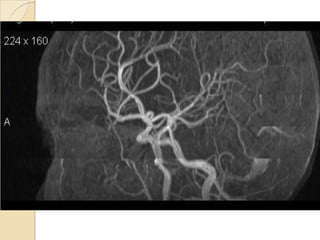
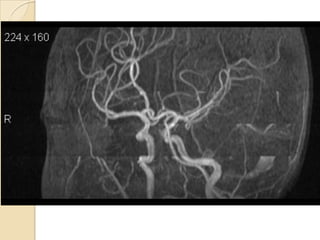
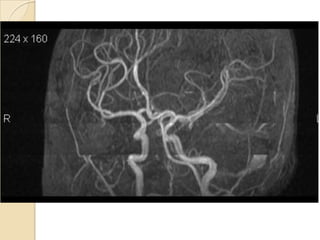
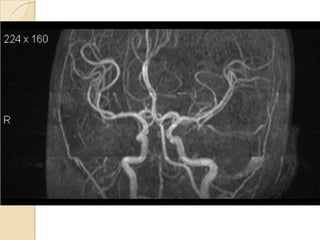
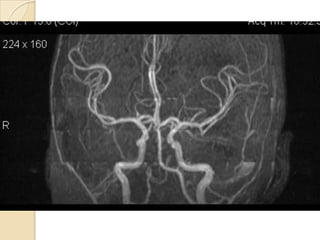
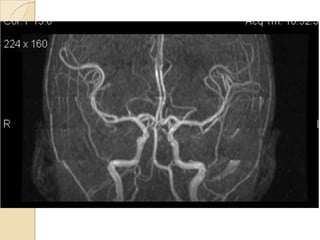
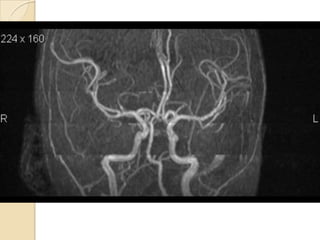
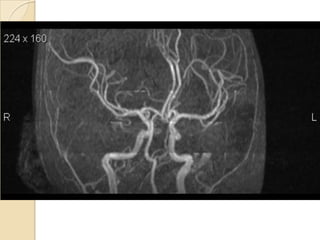
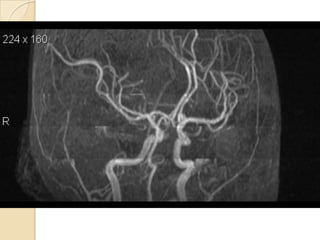
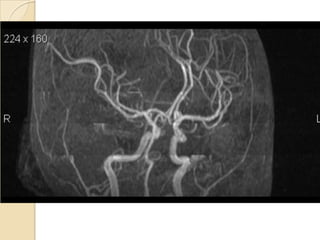
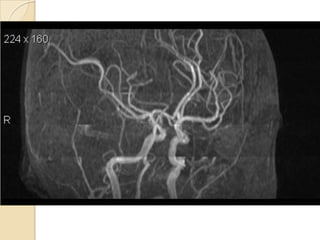
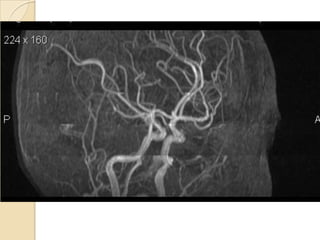
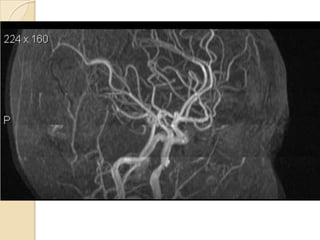
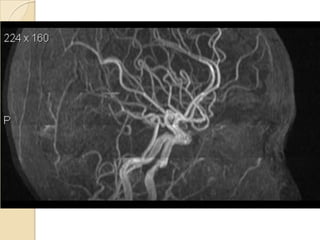
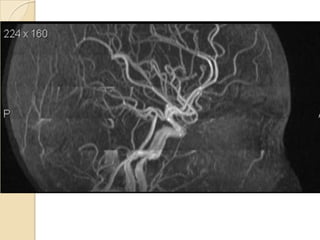
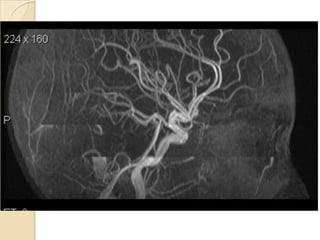
MAGNETIC
RESONANCE
ANGIOGRAPHY
(MRA)
Rahman Ud Din
Lecturer Medical Imaging
NWIHS
OUTLINE
1.INTRODUCTION
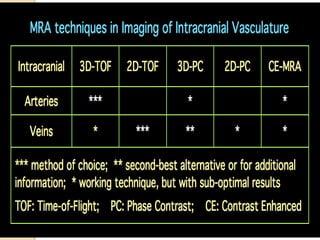
2.TYPES OF MRA
3. INDICATIONS
4.TECHNIQUES & BASIC PRINCIPLES
5.NORMAL MRA AND ITSVARIANTS
6.CLINICAL APPLICATIONS
Introduction
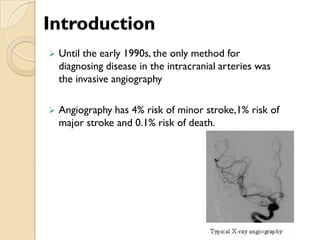
 Until the early 1990s, the only method for
diagnosing disease in the intracranial arteries was
the invasive angiography
 Angiography has 4% risk of minor stroke,1% risk of
major stroke and 0.1% risk of death.
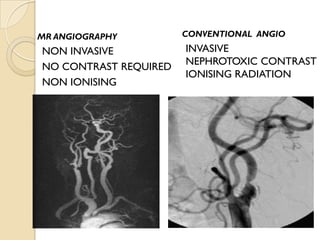
MR ANGIOGRAPHY
NON INVASIVE
NO CONTRAST REQUIRED
NON IONISING
INVASIVE
NEPHROTOXIC CONTRAST
IONISING RADIATION
CONVENTIONAL ANGIO
DSA-USG-CTA-MRA
Vascular structures of brain can be imaged by 4 means:
1. DSA: gold standard. Invasive and risk of nephrotoxic contrast, ionising
radiation
2. Vascular ultrasound: least invasive, can be done bedside, cost effective.
best choice for imaging vessels close to skin surface. Drawback: limited
anatomic coverage, deep vessels cant be imaged, operator dependent,
requires skill
3. CT angio: main drawbacks are contrast use and radiation exposure,
calcifications are overestimated. It is preferred for aorta and coronaries
4. MRA : is non invasive, no radiation exposure. Preferred for carotids and
intracranial vessels as MRI brain can also be obtained and is widely used
in neurological disorders
1. To evaluate conditions of the carotid arteries such as:
 Stenotic / occlusive disease in symptomatic patients (e.g.,
TIA or CVA)
 Stenotic / occlusive disease in asymptomatic members
who are candidates for carotid endarterectomy surgery
when a Doppler Scan is abnormal.
 Aneurysms.
 Cervicocranial arterial dissection in members with
suggestive
signs or symptoms (e.g., unilateral headache ,
oculosympathetic
palsy, amaurosis fugax, and symptoms of focal brain
ischemia)
Indications of MRA
2. To rule out intracranial aneurysm (ICA), including aneurysms of the
Circle ofWillis, in persons who are thought to be at higher risk (e.g.,
history of ICA in a first-degree relative or presence of polycystic
kidney disease);
3.As a follow-up study for a known arteriovenous malformation (AVM),
and for a known non-ruptured intracranial aneurysm that is greater
than 3 mm in size;
4. To evaluate patients with signs/symptoms highly suggestive of
leaking/ruptured aneurysm or AVM (i.e., sudden explosive headache,
stiff neck, blood in the cerebral spinal fluid);
5.To definitively establish presence of stenoses or other abnormalities
of the vertebrobasilar system in patients with symptoms highly
suggestive of vertebrobasilar syndrome (binocular vision loss,
positional vertigo, dysarthria, dysphagia, diplopia).
Indications of MRA contd..
MRATECHNIQUES
1.TIME OF FLIGHT (TOF)
2.PHASE CONTRAST (PC)
3.CONTRAST ENHANCED MRA (CE MRA)
BASIC PRINCIPLES
 Protons are excited using GRE pulse sequence
TOF MRA- “manipulating magnitude of
magnetization”
 Vascular contrast in TOF MRA is due to
difference in the magnitude of the inflowing
protons in the blood and the surrounding
stationary protons.
 No contrast agent injected
 Motion artifact
 Difficulty with slow flow
PC MRA- “manipulating phase of magnetization”
 directional flow encoding magnetic field gradient
causing difference in the phase/orientation
 In PC MRA bipolar gradient is applied and if the
proton is stationary there is no phase shift. However
if the protons are moving, a phase shift occurs.The
faster the proton moves greater the phase shift.
 Phase is proportional to velocity
 Allows quantification of blood flow and
velocity
 More time consuming
CE MRA -
 Uses parameters typical of 3DTOF MRA but gadolinium contrast is
also given.
 Data are acquired after contrast bolus infusion ( Gad. 0.1-.2 mmol/kg).
 Unlike, time-of-flight (TOF) or phase contrast (PC)
imaging, the signals of the blood in CEMRA is based on
the intrinsicT1 signal of blood and rather less on flow
effects; therefore, this technique is less flow sensitive
 It can be performed within seconds
 Nephrogenic systemic fibrosis is rare but serious
complication.
2D and 3D fourier transform
 In 2DFT technique, multiple thin sections of body are
studied individually and even slow flow is identified
 In 3DFT technique , a large volume of tissue is studied
,which can be subsequently partitioned into individual slices,
hence high resolution can be obtained and flow artifacts are
minimised, and less likely to be affected by loops and
tortusity of vessels
 MOTSA(multiple overlapping thin slab acquisition): prevents
proton saturation across the slab.This technique have
advantage of both 2D and 3D studies. It is better than 3D
TOF MRA in correctly identifying vascular loops and
tortusity, and have lesser chances of overestimating carotid
stenosis.
NORMAL MRA
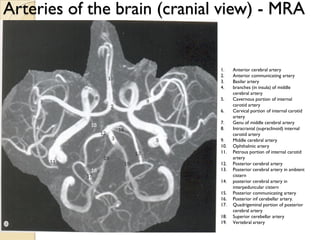
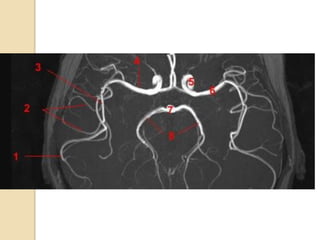
Arteries of the brain (cranial view) - MRA
1. Anterior cerebral artery
2. Anterior communicating artery
3. Basilar artery
4. branches (in insula) of middle
cerebral artery
5. Cavernous portion of internal
carotid artery
6. Cervical portion of internal carotid
artery
7. Genu of middle cerebral artery
8. Intracranial (supraclinoid) internal
carotid artery
9. Middle cerebral artery
10. Ophthalmic artery
11. Petrous portion of internal carotid
artery
12. Posterior cerebral artery
13. Posterior cerebral artery in ambient
cistern
14. posterior cerebral artery in
interpeduncular cistern
15. Posterior communicating artery
16. Posterior inf cerebellar artery.
17. Quadrigeminal portion of posterior
cerebral artery
18. Superior cerebellar artery
19. Vertebral artery
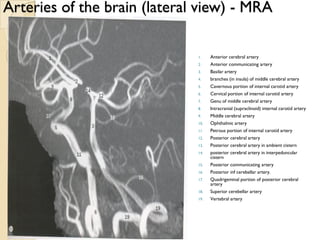
Arteries of the brain (lateral view) - MRA
1. Anterior cerebral artery
2. Anterior communicating artery
3. Basilar artery
4. branches (in insula) of middle cerebral artery
5. Cavernous portion of internal carotid artery
6. Cervical portion of internal carotid artery
7. Genu of middle cerebral artery
8. Intracranial (supraclinoid) internal carotid artery
9. Middle cerebral artery
10. Ophthalmic artery
11. Petrous portion of internal carotid artery
12. Posterior cerebral artery
13. Posterior cerebral artery in ambient cistern
14. posterior cerebral artery in interpeduncular
cistern
15. Posterior communicating artery
16. Posterior inf cerebellar artery.
17. Quadrigeminal portion of posterior cerebral
artery
18. Superior cerebellar artery
19. Vertebral artery
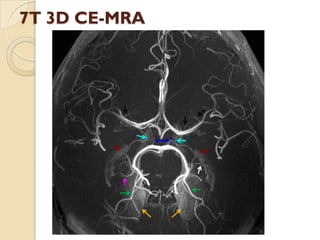
7T 3D CE-MRA
VARIANTS OF CIRCLE OF
WILLIS
Krabbe- Hartkamp et al 1998
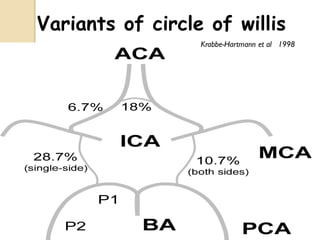
Variants of circle of willis
Krabbe-Hartmann et al 1998
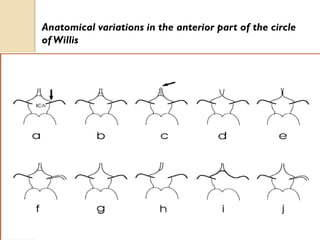
Anatomical variations in the anterior part of the circle
of Willis
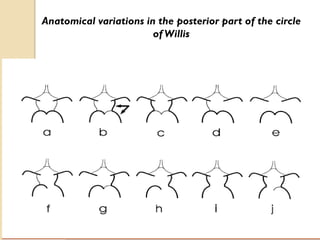
Anatomical variations in the posterior part of the circle
of Willis
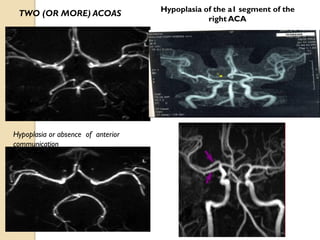
TWO (OR MORE) ACOAS
Hypoplasia or absence of anterior
communication
Hypoplasia of the a1 segment of the
right ACA
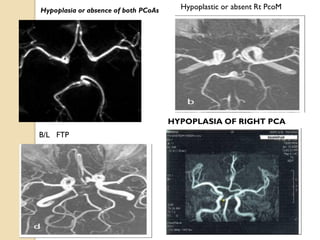
Hypoplasia or absence of both PCoAs
HYPOPLASIA OF RIGHT PCA
B/L FTP
Hypoplastic or absent Rt PcoM
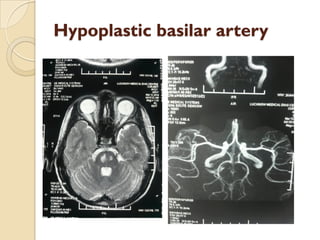
Hypoplastic basilar artery
CLINICAL APPLICATIONS
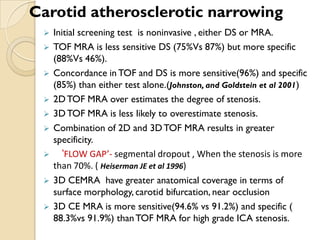
 Initial screening test is noninvasive , either DS or MRA.
 TOF MRA is less sensitive DS (75%Vs 87%) but more specific
(88%Vs 46%).
 Concordance in TOF and DS is more sensitive(96%) and specific
(85%) than either test alone.(Johnston, and Goldstein et al 2001)
 2DTOF MRA over estimates the degree of stenosis.
 3DTOF MRA is less likely to overestimate stenosis.
 Combination of 2D and 3DTOF MRA results in greater
specificity.
 ‘FLOW GAP’- segmental dropout , When the stenosis is more
than 70%. ( Heiserman JE et al 1996)
 3D CEMRA have greater anatomical coverage in terms of
surface morphology, carotid bifurcation, near occlusion
 3D CE MRA is more sensitive(94.6% vs 91.2%) and specific (
88.3%vs 91.9%) thanTOF MRA for high grade ICA stenosis.
Carotid atherosclerotic narrowing
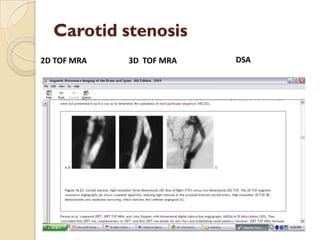
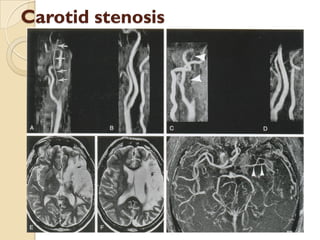
Carotid stenosis
2D TOF MRA 3D TOF MRA DSA
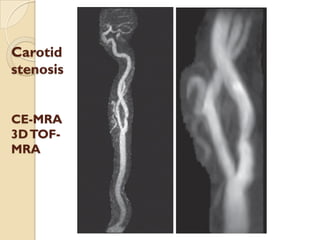
Carotid
stenosis
CE-MRA
3DTOF-
MRA
Carotid stenosis
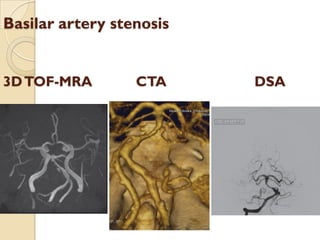
Basilar artery stenosis
3DTOF-MRA CTA DSA
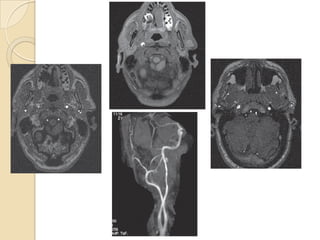
Carotid orVertebral artery dissection
 Catheter angiography has been traditionally used for
diagnosis of carotid dissection.
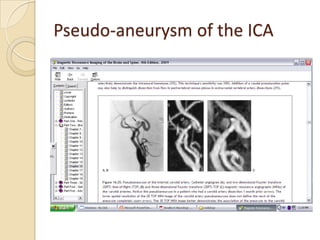
 MRI +fat saturation along with 3D TOF MRA characterise
dissecting hematoma, associated pseudo-aneurysm & length
and caliber of residual patent lumen.
 MRI with MRA is currently the investigation of choice for
suspected dissection.
 Not nearly as helpful in vertebral artery dissections
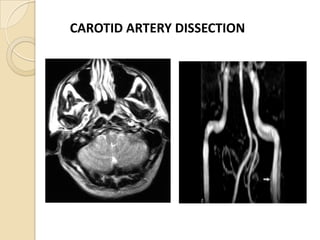
CAROTID ARTERY DISSECTION
Pseudo-aneurysm of the ICA
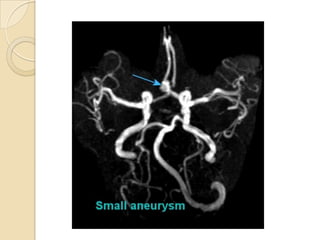
Aneurysms
 3D TOF is now accepted as a non-invasive screening tool for
familial aneurysmal disease.
 Sensitivity is greater for detecting aneurysms > 3mm (94%)
than aneurysms < 3mm (38%). ( White et al 2000)
 Overall inferior to DSA and misses aneurysm <3mm.(Adams
et al 2000)
 3D CE MRA is superior to TOF MRA .It is method of choice
for evaluation of giant cerebral aneurysms.
 CE MRA shows promise in the follow-up of treated
intracranial aneurysms.
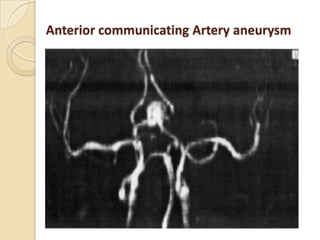
Anterior communicating Artery aneurysm
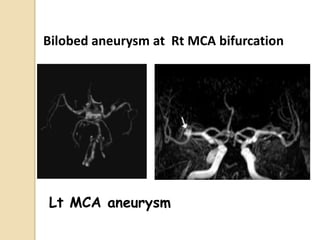
Lt MCA aneurysm
Bilobed aneurysm at Rt MCA bifurcation
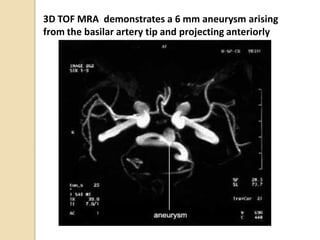
3D TOF MRA demonstrates a 6 mm aneurysm arising
from the basilar artery tip and projecting anteriorly
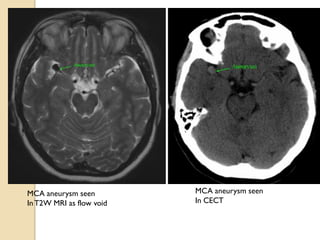
MCA aneurysm seen
InT2W MRI as flow void
MCA aneurysm seen
In CECT
A-V Malformations
 Secondary role to digital subtraction
angiography.
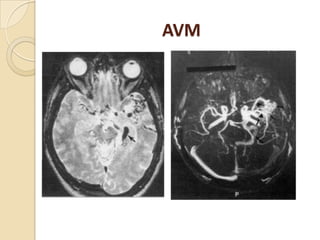
 The typical AVM appears on spin-echo MRI as a
cluster of focal round lesions or serpentine areas
of signal void
 3D CE MRA is superior to 3D TOF MRA and
equivalent to subtraction angiography in 70-
90%of cases in depicting AVM components.
AVM
Acute ischemic stroke
 A novel application of MRA is to guide acute
stroke intervention potentially.
 MRA can be a predictor of clinical outcome in
acute ischemic pt. undergoing thrombolysis with
IV rtPA in window period. ( Marks et al 2008).
 The Boston scale ( BASIS) is a classification tool
to help predict outcomes in acute stroke by
using MRA study. ( Torres-Mozqueda et al 2008)
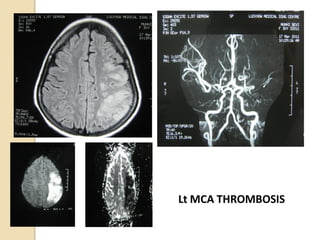
Lt MCA THROMBOSIS
1- No contrast material is required in
angiographic technique-
1. CE-MRA
2. CTA
3. DSA
4. TOF-MRA
2- Angiographic technique for estimation of
velocity and direction of flow-
1. CE-MRA
2. TOF-MRA
3. PC-MRA
4. CTA
3- Complication of gadolinium contrast is –
1- Nephrogenic diabetes insipidus
2- Pulmonary fibrosis
3- Fibrosing alveolitis
4- Neprogenic systemic fibrosis
4- Gold standard for diagnosis and
evaluation of aneurysm is-
1- CTA
2- MRA
3- DSA
4- USG
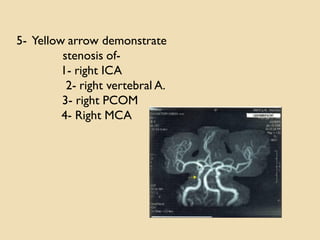
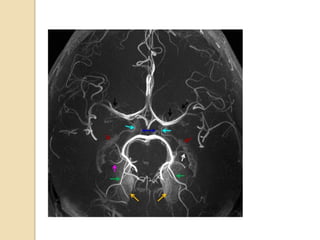
5- Yellow arrow demonstrate
stenosis of-
1- right ICA
2- right vertebral A.
3- right PCOM
4- Right MCA
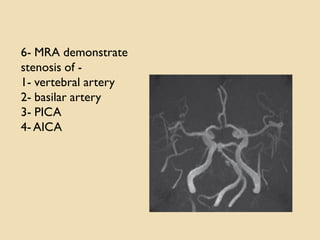
6- MRA demonstrate
stenosis of -
1- vertebral artery
2- basilar artery
3- PICA
4- AICA
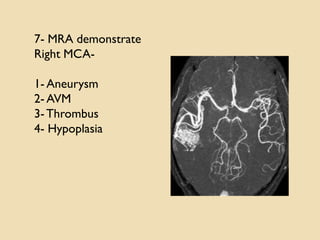
7- MRA demonstrate
Right MCA-
1- Aneurysm
2- AVM
3-Thrombus
4- Hypoplasia
8- Spetzler-Martin grading system is used for-
1- Aneurysm
2- AVM
3-Thrombosis
4- Arterial dissection
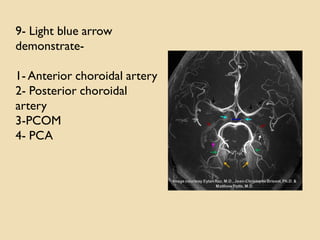
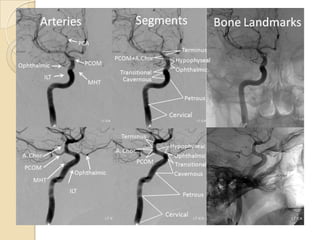
9- Light blue arrow
demonstrate-
1- Anterior choroidal artery
2- Posterior choroidal
artery
3-PCOM
4- PCA
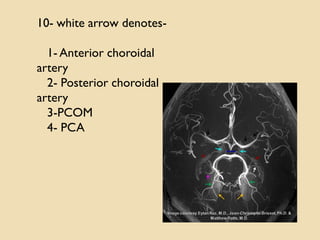
10- white arrow denotes-
1- Anterior choroidal
artery
2- Posterior choroidal
artery
3-PCOM
4- PCA
Summary
1. Two different approaches to MRA are
commonly used:Time-of-Flight (TOF-MRA)
& Phase Contrast (PC-MRA)
2. TOF-MRA is easy to implement and is robust
but has difficulty with slow flow
3. 3DTOF can be combined with fast
imaging methods and Gd contrast agents
to obtain improved depiction of vascular
structures
Summary
4. PC-MRA requires more time to
acquire more images but can result in
high resolution, fewer flow related
artifacts, and quantitative measurement
of flow
5. Phase-contrast MRI may provide the
most accurate, noninvasive method for
measuring blood flow in vivo
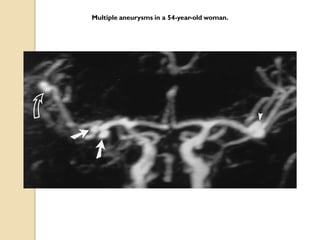
Multiple aneurysms in a 54-year-old woman.
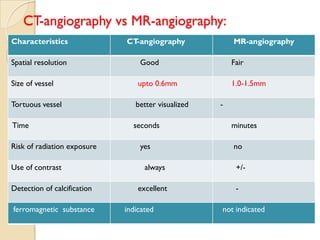
CT-angiography vs MR-angiography:
Characteristics CT-angiography MR-angiography
Spatial resolution Good Fair
Size of vessel upto 0.6mm 1.0-1.5mm
Tortuous vessel better visualized -
Time seconds minutes
Risk of radiation exposure yes no
Use of contrast always +/-
Detection of calcification excellent -
ferromagnetic substance indicated not indicated
Magnetic resonance angiography

Magnetic resonance angiography

  • 1.
  • 2.
    OUTLINE 1.INTRODUCTION 2.TYPES OF MRA 3.INDICATIONS 4.TECHNIQUES & BASIC PRINCIPLES 5.NORMAL MRA AND ITSVARIANTS 6.CLINICAL APPLICATIONS
  • 3.
    Introduction  Until theearly 1990s, the only method for diagnosing disease in the intracranial arteries was the invasive angiography  Angiography has 4% risk of minor stroke,1% risk of major stroke and 0.1% risk of death.
  • 4.
    MR ANGIOGRAPHY NON INVASIVE NOCONTRAST REQUIRED NON IONISING INVASIVE NEPHROTOXIC CONTRAST IONISING RADIATION CONVENTIONAL ANGIO
  • 5.
    DSA-USG-CTA-MRA Vascular structures ofbrain can be imaged by 4 means: 1. DSA: gold standard. Invasive and risk of nephrotoxic contrast, ionising radiation 2. Vascular ultrasound: least invasive, can be done bedside, cost effective. best choice for imaging vessels close to skin surface. Drawback: limited anatomic coverage, deep vessels cant be imaged, operator dependent, requires skill 3. CT angio: main drawbacks are contrast use and radiation exposure, calcifications are overestimated. It is preferred for aorta and coronaries 4. MRA : is non invasive, no radiation exposure. Preferred for carotids and intracranial vessels as MRI brain can also be obtained and is widely used in neurological disorders
  • 6.
    1. To evaluateconditions of the carotid arteries such as:  Stenotic / occlusive disease in symptomatic patients (e.g., TIA or CVA)  Stenotic / occlusive disease in asymptomatic members who are candidates for carotid endarterectomy surgery when a Doppler Scan is abnormal.  Aneurysms.  Cervicocranial arterial dissection in members with suggestive signs or symptoms (e.g., unilateral headache , oculosympathetic palsy, amaurosis fugax, and symptoms of focal brain ischemia) Indications of MRA
  • 7.
    2. To ruleout intracranial aneurysm (ICA), including aneurysms of the Circle ofWillis, in persons who are thought to be at higher risk (e.g., history of ICA in a first-degree relative or presence of polycystic kidney disease); 3.As a follow-up study for a known arteriovenous malformation (AVM), and for a known non-ruptured intracranial aneurysm that is greater than 3 mm in size; 4. To evaluate patients with signs/symptoms highly suggestive of leaking/ruptured aneurysm or AVM (i.e., sudden explosive headache, stiff neck, blood in the cerebral spinal fluid); 5.To definitively establish presence of stenoses or other abnormalities of the vertebrobasilar system in patients with symptoms highly suggestive of vertebrobasilar syndrome (binocular vision loss, positional vertigo, dysarthria, dysphagia, diplopia). Indications of MRA contd..
  • 8.
    MRATECHNIQUES 1.TIME OF FLIGHT(TOF) 2.PHASE CONTRAST (PC) 3.CONTRAST ENHANCED MRA (CE MRA)
  • 9.
    BASIC PRINCIPLES  Protonsare excited using GRE pulse sequence TOF MRA- “manipulating magnitude of magnetization”  Vascular contrast in TOF MRA is due to difference in the magnitude of the inflowing protons in the blood and the surrounding stationary protons.  No contrast agent injected  Motion artifact  Difficulty with slow flow
  • 10.
    PC MRA- “manipulatingphase of magnetization”  directional flow encoding magnetic field gradient causing difference in the phase/orientation  In PC MRA bipolar gradient is applied and if the proton is stationary there is no phase shift. However if the protons are moving, a phase shift occurs.The faster the proton moves greater the phase shift.  Phase is proportional to velocity  Allows quantification of blood flow and velocity  More time consuming
  • 11.
    CE MRA - Uses parameters typical of 3DTOF MRA but gadolinium contrast is also given.  Data are acquired after contrast bolus infusion ( Gad. 0.1-.2 mmol/kg).  Unlike, time-of-flight (TOF) or phase contrast (PC) imaging, the signals of the blood in CEMRA is based on the intrinsicT1 signal of blood and rather less on flow effects; therefore, this technique is less flow sensitive  It can be performed within seconds  Nephrogenic systemic fibrosis is rare but serious complication.
  • 12.
    2D and 3Dfourier transform  In 2DFT technique, multiple thin sections of body are studied individually and even slow flow is identified  In 3DFT technique , a large volume of tissue is studied ,which can be subsequently partitioned into individual slices, hence high resolution can be obtained and flow artifacts are minimised, and less likely to be affected by loops and tortusity of vessels  MOTSA(multiple overlapping thin slab acquisition): prevents proton saturation across the slab.This technique have advantage of both 2D and 3D studies. It is better than 3D TOF MRA in correctly identifying vascular loops and tortusity, and have lesser chances of overestimating carotid stenosis.
  • 14.
  • 15.
    Arteries of thebrain (cranial view) - MRA 1. Anterior cerebral artery 2. Anterior communicating artery 3. Basilar artery 4. branches (in insula) of middle cerebral artery 5. Cavernous portion of internal carotid artery 6. Cervical portion of internal carotid artery 7. Genu of middle cerebral artery 8. Intracranial (supraclinoid) internal carotid artery 9. Middle cerebral artery 10. Ophthalmic artery 11. Petrous portion of internal carotid artery 12. Posterior cerebral artery 13. Posterior cerebral artery in ambient cistern 14. posterior cerebral artery in interpeduncular cistern 15. Posterior communicating artery 16. Posterior inf cerebellar artery. 17. Quadrigeminal portion of posterior cerebral artery 18. Superior cerebellar artery 19. Vertebral artery
  • 16.
    Arteries of thebrain (lateral view) - MRA 1. Anterior cerebral artery 2. Anterior communicating artery 3. Basilar artery 4. branches (in insula) of middle cerebral artery 5. Cavernous portion of internal carotid artery 6. Cervical portion of internal carotid artery 7. Genu of middle cerebral artery 8. Intracranial (supraclinoid) internal carotid artery 9. Middle cerebral artery 10. Ophthalmic artery 11. Petrous portion of internal carotid artery 12. Posterior cerebral artery 13. Posterior cerebral artery in ambient cistern 14. posterior cerebral artery in interpeduncular cistern 15. Posterior communicating artery 16. Posterior inf cerebellar artery. 17. Quadrigeminal portion of posterior cerebral artery 18. Superior cerebellar artery 19. Vertebral artery
  • 20.
  • 41.
    VARIANTS OF CIRCLEOF WILLIS Krabbe- Hartkamp et al 1998
  • 42.
    Variants of circleof willis Krabbe-Hartmann et al 1998
  • 43.
    Anatomical variations inthe anterior part of the circle of Willis
  • 44.
    Anatomical variations inthe posterior part of the circle of Willis
  • 45.
    TWO (OR MORE)ACOAS Hypoplasia or absence of anterior communication Hypoplasia of the a1 segment of the right ACA
  • 46.
    Hypoplasia or absenceof both PCoAs HYPOPLASIA OF RIGHT PCA B/L FTP Hypoplastic or absent Rt PcoM
  • 47.
  • 48.
  • 49.
     Initial screeningtest is noninvasive , either DS or MRA.  TOF MRA is less sensitive DS (75%Vs 87%) but more specific (88%Vs 46%).  Concordance in TOF and DS is more sensitive(96%) and specific (85%) than either test alone.(Johnston, and Goldstein et al 2001)  2DTOF MRA over estimates the degree of stenosis.  3DTOF MRA is less likely to overestimate stenosis.  Combination of 2D and 3DTOF MRA results in greater specificity.  ‘FLOW GAP’- segmental dropout , When the stenosis is more than 70%. ( Heiserman JE et al 1996)  3D CEMRA have greater anatomical coverage in terms of surface morphology, carotid bifurcation, near occlusion  3D CE MRA is more sensitive(94.6% vs 91.2%) and specific ( 88.3%vs 91.9%) thanTOF MRA for high grade ICA stenosis. Carotid atherosclerotic narrowing
  • 50.
    Carotid stenosis 2D TOFMRA 3D TOF MRA DSA
  • 51.
  • 52.
  • 53.
  • 54.
    Carotid orVertebral arterydissection  Catheter angiography has been traditionally used for diagnosis of carotid dissection.  MRI +fat saturation along with 3D TOF MRA characterise dissecting hematoma, associated pseudo-aneurysm & length and caliber of residual patent lumen.  MRI with MRA is currently the investigation of choice for suspected dissection.  Not nearly as helpful in vertebral artery dissections
  • 55.
  • 56.
  • 58.
    Aneurysms  3D TOFis now accepted as a non-invasive screening tool for familial aneurysmal disease.  Sensitivity is greater for detecting aneurysms > 3mm (94%) than aneurysms < 3mm (38%). ( White et al 2000)  Overall inferior to DSA and misses aneurysm <3mm.(Adams et al 2000)  3D CE MRA is superior to TOF MRA .It is method of choice for evaluation of giant cerebral aneurysms.  CE MRA shows promise in the follow-up of treated intracranial aneurysms.
  • 59.
  • 61.
    Lt MCA aneurysm Bilobedaneurysm at Rt MCA bifurcation
  • 62.
    3D TOF MRAdemonstrates a 6 mm aneurysm arising from the basilar artery tip and projecting anteriorly
  • 63.
    MCA aneurysm seen InT2WMRI as flow void MCA aneurysm seen In CECT
  • 65.
    A-V Malformations  Secondaryrole to digital subtraction angiography.  The typical AVM appears on spin-echo MRI as a cluster of focal round lesions or serpentine areas of signal void  3D CE MRA is superior to 3D TOF MRA and equivalent to subtraction angiography in 70- 90%of cases in depicting AVM components.
  • 66.
  • 68.
    Acute ischemic stroke A novel application of MRA is to guide acute stroke intervention potentially.  MRA can be a predictor of clinical outcome in acute ischemic pt. undergoing thrombolysis with IV rtPA in window period. ( Marks et al 2008).  The Boston scale ( BASIS) is a classification tool to help predict outcomes in acute stroke by using MRA study. ( Torres-Mozqueda et al 2008)
  • 69.
  • 71.
    1- No contrastmaterial is required in angiographic technique- 1. CE-MRA 2. CTA 3. DSA 4. TOF-MRA
  • 72.
    2- Angiographic techniquefor estimation of velocity and direction of flow- 1. CE-MRA 2. TOF-MRA 3. PC-MRA 4. CTA
  • 73.
    3- Complication ofgadolinium contrast is – 1- Nephrogenic diabetes insipidus 2- Pulmonary fibrosis 3- Fibrosing alveolitis 4- Neprogenic systemic fibrosis
  • 74.
    4- Gold standardfor diagnosis and evaluation of aneurysm is- 1- CTA 2- MRA 3- DSA 4- USG
  • 75.
    5- Yellow arrowdemonstrate stenosis of- 1- right ICA 2- right vertebral A. 3- right PCOM 4- Right MCA
  • 76.
    6- MRA demonstrate stenosisof - 1- vertebral artery 2- basilar artery 3- PICA 4- AICA
  • 77.
    7- MRA demonstrate RightMCA- 1- Aneurysm 2- AVM 3-Thrombus 4- Hypoplasia
  • 78.
    8- Spetzler-Martin gradingsystem is used for- 1- Aneurysm 2- AVM 3-Thrombosis 4- Arterial dissection
  • 79.
    9- Light bluearrow demonstrate- 1- Anterior choroidal artery 2- Posterior choroidal artery 3-PCOM 4- PCA
  • 80.
    10- white arrowdenotes- 1- Anterior choroidal artery 2- Posterior choroidal artery 3-PCOM 4- PCA
  • 81.
    Summary 1. Two differentapproaches to MRA are commonly used:Time-of-Flight (TOF-MRA) & Phase Contrast (PC-MRA) 2. TOF-MRA is easy to implement and is robust but has difficulty with slow flow 3. 3DTOF can be combined with fast imaging methods and Gd contrast agents to obtain improved depiction of vascular structures
  • 82.
    Summary 4. PC-MRA requiresmore time to acquire more images but can result in high resolution, fewer flow related artifacts, and quantitative measurement of flow 5. Phase-contrast MRI may provide the most accurate, noninvasive method for measuring blood flow in vivo
  • 85.
    Multiple aneurysms ina 54-year-old woman.
  • 87.
    CT-angiography vs MR-angiography: CharacteristicsCT-angiography MR-angiography Spatial resolution Good Fair Size of vessel upto 0.6mm 1.0-1.5mm Tortuous vessel better visualized - Time seconds minutes Risk of radiation exposure yes no Use of contrast always +/- Detection of calcification excellent - ferromagnetic substance indicated not indicated