MRI sequences involve different combinations of pulse sequences and magnetic field gradients that result in particular tissue appearances on images. The main types of sequences include spin echo, gradient echo, inversion recovery, diffusion weighted, perfusion weighted, functional MRI, and magnetic resonance angiography. Each sequence has different parameters that make it particularly suited for evaluating certain tissues, pathologies, or physiological processes.
MRI sequence
From Wikipedia,the free encyclopedia
Jump to navigation Jump to search
Timing diagram for a spin echo type of pulse sequence.
An MRI sequence in magnetic resonance imaging (MRI) is a particular setting of pulse
sequences and pulsed field gradients, resulting in a particular image appearance.[1]
A multiparametric MRI is a combination of two or more sequences, and/or including
other specialized MRI configurations such as spectroscopy.[2]
3.
Contents
1 Overviewtable
2 Spin echo
o 2.1 T1 and T2
o 2.2 Proton density (PD)
3 Gradient echo (GRE)
o 3.1 Spoiling
o 3.2 Steady-state free precession (SSFP)
o 3.3 In-phase and out-of-phase (IP and OOP)
o 3.4 Effective T2 (T2* or "T2-star")
o 3.5 Commercial names of gradient echo sequences
4 Inversion recovery
o 4.1 Fluid-attenuated inversion recovery (FLAIR)
o 4.2 Turbo inversion recovery magnitude (TIRM)
5 Diffusion weighted (DWI)
6 Perfusion weighted (PWI)
7 Functional (fMRI)
8 Magnetic resonance angiography (MRA)
o 8.1 Phase contrast (PC)
9 Susceptibility weighted imaging (SWI)
10 Magnetization transfer (MT)
11 Fast spin echo (FSE)
12 Fat suppression
13 Neuromelanin imaging
14 Uncommon and experimental sequences
o 14.1 T1 rho (T1ρ)
o 14.2 Others
15 References
4.
Group Sequence Abbr.Physics Main clinical
distinctions
Example
Spin echo T1
weighted
T1 Measuring
spin–lattice
relaxation by
using a short
repetition
time (TR)
and echo
time (TE)
Lower
signal for
more water
content, [3]
as
in edema,
tumor,
infarction,
inflammatio
n, infection,
hyperacute
or chronic
hemorrhage
[4]
High signal
for fat[3][4]
High signal
for
paramagneti
c
substances,
such as MRI
contrast
agents[4]
Standard
foundation and
comparison for
other sequences
T2
weighted
T2 Measuring
spin–spin
relaxation by
using long
TR and TE
times
Higher
signal for
more water
content[3]
Low signal
for fat[3]
Low signal
for
paramagneti
c
substances[4]
Standard
foundation and
comparison for
other sequences
5.
Proton
density
weighted
PD Long TR(to
reduce T1) and
short TE (to
minimize T2)[5]
Joint disease and
injury.[6]
High
signal from
meniscus
tears[7]
(pictured)
Gradient
echo
(GRE)
Steady-
state free
precession
SSFP Maintenance of
a steady,
residual
transverse
magnetisation
over successive
cycles.[8]
Creation of
cardiac MRI
videos
(pictured).[8]
Effective
T2
or "T2-
star"
T2* Postexcitation
refocused GRE
with small flip
angle.[9]
Low signal from
hemosiderin
deposits (pictured)
and
hemorrhages.[9]
Inversion
recovery
Short tau
inversion
recovery
STIR Fat suppression
by setting an
inversion time
where the signal
of fat is zero[10]
High signal in
edema, such as in
more severe stress
fracture[11]
Shin
splints pictured:
6.
Fluid-
attenuated
inversion
recovery
FLAI
R
Fluid
suppression
by setting an
inversion
timethat
nulls fluids
High signal in
lacunar infarction,
multiple sclerosis
(MS) plaques,
subarachnoid
haemorrhage and
meningitis
(pictured).[12]
Double
inversion
recovery
DIR Simultaneou
s
suppression
of
cerebrospina
l fluid and
white matter
by two
inversion
times[13]
High signal of
multiple sclerosis
plaques (pictured)[13]
Diffusio
n
weighted
(DWI)
Conventiona
l
DWI Measure of
Brownian
motion of
water
molecules[14]
High signal within
minutes of cerebral
infarction
(pictured).[15]
Apparent
diffusion
coefficient
ADC Reduced T2
weighting
by taking
multiple
conventional
DWI images
with
different
DWI
weighting,
and the
change
corresponds
to
diffusion[16]
Low signal minutes
after cerebral
infarction
(pictured)[17]
Diffusion
tensor
DTI Mainly
tractography
(pictured) by
an overall
greater
Brownian
motion of
Evaluating
white matter
deformation
by tumors[18]
Reduced
fractional
anisotropy
Perfusion
weighted
(PWI)
Dynamic
susceptibility
contrast
DSC Gadolinium
contrast is
injected,and
rapid repeated
imaging
(generally
gradient-echo
echo-planar T2
weighted)
quantifies
susceptibility-
induced signal
loss[20]
In cerebral
infarction, the
infarcted core
and the
penumbra have
decreased
perfusion
(pictured).[21]
Dynamic
contrast
enhanced
DCE Measuring
shortening of the
spin–lattice
relaxation (T1)
induced by a
gadolinium
contrast bolus[22]
Arterial spin
labelling
ASL Magnetic labeling
of arterial blood
below the
imaging slab,
which
subsequently
enters the region
of interest[23]
It
does not need
gadolinium
contrast.[24]
9.
Functional
MRI (fMRI)
Blood-
oxygen-
level
dependent
imaging
BOLD Changesin
oxygen
saturation-
dependent
magnetism of
hemoglobin
reflects tissue
activity.[25]
Localizing
highly active
brain areas
before
surgery[26]
Magnetic
resonance
angiography
(MRA) and
venography
Time-of-
flight
TOF Blood entering
the imaged area
is not yet
magnetically
saturated, giving
it a much higher
signal when
using short echo
time and flow
compensation.
Detection of
aneurysm,
stenosis, or
dissection[27]
Phase-
contrast
magnetic
resonance
imaging
PC-
MRA
Two gradients
with equal
magnitude, but
opposite
direction, are
used to encode a
phase shift,
which is
proportional to
the velocity of
spins.[28]
Detection of
aneurysm,
stenosis, or
dissection
(pictured)[27]
(VIPR)
Susceptibility-weighted SWI Sensitive for
blood and
calcium, by a
fully flow
compensated,
long echo,
gradient recalled
echo (GRE)
pulse sequence
to exploit
magnetic
susceptibility
differences
between tissues
Detecting
small
amounts of
hemorrhage
(diffuse
axonal injury
pictured) or
calcium[29]
10.
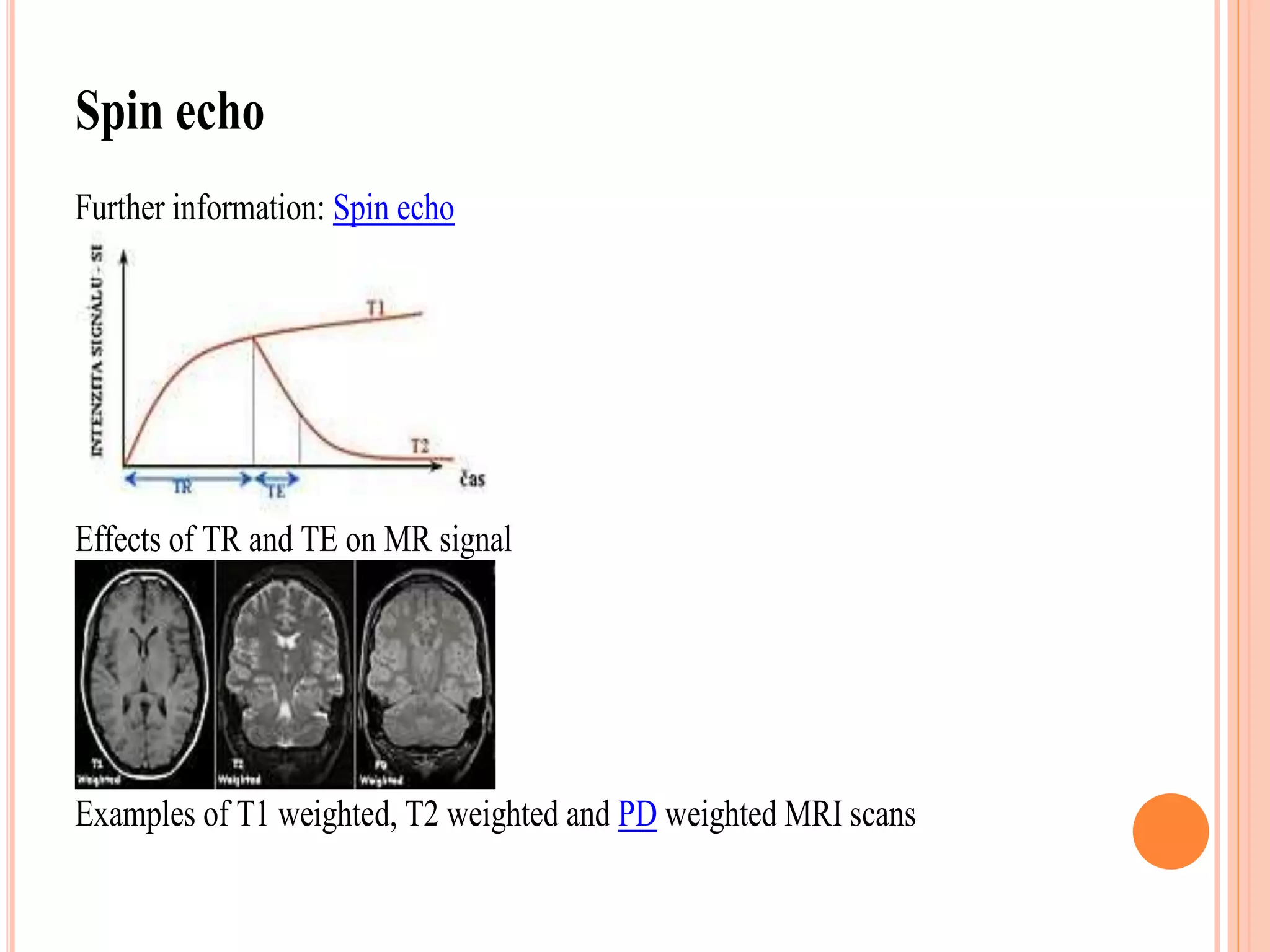
Spin echo
Further information:Spin echo
Effects of TR and TE on MR signal
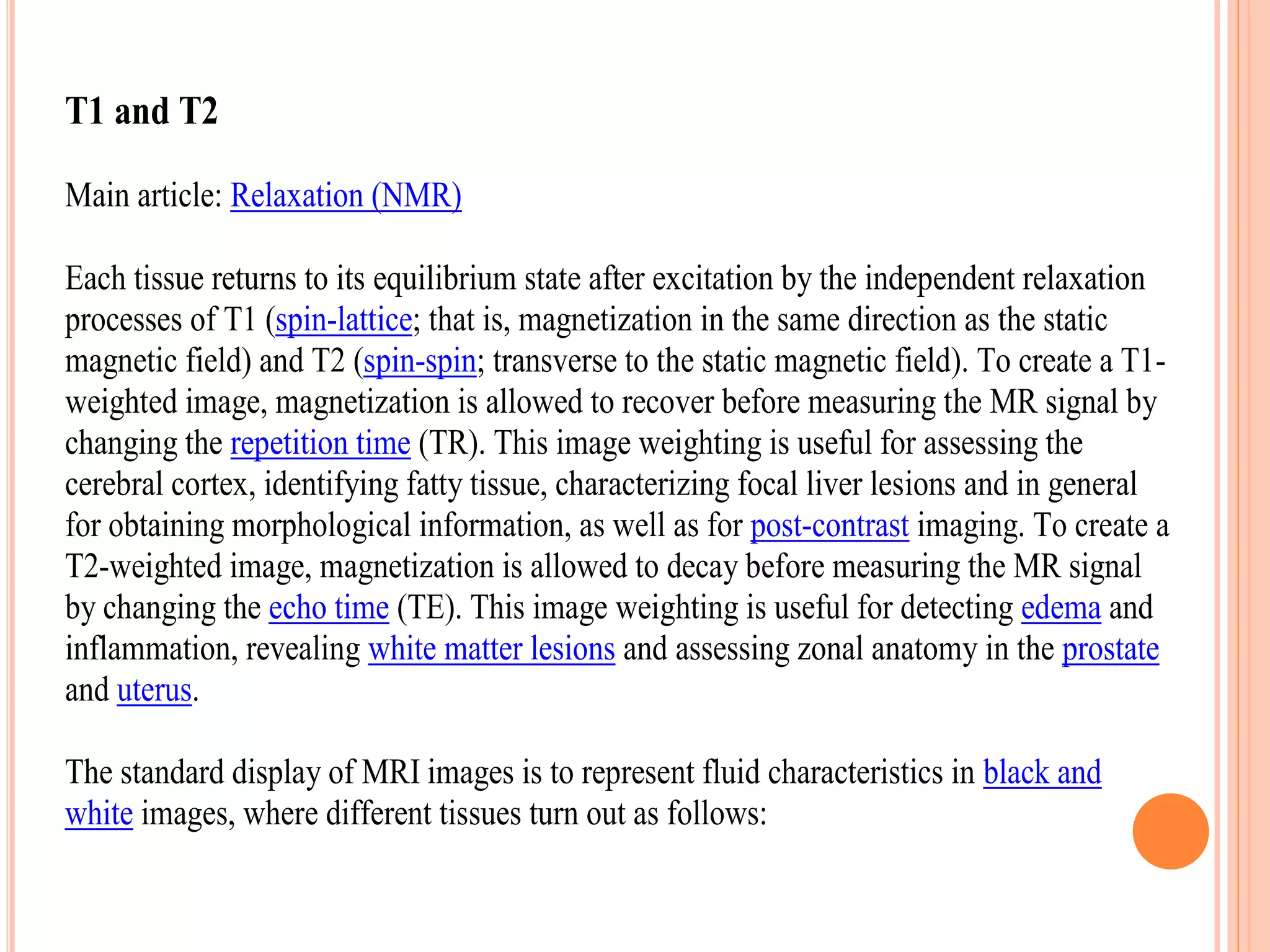
Examples of T1 weighted, T2 weighted and PD weighted MRI scans
11.
T1 and T2
Mainarticle: Relaxation (NMR)
Each tissue returns to its equilibrium state after excitation by the independent relaxation
processes of T1 (spin-lattice; that is, magnetization in the same direction as the static
magnetic field) and T2 (spin-spin; transverse to the static magnetic field). To create a T1-
weighted image, magnetization is allowed to recover before measuring the MR signal by
changing the repetition time (TR). This image weighting is useful for assessing the
cerebral cortex, identifying fatty tissue, characterizing focal liver lesions and in general
for obtaining morphological information, as well as for post-contrast imaging. To create a
T2-weighted image, magnetization is allowed to decay before measuring the MR signal
by changing the echo time (TE). This image weighting is useful for detecting edema and
inflammation, revealing white matter lesions and assessing zonal anatomy in the prostate
and uterus.
The standard display of MRI images is to represent fluid characteristics in black and
white images, where different tissues turn out as follows:
12.
Signal T1-weighted T2-weighted
High Fat[30][31]
Subacute hemorrhage[31]
Melanin[31]
Protein-rich fluid[31]
Slowly flowing blood[31]
Paramagnetic substances,
such as gadolinium,
manganese, copper[31]
Cortical pseudolaminar
necrosis[31]
More water content,[30]
as in
edema, tumor, infarction,
inflammation and infection[31]
Extracellularly located
methemoglobin in subacute
hemorrhage[31]
Inter-
mediate
Gray matter darker than white
matter[32]
White matter darker than grey
matter[32]
Low Bone[30]
Urine
CSF
Air[30]
More water content,[30]
as in
edema, tumor, infarction,
inflammation, infection,
hyperacute or chronic
hemorrhage[31]
Low proton density as in
calcification[31]
Bone[30]
Air[30]
Fat[30]
Low proton density, as in
calcification and fibrosis[31]
Paramagnetic material, such as
deoxyhemoglobin,
intracelullar methemoglobin,
iron, ferritin, hemosiderin,
melanin[31]
Protein-rich fluid[31]
13.
Proton density (PD)
Protondensity weighted image of a knee with synovial chondromatosis.
Proton density (PD) weighted images are created by having a long repetition time (TR)
and a short echo time (TE).[33]
On images of the brain, this sequence has a more
pronounced distinction between gray matter (bright) and white matter (darker gray), but
with little contrast between brain and CSF.[33]
It is very useful for the detection of joint
disease and injury.[34]
14.
Gradient echo (GRE)
Gradientecho sequence.[35]
A gradient echo sequence is the base of many important derived sequences such as echo-
planar imaging and SSFP stationary sequences. It allows to obtain very short repetition
times (TR), and therefore to acquire images in a short time.
The gradient echo sequence is characterized by a single excitation followed by a gradient
applied along the reading axis called the dephasing gradient. This gradient modifies the
spin phase in a spatially dependent manner, so that at the end of the gradient the signal
will be completely canceled because the coherence between the spins will be completely
destroyed.
At this point the reading gradient of opposite polarity is applied, so as to compensate for
the effect of the disparity gradient. When the area of the reading gradient is equal to that
of the mismatching gradient, the spins will have a coherent new phase (except for the
effects of T2* relaxation), and therefore a signal will be detectable again. This signal
takes the name of echo or more specifically of gradient echo signal, because it is
produced by rephasing due to a gradient (unlike the spin echo signal whose rephasing is
due to a radiofrequency pulse).
The sequences of the gradient echo type allow to achieve very short repetition times, as
the acquisition of an echo corresponds to the acquisition of a k-space line, and this
acquisition can be made quick by increasing the amplitude of the gradients of rephasing
and reading. A sequence of the spin echo type must instead wait for the exhaustion of the
signal that is formed spontaneously after the application of the excitation impulse before
it can produce an echo (free induction decay).
For comparison purposes, the repetition time of a gradient echo sequence is of the order
of 3 milliseconds, versus about 30 ms of a spin echo sequence.
15.
Spoiling
At the endof the reading, the residual transverse magnetization can be terminated (through the
application of suitable gradients and the excitation through pulses with a variable phase
radiofrequency) or maintained.
In the first case there is a spoiled sequence, such as the FLASH (Fast Low-Angle Shot) sequence,
while in the second case there are SSFP (Steady-State Free Precession) sequences.
Steady-state free precession (SSFP)
Main article: Steady-state free precession imaging
Steady-state free precession imaging (SSFP MRI) is an MRI technique which uses steady states
of magnetizations. In general, SSFP MRI sequences are based on a (low flip angle) gradient-echo
MRI sequence with a short repetition time which in its generic form has been described as the
FLASH MRI technique. While spoiled gradient-echo sequences refer to a steady state of the
longitudinal magnetization only, SSFP gradient-echo sequences include transverse coherences
(magnetizations) from overlapping multi-order spin echoes and stimulated echoes. This is usually
accomplished by refocusing the phase-encoding gradient in each repetition interval in order to
keep the phase integral (or gradient moment) constant. Fully balanced SSFP MRI sequences
achieve a phase of zero by refocusing all imaging gradients.
New methods and variants of existing methods are often published when they are able to produce
better results in specific fields. Examples of these recent improvements are T*
2-weighted turbo spin-echo (T2 TSE MRI), double inversion recovery MRI (DIR-MRI) or phase-
sensitive inversion recovery MRI (PSIR-MRI), all of them able to improve imaging of brain
lesions.[36][37]
Another example is MP-RAGE (magnetization-prepared rapid acquisition with
gradient echo),[38]
which improves images of multiple sclerosis cortical lesions.[39]
In-phase and out-of-phase (IP and OOP)
In-phase (IP) and out-of-phase (OOP) sequences correspond to paired gradient echo sequences
using the same repetition time (TR) but with two different echo times (TE).[40]
This can detect
even microscopic amounts of fat, which has a drop in signal on OOP compared to IP. Among
renal tumors that do not show macroscopic fat, such a signal drop is seen in 80% of the clear cell
type of renal cell carcinoma as well as in minimal fat angiomyolipoma.[41]
Effective T2 (T2* or "T2-star")
Main article: T2*-weighted imaging
T2*-weighted imaging can be created as a postexcitation refocused gradient echo sequence with
small flip angle. The sequence of a GRE T2*WI requires high uniformity of the magnetic field.[9]
16.
Commercial names ofgradient echo sequences
Academic
Classification
Spoiled gradient echo Steady-State Free
Precession (SSFP)
Balanced
Steady-State
Free
Precession
(bSSFP)
Ordinary
type
Turbo type
(Magnetization
preparation,
extremely low
angle shot, short
TR)
FID-like Echo-like
Siemens FLASH
Fast
Imaging
using Low
Angle Shot
TurboFLASH
Turbo FLASH
FISP
Fast Imaging
with Steady-
state
Precession
PSIF
Reversed
FISP
TrueFISP
True FISP
GE SPGR
Spoiled
GRASS
FastSPGR
Fast SPGR
GRASS
Gradient
Recall
Acquisition
using Steady
States
SSFP
Steady State
Free
Precession
FIESTA
Fast Imaging
Employing
Steady-state
Acquisition
Philips T1 FFE
T1-weighted
Fast Field
Echo
TFE
Turbo Field Echo
FFE
Fast Field
Echo
T2-FFE
T2-weighted
Fast Field
Echo
b-FFE
Balanced Fast
Field Echo
17.
Inversion recovery
Fluid-attenuated inversionrecovery (FLAIR)
Main article: Fluid attenuated inversion recovery
Fluid-attenuated inversion recovery (FLAIR)[42]
is an inversion-recovery pulse sequence
used to nullify the signal from fluids. For example, it can be used in brain imaging to
suppress cerebrospinal fluid so as to bring out periventricular hyperintense lesions, such
as multiple sclerosis plaques. By carefully choosing the inversion time TI (the time
between the inversion and excitation pulses), the signal from any particular tissue can be
suppressed.
Turbo inversion recovery magnitude (TIRM)
Turbo inversion recovery magnitude (TIRM) measures only the magnitude of a turbo
spin echo after a preceding inversion pulse, thus is phase insensitive.[43]
TIRM is superior in the assessment of osteomyelitis and in suspected head and neck
cancer.[44][45]
Osteomyelitis appears as high intensity areas.[46]
In head and neck cancers,
TIRM has been found to both give high signal in tumor mass, as well as low degree of
overestimation of tumor size by reactive inflammatory changes in the surrounding
tissues.[47]
18.
Diffusion weighted (DWI)
Mainarticle: Diffusion MRI
DTI image
Diffusion MRI measures the diffusion of water molecules in biological tissues.[48]
Clinically, diffusion MRI is useful for the diagnoses of conditions (e.g., stroke) or
neurological disorders (e.g., multiple sclerosis), and helps better understand the
connectivity of white matter axons in the central nervous system.[49]
In an isotropic
medium (inside a glass of water for example), water molecules naturally move randomly
according to turbulence and Brownian motion. In biological tissues however, where the
Reynolds number is low enough for laminar flow, the diffusion may be anisotropic. For
example, a molecule inside the axon of a neuron has a low probability of crossing the
myelin membrane. Therefore, the molecule moves principally along the axis of the neural
fiber. If it is known that molecules in a particular voxel diffuse principally in one
direction, the assumption can be made that the majority of the fibers in this area are
parallel to that direction.
The recent development of diffusion tensor imaging (DTI)[50]
enables diffusion to be
measured in multiple directions, and the fractional anisotropy in each direction to be
calculated for each voxel. This enables researchers to make brain maps of fiber directions
to examine the connectivity of different regions in the brain (using tractography) or to
examine areas of neural degeneration and demyelination in diseases like multiple
sclerosis.
Another application of diffusion MRI is diffusion-weighted imaging (DWI). Following
an ischemic stroke, DWI is highly sensitive to the changes occurring in the lesion.[51]
It is
speculated that increases in restriction (barriers) to water diffusion, as a result of
cytotoxic edema (cellular swelling), is responsible for the increase in signal on a DWI
scan. The DWI enhancement appears within 5–10 minutes of the onset of stroke
symptoms (as compared to computed tomography, which often does not detect changes
of acute infarct for up to 4–6 hours) and remains for up to two weeks. Coupled with
imaging of cerebral perfusion, researchers can highlight regions of "perfusion/diffusion
mismatch" that may indicate regions capable of salvage by reperfusion therapy.
19.
Perfusion weighted (PWI)
MRIperfusion showing a delayed time-to-maximum flow (Tmax) in the penumbra in a
case of occlusion of the left middle cerebral artery.
Main article: Perfusion MRI
Perfusion-weighted imaging (PWI) is performed by 3 main techniques:
Dynamic susceptibility contrast (DSC): Gadolinium contrast is injected, and rapid
repeated imaging (generally gradient-echo echo-planar T2 weighted) quantifies
susceptibility-induced signal loss.[52]
Dynamic contrast enhanced (DCE): Measuring shortening of the spin–lattice
relaxation (T1) induced by a gadolinium contrast bolus.[53]
Arterial spin labelling (ASL): Magnetic labeling of arterial blood below the
imaging slab, without the need of gadolinium contrast.[54]
The acquired data is then postprocessed to obtain perfusion maps with different
parameters, such as BV (blood volume), BF (blood flow), MTT (mean transit time) and
TTP (time to peak).
In cerebral infarction, the penumbra has decreased perfusion.[21]
Another MRI sequence,
diffusion weighted MRI, estimates the amount of tissue that is already necrotic, and the
combination of those sequences can therefore be used to estimate the amount of brain
tissue that is salvageable by thrombolysis and/or thrombectomy.
20.
Functional (fMRI)
Main article:Functional magnetic resonance imaging
A fMRI scan showing regions of activation in orange, including the primary visual cortex
(V1, BA17)
Functional MRI (fMRI) measures signal changes in the brain that are due to changing
neural activity. It is used to understand how different parts of the brain respond to
external stimuli or passive activity in a resting state, and has applications in behavioral
and cognitive research, and in planning neurosurgery of eloquent brain areas.[55][56]
Researchers use statistical methods to construct a 3-D parametric map of the brain
indicating the regions of the cortex that demonstrate a significant change in activity in
response to the task. Compared to anatomical T1W imaging, the brain is scanned at lower
spatial resolution but at a higher temporal resolution (typically once every 2–3 seconds).
Increases in neural activity cause changes in the MR signal via T*
2 changes;[57]
this mechanism is referred to as the BOLD (blood-oxygen-level dependent)
effect. Increased neural activity causes an increased demand for oxygen, and the vascular
system actually overcompensates for this, increasing the amount of oxygenated
hemoglobin relative to deoxygenated hemoglobin. Because deoxygenated hemoglobin
attenuates the MR signal, the vascular response leads to a signal increase that is related to
the neural activity. The precise nature of the relationship between neural activity and the
BOLD signal is a subject of current research. The BOLD effect also allows for the
generation of high resolution 3D maps of the venous vasculature within neural tissue.
While BOLD signal analysis is the most common method employed for neuroscience
studies in human subjects, the flexible nature of MR imaging provides means to sensitize
the signal to other aspects of the blood supply. Alternative techniques employ arterial
spin labeling (ASL) or weighting the MRI signal by cerebral blood flow (CBF) and
cerebral blood volume (CBV). The CBV method requires injection of a class of MRI
contrast agents that are now in human clinical trials. Because this method has been shown
to be far more sensitive than the BOLD technique in preclinical studies, it may
potentially expand the role of fMRI in clinical applications. The CBF method provides
more quantitative information than the BOLD signal, albeit at a significant loss of
detection sensitivity.[citation needed]
21.
Magnetic resonance angiography(MRA)
Time-of-flight MRA at the level of the Circle of Willis.
Main article: Magnetic resonance angiography
Magnetic resonance angiography (MRA) is a group of techniques based to image blood
vessels. Magnetic resonance angiography is used to generate images of arteries (and less
commonly veins) in order to evaluate them for stenosis (abnormal narrowing),
occlusions, aneurysms (vessel wall dilatations, at risk of rupture) or other abnormalities.
MRA is often used to evaluate the arteries of the neck and brain, the thoracic and
abdominal aorta, the renal arteries, and the legs (the latter exam is often referred to as a
"run-off").
Phase contrast (PC)
Main article: Phase contrast magnetic resonance imaging
Phase contrast MRI (PC-MRI) is used to measure flow velocities in the body. It is used
mainly to measure blood flow in the heart and throughout the body. PC-MRI may be
considered a method of magnetic resonance velocimetry. Since modern PC-MRI
typically is time-resolved, it also may be referred to as 4-D imaging (three spatial
dimensions plus time).[58]
22.
Susceptibility weighted imaging(SWI)
Main article: Susceptibility weighted imaging
Susceptibility weighted imaging (SWI) is a new type of contrast in MRI different from
spin density, T1, or T2 imaging. This method exploits the susceptibility differences
between tissues and uses a fully velocity compensated, three dimensional, RF spoiled,
high-resolution, 3D gradient echo scan. This special data acquisition and image
processing produces an enhanced contrast magnitude image very sensitive to venous
blood, hemorrhage and iron storage. It is used to enhance the detection and diagnosis of
tumors, vascular and neurovascular diseases (stroke and hemorrhage), multiple
sclerosis,[59]
Alzheimer's, and also detects traumatic brain injuries that may not be
diagnosed using other methods.[60]
Magnetization transfer (MT)
Main article: Magnetization transfer
Magnetization transfer (MT) is a technique to enhance image contrast in certain
applications of MRI.
Bound protons are associated with proteins and as they have a very short T2 decay they
do not normally contribute to image contrast. However, because these protons have a
broad resonance peak they can be excited by a radiofrequency pulse that has no effect on
free protons. Their excitation increases image contrast by transfer of saturated spins from
the bound pool into the free pool, thereby reducing the signal of free water. This
homonuclear magnetization transfer provides an indirect measurement of
macromolecular content in tissue. Implementation of homonuclear magnetization transfer
involves choosing suitable frequency offsets and pulse shapes to saturate the bound spins
sufficiently strongly, within the safety limits of specific absorption rate for MRI.[61]
The most common use of this technique is for suppression of background signal in time
of flight MR angiography.[62]
There are also applications in neuroimaging particularly in
the characterization of white matter lesions in multiple sclerosis.[63]
23.
Fast spin echo(FSE)
Fast spin echo (FSE), also called turbo spin echo (TSE) is a sequence that results in fast
scan times. In this sequence, several 180 refocusing radio-frequency pulses are delivered
during each echo time (TR) interval, and the phase-encoding gradient is briefly switched
on between echoes.[64]
Fat suppression
Fat suppression is useful for example to distinguish active inflammation in the intestines
from fat deposition such as can be caused by long-standing (but possibly inactive)
inflammatory bowel disease, but also obesity, chemotherapy and celiac disease.[65]
Techniques to suppress fat on MRI mainly include:[66]
Identifying fat by the chemical shift of its atoms, causing different time-dependent
phase shifts compared to water.
Frequency-selective saturation of the spektral peak of fat by a "fat sat" pulse
before imaging.
Short tau inversion recovery (STIR), a T1-dependent method
Spectral presaturation with inversion recovery (SPIR)
Neuromelanin imaging
This method exploits the paramagnetic properties of neuromelanin and can be used to
visualize the substantia nigra and the locus coeruleus. It is used to detect the atrophy of
these nuclei in Parkinson's disease and other parkinsonisms, and also detects signal
intensity changes in major depressive disorder and schizophrenia.[67]
24.
Uncommon and experimentalsequences
The following sequences are not commonly used clinically, and/or are at an experimental
stage.
T1 rho (T1ρ)
T1 rho (T1ρ) is an experimental MRI sequence that may be used in musculoskeletal
imaging. It does not yet have widespread use.[68]
Molecules have a kinetic energy that is a function of the temperature and is expressed as
translational and rotational motions, and by collisions between molecules. The moving
dipoles disturb the magnetic field but are often extremely rapid so that the average effect
over a long time-scale may be zero. However, depending on the time-scale, the
interactions between the dipoles do not always average away. At the slowest extreme the
interaction time is effectively infinite and occurs where there are large, stationary field
disturbances (e.g., a metallic implant). In this case the loss of coherence is described as a
"static dephasing". T2* is a measure of the loss of coherence in an ensemble of spins that
includes all interactions (including static dephasing). T2 is a measure of the loss of
coherence that excludes static dephasing, using an RF pulse to reverse the slowest types
of dipolar interaction. There is in fact a continuum of interaction time-scales in a given
biological sample, and the properties of the refocusing RF pulse can be tuned to refocus
more than just static dephasing. In general, the rate of decay of an ensemble of spins is a
function of the interaction times and also the power of the RF pulse. This type of decay,
occurring under the influence of RF, is known as T1ρ. It is similar to T2 decay but with
some slower dipolar interactions refocused, as well as static interactions, hence
T1ρ≥T2.[69]
Others
Saturation recovery sequences are rarely used, but can measure spin-lattice
relaxation time (T1) more quickly than an inversion recovery pulse sequence.[70]
Double-oscillating-diffusion-encoding (DODE) and double diffusion encoding
(DDE) imaging are specific forms of MRI diffusion imaging, which can be used
to measure diameters and lengths of axon pores.[71]
26.
Jones J, GaillardF. "MRI sequences (overview)". Radiopaedia. Retrieved 2017-10-15.
Marino MA, Helbich T, Baltzer P, Pinker-Domenig K (February 2018).
"Multiparametric MRI of the breast: A review". Journal of Magnetic Resonance Imaging.
47 (2): 301–315. doi:10.1002/jmri.25790. PMID 28639300.
"Magnetic Resonance Imaging". University of Wisconsin. Archived from the original
on 2017-05-10. Retrieved 2016-03-14.
Johnson KA. "Basic proton MR imaging. Tissue Signal Characteristics". Harvard
Medical School. Archived from the original on 2016-03-05. Retrieved 2016-03-14.
Graham D, Cloke P, Vosper M (2011-05-31). Principles and Applications of
Radiological Physics E-Book (6 ed.). Elsevier Health Sciences. p. 292. ISBN 978-0-7020-
4614-8.}
du Plessis V, Jones J. "MRI sequences (overview)". Radiopaedia. Retrieved 2017-
01-13.
Lefevre N, Naouri JF, Herman S, Gerometta A, Klouche S, Bohu Y (2016). "A
Current Review of the Meniscus Imaging: Proposition of a Useful Tool for Its Radiologic
Analysis". Radiology Research and Practice. 2016: 8329296.
doi:10.1155/2016/8329296. PMID 27057352.
Luijkx T, Weerakkody Y. "Steady-state free precession MRI". Radiopaedia. Retrieved
2017-10-13.
Chavhan GB, Babyn PS, Thomas B, Shroff MM, Haacke EM (2009). "Principles,
techniques, and applications of T2*-based MR imaging and its special applications".
Radiographics. 29 (5): 1433–49. doi:10.1148/rg.295095034. PMID 19755604.
Sharma R, Taghi Niknejad M. "Short tau inversion recovery". Radiopaedia.
Retrieved 2017-10-13.
Berger F, de Jonge M, Smithuis R, Maas M. "Stress fractures". Radiology Assistant.
Radiology Society of the Netherlands. Retrieved 2017-10-13.
Hacking C, Taghi Niknejad M, et al. "Fluid attenuation inversion recoveryg".
radiopaedia.org. Retrieved 2015-12-03.
Di Muzio B, Abd Rabou A. "Double inversion recovery sequence". Radiopaedia.
Retrieved 2017-10-13.
Lee M, Bashir U. "Diffusion weighted imaging". Radiopaedia. Retrieved 2017-10-
13.
Weerakkody Y, Gaillard F. "Ischaemic stroke". Radiopaedia. Retrieved 2017-10-15.
Hammer M. "MRI Physics: Diffusion-Weighted Imaging". XRayPhysics. Retrieved
2017-10-15.
An H, Ford AL, Vo K, Powers WJ, Lee JM, Lin W (May 2011). "Signal evolution
and infarction risk for apparent diffusion coefficient lesions in acute ischemic stroke are
both time- and perfusion-dependent". Stroke. 42 (5): 1276–81.
doi:10.1161/STROKEAHA.110.610501. PMID 21454821.
Smith D, Bashir U. "Diffusion tensor imaging". Radiopaedia. Retrieved 2017-10-13.
27.
ChuaTC, Wen W, Slavin MJ, Sachdev PS (February 2008). "Diffusion tensor
imaging in mild cognitive impairment and Alzheimer's disease: a review". Current
Opinion in Neurology. 21 (1): 83–92. doi:10.1097/WCO.0b013e3282f4594b.
PMID 18180656.
Gaillard F. "Dynamic susceptibility contrast (DSC) MR perfusion". Radiopaedia.
Retrieved 2017-10-14.
Chen F, Ni YC (March 2012). "Magnetic resonance diffusion-perfusion mismatch in
acute ischemic stroke: An update". World Journal of Radiology. 4 (3): 63–74.
doi:10.4329/wjr.v4.i3.63. PMID 22468186.
Gaillard F. "Dynamic contrast enhanced (DCE) MR perfusion". Radiopaedia.
Retrieved 2017-10-15.
"Arterial spin labeling". University of Michigan. Retrieved 2017-10-27.
Gaillard F. "Arterial spin labelling (ASL) MR perfusion". Radiopaedia. Retrieved
2017-10-15.
Chou I. "Milestone 19: (1990) Functional MRI". Nature. Retrieved 9 August 2013.
Luijkx T, Gaillard F. "Functional MRI". Radiopaedia. Retrieved 2017-10-16.
"Magnetic Resonance Angiography (MRA)". Johns Hopkins Hospital. Retrieved
2017-10-15.
Keshavamurthy J, Ballinger R et al. "Phase contrast imaging". Radiopaedia.
Retrieved 2017-10-15.
Di Muzio B, Gaillard F. "Susceptibility weighted imaging". Retrieved 2017-10-15.
"Magnetic Resonance Imaging". University of Wisconsin. Archived from the original
on 2017-05-10. Retrieved 2016-03-14.
Johnson KA. "Basic proton MR imaging. Tissue Signal Characteristics". Harvard
Medical School. Archived from the original on 2016-03-05. Retrieved 2016-03-14.
Patil T. "MRI sequences". Retrieved 2016-03-14.
"Structural MRI Imaging". UC San Diego School of Medicine. Retrieved 2017
28.
JonesJ, Gaillard F. "MRI sequences (overview)". Radiopaedia. Retrieved 2017-01-
13.
Gebker R, Schwitter J, Fleck E, Nagel E (2007). "How we perform myocardial
perfusion with cardiovascular magnetic resonance". Journal of Cardiovascular Magnetic
Resonance. 9 (3): 539–47. doi:10.1080/10976640600897286. PMID 17365233.
Wattjes MP, Lutterbey GG, Gieseke J, Träber F, Klotz L, Schmidt S, Schild HH
(January 2007). "Double inversion recovery brain imaging at 3T: diagnostic value in the
detection of multiple sclerosis lesions". AJNR. American Journal of Neuroradiology. 28
(1): 54–9. PMID 17213424.
Nelson F, Poonawalla AH, Hou P, Huang F, Wolinsky JS, Narayana PA (October
2007). "Improved identification of intracortical lesions in multiple sclerosis with phase-
sensitive inversion recovery in combination with fast double inversion recovery MR
imaging". AJNR. American Journal of Neuroradiology. 28 (9): 1645–9.
doi:10.3174/ajnr.A0645. PMID 17885241.
Nelson F, Poonawalla A, Hou P, Wolinsky JS, Narayana PA (November 2008). "3D
MPRAGE improves classification of cortical lesions in multiple sclerosis". Multiple
Sclerosis. 14 (9): 1214–9. doi:10.1177/1352458508094644. PMC 2650249.
PMID 18952832.
29.
Brant-ZawadzkiM, Gillan GD, Nitz WR (March 1992). "MP RAGE: a three-
dimensional, T1-weighted, gradient-echo sequence--initial experience in the brain".
Radiology. 182 (3): 769–75. doi:10.1148/radiology.182.3.1535892.
PMID 1535892.[permanent dead link]
Tatco V, Di Muzio B. "In-phase and out-of-phase sequences". Radiopaedia.
Retrieved 2017-10-24.
Reinhard R, van der Zon-Conijn M, Smithuis R. "Kidney - Solid masses". Radiology
Assistant. Retrieved 2017-10-27.
De Coene B, Hajnal JV, Gatehouse P, Longmore DB, White SJ, Oatridge A,
Pennock JM, Young IR, Bydder GM (1992). "MR of the brain using fluid-attenuated
inversion recovery (FLAIR) pulse sequences". AJNR. American Journal of
Neuroradiology. 13 (6): 1555–64. PMID 1332459.
Reiser MF, Semmler W, Hricak H (2007). "Chapter 2.4: Image Contrasts and
Imaging Sequences". Magnetic Resonance Tomography. Springer Science & Business
Media. p. 59. ISBN 978-3-540-29355-2.
Weerakkody Y. "Turbo inversion recovery magnitude". Radiopaedia. Retrieved
2017-10-21.
Hauer MP, Uhl M, Allmann KH, Laubenberger J, Zimmerhackl LB, Langer M
(November 1998). "Comparison of turbo inversion recovery magnitude (TIRM) with T2-
weighted turbo spin-echo and T1-weighted spin-echo MR imaging in the early diagnosis
of acute osteomyelitis in children". Pediatric Radiology. 28 (11): 846–50.
doi:10.1007/s002470050479. PMID 9799315.
30.
AiT. "Chronic osteomyelitis of the left femur". Clinical-MRI. Retrieved 2017-10-21.
Sadick M, Sadick H, Hörmann K, Düber C, Diehl SJ (August 2005). "Diagnostic
evaluation of magnetic resonance imaging with turbo inversion recovery sequence in
head and neck tumors". European Archives of Oto-Rhino-Laryngology. 262 (8): 634–9.
doi:10.1007/s00405-004-0878-x. PMID 15668813.
Le Bihan D, Breton E, Lallemand D, Grenier P, Cabanis E, Laval-Jeantet M
(November 1986). "MR imaging of intravoxel incoherent motions: application to
diffusion and perfusion in neurologic disorders". Radiology. 161 (2): 401–7.
doi:10.1148/radiology.161.2.3763909. PMID 3763909.
"Diffusion Inaging". Stanford University. Archived from the original on 24
December 2011. Retrieved 28 April 2012.
Filler A (2009). "The History, Development and Impact of Computed Imaging in
Neurological Diagnosis and Neurosurgery: CT, MRI, and DTI". Nature Precedings.
doi:10.1038/npre.2009.3267.5.
Moseley ME, Cohen Y, Mintorovitch J, Chileuitt L, Shimizu H, Kucharczyk J,
Wendland MF, Weinstein PR (May 1990). "Early detection of regional cerebral ischemia
in cats: comparison of diffusion- and T2-weighted MRI and spectroscopy". Magnetic
Resonance in Medicine. 14 (2): 330–46. doi:10.1002/mrm.1910140218. PMID 2345513.
Gaillard F. "Dynamic susceptibility contrast (DSC) MR perfusion". Radiopaedia.
Retrieved 2017-10-14.
31.
ProfFrank Gaillard; et al. "Dynamic contrast enhanced (DCE) MR perfusion".
Radiopaedia. Retrieved 2017-10-15.
Gaillard F. "Arterial spin labelling (ASL) MR perfusion". Radiopaedia. Retrieved
2017-10-15.
Heeger DJ, Ress D (February 2002). "What does fMRI tell us about neuronal
activity?". Nature Reviews. Neuroscience. 3 (2): 142–51. doi:10.1038/nrn730.
PMID 11836522.
Giussani C, Roux FE, Ojemann J, Sganzerla EP, Pirillo D, Papagno C (January
2010). "Is preoperative functional magnetic resonance imaging reliable for language
areas mapping in brain tumor surgery? Review of language functional magnetic
resonance imaging and direct cortical stimulation correlation studies". Neurosurgery. 66
(1): 113–20. doi:10.1227/01.NEU.0000360392.15450.C9. PMID 19935438.
Thulborn KR, Waterton JC, Matthews PM, Radda GK (February 1982).
"Oxygenation dependence of the transverse relaxation time of water protons in whole
blood at high field". Biochimica et Biophysica Acta. 714 (2): 265–70. doi:10.1016/0304-
4165(82)90333-6. PMID 6275909.
Stankovic Z, Allen BD, Garcia J, Jarvis KB, Markl M (April 2014). "4D flow
imaging with MRI". Cardiovascular Diagnosis and Therapy. 4 (2): 173–92.
doi:10.3978/j.issn.2223-3652.2014.01.02. PMID 24834414.
Wiggermann V, Hernández Torres E, Vavasour IM, Moore GR, Laule C, MacKay
AL, Li DK, Traboulsee A, Rauscher A (July 2013). "Magnetic resonance frequency shifts
during acute MS lesion formation". Neurology. 81 (3): 211–8.
doi:10.1212/WNL.0b013e31829bfd63. PMC 3770162. PMID 23761621.
Reichenbach JR, Venkatesan R, Schillinger DJ, Kido DK, Haacke EM (July 1997).
"Small vessels in the human brain: MR venography with deoxyhemoglobin as an intrinsic
contrast agent". Radiology. 204 (1): 272–7. doi:10.1148/radiology.204.1.9205259.
PMID 9205259.[permanent dead link]
32.
McRobbieDW (2007). MRI from picture to proton. Cambridge, UK ; New York:
Cambridge University Press. ISBN 978-0-521-68384-5.
Wheaton AJ, Miyazaki M (August 2012). "Non-contrast enhanced MR angiography:
physical principles". Journal of Magnetic Resonance Imaging. 36 (2): 286–304.
doi:10.1002/jmri.23641. PMID 22807222.
Filippi M, Rocca MA, De Stefano N, Enzinger C, Fisher E, Horsfield MA, Inglese M,
Pelletier D, Comi G (December 2011). "Magnetic resonance techniques in multiple
sclerosis: the present and the future". Archives of Neurology. 68 (12): 1514–20.
doi:10.1001/archneurol.2011.914. PMID 22159052.
Weishaupt D, Köchli VD, Marincek B (2008). "Chapter 8: Fast Pulse sequences".
How does MRI work?: An Introduction to the Physics and Function of Magnetic
Resonance Imaging (2nd ed.). Springer Science & Business Media. p. 64. ISBN 978-3-
540-37845-7.
Gore R, Smithuis R (2014-05-21). "Bowel wall thickening - CT-pattern - Type 4 -
Fat target sign". Radiology Assistant. Retrieved 2017-09-27.
Weishaupt D, Koechli VD, Marincek B (2008). "Chapter 9: Fast Suppression
Techniques". How does MRI work?: An Introduction to the Physics and Function of
Magnetic Resonance Imaging (2 ed.). Springer Science & Business Media. p. 70.
ISBN 978-3-540-37845-7.
33.
SasakiM, Shibata E, Tohyama K, Takahashi J, Otsuka K, Tsuchiya K, Takahashi S,
Ehara S, Terayama Y, Sakai A (July 2006). "Neuromelanin magnetic resonance imaging
of locus ceruleus and substantia nigra in Parkinson's disease". NeuroReport. 17 (11):
1215–8. doi:10.1097/01.wnr.0000227984.84927.a7. PMID 16837857.
Luijkx T, Morgan MA. "T1 rho". Radiopaedia. Retrieved 2017-10-15.
Borthakur A, Mellon E, Niyogi S, Witschey W, Kneeland JB, Reddy R (November
2006). "Sodium and T1rho MRI for molecular and diagnostic imaging of articular
cartilage". NMR in Biomedicine. 19 (7): 781–821. doi:10.1002/nbm.1102.
PMC 2896046. PMID 17075961.
Jones J, Ballinger JR. "Saturation recovery sequences". Radiopaedia. Retrieved
2017-10-15.
Andrada I, Ivana D, Noam S, Daniel A (2016). "Advanced diffusion MRI for
microstructure imaging". Frontiers in Physics. 4. doi:10.3389/conf.FPHY.2016.01.00001

![MRI sequence
From Wikipedia, the free encyclopedia
Jump to navigation Jump to search
Timing diagram for a spin echo type of pulse sequence.
An MRI sequence in magnetic resonance imaging (MRI) is a particular setting of pulse
sequences and pulsed field gradients, resulting in a particular image appearance.[1]
A multiparametric MRI is a combination of two or more sequences, and/or including
other specialized MRI configurations such as spectroscopy.[2]](https://image.slidesharecdn.com/mrisequences-190206143547/75/Mri-sequences-2-2048.jpg)

![Group Sequence Abbr. Physics Main clinical
distinctions
Example
Spin echo T1
weighted
T1 Measuring
spin–lattice
relaxation by
using a short
repetition
time (TR)
and echo
time (TE)
Lower
signal for
more water
content, [3]
as
in edema,
tumor,
infarction,
inflammatio
n, infection,
hyperacute
or chronic
hemorrhage
[4]
High signal
for fat[3][4]
High signal
for
paramagneti
c
substances,
such as MRI
contrast
agents[4]
Standard
foundation and
comparison for
other sequences
T2
weighted
T2 Measuring
spin–spin
relaxation by
using long
TR and TE
times
Higher
signal for
more water
content[3]
Low signal
for fat[3]
Low signal
for
paramagneti
c
substances[4]
Standard
foundation and
comparison for
other sequences](https://image.slidesharecdn.com/mrisequences-190206143547/75/Mri-sequences-4-2048.jpg)
![Proton
density
weighted
PD Long TR (to
reduce T1) and
short TE (to
minimize T2)[5]
Joint disease and
injury.[6]
High
signal from
meniscus
tears[7]
(pictured)
Gradient
echo
(GRE)
Steady-
state free
precession
SSFP Maintenance of
a steady,
residual
transverse
magnetisation
over successive
cycles.[8]
Creation of
cardiac MRI
videos
(pictured).[8]
Effective
T2
or "T2-
star"
T2* Postexcitation
refocused GRE
with small flip
angle.[9]
Low signal from
hemosiderin
deposits (pictured)
and
hemorrhages.[9]
Inversion
recovery
Short tau
inversion
recovery
STIR Fat suppression
by setting an
inversion time
where the signal
of fat is zero[10]
High signal in
edema, such as in
more severe stress
fracture[11]
Shin
splints pictured:](https://image.slidesharecdn.com/mrisequences-190206143547/75/Mri-sequences-5-2048.jpg)
![Fluid-
attenuated
inversion
recovery
FLAI
R
Fluid
suppression
by setting an
inversion
time that
nulls fluids
High signal in
lacunar infarction,
multiple sclerosis
(MS) plaques,
subarachnoid
haemorrhage and
meningitis
(pictured).[12]
Double
inversion
recovery
DIR Simultaneou
s
suppression
of
cerebrospina
l fluid and
white matter
by two
inversion
times[13]
High signal of
multiple sclerosis
plaques (pictured)[13]
Diffusio
n
weighted
(DWI)
Conventiona
l
DWI Measure of
Brownian
motion of
water
molecules[14]
High signal within
minutes of cerebral
infarction
(pictured).[15]
Apparent
diffusion
coefficient
ADC Reduced T2
weighting
by taking
multiple
conventional
DWI images
with
different
DWI
weighting,
and the
change
corresponds
to
diffusion[16]
Low signal minutes
after cerebral
infarction
(pictured)[17]
Diffusion
tensor
DTI Mainly
tractography
(pictured) by
an overall
greater
Brownian
motion of
Evaluating
white matter
deformation
by tumors[18]
Reduced
fractional
anisotropy](https://image.slidesharecdn.com/mrisequences-190206143547/75/Mri-sequences-6-2048.jpg)
![Diffusion
tensor
DTI Mainlytractography
(pictured)byanoverall
greaterBrownian
motionofwater
moleculesinthe
directionsofnerve
fibers[18]
Evaluatingwhite
matter
deformationby
tumors[18]
Reducedfractional
anisotropymay
indicate
dementia[19]](https://image.slidesharecdn.com/mrisequences-190206143547/75/Mri-sequences-7-2048.jpg)
![Perfusion
weighted
(PWI)
Dynamic
susceptibility
contrast
DSC Gadolinium
contrast is
injected, and
rapid repeated
imaging
(generally
gradient-echo
echo-planar T2
weighted)
quantifies
susceptibility-
induced signal
loss[20]
In cerebral
infarction, the
infarcted core
and the
penumbra have
decreased
perfusion
(pictured).[21]
Dynamic
contrast
enhanced
DCE Measuring
shortening of the
spin–lattice
relaxation (T1)
induced by a
gadolinium
contrast bolus[22]
Arterial spin
labelling
ASL Magnetic labeling
of arterial blood
below the
imaging slab,
which
subsequently
enters the region
of interest[23]
It
does not need
gadolinium
contrast.[24]](https://image.slidesharecdn.com/mrisequences-190206143547/75/Mri-sequences-8-2048.jpg)
![Functional
MRI (fMRI)
Blood-
oxygen-
level
dependent
imaging
BOLD Changes in
oxygen
saturation-
dependent
magnetism of
hemoglobin
reflects tissue
activity.[25]
Localizing
highly active
brain areas
before
surgery[26]
Magnetic
resonance
angiography
(MRA) and
venography
Time-of-
flight
TOF Blood entering
the imaged area
is not yet
magnetically
saturated, giving
it a much higher
signal when
using short echo
time and flow
compensation.
Detection of
aneurysm,
stenosis, or
dissection[27]
Phase-
contrast
magnetic
resonance
imaging
PC-
MRA
Two gradients
with equal
magnitude, but
opposite
direction, are
used to encode a
phase shift,
which is
proportional to
the velocity of
spins.[28]
Detection of
aneurysm,
stenosis, or
dissection
(pictured)[27]
(VIPR)
Susceptibility-weighted SWI Sensitive for
blood and
calcium, by a
fully flow
compensated,
long echo,
gradient recalled
echo (GRE)
pulse sequence
to exploit
magnetic
susceptibility
differences
between tissues
Detecting
small
amounts of
hemorrhage
(diffuse
axonal injury
pictured) or
calcium[29]](https://image.slidesharecdn.com/mrisequences-190206143547/75/Mri-sequences-9-2048.jpg)
![Signal T1-weighted T2-weighted
High Fat[30][31]
Subacute hemorrhage[31]
Melanin[31]
Protein-rich fluid[31]
Slowly flowing blood[31]
Paramagnetic substances,
such as gadolinium,
manganese, copper[31]
Cortical pseudolaminar
necrosis[31]
More water content,[30]
as in
edema, tumor, infarction,
inflammation and infection[31]
Extracellularly located
methemoglobin in subacute
hemorrhage[31]
Inter-
mediate
Gray matter darker than white
matter[32]
White matter darker than grey
matter[32]
Low Bone[30]
Urine
CSF
Air[30]
More water content,[30]
as in
edema, tumor, infarction,
inflammation, infection,
hyperacute or chronic
hemorrhage[31]
Low proton density as in
calcification[31]
Bone[30]
Air[30]
Fat[30]
Low proton density, as in
calcification and fibrosis[31]
Paramagnetic material, such as
deoxyhemoglobin,
intracelullar methemoglobin,
iron, ferritin, hemosiderin,
melanin[31]
Protein-rich fluid[31]](https://image.slidesharecdn.com/mrisequences-190206143547/75/Mri-sequences-12-2048.jpg)
![Proton density (PD)
Proton density weighted image of a knee with synovial chondromatosis.
Proton density (PD) weighted images are created by having a long repetition time (TR)
and a short echo time (TE).[33]
On images of the brain, this sequence has a more
pronounced distinction between gray matter (bright) and white matter (darker gray), but
with little contrast between brain and CSF.[33]
It is very useful for the detection of joint
disease and injury.[34]](https://image.slidesharecdn.com/mrisequences-190206143547/75/Mri-sequences-13-2048.jpg)
![Gradient echo (GRE)
Gradient echo sequence.[35]
A gradient echo sequence is the base of many important derived sequences such as echo-
planar imaging and SSFP stationary sequences. It allows to obtain very short repetition
times (TR), and therefore to acquire images in a short time.
The gradient echo sequence is characterized by a single excitation followed by a gradient
applied along the reading axis called the dephasing gradient. This gradient modifies the
spin phase in a spatially dependent manner, so that at the end of the gradient the signal
will be completely canceled because the coherence between the spins will be completely
destroyed.
At this point the reading gradient of opposite polarity is applied, so as to compensate for
the effect of the disparity gradient. When the area of the reading gradient is equal to that
of the mismatching gradient, the spins will have a coherent new phase (except for the
effects of T2* relaxation), and therefore a signal will be detectable again. This signal
takes the name of echo or more specifically of gradient echo signal, because it is
produced by rephasing due to a gradient (unlike the spin echo signal whose rephasing is
due to a radiofrequency pulse).
The sequences of the gradient echo type allow to achieve very short repetition times, as
the acquisition of an echo corresponds to the acquisition of a k-space line, and this
acquisition can be made quick by increasing the amplitude of the gradients of rephasing
and reading. A sequence of the spin echo type must instead wait for the exhaustion of the
signal that is formed spontaneously after the application of the excitation impulse before
it can produce an echo (free induction decay).
For comparison purposes, the repetition time of a gradient echo sequence is of the order
of 3 milliseconds, versus about 30 ms of a spin echo sequence.](https://image.slidesharecdn.com/mrisequences-190206143547/75/Mri-sequences-14-2048.jpg)
![Spoiling
At the end of the reading, the residual transverse magnetization can be terminated (through the
application of suitable gradients and the excitation through pulses with a variable phase
radiofrequency) or maintained.
In the first case there is a spoiled sequence, such as the FLASH (Fast Low-Angle Shot) sequence,
while in the second case there are SSFP (Steady-State Free Precession) sequences.
Steady-state free precession (SSFP)
Main article: Steady-state free precession imaging
Steady-state free precession imaging (SSFP MRI) is an MRI technique which uses steady states
of magnetizations. In general, SSFP MRI sequences are based on a (low flip angle) gradient-echo
MRI sequence with a short repetition time which in its generic form has been described as the
FLASH MRI technique. While spoiled gradient-echo sequences refer to a steady state of the
longitudinal magnetization only, SSFP gradient-echo sequences include transverse coherences
(magnetizations) from overlapping multi-order spin echoes and stimulated echoes. This is usually
accomplished by refocusing the phase-encoding gradient in each repetition interval in order to
keep the phase integral (or gradient moment) constant. Fully balanced SSFP MRI sequences
achieve a phase of zero by refocusing all imaging gradients.
New methods and variants of existing methods are often published when they are able to produce
better results in specific fields. Examples of these recent improvements are T*
2-weighted turbo spin-echo (T2 TSE MRI), double inversion recovery MRI (DIR-MRI) or phase-
sensitive inversion recovery MRI (PSIR-MRI), all of them able to improve imaging of brain
lesions.[36][37]
Another example is MP-RAGE (magnetization-prepared rapid acquisition with
gradient echo),[38]
which improves images of multiple sclerosis cortical lesions.[39]
In-phase and out-of-phase (IP and OOP)
In-phase (IP) and out-of-phase (OOP) sequences correspond to paired gradient echo sequences
using the same repetition time (TR) but with two different echo times (TE).[40]
This can detect
even microscopic amounts of fat, which has a drop in signal on OOP compared to IP. Among
renal tumors that do not show macroscopic fat, such a signal drop is seen in 80% of the clear cell
type of renal cell carcinoma as well as in minimal fat angiomyolipoma.[41]
Effective T2 (T2* or "T2-star")
Main article: T2*-weighted imaging
T2*-weighted imaging can be created as a postexcitation refocused gradient echo sequence with
small flip angle. The sequence of a GRE T2*WI requires high uniformity of the magnetic field.[9]](https://image.slidesharecdn.com/mrisequences-190206143547/75/Mri-sequences-15-2048.jpg)

![Inversion recovery
Fluid-attenuated inversion recovery (FLAIR)
Main article: Fluid attenuated inversion recovery
Fluid-attenuated inversion recovery (FLAIR)[42]
is an inversion-recovery pulse sequence
used to nullify the signal from fluids. For example, it can be used in brain imaging to
suppress cerebrospinal fluid so as to bring out periventricular hyperintense lesions, such
as multiple sclerosis plaques. By carefully choosing the inversion time TI (the time
between the inversion and excitation pulses), the signal from any particular tissue can be
suppressed.
Turbo inversion recovery magnitude (TIRM)
Turbo inversion recovery magnitude (TIRM) measures only the magnitude of a turbo
spin echo after a preceding inversion pulse, thus is phase insensitive.[43]
TIRM is superior in the assessment of osteomyelitis and in suspected head and neck
cancer.[44][45]
Osteomyelitis appears as high intensity areas.[46]
In head and neck cancers,
TIRM has been found to both give high signal in tumor mass, as well as low degree of
overestimation of tumor size by reactive inflammatory changes in the surrounding
tissues.[47]](https://image.slidesharecdn.com/mrisequences-190206143547/75/Mri-sequences-17-2048.jpg)
![Diffusion weighted (DWI)
Main article: Diffusion MRI
DTI image
Diffusion MRI measures the diffusion of water molecules in biological tissues.[48]
Clinically, diffusion MRI is useful for the diagnoses of conditions (e.g., stroke) or
neurological disorders (e.g., multiple sclerosis), and helps better understand the
connectivity of white matter axons in the central nervous system.[49]
In an isotropic
medium (inside a glass of water for example), water molecules naturally move randomly
according to turbulence and Brownian motion. In biological tissues however, where the
Reynolds number is low enough for laminar flow, the diffusion may be anisotropic. For
example, a molecule inside the axon of a neuron has a low probability of crossing the
myelin membrane. Therefore, the molecule moves principally along the axis of the neural
fiber. If it is known that molecules in a particular voxel diffuse principally in one
direction, the assumption can be made that the majority of the fibers in this area are
parallel to that direction.
The recent development of diffusion tensor imaging (DTI)[50]
enables diffusion to be
measured in multiple directions, and the fractional anisotropy in each direction to be
calculated for each voxel. This enables researchers to make brain maps of fiber directions
to examine the connectivity of different regions in the brain (using tractography) or to
examine areas of neural degeneration and demyelination in diseases like multiple
sclerosis.
Another application of diffusion MRI is diffusion-weighted imaging (DWI). Following
an ischemic stroke, DWI is highly sensitive to the changes occurring in the lesion.[51]
It is
speculated that increases in restriction (barriers) to water diffusion, as a result of
cytotoxic edema (cellular swelling), is responsible for the increase in signal on a DWI
scan. The DWI enhancement appears within 5–10 minutes of the onset of stroke
symptoms (as compared to computed tomography, which often does not detect changes
of acute infarct for up to 4–6 hours) and remains for up to two weeks. Coupled with
imaging of cerebral perfusion, researchers can highlight regions of "perfusion/diffusion
mismatch" that may indicate regions capable of salvage by reperfusion therapy.](https://image.slidesharecdn.com/mrisequences-190206143547/75/Mri-sequences-18-2048.jpg)
![Perfusion weighted (PWI)
MRI perfusion showing a delayed time-to-maximum flow (Tmax) in the penumbra in a
case of occlusion of the left middle cerebral artery.
Main article: Perfusion MRI
Perfusion-weighted imaging (PWI) is performed by 3 main techniques:
Dynamic susceptibility contrast (DSC): Gadolinium contrast is injected, and rapid
repeated imaging (generally gradient-echo echo-planar T2 weighted) quantifies
susceptibility-induced signal loss.[52]
Dynamic contrast enhanced (DCE): Measuring shortening of the spin–lattice
relaxation (T1) induced by a gadolinium contrast bolus.[53]
Arterial spin labelling (ASL): Magnetic labeling of arterial blood below the
imaging slab, without the need of gadolinium contrast.[54]
The acquired data is then postprocessed to obtain perfusion maps with different
parameters, such as BV (blood volume), BF (blood flow), MTT (mean transit time) and
TTP (time to peak).
In cerebral infarction, the penumbra has decreased perfusion.[21]
Another MRI sequence,
diffusion weighted MRI, estimates the amount of tissue that is already necrotic, and the
combination of those sequences can therefore be used to estimate the amount of brain
tissue that is salvageable by thrombolysis and/or thrombectomy.](https://image.slidesharecdn.com/mrisequences-190206143547/75/Mri-sequences-19-2048.jpg)
![Functional (fMRI)
Main article: Functional magnetic resonance imaging
A fMRI scan showing regions of activation in orange, including the primary visual cortex
(V1, BA17)
Functional MRI (fMRI) measures signal changes in the brain that are due to changing
neural activity. It is used to understand how different parts of the brain respond to
external stimuli or passive activity in a resting state, and has applications in behavioral
and cognitive research, and in planning neurosurgery of eloquent brain areas.[55][56]
Researchers use statistical methods to construct a 3-D parametric map of the brain
indicating the regions of the cortex that demonstrate a significant change in activity in
response to the task. Compared to anatomical T1W imaging, the brain is scanned at lower
spatial resolution but at a higher temporal resolution (typically once every 2–3 seconds).
Increases in neural activity cause changes in the MR signal via T*
2 changes;[57]
this mechanism is referred to as the BOLD (blood-oxygen-level dependent)
effect. Increased neural activity causes an increased demand for oxygen, and the vascular
system actually overcompensates for this, increasing the amount of oxygenated
hemoglobin relative to deoxygenated hemoglobin. Because deoxygenated hemoglobin
attenuates the MR signal, the vascular response leads to a signal increase that is related to
the neural activity. The precise nature of the relationship between neural activity and the
BOLD signal is a subject of current research. The BOLD effect also allows for the
generation of high resolution 3D maps of the venous vasculature within neural tissue.
While BOLD signal analysis is the most common method employed for neuroscience
studies in human subjects, the flexible nature of MR imaging provides means to sensitize
the signal to other aspects of the blood supply. Alternative techniques employ arterial
spin labeling (ASL) or weighting the MRI signal by cerebral blood flow (CBF) and
cerebral blood volume (CBV). The CBV method requires injection of a class of MRI
contrast agents that are now in human clinical trials. Because this method has been shown
to be far more sensitive than the BOLD technique in preclinical studies, it may
potentially expand the role of fMRI in clinical applications. The CBF method provides
more quantitative information than the BOLD signal, albeit at a significant loss of
detection sensitivity.[citation needed]](https://image.slidesharecdn.com/mrisequences-190206143547/75/Mri-sequences-20-2048.jpg)
![Magnetic resonance angiography (MRA)
Time-of-flight MRA at the level of the Circle of Willis.
Main article: Magnetic resonance angiography
Magnetic resonance angiography (MRA) is a group of techniques based to image blood
vessels. Magnetic resonance angiography is used to generate images of arteries (and less
commonly veins) in order to evaluate them for stenosis (abnormal narrowing),
occlusions, aneurysms (vessel wall dilatations, at risk of rupture) or other abnormalities.
MRA is often used to evaluate the arteries of the neck and brain, the thoracic and
abdominal aorta, the renal arteries, and the legs (the latter exam is often referred to as a
"run-off").
Phase contrast (PC)
Main article: Phase contrast magnetic resonance imaging
Phase contrast MRI (PC-MRI) is used to measure flow velocities in the body. It is used
mainly to measure blood flow in the heart and throughout the body. PC-MRI may be
considered a method of magnetic resonance velocimetry. Since modern PC-MRI
typically is time-resolved, it also may be referred to as 4-D imaging (three spatial
dimensions plus time).[58]](https://image.slidesharecdn.com/mrisequences-190206143547/75/Mri-sequences-21-2048.jpg)
![Susceptibility weighted imaging (SWI)
Main article: Susceptibility weighted imaging
Susceptibility weighted imaging (SWI) is a new type of contrast in MRI different from
spin density, T1, or T2 imaging. This method exploits the susceptibility differences
between tissues and uses a fully velocity compensated, three dimensional, RF spoiled,
high-resolution, 3D gradient echo scan. This special data acquisition and image
processing produces an enhanced contrast magnitude image very sensitive to venous
blood, hemorrhage and iron storage. It is used to enhance the detection and diagnosis of
tumors, vascular and neurovascular diseases (stroke and hemorrhage), multiple
sclerosis,[59]
Alzheimer's, and also detects traumatic brain injuries that may not be
diagnosed using other methods.[60]
Magnetization transfer (MT)
Main article: Magnetization transfer
Magnetization transfer (MT) is a technique to enhance image contrast in certain
applications of MRI.
Bound protons are associated with proteins and as they have a very short T2 decay they
do not normally contribute to image contrast. However, because these protons have a
broad resonance peak they can be excited by a radiofrequency pulse that has no effect on
free protons. Their excitation increases image contrast by transfer of saturated spins from
the bound pool into the free pool, thereby reducing the signal of free water. This
homonuclear magnetization transfer provides an indirect measurement of
macromolecular content in tissue. Implementation of homonuclear magnetization transfer
involves choosing suitable frequency offsets and pulse shapes to saturate the bound spins
sufficiently strongly, within the safety limits of specific absorption rate for MRI.[61]
The most common use of this technique is for suppression of background signal in time
of flight MR angiography.[62]
There are also applications in neuroimaging particularly in
the characterization of white matter lesions in multiple sclerosis.[63]](https://image.slidesharecdn.com/mrisequences-190206143547/75/Mri-sequences-22-2048.jpg)
![Fast spin echo (FSE)
Fast spin echo (FSE), also called turbo spin echo (TSE) is a sequence that results in fast
scan times. In this sequence, several 180 refocusing radio-frequency pulses are delivered
during each echo time (TR) interval, and the phase-encoding gradient is briefly switched
on between echoes.[64]
Fat suppression
Fat suppression is useful for example to distinguish active inflammation in the intestines
from fat deposition such as can be caused by long-standing (but possibly inactive)
inflammatory bowel disease, but also obesity, chemotherapy and celiac disease.[65]
Techniques to suppress fat on MRI mainly include:[66]
Identifying fat by the chemical shift of its atoms, causing different time-dependent
phase shifts compared to water.
Frequency-selective saturation of the spektral peak of fat by a "fat sat" pulse
before imaging.
Short tau inversion recovery (STIR), a T1-dependent method
Spectral presaturation with inversion recovery (SPIR)
Neuromelanin imaging
This method exploits the paramagnetic properties of neuromelanin and can be used to
visualize the substantia nigra and the locus coeruleus. It is used to detect the atrophy of
these nuclei in Parkinson's disease and other parkinsonisms, and also detects signal
intensity changes in major depressive disorder and schizophrenia.[67]](https://image.slidesharecdn.com/mrisequences-190206143547/75/Mri-sequences-23-2048.jpg)
![Uncommon and experimental sequences
The following sequences are not commonly used clinically, and/or are at an experimental
stage.
T1 rho (T1ρ)
T1 rho (T1ρ) is an experimental MRI sequence that may be used in musculoskeletal
imaging. It does not yet have widespread use.[68]
Molecules have a kinetic energy that is a function of the temperature and is expressed as
translational and rotational motions, and by collisions between molecules. The moving
dipoles disturb the magnetic field but are often extremely rapid so that the average effect
over a long time-scale may be zero. However, depending on the time-scale, the
interactions between the dipoles do not always average away. At the slowest extreme the
interaction time is effectively infinite and occurs where there are large, stationary field
disturbances (e.g., a metallic implant). In this case the loss of coherence is described as a
"static dephasing". T2* is a measure of the loss of coherence in an ensemble of spins that
includes all interactions (including static dephasing). T2 is a measure of the loss of
coherence that excludes static dephasing, using an RF pulse to reverse the slowest types
of dipolar interaction. There is in fact a continuum of interaction time-scales in a given
biological sample, and the properties of the refocusing RF pulse can be tuned to refocus
more than just static dephasing. In general, the rate of decay of an ensemble of spins is a
function of the interaction times and also the power of the RF pulse. This type of decay,
occurring under the influence of RF, is known as T1ρ. It is similar to T2 decay but with
some slower dipolar interactions refocused, as well as static interactions, hence
T1ρ≥T2.[69]
Others
Saturation recovery sequences are rarely used, but can measure spin-lattice
relaxation time (T1) more quickly than an inversion recovery pulse sequence.[70]
Double-oscillating-diffusion-encoding (DODE) and double diffusion encoding
(DDE) imaging are specific forms of MRI diffusion imaging, which can be used
to measure diameters and lengths of axon pores.[71]](https://image.slidesharecdn.com/mrisequences-190206143547/75/Mri-sequences-24-2048.jpg)


![ Brant-Zawadzki M, Gillan GD, Nitz WR (March 1992). "MP RAGE: a three-
dimensional, T1-weighted, gradient-echo sequence--initial experience in the brain".
Radiology. 182 (3): 769–75. doi:10.1148/radiology.182.3.1535892.
PMID 1535892.[permanent dead link]
Tatco V, Di Muzio B. "In-phase and out-of-phase sequences". Radiopaedia.
Retrieved 2017-10-24.
Reinhard R, van der Zon-Conijn M, Smithuis R. "Kidney - Solid masses". Radiology
Assistant. Retrieved 2017-10-27.
De Coene B, Hajnal JV, Gatehouse P, Longmore DB, White SJ, Oatridge A,
Pennock JM, Young IR, Bydder GM (1992). "MR of the brain using fluid-attenuated
inversion recovery (FLAIR) pulse sequences". AJNR. American Journal of
Neuroradiology. 13 (6): 1555–64. PMID 1332459.
Reiser MF, Semmler W, Hricak H (2007). "Chapter 2.4: Image Contrasts and
Imaging Sequences". Magnetic Resonance Tomography. Springer Science & Business
Media. p. 59. ISBN 978-3-540-29355-2.
Weerakkody Y. "Turbo inversion recovery magnitude". Radiopaedia. Retrieved
2017-10-21.
Hauer MP, Uhl M, Allmann KH, Laubenberger J, Zimmerhackl LB, Langer M
(November 1998). "Comparison of turbo inversion recovery magnitude (TIRM) with T2-
weighted turbo spin-echo and T1-weighted spin-echo MR imaging in the early diagnosis
of acute osteomyelitis in children". Pediatric Radiology. 28 (11): 846–50.
doi:10.1007/s002470050479. PMID 9799315.](https://image.slidesharecdn.com/mrisequences-190206143547/75/Mri-sequences-29-2048.jpg)
![ Prof Frank Gaillard; et al. "Dynamic contrast enhanced (DCE) MR perfusion".
Radiopaedia. Retrieved 2017-10-15.
Gaillard F. "Arterial spin labelling (ASL) MR perfusion". Radiopaedia. Retrieved
2017-10-15.
Heeger DJ, Ress D (February 2002). "What does fMRI tell us about neuronal
activity?". Nature Reviews. Neuroscience. 3 (2): 142–51. doi:10.1038/nrn730.
PMID 11836522.
Giussani C, Roux FE, Ojemann J, Sganzerla EP, Pirillo D, Papagno C (January
2010). "Is preoperative functional magnetic resonance imaging reliable for language
areas mapping in brain tumor surgery? Review of language functional magnetic
resonance imaging and direct cortical stimulation correlation studies". Neurosurgery. 66
(1): 113–20. doi:10.1227/01.NEU.0000360392.15450.C9. PMID 19935438.
Thulborn KR, Waterton JC, Matthews PM, Radda GK (February 1982).
"Oxygenation dependence of the transverse relaxation time of water protons in whole
blood at high field". Biochimica et Biophysica Acta. 714 (2): 265–70. doi:10.1016/0304-
4165(82)90333-6. PMID 6275909.
Stankovic Z, Allen BD, Garcia J, Jarvis KB, Markl M (April 2014). "4D flow
imaging with MRI". Cardiovascular Diagnosis and Therapy. 4 (2): 173–92.
doi:10.3978/j.issn.2223-3652.2014.01.02. PMID 24834414.
Wiggermann V, Hernández Torres E, Vavasour IM, Moore GR, Laule C, MacKay
AL, Li DK, Traboulsee A, Rauscher A (July 2013). "Magnetic resonance frequency shifts
during acute MS lesion formation". Neurology. 81 (3): 211–8.
doi:10.1212/WNL.0b013e31829bfd63. PMC 3770162. PMID 23761621.
Reichenbach JR, Venkatesan R, Schillinger DJ, Kido DK, Haacke EM (July 1997).
"Small vessels in the human brain: MR venography with deoxyhemoglobin as an intrinsic
contrast agent". Radiology. 204 (1): 272–7. doi:10.1148/radiology.204.1.9205259.
PMID 9205259.[permanent dead link]](https://image.slidesharecdn.com/mrisequences-190206143547/75/Mri-sequences-31-2048.jpg)


